NIV in congestive heart failure
from acute to chronic
臺大醫院 胸腔內科
簡榮彥
20190324
Congestive hart failure with pulmonary edema
• Imbalance of starling
forces
• Increased pulmonary
capillary pressure
• Decreased plasma oncotic
pressure
• Increased negative
interstitial pressure
• Lymphatic obstruction
• Idiopathic mechanism
Heart-Lung interactions
• The respiratory muscles
have to generate large
negative swings in pleural
pressure to start inspiratory
flow and maintain adequate
tidal volumes
• This increase in negative
intrathoracic pressure
aggravates pulmonary
edema by increasing both
preload and afterload
Effects of positive airway pressure
RV LV
Ppleural
ParteryPvein
• Ppleural ↑ ➔ (Partery - Ppleural) ↓ ➔ ↓ After-load
• Ppleural ↑ ➔ (Pvein - Ppleural) ↓ ➔ ↓ Venous return ➔ ↓ Pre-load
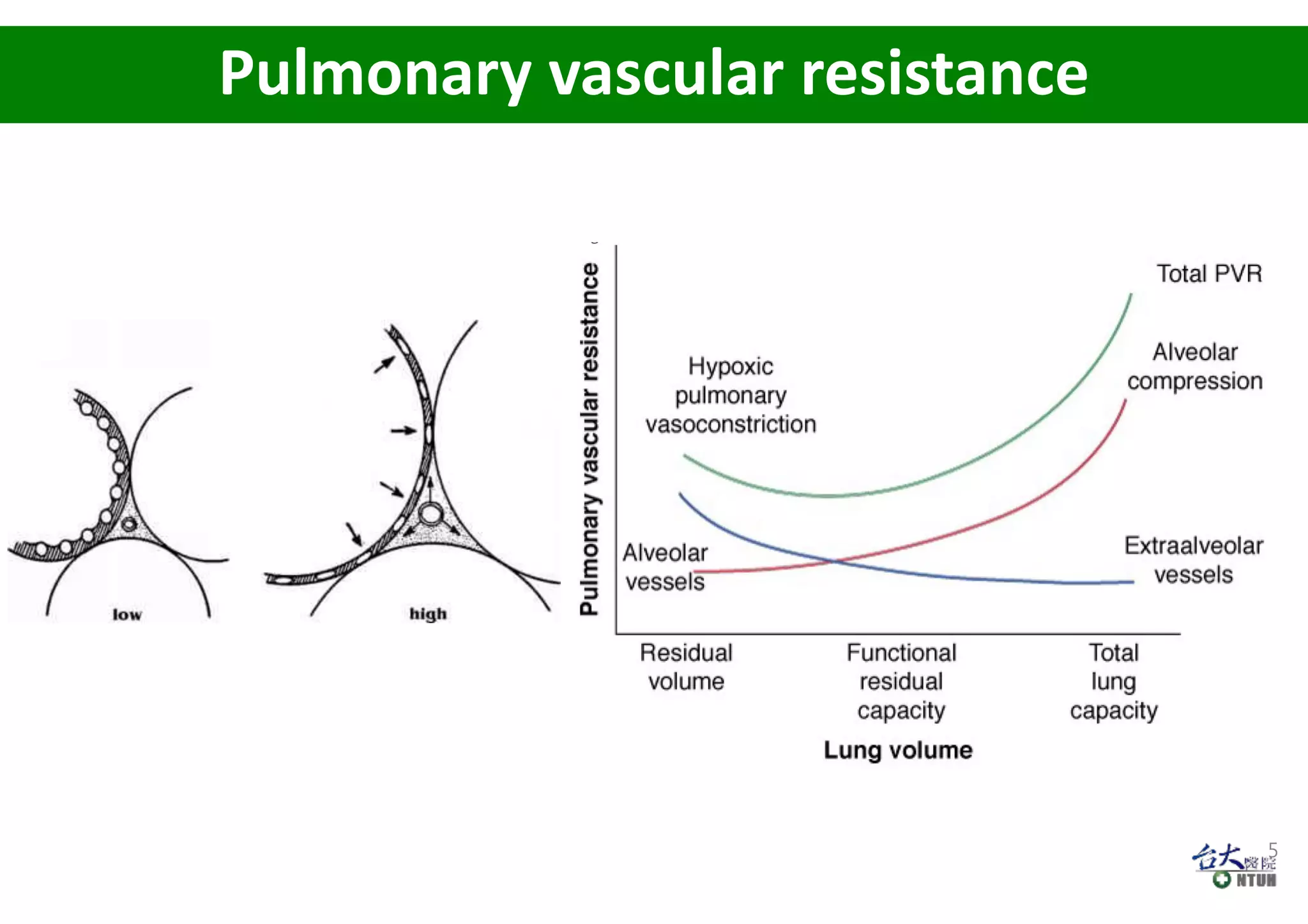
Pulmonary vascular resistance
5
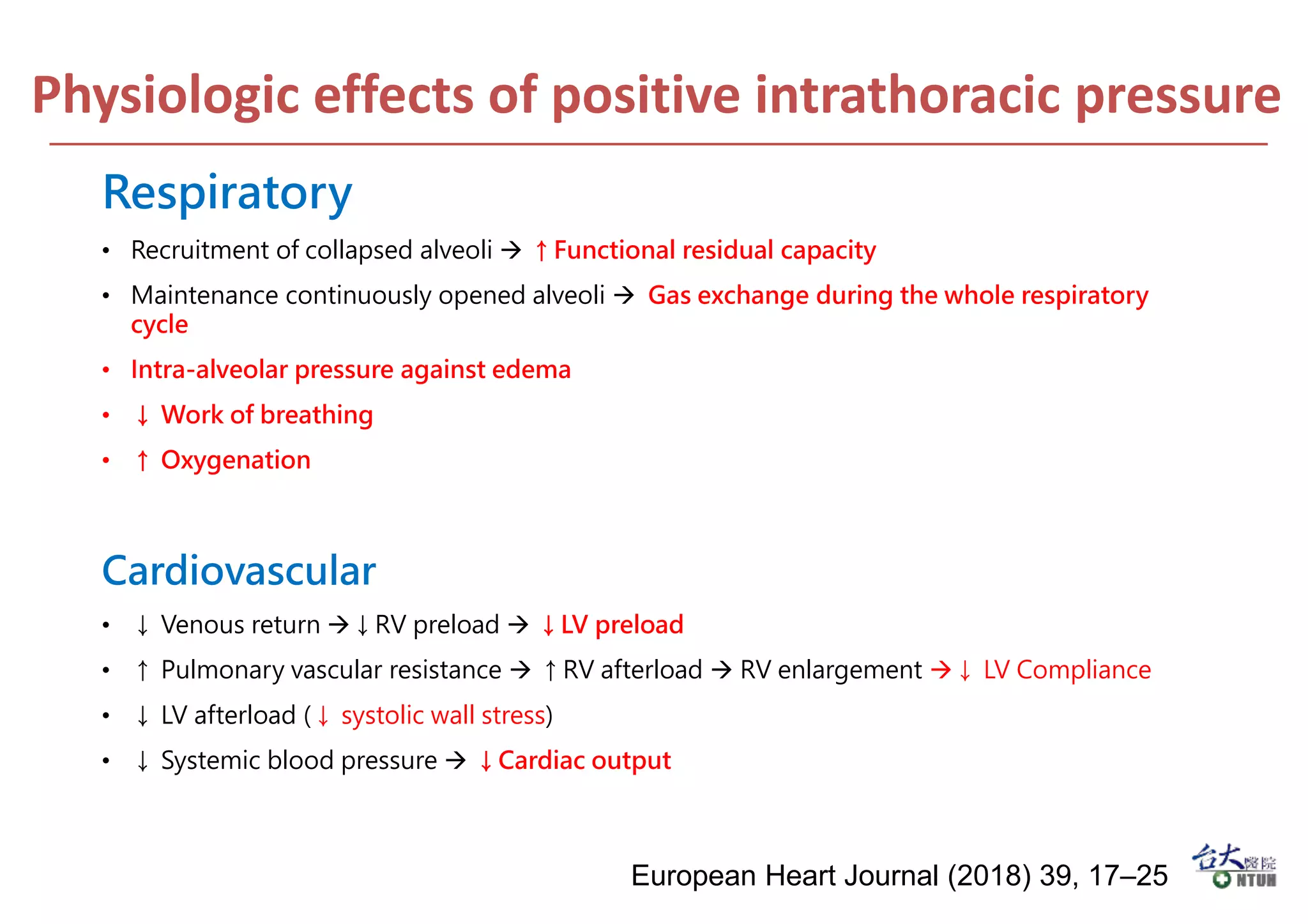
Physiologic effects of positive intrathoracic pressure
Respiratory
• Recruitment of collapsed alveoli → ↑Functional residual capacity
• Maintenance continuously opened alveoli → Gas exchange during the whole respiratory
cycle
• Intra-alveolar pressure against edema
• ↓ Work of breathing
• ↑ Oxygenation
Cardiovascular
• ↓ Venous return →↓RV preload → ↓LV preload
• ↑ Pulmonary vascular resistance → ↑RV afterload → RV enlargement →↓ LV Compliance
• ↓ LV afterload (↓ systolic wall stress)
• ↓ Systemic blood pressure → ↓Cardiac output
European Heart Journal (2018) 39, 17–25
Heart-Lung interactions
RV
LV
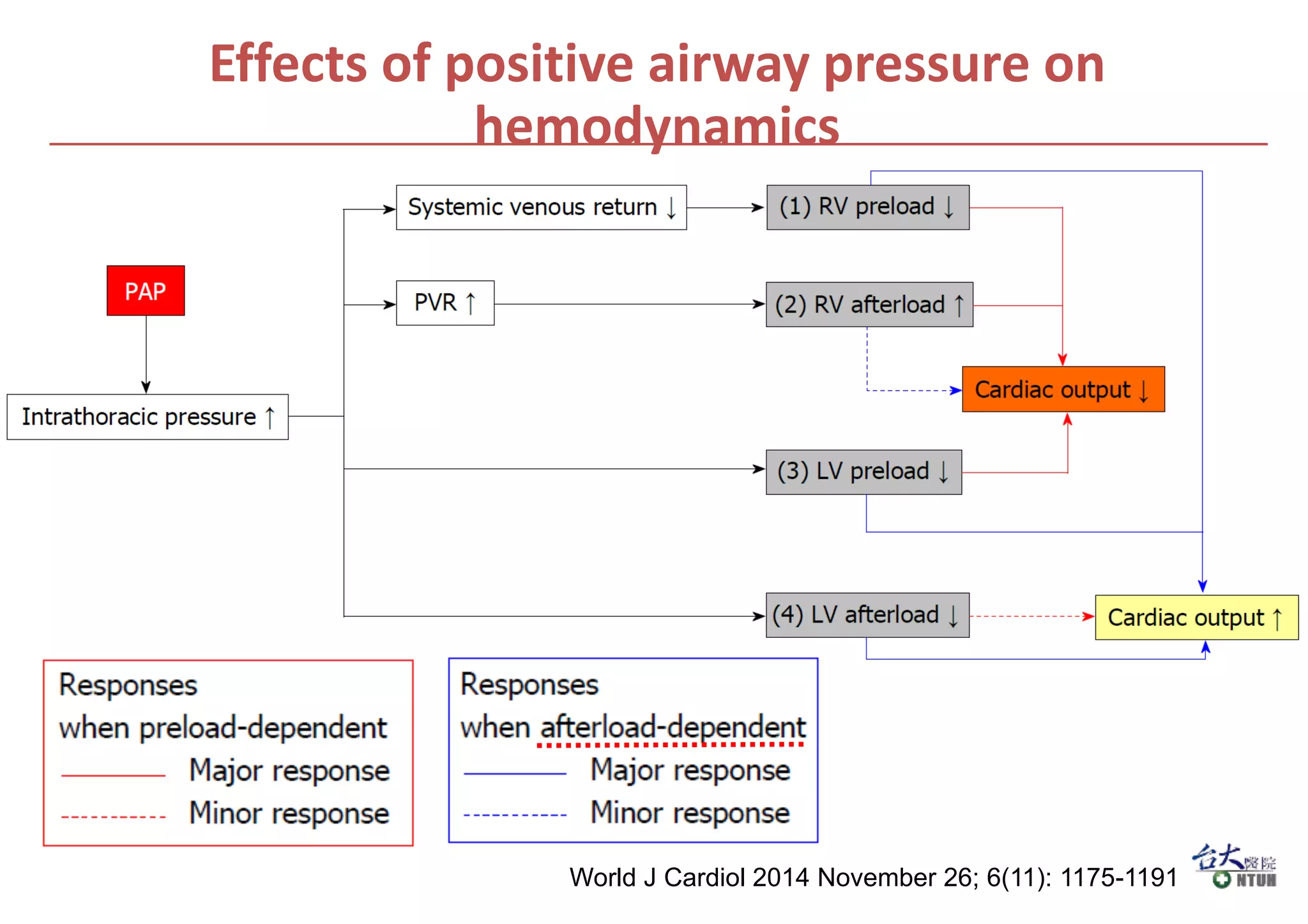
Effects of positive airway pressure on
hemodynamics
World J Cardiol 2014 November 26; 6(11): 1175-1191
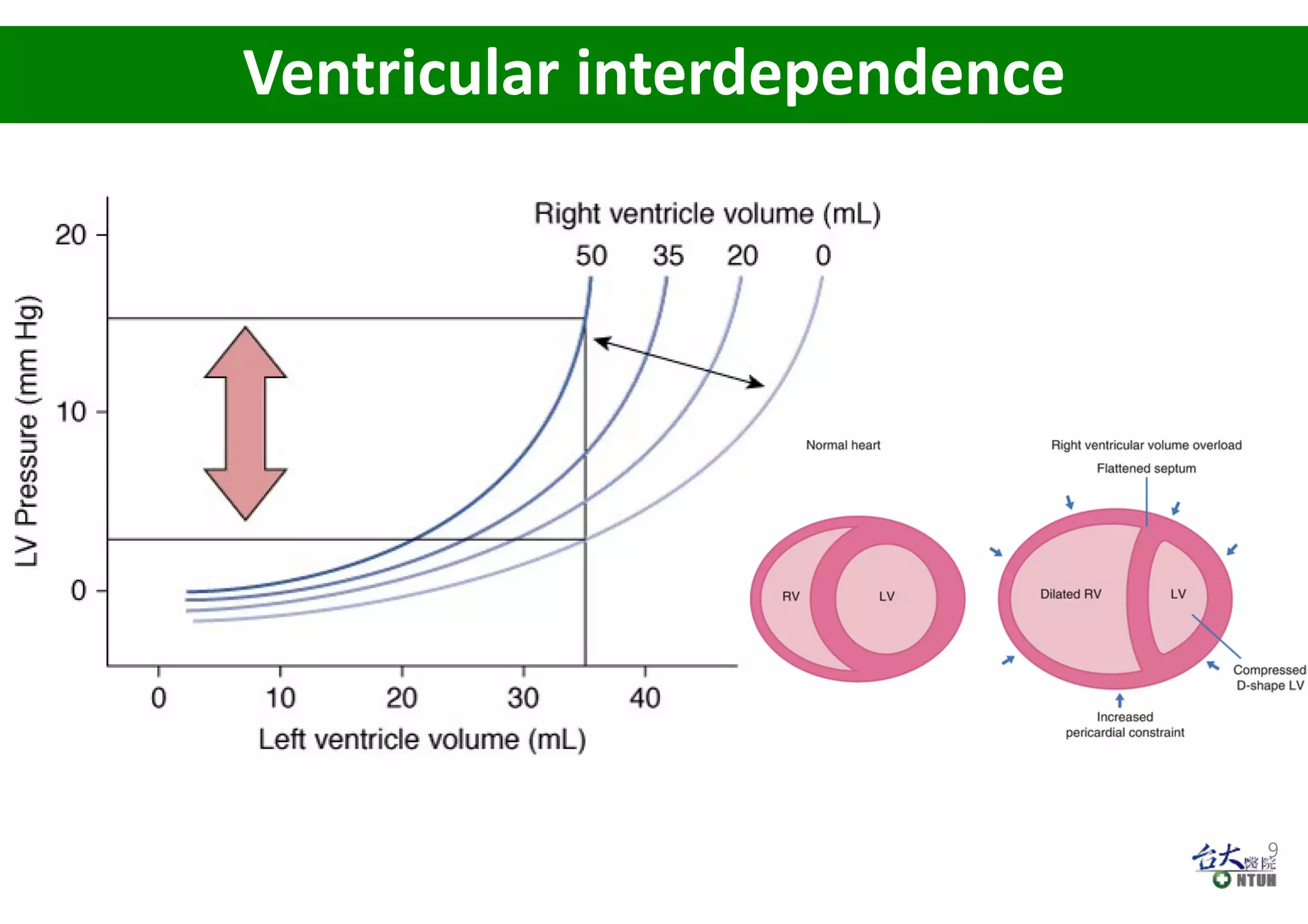
Ventricular interdependence
9
Effects of CPAP in CHF
AM J RESPIR CRIT CARE MED 1997;155:500-505
PAWP In 9 patients with acute left heart failure
(PAOP ~ 18 mm Hg, and CI ~ 2.8 l/min/m2)
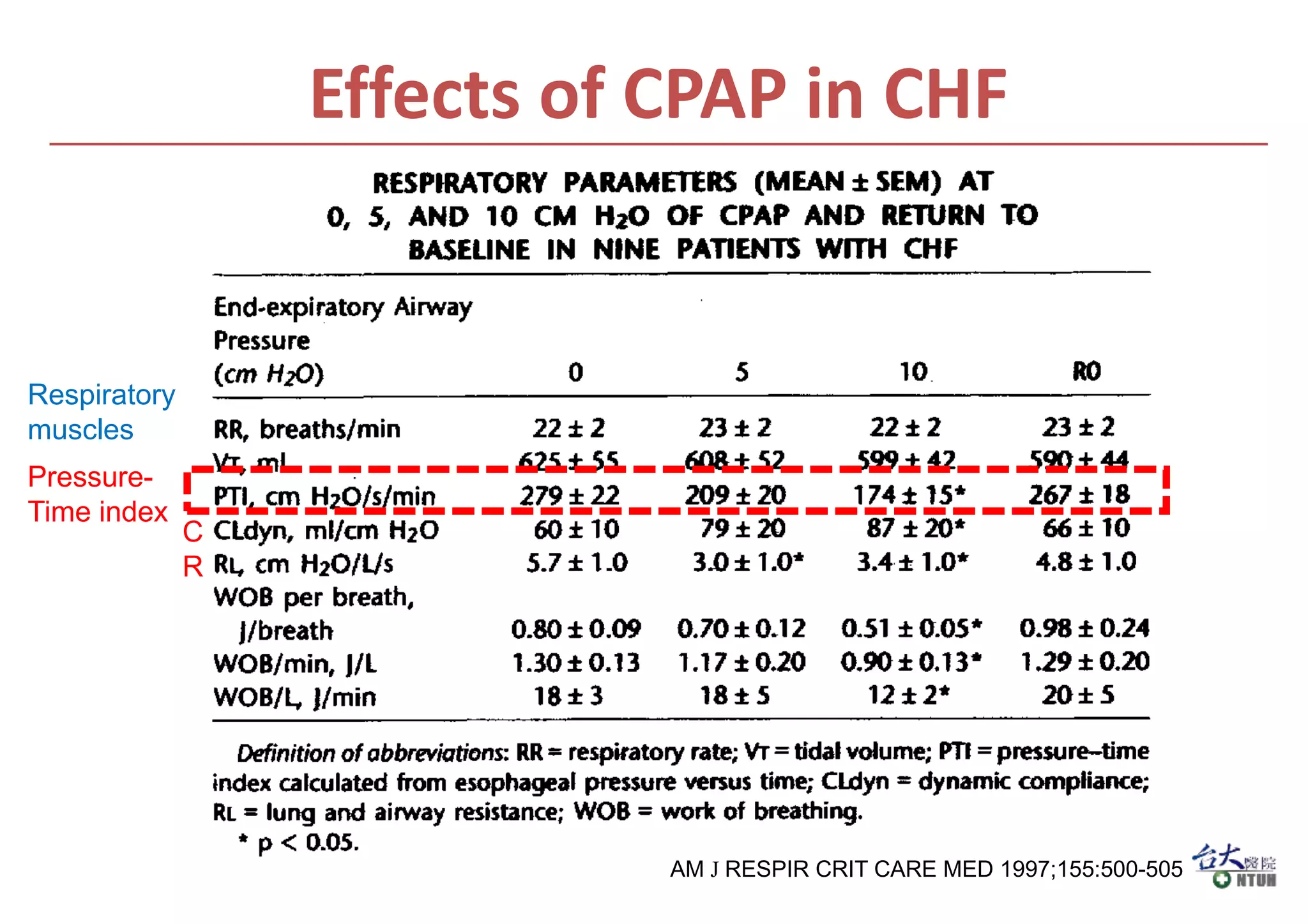
Effects of CPAP in CHF
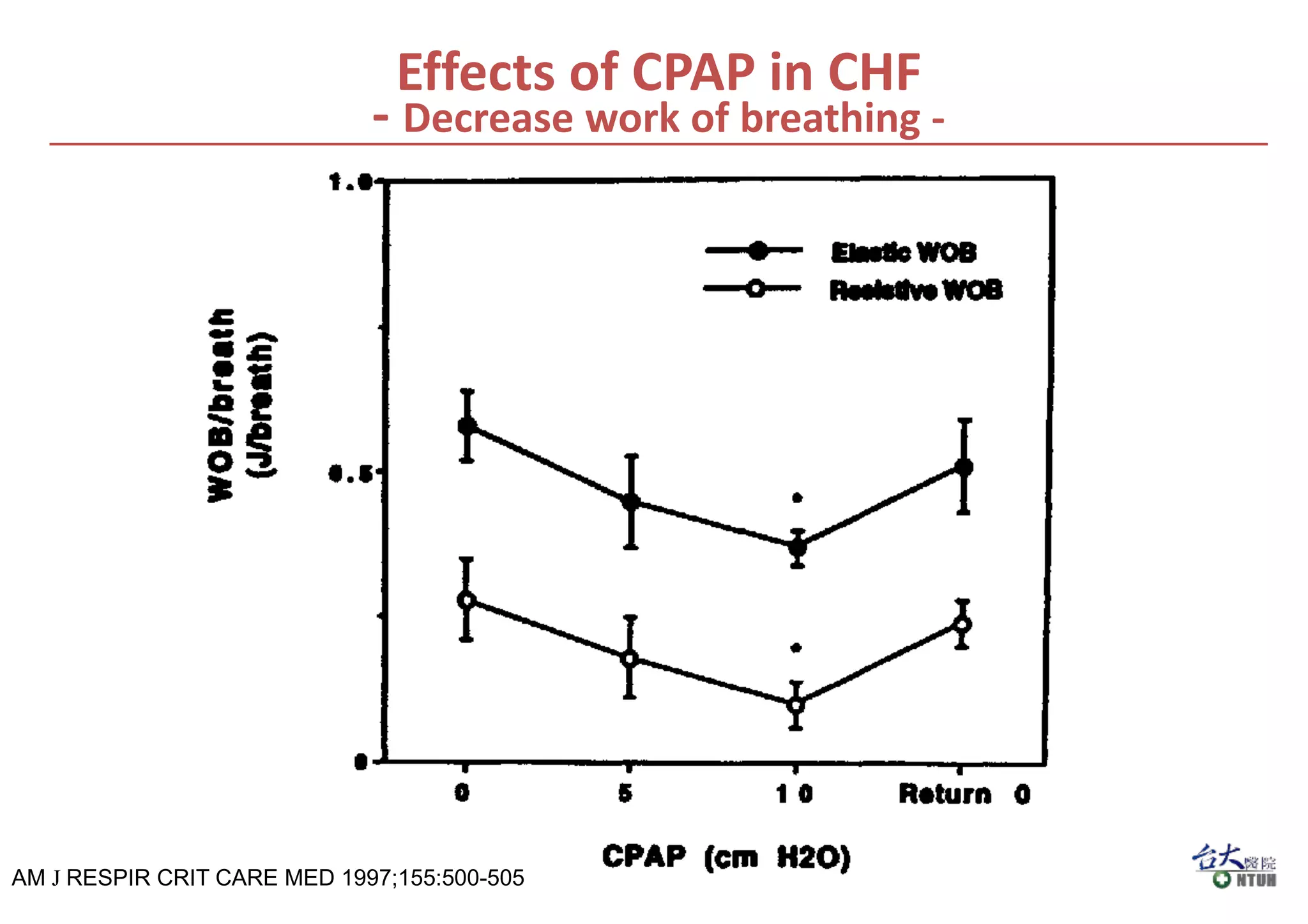
AM J RESPIR CRIT CARE MED 1997;155:500-505
Pressure-
Time index
Respiratory
muscles
C
R
Effects of CPAP in CHF
- Decrease negative swings in intrathoracic pressure -
AM J RESPIR CRIT CARE MED 1997;155:500-505
Effects of CPAP in CHF
- Decrease work of breathing -
Hemodynamic effects of CPAP in CHF
Stroke volume index
AM J RESPIR CRIT CARE MED 1997;155:500-505
• No significant change in SVI
• Mean transmural filling pressures decreased significantly with CPAP, suggesting a
better cardiac performance
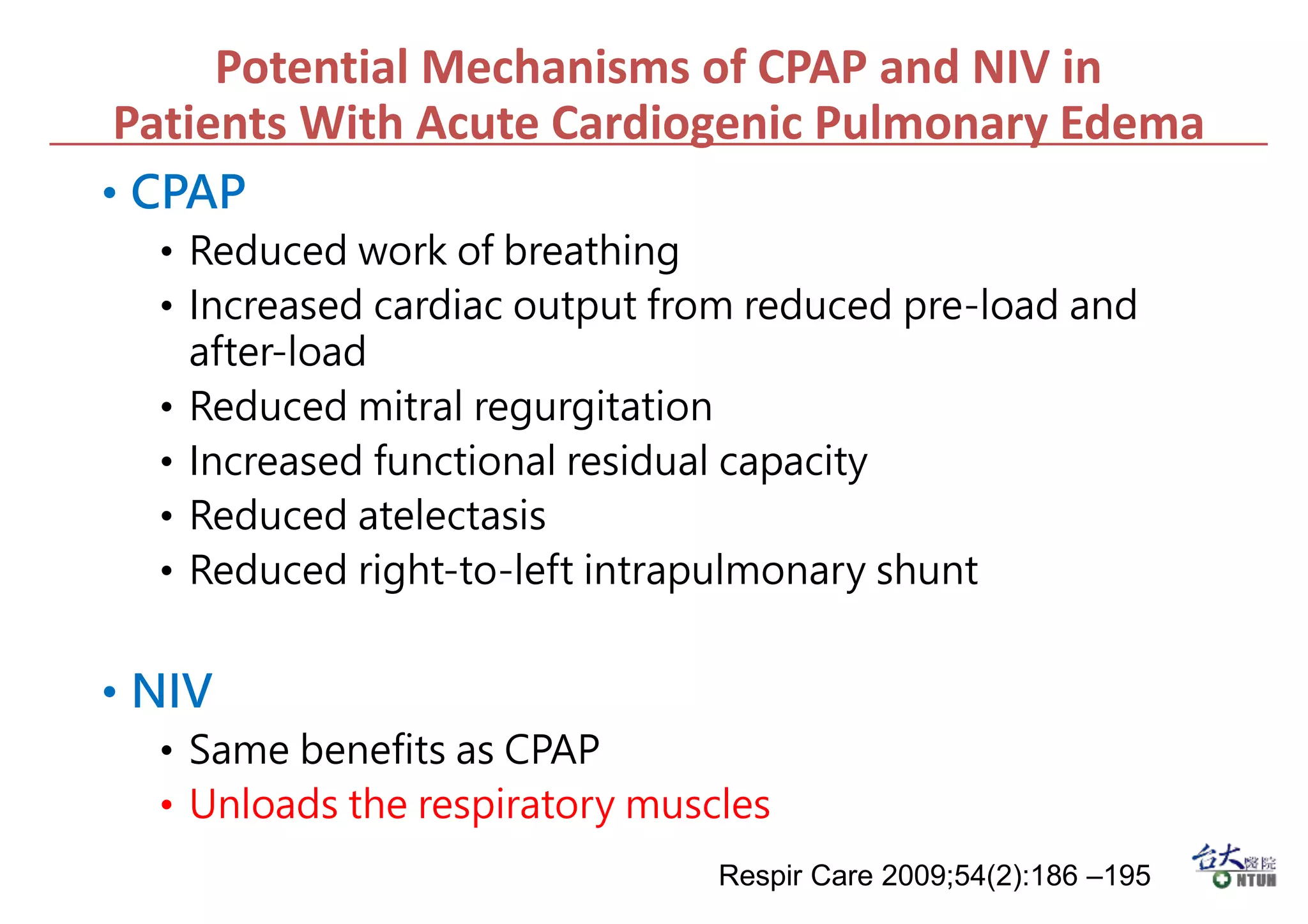
Potential Mechanisms of CPAP and NIV in
Patients With Acute Cardiogenic Pulmonary Edema
• CPAP
• Reduced work of breathing
• Increased cardiac output from reduced pre-load and
after-load
• Reduced mitral regurgitation
• Increased functional residual capacity
• Reduced atelectasis
• Reduced right-to-left intrapulmonary shunt
• NIV
• Same benefits as CPAP
• Unloads the respiratory muscles
Respir Care 2009;54(2):186 –195
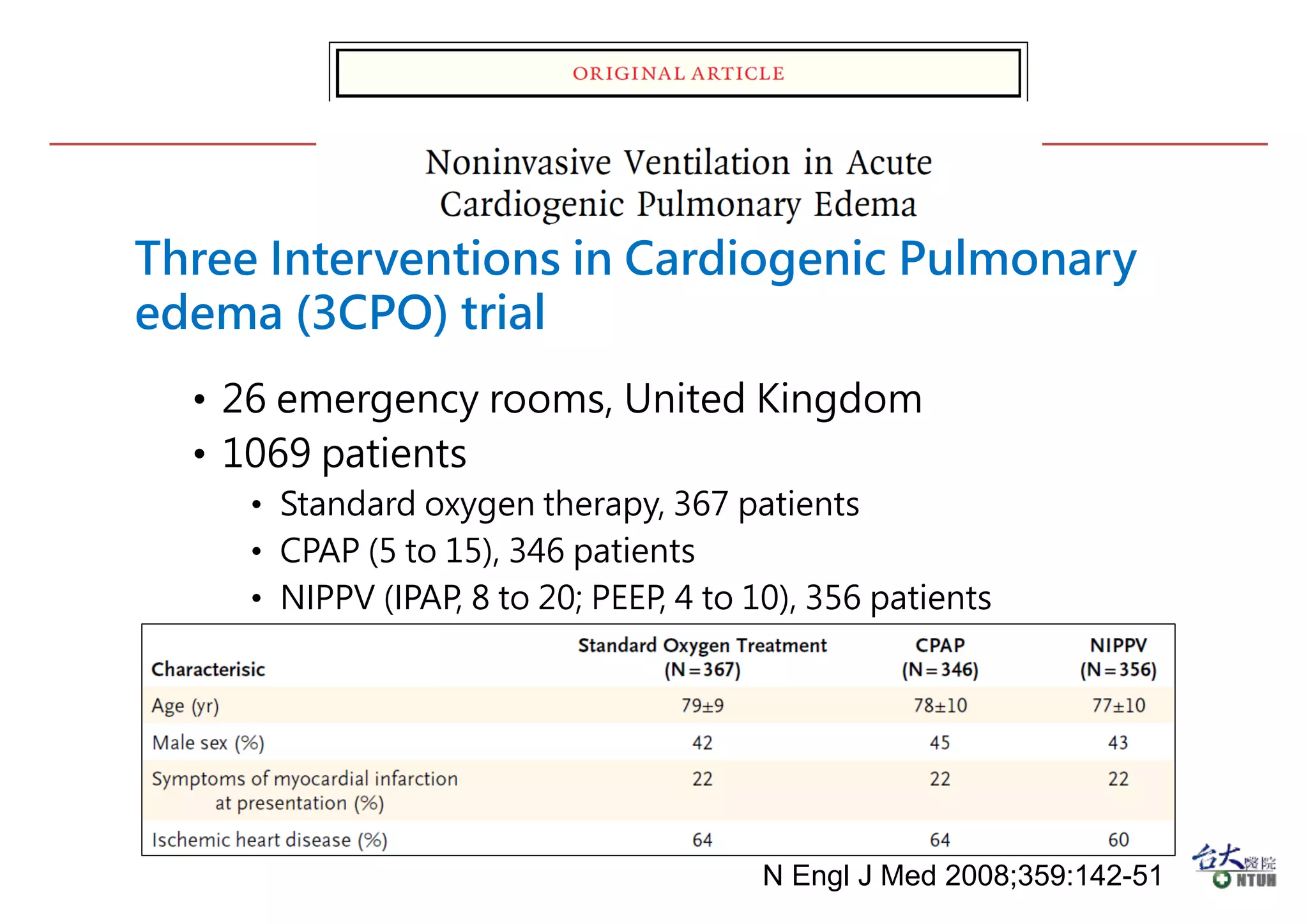
Three Interventions in Cardiogenic Pulmonary
edema (3CPO) trial
• 26 emergency rooms, United Kingdom
• 1069 patients
• Standard oxygen therapy, 367 patients
• CPAP (5 to 15), 346 patients
• NIPPV (IPAP, 8 to 20; PEEP, 4 to 10), 356 patients
N Engl J Med 2008;359:142-51
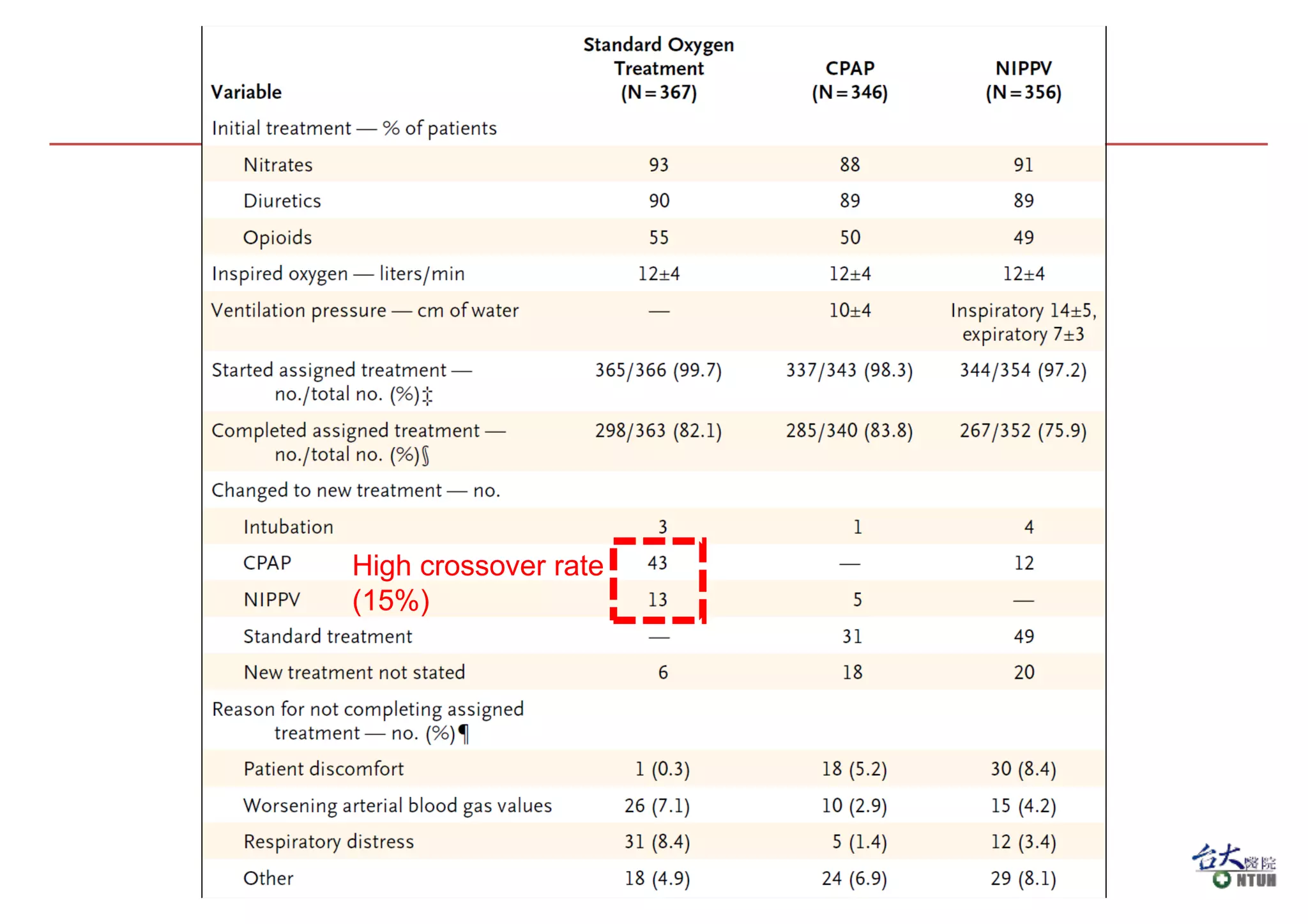
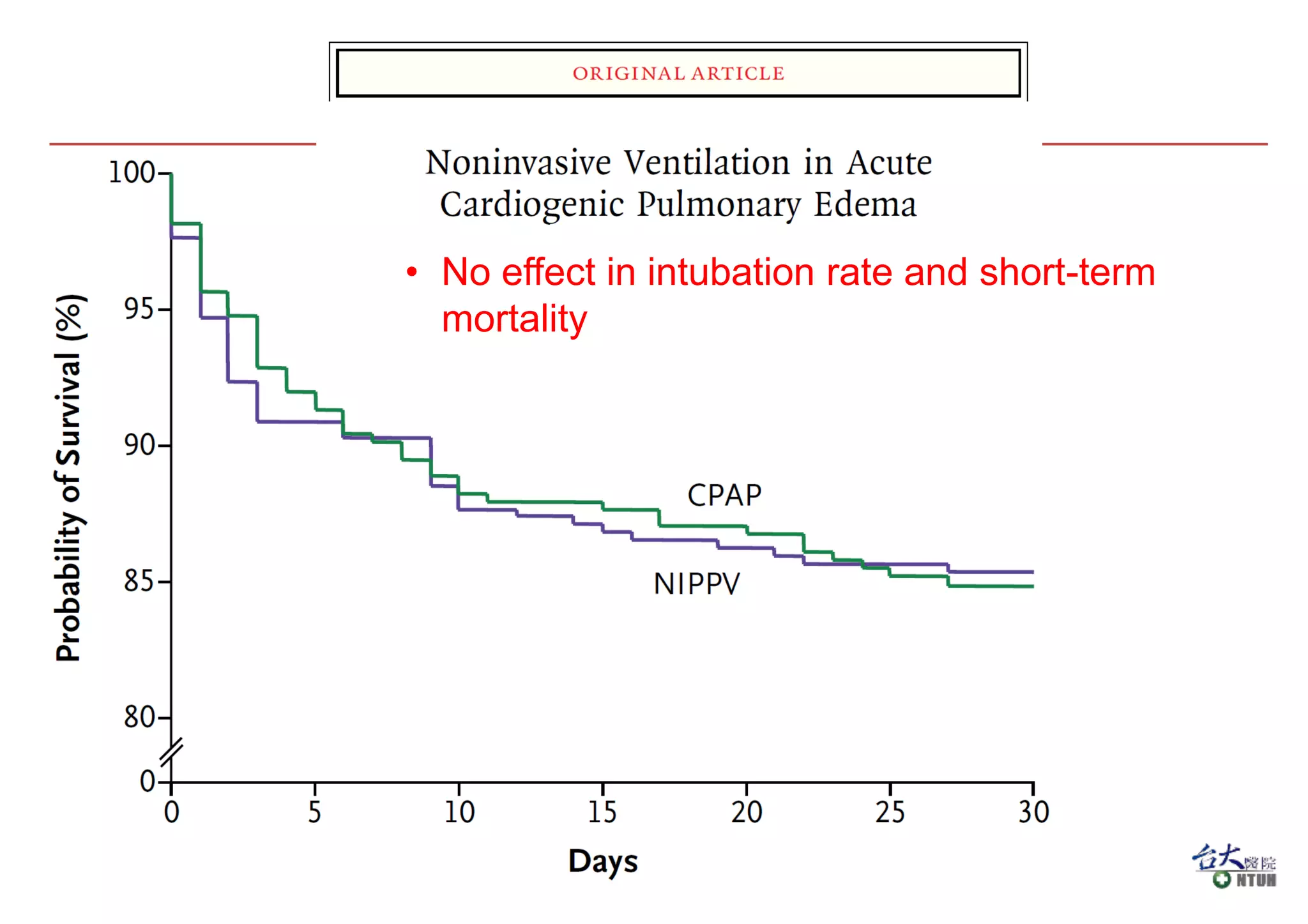
3CPO trial
N Engl J Med 2008;359:142-51
3CPO trial
N Engl J Med 2008;359:142-51
High crossover rate
(15%)
• No effect in intubation rate and short-term
mortality
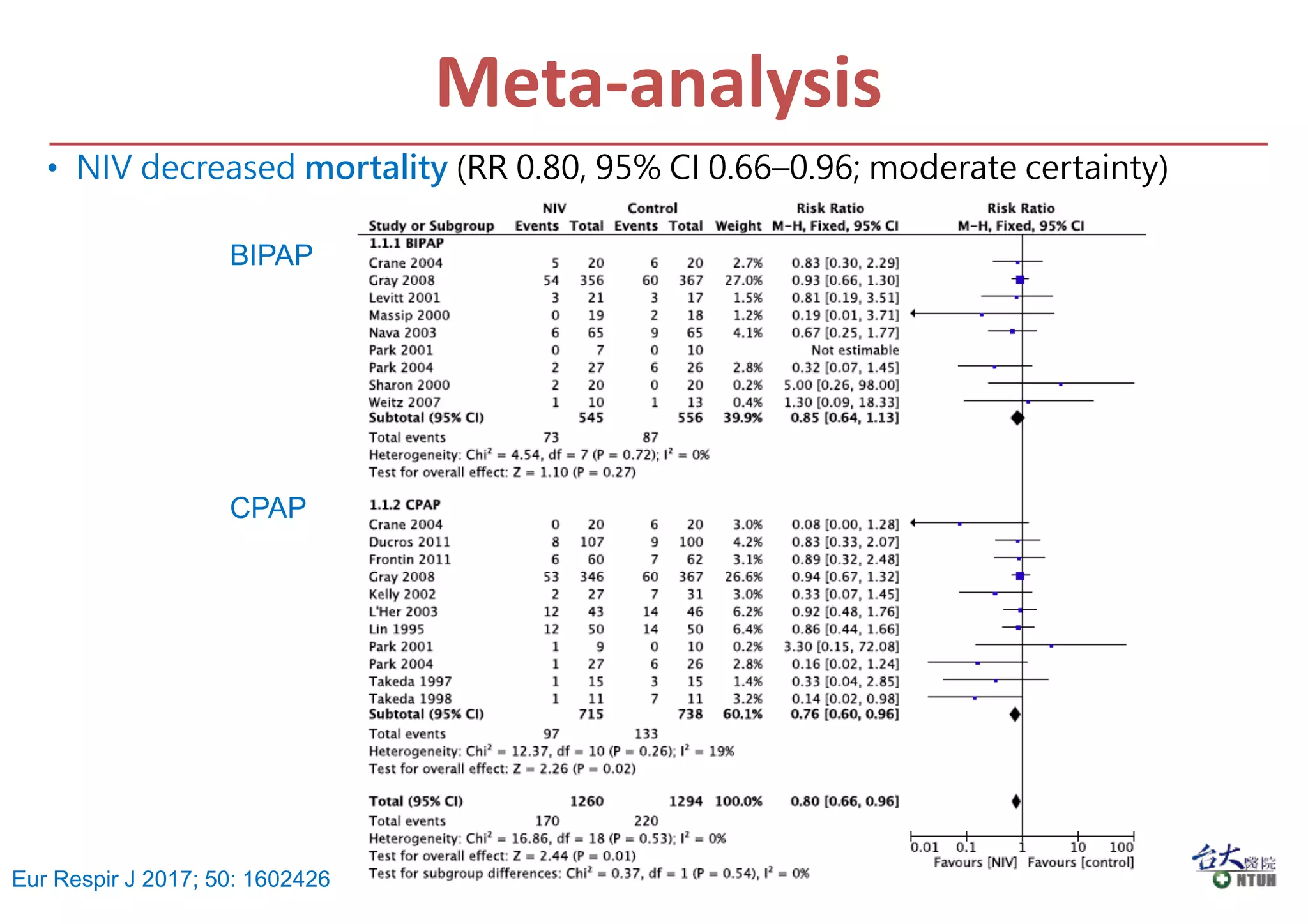
Meta-analysis
• NIV decreased mortality (RR 0.80, 95% CI 0.66–0.96; moderate certainty)
BIPAP
CPAP
Eur Respir J 2017; 50: 1602426
Meta-analysis
• NIV decreased the need for intubation (RR 0.60, 95% CI 0.44–0.80; low certainty)
BIPAP
CPAP
Eur Respir J 2017; 50: 1602426
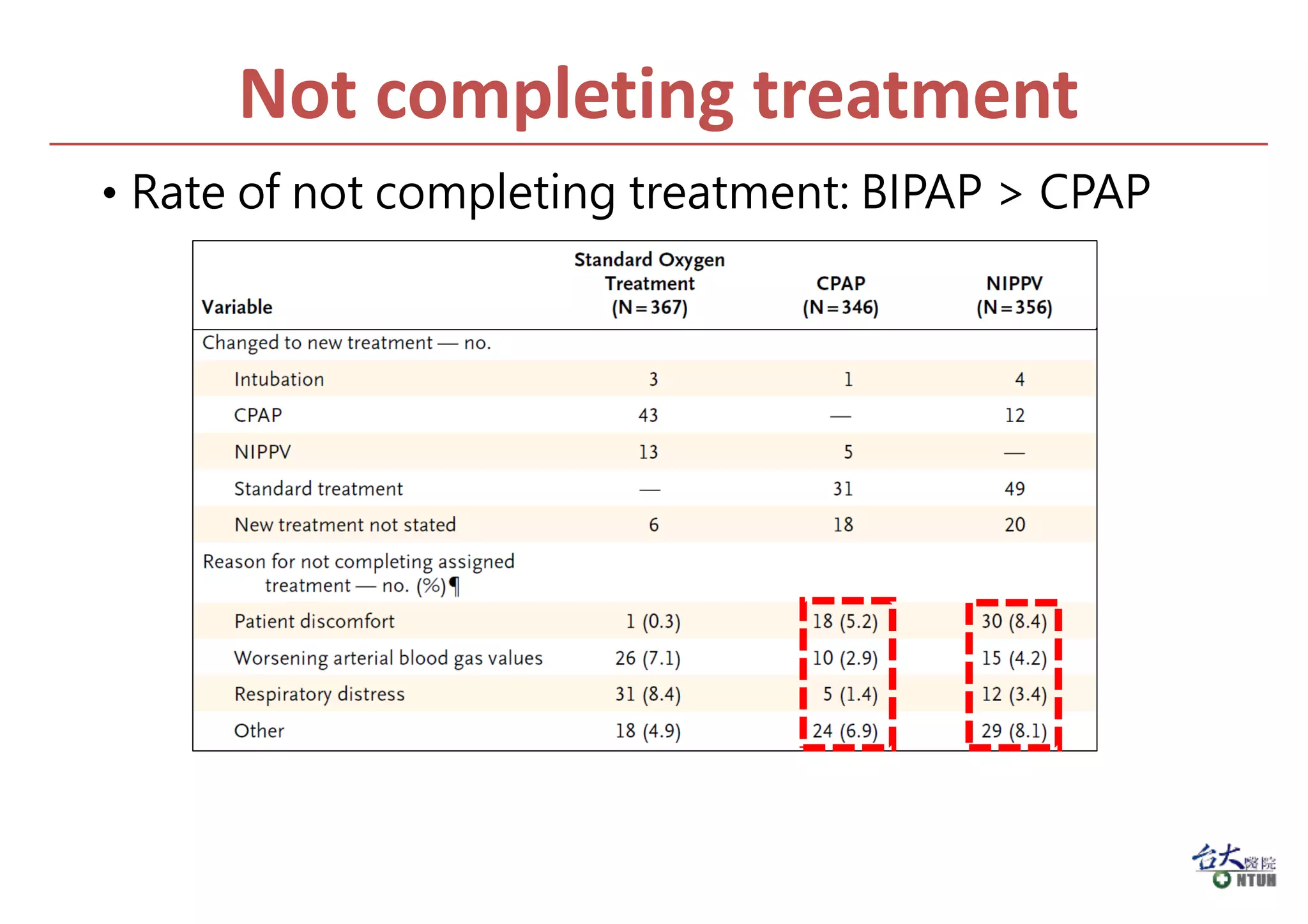
Not completing treatment
• Rate of not completing treatment: BIPAP > CPAP
Higher AMI in BiPAP than CPAP
Crit Care Med 1997; 25:620-628
Meta-analysis
NIV is not associated with increased myocardial infarction
Eur Respir J 2017; 50: 1602426
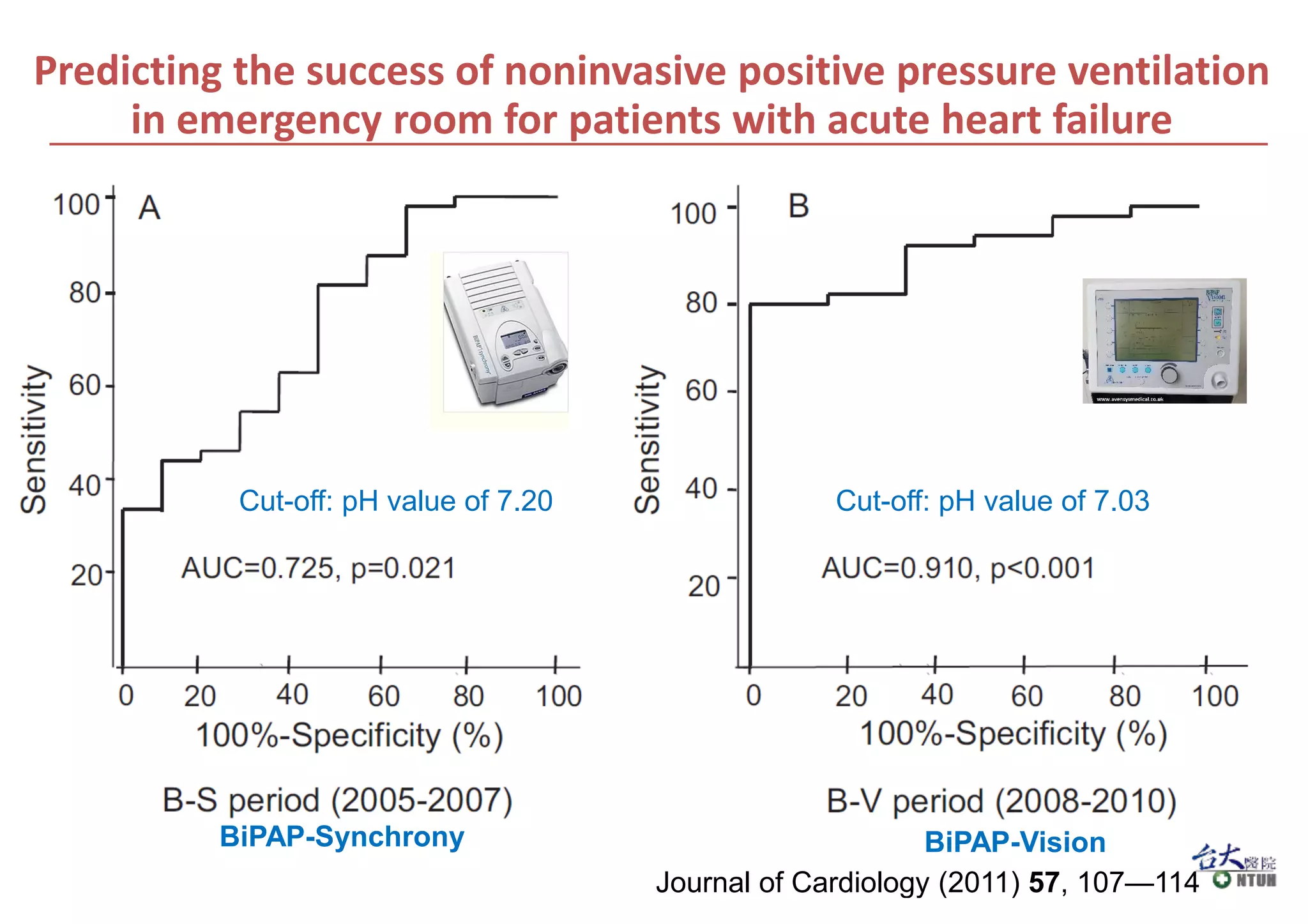
Predicting the success of noninvasive positive pressure ventilation
in emergency room for patients with acute heart failure
• 343 patients
Journal of Cardiology (2011) 57, 107—114
BiPAP-Synchrony BiPAP-Vision
Predicting the success of noninvasive positive pressure ventilation
in emergency room for patients with acute heart failure
Cut-off: pH value of 7.20 Cut-off: pH value of 7.03
Journal of Cardiology (2011) 57, 107—114
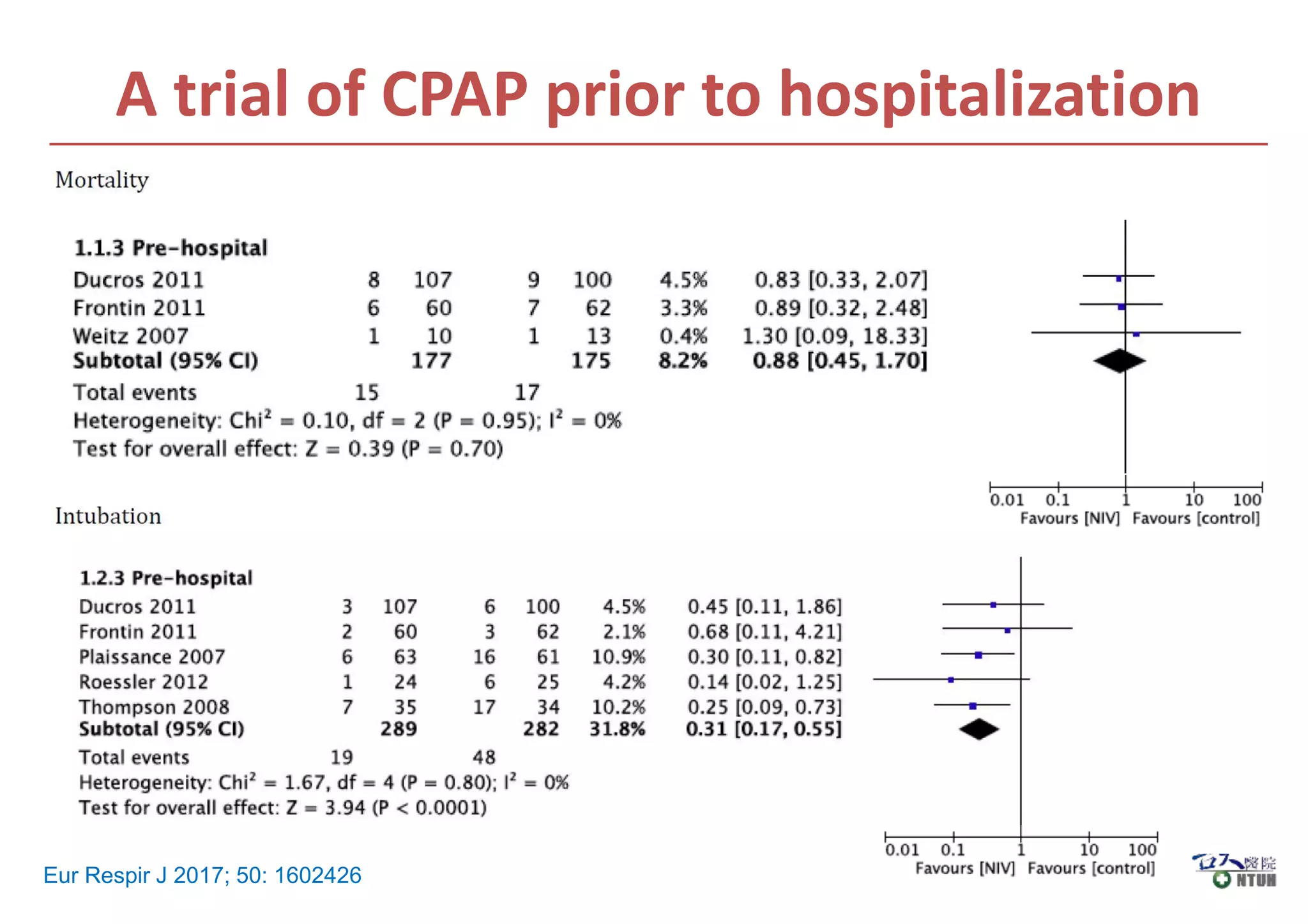
Should a trial of CPAP prior to hospitalization be
used to prevent deterioration in patients with ARF
due to cardiogenic pulmonary edema ?
A trial of CPAP prior to hospitalization
Eur Respir J 2017; 50: 1602426
BIPAP vs CPAP
• CPAP has some advantages over bilevel NIV
• Simpler technology
• Easier synchronization
• Less expensive equipment
• The current evidence summary demonstrates
significant benefit of both interventions compared
with standard care, and insufficient evidence to
recommend one modality over the other
Eur Respir J 2017; 50: 1602426
Most trials of both CPAP and NIV generally
excluded patients with acute myocardial infarction
that required revascularization with thrombolytics
or invasive procedures !
Non-invasive ventilation in acute heart failure syndromes
European Heart Journal (2018) 39, 17–25
NIV in Chronic heart failure
• NIV improved LVEF in chronic CHF
Canadian Respiratory Journal 2016, Article ID 3915237
NIV in Chronic heart failure
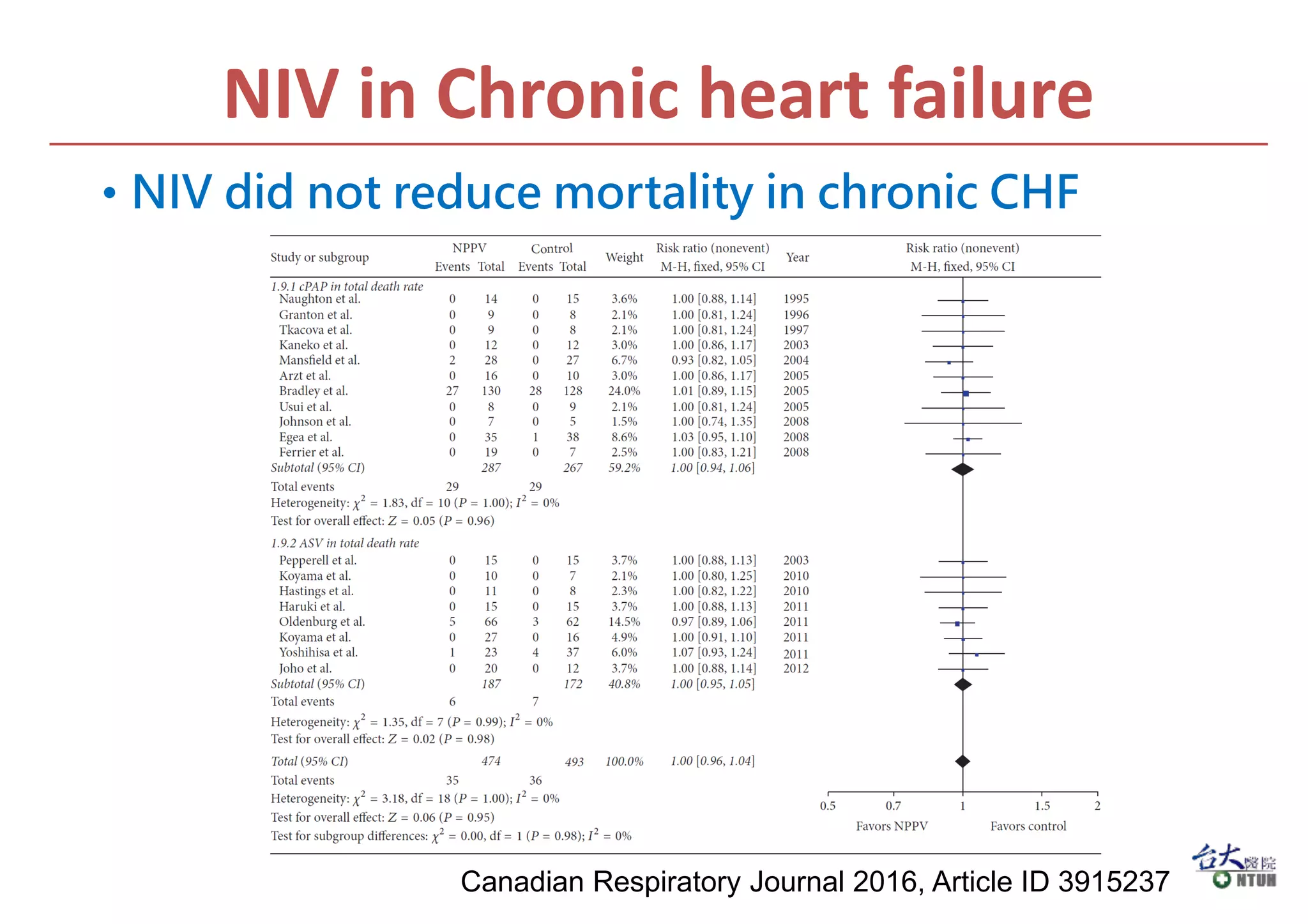
• NIV did not reduce mortality in chronic CHF
Canadian Respiratory Journal 2016, Article ID 3915237
NIV in Chronic heart failure
Canadian Respiratory Journal 2016, Article ID 3915237
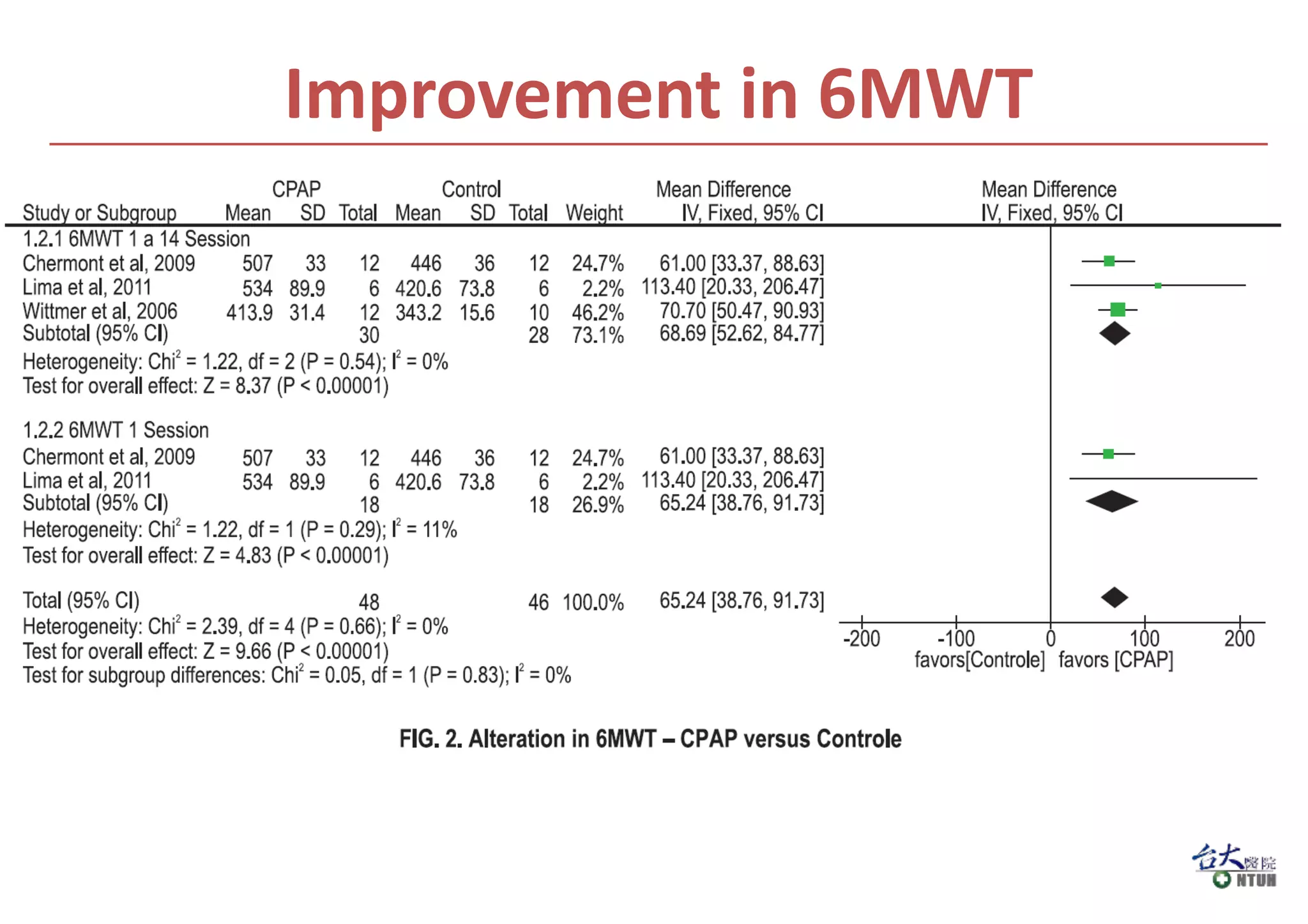
Improvement in 6MWT
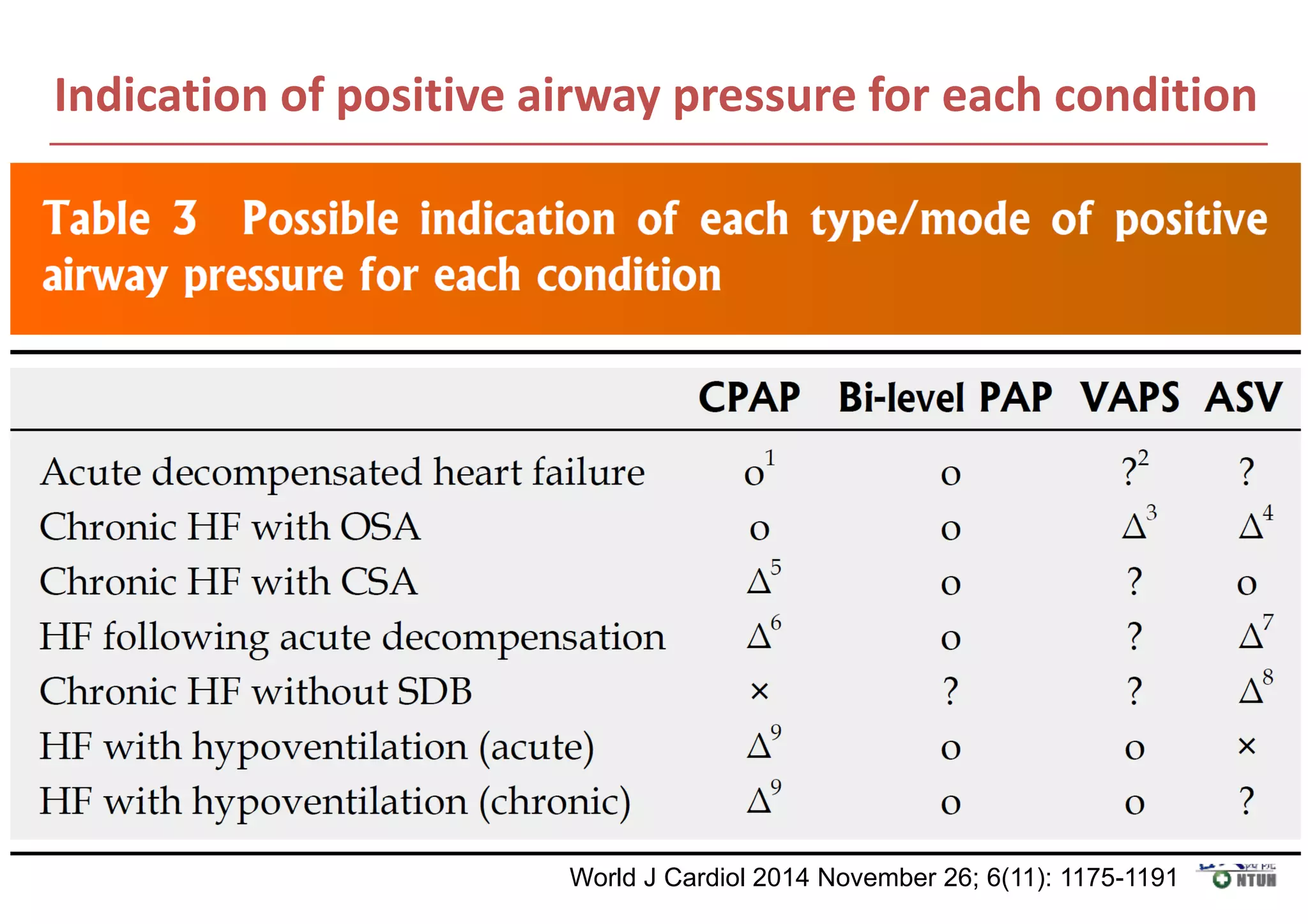
NIV strategy according to different heart failure
conditions
World J Cardiol 2014 November 26; 6(11): 1175-1191
Take home messages
• In patient with acute CHF with pulmonary edema
(1) NIV decreases the need for intubation
(2) NIV reduced hospital mortality
(3) NIV is not associated with increased myocardial infarction
(4) CPAP and NIV have similar effects, but CPAP has some advantages
• NIV can be used for patients with cardiogenic pulmonary
edema in the pre-hospital setting
• NIV improved LVEF and BNP but did not improve overall
mortality in patients with chronic heart failure
Patients in cardiogenic shock were excluded in trials
Many trials excluded patients requiring acute revascularization
Some have excluded patients with acute coronary syndrome
Thanks for your attention
NIV in Chronic heart failure
• In the present meta-analysis, use of NPPV plus
SMT improved LVEF and reduced plasma BNP level
but did not improve overall mortality in patients
with chronic heart failure.
Indication of positive airway pressure for each condition
World J Cardiol 2014 November 26; 6(11): 1175-1191
Heart-Lung interactions
● Effect of Intrathoracic Pressure
● Systemic venous return
● Left ventricular afterload
43

NIV in CHF

  • 1.
    NIV in congestiveheart failure from acute to chronic 臺大醫院 胸腔內科 簡榮彥 20190324
  • 2.
    Congestive hart failurewith pulmonary edema • Imbalance of starling forces • Increased pulmonary capillary pressure • Decreased plasma oncotic pressure • Increased negative interstitial pressure • Lymphatic obstruction • Idiopathic mechanism
  • 3.
    Heart-Lung interactions • Therespiratory muscles have to generate large negative swings in pleural pressure to start inspiratory flow and maintain adequate tidal volumes • This increase in negative intrathoracic pressure aggravates pulmonary edema by increasing both preload and afterload
  • 4.
    Effects of positiveairway pressure RV LV Ppleural ParteryPvein • Ppleural ↑ ➔ (Partery - Ppleural) ↓ ➔ ↓ After-load • Ppleural ↑ ➔ (Pvein - Ppleural) ↓ ➔ ↓ Venous return ➔ ↓ Pre-load
  • 5.
  • 6.
    Physiologic effects ofpositive intrathoracic pressure Respiratory • Recruitment of collapsed alveoli → ↑Functional residual capacity • Maintenance continuously opened alveoli → Gas exchange during the whole respiratory cycle • Intra-alveolar pressure against edema • ↓ Work of breathing • ↑ Oxygenation Cardiovascular • ↓ Venous return →↓RV preload → ↓LV preload • ↑ Pulmonary vascular resistance → ↑RV afterload → RV enlargement →↓ LV Compliance • ↓ LV afterload (↓ systolic wall stress) • ↓ Systemic blood pressure → ↓Cardiac output European Heart Journal (2018) 39, 17–25
  • 7.
  • 8.
    Effects of positiveairway pressure on hemodynamics World J Cardiol 2014 November 26; 6(11): 1175-1191
  • 9.
  • 10.
    Effects of CPAPin CHF AM J RESPIR CRIT CARE MED 1997;155:500-505 PAWP In 9 patients with acute left heart failure (PAOP ~ 18 mm Hg, and CI ~ 2.8 l/min/m2)
  • 11.
    Effects of CPAPin CHF AM J RESPIR CRIT CARE MED 1997;155:500-505 Pressure- Time index Respiratory muscles C R
  • 12.
    Effects of CPAPin CHF - Decrease negative swings in intrathoracic pressure - AM J RESPIR CRIT CARE MED 1997;155:500-505
  • 13.
    AM J RESPIRCRIT CARE MED 1997;155:500-505 Effects of CPAP in CHF - Decrease work of breathing -
  • 14.
    Hemodynamic effects ofCPAP in CHF Stroke volume index AM J RESPIR CRIT CARE MED 1997;155:500-505 • No significant change in SVI • Mean transmural filling pressures decreased significantly with CPAP, suggesting a better cardiac performance
  • 15.
    Potential Mechanisms ofCPAP and NIV in Patients With Acute Cardiogenic Pulmonary Edema • CPAP • Reduced work of breathing • Increased cardiac output from reduced pre-load and after-load • Reduced mitral regurgitation • Increased functional residual capacity • Reduced atelectasis • Reduced right-to-left intrapulmonary shunt • NIV • Same benefits as CPAP • Unloads the respiratory muscles Respir Care 2009;54(2):186 –195
  • 16.
    Three Interventions inCardiogenic Pulmonary edema (3CPO) trial • 26 emergency rooms, United Kingdom • 1069 patients • Standard oxygen therapy, 367 patients • CPAP (5 to 15), 346 patients • NIPPV (IPAP, 8 to 20; PEEP, 4 to 10), 356 patients N Engl J Med 2008;359:142-51
  • 17.
    3CPO trial N EnglJ Med 2008;359:142-51
  • 18.
    3CPO trial N EnglJ Med 2008;359:142-51
  • 19.
  • 20.
    • No effectin intubation rate and short-term mortality
  • 21.
    Meta-analysis • NIV decreasedmortality (RR 0.80, 95% CI 0.66–0.96; moderate certainty) BIPAP CPAP Eur Respir J 2017; 50: 1602426
  • 22.
    Meta-analysis • NIV decreasedthe need for intubation (RR 0.60, 95% CI 0.44–0.80; low certainty) BIPAP CPAP Eur Respir J 2017; 50: 1602426
  • 23.
    Not completing treatment •Rate of not completing treatment: BIPAP > CPAP
  • 24.
    Higher AMI inBiPAP than CPAP Crit Care Med 1997; 25:620-628
  • 25.
    Meta-analysis NIV is notassociated with increased myocardial infarction Eur Respir J 2017; 50: 1602426
  • 26.
    Predicting the successof noninvasive positive pressure ventilation in emergency room for patients with acute heart failure • 343 patients Journal of Cardiology (2011) 57, 107—114
  • 27.
    BiPAP-Synchrony BiPAP-Vision Predicting thesuccess of noninvasive positive pressure ventilation in emergency room for patients with acute heart failure Cut-off: pH value of 7.20 Cut-off: pH value of 7.03 Journal of Cardiology (2011) 57, 107—114
  • 28.
    Should a trialof CPAP prior to hospitalization be used to prevent deterioration in patients with ARF due to cardiogenic pulmonary edema ?
  • 29.
    A trial ofCPAP prior to hospitalization Eur Respir J 2017; 50: 1602426
  • 30.
    BIPAP vs CPAP •CPAP has some advantages over bilevel NIV • Simpler technology • Easier synchronization • Less expensive equipment • The current evidence summary demonstrates significant benefit of both interventions compared with standard care, and insufficient evidence to recommend one modality over the other Eur Respir J 2017; 50: 1602426
  • 31.
    Most trials ofboth CPAP and NIV generally excluded patients with acute myocardial infarction that required revascularization with thrombolytics or invasive procedures !
  • 32.
    Non-invasive ventilation inacute heart failure syndromes European Heart Journal (2018) 39, 17–25
  • 33.
    NIV in Chronicheart failure • NIV improved LVEF in chronic CHF Canadian Respiratory Journal 2016, Article ID 3915237
  • 34.
    NIV in Chronicheart failure • NIV did not reduce mortality in chronic CHF Canadian Respiratory Journal 2016, Article ID 3915237
  • 35.
    NIV in Chronicheart failure Canadian Respiratory Journal 2016, Article ID 3915237
  • 36.
  • 37.
    NIV strategy accordingto different heart failure conditions World J Cardiol 2014 November 26; 6(11): 1175-1191
  • 38.
    Take home messages •In patient with acute CHF with pulmonary edema (1) NIV decreases the need for intubation (2) NIV reduced hospital mortality (3) NIV is not associated with increased myocardial infarction (4) CPAP and NIV have similar effects, but CPAP has some advantages • NIV can be used for patients with cardiogenic pulmonary edema in the pre-hospital setting • NIV improved LVEF and BNP but did not improve overall mortality in patients with chronic heart failure Patients in cardiogenic shock were excluded in trials Many trials excluded patients requiring acute revascularization Some have excluded patients with acute coronary syndrome
  • 39.
    Thanks for yourattention
  • 40.
    NIV in Chronicheart failure • In the present meta-analysis, use of NPPV plus SMT improved LVEF and reduced plasma BNP level but did not improve overall mortality in patients with chronic heart failure.
  • 41.
    Indication of positiveairway pressure for each condition World J Cardiol 2014 November 26; 6(11): 1175-1191
  • 43.
    Heart-Lung interactions ● Effectof Intrathoracic Pressure ● Systemic venous return ● Left ventricular afterload 43