Nitrogen Cycle
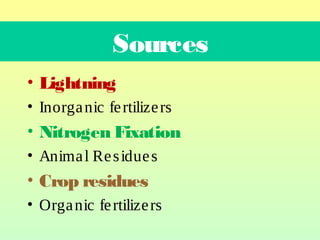
Sources
• Lightning
• Inorganic fertilizers
• Nitrogen Fixation
• Animal Residues
• Crop residues
• Organic fertilizers
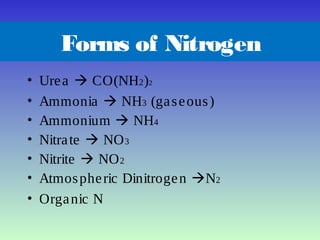
Forms of Nitrogen
• Urea  CO(NH2)2
• Ammonia  NH3 (gaseous)
• Ammonium  NH4
• Nitrate  NO3
• Nitrite  NO2
• Atmospheric Dinitrogen N2
• Organic N
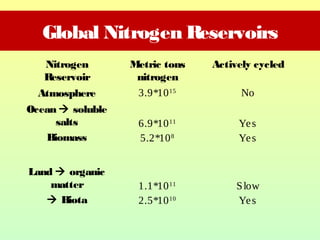
Global Nitrogen Reservoirs
Nitrogen
Reservoir
Metric tons
nitrogen
Actively cycled
Atmosphere 3.9*1015
No
Ocean  soluble
salts
Biomass
6.9*1011
5.2*108
Yes
Yes
Land  organic
matter
 Biota
1.1*1011
2.5*1010
Slow
Yes
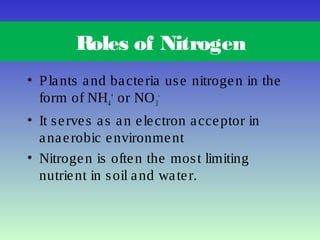
Roles of Nitrogen
• Plants and bacteria use nitrogen in the
form of NH4
+
or NO3
-
• It serves as an electron acceptor in
anaerobic environment
• Nitrogen is often the most limiting
nutrient in soil and water.
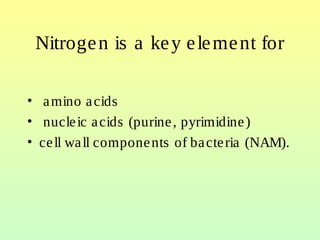
Nitrogen is a key element for
• amino acids
• nucleic acids (purine, pyrimidine)
• cell wall components of bacteria (NAM).
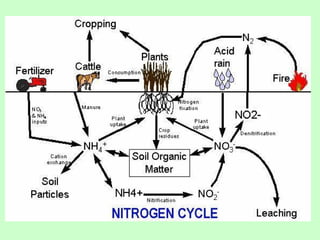
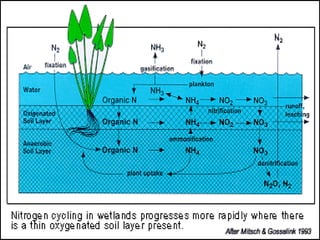
Nitrogen Cycles
• Ammonification/mineralization
• Immobilization
• Nitrogen Fixation
• Nitrification
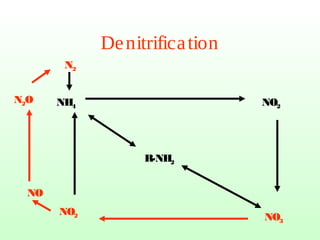
• Denitrification
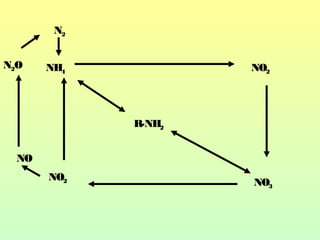
R-NH2
NH4 NO2
NO3
NO2
NO
N2O
N2
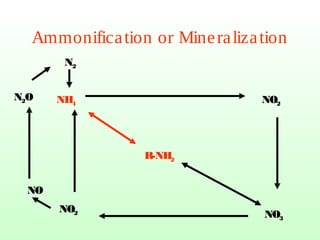
Ammonification or Mineralization
R-NH2
NH4 NO2
NO3
NO2
NO
N2O
N2
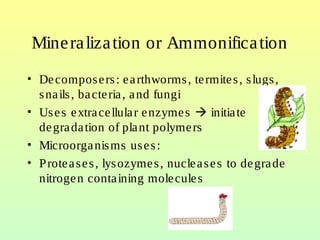
Mineralization or Ammonification
• Decomposers: earthworms, termites, slugs,
snails, bacteria, and fungi
• Uses extracellular enzymes  initiate
degradation of plant polymers
• Microorganisms uses:
• Proteases, lysozymes, nucleases to degrade
nitrogen containing molecules
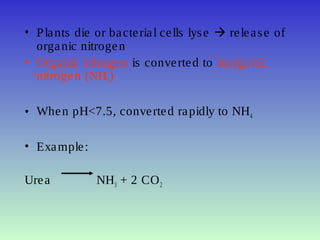
• Plants die or bacterial cells lyse  release of
organic nitrogen
• Organic nitrogen is converted to inorganic
nitrogen (NH3)
• When pH<7.5, converted rapidly to NH4
• Example:
Urea NH3 + 2 CO2
Immobilization
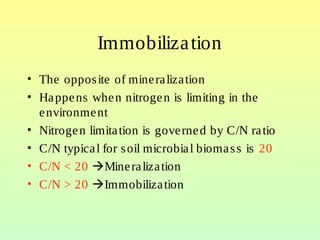
• The opposite of mineralization
• Happens when nitrogen is limiting in the
environment
• Nitrogen limitation is governed by C/N ratio
• C/N typical for soil microbial biomass is 20
• C/N < 20 Mineralization
• C/N > 20 Immobilization
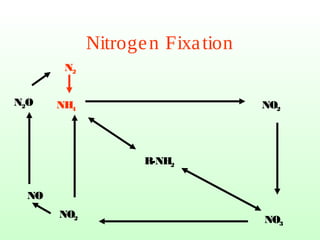
Nitrogen Fixation
R-NH2
NH4 NO2
NO3
NO2
NO
N2O
N2
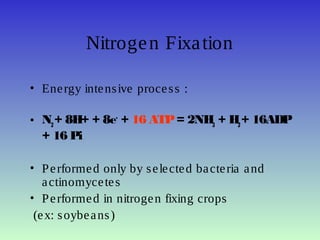
Nitrogen Fixation
• Energy intensive process :
• N2
+ 8H+ + 8e-
+ 16 ATP= 2NH3
+ H2
+ 16ADP
+ 16 Pi
• Performed only by selected bacteria and
actinomycetes
• Performed in nitrogen fixing crops
(ex: soybeans)
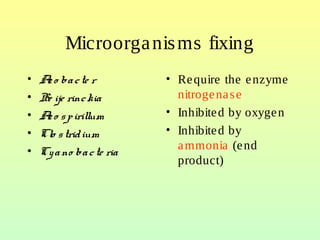
Microorganisms fixing
• Azo bacte r
• Be ije rinckia
• Azo spirillum
• Clo stridium
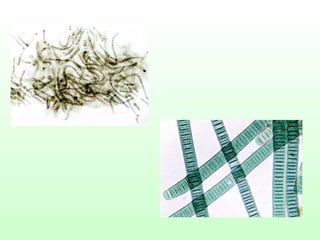
• Cyano bacte ria
• Require the enzyme
nitrogenase
• Inhibited by oxygen
• Inhibited by
ammonia (end
product)
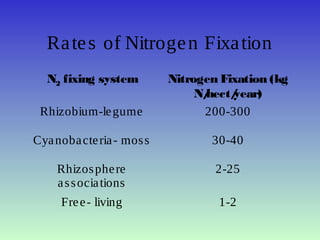
Rates of Nitrogen Fixation
N2 fixing system Nitrogen Fixation (kg
N/hect/year)
Rhizobium-legume 200-300
Cyanobacteria- moss 30-40
Rhizosphere
associations
2-25
Free- living 1-2
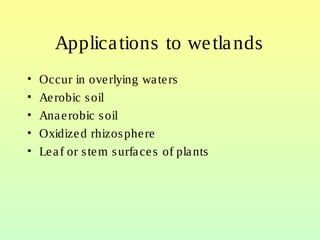
Applications to wetlands
• Occur in overlying waters
• Aerobic soil
• Anaerobic soil
• Oxidized rhizosphere
• Leaf or stem surfaces of plants
Bacterial Fixation
• Occurs mostly in salt marshes
• Is absent from low pH peat of northern
bogs
• Cyanobacteria found in waterlogged
soils
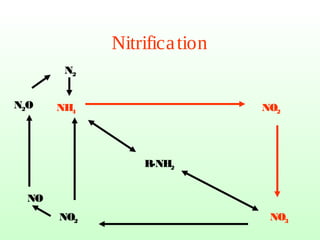
Nitrification
R-NH2
NH4 NO2
NO3NO2
NO
N2O
N2
Nitrification
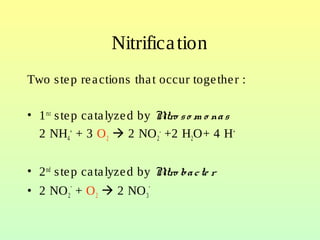
Two step reactions that occur together :
• 1rst
step catalyzed by Nitro so m o nas
2 NH4
+
+ 3 O2  2 NO2
-
+2 H2O+ 4 H+
• 2nd
step catalyzed by Nitro bacte r
• 2 NO2
-
+ O2  2 NO3
-
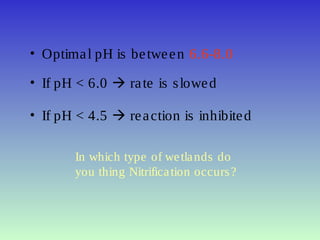
• Optimal pH is between 6.6-8.0
• If pH < 6.0  rate is slowed
• If pH < 4.5  reaction is inhibited
In which type of wetlands do
you thing Nitrification occurs?
Denitrification
R-NH2
NH4 NO2
NO3
NO2
NO
N2O
N2
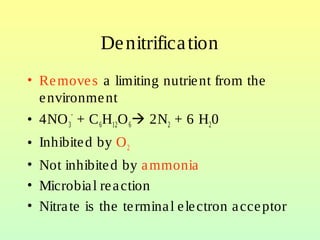
Denitrification
• Removes a limiting nutrient from the
environment
• 4NO3
-
+ C6H12O6 2N2 + 6 H20
• Inhibited by O2
• Not inhibited by ammonia
• Microbial reaction
• Nitrate is the terminal electron acceptor
Looking at the Nitrogen cycle
through the eye of NH4
Surface
water
Oxidized
layer
Reduced
soil layer
[NH4]
HIGH
Low
[NH4]
Slow Diffusion
Biodegradation
C/N <20
C/N >20
Surface
water
Oxidized
layer
Reduced
soil layer
[NH4]
HIGH
Low
[NH4]
Slow Diffusion
Nitrification
[NO3] high
Surface
water
Oxidized
layer
Reduced
soil layer
[NO3] high
Leaching
[NO3] Low
N2
Denitrification
Nitrogen cycle (ppt presentation)

Nitrogen cycle (ppt presentation)