The Nitrogen Cycle
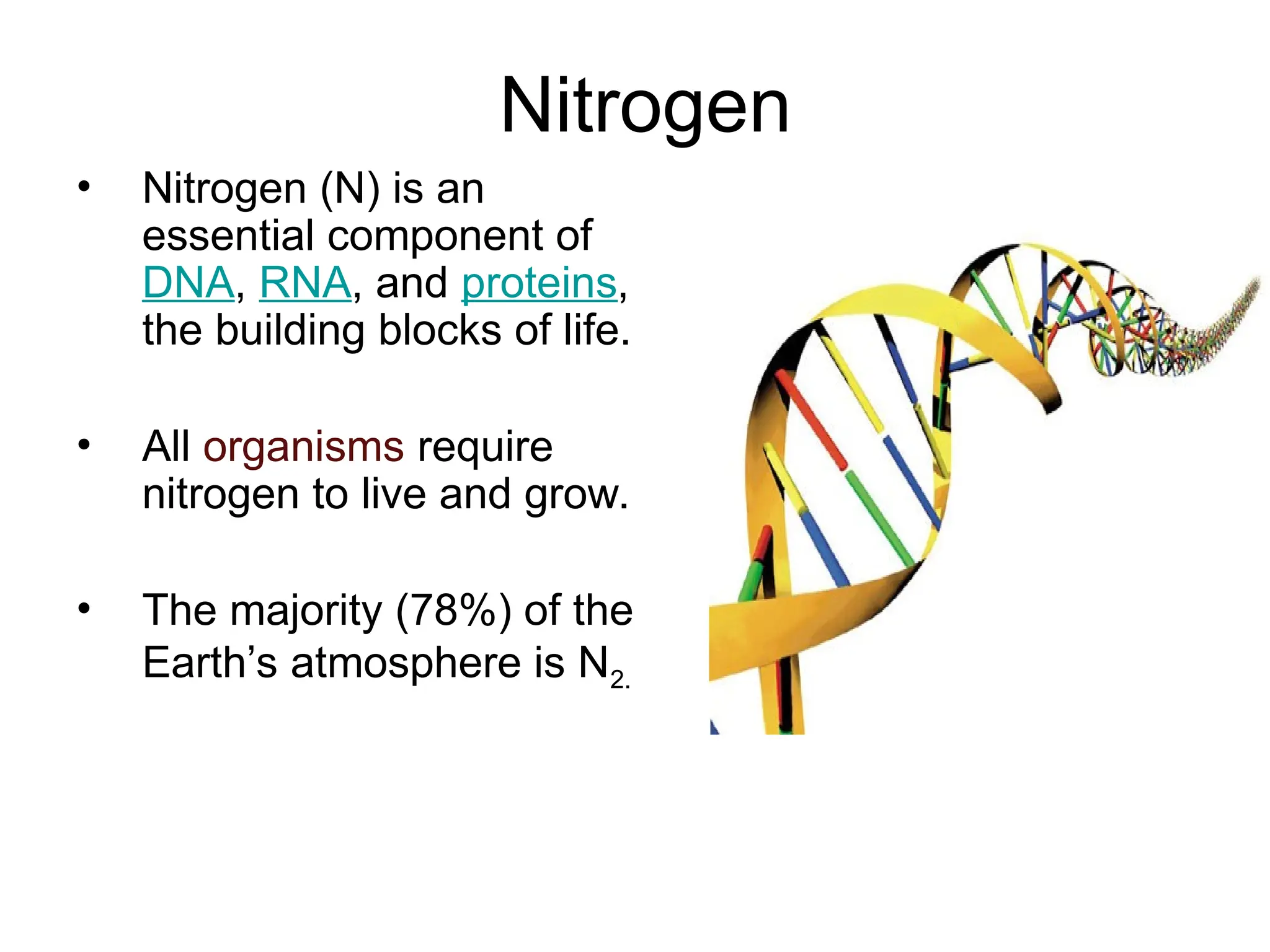
• Nitrogen (N) is an
essential component of
DNA, RNA, and proteins,
the building blocks of life.
• All organisms require
nitrogen to live and grow.
• The majority (78%) of the
Earth’s atmosphere is N2.
Nitrogen
Nitrogen’s triple bond
• Although the majority of the air
we breathe is N2, most of the
nitrogen in the atmosphere is
unavailable for use by
organisms.
• This is because the strong
triple bond between the N
atoms in N2 molecules makes it
relatively inert (like a noble
gas).
How can we use N2 gas?
• In order for plants and
animals to be able to
use nitrogen, N2 gas
must first be converted
to more a chemically
available form such as
ammonium (NH4
+
) or
nitrate (NO3
-).
• This is called FIXATION
WE CAN’T!
Nitrogen Fixation (N2 --> NH3 or NH4
+
)
HOW?
Biological or
Environmental or Humans
BIOLOGICAL:
Bacteria (called Nitrogen-
fixing bacteria)
These bacteria form
symbiotic relationships with
host plants.
The bacteria live in nodules
found in the roots of the
legume family of plants
(e.g. beans, peas, and
clover)
Nitrogen Fixation (N2 --> NO3
-
or NH4
+
)
THREE WAYS TO FIX N2:
Biological or
Environmental or
Humans
1. BIOLOGICAL:
Bacterial fixation: Bacteria
form symbiotic relationships
with host plants.
The bacteria live in
nodules found in the roots
of the legume family of
plants (e.g. beans, peas,
and clover)
Legumes therefore increase the
amount of N in the soil
BIOLOGICAL
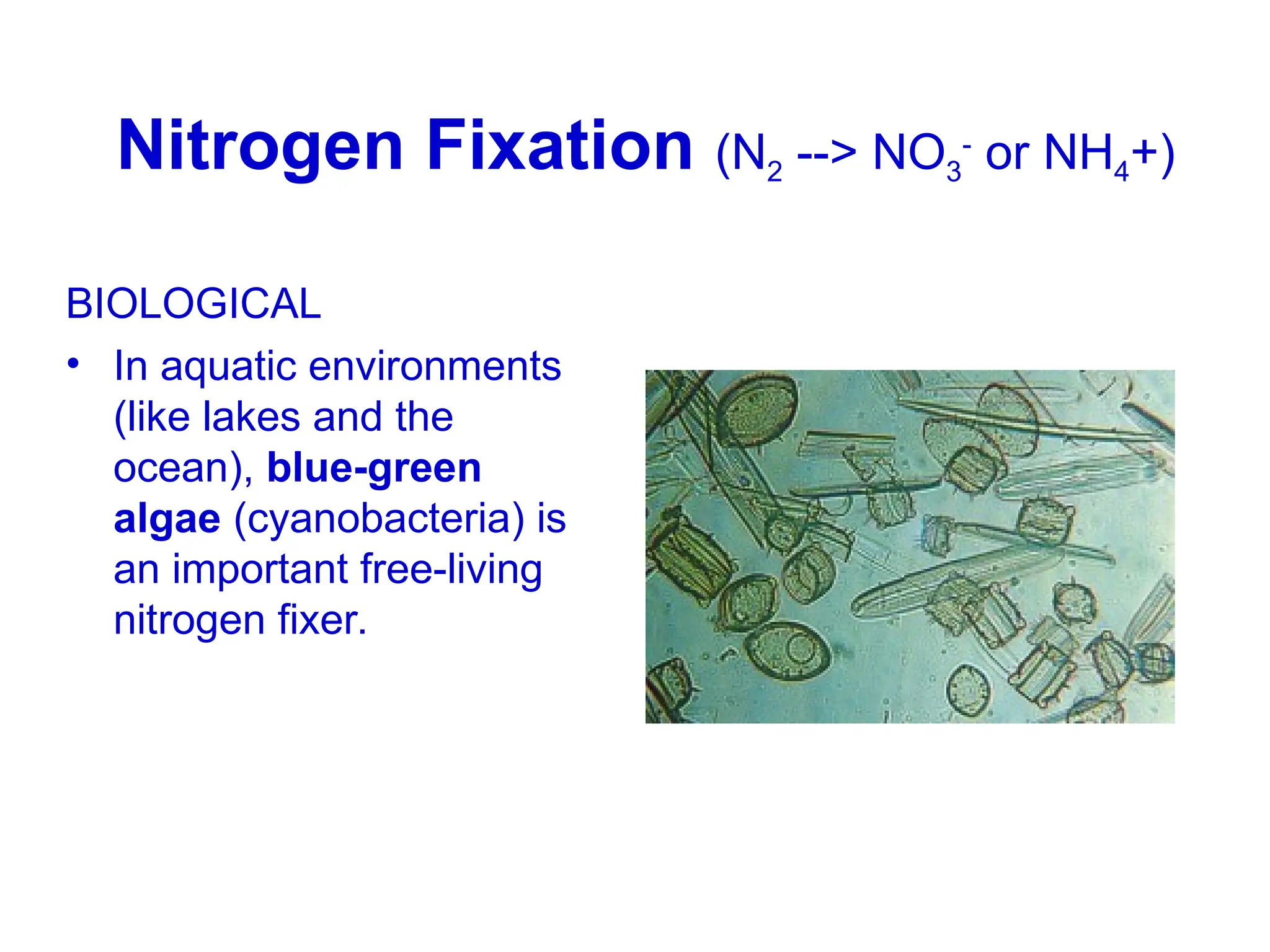
• In aquatic environments
(like lakes and the
ocean), blue-green
algae (cyanobacteria) is
an important free-living
nitrogen fixer.
Nitrogen Fixation (N2 --> NO3
-
or NH4+)
Nitrogen Fixation (N2 --> NO3
-
or NH4
+
)
2. ENVIRONMENTAL
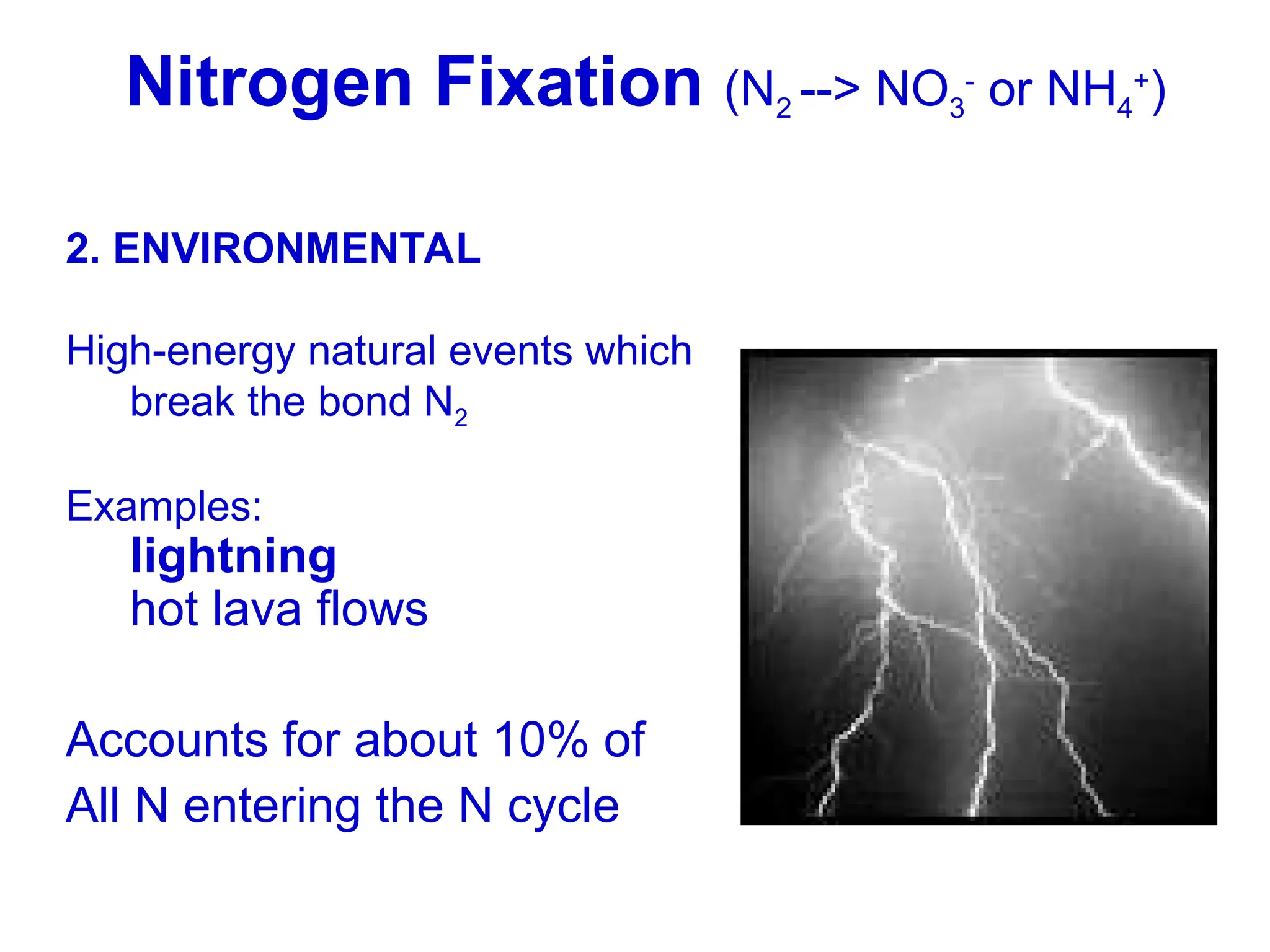
High-energy natural events which
break the bond N2
Examples:
lightning
hot lava flows
Accounts for about 10% of
All N entering the N cycle
Nitrogen Fixation N2 --> NO3
-
or NH4
+
3. HUMAN IMPACT
• Burning fossil fuels,
• Artificially creating
synthetic nitrogen
fertilizers,
• and cultivation of large
crops of legumes
all fix excess nitrogen.
Nitrogen
Fixation
Atmospheric
Nitrogen is
broken into
useable
nitrogen (NH
NH3
3 or
or
NH
NH4
4
+
+
)
)
Nitrification
NH3 or NH4
+
--> NO2
-
--> NO3
-
(Nitrifying) Bacteria
add oxygen to
nitrogen in two
steps to convert
ammonia to
nitrates, the most
abundant type in
the soil
Nitrification
Names of the bacteria
• Nitrosomonas
– Works first
– Converts
ammonia to nitrite
• Nitrobacter
– Works next
– Converts nitrite to
nitrate
– Nitrites are
poisonous
Nitrogen assimilation
• The ammonia (NH3) and nitrates are
usually quickly incorporated into
protein and other organic nitrogen
compounds (during photosynthesis)
• It’s either absorbed by a plant, by the
bacteria itself, or by another soil
organism.
• Organisms at the top of the food chain
(like us!) eat and grow, using nitrogen
to build our cells, enzymes and DNA
Nitrogen Mineralization
also called Ammonification
Organic N --> NH4
+
• Plants and animals return
nitrogen to the environment
when they Decay or excrete
waste
• decomposers (bacteria, fungi,
etc.) break down proteins to
ammonia, a simpler compound
• During this process, a significant
amount of the nitrogen contained
within the dead organism is
converted to ammonium (NH4
+
).
Denitrification
NO3
-
--> N2
(Denitrifying) Bacteria
in waterlogged soils
or wetlands do it)
Denitrification removes
nitrogen as nitrates
from ecosystems,
and converts it back
to atmospheric N2 or
nitrous oxide gas
(N2O).
Human Impact
• FERTILIZERS!
• Extra nitrogen fertilizer can runoff,
where it contaminates surface water
or infiltrates into ground water.
• In drinking water, excess nitrogen
can lead to cancer in humans and
respiratory distress in infants: BLUE
BABY SYNDROME,
• Bacterial action on fertilizer also
adds Nitrous oxide (N2O) to the air,
where it acts as a greenhouse gas
contributing to climate change
Human Impact
• In surface waters, extra nitrogen can lead to
eutrophication
• This leads to
– harmful algal blooms,
– Fish kills when the DO
drops
– and species shifts in
aquatic and land
ecosystems, often
lowering biodiversity
Nitrogen Cycle Pictures
Good descriptions of the nitrogen cycle have these 3
processes:
– Nitrogen fixation (N2 bonds are broken)
– Nitrification (oxygen is added to form nitrogen oxides)
– Denitrification (N2 is put back into the air)
It is also helpful to have these 2
– Ammonification (waste conversion by decomposers)
– Assimilation (intake by producers to be used to make
proteins)
N as a pollutant of water and air
• Human activities
have more than
doubled the annual
release of N from
the land to the rest
of the environment!
• most of this from the
increased use of
inorganic fertilizers
TWO Alternatives to fertilizer
1. No-tillage practices
or adding humus
(compost): Leaving the
plant stalks or roots in
the ground will allow
decomposition
(ammonification) and
nitrification to continue.
This will add nitrates to
the soil, using the
naturally occurring soil
bacteria.
2. Crop rotation:
planting legumes one
season, and the
commercial crop the
next. Legumes have a
symbiotic relationship
with nitrogen fixing
bacteria and will ADD
NITRATES to any soil
they are grown in. No
need for fertilizer!

BIOLOGCALFIXATIO nitrogen- cycle _1_.ppt

  • 1.
  • 2.
    • Nitrogen (N)is an essential component of DNA, RNA, and proteins, the building blocks of life. • All organisms require nitrogen to live and grow. • The majority (78%) of the Earth’s atmosphere is N2. Nitrogen
  • 3.
    Nitrogen’s triple bond •Although the majority of the air we breathe is N2, most of the nitrogen in the atmosphere is unavailable for use by organisms. • This is because the strong triple bond between the N atoms in N2 molecules makes it relatively inert (like a noble gas).
  • 4.
    How can weuse N2 gas? • In order for plants and animals to be able to use nitrogen, N2 gas must first be converted to more a chemically available form such as ammonium (NH4 + ) or nitrate (NO3 -). • This is called FIXATION WE CAN’T!
  • 5.
    Nitrogen Fixation (N2--> NH3 or NH4 + ) HOW? Biological or Environmental or Humans BIOLOGICAL: Bacteria (called Nitrogen- fixing bacteria) These bacteria form symbiotic relationships with host plants. The bacteria live in nodules found in the roots of the legume family of plants (e.g. beans, peas, and clover) Nitrogen Fixation (N2 --> NO3 - or NH4 + ) THREE WAYS TO FIX N2: Biological or Environmental or Humans 1. BIOLOGICAL: Bacterial fixation: Bacteria form symbiotic relationships with host plants. The bacteria live in nodules found in the roots of the legume family of plants (e.g. beans, peas, and clover) Legumes therefore increase the amount of N in the soil
  • 6.
    BIOLOGICAL • In aquaticenvironments (like lakes and the ocean), blue-green algae (cyanobacteria) is an important free-living nitrogen fixer. Nitrogen Fixation (N2 --> NO3 - or NH4+)
  • 7.
    Nitrogen Fixation (N2--> NO3 - or NH4 + ) 2. ENVIRONMENTAL High-energy natural events which break the bond N2 Examples: lightning hot lava flows Accounts for about 10% of All N entering the N cycle
  • 8.
    Nitrogen Fixation N2--> NO3 - or NH4 + 3. HUMAN IMPACT • Burning fossil fuels, • Artificially creating synthetic nitrogen fertilizers, • and cultivation of large crops of legumes all fix excess nitrogen.
  • 9.
  • 10.
    Nitrification NH3 or NH4 + -->NO2 - --> NO3 - (Nitrifying) Bacteria add oxygen to nitrogen in two steps to convert ammonia to nitrates, the most abundant type in the soil
  • 11.
  • 12.
    Names of thebacteria • Nitrosomonas – Works first – Converts ammonia to nitrite • Nitrobacter – Works next – Converts nitrite to nitrate – Nitrites are poisonous
  • 13.
    Nitrogen assimilation • Theammonia (NH3) and nitrates are usually quickly incorporated into protein and other organic nitrogen compounds (during photosynthesis) • It’s either absorbed by a plant, by the bacteria itself, or by another soil organism. • Organisms at the top of the food chain (like us!) eat and grow, using nitrogen to build our cells, enzymes and DNA
  • 14.
    Nitrogen Mineralization also calledAmmonification Organic N --> NH4 + • Plants and animals return nitrogen to the environment when they Decay or excrete waste • decomposers (bacteria, fungi, etc.) break down proteins to ammonia, a simpler compound • During this process, a significant amount of the nitrogen contained within the dead organism is converted to ammonium (NH4 + ).
  • 16.
    Denitrification NO3 - --> N2 (Denitrifying) Bacteria inwaterlogged soils or wetlands do it) Denitrification removes nitrogen as nitrates from ecosystems, and converts it back to atmospheric N2 or nitrous oxide gas (N2O).
  • 17.
    Human Impact • FERTILIZERS! •Extra nitrogen fertilizer can runoff, where it contaminates surface water or infiltrates into ground water. • In drinking water, excess nitrogen can lead to cancer in humans and respiratory distress in infants: BLUE BABY SYNDROME, • Bacterial action on fertilizer also adds Nitrous oxide (N2O) to the air, where it acts as a greenhouse gas contributing to climate change
  • 18.
    Human Impact • Insurface waters, extra nitrogen can lead to eutrophication • This leads to – harmful algal blooms, – Fish kills when the DO drops – and species shifts in aquatic and land ecosystems, often lowering biodiversity
  • 19.
    Nitrogen Cycle Pictures Gooddescriptions of the nitrogen cycle have these 3 processes: – Nitrogen fixation (N2 bonds are broken) – Nitrification (oxygen is added to form nitrogen oxides) – Denitrification (N2 is put back into the air) It is also helpful to have these 2 – Ammonification (waste conversion by decomposers) – Assimilation (intake by producers to be used to make proteins)
  • 21.
    N as apollutant of water and air • Human activities have more than doubled the annual release of N from the land to the rest of the environment! • most of this from the increased use of inorganic fertilizers
  • 22.
    TWO Alternatives tofertilizer 1. No-tillage practices or adding humus (compost): Leaving the plant stalks or roots in the ground will allow decomposition (ammonification) and nitrification to continue. This will add nitrates to the soil, using the naturally occurring soil bacteria. 2. Crop rotation: planting legumes one season, and the commercial crop the next. Legumes have a symbiotic relationship with nitrogen fixing bacteria and will ADD NITRATES to any soil they are grown in. No need for fertilizer!