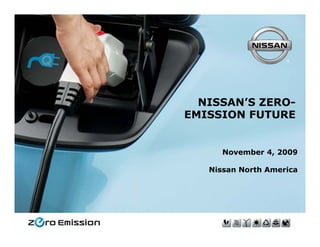
NISSAN’S ZERO-
                 EMISSION FUTURE


                       November 4, 2009

                    Nissan North America


August 6, 2009
NISSAN GREEN PROGRAM

    “Seeking a symbiosis of people, vehicles, and nature”

With a goal of sustainable mobility, Nissan is taking a
proactive approach to finding solutions to environmental
challenges.

Reducing CO2 emissions is a
major focus of the Nissan Green
Program.
LONG-TERM GOAL FOR REDUCING CO2

Intergovernmental Panel for Climate Change (IPCC) study:

       By 2050 CO2 emissions must be reduced by 70%~90% vs. 2000 levels

                      100


                                                                             70% Reduction
New Car’s Well To Wheel
  CO2 Emissions (%)


                          80
                                                      550ppm


                                                                                             90% Reduction
                          60
                                      450ppm
                          40


                          20


                          0
                               2000   2010     2020     2030   2040   2050
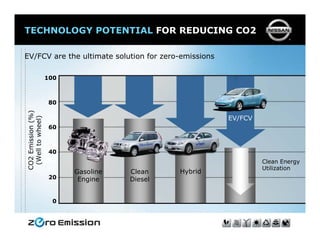
TECHNOLOGY POTENTIAL FOR REDUCING CO2

EV/FCV are the ultimate solution for zero-emissions

                   100


                   80
CO2 Emission (%)
 (Well to wheel)


                                                      EV/FCV
                   60


                   40
                                                               Clean Energy
                                                               Utilization
                         Gasoline   Clean    Hybrid
                   20     Engine    Diesel


                    0
HISTORY OF NISSAN’S EV

• 17 years of experience in lithium-ion battery/car application
• Late CY2010 launch all new pure electric vehicle


  1998 Altra EV     2000 Hypermini   2008 Test Vehicle   2010 Leaf US, JPN


                           PIVO      PIVO2           NUVU
                  2005 Tokyo MS      07 Tokyo MS     2008 Paris MS
LITHIUM-ION BATTERY

• High reliability in automotive applications
• Ready for mass production

       2X POWER                    2X ENERGY                     1/2 SIZE

                 2.5kW/kg                    140Wh/kg
                                                                         In 1/2 SIZE


                                                         Cylinder type       Laminated
  Conventional   Laminated    Conventional   Laminated
                                                                               type

                                                                    Charge
 Achieved High Reliability
 • High heat stability with the use of
                                                                  Discharge
   manganese positive electrodes
 • Enhanced cooling performance by
   lamination
MAJOR INVESTMENT IN BATTERY TECH


  Material        Cell          Module            Pack         Vehicle


   NISSAN AND NEC JOINT VENTURE - AESC - STARTS OPERATIONS
           12.0 billion yen investment to mass produce
                  advanced lithium-ion batteries
   TOKYO (May 19, 2008) – Nissan Motor Co., Ltd., NEC Corporation, and its
  subsidiary NEC TOKIN Corporation, today announced that its joint-venture
  company – Automotive Energy Supply Corporation (AESC) – has begun full
    operations. AESC’s start of operation follows the announcement of the
                         joint-venture in April 2007.
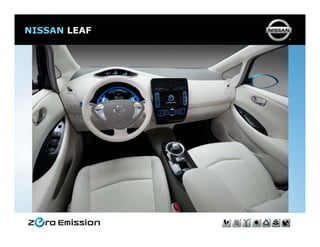
NISSAN LEAF

All the feature customers have come to expect:

                        Space For      100-Mile
                        5 People        Range     Advanced
            Compact
                                                   Safety
            Car Size                              Features

   Unique                                                Premium
   Design                                                Amenities
NISSAN LEAF
NISSAN LEAF
NISSAN LEAF
NISSAN LEAF
NISSAN LEAF
NISSAN LEAF
NISSAN LEAF PLATFORM
NISSAN LEAF

Highlights                                     Size            5-door compact hatchback
•   Zero emission
                                             Capacity                 4~5 Adults
•   Affordable
                                                                       100 miles
                                              Range
•   Stimulating acceleration                                            (US LA4)

•   Quietness                               Top Speed                  ~88 mph

•   100-mile range sufficient for daily                            Laminated Li-ion
                                             Battery
    use                                                         (Manufactured by AESC)

•   Advanced intelligent                  Capacity/Power           24 kWh/over 90kW
    transportation (IT) system
                                                           High-response synchronous AC Motor
                                              Motor
                                                                      80kW/280Nm


                                            IT System       Integrated communication system
NISSAN LEAF IT SOLUTIONS
RECYCLABILITY/RECOVERABILITY

• Up to 99% recyclable
• Made with recycled materials, designed for recoverability
BENEFITS TO THE CONSUMER

• True zero-emission vehicle
• Affordable pricing
• Lower Total Cost of Ownership than a comparable
  Internal Combustion Engine vehicle
• Lower maintenance costs than an ICE vehicle
    Less complexity
    No engine, transmission, exhaust system
    No oil changes


Cost per mile comparison (15k miles):
• Car (25mpg, $3/gal)     = $0.12 per mile / $1,800
• EV ($0.11 kWh - US Avg) = $0.026 per mile / $396

 Cost per mile of EVs can be 20-30% of the cost of fuel for
 a comparable internal combustion engine vehicle
CHARGING NETWORK CONCEPT


                                                Charging Network

                 Home Charging    Destination Charging       Pathway Charging
    EV Usage     Short Distance         Mid Distance           Long Distance


                                                                             Charger

                                  Charger          Charger         Charger


 Charger Type       Normal           Normal or Quick               Quick
                                  (depends on stay time)


 Charging Site       Home             Workplace, Movie       Major Road Highway
                                       Theatre, Mall,           Service Area
                                       Restaurant, or
                                        Parking Lot
WHEN WILL NISSAN’S EV
BE AVAILABLE?

• Nissan will partner with select public and private organizations to make
  EVs available for fleet/commercial use in 2010 and 2011
• Regionally, individual retail sales may begin as soon as late 2010 if the
  infrastructure is ready
• EVs will be mass marketed to individual consumers in 2012


     2008           2009           2010            2011           2012


                 Today               SOP/SOS                   Mass Market
                                                                  Sales

                                        Fall
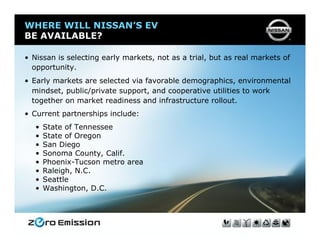
WHERE WILL NISSAN’S EV
BE AVAILABLE?

• Nissan is selecting early markets, not as a trial, but as real markets of
  opportunity.
• Early markets are selected via favorable demographics, environmental
  mindset, public/private support, and cooperative utilities to work
  together on market readiness and infrastructure rollout.
• Current partnerships include:
   •   State of Tennessee
   •   State of Oregon
   •   San Diego
   •   Sonoma County, Calif.
   •   Phoenix-Tucson metro area
   •   Raleigh, N.C.
   •   Seattle
   •   Washington, D.C.
EACH PARTNER’S STRENGTHS
CAN BE LEVERAGED

        Nissan                                    State or Region
•Electric Vehicle                              •Promote EV awareness
•Battery                                       •Infrastructure
•EV knowledge & support                        •EVSE Permit Process
•EV service and                                •Legislation/Incentives
 maintenance                                   •Public education
                                               •EV fleet vehicles
                              A SUSTAINABLE
                             FUTURE REQUIRES
                            ALL STAKEHOLDERS
     Companies              WORKING TOGETHER           Utilities
•EV fleet vehicles                             •Expand renewable
•Workplace Charging                             electricity sources
•Promote EV awareness                          •Capacity expansion
•Incentives for employees                      •Time of use rates
                                               •Demand Response
                                               •Infrastructure
EV MARKET READINESS

• Incentives for consumers
  –   Financial (tax deduction, free permitting, subsidized charger installation)
  –   Non-financial (HOV lane access, preferential parking, etc.)


• Streamlined EVSE permit process
  –   Fast, easy permit application process (online permitting)
  –   Expedient installation approvals or installer self certification


• Charging Infrastructure
  -   Home
  -   Workplace
  -   Public


• Education and Public Outreach
   - Educate the public on environmental, social, and financial benefits of zero
     emission vehicles
ECONOMIC STIMULUS PACKAGE


• Up to $7,500 tax credit for first 200,000 vehicles/OEM
• Up to $2,000 tax credit for individuals (50% for businesses) to
  purchase and install chargers
• $1.6B loan from U.S. Department of Energy
  -   Nissan to invest in its Smyrna, TN Manufacturing facility
  -   New battery production facility
  -   Retool plant for EV manufacturing
  -   Potential capacity for 150,000 vehicles / 200,000 batteries
  -   Production to begin in 2012

• $99.6M Dept. of Energy Grant to deploy charging network:
      State of Tennessee
      State of Oregon
      San Diego
      Phoenix/Tucson
      Seattle

• State Incentives
NISSAN LEAF


 • Real Car
 • 100 Mile Range
 • Launching in 15 months
 • What are you doing to get “Plug In” Ready?
NISSAN LEAF


              THANK YOU!

Nissan Leaf Ev Zero Emission

  • 1.
    NISSAN’S ZERO- EMISSION FUTURE November 4, 2009 Nissan North America August 6, 2009
  • 2.
    NISSAN GREEN PROGRAM “Seeking a symbiosis of people, vehicles, and nature” With a goal of sustainable mobility, Nissan is taking a proactive approach to finding solutions to environmental challenges. Reducing CO2 emissions is a major focus of the Nissan Green Program.
  • 3.
    LONG-TERM GOAL FORREDUCING CO2 Intergovernmental Panel for Climate Change (IPCC) study: By 2050 CO2 emissions must be reduced by 70%~90% vs. 2000 levels 100 70% Reduction New Car’s Well To Wheel CO2 Emissions (%) 80 550ppm 90% Reduction 60 450ppm 40 20 0 2000 2010 2020 2030 2040 2050
  • 4.
    TECHNOLOGY POTENTIAL FORREDUCING CO2 EV/FCV are the ultimate solution for zero-emissions 100 80 CO2 Emission (%) (Well to wheel) EV/FCV 60 40 Clean Energy Utilization Gasoline Clean Hybrid 20 Engine Diesel 0
  • 5.
    HISTORY OF NISSAN’SEV • 17 years of experience in lithium-ion battery/car application • Late CY2010 launch all new pure electric vehicle 1998 Altra EV 2000 Hypermini 2008 Test Vehicle 2010 Leaf US, JPN PIVO PIVO2 NUVU 2005 Tokyo MS 07 Tokyo MS 2008 Paris MS
  • 6.
    LITHIUM-ION BATTERY • Highreliability in automotive applications • Ready for mass production 2X POWER 2X ENERGY 1/2 SIZE 2.5kW/kg 140Wh/kg In 1/2 SIZE Cylinder type Laminated Conventional Laminated Conventional Laminated type Charge Achieved High Reliability • High heat stability with the use of Discharge manganese positive electrodes • Enhanced cooling performance by lamination
  • 7.
    MAJOR INVESTMENT INBATTERY TECH Material Cell Module Pack Vehicle NISSAN AND NEC JOINT VENTURE - AESC - STARTS OPERATIONS 12.0 billion yen investment to mass produce advanced lithium-ion batteries TOKYO (May 19, 2008) – Nissan Motor Co., Ltd., NEC Corporation, and its subsidiary NEC TOKIN Corporation, today announced that its joint-venture company – Automotive Energy Supply Corporation (AESC) – has begun full operations. AESC’s start of operation follows the announcement of the joint-venture in April 2007.
  • 8.
    NISSAN LEAF All thefeature customers have come to expect: Space For 100-Mile 5 People Range Advanced Compact Safety Car Size Features Unique Premium Design Amenities
  • 9.
  • 10.
  • 11.
  • 12.
  • 13.
  • 14.
  • 15.
  • 16.
    NISSAN LEAF Highlights Size 5-door compact hatchback • Zero emission Capacity 4~5 Adults • Affordable 100 miles Range • Stimulating acceleration (US LA4) • Quietness Top Speed ~88 mph • 100-mile range sufficient for daily Laminated Li-ion Battery use (Manufactured by AESC) • Advanced intelligent Capacity/Power 24 kWh/over 90kW transportation (IT) system High-response synchronous AC Motor Motor 80kW/280Nm IT System Integrated communication system
  • 17.
    NISSAN LEAF ITSOLUTIONS
  • 18.
    RECYCLABILITY/RECOVERABILITY • Up to99% recyclable • Made with recycled materials, designed for recoverability
  • 19.
    BENEFITS TO THECONSUMER • True zero-emission vehicle • Affordable pricing • Lower Total Cost of Ownership than a comparable Internal Combustion Engine vehicle • Lower maintenance costs than an ICE vehicle Less complexity No engine, transmission, exhaust system No oil changes Cost per mile comparison (15k miles): • Car (25mpg, $3/gal) = $0.12 per mile / $1,800 • EV ($0.11 kWh - US Avg) = $0.026 per mile / $396 Cost per mile of EVs can be 20-30% of the cost of fuel for a comparable internal combustion engine vehicle
  • 20.
    CHARGING NETWORK CONCEPT Charging Network Home Charging Destination Charging Pathway Charging EV Usage Short Distance Mid Distance Long Distance Charger Charger Charger Charger Charger Type Normal Normal or Quick Quick (depends on stay time) Charging Site Home Workplace, Movie Major Road Highway Theatre, Mall, Service Area Restaurant, or Parking Lot
  • 21.
    WHEN WILL NISSAN’SEV BE AVAILABLE? • Nissan will partner with select public and private organizations to make EVs available for fleet/commercial use in 2010 and 2011 • Regionally, individual retail sales may begin as soon as late 2010 if the infrastructure is ready • EVs will be mass marketed to individual consumers in 2012 2008 2009 2010 2011 2012 Today SOP/SOS Mass Market Sales Fall
  • 22.
    WHERE WILL NISSAN’SEV BE AVAILABLE? • Nissan is selecting early markets, not as a trial, but as real markets of opportunity. • Early markets are selected via favorable demographics, environmental mindset, public/private support, and cooperative utilities to work together on market readiness and infrastructure rollout. • Current partnerships include: • State of Tennessee • State of Oregon • San Diego • Sonoma County, Calif. • Phoenix-Tucson metro area • Raleigh, N.C. • Seattle • Washington, D.C.
  • 23.
    EACH PARTNER’S STRENGTHS CANBE LEVERAGED Nissan State or Region •Electric Vehicle •Promote EV awareness •Battery •Infrastructure •EV knowledge & support •EVSE Permit Process •EV service and •Legislation/Incentives maintenance •Public education •EV fleet vehicles A SUSTAINABLE FUTURE REQUIRES ALL STAKEHOLDERS Companies WORKING TOGETHER Utilities •EV fleet vehicles •Expand renewable •Workplace Charging electricity sources •Promote EV awareness •Capacity expansion •Incentives for employees •Time of use rates •Demand Response •Infrastructure
  • 24.
    EV MARKET READINESS •Incentives for consumers – Financial (tax deduction, free permitting, subsidized charger installation) – Non-financial (HOV lane access, preferential parking, etc.) • Streamlined EVSE permit process – Fast, easy permit application process (online permitting) – Expedient installation approvals or installer self certification • Charging Infrastructure - Home - Workplace - Public • Education and Public Outreach - Educate the public on environmental, social, and financial benefits of zero emission vehicles
  • 25.
    ECONOMIC STIMULUS PACKAGE •Up to $7,500 tax credit for first 200,000 vehicles/OEM • Up to $2,000 tax credit for individuals (50% for businesses) to purchase and install chargers • $1.6B loan from U.S. Department of Energy - Nissan to invest in its Smyrna, TN Manufacturing facility - New battery production facility - Retool plant for EV manufacturing - Potential capacity for 150,000 vehicles / 200,000 batteries - Production to begin in 2012 • $99.6M Dept. of Energy Grant to deploy charging network: State of Tennessee State of Oregon San Diego Phoenix/Tucson Seattle • State Incentives
  • 26.
    NISSAN LEAF •Real Car • 100 Mile Range • Launching in 15 months • What are you doing to get “Plug In” Ready?
  • 27.
    NISSAN LEAF THANK YOU!