Bill Krueger Senior Vice President, Manufacturing, Purchasing  and Supply Chain Management  for the Americas Nissan North America Inc.
Global Sourcing Strategies Supply Chain 15,000km, 150km …or 15km?  Bill Krueger   Automotive News Manufacturing Conference May 17, 2007
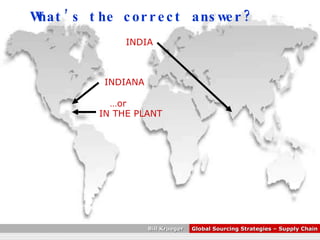
INDIA INDIANA IN THE PLANT … or What’s the correct answer?
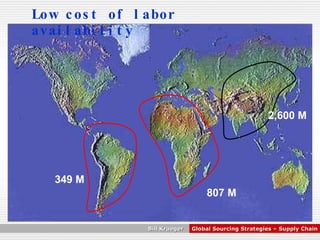
Low cost of labor availability 349 M 807 M 2,600 M
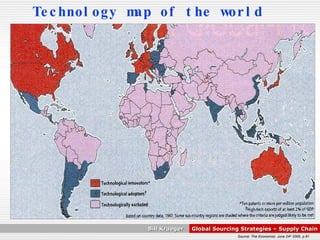
Technology map of the world Source: The Economist, June 24 th  2000, p.81
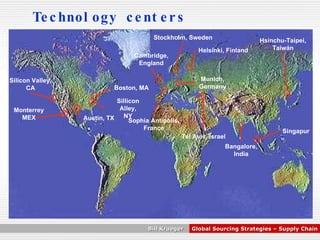
Technology centers Sillicon Alley, NY Boston, MA Austin, TX Cambridge, England Stockholm, Sweden Helsinki, Finland Sophia Antipolis, France Munich, Germany Tel Aviv, Israel Bangalore, India Singapur Hsinchu-Taipei, Taiwán Silicon Valley, CA Monterrey MEX
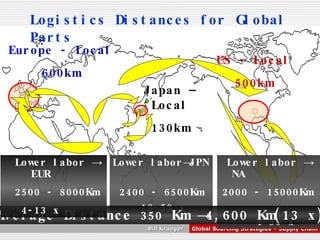
Japan – Local 130km Europe - Local 600km Lower labor->JPN     2400 - 6500Km   18-50 x   Lower labor -> NA       2000 - 15000Km     4-30 x US - Local 500km Average Distance  350  Km ->4,600 Km(13 x) Logistics Distances for   Global Parts Lower labor -> EUR    2500 - 8000Km 4-13 x   
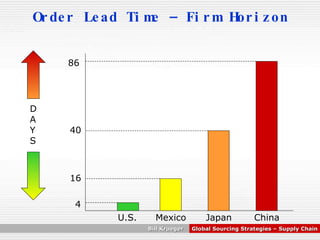
Order Lead Time – Firm Horizon U.S. Mexico Japan China 86 40 16 4 D A Y S
Risks associated with Global sourcing Financial Risks Obsolescence-Commitment for Fab & Raw materials due to extended supply pipeline. Currency Fluctuation/Stability-price adjust agreements Premium Freight-recovery & refilling the pipeline Inventory Carrying Cost Non-Price related Supply Chain Costs Warehousing Repackaging Expendable packaging disposal Sequencing parts Transportation Price Fluctuations Supplier Management & Oversight Cost
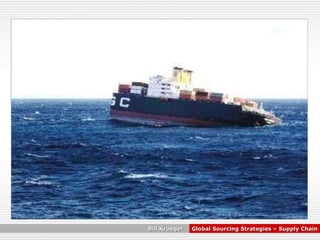
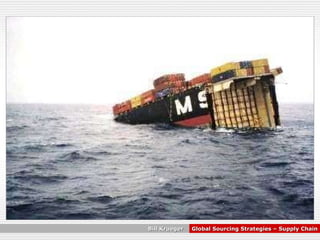
Supply Risks   US Customs Delays due to lack of C-TPAT certification Transit Delays – Weather Carrier route changes Port of call cancellation Port labor or Customs disruptions/ strikes Freight Damage Systems failures Raw Material Supply Control & Stability Design Change & Engineering Change Coordination Global Supplier Capacity Risks associated with Global sourcing


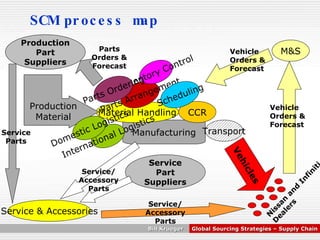
SCM process map Manufacturing Material Handling CCR Transport M&S Service & Accessories Service Part Suppliers Service Parts Service/ Accessory Parts Service/ Accessory Parts Parts Arrangement Scheduling Inventory Control Parts Ordering Production Material Nissan and Infiniti Dealers Vehicles Vehicle Orders & Forecast Vehicle Orders & Forecast Production Part Suppliers Parts Orders & Forecast International Logistics Domestic Logistics
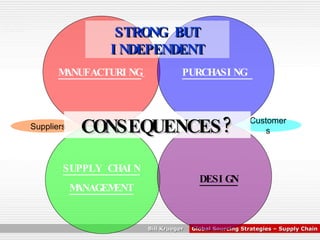
MANUFACTURING   PURCHASING  DESIGN SUPPLY CHAIN MANAGEMENT STRONG BUT INDEPENDENT Customers Suppliers CONSEQUENCES?
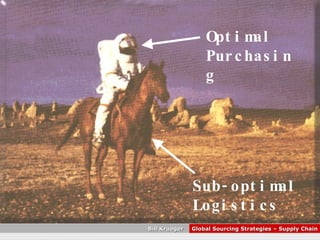
Sub-optimal Logistics Optimal Purchasing
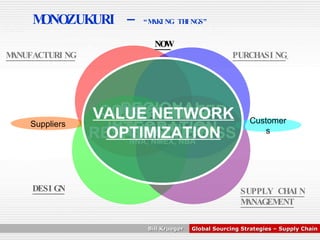
MONOZUKURI –  “MAKING THINGS” MANUFACTURING DESIGN PURCHASING   SUPPLY CHAIN MANAGEMENT CUSTOMER QUALITY NOW CONSOLIDATED OBJECTIVES REGIONAL INTEGRATION NNA, NMEX, NBA CUSTOMER RESPONSIVENESS Customers Suppliers VALUE NETWORK OPTIMIZATION
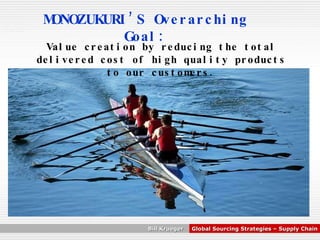
MONOZUKURI’S Overarching Goal: Value creation by  reducing the total delivered cost  of high  quality  products to our  customers .
Parts assembly level optimization Development of efficient packaging Transportation filling optimization Build the logistics corridor Regional Supply Chain Management (Americas)
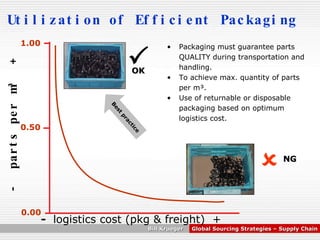
  NG OK Utilization of Efficient Packaging 0.00 0.50 1.00 -  parts per m³  +  -  logistics cost (pkg & freight)  +   Packaging must guarantee parts QUALITY during transportation and handling. To achieve max. quantity of parts per m³. Use of returnable or disposable packaging based on optimum logistics cost. Best practice
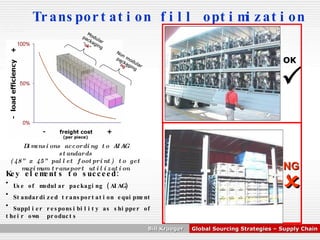
Transportation fill optimization Modular packaging “ ok ” Non modular packaging “ ng ” Dimensions according to AIAG standards (48” x 45” pallet footprint) to get maximum transport utilization   NG Key elements to succeed: Use of modular packaging (AIAG) Standardized transportation equipment Supplier responsibility as shipper of their own  products (per piece) OK
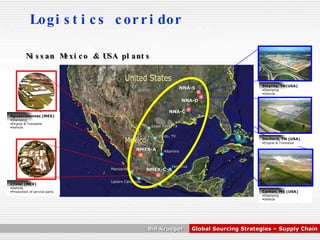
NNA-S NNA-D NNA-C NMEX-A NMEX-C United States Mexico Aguascalientes (MEX) Stamping Engine & Transaxle Vehicle CIVAC (MEX) Vehicle Production of service parts Canton, MS (USA) Stamping Vehicle Decherd, TN (USA) Engine & Transaxle Smyrna, TN(USA) Stamping Vehicle Nissan Mexico & USA plants Laredo, TX Veracruz Altamira Lazaro Cardenas Manzanillo Acapulco Eagle Pass, TX Logistics corridor
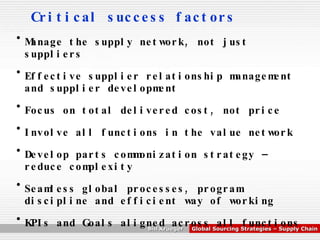
Critical success factors Manage the supply network, not just suppliers Effective supplier relationship management and supplier development Focus on total delivered cost, not price Involve all functions in the value network Develop parts commonization strategy – reduce complexity Seamless global processes, program discipline and efficient way of working KPIs and Goals aligned across all functions
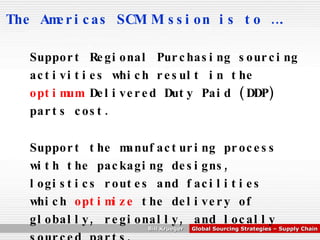
The Americas SCM Mission is to …. Support Regional Purchasing sourcing activities which result in the  optimum  Delivered Duty Paid (DDP) parts cost.  Support the manufacturing process with the packaging designs, logistics routes and facilities which  optimize  the delivery of globally, regionally, and locally sourced parts.
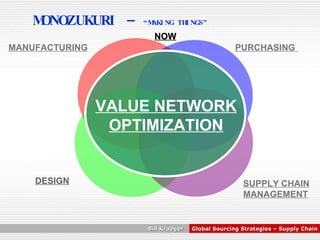
VALUE NETWORK OPTIMIZATION MONOZUKURI –  “MAKING THINGS” MANUFACTURING DESIGN PURCHASING  SUPPLY CHAIN MANAGEMENT NOW

Pres Krueger Nissan

  • 1.
    Bill Krueger SeniorVice President, Manufacturing, Purchasing and Supply Chain Management for the Americas Nissan North America Inc.
  • 2.
    Global Sourcing StrategiesSupply Chain 15,000km, 150km …or 15km? Bill Krueger Automotive News Manufacturing Conference May 17, 2007
  • 3.
    INDIA INDIANA INTHE PLANT … or What’s the correct answer?
  • 4.
    Low cost oflabor availability 349 M 807 M 2,600 M
  • 5.
    Technology map ofthe world Source: The Economist, June 24 th 2000, p.81
  • 6.
    Technology centers SilliconAlley, NY Boston, MA Austin, TX Cambridge, England Stockholm, Sweden Helsinki, Finland Sophia Antipolis, France Munich, Germany Tel Aviv, Israel Bangalore, India Singapur Hsinchu-Taipei, Taiwán Silicon Valley, CA Monterrey MEX
  • 7.
    Japan – Local130km Europe - Local 600km Lower labor->JPN     2400 - 6500Km   18-50 x   Lower labor -> NA       2000 - 15000Km     4-30 x US - Local 500km Average Distance 350 Km ->4,600 Km(13 x) Logistics Distances for Global Parts Lower labor -> EUR    2500 - 8000Km 4-13 x   
  • 8.
    Order Lead Time– Firm Horizon U.S. Mexico Japan China 86 40 16 4 D A Y S
  • 9.
    Risks associated withGlobal sourcing Financial Risks Obsolescence-Commitment for Fab & Raw materials due to extended supply pipeline. Currency Fluctuation/Stability-price adjust agreements Premium Freight-recovery & refilling the pipeline Inventory Carrying Cost Non-Price related Supply Chain Costs Warehousing Repackaging Expendable packaging disposal Sequencing parts Transportation Price Fluctuations Supplier Management & Oversight Cost
  • 10.
    Supply Risks US Customs Delays due to lack of C-TPAT certification Transit Delays – Weather Carrier route changes Port of call cancellation Port labor or Customs disruptions/ strikes Freight Damage Systems failures Raw Material Supply Control & Stability Design Change & Engineering Change Coordination Global Supplier Capacity Risks associated with Global sourcing
  • 11.
  • 12.
  • 13.
  • 14.
  • 15.
  • 16.
  • 17.
    SCM process mapManufacturing Material Handling CCR Transport M&S Service & Accessories Service Part Suppliers Service Parts Service/ Accessory Parts Service/ Accessory Parts Parts Arrangement Scheduling Inventory Control Parts Ordering Production Material Nissan and Infiniti Dealers Vehicles Vehicle Orders & Forecast Vehicle Orders & Forecast Production Part Suppliers Parts Orders & Forecast International Logistics Domestic Logistics
  • 18.
    MANUFACTURING PURCHASING DESIGN SUPPLY CHAIN MANAGEMENT STRONG BUT INDEPENDENT Customers Suppliers CONSEQUENCES?
  • 19.
  • 20.
    MONOZUKURI – “MAKING THINGS” MANUFACTURING DESIGN PURCHASING SUPPLY CHAIN MANAGEMENT CUSTOMER QUALITY NOW CONSOLIDATED OBJECTIVES REGIONAL INTEGRATION NNA, NMEX, NBA CUSTOMER RESPONSIVENESS Customers Suppliers VALUE NETWORK OPTIMIZATION
  • 21.
    MONOZUKURI’S Overarching Goal:Value creation by reducing the total delivered cost of high quality products to our customers .
  • 22.
    Parts assembly leveloptimization Development of efficient packaging Transportation filling optimization Build the logistics corridor Regional Supply Chain Management (Americas)
  • 23.
      NGOK Utilization of Efficient Packaging 0.00 0.50 1.00 - parts per m³ + - logistics cost (pkg & freight) + Packaging must guarantee parts QUALITY during transportation and handling. To achieve max. quantity of parts per m³. Use of returnable or disposable packaging based on optimum logistics cost. Best practice
  • 24.
    Transportation fill optimizationModular packaging “ ok ” Non modular packaging “ ng ” Dimensions according to AIAG standards (48” x 45” pallet footprint) to get maximum transport utilization   NG Key elements to succeed: Use of modular packaging (AIAG) Standardized transportation equipment Supplier responsibility as shipper of their own products (per piece) OK
  • 25.
    NNA-S NNA-D NNA-CNMEX-A NMEX-C United States Mexico Aguascalientes (MEX) Stamping Engine & Transaxle Vehicle CIVAC (MEX) Vehicle Production of service parts Canton, MS (USA) Stamping Vehicle Decherd, TN (USA) Engine & Transaxle Smyrna, TN(USA) Stamping Vehicle Nissan Mexico & USA plants Laredo, TX Veracruz Altamira Lazaro Cardenas Manzanillo Acapulco Eagle Pass, TX Logistics corridor
  • 26.
    Critical success factorsManage the supply network, not just suppliers Effective supplier relationship management and supplier development Focus on total delivered cost, not price Involve all functions in the value network Develop parts commonization strategy – reduce complexity Seamless global processes, program discipline and efficient way of working KPIs and Goals aligned across all functions
  • 27.
    The Americas SCMMission is to …. Support Regional Purchasing sourcing activities which result in the optimum Delivered Duty Paid (DDP) parts cost. Support the manufacturing process with the packaging designs, logistics routes and facilities which optimize the delivery of globally, regionally, and locally sourced parts.
  • 28.
    VALUE NETWORK OPTIMIZATIONMONOZUKURI – “MAKING THINGS” MANUFACTURING DESIGN PURCHASING SUPPLY CHAIN MANAGEMENT NOW

Editor's Notes

  • #3 Good evening and welcome to Nashville. As all of the speakers will likely mention in one form or another, every aspect of our industry has a global orientation. Supply chains can reach 15,000 km, 150 km or just 15 meters.
  • #4 Another way of looking at it is, do we want to source our parts from India, Indianapolis or inside the plant. Which is right for the situation? It depends… Contrary to popular belief, global sourcing isn’t just about cost. If we can’t create a win-win situation with a suppliers -- wherever they’re located – it’s not a good deal for us. The new enemy of success is complacency – it’s stagnating our thought process and thinking we’ve made all the improvements we can make.
  • #8 Our positive opinion of the many advantages of global sourcing was tempered with a realization that our average distances were thirteen times what they had been with a local sourcing strategy.
  • #9 Of course, the whole game changes as you go from local supply chains to global and LCC sourcing. The difference is obvious when you have lead times go from less than a week to three months.
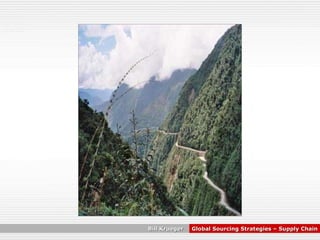
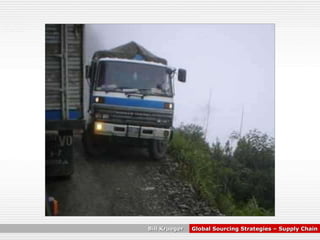
  • #12 And some of these supply lines are picturesque, but very different…
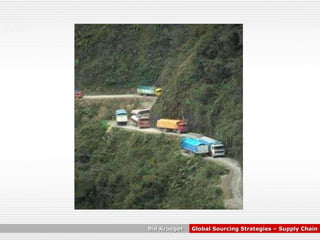
  • #13 …and sometimes crowded….
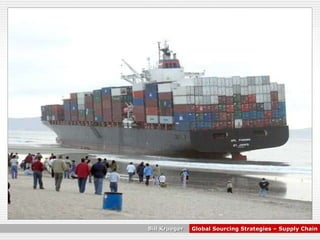
  • #14 VERY crowded!
  • #18 I’m going to show kind of a slow-motion diagram of what our supply chain looked like not too long ago. Behind this inefficient process map were silos – business units that didn’t have common goals or a culture of communication. Not too long ago we actually had separate trucks delivering the same part from the same supplier to two buildings about 100 yards apart in Smyrna. On different days! It was more than communication… the problem was we had a system – shown here, that had a silo mentality and not an organizational efficiency point of view. We were getting the work done, but we weren’t working as a team in the big picture.
  • #19 Not long ago, each of these separate organizations within Nissan was producing very good work. But because they had no common culture for communication and because each reported up to a different executive there was little synergy taking place. A basketball analogy I like to use for this is Ohio State’s team. They had the best scorer, the best rebounder, best assist man – and they were very successful… but they eventually couldn’t stack up against an excellent, cohesive TEAM.
  • #20 10
  • #21 The concept of Monokuzuri is optimizing your value chain by setting team goals and creating a culture of synergy and communication that systematically squeezes waste out of the sytem. From silos we’ve evolved to a functional focus – and we’re moving toward real-time functional optimization of the value chain. Cost savings, quality gains and better efficiency are going to continuously occur as a result of a total system focus of monokuzuri.
  • #27 Perhaps the easiest way to illustrate our objectives is to show you how we determine success. As I mentioned earlier, we take a more holistic view of the network and strive to make our suppliers partners in managing the network. Talk to the slides
  • #29 The concept of Monokuzuri is optimizing your value chain by setting team goals and creating a culture of synergy and communication that systematically squeezes waste out of the sytem. From silos we’ve evolved to a functional focus – and we’re moving toward real-time functional optimization of the value chain. Cost savings, quality gains and better efficiency are going to continuously occur as a result of a total system focus of monokuzuri.