Hybrid Synergy Drive - HSD


                    Sanjeev Prasad. M
                    CAE- 09
Outline
 The Environmental Issues
 What is a Hybrid Vehicle?
 History of the Hybrid
 Hybrid efficiency
 Myths about Hybrids
 Hybrid Line-up
 Hybrids in Fleets
 The Future of Hybrid Technology
Mobility on a grand scale
Challenges, also on a grand scale
The Call to Action
    “There is no future for the automotive industry
        without the promotion of environmental
       technology. Toyota is convinced that only
      companies that succeed in this area will be
                 acceptable to society.”


                         Fujio Cho
                         Chairman, Toyota Motor Corporation
The Reality
   “The new social priorities of the emerging era
    will call for radically new approaches to
    vehicles. Automakers have to address the
    issue of co-existence with society, particularly
    in relation to environmental preservation and
    safety…”
                           Hiroshi Okuda
                           Chairman
                        Toyota Motor Corp., Japan, 2004
Environmental Commitment
    Toyota is a world leader in producing advanced technology
     vehicles that are environmentally friendly.
    Toyota vehicles are consistently among the winners of
     EnerGuide’s most fuel efficient vehicle in class awards.
    Landfill Diversion & Recycling
      Reduced landfill waste by 85% at TCI headquarters
      Recycle 95% of packaging and parts at vehicle processing
        and parts distribution centres
    Environmental and Community Partnerships
      Toyota Earth Day Scholarship
      Toyota Evergreen Learning Grounds
A significant and growing percentage of customers
indicate a willingness to buy an environmentally
friendly vehicle


 If, and only if, all other attributes are EQUAL
 or Better
Technology Design Objectives
   Significant fuel economy improvement.

   Major reduction in exhaust emissions.

   No new infrastructure needs (e.g. fuelling
    stations).

   No perceived difference by customer in
    vehicle performance, handling, etc.

   A competitive price to encourage adoption.
What is a Hybrid Vehicle?

    What is a Hybrid System?
        Fusion between an internal combustion
     engine and electric motor—achieving different
     functions through different power
     combinations.

    Automobile hybrid systems combine two
     motive power sources, such as an internal
     combustion engine and an electric motor.
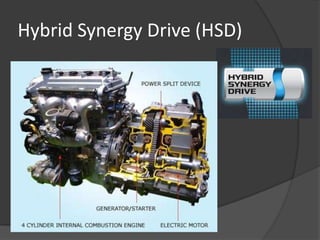
Hybrid Synergy Drive (HSD)
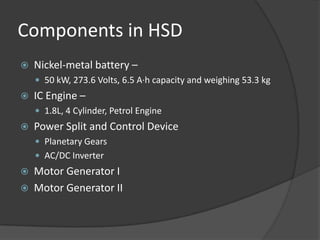
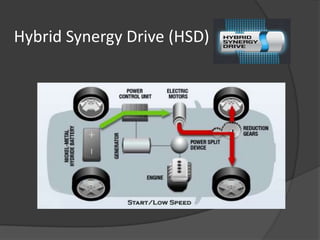
Components in HSD
   Nickel-metal battery –
     50 kW, 273.6 Volts, 6.5 A·h capacity and weighing 53.3 kg
   IC Engine –
     1.8L, 4 Cylinder, Petrol Engine
   Power Split and Control Device
     Planetary Gears
     AC/DC Inverter
   Motor Generator I
   Motor Generator II
HSD Features
  Idle Stop/Start
  Regenerative Braking
  Electric-only mode (Engine off)
  Power boost
  Self-charging battery (nickel-metal hybrid)
  Low Emissions
  Low Fuel Consumption
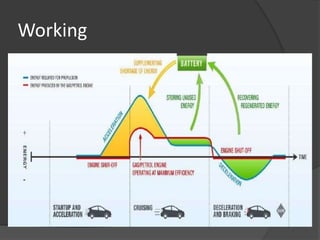
Working
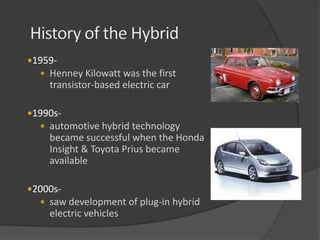
1959-
   Henney Kilowatt was the first
    transistor-based electric car

1990s-
   automotive hybrid technology
    became successful when the Honda
    Insight & Toyota Prius became
    available

2000s-
   saw development of plug-in hybrid
    electric vehicles
Types of HSD
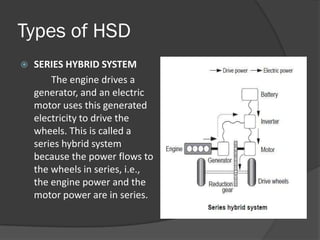
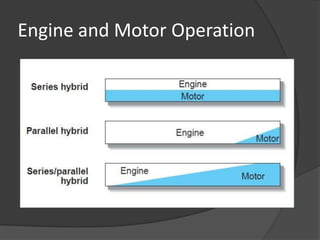
   SERIES HYBRID SYSTEM
        The engine drives a
    generator, and an electric
    motor uses this generated
    electricity to drive the
    wheels. This is called a
    series hybrid system
    because the power flows to
    the wheels in series, i.e.,
    the engine power and the
    motor power are in series.
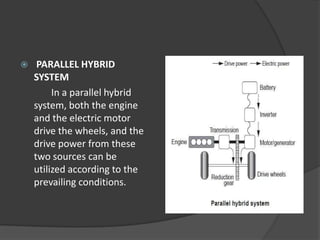
    PARALLEL HYBRID
    SYSTEM
         In a parallel hybrid
    system, both the engine
    and the electric motor
    drive the wheels, and the
    drive power from these
    two sources can be
    utilized according to the
    prevailing conditions.
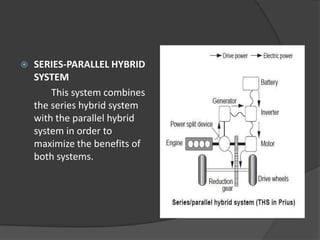
   SERIES-PARALLEL HYBRID
    SYSTEM
        This system combines
    the series hybrid system
    with the parallel hybrid
    system in order to
    maximize the benefits of
    both systems.
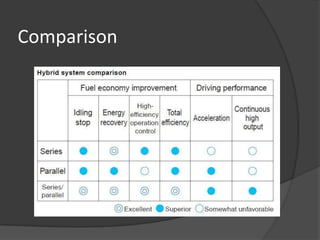
Comparison
Characteristics of Hybrid Systems
     ENERGY-LOSS REDUCTION
         The system automatically stops the idling of the
     engine (idling stop), thus reducing the energy that
     would normally be wasted.
     ENERGY RECOVERY AND REUSE
         The energy that would normally be wasted as
     heat during deceleration and braking is recovered as
     electrical energy, which is then used to power the
     starter and the electric motor.
   MOTOR ASSIST
         The electric motor assists the engine during
    acceleration.
   HIGH-EFFICIENCY OPERATION CONTROL
         The system maximizes the vehicle’s overall
    efficiency by using the electric motor to run the vehicle
    under operating conditions in which the engine’s
    efficiency is low and by generating electricity under
    operating conditions in which the engine’s efficiency is
    high.
Engine and Motor Operation
Hybrid Synergy Drive (HSD)
Hybrid Synergy Drive Benefits

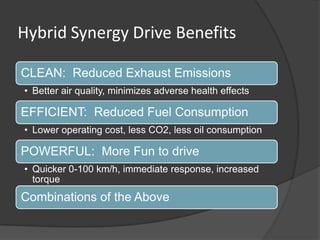
CLEAN: Reduced Exhaust Emissions
• Better air quality, minimizes adverse health effects

EFFICIENT: Reduced Fuel Consumption
• Lower operating cost, less CO2, less oil consumption

POWERFUL: More Fun to drive
• Quicker 0-100 km/h, immediate response, increased
  torque
Combinations of the Above
Midsize Vehicle Fuel Consumption
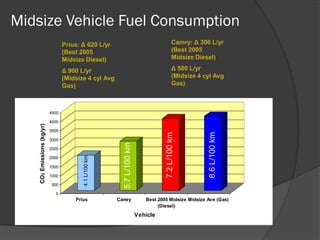
                                   Prius: Δ 620 L/yr                                        Camry: Δ 300 L/yr
                                   (Best 2005                                               (Best 2005
                                   Midsize Diesel)                                          Midsize Diesel)

                                   Δ 900 L/yr                                               Δ 580 L/yr
                                   (Midsize 4 cyl Avg                                       (Midsize 4 cyl Avg
                                   Gas)                                                     Gas)


                            4500

                            4000
    CO2 Emissions (kg/yr)


                            3500


                                                                                     7.2 L/100 km


                                                                                                        8.6 L/100 km
                            3000
                                                           5.7 L/100 km

                            2500
                                          4.1 L/100 km


                            2000

                            1500

                            1000

                            500

                              0
                                       Prius             Camry               Best 2005 Midsize Midsize Ave (Gas)
                                                                                  (Diesel)
                                                                          Vehicle
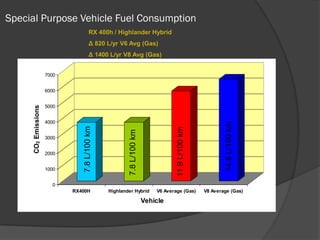
Special Purpose Vehicle Fuel Consumption
                                      RX 400h / Highlander Hybrid
                                      Δ 820 L/yr V6 Avg (Gas)
                                      Δ 1400 L/yr V8 Avg (Gas)


                     7000


                     6000


                     5000
     CO2 Emissions


                     4000


                                                                                                         14.8 L/100 km
                               7.8 L/100 km


                                                                                 11.9 L/100 km
                                                      7.8 L/100 km
                     3000


                     2000


                     1000


                       0
                            RX400H            Highlander Hybrid          V6 Average (Gas)        V8 Average (Gas)

                                                                     Vehicle
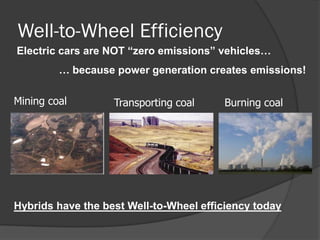
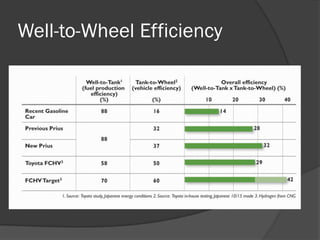
Well-to-Wheel Efficiency
Electric cars are NOT “zero emissions” vehicles…
         … because power generation creates emissions!

Mining coal        Transporting coal    Burning coal


Hybrids have the best Well-to-Wheel efficiency today
Well-to-Wheel Efficiency
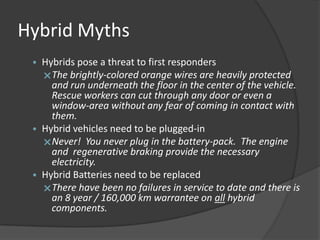
Hybrid Myths
 • Hybrids pose a threat to first responders
   The brightly-colored orange wires are heavily protected
     and run underneath the floor in the center of the vehicle.
     Rescue workers can cut through any door or even a
     window-area without any fear of coming in contact with
     them.
 • Hybrid vehicles need to be plugged-in
   Never! You never plug in the battery-pack. The engine
     and regenerative braking provide the necessary
     electricity.
 • Hybrid Batteries need to be replaced
   There have been no failures in service to date and there is
     an 8 year / 160,000 km warrantee on all hybrid
     components.
Contd…
• Hybrids are small and underpowered
  As explained in the last couple of slides, this is simply
    not the case. Hybrids out-perform their conventional
    counterparts and often come equipped with features
    not found on other models.
• Electromagnetic Fields in hybrids are harmful to human
  health
  EMFs inside and outside of Toyota hybrids are at the
    same low levels as conventional gasoline vehicles.
    Therefore there are no additional health risks to drivers,
    passengers or by-standers.
• Hybrids are only about improving fuel economy
  In addition to improved fuel efficiency, hybrid vehicles
    produce less smog forming emissions, and offer
    improved performance.
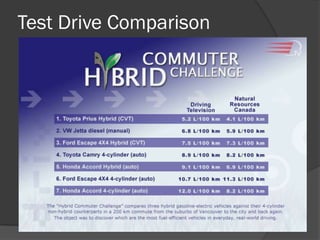
Test Drive Comparison
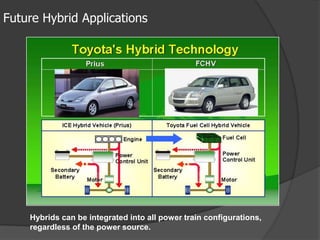
Future Hybrid Applications


    Hybrids can be integrated into all power train configurations,
    regardless of the power source.
Conclusion
   Reducing wasted energy
   Reducing the size & power of the ICE engine
 Energy Efficient
 Sustainable use of Non- renewable energy
  resources
 Eco-friendly
Reference
 www.toyota.com/hybrids
 www.toyotacanada.ca
 www.hybridsynergydrive.co.za
 www.howstuffworks.com
 www.wikipedia.com
 www.hybridworld.com
Hybrid Synergy Drive

Hybrid Synergy Drive

  • 1.
    Hybrid Synergy Drive- HSD Sanjeev Prasad. M CAE- 09
  • 2.
    Outline  The EnvironmentalIssues  What is a Hybrid Vehicle?  History of the Hybrid  Hybrid efficiency  Myths about Hybrids  Hybrid Line-up  Hybrids in Fleets  The Future of Hybrid Technology
  • 3.
    Mobility on agrand scale
  • 4.
    Challenges, also ona grand scale
  • 5.
    The Call toAction “There is no future for the automotive industry without the promotion of environmental technology. Toyota is convinced that only companies that succeed in this area will be acceptable to society.” Fujio Cho Chairman, Toyota Motor Corporation
  • 6.
    The Reality  “The new social priorities of the emerging era will call for radically new approaches to vehicles. Automakers have to address the issue of co-existence with society, particularly in relation to environmental preservation and safety…” Hiroshi Okuda Chairman Toyota Motor Corp., Japan, 2004
  • 7.
    Environmental Commitment  Toyota is a world leader in producing advanced technology vehicles that are environmentally friendly.  Toyota vehicles are consistently among the winners of EnerGuide’s most fuel efficient vehicle in class awards.  Landfill Diversion & Recycling  Reduced landfill waste by 85% at TCI headquarters  Recycle 95% of packaging and parts at vehicle processing and parts distribution centres  Environmental and Community Partnerships  Toyota Earth Day Scholarship  Toyota Evergreen Learning Grounds
  • 8.
    A significant andgrowing percentage of customers indicate a willingness to buy an environmentally friendly vehicle If, and only if, all other attributes are EQUAL or Better
  • 9.
    Technology Design Objectives  Significant fuel economy improvement.  Major reduction in exhaust emissions.  No new infrastructure needs (e.g. fuelling stations).  No perceived difference by customer in vehicle performance, handling, etc.  A competitive price to encourage adoption.
  • 10.
    What is aHybrid Vehicle?  What is a Hybrid System? Fusion between an internal combustion engine and electric motor—achieving different functions through different power combinations.  Automobile hybrid systems combine two motive power sources, such as an internal combustion engine and an electric motor.
  • 11.
  • 12.
    Components in HSD  Nickel-metal battery –  50 kW, 273.6 Volts, 6.5 A·h capacity and weighing 53.3 kg  IC Engine –  1.8L, 4 Cylinder, Petrol Engine  Power Split and Control Device  Planetary Gears  AC/DC Inverter  Motor Generator I  Motor Generator II
  • 13.
    HSD Features Idle Stop/Start  Regenerative Braking  Electric-only mode (Engine off)  Power boost  Self-charging battery (nickel-metal hybrid)  Low Emissions  Low Fuel Consumption
  • 14.
  • 15.
    1959- Henney Kilowatt was the first transistor-based electric car 1990s-  automotive hybrid technology became successful when the Honda Insight & Toyota Prius became available 2000s-  saw development of plug-in hybrid electric vehicles
  • 16.
    Types of HSD  SERIES HYBRID SYSTEM The engine drives a generator, and an electric motor uses this generated electricity to drive the wheels. This is called a series hybrid system because the power flows to the wheels in series, i.e., the engine power and the motor power are in series.
  • 17.
    PARALLEL HYBRID SYSTEM In a parallel hybrid system, both the engine and the electric motor drive the wheels, and the drive power from these two sources can be utilized according to the prevailing conditions.
  • 18.
    SERIES-PARALLEL HYBRID SYSTEM This system combines the series hybrid system with the parallel hybrid system in order to maximize the benefits of both systems.
  • 19.
  • 20.
    Characteristics of HybridSystems  ENERGY-LOSS REDUCTION The system automatically stops the idling of the engine (idling stop), thus reducing the energy that would normally be wasted.  ENERGY RECOVERY AND REUSE The energy that would normally be wasted as heat during deceleration and braking is recovered as electrical energy, which is then used to power the starter and the electric motor.
  • 21.
    MOTOR ASSIST The electric motor assists the engine during acceleration.  HIGH-EFFICIENCY OPERATION CONTROL The system maximizes the vehicle’s overall efficiency by using the electric motor to run the vehicle under operating conditions in which the engine’s efficiency is low and by generating electricity under operating conditions in which the engine’s efficiency is high.
  • 22.
  • 23.
  • 24.
    Hybrid Synergy DriveBenefits CLEAN: Reduced Exhaust Emissions • Better air quality, minimizes adverse health effects EFFICIENT: Reduced Fuel Consumption • Lower operating cost, less CO2, less oil consumption POWERFUL: More Fun to drive • Quicker 0-100 km/h, immediate response, increased torque Combinations of the Above
  • 25.
    Midsize Vehicle FuelConsumption Prius: Δ 620 L/yr Camry: Δ 300 L/yr (Best 2005 (Best 2005 Midsize Diesel) Midsize Diesel) Δ 900 L/yr Δ 580 L/yr (Midsize 4 cyl Avg (Midsize 4 cyl Avg Gas) Gas) 4500 4000 CO2 Emissions (kg/yr) 3500 7.2 L/100 km 8.6 L/100 km 3000 5.7 L/100 km 2500 4.1 L/100 km 2000 1500 1000 500 0 Prius Camry Best 2005 Midsize Midsize Ave (Gas) (Diesel) Vehicle
  • 26.
    Special Purpose VehicleFuel Consumption RX 400h / Highlander Hybrid Δ 820 L/yr V6 Avg (Gas) Δ 1400 L/yr V8 Avg (Gas) 7000 6000 5000 CO2 Emissions 4000 14.8 L/100 km 7.8 L/100 km 11.9 L/100 km 7.8 L/100 km 3000 2000 1000 0 RX400H Highlander Hybrid V6 Average (Gas) V8 Average (Gas) Vehicle
  • 27.
    Well-to-Wheel Efficiency Electric carsare NOT “zero emissions” vehicles… … because power generation creates emissions! Mining coal Transporting coal Burning coal Hybrids have the best Well-to-Wheel efficiency today
  • 28.
  • 29.
    Hybrid Myths •Hybrids pose a threat to first responders The brightly-colored orange wires are heavily protected and run underneath the floor in the center of the vehicle. Rescue workers can cut through any door or even a window-area without any fear of coming in contact with them. • Hybrid vehicles need to be plugged-in Never! You never plug in the battery-pack. The engine and regenerative braking provide the necessary electricity. • Hybrid Batteries need to be replaced There have been no failures in service to date and there is an 8 year / 160,000 km warrantee on all hybrid components.
  • 30.
    Contd… • Hybrids aresmall and underpowered As explained in the last couple of slides, this is simply not the case. Hybrids out-perform their conventional counterparts and often come equipped with features not found on other models. • Electromagnetic Fields in hybrids are harmful to human health EMFs inside and outside of Toyota hybrids are at the same low levels as conventional gasoline vehicles. Therefore there are no additional health risks to drivers, passengers or by-standers. • Hybrids are only about improving fuel economy In addition to improved fuel efficiency, hybrid vehicles produce less smog forming emissions, and offer improved performance.
  • 31.
  • 32.
    Future Hybrid Applications Hybrids can be integrated into all power train configurations, regardless of the power source.
  • 33.
    Conclusion  Reducing wasted energy  Reducing the size & power of the ICE engine  Energy Efficient  Sustainable use of Non- renewable energy resources  Eco-friendly
  • 34.
    Reference  www.toyota.com/hybrids  www.toyotacanada.ca www.hybridsynergydrive.co.za  www.howstuffworks.com  www.wikipedia.com  www.hybridworld.com