



Nikhar Tak
Bachelor Of Business Administration
2016-2017
Dezyne E’cole College
www.dezyneecole.com
Consumer Behavior
By
Chapter Outline
 What Is Market Segmentation?
 Bases for Segmentation
 Criteria for Effective Targeting of Segments
 Implementing Segmentation Strategies
Market Segmentation
The process of dividing a potential
market into distinct subsets of
consumers and selecting one or more
segments as a target market to be
reached with a distinct marketing mix.
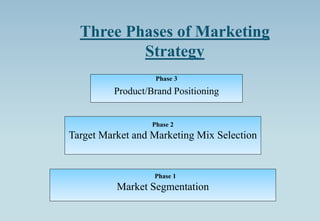
Three Phases of Marketing
Strategy
Phase 2
Target Market and Marketing Mix Selection
Phase 3
Product/Brand Positioning
Phase 1
Market Segmentation
Segmentation Studies
 Discover the needs and wants of groups of
consumers to develop specialized products to
satisfy group needs
 Used to identify the most appropriate media
for advertising
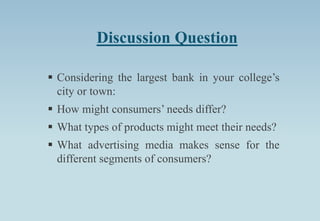
Discussion Question
 Considering the largest bank in your college’s
city or town:
 How might consumers’ needs differ?
 What types of products might meet their needs?
 What advertising media makes sense for the
different segments of consumers?
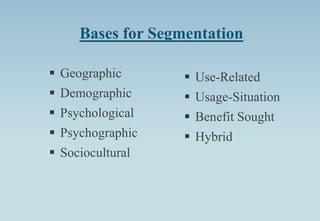
Bases for Segmentation
 Geographic
 Demographic
 Psychological
 Psychographic
 Sociocultural
 Use-Related
 Usage-Situation
 Benefit Sought
 Hybrid
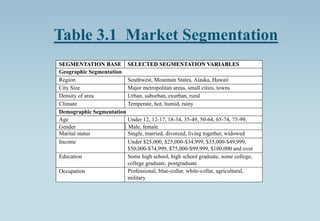
Table 3.1 Market Segmentation
Occupation
SEGMENTATION BASE SELECTED SEGMENTATION VARIABLES
Geographic Segmentation
Climate
Density of area
City Size
Region Southwest, Mountain States, Alaska, Hawaii
Major metropolitan areas, small cities, towns
Urban, suburban, exurban, rural
Temperate, hot, humid, rainy
Demographic Segmentation
Income
Marital status
Gender
Age Under 12, 12-17, 18-34, 35-49, 50-64, 65-74, 75-99,
100+Male, female
Single, married, divorced, living together, widowed
Under $25,000, $25,000-$34,999, $35,000-$49,999,
$50,000-$74,999, $75,000-$99,999, $100,000 and over
Education Some high school, high school graduate, some college,
college graduate, postgraduate
Professional, blue-collar, white-collar, agricultural,
military
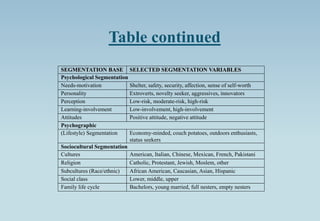
Table continued
SEGMENTATION BASE SELECTED SEGMENTATION VARIABLES
Psychological Segmentation
Learning-involvement
Perception
Personality
Needs-motivation Shelter, safety, security, affection, sense of self-worth
Extroverts, novelty seeker, aggressives, innovators
Low-risk, moderate-risk, high-risk
Low-involvement, high-involvement
Psychographic
Subcultures (Race/ethnic)
Religion
Cultures
(Lifestyle) Segmentation Economy-minded, couch potatoes, outdoors enthusiasts,
status seekers
American, Italian, Chinese, Mexican, French, Pakistani
Catholic, Protestant, Jewish, Moslem, other
African American, Caucasian, Asian, Hispanic
Family life cycle
Social class Lower, middle, upper
Bachelors, young married, full nesters, empty nesters
Attitudes Positive attitude, negative attitude
Sociocultural Segmentation
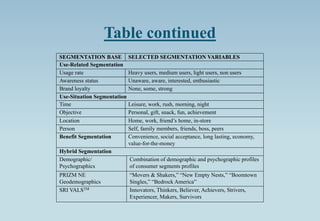
SEGMENTATION BASE SELECTED SEGMENTATION VARIABLES
Use-Related Segmentation
Brand loyalty
Awareness status
Usage rate Heavy users, medium users, light users, non users
Unaware, aware, interested, enthusiastic
None, some, strong
Use-Situation Segmentation
Location
Objective
Time Leisure, work, rush, morning, night
Personal, gift, snack, fun, achievement
Home, work, friend’s home, in-store
Person Self, family members, friends, boss, peers
Benefit Segmentation Convenience, social acceptance, long lasting, economy,
value-for-the-money
Table continued
Hybrid Segmentation
PRIZM NE
Geodemographics
“Movers & Shakers,” “New Empty Nests,” “Boomtown
Singles,” “Bedrock America”
Demographic/
Psychographics
Combination of demographic and psychographic profiles
of consumer segments profiles
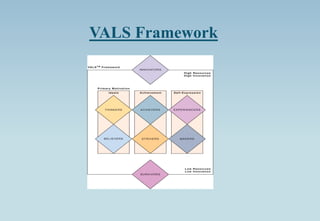
SRI VALSTM Innovators, Thinkers, Believer, Achievers, Strivers,
Experiencer, Makers, Survivors
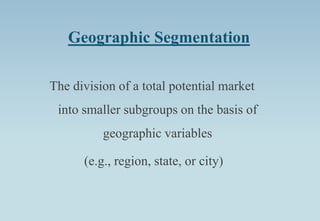
Geographic Segmentation
The division of a total potential market
into smaller subgroups on the basis of
geographic variables
(e.g., region, state, or city)
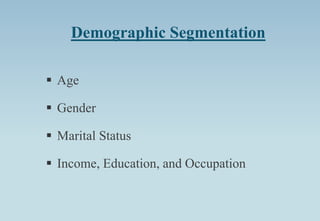
Demographic Segmentation
 Age
 Gender
 Marital Status
 Income, Education, and Occupation
Psychological Segmentation
 Motivations
 Personality
 Perceptions
 Learning
 Attitudes
Two High-End Watches for Different
Psychological Segments
Psychographic Segmentation
 Also known as Lifestyle Analysis
 Psychographic variables include attitudes,
interests, and opinions
(AIOs)
Sociocultural Segmentation
 Family Life Cycle
 Social Class
 Culture, Subculture, and Cross-Culture
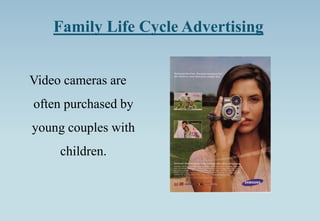
Family Life Cycle Advertising
Video cameras are
often purchased by
young couples with
children.
Use-Related Segmentation
Heavy vs. LightRate of Usage
Awareness Status
Brand Loyalty
Aware vs. Unaware
Brand Loyal vs. Brand
Switchers
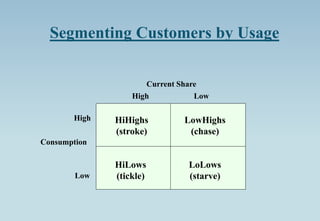
Segmenting Customers by Usage
High
Low
Consumption
High Low
LoLows
(starve)
HiHighs
(stroke)
LowHighs
(chase)
HiLows
(tickle)
Current Share
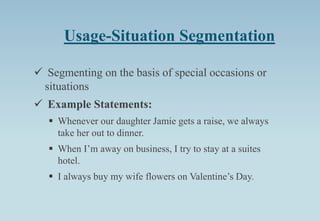
Usage-Situation Segmentation
 Segmenting on the basis of special occasions or
situations
 Example Statements:
 Whenever our daughter Jamie gets a raise, we always
take her out to dinner.
 When I’m away on business, I try to stay at a suites
hotel.
 I always buy my wife flowers on Valentine’s Day.
Benefit Segmentation
Segmenting on the basis of the most important
and meaningful benefit
Band-Aid offers
“flex” as a
benefit to
consumers.
Hybrid Segmentation Approaches
 Psychographic-Demographic Profiles
 Geo demographic Segmentation
 SRI Consulting’s VALS
VALS Framework
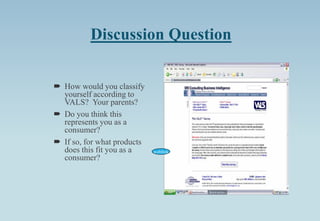
Discussion Question
 How would you classify
yourself according to
VALS? Your parents?
 Do you think this
represents you as a
consumer?
 If so, for what products
does this fit you as a
consumer?
weblink
Criteria for Effective Targeting of
Market Segments
Identification
Sufficiency
Stability
Accessibility
Implementing Segmentation
Strategies
Concentrated Marketing
One segment
Differentiated
Several segments with individual marketing mizes
Thank You
By
Nikhar Tak
Bachelor Of Business Administration
2016-2017
Dezyne E’cole College
www.dezyneecole.com

Nikhar Tak BBA 2nd Year

  • 1.
    Nikhar Tak Bachelor OfBusiness Administration 2016-2017 Dezyne E’cole College www.dezyneecole.com Consumer Behavior By
  • 2.
    Chapter Outline  WhatIs Market Segmentation?  Bases for Segmentation  Criteria for Effective Targeting of Segments  Implementing Segmentation Strategies
  • 3.
    Market Segmentation The processof dividing a potential market into distinct subsets of consumers and selecting one or more segments as a target market to be reached with a distinct marketing mix.
  • 4.
    Three Phases ofMarketing Strategy Phase 2 Target Market and Marketing Mix Selection Phase 3 Product/Brand Positioning Phase 1 Market Segmentation
  • 5.
    Segmentation Studies  Discoverthe needs and wants of groups of consumers to develop specialized products to satisfy group needs  Used to identify the most appropriate media for advertising
  • 6.
    Discussion Question  Consideringthe largest bank in your college’s city or town:  How might consumers’ needs differ?  What types of products might meet their needs?  What advertising media makes sense for the different segments of consumers?
  • 7.
    Bases for Segmentation Geographic  Demographic  Psychological  Psychographic  Sociocultural  Use-Related  Usage-Situation  Benefit Sought  Hybrid
  • 8.
    Table 3.1 MarketSegmentation Occupation SEGMENTATION BASE SELECTED SEGMENTATION VARIABLES Geographic Segmentation Climate Density of area City Size Region Southwest, Mountain States, Alaska, Hawaii Major metropolitan areas, small cities, towns Urban, suburban, exurban, rural Temperate, hot, humid, rainy Demographic Segmentation Income Marital status Gender Age Under 12, 12-17, 18-34, 35-49, 50-64, 65-74, 75-99, 100+Male, female Single, married, divorced, living together, widowed Under $25,000, $25,000-$34,999, $35,000-$49,999, $50,000-$74,999, $75,000-$99,999, $100,000 and over Education Some high school, high school graduate, some college, college graduate, postgraduate Professional, blue-collar, white-collar, agricultural, military
  • 9.
    Table continued SEGMENTATION BASESELECTED SEGMENTATION VARIABLES Psychological Segmentation Learning-involvement Perception Personality Needs-motivation Shelter, safety, security, affection, sense of self-worth Extroverts, novelty seeker, aggressives, innovators Low-risk, moderate-risk, high-risk Low-involvement, high-involvement Psychographic Subcultures (Race/ethnic) Religion Cultures (Lifestyle) Segmentation Economy-minded, couch potatoes, outdoors enthusiasts, status seekers American, Italian, Chinese, Mexican, French, Pakistani Catholic, Protestant, Jewish, Moslem, other African American, Caucasian, Asian, Hispanic Family life cycle Social class Lower, middle, upper Bachelors, young married, full nesters, empty nesters Attitudes Positive attitude, negative attitude Sociocultural Segmentation
  • 10.
    SEGMENTATION BASE SELECTEDSEGMENTATION VARIABLES Use-Related Segmentation Brand loyalty Awareness status Usage rate Heavy users, medium users, light users, non users Unaware, aware, interested, enthusiastic None, some, strong Use-Situation Segmentation Location Objective Time Leisure, work, rush, morning, night Personal, gift, snack, fun, achievement Home, work, friend’s home, in-store Person Self, family members, friends, boss, peers Benefit Segmentation Convenience, social acceptance, long lasting, economy, value-for-the-money Table continued Hybrid Segmentation PRIZM NE Geodemographics “Movers & Shakers,” “New Empty Nests,” “Boomtown Singles,” “Bedrock America” Demographic/ Psychographics Combination of demographic and psychographic profiles of consumer segments profiles SRI VALSTM Innovators, Thinkers, Believer, Achievers, Strivers, Experiencer, Makers, Survivors
  • 11.
    Geographic Segmentation The divisionof a total potential market into smaller subgroups on the basis of geographic variables (e.g., region, state, or city)
  • 12.
    Demographic Segmentation  Age Gender  Marital Status  Income, Education, and Occupation
  • 13.
    Psychological Segmentation  Motivations Personality  Perceptions  Learning  Attitudes
  • 14.
    Two High-End Watchesfor Different Psychological Segments
  • 15.
    Psychographic Segmentation  Alsoknown as Lifestyle Analysis  Psychographic variables include attitudes, interests, and opinions (AIOs)
  • 16.
    Sociocultural Segmentation  FamilyLife Cycle  Social Class  Culture, Subculture, and Cross-Culture
  • 17.
    Family Life CycleAdvertising Video cameras are often purchased by young couples with children.
  • 18.
    Use-Related Segmentation Heavy vs.LightRate of Usage Awareness Status Brand Loyalty Aware vs. Unaware Brand Loyal vs. Brand Switchers
  • 19.
    Segmenting Customers byUsage High Low Consumption High Low LoLows (starve) HiHighs (stroke) LowHighs (chase) HiLows (tickle) Current Share
  • 20.
    Usage-Situation Segmentation  Segmentingon the basis of special occasions or situations  Example Statements:  Whenever our daughter Jamie gets a raise, we always take her out to dinner.  When I’m away on business, I try to stay at a suites hotel.  I always buy my wife flowers on Valentine’s Day.
  • 21.
    Benefit Segmentation Segmenting onthe basis of the most important and meaningful benefit
  • 22.
    Band-Aid offers “flex” asa benefit to consumers.
  • 23.
    Hybrid Segmentation Approaches Psychographic-Demographic Profiles  Geo demographic Segmentation  SRI Consulting’s VALS
  • 24.
  • 25.
    Discussion Question  Howwould you classify yourself according to VALS? Your parents?  Do you think this represents you as a consumer?  If so, for what products does this fit you as a consumer? weblink
  • 26.
    Criteria for EffectiveTargeting of Market Segments Identification Sufficiency Stability Accessibility
  • 27.
    Implementing Segmentation Strategies Concentrated Marketing Onesegment Differentiated Several segments with individual marketing mizes
  • 28.
    Thank You By Nikhar Tak BachelorOf Business Administration 2016-2017 Dezyne E’cole College www.dezyneecole.com