
Retailing Implication of Consumer
Demographic & Lifestyle
Presented By
Harshal
Verma
MBA (Gen.),3rd
Demographic
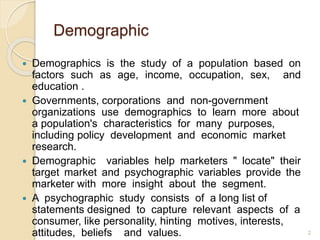
 Demographics is the study of a population based on
factors such as age, income, occupation, sex, and
education .
 Governments, corporations and non-government
organizations use demographics to learn more about
a population's characteristics for many purposes,
including policy development and economic market
research.
 Demographic variables help marketers " locate" their
target market and psychographic variables provide the
marketer with more insight about the segment.
 A psychographic study consists of a long list of
statements designed to capture relevant aspects of a
consumer, like personality, hinting motives, interests,
attitudes, beliefs and values. 2
Demographic Environment
 Population size
 Age structure
 Population distribution
 Income
 Occupation
 Education
 Gender
 Family size
 Family Life cycle
 Social class
3
Some specific questions are:
 Which demographic factors help marketers
describe and understand the market
segments?
 What is the importance of anticipating
demographic
shifts in society to develop marketing
strategies?
 What are some impacts of changing roles
(such as gender roles) on society and
consumption? 4
Lifestyle
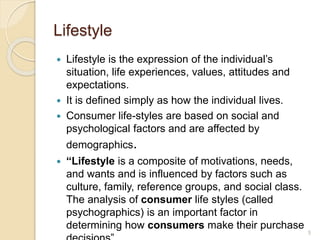
 Lifestyle is the expression of the individual’s
situation, life experiences, values, attitudes and
expectations.
 It is defined simply as how the individual lives.
 Consumer life-styles are based on social and
psychological factors and are affected by
demographics.
 “Lifestyle is a composite of motivations, needs,
and wants and is influenced by factors such as
culture, family, reference groups, and social class.
The analysis of consumer life styles (called
psychographics) is an important factor in
determining how consumers make their purchase
5
Determinants of lifestyle
6
Approaches to study LIFESTYLE
An AIO inventory for use in segmenting, targeting
and positioning.
7
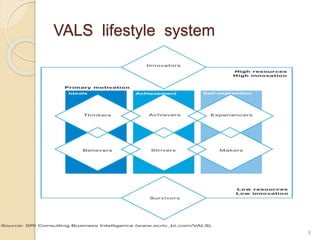
VALS lifestyle system
8
The 8 psychographic segments of
VALS
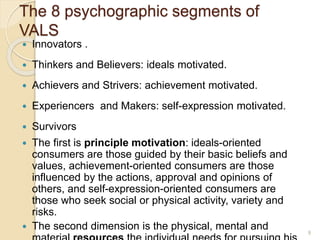
 Innovators .
 Thinkers and Believers: ideals motivated.
 Achievers and Strivers: achievement motivated.
 Experiencers and Makers: self-expression motivated.
 Survivors
 The first is principle motivation: ideals-oriented
consumers are those guided by their basic beliefs and
values, achievement-oriented consumers are those
influenced by the actions, approval and opinions of
others, and self-expression-oriented consumers are
those who seek social or physical activity, variety and
risks.
 The second dimension is the physical, mental and 9
Shortcomings of VALS
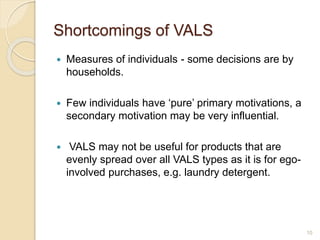
 Measures of individuals - some decisions are by
households.
 Few individuals have ‘pure’ primary motivations, a
secondary motivation may be very influential.
 VALS may not be useful for products that are
evenly spread over all VALS types as it is for ego-
involved purchases, e.g. laundry detergent.
10
Retail Implications of consumer
demographics & Lifestyle
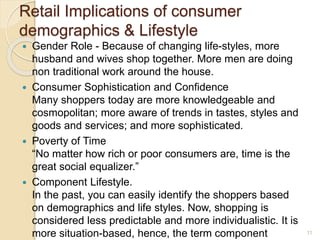
 Gender Role - Because of changing life-styles, more
husband and wives shop together. More men are doing
non traditional work around the house.
 Consumer Sophistication and Confidence
Many shoppers today are more knowledgeable and
cosmopolitan; more aware of trends in tastes, styles and
goods and services; and more sophisticated.
 Poverty of Time
“No matter how rich or poor consumers are, time is the
great social equalizer.”
 Component Lifestyle.
In the past, you can easily identify the shoppers based
on demographics and life styles. Now, shopping is
considered less predictable and more individualistic. It is
more situation-based, hence, the term component 11
References
 https://fyi.uwex.edu/downtown-market-
analysis/understanding-the-market/demographics-
and-lifestyle-analysis/
 https://prezi.com/funinma0kvxn/retailing-
implications-of-consumer-demographics-and-
lifestyl/
 http://www.businessdictionary.com/definition/lifestyl
e.html
12
13

Consumer Demographic and lifestyle

  • 1.
    Retailing Implication ofConsumer Demographic & Lifestyle Presented By Harshal Verma MBA (Gen.),3rd
  • 2.
    Demographic  Demographics isthe study of a population based on factors such as age, income, occupation, sex, and education .  Governments, corporations and non-government organizations use demographics to learn more about a population's characteristics for many purposes, including policy development and economic market research.  Demographic variables help marketers " locate" their target market and psychographic variables provide the marketer with more insight about the segment.  A psychographic study consists of a long list of statements designed to capture relevant aspects of a consumer, like personality, hinting motives, interests, attitudes, beliefs and values. 2
  • 3.
    Demographic Environment  Populationsize  Age structure  Population distribution  Income  Occupation  Education  Gender  Family size  Family Life cycle  Social class 3
  • 4.
    Some specific questionsare:  Which demographic factors help marketers describe and understand the market segments?  What is the importance of anticipating demographic shifts in society to develop marketing strategies?  What are some impacts of changing roles (such as gender roles) on society and consumption? 4
  • 5.
    Lifestyle  Lifestyle isthe expression of the individual’s situation, life experiences, values, attitudes and expectations.  It is defined simply as how the individual lives.  Consumer life-styles are based on social and psychological factors and are affected by demographics.  “Lifestyle is a composite of motivations, needs, and wants and is influenced by factors such as culture, family, reference groups, and social class. The analysis of consumer life styles (called psychographics) is an important factor in determining how consumers make their purchase 5
  • 6.
  • 7.
    Approaches to studyLIFESTYLE An AIO inventory for use in segmenting, targeting and positioning. 7
  • 8.
  • 9.
    The 8 psychographicsegments of VALS  Innovators .  Thinkers and Believers: ideals motivated.  Achievers and Strivers: achievement motivated.  Experiencers and Makers: self-expression motivated.  Survivors  The first is principle motivation: ideals-oriented consumers are those guided by their basic beliefs and values, achievement-oriented consumers are those influenced by the actions, approval and opinions of others, and self-expression-oriented consumers are those who seek social or physical activity, variety and risks.  The second dimension is the physical, mental and 9
  • 10.
    Shortcomings of VALS Measures of individuals - some decisions are by households.  Few individuals have ‘pure’ primary motivations, a secondary motivation may be very influential.  VALS may not be useful for products that are evenly spread over all VALS types as it is for ego- involved purchases, e.g. laundry detergent. 10
  • 11.
    Retail Implications ofconsumer demographics & Lifestyle  Gender Role - Because of changing life-styles, more husband and wives shop together. More men are doing non traditional work around the house.  Consumer Sophistication and Confidence Many shoppers today are more knowledgeable and cosmopolitan; more aware of trends in tastes, styles and goods and services; and more sophisticated.  Poverty of Time “No matter how rich or poor consumers are, time is the great social equalizer.”  Component Lifestyle. In the past, you can easily identify the shoppers based on demographics and life styles. Now, shopping is considered less predictable and more individualistic. It is more situation-based, hence, the term component 11
  • 12.
  • 13.