Principle of NIBP
PALPATION
I cuff rapidly to 70 mmHg, and increase by 10 mm Hg increments
while palpating the radial pulse. Note the level of pressure at which
the pulse disappears and subsequently reappears during deflation;
will be systolic blood pressure.
limitation
While being easy to perform, this technique has been shown to
underestimate a systolic pressure of 120 mm Hg by 25%.
Diastolic and mean pressures cannot be determined.
AUSCULTATION
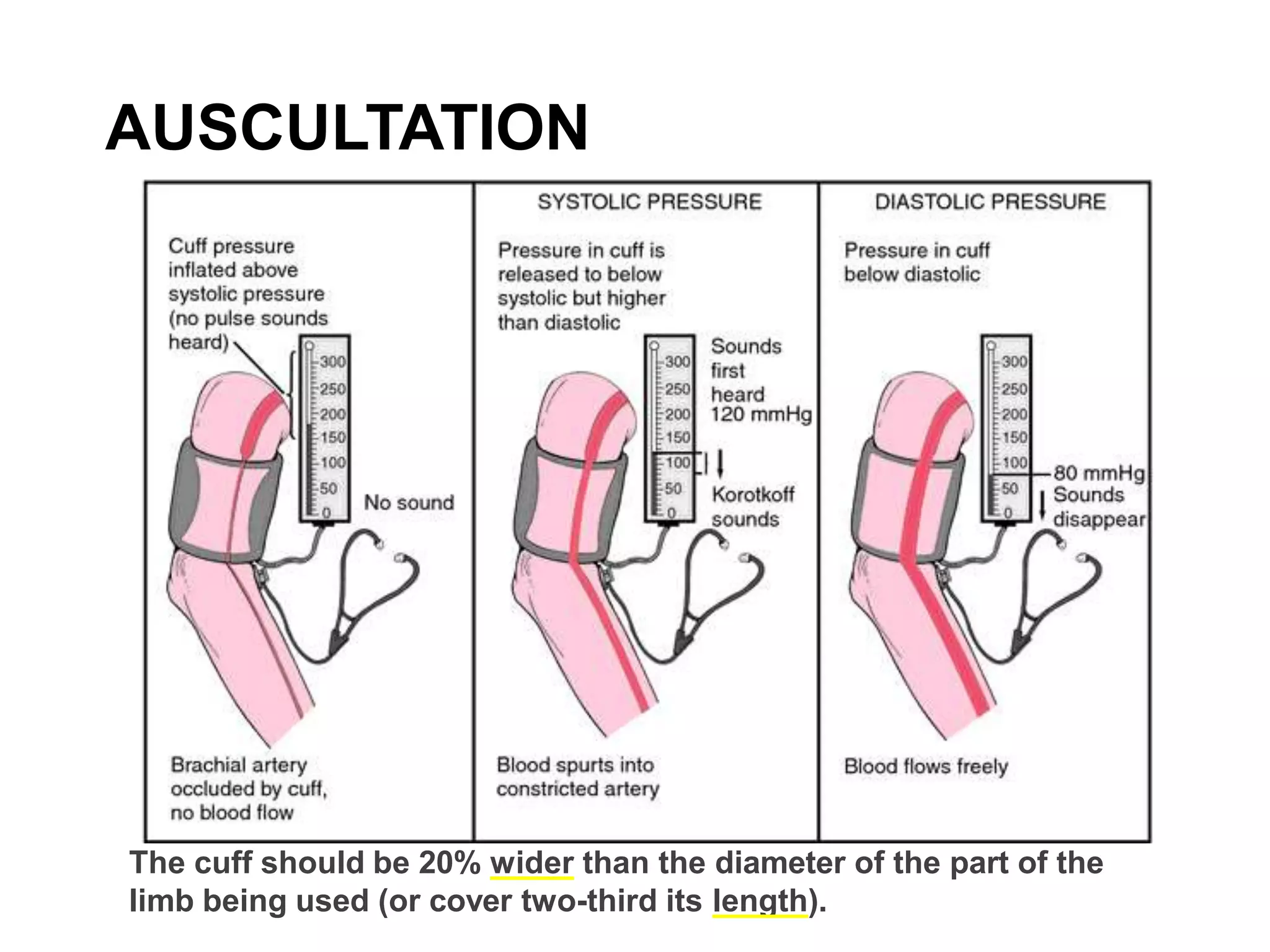
The cuff should be 20% wider than the diameter of the part of the
limb being used (or cover two-third its length).
OSCILLOMETRY
DOPPLER
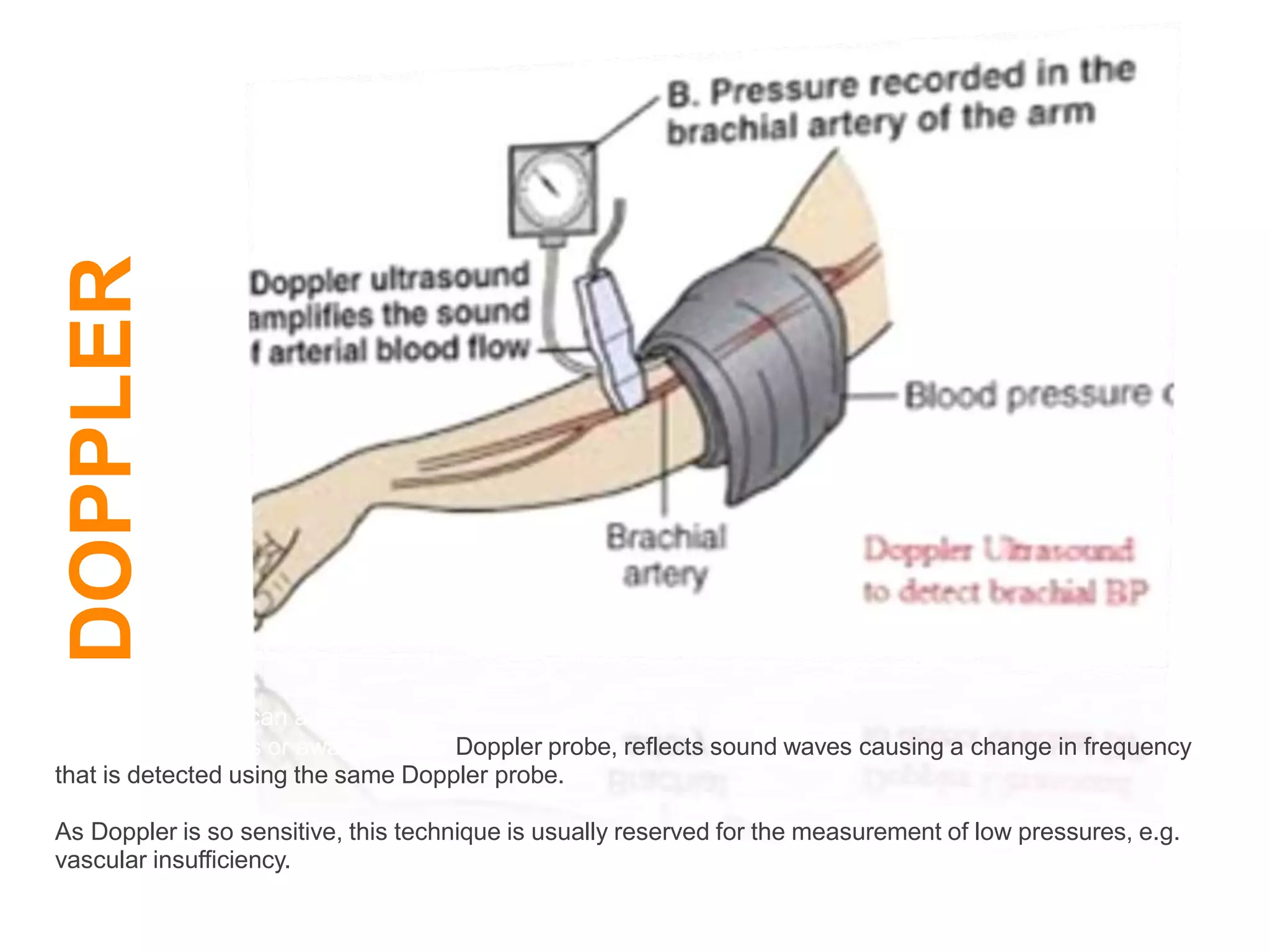
Systolic pressure can also be determined using the Doppler principle.
Blood flow towards or away from the Doppler probe, reflects sound waves causing a change in frequency
that is detected using the same Doppler probe.
As Doppler is so sensitive, this technique is usually reserved for the measurement of low pressures, e.g.
vascular insufficiency.
PLETHYSMOGRAPHY
Blood pressure cuffs or other sensors are placed at different
locations on the arms, legs, fingers, and/or toes. The sensors
record the pulse waves that occur with each heart beat. (This
data is translated into a graphic recording for later review.)
Limitation---
This does not give real time blood pressure
The test usually takes less than 20 to 30 minutes.
PLETHYSMOGRAP
HY
TONOMETRY
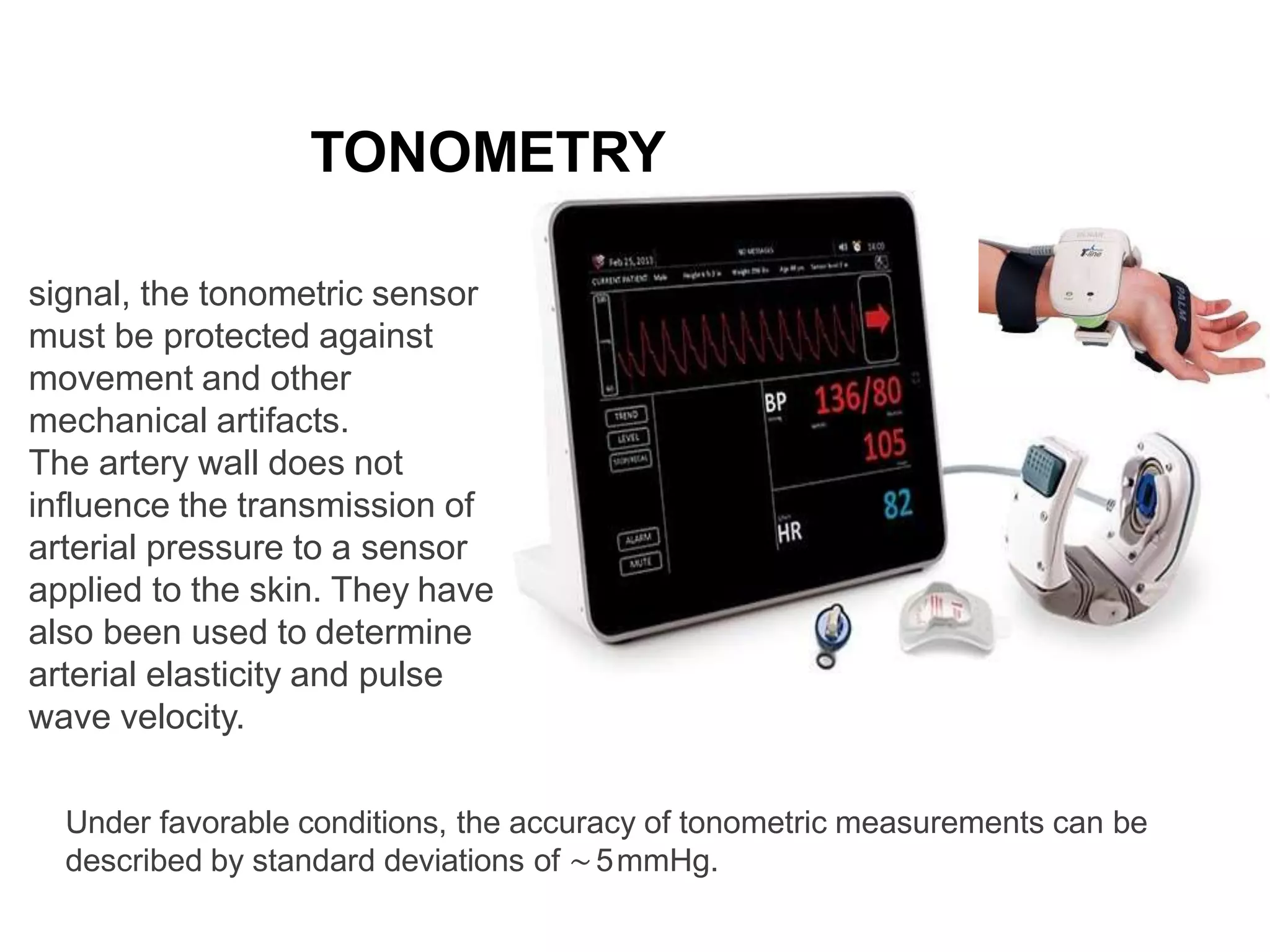
In order to obtain a stable bp
signal, the tonometric sensor
must be protected against
movement and other
mechanical artifacts.
The artery wall does not
influence the transmission of
arterial pressure to a sensor
applied to the skin. They have
also been used to determine
arterial elasticity and pulse
wave velocity.
Under favorable conditions, the accuracy of tonometric measurements can be
described by standard deviations of ∼5mmHg.
Limitation
• Cannot be used for continuous (beat to beat)
monitoring
• Painful, nerve injuries, if used for long periods
and frequently
• Accuracy: Patient movement, arrythmias,
extremes of blood pressure ( Oscillometric
measurement overestimates BP in
hypotension and underestimates BP in
hypertension)
Thank you

NIBP

  • 1.
  • 2.
    PALPATION I cuff rapidlyto 70 mmHg, and increase by 10 mm Hg increments while palpating the radial pulse. Note the level of pressure at which the pulse disappears and subsequently reappears during deflation; will be systolic blood pressure. limitation While being easy to perform, this technique has been shown to underestimate a systolic pressure of 120 mm Hg by 25%. Diastolic and mean pressures cannot be determined.
  • 3.
    AUSCULTATION The cuff shouldbe 20% wider than the diameter of the part of the limb being used (or cover two-third its length).
  • 4.
  • 5.
    DOPPLER Systolic pressure canalso be determined using the Doppler principle. Blood flow towards or away from the Doppler probe, reflects sound waves causing a change in frequency that is detected using the same Doppler probe. As Doppler is so sensitive, this technique is usually reserved for the measurement of low pressures, e.g. vascular insufficiency.
  • 6.
    PLETHYSMOGRAPHY Blood pressure cuffsor other sensors are placed at different locations on the arms, legs, fingers, and/or toes. The sensors record the pulse waves that occur with each heart beat. (This data is translated into a graphic recording for later review.) Limitation--- This does not give real time blood pressure The test usually takes less than 20 to 30 minutes.
  • 7.
  • 8.
    TONOMETRY In order toobtain a stable bp signal, the tonometric sensor must be protected against movement and other mechanical artifacts. The artery wall does not influence the transmission of arterial pressure to a sensor applied to the skin. They have also been used to determine arterial elasticity and pulse wave velocity. Under favorable conditions, the accuracy of tonometric measurements can be described by standard deviations of ∼5mmHg.
  • 9.
    Limitation • Cannot beused for continuous (beat to beat) monitoring • Painful, nerve injuries, if used for long periods and frequently • Accuracy: Patient movement, arrythmias, extremes of blood pressure ( Oscillometric measurement overestimates BP in hypotension and underestimates BP in hypertension)
  • 10.