Network Function Virtualisation - 
VNF Architecture 
Neelima Sharma
The content of this presentation is taken from the ETSI 
NFV specifications and from various presentations 
available on internet
What is covered… 
 Overview of VNF in NFV framework 
 VNF Design Patterns and Properties 
 VNF LifeCycle 
 VNF Fault Management
Virtual Network Functions - Overview 
 Software implementation of the legacy network functions 
 Network Function capable of running over NFVI 
 Network Function orchestrated by NFVO and VNF Manager 
 VNF may be implemented as single network entity as per standards 
 VNF may be implemented as group of network entities 
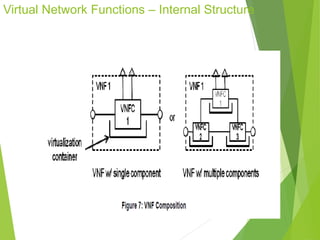
 VNF provider structure the software into software components called 
as VNF Components (VNFC) 
 VNF’s are implemented with one or more VNFC 
 VNF instance map 1:1 to NFVI virtualized container interface as 
shown in the below slide 
 VNF instance is the runtime instantiation of the VNF which consist of 
VNFC instance (VNFCI) 
 Requirements for the initial deployment are defined in VNF descriptor 
(VNFD) 
 A VNF can generally be assumed to be packaged by a single VNF 
provider
Virtual Network Functions – Functional View 
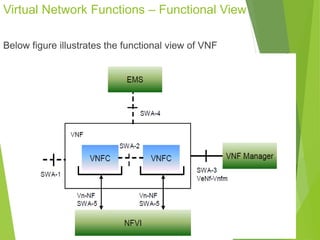
Below figure illustrates the functional view of VNF
Virtual Network Functions – Interfaces 
 Interface is a point of interaction between two entities 
 ESTI refers interfaces as reference point 
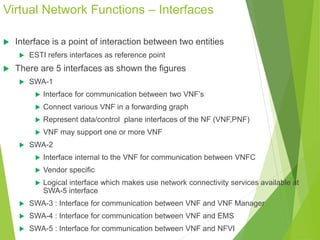
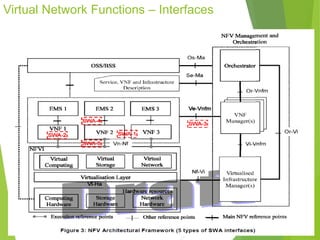
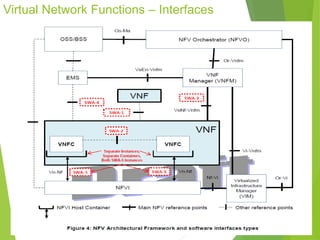
 There are 5 interfaces as shown the figures 
 SWA-1 
 Interface for communication between two VNF’s 
 Connect various VNF in a forwarding graph 
 Represent data/control plane interfaces of the NF (VNF,PNF) 
 VNF may support one or more VNF 
 SWA-2 
 Interface internal to the VNF for communication between VNFC 
 Vendor specific 
 Logical interface which makes use network connectivity services available at 
SWA-5 interface 
 SWA-3 : Interface for communication between VNF and VNF Manager 
 SWA-4 : Interface for communication between VNF and EMS 
 SWA-5 : Interface for communication between VNF and NFVI
Virtual Network Functions – Interfaces 
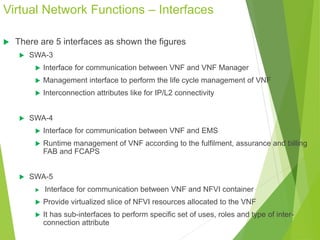
 There are 5 interfaces as shown the figures 
 SWA-3 
 Interface for communication between VNF and VNF Manager 
 Management interface to perform the life cycle management of VNF 
 Interconnection attributes like for IP/L2 connectivity 
 SWA-4 
 Interface for communication between VNF and EMS 
 Runtime management of VNF according to the fulfilment, assurance and billing 
FAB and FCAPS 
 SWA-5 
 Interface for communication between VNF and NFVI container 
 Provide virtualized slice of NFVI resources allocated to the VNF 
 It has sub-interfaces to perform specific set of uses, roles and type of inter-connection 
attribute
Virtual Network Functions – Interfaces
Virtual Network Functions – Design and Properties 
This slides further are divided further as 
 Internal structure 
 Life Cycle 
 VNFC states 
 Load Balancing
Virtual Network Functions – Internal Structure
Virtual Network Functions - Instantiation 
There are two ways to achieve this 
 Parallelizable 
 Instantiation multiple time per VNF instance but with constraints on the number 
 Non-Parallelizable 
 Instantiation once per VNF instance
Virtual Network Functions - States 
 StateFul VNFC 
 VNFC that needs to handles state information of the VNF 
 VNFC can be implemented stateless by storing the state in the external 
repository to VNFC 
 Stateless VNFC 
 VNFC that does not need to handle the state information
Virtual Network Functions – Load Balancer 
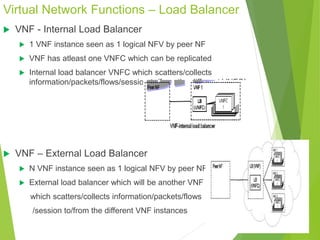
 VNF - Internal Load Balancer 
 1 VNF instance seen as 1 logical NFV by peer NF 
 VNF has atleast one VNFC which can be replicated 
 Internal load balancer VNFC which scatters/collects 
information/packets/flows/session to/from the different VNFCI 
 VNF – External Load Balancer 
 N VNF instance seen as 1 logical NFV by peer NF 
 External load balancer which will be another VNF 
which scatters/collects information/packets/flows 
/session to/from the different VNF instances
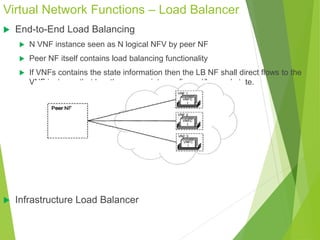
Virtual Network Functions – Load Balancer 
 End-to-End Load Balancing 
 N VNF instance seen as N logical NFV by peer NF 
 Peer NF itself contains load balancing functionality 
 If VNFs contains the state information then the LB NF shall direct flows to the 
VNF instance that has the appropriate configured/learned state. 
 Infrastructure Load Balancer
Virtual Network Functions – VNF Scaling 
 Auto Scaling 
 VNF manager triggers the scaling based on rules in VNFD 
 Both scale out/in and scale down/up may be supported 
 On demand Scaling 
 VNF contains resource controller functionality to monitor KPI and trigger the 
scaling of VNFs 
 Both scale out/in and scale down/up may be supported 
 Scaling based on management request 
 Manually triggered scaling 
 OSS/BSS triggered scaling based on rules in VNFD via NFVO
Virtual Network Functions – VNF Update and Upgrade 
 VNF Update 
 Does not introduce new functionality and/or new interfaces 
 Methods for updating can differ from vendor to vendor 
 Automatic procedure to start the update which is controllable and perform the 
roll-back on failure 
 VNF Upgrade 
 Might introduce new functionality and/or new interfaces 
 Methods for updating can differ from vendor to vendor 
 Automatic procedure to start the update which is controllable and perform the 
roll-back on failure
Virtual Network Functions – VNF Properties 
 Hardware Independence 
 COTS-Ready 
 Partly COTS-Ready 
 Hardware dependent 
 Virtualization and Container Awareness 
 Hypervisor agnostic 
 Hypervisor dependent 
 Operating system containers 
 Higher layer container technologies 
 Not virtualized and no container technology 
 Partly virtualized
Virtual Network Functions – VNF Properties 
 Elasticity 
 No elasticity 
 Elasticity by scaling up/down only 
 Elasticity by scaling in/out only 
 Elasticity in either dimension 
 VNF Policy Management 
 Fully policy based VNF 
 Not policy based VNF 
 Migration Operations 
 No live migration supported 
 Live migration supported 
 Migration partially supported 
 Other migration mechanisms
Virtual Network Functions – VNF Description (VNFD) 
 Definition : 
“The template captures the general characteristics of each VNF and is used to on-board 
the VNF, in order to support on demand instantiation of the VNF’s in an operator’s 
network. “ 
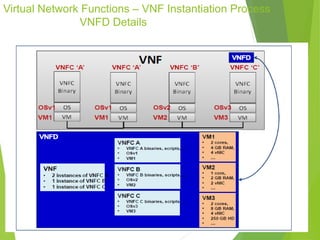
 VNFD Composition 
 VNF identification data 
 Data to uniquely identify the VNF vendor/provider 
 Type and description of the VNF 
 Version 
 VNF specific data 
 Specific VNF configuration data 
 Connectivity requirements and inter-dependencies of VNFCs 
 VNF lifecycle workflow scripts 
 Deployment flavours
Virtual Network Functions – VNF Description (VNFD) 
 VNFC Data 
 VNF identification data 
 Type and identification 
 Specific VNFC configuration data and scripts. 
 Deployment constraints 
 Virtual container files/images references 
 VNFC binaries plus operating system 
 Empty operating system, and/or 
 Empty virtual container (i.e., unloaded operating system) 
 Virtualized Resource requirements 
 Compute Resources 
 Storage Resources 
 Network Resources
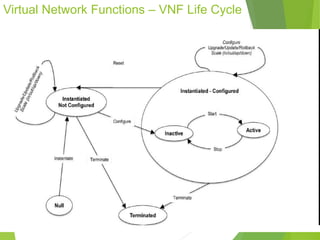
Virtual Network Functions – VNF Life Cycle
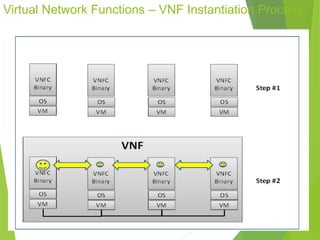
Virtual Network Functions – VNF Instantiation Process
Virtual Network Functions – VNF Instantiation Process 
VNFD Details
Virtual Network Functions – VNF Fault Management 
 VNF fault management includes 
 Fault Detection 
 Fault localization 
 Fault reporting 
 Faults involving the virtualized resources allocated and consumed by VNF 
 Faults within a VNF 
 Virtualized Resource Faults 
 Fault in virtualized resources that might affect a VNF’s proper functioning 
 Fault in the VNF’s redundancy scheme 
 Fault in the Vn-nf/SWA-5 interface 
 Faults concerning the virtualization container connectivity
Virtual Network Functions – VNF Fault Management 
 VNF Faults 
 Software bug related faults 
 Communication failures among VNFC’s 
 Security faults 
 VNF configuration failures
THANK YOU !!!!

NFV : Virtual Network Function Architecture

  • 1.
    Network Function Virtualisation- VNF Architecture Neelima Sharma
  • 2.
    The content ofthis presentation is taken from the ETSI NFV specifications and from various presentations available on internet
  • 3.
    What is covered…  Overview of VNF in NFV framework  VNF Design Patterns and Properties  VNF LifeCycle  VNF Fault Management
  • 4.
    Virtual Network Functions- Overview  Software implementation of the legacy network functions  Network Function capable of running over NFVI  Network Function orchestrated by NFVO and VNF Manager  VNF may be implemented as single network entity as per standards  VNF may be implemented as group of network entities  VNF provider structure the software into software components called as VNF Components (VNFC)  VNF’s are implemented with one or more VNFC  VNF instance map 1:1 to NFVI virtualized container interface as shown in the below slide  VNF instance is the runtime instantiation of the VNF which consist of VNFC instance (VNFCI)  Requirements for the initial deployment are defined in VNF descriptor (VNFD)  A VNF can generally be assumed to be packaged by a single VNF provider
  • 5.
    Virtual Network Functions– Functional View Below figure illustrates the functional view of VNF
  • 6.
    Virtual Network Functions– Interfaces  Interface is a point of interaction between two entities  ESTI refers interfaces as reference point  There are 5 interfaces as shown the figures  SWA-1  Interface for communication between two VNF’s  Connect various VNF in a forwarding graph  Represent data/control plane interfaces of the NF (VNF,PNF)  VNF may support one or more VNF  SWA-2  Interface internal to the VNF for communication between VNFC  Vendor specific  Logical interface which makes use network connectivity services available at SWA-5 interface  SWA-3 : Interface for communication between VNF and VNF Manager  SWA-4 : Interface for communication between VNF and EMS  SWA-5 : Interface for communication between VNF and NFVI
  • 7.
    Virtual Network Functions– Interfaces  There are 5 interfaces as shown the figures  SWA-3  Interface for communication between VNF and VNF Manager  Management interface to perform the life cycle management of VNF  Interconnection attributes like for IP/L2 connectivity  SWA-4  Interface for communication between VNF and EMS  Runtime management of VNF according to the fulfilment, assurance and billing FAB and FCAPS  SWA-5  Interface for communication between VNF and NFVI container  Provide virtualized slice of NFVI resources allocated to the VNF  It has sub-interfaces to perform specific set of uses, roles and type of inter-connection attribute
  • 8.
  • 9.
  • 10.
    Virtual Network Functions– Design and Properties This slides further are divided further as  Internal structure  Life Cycle  VNFC states  Load Balancing
  • 11.
    Virtual Network Functions– Internal Structure
  • 12.
    Virtual Network Functions- Instantiation There are two ways to achieve this  Parallelizable  Instantiation multiple time per VNF instance but with constraints on the number  Non-Parallelizable  Instantiation once per VNF instance
  • 13.
    Virtual Network Functions- States  StateFul VNFC  VNFC that needs to handles state information of the VNF  VNFC can be implemented stateless by storing the state in the external repository to VNFC  Stateless VNFC  VNFC that does not need to handle the state information
  • 14.
    Virtual Network Functions– Load Balancer  VNF - Internal Load Balancer  1 VNF instance seen as 1 logical NFV by peer NF  VNF has atleast one VNFC which can be replicated  Internal load balancer VNFC which scatters/collects information/packets/flows/session to/from the different VNFCI  VNF – External Load Balancer  N VNF instance seen as 1 logical NFV by peer NF  External load balancer which will be another VNF which scatters/collects information/packets/flows /session to/from the different VNF instances
  • 15.
    Virtual Network Functions– Load Balancer  End-to-End Load Balancing  N VNF instance seen as N logical NFV by peer NF  Peer NF itself contains load balancing functionality  If VNFs contains the state information then the LB NF shall direct flows to the VNF instance that has the appropriate configured/learned state.  Infrastructure Load Balancer
  • 16.
    Virtual Network Functions– VNF Scaling  Auto Scaling  VNF manager triggers the scaling based on rules in VNFD  Both scale out/in and scale down/up may be supported  On demand Scaling  VNF contains resource controller functionality to monitor KPI and trigger the scaling of VNFs  Both scale out/in and scale down/up may be supported  Scaling based on management request  Manually triggered scaling  OSS/BSS triggered scaling based on rules in VNFD via NFVO
  • 17.
    Virtual Network Functions– VNF Update and Upgrade  VNF Update  Does not introduce new functionality and/or new interfaces  Methods for updating can differ from vendor to vendor  Automatic procedure to start the update which is controllable and perform the roll-back on failure  VNF Upgrade  Might introduce new functionality and/or new interfaces  Methods for updating can differ from vendor to vendor  Automatic procedure to start the update which is controllable and perform the roll-back on failure
  • 18.
    Virtual Network Functions– VNF Properties  Hardware Independence  COTS-Ready  Partly COTS-Ready  Hardware dependent  Virtualization and Container Awareness  Hypervisor agnostic  Hypervisor dependent  Operating system containers  Higher layer container technologies  Not virtualized and no container technology  Partly virtualized
  • 19.
    Virtual Network Functions– VNF Properties  Elasticity  No elasticity  Elasticity by scaling up/down only  Elasticity by scaling in/out only  Elasticity in either dimension  VNF Policy Management  Fully policy based VNF  Not policy based VNF  Migration Operations  No live migration supported  Live migration supported  Migration partially supported  Other migration mechanisms
  • 20.
    Virtual Network Functions– VNF Description (VNFD)  Definition : “The template captures the general characteristics of each VNF and is used to on-board the VNF, in order to support on demand instantiation of the VNF’s in an operator’s network. “  VNFD Composition  VNF identification data  Data to uniquely identify the VNF vendor/provider  Type and description of the VNF  Version  VNF specific data  Specific VNF configuration data  Connectivity requirements and inter-dependencies of VNFCs  VNF lifecycle workflow scripts  Deployment flavours
  • 21.
    Virtual Network Functions– VNF Description (VNFD)  VNFC Data  VNF identification data  Type and identification  Specific VNFC configuration data and scripts.  Deployment constraints  Virtual container files/images references  VNFC binaries plus operating system  Empty operating system, and/or  Empty virtual container (i.e., unloaded operating system)  Virtualized Resource requirements  Compute Resources  Storage Resources  Network Resources
  • 22.
    Virtual Network Functions– VNF Life Cycle
  • 23.
    Virtual Network Functions– VNF Instantiation Process
  • 24.
    Virtual Network Functions– VNF Instantiation Process VNFD Details
  • 25.
    Virtual Network Functions– VNF Fault Management  VNF fault management includes  Fault Detection  Fault localization  Fault reporting  Faults involving the virtualized resources allocated and consumed by VNF  Faults within a VNF  Virtualized Resource Faults  Fault in virtualized resources that might affect a VNF’s proper functioning  Fault in the VNF’s redundancy scheme  Fault in the Vn-nf/SWA-5 interface  Faults concerning the virtualization container connectivity
  • 26.
    Virtual Network Functions– VNF Fault Management  VNF Faults  Software bug related faults  Communication failures among VNFC’s  Security faults  VNF configuration failures
  • 27.