Network Function Virtualisation - 
Infrastructure Overview 
Neelima Sharma
The content of this presentation is taken from the ETSI 
NFV specifications and from various presentations 
available on internet
What is covered… 
 NFV Infrastructure – Overview 
 NFV Infrastructure – Architecture 
 NFV Infrastructure – NFVI and Cloud 
Computing 
 NFV Infrastructure – Domain architecture and 
associated interfaces 
 NFV Infrastructure – Compute Domain 
 NFV Infrastructure – Hypervisor Domain 
 NFV Infrastructure – Network Domain 
 NFV Infrastructure – Challenges
NFV Infrastructure - Overview 
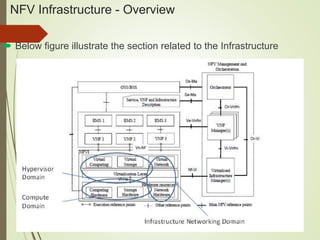
 Below figure illustrate the section related to the Infrastructure
NFV Infrastructure - Overview 
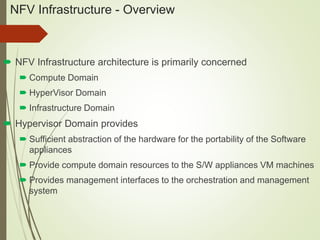
 NFV Infrastructure architecture is primarily concerned 
 Compute Domain 
 HyperVisor Domain 
 Infrastructure Domain 
 Hypervisor Domain provides 
 Sufficient abstraction of the hardware for the portability of the Software 
appliances 
 Provide compute domain resources to the S/W appliances VM machines 
 Provides management interfaces to the orchestration and management 
system
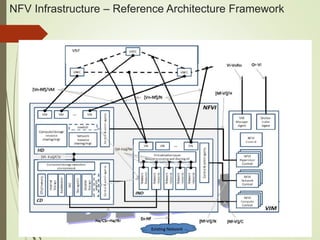
NFV Infrastructure – Reference Architecture Framework
NFV Infrastructure – Architectural Principles of VNF 
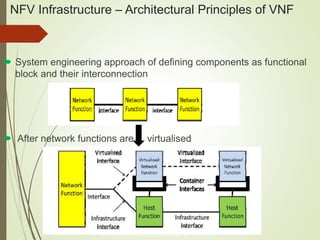
 System engineering approach of defining components as functional 
block and their interconnection 
 After network functions are virtualised
NFV Infrastructure – Architectural Principles of VNF 
 Behavior of functional block is determined by 
 Static transfer function of the functional blocks 
 Dynamic state of the functional blocks 
 Inputs it received in its interface 
 Virtualization resulted in the following 
 Division of functional block between a host function and VNF 
 Creation of new container interface between the host function and the 
VNF it is hosting 
 Division of the interface between the two network functions which are 
now virtualized between infrastructure interface and a virtualized 
interface 
 Relationship between VNF and host 
 VNF is a configuration of the host function 
 VNF is an abstract view of the host function when configured by VNF
NFV Infrastructure – Architectural Principles of VNF 
 NFV architecture is defined using the following entities 
 Host functions with their associated offered container interfaces and 
associated infrastructure interfaces 
 VNF with their associated used container interfaces and virtualized 
interfaces
NFV Infrastructure – Management and Orchestration of 
VNF 
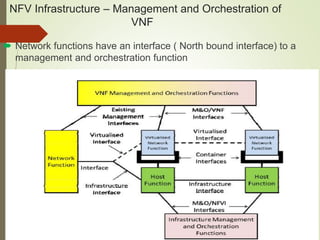
 Network functions have an interface ( North bound interface) to a 
management and orchestration function
NFV Infrastructure – NFVI and Cloud Computing 
 Five essentials characteristics of cloud services 
 On demand self service 
 Broad network access 
 Resource pooling 
 Rapid elasticity 
 Measured service 
 Service models impacting NFVI 
 SaaS 
VNF’s are software applications on cloud 
VNF’s are executed according to a private cloud model 
 Example is VNFaaS
NFV Infrastructure – NFVI and Cloud Computing 
 PaaS 
Service model consistent with deployment by network operators of services 
 VNPaaS is a use case 
 IaaS 
Capability provided is the provisioning of compute, storage and 
communication resources for the application to run 
 Good use case is NFVIaaS
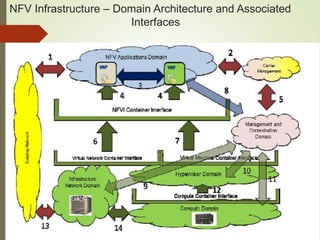
NFV Infrastructure – Domain Architecture and Associated 
Interfaces
NFV Infrastructure – Domain Architecture and Associated 
Interfaces 
 VNF can be decomposed and made up from sub-parts which are 
themselves VNF which are interconnected by infrastructure 
 VNF’s can automatically request for management and orchestration 
 Network interfaces must be decomposed between the infrastructure 
protocols and the VNF protocols 
 Infrastructure network is completely abstracted by the network infrastructure 
container interface 
 NFV infrastructure, applications and MANO are fully interoperable with the 
existing OSS/BSS and carrier networks 
 Below attached excel provides the details of the interfaces
NFV Infrastructure – Compute Domain 
 Role of the Compute domain is to provide the interface to the network 
infrastructure domain but does not support network connectivity 
 Principal elements of the compute domain 
 CPU 
 Network Interface Controller (NIC) 
 Storage 
 Server 
 Chasis 
 Remote management 
 Functional description of the compute domain needs to reference the 
speed of execution
NFV Infrastructure – Compute Domain 
 Primary characteristics of storage are : 
 Latency in accessing a specific state held in storage 
 Size of the storage 
 Volatility or persistence of the storage 
 Scope of Compute node includes 
 CPU with storage 
 Hardware for encryption and decryption 
 Packet switching 
 Accelerated packet forwarding
NFV Infrastructure – Hypervisor Domain 
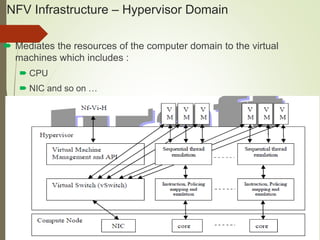
 Mediates the resources of the computer domain to the virtual 
machines which includes : 
 CPU 
 NIC and so on …
NFV Infrastructure – Hypervisor Domain 
 Forthcoming hardware improve the performance of VM’s which 
includes 
 multicore processors supporting multiple independent parallel threads of 
execution 
 system-on-chip processors that integrate multiple cores, DRAM 
interfaces, network interfaces, storage,interfaces and hardware 
acceleration for security, multicore processing, networking, storage and 
application acceleration. 
 specific CPU enhancements/instructions to control memory allocation 
and direct access on I/O devices to VM memory allocations 
 PCI-e bus enhancements, notably SR-IOV
NFV Infrastructure – Hypervisor Domain 
 Specific features of hypervisor support for high performance NFV 
VMs include 
 exclusive allocation of whole CPU cores to VMs 
 direct memory mapped polled drivers for VMs to directly access the 
physical NICs using user mode instructions requiring no ‘context 
switching’ 
 direct memory mapped polled drivers for interVM communications again 
using user mode instructions requiring no ‘context switching 
 vSwitch implementation as a high performance VM again using direct 
memory mapping and user mode instructions requiring no ‘context 
switching’
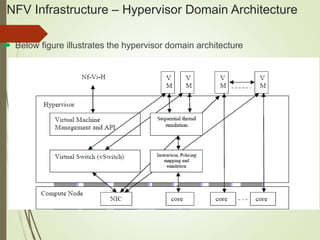
NFV Infrastructure – Hypervisor Domain Architecture 
 Below figure illustrates the hypervisor domain architecture
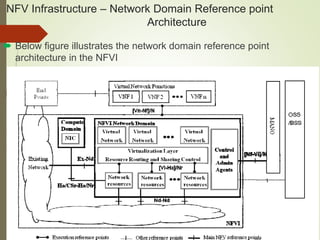
NFV Infrastructure – Network Domain Reference point 
Architecture 
 Below figure illustrates the network domain reference point 
architecture in the NFVI
NFV Infrastructure – Network Infrastructure Domain 
 Roles of network domains includes : 
 Communication channel between the VNFC’s of a distributed VNF 
 Communication channel between different VNFs 
 Communication channel between VNFs and their orchestration and 
management 
 Communication channel between components of the NFVI and their 
orchestration and management 
 Means of remote deployment of VNFCs 
 Means of interconnection with the existing carrier network
NFV Infrastructure – Network Infrastructure Domain 
 Essential elements needed for providing the connectivity with 
domain: 
 An infrastructure addressing scheme with address allocation and 
management 
 A routing process which can relate infrastructure addresses to routes 
through the infrastructure network topology 
 A bandwidth allocation process 
 A set of OAM processes to verify reliability, availability and integrity of 
connectivity services 
 Requirement for bandwidth aspects requires : 
 Permanently allocated, fully guaranteed bandwidth 
 Respecting prioritization markings of the packet 
 Guaranteed minimal latency variation
NFV Infrastructure – Network Infrastructure Domain 
 Requirement for infrastructure network and VNF protocols to work 
together 
 Common Header 
MAC header associated with NIC should be understood by both 
 Transparent encapsulation 
Carry the packet from the VNFC as a transparent payload and must add a 
completely new header for transport by the infrastructure network 
 Address binding 
Mac addresses presented to the VNFC must be bound to infrastructure 
network addresses
NFV Infrastructure – Challenges in Performance 
 General recommendations to apply to network SW design 
 SW requiring high performance should be partitioned in independent 
modules running in different threads 
 Modules should have independent memory structures in order to avoid 
OS deadlocks 
 Modules should communicate each other in pipeline structures, 
minimising the use of the OS as an intermediate step 
 OS interruptions should be reduced, if possible, to zero, due to its high 
consumption of CPU cycles 
 The use of OS network stacks should be avoided 
 Network cards and other peripherals should communicate directly with 
the modules through memory
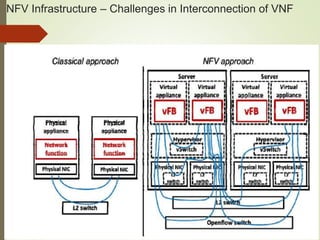
NFV Infrastructure – Challenges in Interconnection of VNF

Network Function Virtualization : Infrastructure Overview

  • 1.
    Network Function Virtualisation- Infrastructure Overview Neelima Sharma
  • 2.
    The content ofthis presentation is taken from the ETSI NFV specifications and from various presentations available on internet
  • 3.
    What is covered…  NFV Infrastructure – Overview  NFV Infrastructure – Architecture  NFV Infrastructure – NFVI and Cloud Computing  NFV Infrastructure – Domain architecture and associated interfaces  NFV Infrastructure – Compute Domain  NFV Infrastructure – Hypervisor Domain  NFV Infrastructure – Network Domain  NFV Infrastructure – Challenges
  • 4.
    NFV Infrastructure -Overview  Below figure illustrate the section related to the Infrastructure
  • 5.
    NFV Infrastructure -Overview  NFV Infrastructure architecture is primarily concerned  Compute Domain  HyperVisor Domain  Infrastructure Domain  Hypervisor Domain provides  Sufficient abstraction of the hardware for the portability of the Software appliances  Provide compute domain resources to the S/W appliances VM machines  Provides management interfaces to the orchestration and management system
  • 6.
    NFV Infrastructure –Reference Architecture Framework
  • 7.
    NFV Infrastructure –Architectural Principles of VNF  System engineering approach of defining components as functional block and their interconnection  After network functions are virtualised
  • 8.
    NFV Infrastructure –Architectural Principles of VNF  Behavior of functional block is determined by  Static transfer function of the functional blocks  Dynamic state of the functional blocks  Inputs it received in its interface  Virtualization resulted in the following  Division of functional block between a host function and VNF  Creation of new container interface between the host function and the VNF it is hosting  Division of the interface between the two network functions which are now virtualized between infrastructure interface and a virtualized interface  Relationship between VNF and host  VNF is a configuration of the host function  VNF is an abstract view of the host function when configured by VNF
  • 9.
    NFV Infrastructure –Architectural Principles of VNF  NFV architecture is defined using the following entities  Host functions with their associated offered container interfaces and associated infrastructure interfaces  VNF with their associated used container interfaces and virtualized interfaces
  • 10.
    NFV Infrastructure –Management and Orchestration of VNF  Network functions have an interface ( North bound interface) to a management and orchestration function
  • 11.
    NFV Infrastructure –NFVI and Cloud Computing  Five essentials characteristics of cloud services  On demand self service  Broad network access  Resource pooling  Rapid elasticity  Measured service  Service models impacting NFVI  SaaS VNF’s are software applications on cloud VNF’s are executed according to a private cloud model  Example is VNFaaS
  • 12.
    NFV Infrastructure –NFVI and Cloud Computing  PaaS Service model consistent with deployment by network operators of services  VNPaaS is a use case  IaaS Capability provided is the provisioning of compute, storage and communication resources for the application to run  Good use case is NFVIaaS
  • 13.
    NFV Infrastructure –Domain Architecture and Associated Interfaces
  • 14.
    NFV Infrastructure –Domain Architecture and Associated Interfaces  VNF can be decomposed and made up from sub-parts which are themselves VNF which are interconnected by infrastructure  VNF’s can automatically request for management and orchestration  Network interfaces must be decomposed between the infrastructure protocols and the VNF protocols  Infrastructure network is completely abstracted by the network infrastructure container interface  NFV infrastructure, applications and MANO are fully interoperable with the existing OSS/BSS and carrier networks  Below attached excel provides the details of the interfaces
  • 15.
    NFV Infrastructure –Compute Domain  Role of the Compute domain is to provide the interface to the network infrastructure domain but does not support network connectivity  Principal elements of the compute domain  CPU  Network Interface Controller (NIC)  Storage  Server  Chasis  Remote management  Functional description of the compute domain needs to reference the speed of execution
  • 16.
    NFV Infrastructure –Compute Domain  Primary characteristics of storage are :  Latency in accessing a specific state held in storage  Size of the storage  Volatility or persistence of the storage  Scope of Compute node includes  CPU with storage  Hardware for encryption and decryption  Packet switching  Accelerated packet forwarding
  • 17.
    NFV Infrastructure –Hypervisor Domain  Mediates the resources of the computer domain to the virtual machines which includes :  CPU  NIC and so on …
  • 18.
    NFV Infrastructure –Hypervisor Domain  Forthcoming hardware improve the performance of VM’s which includes  multicore processors supporting multiple independent parallel threads of execution  system-on-chip processors that integrate multiple cores, DRAM interfaces, network interfaces, storage,interfaces and hardware acceleration for security, multicore processing, networking, storage and application acceleration.  specific CPU enhancements/instructions to control memory allocation and direct access on I/O devices to VM memory allocations  PCI-e bus enhancements, notably SR-IOV
  • 19.
    NFV Infrastructure –Hypervisor Domain  Specific features of hypervisor support for high performance NFV VMs include  exclusive allocation of whole CPU cores to VMs  direct memory mapped polled drivers for VMs to directly access the physical NICs using user mode instructions requiring no ‘context switching’  direct memory mapped polled drivers for interVM communications again using user mode instructions requiring no ‘context switching  vSwitch implementation as a high performance VM again using direct memory mapping and user mode instructions requiring no ‘context switching’
  • 20.
    NFV Infrastructure –Hypervisor Domain Architecture  Below figure illustrates the hypervisor domain architecture
  • 21.
    NFV Infrastructure –Network Domain Reference point Architecture  Below figure illustrates the network domain reference point architecture in the NFVI
  • 22.
    NFV Infrastructure –Network Infrastructure Domain  Roles of network domains includes :  Communication channel between the VNFC’s of a distributed VNF  Communication channel between different VNFs  Communication channel between VNFs and their orchestration and management  Communication channel between components of the NFVI and their orchestration and management  Means of remote deployment of VNFCs  Means of interconnection with the existing carrier network
  • 23.
    NFV Infrastructure –Network Infrastructure Domain  Essential elements needed for providing the connectivity with domain:  An infrastructure addressing scheme with address allocation and management  A routing process which can relate infrastructure addresses to routes through the infrastructure network topology  A bandwidth allocation process  A set of OAM processes to verify reliability, availability and integrity of connectivity services  Requirement for bandwidth aspects requires :  Permanently allocated, fully guaranteed bandwidth  Respecting prioritization markings of the packet  Guaranteed minimal latency variation
  • 24.
    NFV Infrastructure –Network Infrastructure Domain  Requirement for infrastructure network and VNF protocols to work together  Common Header MAC header associated with NIC should be understood by both  Transparent encapsulation Carry the packet from the VNFC as a transparent payload and must add a completely new header for transport by the infrastructure network  Address binding Mac addresses presented to the VNFC must be bound to infrastructure network addresses
  • 25.
    NFV Infrastructure –Challenges in Performance  General recommendations to apply to network SW design  SW requiring high performance should be partitioned in independent modules running in different threads  Modules should have independent memory structures in order to avoid OS deadlocks  Modules should communicate each other in pipeline structures, minimising the use of the OS as an intermediate step  OS interruptions should be reduced, if possible, to zero, due to its high consumption of CPU cycles  The use of OS network stacks should be avoided  Network cards and other peripherals should communicate directly with the modules through memory
  • 26.
    NFV Infrastructure –Challenges in Interconnection of VNF