Network Function
Virtualization
1
Contents
• NFV Motivation
• Virtual Machines
• NFV benefits & requirements
• NFV Architecture
• NFV Infrastructure
• Virtualized Network Functions
• NFV Management and Orchestration
• NFV Use Cases
• NFV and SDN
• Network virtualization
• VLAN and VPN.
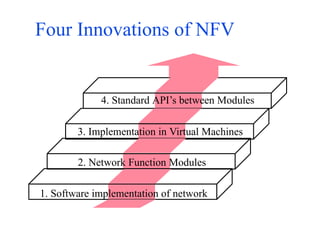
Four Innovations of NFV
4. Standard API’s between Modules
3. Implementation in Virtual Machines
2. Network Function Modules
1. Software implementation of network
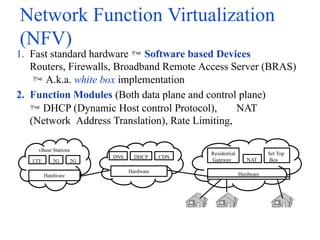
Network Function Virtualization
(NFV)
1. Fast standard hardware  Software based Devices
Routers, Firewalls, Broadband Remote Access Server (BRAS)
 A.k.a. white box implementation
2. Function Modules (Both data plane and control plane)
 DHCP (Dynamic Host control Protocol), NAT
(Network Address Translation), Rate Limiting,
Set Top
Box
NAT
Residential
Gateway
Hardware
vBase Stations
3G 2G
LTE
Hardware
CDN
DNS DHCP
Hardware
NFV (Cont)
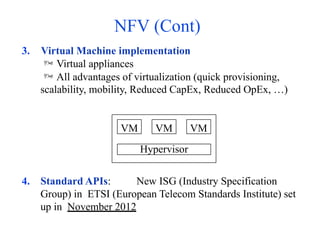
3. Virtual Machine implementation
 Virtual appliances
 All advantages of virtualization (quick provisioning,
scalability, mobility, Reduced CapEx, Reduced OpEx, …)
4. Standard APIs: New ISG (Industry Specification
Group) in ETSI (European Telecom Standards Institute) set
up in November 2012
Hypervisor
VM VM VM
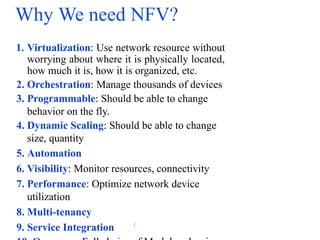
Why We need NFV?
/
1. Virtualization: Use network resource without
worrying about where it is physically located,
how much it is, how it is organized, etc.
2. Orchestration: Manage thousands of devices
3. Programmable: Should be able to change
behavior on the fly.
4. Dynamic Scaling: Should be able to change
size, quantity
5. Automation
6. Visibility: Monitor resources, connectivity
7. Performance: Optimize network device
utilization
8. Multi-tenancy
9. Service Integration
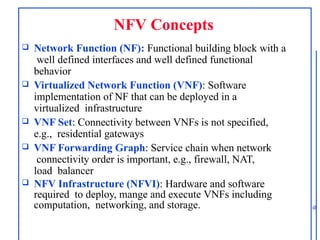
NFV Concepts
 Network Function (NF): Functional building block with a
well defined interfaces and well defined functional
behavior
 Virtualized Network Function (VNF): Software
implementation of NF that can be deployed in a
virtualized infrastructure
 VNF Set: Connectivity between VNFs is not specified,
e.g., residential gateways
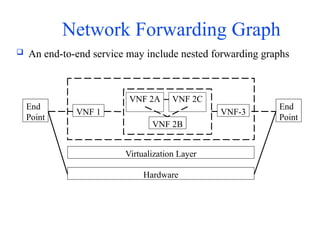
 VNF Forwarding Graph: Service chain when network
connectivity order is important, e.g., firewall, NAT,
load balancer
 NFV Infrastructure (NFVI): Hardware and software
required to deploy, mange and execute VNFs including
computation, networking, and storage. df
Network Forwarding Graph
 An end-to-end service may include nested forwarding graphs
End
Point
VNF 1
VNF 2B
VNF 2A VNF 2C
VNF-3
End
Point
Virtualization Layer
Hardware
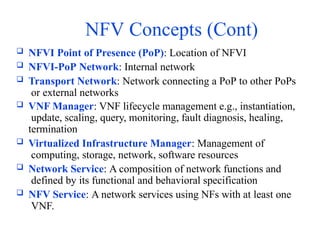
NFV Concepts (Cont)
 NFVI Point of Presence (PoP): Location of NFVI
 NFVI-PoP Network: Internal network
 Transport Network: Network connecting a PoP to other PoPs
or external networks
 VNF Manager: VNF lifecycle management e.g., instantiation,
update, scaling, query, monitoring, fault diagnosis, healing,
termination
 Virtualized Infrastructure Manager: Management of
computing, storage, network, software resources
 Network Service: A composition of network functions and
defined by its functional and behavioral specification
 NFV Service: A network services using NFs with at least one
VNF.
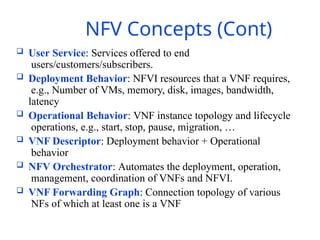
NFV Concepts (Cont)
 User Service: Services offered to end
users/customers/subscribers.
 Deployment Behavior: NFVI resources that a VNF requires,
e.g., Number of VMs, memory, disk, images, bandwidth,
latency
 Operational Behavior: VNF instance topology and lifecycle
operations, e.g., start, stop, pause, migration, …
 VNF Descriptor: Deployment behavior + Operational
behavior
 NFV Orchestrator: Automates the deployment, operation,
management, coordination of VNFs and NFVI.
 VNF Forwarding Graph: Connection topology of various
NFs of which at least one is a VNF
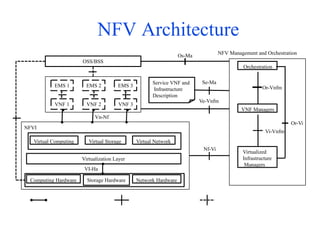
NFV Architecture
NFV Management and Orchestration
Orchestration
VNF Managers
Virtualized
Infrastructure
Managers
Computing Hardware Storage Hardware Network Hardware
Virtualization Layer
Virtual Computing Virtual Storage Virtual Network
VNF 1 VNF 2 VNF 3
EMS 1 EMS 2 EMS 3
OSS/BSS
Service VNF and
Infrastructure
Description
Or-Vnfm
Vi-Vnfm
Os-Ma
Se-Ma
Ve-Vnfm
Nf-Vi
VI-Ha
Vn-Nf
NFVI
Or-Vi
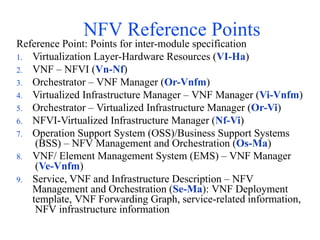
NFV Reference Points
Reference Point: Points for inter-module specification
1. Virtualization Layer-Hardware Resources (VI-Ha)
2. VNF – NFVI (Vn-Nf)
3. Orchestrator – VNF Manager (Or-Vnfm)
4. Virtualized Infrastructure Manager – VNF Manager (Vi-Vnfm)
5. Orchestrator – Virtualized Infrastructure Manager (Or-Vi)
6. NFVI-Virtualized Infrastructure Manager (Nf-Vi)
7. Operation Support System (OSS)/Business Support Systems
(BSS) – NFV Management and Orchestration (Os-Ma)
8. VNF/ Element Management System (EMS) – VNF Manager
(Ve-Vnfm)
9. Service, VNF and Infrastructure Description – NFV
Management and Orchestration (Se-Ma): VNF Deployment
template, VNF Forwarding Graph, service-related information,
NFV infrastructure information
NFV Benefits
• Flexibility to rapidly, dynamically instantiate services
in different locations without installing new
equipment.
• Faster time-to-market for new service introduction
• Improving operational efficiency by taking advantage
of a homogeneous hardware network platform
• Reducing costs through leveraging the economies of
scale of the IT industry
• Reducing operational costs: less power, less space,
improving network monitoring
NFV Framework Requirements
1. General: Partial or full Virtualization, Predictable performance
2. Portability: Decoupled from underlying infrastructure
3. Performance: as described and facilities to monitor
4. Elasticity: Scalable to meet SLAs. Movable to other servers.
5. Resiliency: Be able to recreate after failure.
Specified packet loss rate, calls drops, time to recover, etc.
6. Security: Role-based authorization, authentication
7. Service Continuity: Seamless or non-seamless continuity after
failures or migration
NFV Framework Requirements (Cont)
8. Service Assurance: Time stamp and forward copies of
packets for Fault detection
9. Energy Efficiency Requirements: Should be possible to put
a subset of VNF in a power conserving sleep state
10. Transition: Coexistence with Legacy and Interoperability
among multi-vendor implementations
11. Service Models: Operators may use NFV infrastructure
operated by other operators
NFV Challenges
Converge IT and Telecom industry to a common
understanding of the topic
Achieve (high) performance with portability across
different hardware platforms
Achieve co-existence with existing hardware based
network platforms
Ensure security & integrity when Managing and
orchestrating virtual networks
Integrate multiple virtual appliances from different
vendors (on a single HW platform).
Achieve scale benefits through Mananement &
Orchestration automation.
NFV Use Cases
 Cloud:
1. NFV infrastructure as a service (NFVIaaS) like IaaS
2. Virtual Network Functions (VNFs) as a service (VNFaaS)
like SaaS
3. VNF forwarding graphs (Service Chains)
4. Virtual Network Platform as a Service (VNPaaS) like
PaaS
 Mobile:
5. Virtualization of the Mobile Core Network and IMS
6. Virtualization of Mobile Base Station
 Data Center:
7. Virtualization of CDNs
 Access/Residential:
8. Virtualization of the Home environment
9. Fixed Access NFV
/
NFV Proof of Concepts (PoCs)
ETSI has formed and NFV ISG PoC Forum.
Following modules have been demoed:
1. Virtual Broadband Remote Access Server (BRAS) by British
Telecom
2. Virtual IP Multimedia System (IMS) by Deutsche Telekom
3. Virtual Evolved Packet Core (vEPC) by Orange Silicon
Valley
4. Carrier-Grade Network Address Translator (CGNAT) and
Deep Packet Inspection (DPI), Home Gateway by Telefonica
5. Perimeta Session Border Controller (SBC) from Metaswitch
6. Deep packet inspection from Procera
Most of these are based on Cloud technologies, e.g., OpenStack
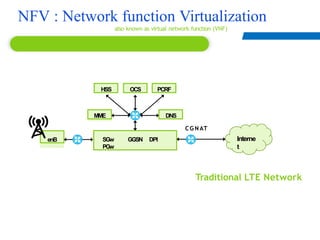
NFV : Network function Virtualization
also known as virtual network function (VNF)
enB SGw GGSN DPI
PGw
MME
HSS OCS PCRF
Interne
t
Traditional LTE Network
C G N AT
DNS
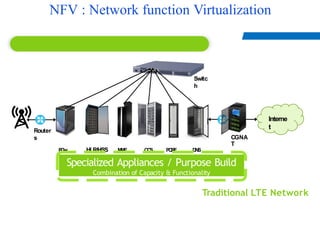
NFV : Network function Virtualization
Interne
t
Traditional LTE Network
CGNA
T
P
G
w HLR/HSS M
M
E O
C
S P
C
R
F D
N
S
Specialized Appliances / Purpose Build
Combination of Capacity & Functionality
Router
s
Switc
h
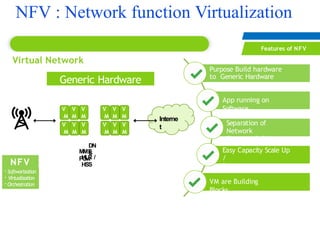
NFV
- Softwarization
- Virtualization
- Orchestration
Purpose Build hardware
to Generic Hardware
App running on
Software
Separation of
Network
Function & Capacity
Easy Capacity Scale Up
/
Down
VM are Building
Blocks
NFV : Network function Virtualization
Interne
t
Virtual Network
Generic Hardware
HLR /
HSS
MME
PGw
DN
S
Features of NFV
V V V
M M M
V V V
M M M
V V V
M M M
V V V
M M M
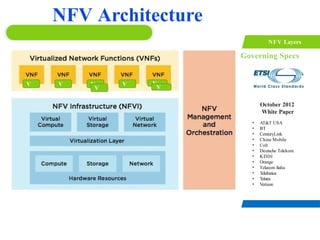
NFV Architecture
NFV Layers
Governing Specs
October 2012
White Paper
• AT&T USA
• BT
• CenturyLink
• China Mobile
• Colt
• Deutsche Telekom
• KDDI
• Orange
• Telecom Italia
• Telefonica
• Telstra
• Verizon
V
M
V
M
V
M
V
M
V
M
V
M
V
M
NFV : Network function Virtualization
Interne
t
Cloud LTE
Network
Components of NFV
MM
E
MS
C
CRA
N PCR
F
SMS
C
Switc
h
Rout
er
Virtual
Machines
Virtual
Machines
HLR
PGw
Each Application running on
One or Multiple VMs
Generic Hardware
Virtual M achines
vSMS
C
vMS
C
vHL
R
vSGS
N
vGGS
N
NFV
Architecture
NFV Layers
OSS / BSS
Orchestration
Service , VNF &
Infra description
EM1
VNF1
vSMSC
EM2
VNF2
vMSC
EM3
VNF3
vHL
R
Virtual
Compute
Virtual
Memory
Virtual
Network
Virtualization Layer
Compute Memory Network
VNF Manager
VIM Virtualized
Infrastructure
Manager
NF-Vi
NFVI
Ve-Vnfm
Se-Ma
Os-Ma
Or-Vnfm
Vi-Vnfm
Or-
Vi
NFV Management
& Orchestration
VNF ( Virtual
Network Function)
NFVI
(Network Function Virtualization
Infrastructure)
• Manage Physical part in NFVI
• Hypervisor : Responsible for
abstracting physical resources
into virtual resources
VIM
(Virtualized Infrastructure
Manager)
• Management / Control for NFVI
• Also manages Reports & events
Blades of HP / DELL Hardware
NFVI(Network Function Virtualization Infrastructure)
NFV Layers
OSS /
BSS
Orchestration
Service , VNF &
Infra description
EM1 EM2 EM3
Virtual
Compute
Virtual
Memory
Virtual
Network
Virtualization Layer
Compute Memory Network
VNF Manager
VIM Virtualized
Infrastructure
Manager
NF-Vi
NFVI
Ve-Vnfm
Se-Ma
Os-Ma
Or-Vnfm
Vi-Vnfm
Or-Vi
NFV Management
& Orchestration
VNF
• A VNF is the basic block in
NFV Architecture , Example :-
• vIMS
• vMME
• vMSC
• vSwitch
• vRouter
• EM (Element Management) FCAPS of
Application such as Link down , KPI Degradation
etc.
VNF ( Virtual
Network Function)
VNF Manager
• Life cycle VNFs :
• setting up/
• Maintaining
• Tearing down
• FCAPS of Virtualization and VNF
NFV Architecture
VNF1
vSMSC
VNF2
vMSC
VNF3
vHL
R
VM
VM
V
M
VM VM
VM
VNF(Virtualized Network Functions)
NFV
Architecture
NFV Layers
NFV Orchestrator (NFVO)
• Key to Automation of SDN &
NFV
• Performs :-
• Resource orchestration
• Network service orchestration
• Global resource management of
NFVI resources via VNFM &
VIM
• Allocating and scaling resources
• Single Orchestrator for NFV
service
OSS /
BSS
Orchestration
Service , VNF &
Infra description
EM1
VNF1
EM2
VNF2
EM3
VNF3
Virtual
Compute
Virtual
Memory
Virtual
Network
Virtualization Layer
Compute Memory Network
VNF Manager
VIM Virtualized
Infrastructure
Manager
NF-Vi
NFVI
Ve-Vnfm
Se-Ma
Os-Ma
Or-Vnfm
Vi-Vnfm
Or-
Vi
NFV Management
& Orchestration
VNF ( Virtual
Network Function)
NFV Management and Orchestration (NFVO)
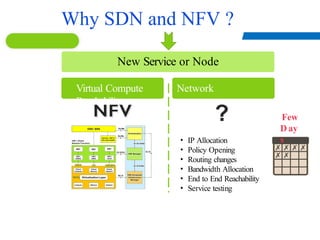
Why SDN and NFV ?
New Service or Node
Virtual Compute Network
Reachability
Few
D ay
s
• IP Allocation
• Policy Opening
• Routing changes
• Bandwidth Allocation
• End to End Reachability
• Service testing
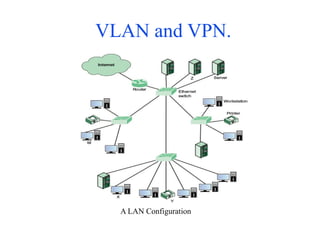
VLAN and VPN.
A LAN Configuration
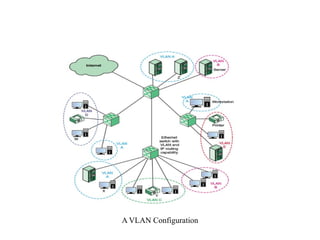
VLAN
• A virtual network abstraction on top of a physical
packet-switched network.
• A VLAN is essentially a broadcast domain for a
specified set of switches.
• These switches are required to be aware of the
existence of VLANs and configured accordingly, to
perform switching of packets between devices
belonging to the same VLAN
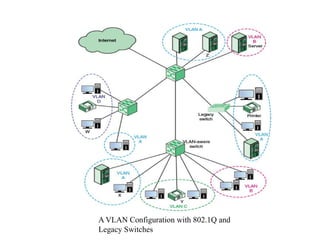
A VLAN Configuration
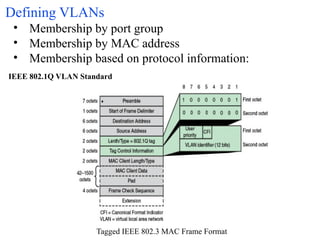
Defining VLANs
• Membership by port group
• Membership by MAC address
• Membership based on protocol information:
IEEE 802.1Q VLAN Standard
Tagged IEEE 802.3 MAC Frame Format
A VLAN Configuration with 802.1Q and
Legacy Switches
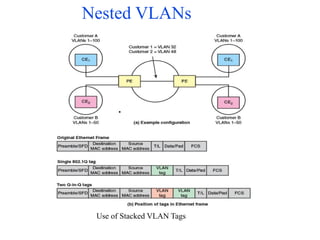
Nested VLANs
Use of Stacked VLAN Tags
Virtual Private Networks
• The use of encryption and authentication in the
lower protocol layers to provide a secure
connection through an otherwise unsecure
network, typically the Internet.
• VPNs are generally cheaper than real private
networks using private lines but rely on having
the same encryption and authentication system
at both ends.
• The encryption may be performed by firewall
software or possibly by routers.
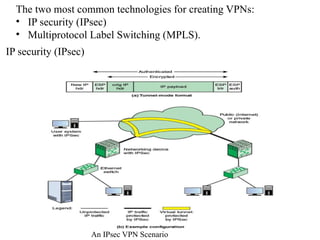
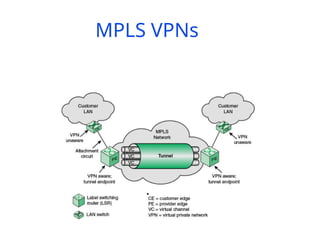
The two most common technologies for creating VPNs:
• IP security (IPsec)
• Multiprotocol Label Switching (MPLS).
IP security (IPsec)
An IPsec VPN Scenario
MPLS VPNs
Network Virtualization
• Network Virtualization
• Logical resource
• Virtual resource
• Virtual network
• Network virtualization (NV)
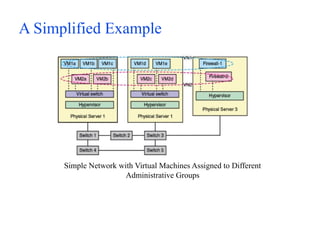
A Simplified Example
Simple Network with Virtual Machines Assigned to Different
Administrative Groups
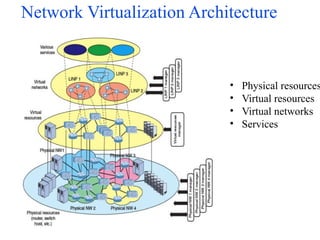
Network Virtualization Architecture
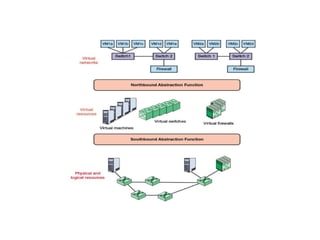
• Physical resources
• Virtual resources
• Virtual networks
• Services
Benefits of Network Virtualization
• Flexibility
• Operational cost savings
• Agility
• Scalability
• Capital cost savings
• Rapid service provisioning/time to
market
•

Modern Networking Unit 3 Network Function virtualization

  • 1.
  • 2.
    Contents • NFV Motivation •Virtual Machines • NFV benefits & requirements • NFV Architecture • NFV Infrastructure • Virtualized Network Functions • NFV Management and Orchestration • NFV Use Cases • NFV and SDN • Network virtualization • VLAN and VPN.
  • 3.
    Four Innovations ofNFV 4. Standard API’s between Modules 3. Implementation in Virtual Machines 2. Network Function Modules 1. Software implementation of network
  • 4.
    Network Function Virtualization (NFV) 1.Fast standard hardware  Software based Devices Routers, Firewalls, Broadband Remote Access Server (BRAS)  A.k.a. white box implementation 2. Function Modules (Both data plane and control plane)  DHCP (Dynamic Host control Protocol), NAT (Network Address Translation), Rate Limiting, Set Top Box NAT Residential Gateway Hardware vBase Stations 3G 2G LTE Hardware CDN DNS DHCP Hardware
  • 5.
    NFV (Cont) 3. VirtualMachine implementation  Virtual appliances  All advantages of virtualization (quick provisioning, scalability, mobility, Reduced CapEx, Reduced OpEx, …) 4. Standard APIs: New ISG (Industry Specification Group) in ETSI (European Telecom Standards Institute) set up in November 2012 Hypervisor VM VM VM
  • 6.
    Why We needNFV? / 1. Virtualization: Use network resource without worrying about where it is physically located, how much it is, how it is organized, etc. 2. Orchestration: Manage thousands of devices 3. Programmable: Should be able to change behavior on the fly. 4. Dynamic Scaling: Should be able to change size, quantity 5. Automation 6. Visibility: Monitor resources, connectivity 7. Performance: Optimize network device utilization 8. Multi-tenancy 9. Service Integration
  • 7.
    NFV Concepts  NetworkFunction (NF): Functional building block with a well defined interfaces and well defined functional behavior  Virtualized Network Function (VNF): Software implementation of NF that can be deployed in a virtualized infrastructure  VNF Set: Connectivity between VNFs is not specified, e.g., residential gateways  VNF Forwarding Graph: Service chain when network connectivity order is important, e.g., firewall, NAT, load balancer  NFV Infrastructure (NFVI): Hardware and software required to deploy, mange and execute VNFs including computation, networking, and storage. df
  • 8.
    Network Forwarding Graph An end-to-end service may include nested forwarding graphs End Point VNF 1 VNF 2B VNF 2A VNF 2C VNF-3 End Point Virtualization Layer Hardware
  • 9.
    NFV Concepts (Cont) NFVI Point of Presence (PoP): Location of NFVI  NFVI-PoP Network: Internal network  Transport Network: Network connecting a PoP to other PoPs or external networks  VNF Manager: VNF lifecycle management e.g., instantiation, update, scaling, query, monitoring, fault diagnosis, healing, termination  Virtualized Infrastructure Manager: Management of computing, storage, network, software resources  Network Service: A composition of network functions and defined by its functional and behavioral specification  NFV Service: A network services using NFs with at least one VNF.
  • 10.
    NFV Concepts (Cont) User Service: Services offered to end users/customers/subscribers.  Deployment Behavior: NFVI resources that a VNF requires, e.g., Number of VMs, memory, disk, images, bandwidth, latency  Operational Behavior: VNF instance topology and lifecycle operations, e.g., start, stop, pause, migration, …  VNF Descriptor: Deployment behavior + Operational behavior  NFV Orchestrator: Automates the deployment, operation, management, coordination of VNFs and NFVI.  VNF Forwarding Graph: Connection topology of various NFs of which at least one is a VNF
  • 11.
    NFV Architecture NFV Managementand Orchestration Orchestration VNF Managers Virtualized Infrastructure Managers Computing Hardware Storage Hardware Network Hardware Virtualization Layer Virtual Computing Virtual Storage Virtual Network VNF 1 VNF 2 VNF 3 EMS 1 EMS 2 EMS 3 OSS/BSS Service VNF and Infrastructure Description Or-Vnfm Vi-Vnfm Os-Ma Se-Ma Ve-Vnfm Nf-Vi VI-Ha Vn-Nf NFVI Or-Vi
  • 12.
    NFV Reference Points ReferencePoint: Points for inter-module specification 1. Virtualization Layer-Hardware Resources (VI-Ha) 2. VNF – NFVI (Vn-Nf) 3. Orchestrator – VNF Manager (Or-Vnfm) 4. Virtualized Infrastructure Manager – VNF Manager (Vi-Vnfm) 5. Orchestrator – Virtualized Infrastructure Manager (Or-Vi) 6. NFVI-Virtualized Infrastructure Manager (Nf-Vi) 7. Operation Support System (OSS)/Business Support Systems (BSS) – NFV Management and Orchestration (Os-Ma) 8. VNF/ Element Management System (EMS) – VNF Manager (Ve-Vnfm) 9. Service, VNF and Infrastructure Description – NFV Management and Orchestration (Se-Ma): VNF Deployment template, VNF Forwarding Graph, service-related information, NFV infrastructure information
  • 13.
    NFV Benefits • Flexibilityto rapidly, dynamically instantiate services in different locations without installing new equipment. • Faster time-to-market for new service introduction • Improving operational efficiency by taking advantage of a homogeneous hardware network platform • Reducing costs through leveraging the economies of scale of the IT industry • Reducing operational costs: less power, less space, improving network monitoring
  • 14.
    NFV Framework Requirements 1.General: Partial or full Virtualization, Predictable performance 2. Portability: Decoupled from underlying infrastructure 3. Performance: as described and facilities to monitor 4. Elasticity: Scalable to meet SLAs. Movable to other servers. 5. Resiliency: Be able to recreate after failure. Specified packet loss rate, calls drops, time to recover, etc. 6. Security: Role-based authorization, authentication 7. Service Continuity: Seamless or non-seamless continuity after failures or migration
  • 15.
    NFV Framework Requirements(Cont) 8. Service Assurance: Time stamp and forward copies of packets for Fault detection 9. Energy Efficiency Requirements: Should be possible to put a subset of VNF in a power conserving sleep state 10. Transition: Coexistence with Legacy and Interoperability among multi-vendor implementations 11. Service Models: Operators may use NFV infrastructure operated by other operators
  • 16.
    NFV Challenges Converge ITand Telecom industry to a common understanding of the topic Achieve (high) performance with portability across different hardware platforms Achieve co-existence with existing hardware based network platforms Ensure security & integrity when Managing and orchestrating virtual networks Integrate multiple virtual appliances from different vendors (on a single HW platform). Achieve scale benefits through Mananement & Orchestration automation.
  • 17.
    NFV Use Cases Cloud: 1. NFV infrastructure as a service (NFVIaaS) like IaaS 2. Virtual Network Functions (VNFs) as a service (VNFaaS) like SaaS 3. VNF forwarding graphs (Service Chains) 4. Virtual Network Platform as a Service (VNPaaS) like PaaS  Mobile: 5. Virtualization of the Mobile Core Network and IMS 6. Virtualization of Mobile Base Station  Data Center: 7. Virtualization of CDNs  Access/Residential: 8. Virtualization of the Home environment 9. Fixed Access NFV /
  • 18.
    NFV Proof ofConcepts (PoCs) ETSI has formed and NFV ISG PoC Forum. Following modules have been demoed: 1. Virtual Broadband Remote Access Server (BRAS) by British Telecom 2. Virtual IP Multimedia System (IMS) by Deutsche Telekom 3. Virtual Evolved Packet Core (vEPC) by Orange Silicon Valley 4. Carrier-Grade Network Address Translator (CGNAT) and Deep Packet Inspection (DPI), Home Gateway by Telefonica 5. Perimeta Session Border Controller (SBC) from Metaswitch 6. Deep packet inspection from Procera Most of these are based on Cloud technologies, e.g., OpenStack
  • 19.
    NFV : Networkfunction Virtualization also known as virtual network function (VNF) enB SGw GGSN DPI PGw MME HSS OCS PCRF Interne t Traditional LTE Network C G N AT DNS
  • 20.
    NFV : Networkfunction Virtualization Interne t Traditional LTE Network CGNA T P G w HLR/HSS M M E O C S P C R F D N S Specialized Appliances / Purpose Build Combination of Capacity & Functionality Router s Switc h
  • 21.
    NFV - Softwarization - Virtualization -Orchestration Purpose Build hardware to Generic Hardware App running on Software Separation of Network Function & Capacity Easy Capacity Scale Up / Down VM are Building Blocks NFV : Network function Virtualization Interne t Virtual Network Generic Hardware HLR / HSS MME PGw DN S Features of NFV V V V M M M V V V M M M V V V M M M V V V M M M
  • 22.
    NFV Architecture NFV Layers GoverningSpecs October 2012 White Paper • AT&T USA • BT • CenturyLink • China Mobile • Colt • Deutsche Telekom • KDDI • Orange • Telecom Italia • Telefonica • Telstra • Verizon V M V M V M V M V M V M V M
  • 23.
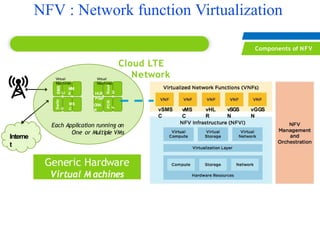
    NFV : Networkfunction Virtualization Interne t Cloud LTE Network Components of NFV MM E MS C CRA N PCR F SMS C Switc h Rout er Virtual Machines Virtual Machines HLR PGw Each Application running on One or Multiple VMs Generic Hardware Virtual M achines vSMS C vMS C vHL R vSGS N vGGS N
  • 24.
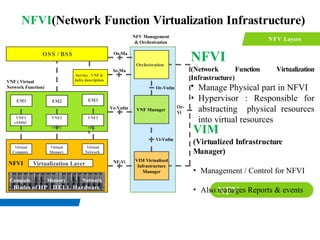
    NFV Architecture NFV Layers OSS /BSS Orchestration Service , VNF & Infra description EM1 VNF1 vSMSC EM2 VNF2 vMSC EM3 VNF3 vHL R Virtual Compute Virtual Memory Virtual Network Virtualization Layer Compute Memory Network VNF Manager VIM Virtualized Infrastructure Manager NF-Vi NFVI Ve-Vnfm Se-Ma Os-Ma Or-Vnfm Vi-Vnfm Or- Vi NFV Management & Orchestration VNF ( Virtual Network Function) NFVI (Network Function Virtualization Infrastructure) • Manage Physical part in NFVI • Hypervisor : Responsible for abstracting physical resources into virtual resources VIM (Virtualized Infrastructure Manager) • Management / Control for NFVI • Also manages Reports & events Blades of HP / DELL Hardware NFVI(Network Function Virtualization Infrastructure)
  • 25.
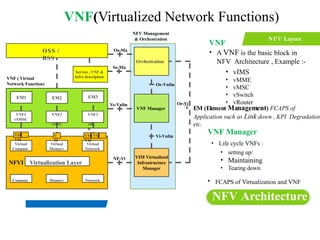
    NFV Layers OSS / BSS Orchestration Service, VNF & Infra description EM1 EM2 EM3 Virtual Compute Virtual Memory Virtual Network Virtualization Layer Compute Memory Network VNF Manager VIM Virtualized Infrastructure Manager NF-Vi NFVI Ve-Vnfm Se-Ma Os-Ma Or-Vnfm Vi-Vnfm Or-Vi NFV Management & Orchestration VNF • A VNF is the basic block in NFV Architecture , Example :- • vIMS • vMME • vMSC • vSwitch • vRouter • EM (Element Management) FCAPS of Application such as Link down , KPI Degradation etc. VNF ( Virtual Network Function) VNF Manager • Life cycle VNFs : • setting up/ • Maintaining • Tearing down • FCAPS of Virtualization and VNF NFV Architecture VNF1 vSMSC VNF2 vMSC VNF3 vHL R VM VM V M VM VM VM VNF(Virtualized Network Functions)
  • 26.
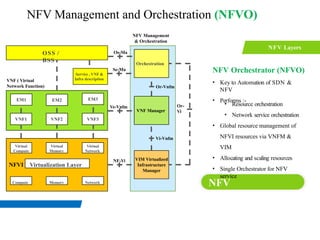
    NFV Architecture NFV Layers NFV Orchestrator(NFVO) • Key to Automation of SDN & NFV • Performs :- • Resource orchestration • Network service orchestration • Global resource management of NFVI resources via VNFM & VIM • Allocating and scaling resources • Single Orchestrator for NFV service OSS / BSS Orchestration Service , VNF & Infra description EM1 VNF1 EM2 VNF2 EM3 VNF3 Virtual Compute Virtual Memory Virtual Network Virtualization Layer Compute Memory Network VNF Manager VIM Virtualized Infrastructure Manager NF-Vi NFVI Ve-Vnfm Se-Ma Os-Ma Or-Vnfm Vi-Vnfm Or- Vi NFV Management & Orchestration VNF ( Virtual Network Function) NFV Management and Orchestration (NFVO)
  • 27.
    Why SDN andNFV ? New Service or Node Virtual Compute Network Reachability Few D ay s • IP Allocation • Policy Opening • Routing changes • Bandwidth Allocation • End to End Reachability • Service testing
  • 28.
    VLAN and VPN. ALAN Configuration
  • 29.
    VLAN • A virtualnetwork abstraction on top of a physical packet-switched network. • A VLAN is essentially a broadcast domain for a specified set of switches. • These switches are required to be aware of the existence of VLANs and configured accordingly, to perform switching of packets between devices belonging to the same VLAN
  • 30.
  • 31.
    Defining VLANs • Membershipby port group • Membership by MAC address • Membership based on protocol information: IEEE 802.1Q VLAN Standard Tagged IEEE 802.3 MAC Frame Format
  • 32.
    A VLAN Configurationwith 802.1Q and Legacy Switches
  • 33.
    Nested VLANs Use ofStacked VLAN Tags
  • 34.
    Virtual Private Networks •The use of encryption and authentication in the lower protocol layers to provide a secure connection through an otherwise unsecure network, typically the Internet. • VPNs are generally cheaper than real private networks using private lines but rely on having the same encryption and authentication system at both ends. • The encryption may be performed by firewall software or possibly by routers.
  • 35.
    The two mostcommon technologies for creating VPNs: • IP security (IPsec) • Multiprotocol Label Switching (MPLS). IP security (IPsec) An IPsec VPN Scenario
  • 36.
  • 37.
    Network Virtualization • NetworkVirtualization • Logical resource • Virtual resource • Virtual network • Network virtualization (NV)
  • 38.
    A Simplified Example SimpleNetwork with Virtual Machines Assigned to Different Administrative Groups
  • 40.
    Network Virtualization Architecture •Physical resources • Virtual resources • Virtual networks • Services
  • 41.
    Benefits of NetworkVirtualization • Flexibility • Operational cost savings • Agility • Scalability • Capital cost savings • Rapid service provisioning/time to market •