
Aruba-Certified Mobility
Professional (ACMP) 6.1
Study Guide
2Aruba Study Guide: ACMP 6.1
The Aruba-Certified
Mobility Professional
(ACMP) 6.1 exam questions
cover the topics listed below.
The questions include key
concepts, networking and
topology design, GUI and
CLI interpretation, GUI and
CLI troubleshooting and
interpretation of CLI
configuration file segments.
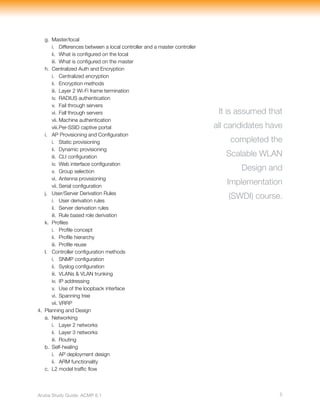
•	 Product Knowledge
•	 Firewall Roles and Policies
•	 Operations
•	 Planning and Design
•	 RFProtect
•	 Troubleshooting
•	 Applications and Solutions
Preparation for ACMP
includes familiarity with
IAW/SWDI 6.1 courseware,
or its equivalent MBC 6.1.
Additionally, review of VRDs
will help to reinforce the
concepts learned within
the courses.
Table of Contents
Overview
Topic Details
Sample Questions
2
3
7
3Aruba Study Guide: ACMP 6.1
Topic Details
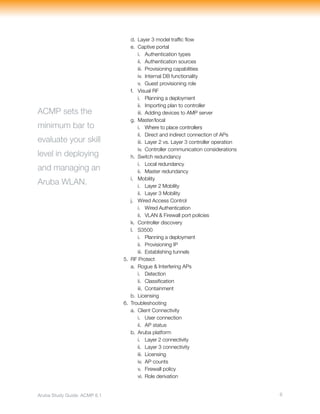
1.	 Product Knowledge
a.	 Mobility Controllers Models
i.	 Understand the limits of user scaling for different
controller models
ii.	 Understand the limits of AP scaling for different
controller models
iii.	 Understand the limits of Remote AP scaling for different
controller models
iv.	 Power supplies offered for various models
v.	 Chassis based controller modules
vi.	Power-over-Ethernet support
b.	 AP models
i.	 Indoor AP models
ii.	 Outdoor AP models
iii.	 Models supporting internal and external antennas
iv.	 Antenna types offered as external antennas
v.	 Models supporting Power-over-Ethernet support
vi.	802.11a/b/g/n support by model
c.	 Licensing
i.	 Understand the 6.1 licensing model for all controllers
ii.	 Be able to articulate the features and functions of the Aruba
software licenses
iii.	 Be able to articulate the features and functions included in
the base ArubaOS
2.	 Firewall Roles and Policies
a.	 Policy Design
i.	 Function of firewall design
ii.	 Interpretation and troubleshooting of firewall rule policy
iii.	 Application of firewall policy to user roles
iv.	 Application of firewall policy to interfaces
v.	 Be able to articulate the difference between a stateful firewall
and an access control list (ACL)
vi.	Describe an Ethertype ACL
b.	 Roles
i.	 Describe the function of built-in roles
ii.	 Describe the use and creation of user created roles
iii.	 Understand role derivation
c.	 Aliases
i.	 Describe the function and use of aliases
ii.	 Understand the built in aliases
d.	 NAT
i.	 Describe the function of source NAT
ii.	 Describe the function of destination NAT
iii.	 Understand the use of NAT for captive portal authentication
iv.	 Describe VLAN based NAT functionality
e.	 Interpret example policy
Review of VRDs will
help to reinforce the
concepts learned
within the courses.
4Aruba Study Guide: ACMP 6.1
3.	 Operations
a.	 Authentication
i.	 802.1X
ii.	 Pre-Shared Keys
iii.	 Open system
iv.	 Captive portal with credentials
v.	 Captive portal with guest logon
b.	 Configuration Wizards
i.	 Configuration of the controller using the Controller Wizard
ii.	 VLAN and IP address configuration
iii.	 Port configuration
iv.	 Network time configuration
v.	 Controller role configuration
vi.	License configuration
vii.	LAN configuration
viii.	WLAN configuration for employee SSIDs
ix.	WLAN configuration for guest SSIDs
x.	 RADIUS server configuration
xi.	802.1X authentication configuration
xii.	Captive portal configuration and customization
c.	 Management
i.	 Software upgrades on the controllers and APs
ii.	 Interface layout
iii.	 AP management
iv.	 License management
v.	 Configuration screens
vi.	Monitoring screens
vii.	Security screens
d.	 Power over Ethernet
i.	 Power provided
ii.	 Standards
iii.	 Transmission distances
e.	 Roaming
i.	 Layer 2 roaming
ii.	 Layer 3 roaming
iii.	 Mobility domains
iv.	 HAT table configuration
f.	 RF management and ARM
i.	 ARM channel and power selection
ii.	 ARM self healing
iii.	 ARM band steering
iv.	 ARM Spectrum load balancing
v.	 ARM Airtime fairness
vi.	ARM rate shaping
vii.	Client aware ARM scanning
viii.	Spectrum Monitor provisioning
ix.	Spectrum Monitor usage
An ACMP certified
engineer is able to
deploy and manage
a large-scale, multi-
controller network.
5Aruba Study Guide: ACMP 6.1
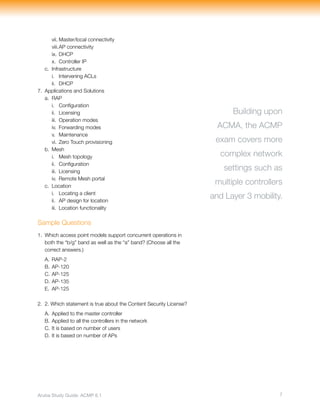
g.	 Master/local
i.	 Differences between a local controller and a master controller
ii.	 What is configured on the local
iii.	 What is configured on the master
h.	 Centralized Auth and Encryption
i.	 Centralized encryption
ii.	 Encryption methods
iii.	 Layer 2 Wi-Fi frame termination
iv.	 RADIUS authentication
v.	 Fail through servers
vi.	Fall through servers
vii.	Machine authentication
viii.	Per-SSID captive portal
i.	 AP Provisioning and Configuration
i.	 Static provisioning
ii.	 Dynamic provisioning
iii.	 CLI configuration
iv.	 Web interface configuration
v.	 Group selection
vi.	Antenna provisioning
vii.	Serial configuration
j.	 User/Server Derivation Rules
i.	 User derivation rules
ii.	 Server derivation rules
iii.	 Rule based role derivation
k.	 Profiles
i.	 Profile concept
ii.	 Profile hierarchy
iii.	 Profile reuse
l.	 Controller configuration methods
i.	 SNMP configuration
ii.	 Syslog configuration
iii.	 VLANs & VLAN trunking
iv.	 IP addressing
v.	 Use of the loopback interface
vi.	Spanning tree
vii.	VRRP
4.	 Planning and Design
a.	 Networking
i.	 Layer 2 networks
ii.	 Layer 3 networks
iii.	 Routing
b.	 Self-healing
i.	 AP deployment design
ii.	 ARM functionality
c.	 L2 model traffic flow
It is assumed that
all candidates have
completed the
Scalable WLAN
Design and
Implementation
(SWDI) course.
6Aruba Study Guide: ACMP 6.1
d.	 Layer 3 model traffic flow
e.	 Captive portal
i.	 Authentication types
ii.	 Authentication sources
iii.	 Provisioning capabilities
iv.	 Internal DB functionality
v.	 Guest provisioning role
f.	 Visual RF
i.	 Planning a deployment
ii.	 Importing plan to controller
iii.	 Adding devices to AMP server
g.	 Master/local
i.	 Where to place controllers
ii.	 Direct and indirect connection of APs
iii.	 Layer 2 vs. Layer 3 controller operation
iv.	 Controller communication considerations
h.	 Switch redundancy
i.	 Local redundancy
ii.	 Master redundancy
i.	 Mobility
i.	 Layer 2 Mobility
ii.	 Layer 3 Mobility
j.	 Wired Access Control
i.	 Wired Authentication
ii.	 VLAN & Firewall port policies
k.	 Controller discovery
l.	 S3500
i.	 Planning a deployment
ii.	 Provisioning IP
iii.	 Establishing tunnels
5.	 RF Protect
a.	 Rogue & Interfering APs
i.	 Detection
ii.	 Classification
iii.	 Containment
b.	 Licensing
6.	 Troubleshooting
a.	 Client Connectivity
i.	 User connection
ii.	 AP status
b.	 Aruba platform
i.	 Layer 2 connectivity
ii.	 Layer 3 connectivity
iii.	 Licensing
iv.	 AP counts
v.	 Firewall policy
vi.	Role derivation
ACMP sets the
minimum bar to
evaluate your skill
level in deploying
and managing an
Aruba WLAN.
7Aruba Study Guide: ACMP 6.1
vii.	Master/local connectivity
viii.	AP connectivity
ix.	DHCP
x.	 Controller IP
c.	 Infrastructure
i.	 Intervening ACLs
ii.	 DHCP
7.	 Applications and Solutions
a.	 RAP
i.	 Configuration
ii.	 Licensing
iii.	 Operation modes
iv.	 Forwarding modes
v.	 Maintenance
vi.	Zero Touch provisioning
b.	 Mesh
i.	 Mesh topology
ii.	 Configuration
iii.	 Licensing
iv.	 Remote Mesh portal
c.	 Location
i.	 Locating a client
ii.	 AP design for location
iii.	 Location functionality
Sample Questions
1.	 Which access point models support concurrent operations in
both the “b/g” band as well as the “a” band? (Choose all the
correct answers.)
A.	 RAP-2
B.	AP-120
C.	AP-125
D.	AP-135
E.	 AP-125
2.	 2. Which statement is true about the Content Security License?
A.	 Applied to the master controller
B.	Applied to all the controllers in the network
C.	It is based on number of users
D.	It is based on number of APs
Building upon
ACMA, the ACMP
exam covers more
complex network
settings such as
multiple controllers
and Layer 3 mobility.
8Aruba Study Guide: ACMP 6.1
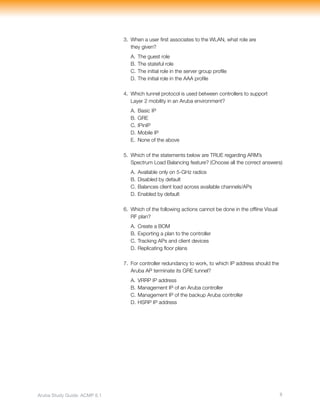
3.	 When a user first associates to the WLAN, what role are
they given?
A.	 The guest role
B.	The stateful role
C.	The initial role in the server group profile
D.	The initial role in the AAA profile
4.	 Which tunnel protocol is used between controllers to support
Layer 2 mobility in an Aruba environment?
A.	 Basic IP
B.	GRE
C.	IPinIP
D.	Mobile IP
E.	 None of the above
5.	 Which of the statements below are TRUE regarding ARM’s
Spectrum Load Balancing feature? (Choose all the correct answers)
A.	 Available only on 5-GHz radios
B.	Disabled by default
C.	Balances client load across available channels/APs
D.	Enabled by default
6.	 Which of the following actions cannot be done in the offline Visual
RF plan?
A.	 Create a BOM
B.	Exporting a plan to the controller
C.	Tracking APs and client devices
D.	Replicating floor plans
7.	 For controller redundancy to work, to which IP address should the
Aruba AP terminate its GRE tunnel?
A.	 VRRP IP address
B.	Management IP of an Aruba controller
C.	Management IP of the backup Aruba controller
D.	HSRP IP address
9Aruba Study Guide: ACMP 6.1
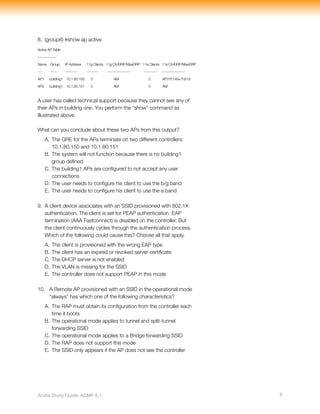
8.	 (group8) #show ap active
Active AP Table
---------------
Name Group IP Address 11g Clients 11g Ch/EIRP/MaxEIRP 11a Clients 11a Ch/EIRP/MaxEIRP
---- ----- ---------- --------- ------------------- ----------- -------------------
AP1 building1 10.1.80.150 0 AM 0 AP:HT:149+/19/19
AP2 building1 10.1.80.151 0 AM 0 AM
A user has called technical support because they cannot see any of
their APs in building one. You perform the “show” command as
illustrated above.
What can you conclude about these two APs from this output?
A.	 The GRE for the APs terminate on two different controllers:
10.1.80.150 and 10.1.80.151
B.	The system will not function because there is no building1
group defined
C.	The building1 APs are configured to not accept any user
connections
D.	The user needs to configure his client to use the b/g band
E.	 The user needs to configure his client to use the a band
9.	 A client device associates with an SSID provisioned with 802.1X
authentication. The client is set for PEAP authentication. EAP
termination (AAA Fastconnect) is disabled on the controller. But
the client continuously cycles through the authentication process.
Which of the following could cause this? Choose all that apply.
A.	 The client is provisioned with the wrong EAP type
B.	The client has an expired or revoked server certificate
C.	The DHCP server is not enabled
D.	The VLAN is missing for the SSID
E.	 The controller does not support PEAP in this mode
10.	 A Remote AP provisioned with an SSID in the operational mode
“always” has which one of the following characteristics?
A.	 The RAP must obtain its configuration from the controller each
time it boots
B.	The operational mode applies to tunnel and split-tunnel
forwarding SSID
C.	The operational mode applies to a Bridge forwarding SSID
D.	The RAP does not support this mode
E.	 The SSID only appears if the AP does not see the controller
10Aruba Study Guide: ACMP 6.1
11.	 What is the purpose of Mesh Clusters?
A.	 To separate mesh points and mesh portals
B.	To make sure that mesh points and portals with the same VAPs
are not in the same cluster
C.	To create a group of mesh points and mesh portals that create
mesh links with each other using the same 802.11 connection
settings
D.	To cluster mesh APs of the same model together
12.	 Which of the following charts are available for selection in the
Spectrum Dashboard for an AP-125?
A.	 FFT Duty Cycle
B.	Channel Quality
C.	Active Devices by Channel
D.	Number of Spectrum Monitors
13.	 Which of the following needs to be done prior to using the
GUI quick setup of a factory defaulted Aruba S3500 Mobility
Access Switch?
A.	 Set the S3500 IP address to the 172.16.0.0 range
B.	Quick-Setup needs to be enabled on the LCD Panel
C.	Connect the S3500 to the network for DHCP
D.	Set the laptop IP address to the 192.168.0.0 range
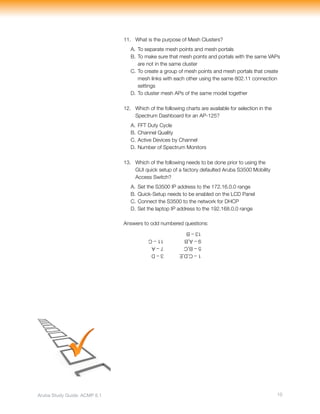
Answers to odd numbered questions:
1–C,D,E	3–D
5–B,C		7–A
9–A,B		11–C
13–B
© 2011 Aruba Networks, Inc. Aruba Networks’ trademarks include AirWave®, Aruba Networks®, Aruba Wireless Networks®, the regis-
tered Aruba the Mobile Edge Company logo, Aruba Mobility Management System®, Mobile Edge Architecture®, People Move. Networks
Must Follow®, RFProtect®, and Green Island®. All rights reserved. All other trademarks are the property of their respective owners.
1344 Crossman Avenue. Sunnyvale, CA 94089
1-866-55-ARUBA | Tel. +1 408.227.4500 | Fax. +1 408.227.4550 | info@arubanetworks.com
www.arubanetworks.com

Acmp study guide_d[1]

  • 1.
  • 2.
    2Aruba Study Guide:ACMP 6.1 The Aruba-Certified Mobility Professional (ACMP) 6.1 exam questions cover the topics listed below. The questions include key concepts, networking and topology design, GUI and CLI interpretation, GUI and CLI troubleshooting and interpretation of CLI configuration file segments. • Product Knowledge • Firewall Roles and Policies • Operations • Planning and Design • RFProtect • Troubleshooting • Applications and Solutions Preparation for ACMP includes familiarity with IAW/SWDI 6.1 courseware, or its equivalent MBC 6.1. Additionally, review of VRDs will help to reinforce the concepts learned within the courses. Table of Contents Overview Topic Details Sample Questions 2 3 7
  • 3.
    3Aruba Study Guide:ACMP 6.1 Topic Details 1. Product Knowledge a. Mobility Controllers Models i. Understand the limits of user scaling for different controller models ii. Understand the limits of AP scaling for different controller models iii. Understand the limits of Remote AP scaling for different controller models iv. Power supplies offered for various models v. Chassis based controller modules vi. Power-over-Ethernet support b. AP models i. Indoor AP models ii. Outdoor AP models iii. Models supporting internal and external antennas iv. Antenna types offered as external antennas v. Models supporting Power-over-Ethernet support vi. 802.11a/b/g/n support by model c. Licensing i. Understand the 6.1 licensing model for all controllers ii. Be able to articulate the features and functions of the Aruba software licenses iii. Be able to articulate the features and functions included in the base ArubaOS 2. Firewall Roles and Policies a. Policy Design i. Function of firewall design ii. Interpretation and troubleshooting of firewall rule policy iii. Application of firewall policy to user roles iv. Application of firewall policy to interfaces v. Be able to articulate the difference between a stateful firewall and an access control list (ACL) vi. Describe an Ethertype ACL b. Roles i. Describe the function of built-in roles ii. Describe the use and creation of user created roles iii. Understand role derivation c. Aliases i. Describe the function and use of aliases ii. Understand the built in aliases d. NAT i. Describe the function of source NAT ii. Describe the function of destination NAT iii. Understand the use of NAT for captive portal authentication iv. Describe VLAN based NAT functionality e. Interpret example policy Review of VRDs will help to reinforce the concepts learned within the courses.
  • 4.
    4Aruba Study Guide:ACMP 6.1 3. Operations a. Authentication i. 802.1X ii. Pre-Shared Keys iii. Open system iv. Captive portal with credentials v. Captive portal with guest logon b. Configuration Wizards i. Configuration of the controller using the Controller Wizard ii. VLAN and IP address configuration iii. Port configuration iv. Network time configuration v. Controller role configuration vi. License configuration vii. LAN configuration viii. WLAN configuration for employee SSIDs ix. WLAN configuration for guest SSIDs x. RADIUS server configuration xi. 802.1X authentication configuration xii. Captive portal configuration and customization c. Management i. Software upgrades on the controllers and APs ii. Interface layout iii. AP management iv. License management v. Configuration screens vi. Monitoring screens vii. Security screens d. Power over Ethernet i. Power provided ii. Standards iii. Transmission distances e. Roaming i. Layer 2 roaming ii. Layer 3 roaming iii. Mobility domains iv. HAT table configuration f. RF management and ARM i. ARM channel and power selection ii. ARM self healing iii. ARM band steering iv. ARM Spectrum load balancing v. ARM Airtime fairness vi. ARM rate shaping vii. Client aware ARM scanning viii. Spectrum Monitor provisioning ix. Spectrum Monitor usage An ACMP certified engineer is able to deploy and manage a large-scale, multi- controller network.
  • 5.
    5Aruba Study Guide:ACMP 6.1 g. Master/local i. Differences between a local controller and a master controller ii. What is configured on the local iii. What is configured on the master h. Centralized Auth and Encryption i. Centralized encryption ii. Encryption methods iii. Layer 2 Wi-Fi frame termination iv. RADIUS authentication v. Fail through servers vi. Fall through servers vii. Machine authentication viii. Per-SSID captive portal i. AP Provisioning and Configuration i. Static provisioning ii. Dynamic provisioning iii. CLI configuration iv. Web interface configuration v. Group selection vi. Antenna provisioning vii. Serial configuration j. User/Server Derivation Rules i. User derivation rules ii. Server derivation rules iii. Rule based role derivation k. Profiles i. Profile concept ii. Profile hierarchy iii. Profile reuse l. Controller configuration methods i. SNMP configuration ii. Syslog configuration iii. VLANs & VLAN trunking iv. IP addressing v. Use of the loopback interface vi. Spanning tree vii. VRRP 4. Planning and Design a. Networking i. Layer 2 networks ii. Layer 3 networks iii. Routing b. Self-healing i. AP deployment design ii. ARM functionality c. L2 model traffic flow It is assumed that all candidates have completed the Scalable WLAN Design and Implementation (SWDI) course.
  • 6.
    6Aruba Study Guide:ACMP 6.1 d. Layer 3 model traffic flow e. Captive portal i. Authentication types ii. Authentication sources iii. Provisioning capabilities iv. Internal DB functionality v. Guest provisioning role f. Visual RF i. Planning a deployment ii. Importing plan to controller iii. Adding devices to AMP server g. Master/local i. Where to place controllers ii. Direct and indirect connection of APs iii. Layer 2 vs. Layer 3 controller operation iv. Controller communication considerations h. Switch redundancy i. Local redundancy ii. Master redundancy i. Mobility i. Layer 2 Mobility ii. Layer 3 Mobility j. Wired Access Control i. Wired Authentication ii. VLAN & Firewall port policies k. Controller discovery l. S3500 i. Planning a deployment ii. Provisioning IP iii. Establishing tunnels 5. RF Protect a. Rogue & Interfering APs i. Detection ii. Classification iii. Containment b. Licensing 6. Troubleshooting a. Client Connectivity i. User connection ii. AP status b. Aruba platform i. Layer 2 connectivity ii. Layer 3 connectivity iii. Licensing iv. AP counts v. Firewall policy vi. Role derivation ACMP sets the minimum bar to evaluate your skill level in deploying and managing an Aruba WLAN.
  • 7.
    7Aruba Study Guide:ACMP 6.1 vii. Master/local connectivity viii. AP connectivity ix. DHCP x. Controller IP c. Infrastructure i. Intervening ACLs ii. DHCP 7. Applications and Solutions a. RAP i. Configuration ii. Licensing iii. Operation modes iv. Forwarding modes v. Maintenance vi. Zero Touch provisioning b. Mesh i. Mesh topology ii. Configuration iii. Licensing iv. Remote Mesh portal c. Location i. Locating a client ii. AP design for location iii. Location functionality Sample Questions 1. Which access point models support concurrent operations in both the “b/g” band as well as the “a” band? (Choose all the correct answers.) A. RAP-2 B. AP-120 C. AP-125 D. AP-135 E. AP-125 2. 2. Which statement is true about the Content Security License? A. Applied to the master controller B. Applied to all the controllers in the network C. It is based on number of users D. It is based on number of APs Building upon ACMA, the ACMP exam covers more complex network settings such as multiple controllers and Layer 3 mobility.
  • 8.
    8Aruba Study Guide:ACMP 6.1 3. When a user first associates to the WLAN, what role are they given? A. The guest role B. The stateful role C. The initial role in the server group profile D. The initial role in the AAA profile 4. Which tunnel protocol is used between controllers to support Layer 2 mobility in an Aruba environment? A. Basic IP B. GRE C. IPinIP D. Mobile IP E. None of the above 5. Which of the statements below are TRUE regarding ARM’s Spectrum Load Balancing feature? (Choose all the correct answers) A. Available only on 5-GHz radios B. Disabled by default C. Balances client load across available channels/APs D. Enabled by default 6. Which of the following actions cannot be done in the offline Visual RF plan? A. Create a BOM B. Exporting a plan to the controller C. Tracking APs and client devices D. Replicating floor plans 7. For controller redundancy to work, to which IP address should the Aruba AP terminate its GRE tunnel? A. VRRP IP address B. Management IP of an Aruba controller C. Management IP of the backup Aruba controller D. HSRP IP address
  • 9.
    9Aruba Study Guide:ACMP 6.1 8. (group8) #show ap active Active AP Table --------------- Name Group IP Address 11g Clients 11g Ch/EIRP/MaxEIRP 11a Clients 11a Ch/EIRP/MaxEIRP ---- ----- ---------- --------- ------------------- ----------- ------------------- AP1 building1 10.1.80.150 0 AM 0 AP:HT:149+/19/19 AP2 building1 10.1.80.151 0 AM 0 AM A user has called technical support because they cannot see any of their APs in building one. You perform the “show” command as illustrated above. What can you conclude about these two APs from this output? A. The GRE for the APs terminate on two different controllers: 10.1.80.150 and 10.1.80.151 B. The system will not function because there is no building1 group defined C. The building1 APs are configured to not accept any user connections D. The user needs to configure his client to use the b/g band E. The user needs to configure his client to use the a band 9. A client device associates with an SSID provisioned with 802.1X authentication. The client is set for PEAP authentication. EAP termination (AAA Fastconnect) is disabled on the controller. But the client continuously cycles through the authentication process. Which of the following could cause this? Choose all that apply. A. The client is provisioned with the wrong EAP type B. The client has an expired or revoked server certificate C. The DHCP server is not enabled D. The VLAN is missing for the SSID E. The controller does not support PEAP in this mode 10. A Remote AP provisioned with an SSID in the operational mode “always” has which one of the following characteristics? A. The RAP must obtain its configuration from the controller each time it boots B. The operational mode applies to tunnel and split-tunnel forwarding SSID C. The operational mode applies to a Bridge forwarding SSID D. The RAP does not support this mode E. The SSID only appears if the AP does not see the controller
  • 10.
    10Aruba Study Guide:ACMP 6.1 11. What is the purpose of Mesh Clusters? A. To separate mesh points and mesh portals B. To make sure that mesh points and portals with the same VAPs are not in the same cluster C. To create a group of mesh points and mesh portals that create mesh links with each other using the same 802.11 connection settings D. To cluster mesh APs of the same model together 12. Which of the following charts are available for selection in the Spectrum Dashboard for an AP-125? A. FFT Duty Cycle B. Channel Quality C. Active Devices by Channel D. Number of Spectrum Monitors 13. Which of the following needs to be done prior to using the GUI quick setup of a factory defaulted Aruba S3500 Mobility Access Switch? A. Set the S3500 IP address to the 172.16.0.0 range B. Quick-Setup needs to be enabled on the LCD Panel C. Connect the S3500 to the network for DHCP D. Set the laptop IP address to the 192.168.0.0 range Answers to odd numbered questions: 1–C,D,E 3–D 5–B,C 7–A 9–A,B 11–C 13–B
  • 11.
    © 2011 ArubaNetworks, Inc. Aruba Networks’ trademarks include AirWave®, Aruba Networks®, Aruba Wireless Networks®, the regis- tered Aruba the Mobile Edge Company logo, Aruba Mobility Management System®, Mobile Edge Architecture®, People Move. Networks Must Follow®, RFProtect®, and Green Island®. All rights reserved. All other trademarks are the property of their respective owners. 1344 Crossman Avenue. Sunnyvale, CA 94089 1-866-55-ARUBA | Tel. +1 408.227.4500 | Fax. +1 408.227.4550 | info@arubanetworks.com www.arubanetworks.com