Connect. Collaborate. Accelerate.
NextGen
Network
Synchronization
Protempis
(formerlyTrimbleTiming & Frequency Division)
Dhiman D Chowdhury
Connect. Collaborate. Accelerate.
Brand Announcement
TrimbleTiming and Frequency Division is now
Protempis
www.protempis.com
Connect. Collaborate. Accelerate.
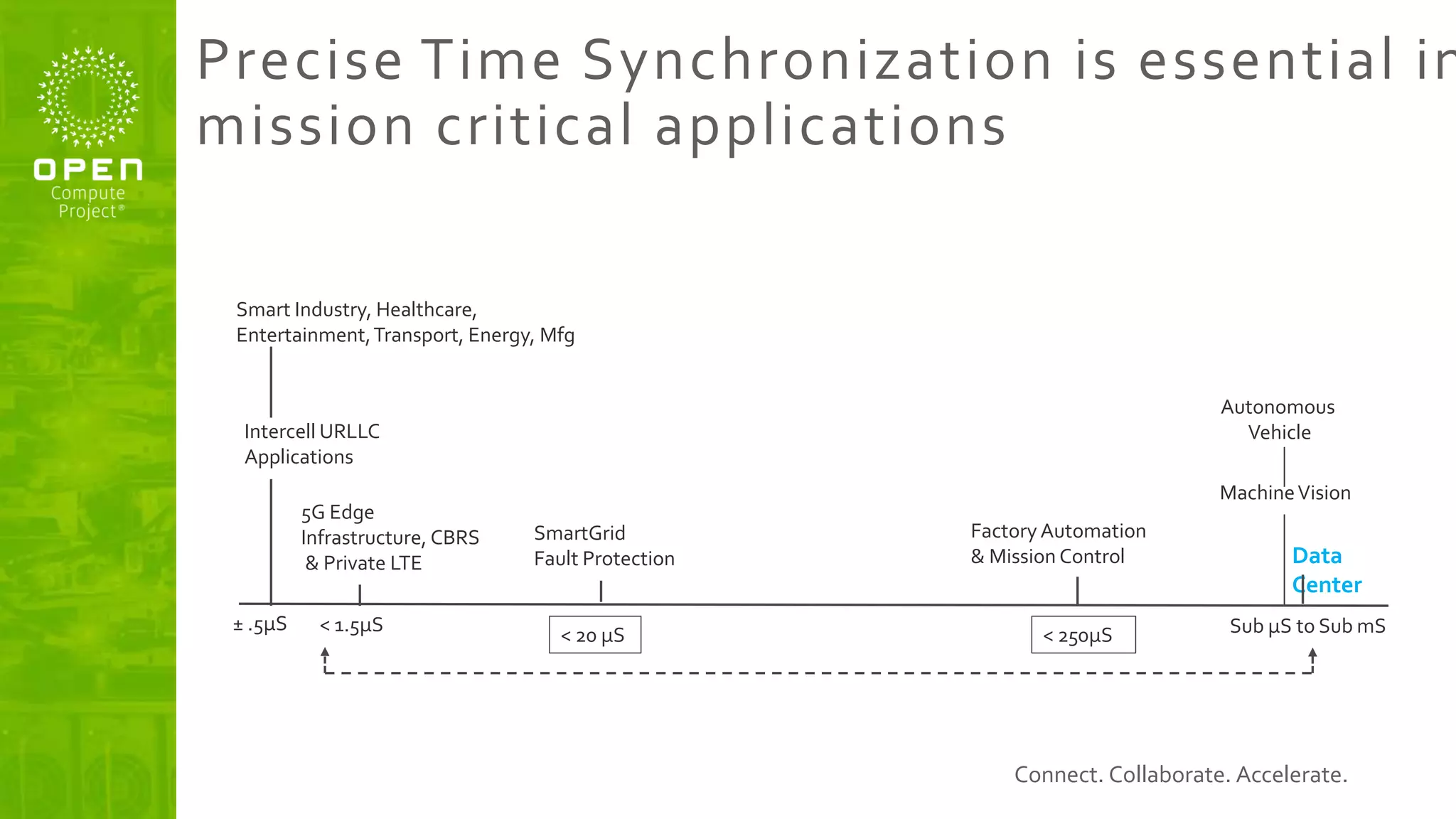
Precise Time Synchronization is essential in
mission critical applications
< 1.5µS < 250µS
Factory Automation
& Mission Control
< 20 µS
SmartGrid
Fault Protection
5G Edge
Infrastructure, CBRS
& Private LTE Data
Center
Intercell URLLC
Applications
± .5µS
Smart Industry, Healthcare,
Entertainment,Transport, Energy, Mfg
Sub µS to Sub mS
MachineVision
Autonomous
Vehicle
Connect. Collaborate. Accelerate.
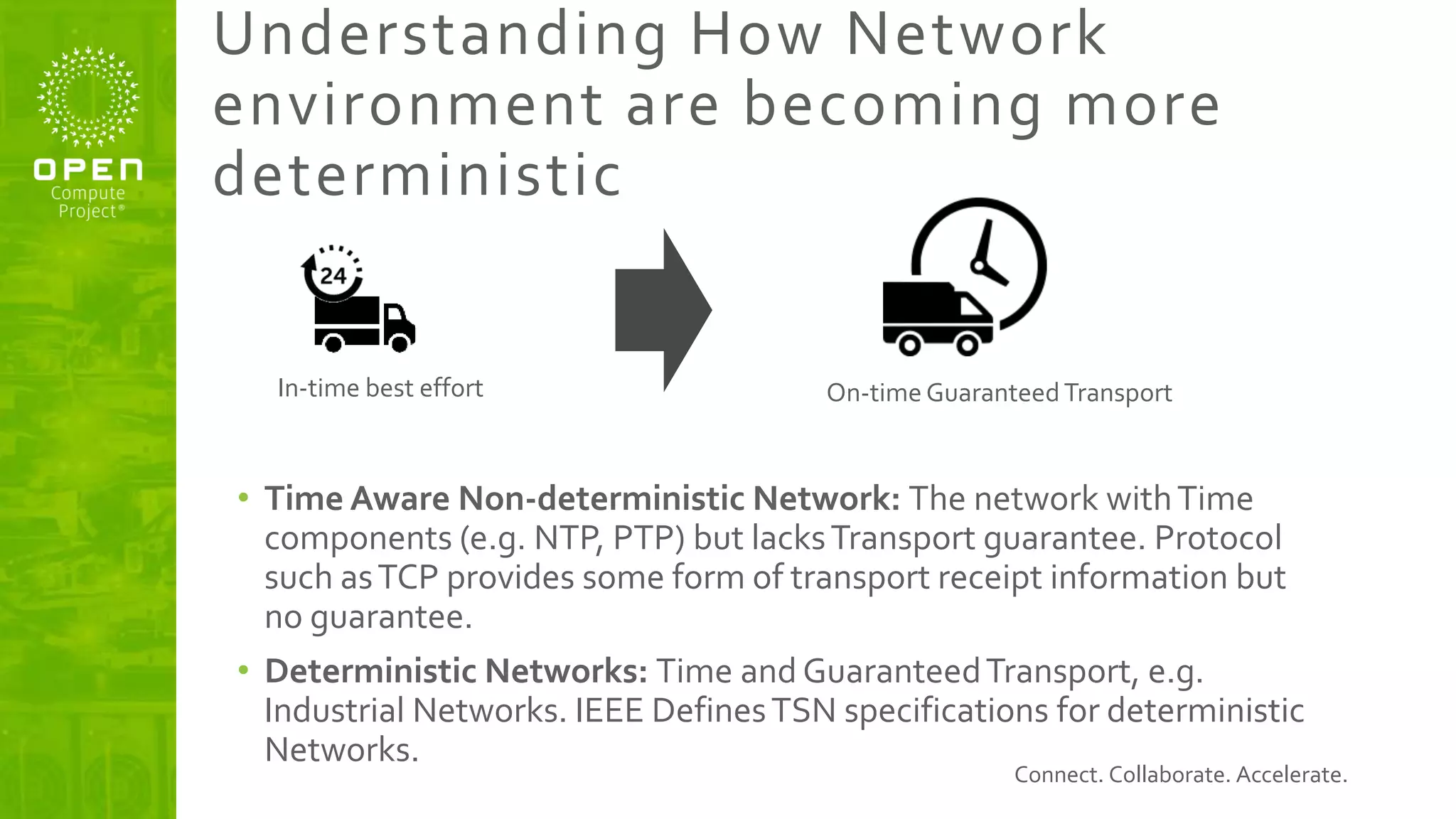
Understanding How Network
environment are becoming more
deterministic
• Time Aware Non-deterministic Network: The network withTime
components (e.g. NTP, PTP) but lacksTransport guarantee. Protocol
such asTCP provides some form of transport receipt information but
no guarantee.
• Deterministic Networks: Time and GuaranteedTransport, e.g.
Industrial Networks. IEEE DefinesTSN specifications for deterministic
Networks.
In-time best effort On-time Guaranteed Transport
Connect. Collaborate. Accelerate.
Time Error Budget consideration for
the synchronization of Time Aware
Non-Deterministic Network
• Device level Clock Drift: Clock Drift is measured inTE (Time
Error) budget. AT-GM should be <100ns andT-BC <50 ns in
TE.
• Packet DelayVariation (PDV): Due to queuing mechanism,
networking gear may induce significant PDVs. A non PTP
aware switch may induce more than 180 ns in PDV.
• AccumulatedTime Error: It is measured at device level with
TE of incoming port and outgoing port.
• Link Asymmetries: AllTE includingTE induced by cables and
PHYs etc.
Connect. Collaborate. Accelerate.
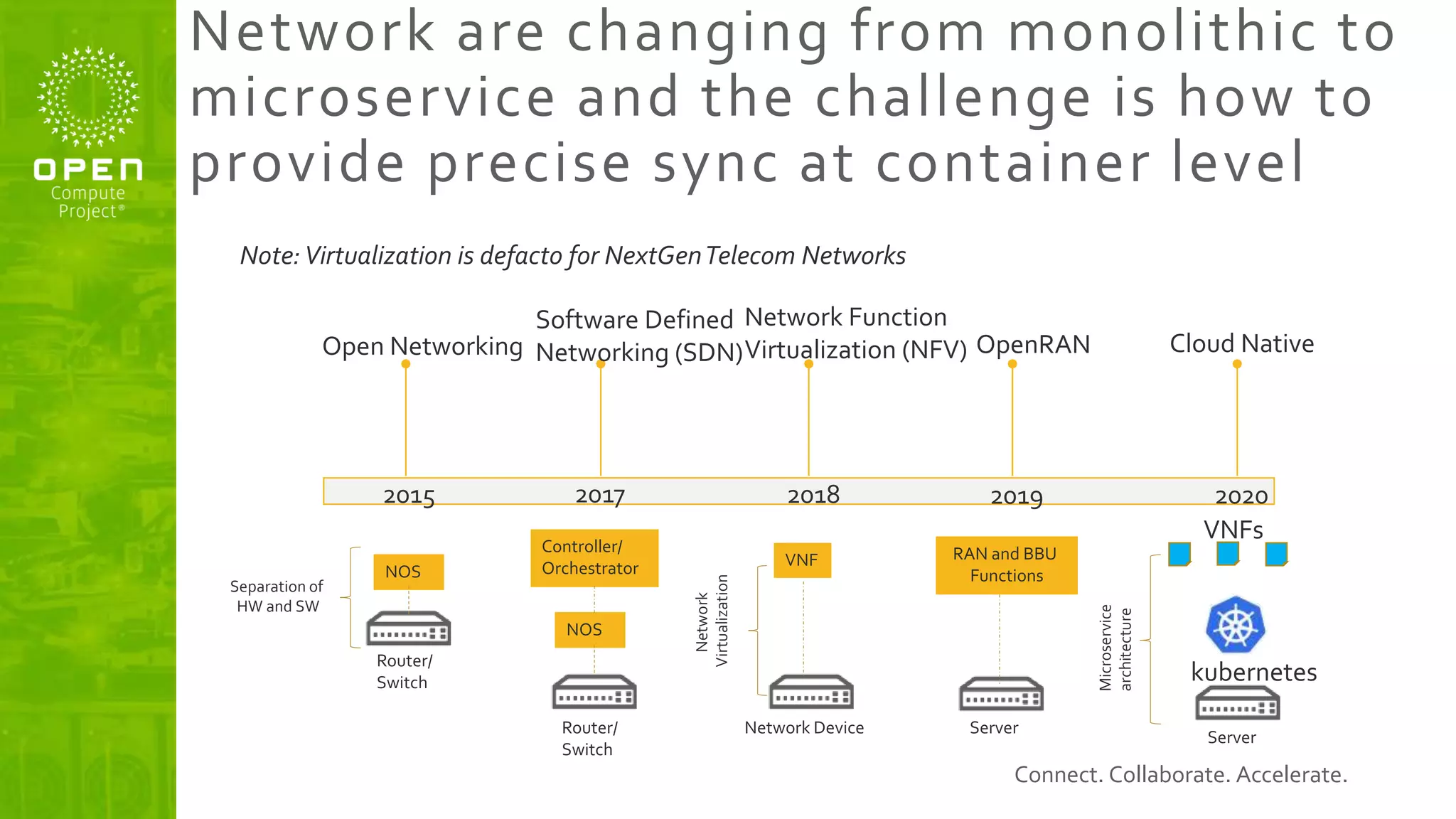
Network are changing from monolithic to
microservice and the challenge is how to
provide precise sync at container level
2015
NOS
Separation of
HW and SW
Open Networking
2017
NOS
Controller/
Orchestrator
Software Defined
Networking (SDN)
2018
Router/
Switch
Router/
Switch
Network Device
VNF
Network Function
Virtualization (NFV)
Network
Virtualization
2019
Server
RAN and BBU
Functions
OpenRAN
2020
Server
kubernetes
VNFs
Microservice
architecture
Cloud Native
Note:Virtualization is defacto for NextGenTelecom Networks
Connect. Collaborate. Accelerate.
Guaranteeing end-to-end time requires
identifying and mitigating sources of Time
error in the networks
T-GM T-BC T-BC T-BC
End device or
application
T-TSC
Time Error Generation
<100 ns
[G.8272]
DynamicTime Error (dTE)
<20 ns perT-BC
ConstantTime Error (cTE)
<50 ns perT-BC (typeA)
<20 ns perT-BC (type B)
cTE generated at link chain
Noise generated by
end application
[ITU-T defines telecom base
station application to be
measured <150ns]
Ref: G.8271/Y.1366.1
Connect. Collaborate. Accelerate.
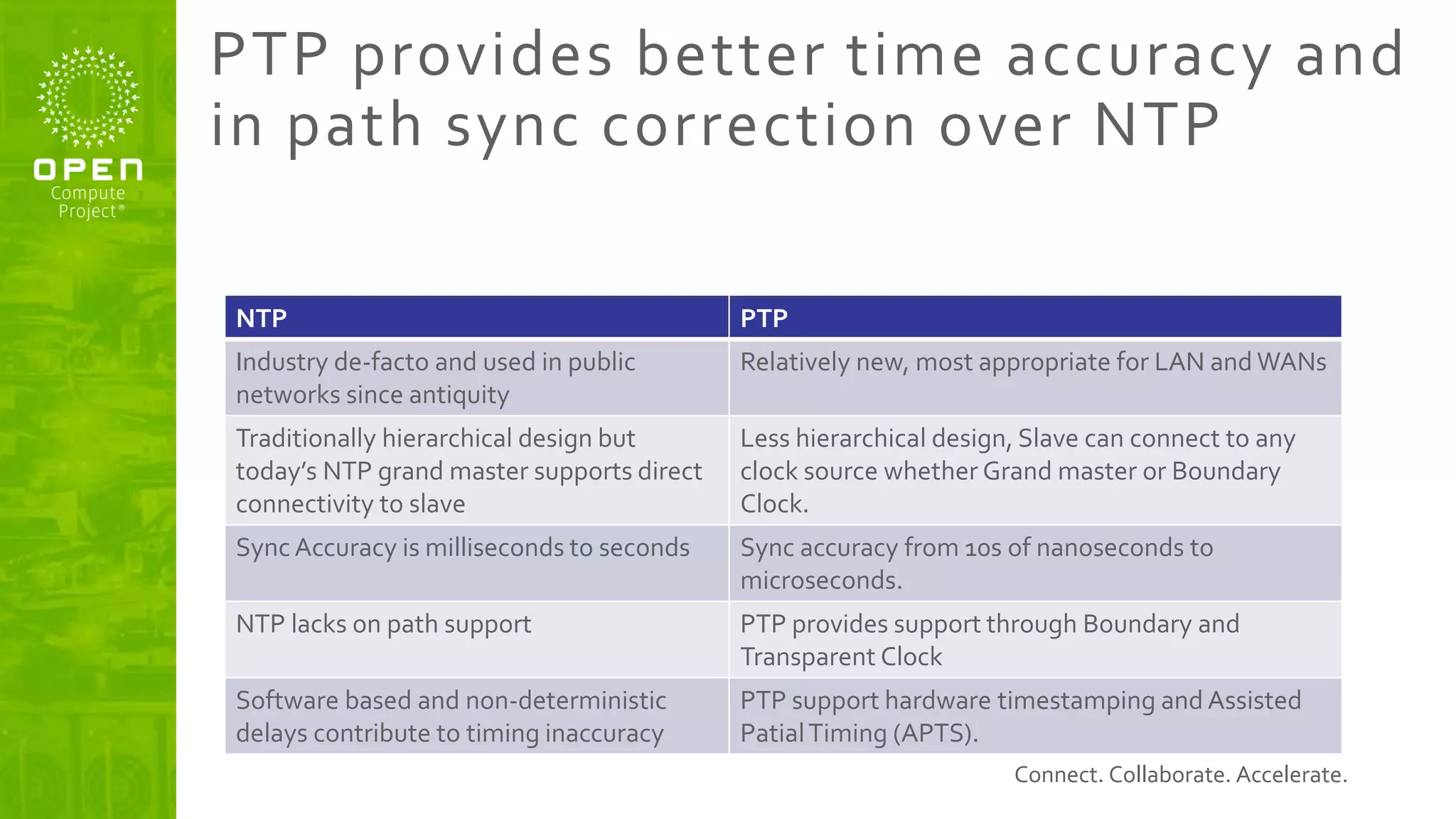
PTP provides better time accuracy and
in path sync correction over NTP
NTP PTP
Industry de-facto and used in public
networks since antiquity
Relatively new, most appropriate for LAN and WANs
Traditionally hierarchical design but
today’s NTP grand master supports direct
connectivity to slave
Less hierarchical design, Slave can connect to any
clock source whether Grand master or Boundary
Clock.
Sync Accuracy is milliseconds to seconds Sync accuracy from 10s of nanoseconds to
microseconds.
NTP lacks on path support PTP provides support through Boundary and
Transparent Clock
Software based and non-deterministic
delays contribute to timing inaccuracy
PTP support hardware timestamping and Assisted
PatialTiming (APTS).
Connect. Collaborate. Accelerate.
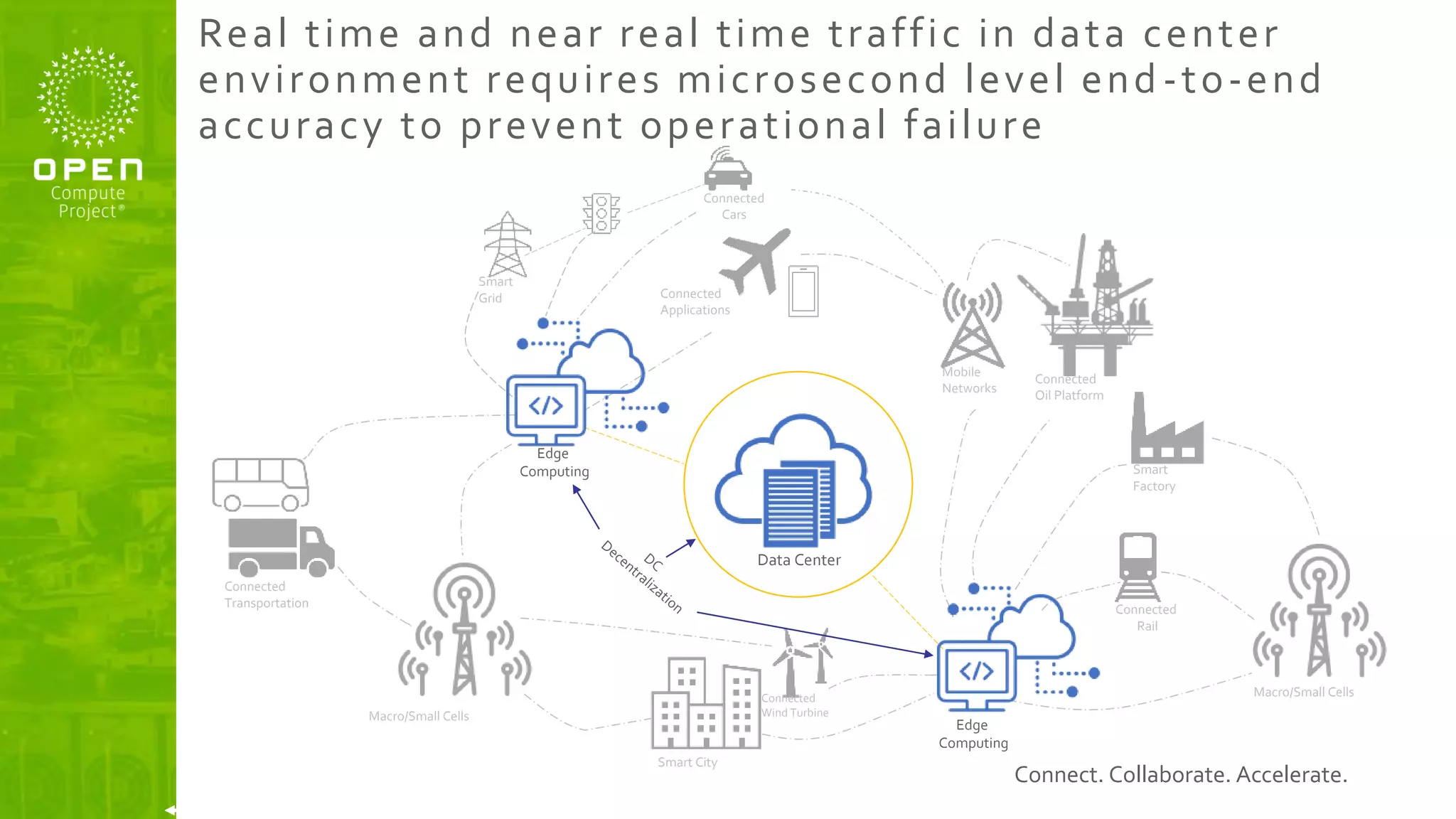
Real time and near real time traffic in data center
environment requires microsecond level end -to-end
accuracy to prevent operational failure
Edge
Computing
Edge
Computing
Smart
Grid
Connected
Cars
Smart
Factory
Connected
Applications
Connected
Oil Platform
Connected
Rail
Connected
Transportation
Smart City
Data Center
Mobile
Networks
Connected
Wind Turbine
Macro/Small Cells
Macro/Small Cells
Time Synchronization
Connect. Collaborate. Accelerate.
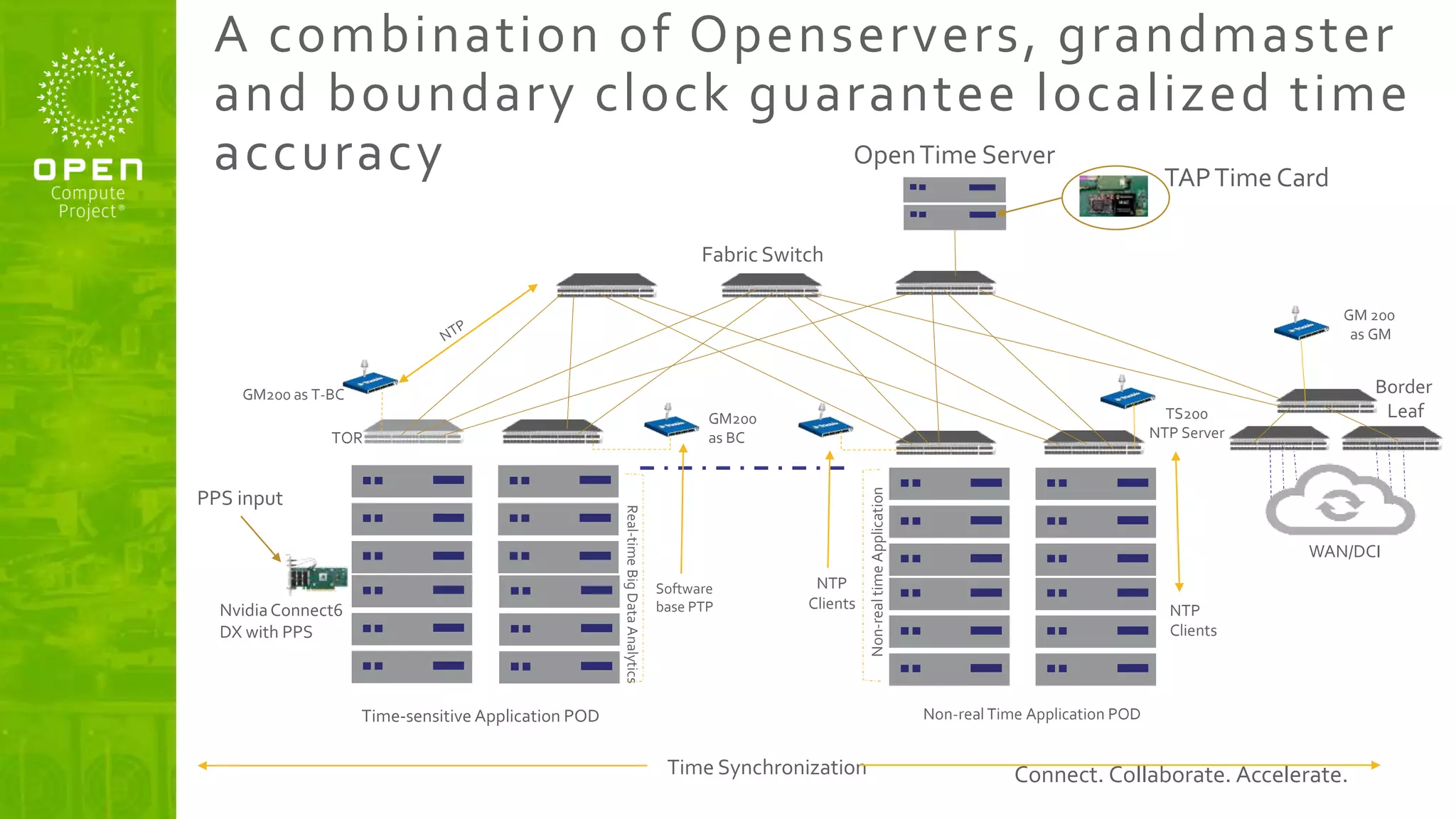
A combination of Openservers, grandmaster
and boundary clock guarantee localized time
accuracy
Time-sensitive Application POD Non-real Time Application POD
PTP
Slave
GM200 as T-BC
TOR TOR
WAN/DCI
Border
Leaf
Real-time
Big
Data
Analytics
Non-real
time
Application
Fabric Switch
Time Synchronization
GM 200
as GM
Software
base PTP
GM200
as BC
TS200
NTP Server
NTP
Clients
NTP
Clients
TOR
OpenTime Server
TAPTime Card
NvidiaConnect6
DX with PPS
PPS input
Connect. Collaborate. Accelerate.
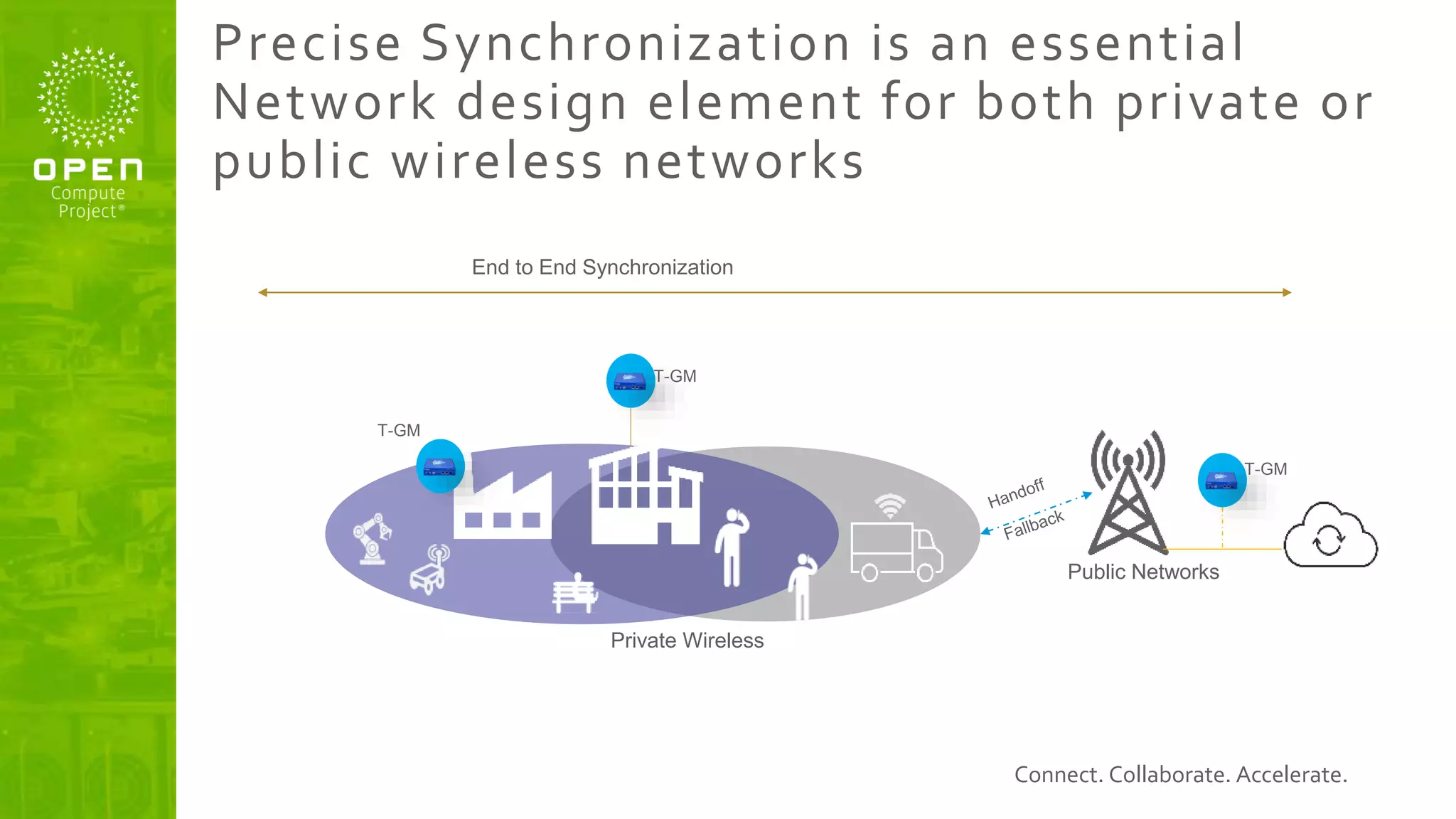
Precise Synchronization is an essential
Network design element for both private or
public wireless networks
Private Wireless
Public Networks
End to End Synchronization
T-GM
T-GM
T-GM
Connect. Collaborate. Accelerate.
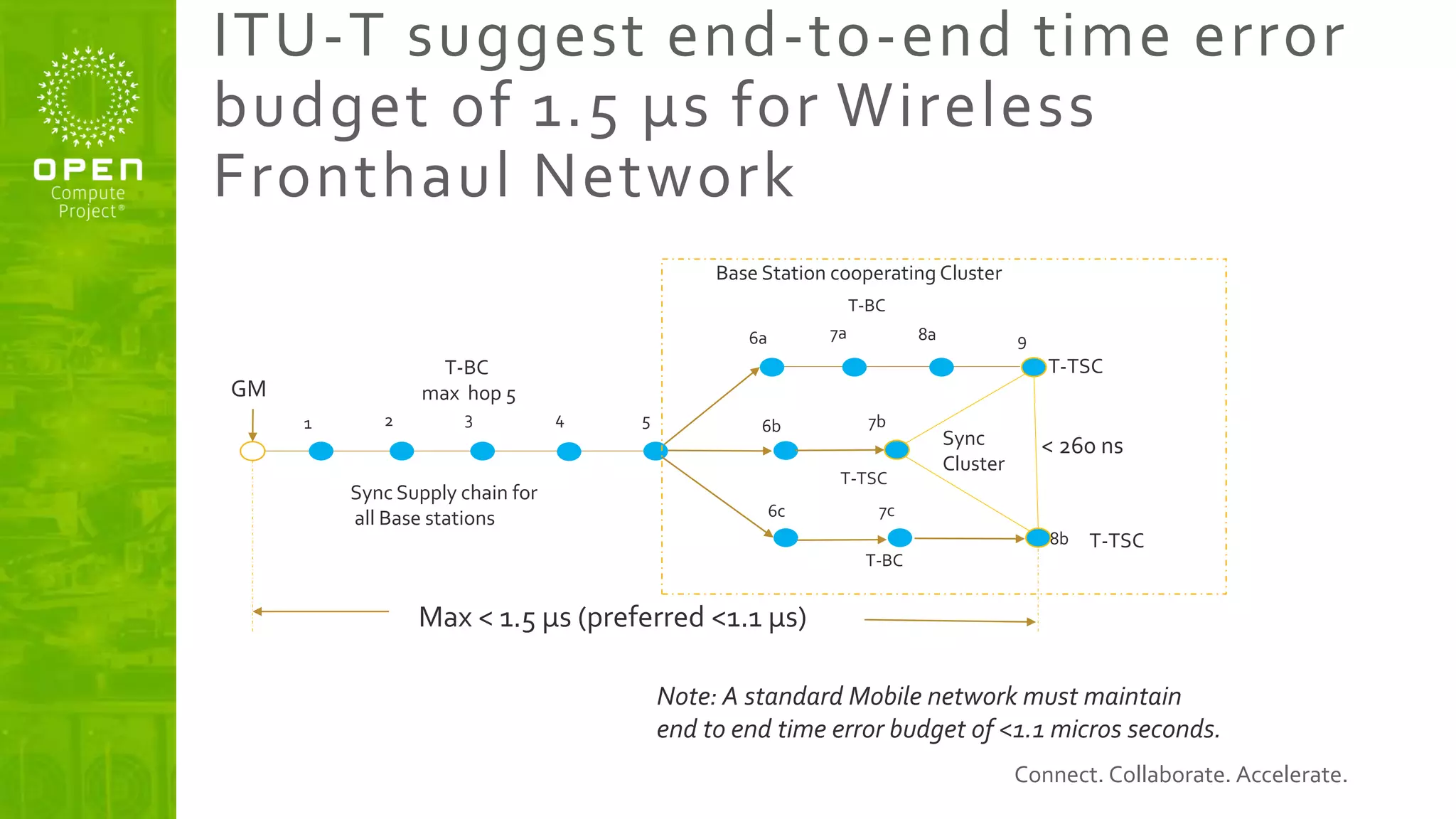
ITU-T suggest end-to-end time error
budget of 1.5 µs for Wireless
Fronthaul Network
GM
1 2 3 4 5 6b 7b
Sync
Cluster
< 260 ns
Sync Supply chain for
all Base stations
T-BC
max hop 5
6c 7c
8b
9
6a 7a 8a
Max < 1.5 µs (preferred <1.1 µs)
T-TSC
T-TSC
T-TSC
T-BC
T-BC
Base Station cooperating Cluster
Note: A standard Mobile network must maintain
end to end time error budget of <1.1 micros seconds.
Connect. Collaborate. Accelerate.
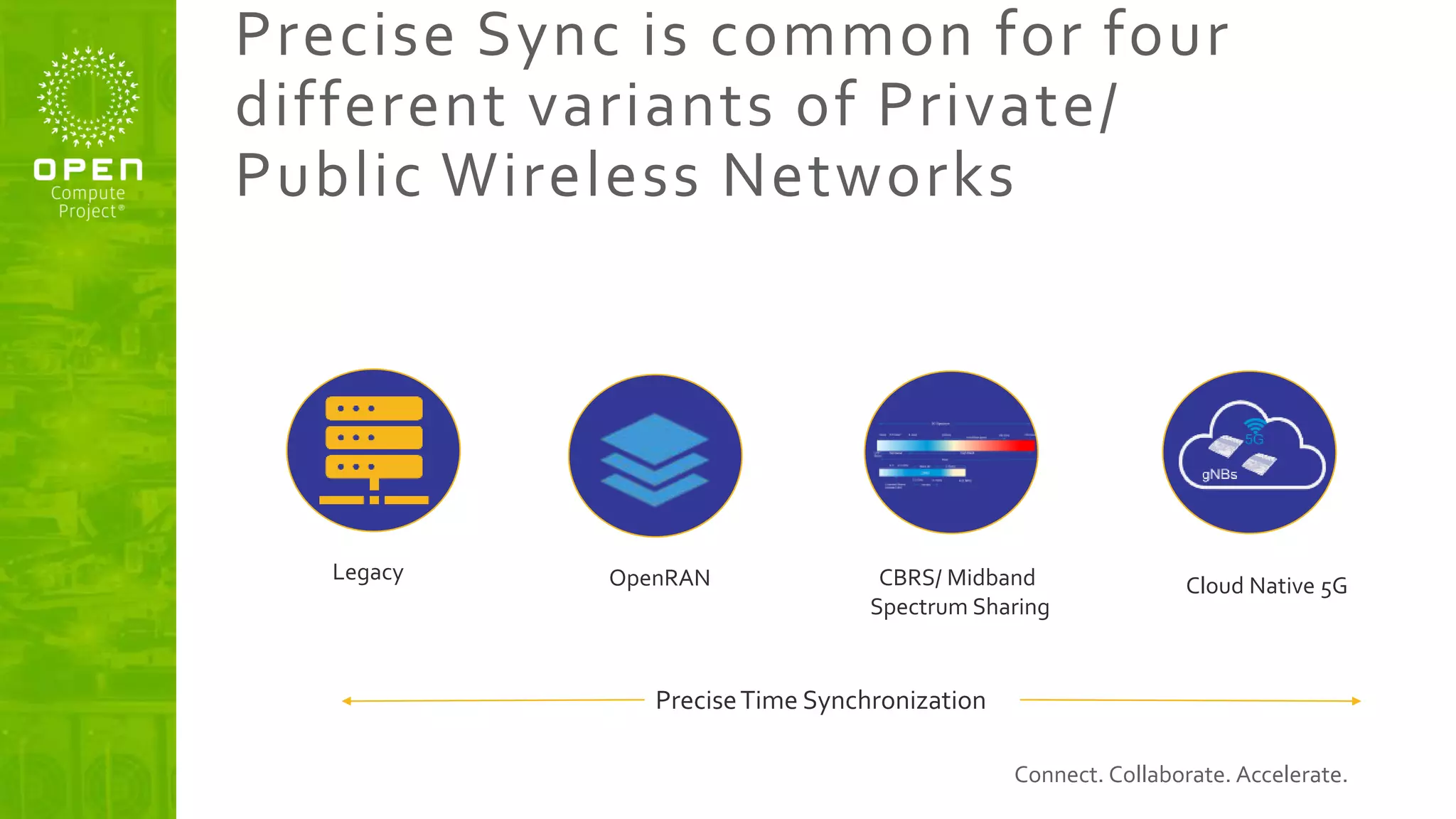
Precise Sync is common for four
different variants of Private/
Public Wireless Networks
CBRS/ Midband
Spectrum Sharing
Cloud Native 5G
OpenRAN
Legacy
PreciseTime Synchronization
Connect. Collaborate. Accelerate.
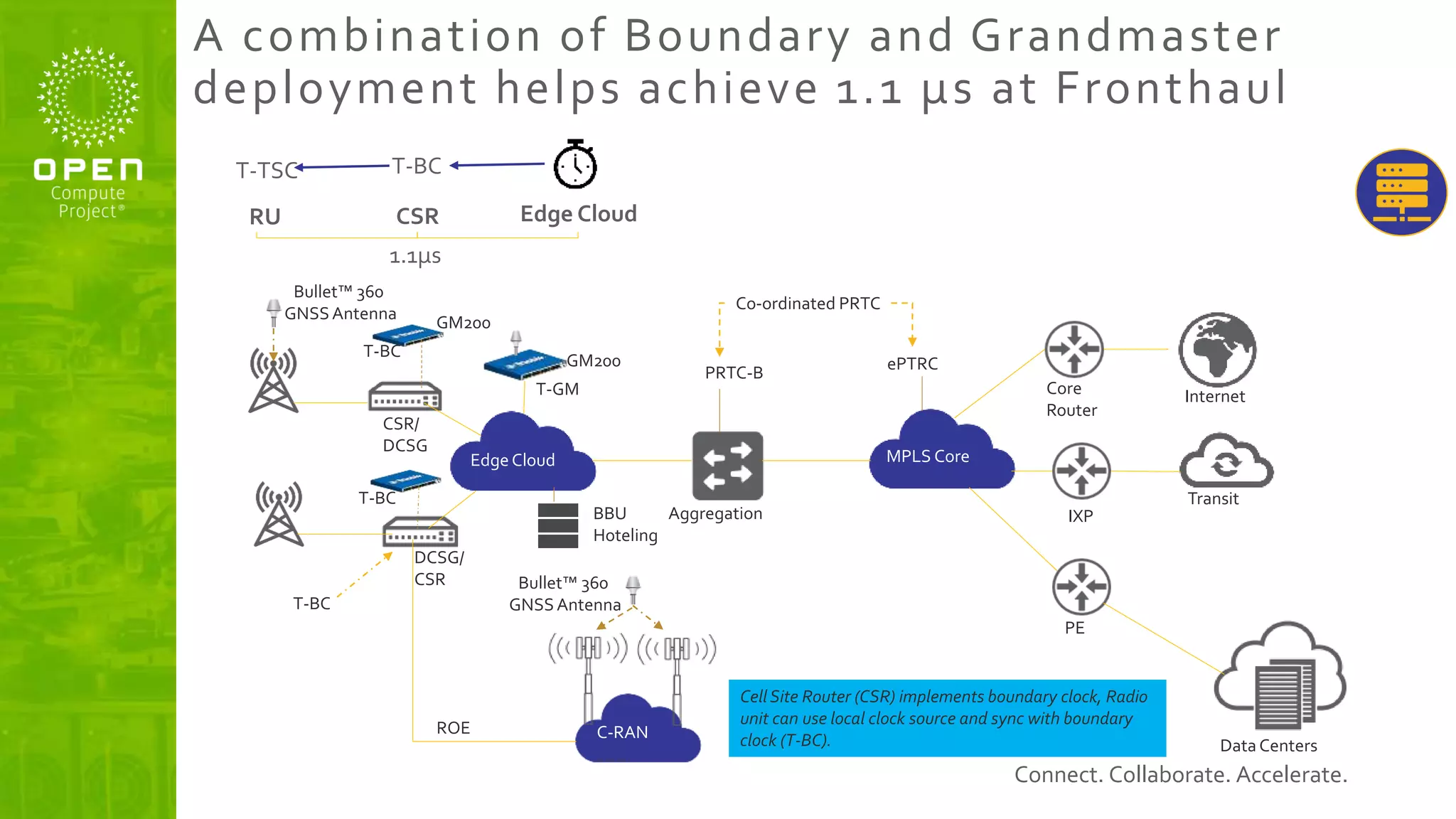
A combination of Boundary and Grandmaster
deployment helps achieve 1.1 µs at Fronthaul
Edge Cloud MPLS Core
IXP
Core
Router
PE
Internet
Data Centers
Aggregation
C-RAN
ROE
GM200
CSR/
DCSG
DCSG/
CSR
Transit
T-BC
T-BC
T-BC
PRTC-B ePTRC
Co-ordinated PRTC
Bullet™ 360
GNSSAntenna
Bullet™ 360
GNSSAntenna GM200
T-GM
BBU
Hoteling
CellSite Router (CSR) implements boundary clock, Radio
unit can use local clock source and sync with boundary
clock (T-BC).
RU CSR Edge Cloud
T-BC
T-TSC
1.1µs
Connect. Collaborate. Accelerate.
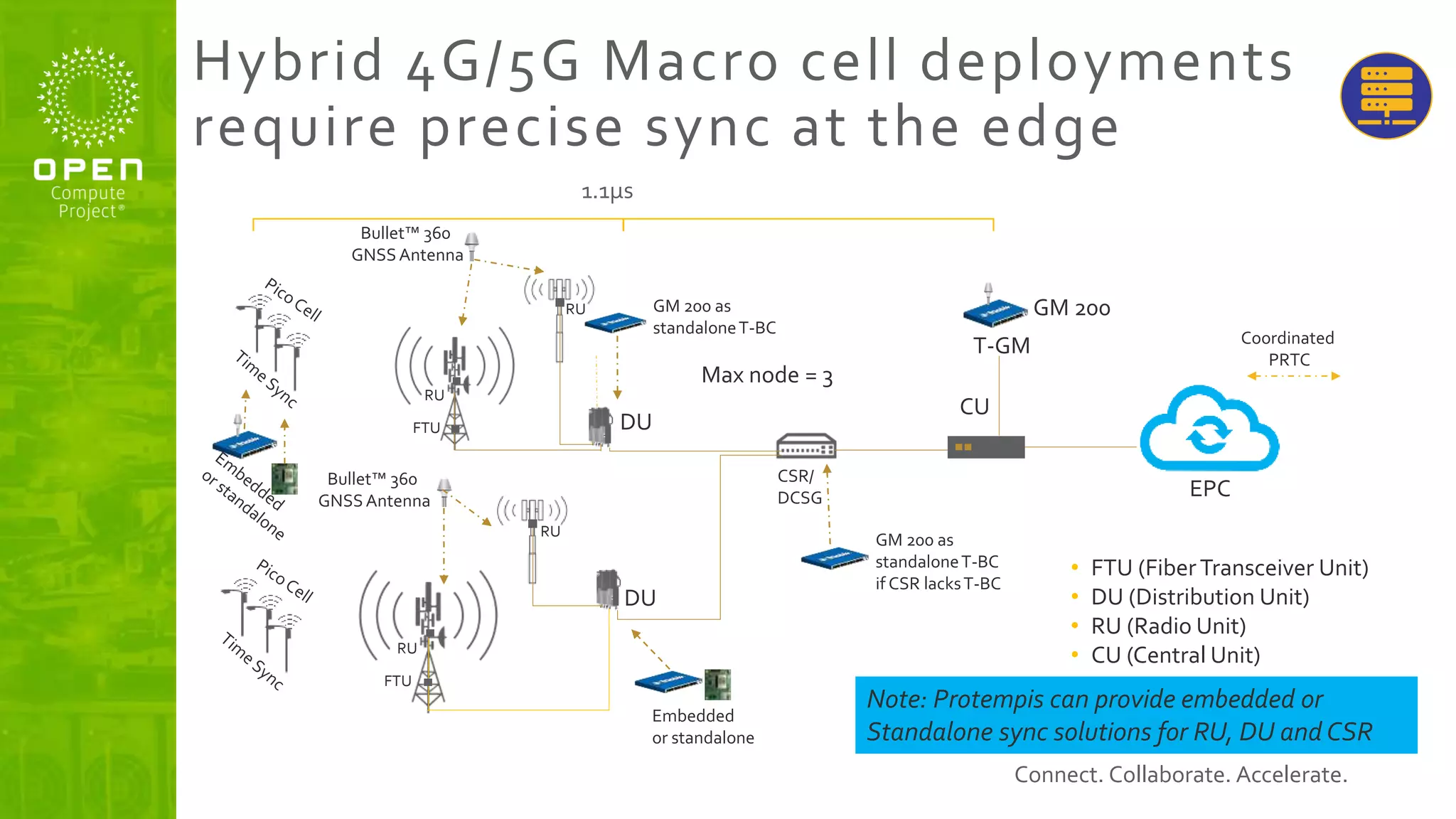
Hybrid 4G/5G Macro cell deployments
require precise sync at the edge
CU
EPC
T-GM
Max node = 3
CSR/
DCSG
DU
DU
RU
RU
FTU
FTU
RU
• FTU (Fiber Transceiver Unit)
• DU (Distribution Unit)
• RU (Radio Unit)
• CU (Central Unit)
RU
GM 200
Coordinated
PRTC
GM 200 as
standaloneT-BC
Embedded
or standalone
GM 200 as
standaloneT-BC
if CSR lacksT-BC
Bullet™ 360
GNSSAntenna
Bullet™ 360
GNSSAntenna
Note: Protempis can provide embedded or
Standalone sync solutions for RU, DU and CSR
1.1µs
Connect. Collaborate. Accelerate.
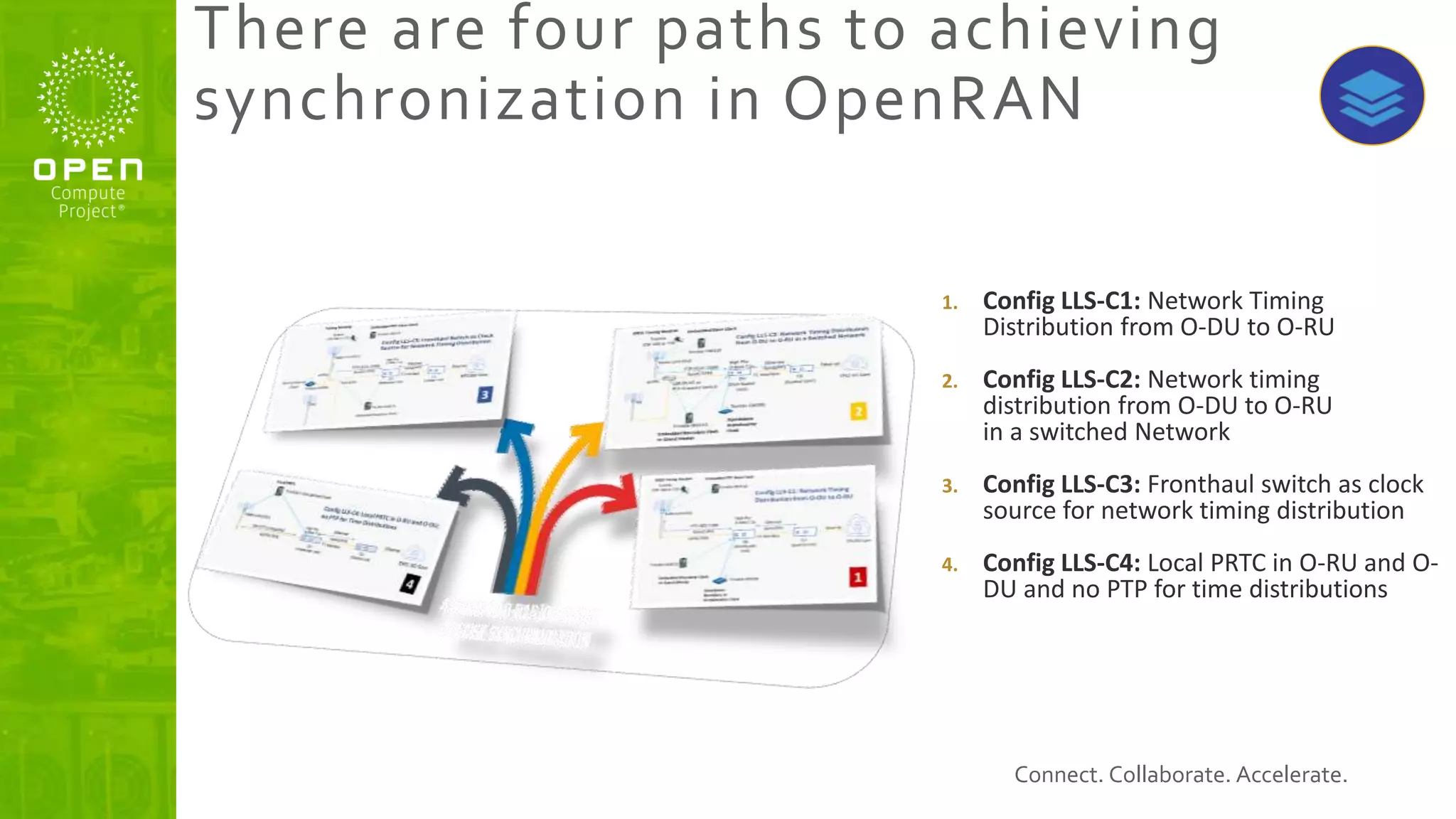
There are four paths to achieving
synchronization in OpenRAN
1. Config LLS-C1: Network Timing
Distribution from O-DU to O-RU
2. Config LLS-C2: Network timing
distribution from O-DU to O-RU
in a switched Network
3. Config LLS-C3: Fronthaul switch as clock
source for network timing distribution
4. Config LLS-C4: Local PRTC in O-RU and O-
DU and no PTP for time distributions
Connect. Collaborate. Accelerate.
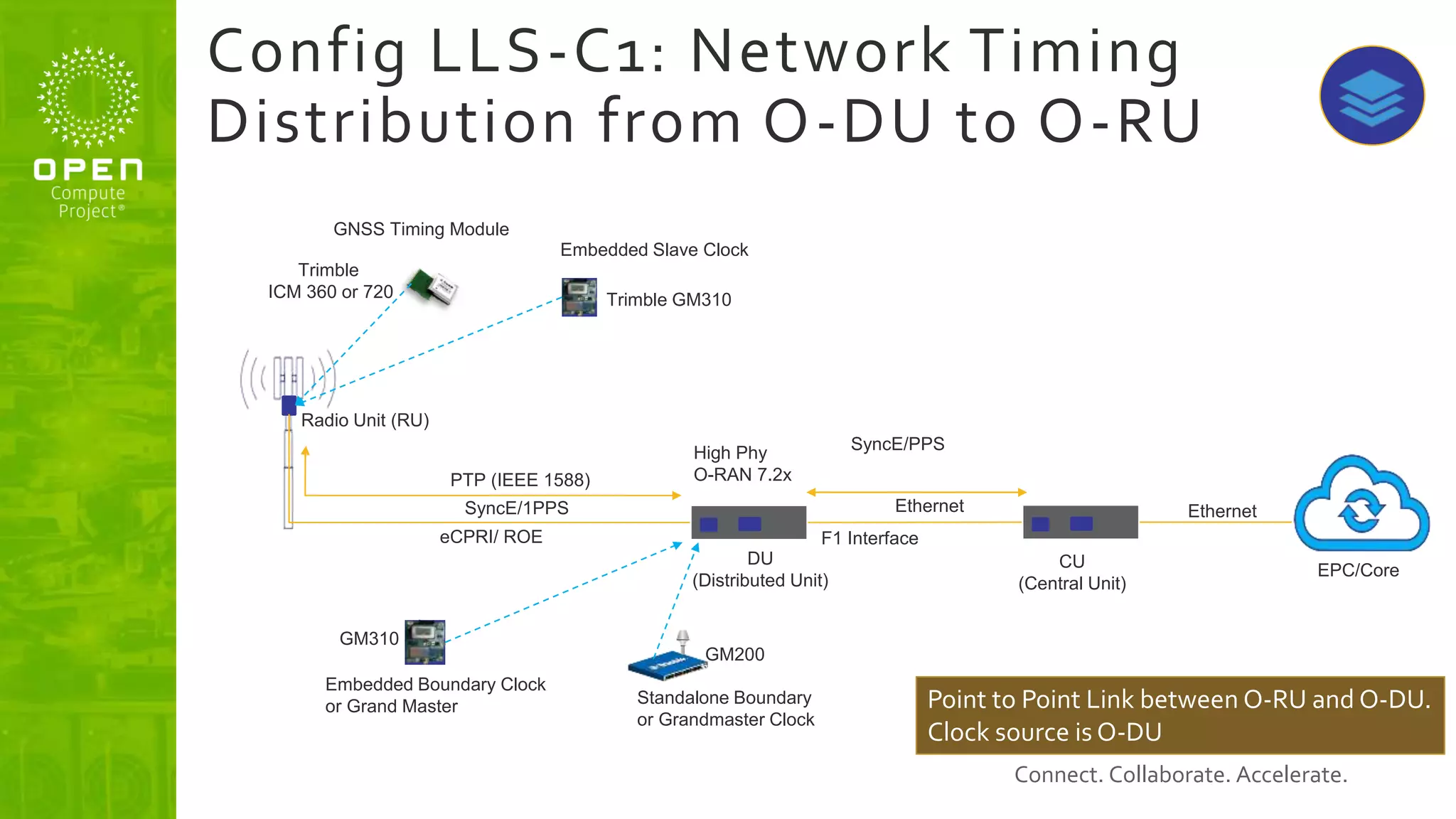
Config LLS-C1: Network Timing
Distribution from O-DU to O-RU
DU
(Distributed Unit)
CU
(Central Unit)
Radio Unit (RU)
eCPRI/ ROE F1 Interface
Ethernet
SyncE/1PPS
SyncE/PPS
EPC/Core
High Phy
O-RAN 7.2x
Ethernet
GNSS Timing Module
Trimble
ICM 360 or 720
Embedded Slave Clock
Trimble GM310
Embedded Boundary Clock
or Grand Master
PTP (IEEE 1588)
Standalone Boundary
or Grandmaster Clock
GM200
GM310
Point to Point Link between O-RU and O-DU.
Clock source is O-DU
Connect. Collaborate. Accelerate.
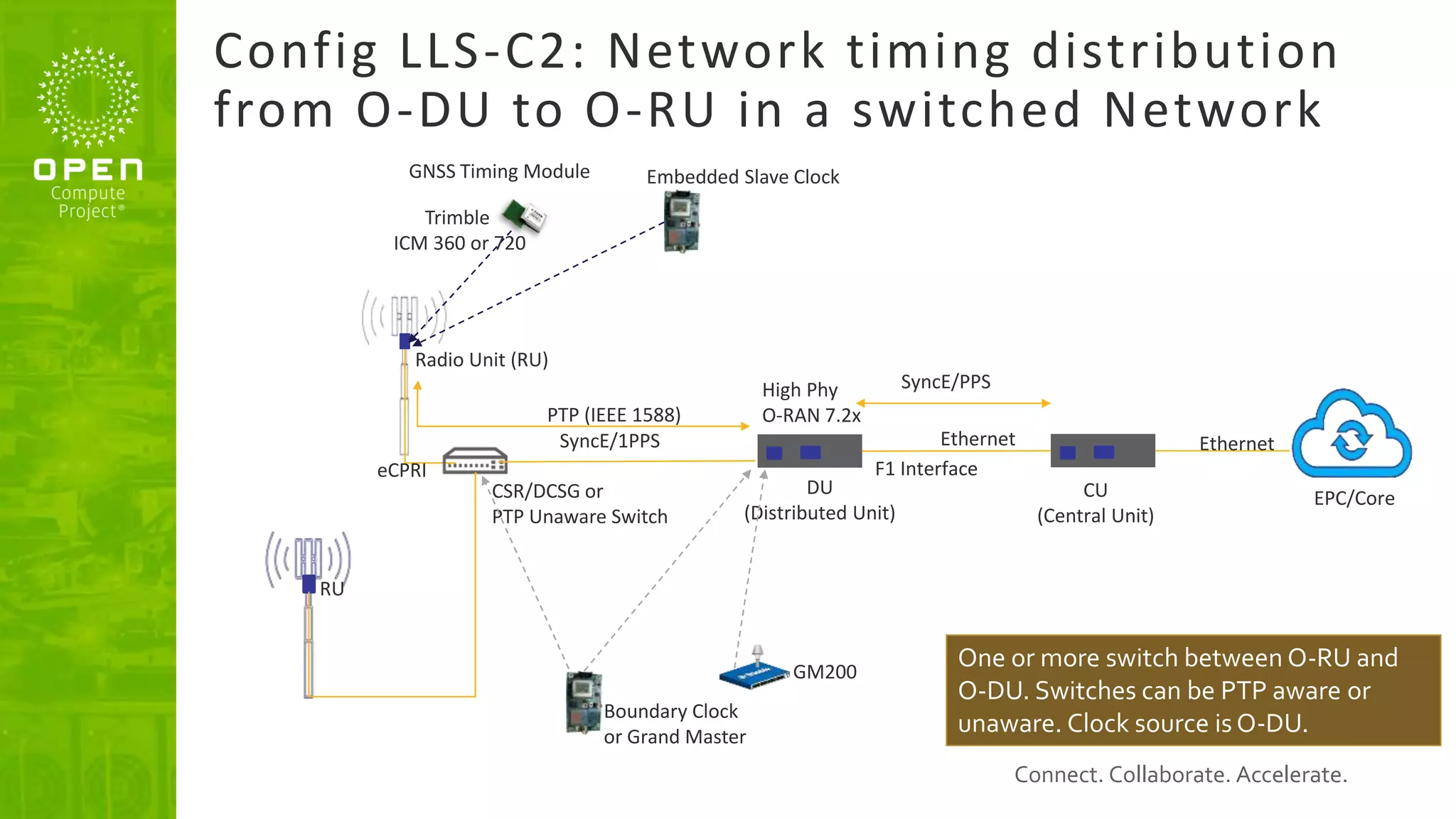
Config LLS-C2: Network timing distribution
from O-DU to O-RU in a switched Network
DU
(Distributed Unit)
CU
(Central Unit)
Radio Unit (RU)
eCPRI F1 Interface
Ethernet
SyncE/1PPS
SyncE/PPS
EPC/Core
High Phy
O-RAN 7.2x
Ethernet
GNSS Timing Module
Trimble
ICM 360 or 720
Embedded Slave Clock
Boundary Clock
or Grand Master
PTP (IEEE 1588)
GM200
CSR/DCSG or
PTP Unaware Switch
RU
One or more switch between O-RU and
O-DU. Switches can be PTP aware or
unaware. Clock source is O-DU.
Connect. Collaborate. Accelerate.
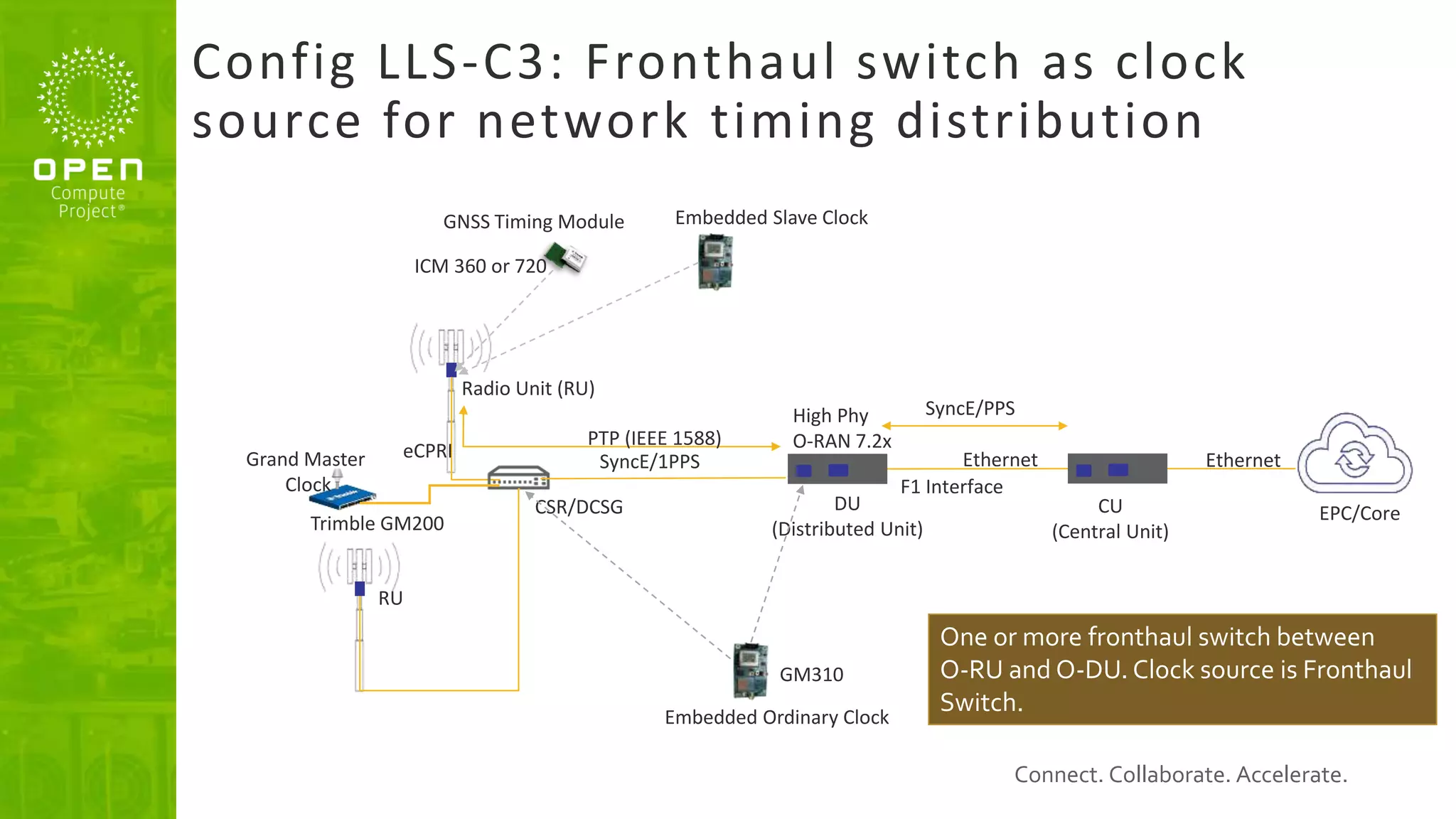
Config LLS-C3: Fronthaul switch as clock
source for network timing distribution
DU
(Distributed Unit)
CU
(Central Unit)
Radio Unit (RU)
eCPRI
F1 Interface
Ethernet
SyncE/1PPS
SyncE/PPS
EPC/Core
High Phy
O-RAN 7.2x
Ethernet
GNSS Timing Module
ICM 360 or 720
Embedded Slave Clock
Embedded Ordinary Clock
PTP (IEEE 1588)
Trimble GM200
GM310
CSR/DCSG
RU
Grand Master
Clock
One or more fronthaul switch between
O-RU and O-DU. Clock source is Fronthaul
Switch.
Connect. Collaborate. Accelerate.
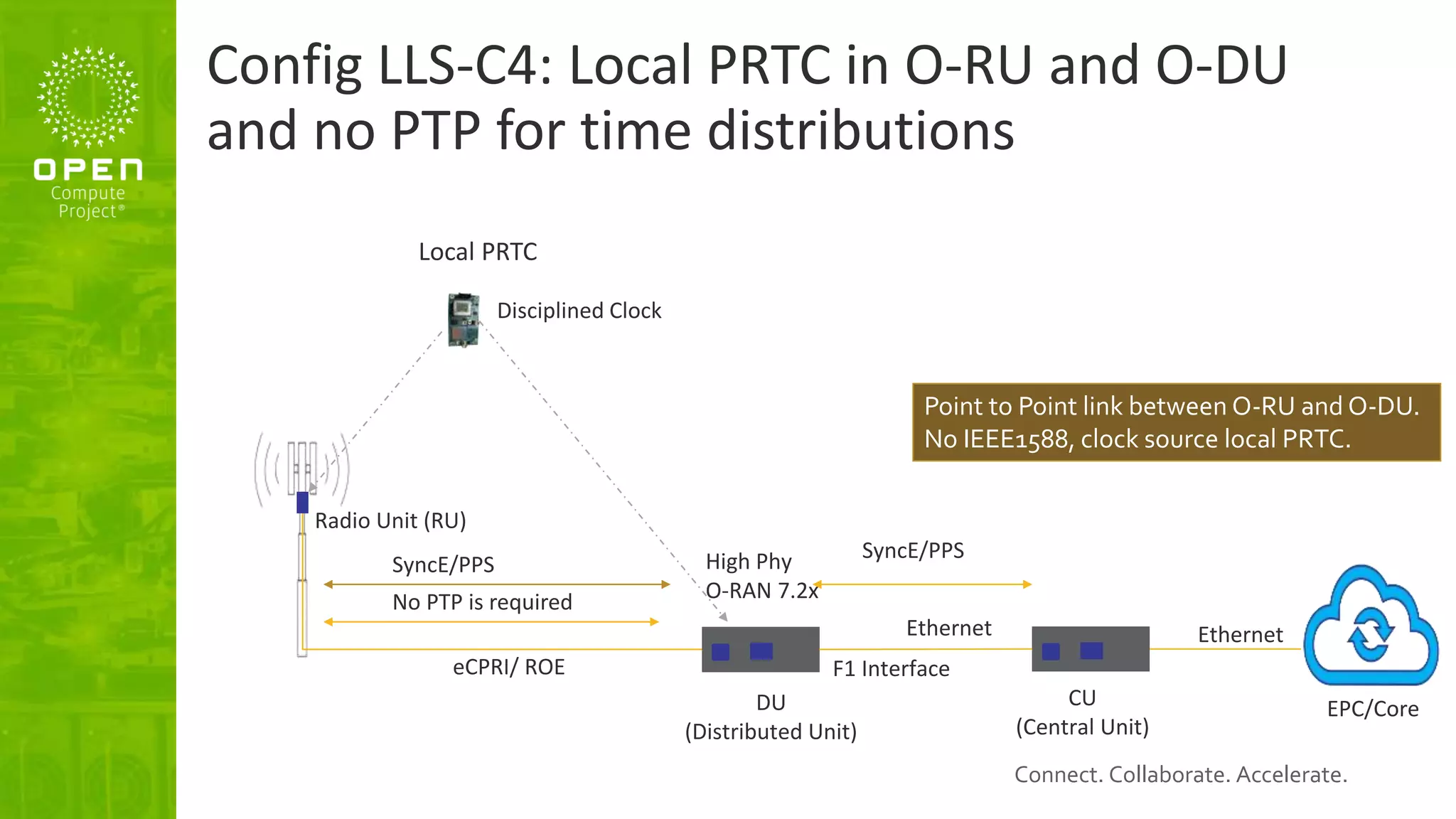
Config LLS-C4: Local PRTC in O-RU and O-DU
and no PTP for time distributions
DU
(Distributed Unit)
CU
(Central Unit)
Radio Unit (RU)
eCPRI/ ROE F1 Interface
Ethernet
SyncE/PPS
EPC/Core
High Phy
O-RAN 7.2x
Ethernet
Local PRTC
No PTP is required
Disciplined Clock
Point to Point link between O-RU and O-DU.
No IEEE1588, clock source local PRTC.
SyncE/PPS
Connect. Collaborate. Accelerate.
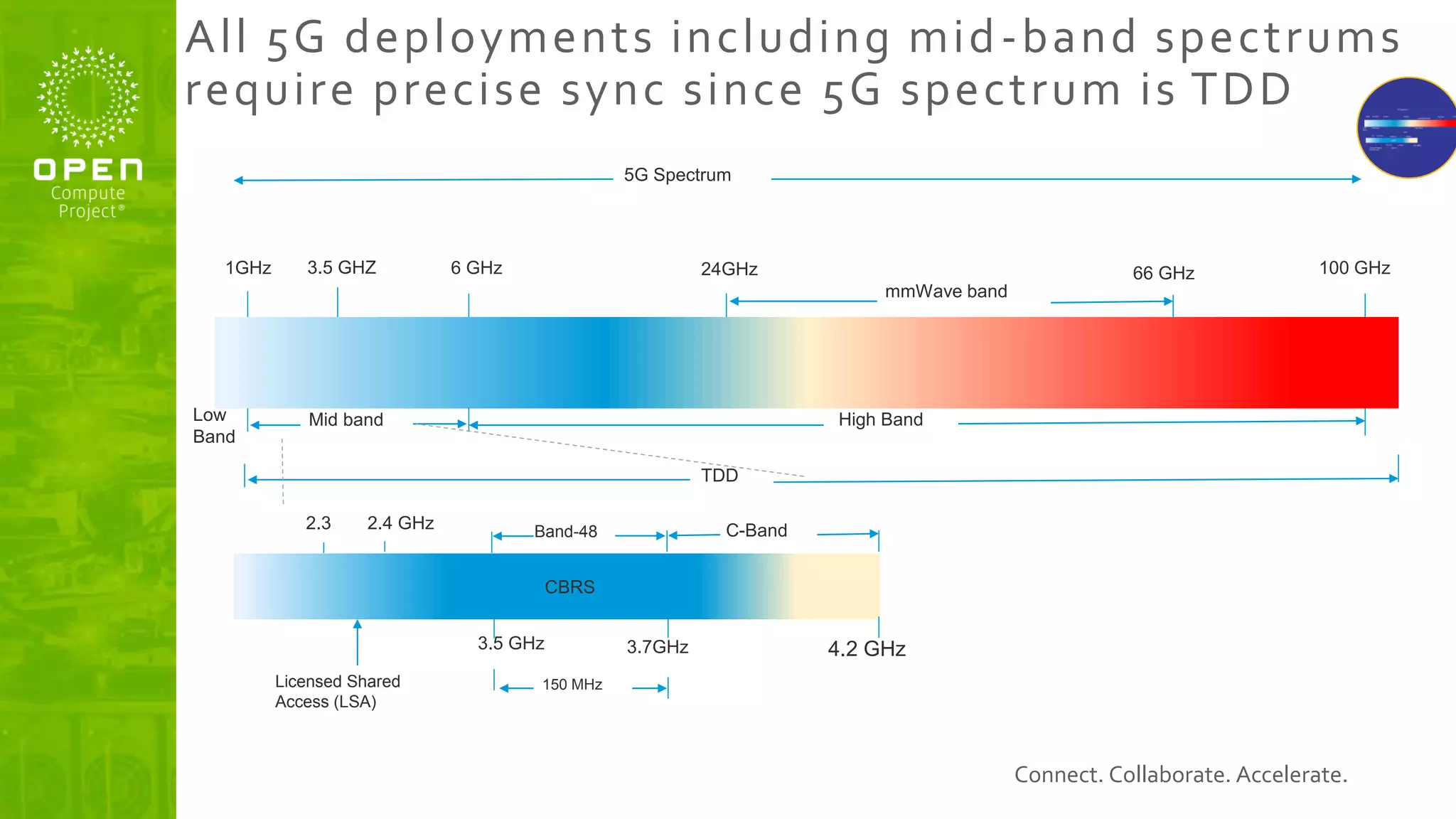
All 5G deployments including mid-band spectrums
require precise sync since 5G spectrum is TDD
100 GHz
6 GHz
1GHz
Mid band High Band
24GHz
TDD
Low
Band
3.5 GHZ
3.5 GHz 3.7GHz 4.2 GHz
CBRS
C-Band
150 MHz
5G Spectrum
2.3 2.4 GHz
Licensed Shared
Access (LSA)
66 GHz
mmWave band
Band-48
Connect. Collaborate. Accelerate.
GNSS Antenna
GM200
as T-GM
GM200 as T-BC
PTP-unaware
Switch
PTP-unaware
Switch
Neutral
Host
SAS
EPC
MNO
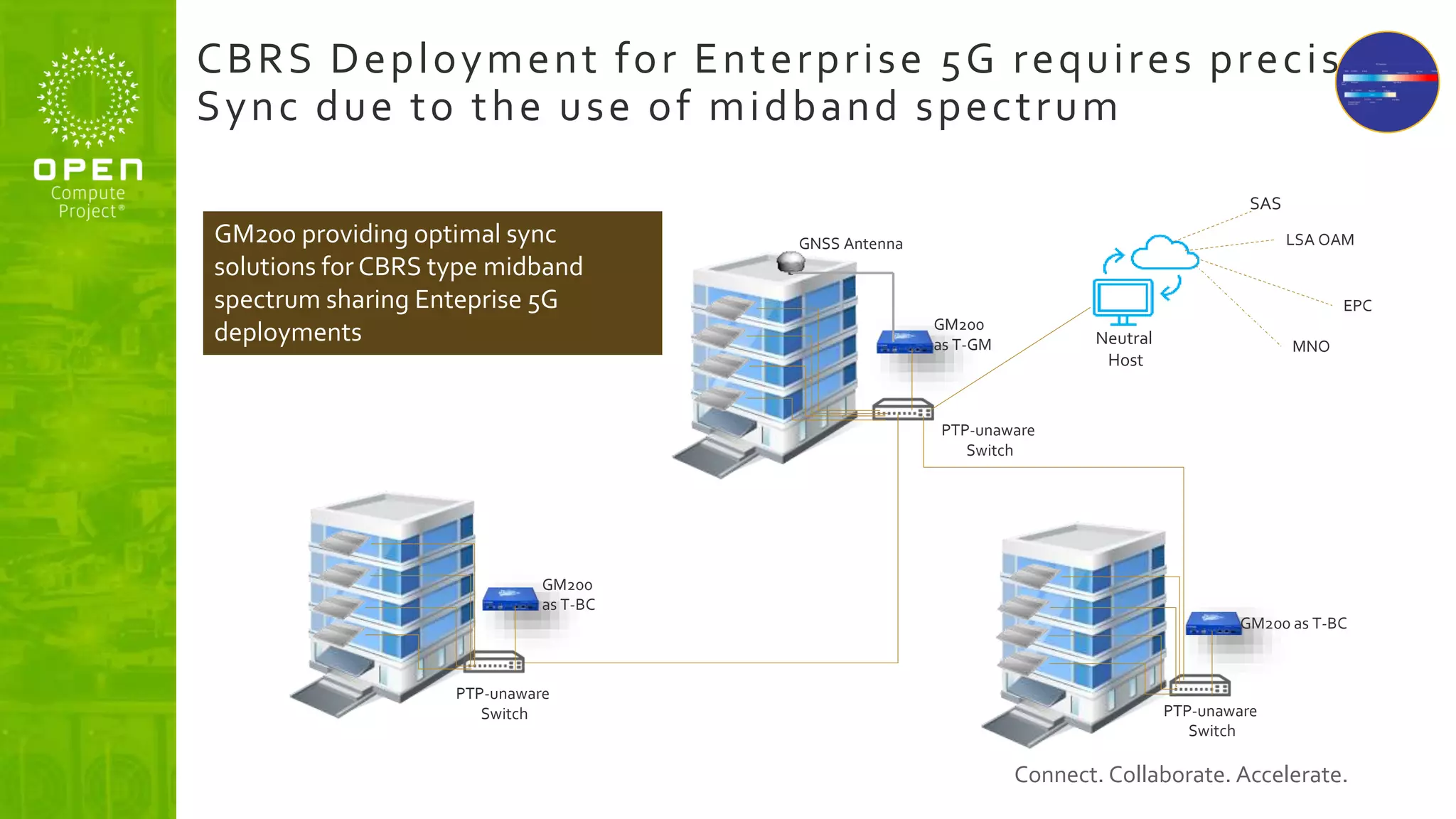
GM200 providing optimal sync
solutions for CBRS type midband
spectrum sharing Enteprise 5G
deployments
GM200
as T-BC
PTP-unaware
Switch
LSA OAM
CBRS Deployment for Enterprise 5G requires precise
Sync due to the use of midband spectrum
Connect. Collaborate. Accelerate.
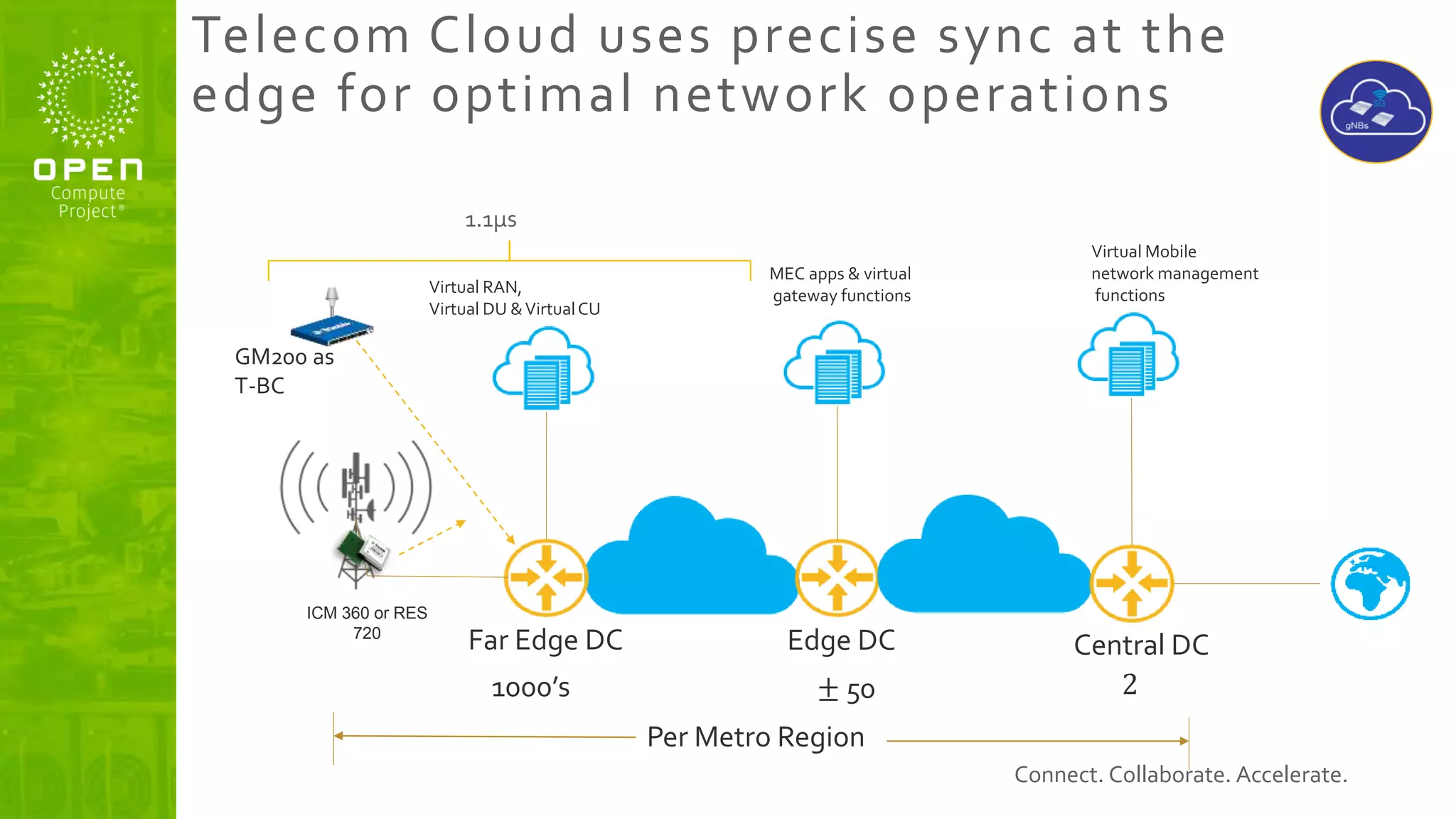
Telecom Cloud uses precise sync at the
edge for optimal network operations
Central DC
Edge DC
Far Edge DC
1000’s ± 50 2
Virtual RAN,
Virtual DU &VirtualCU
MEC apps & virtual
gateway functions
Virtual Mobile
network management
functions
Per Metro Region
GM200 as
T-BC
ICM 360 or RES
720
1.1µs
Connect. Collaborate. Accelerate.
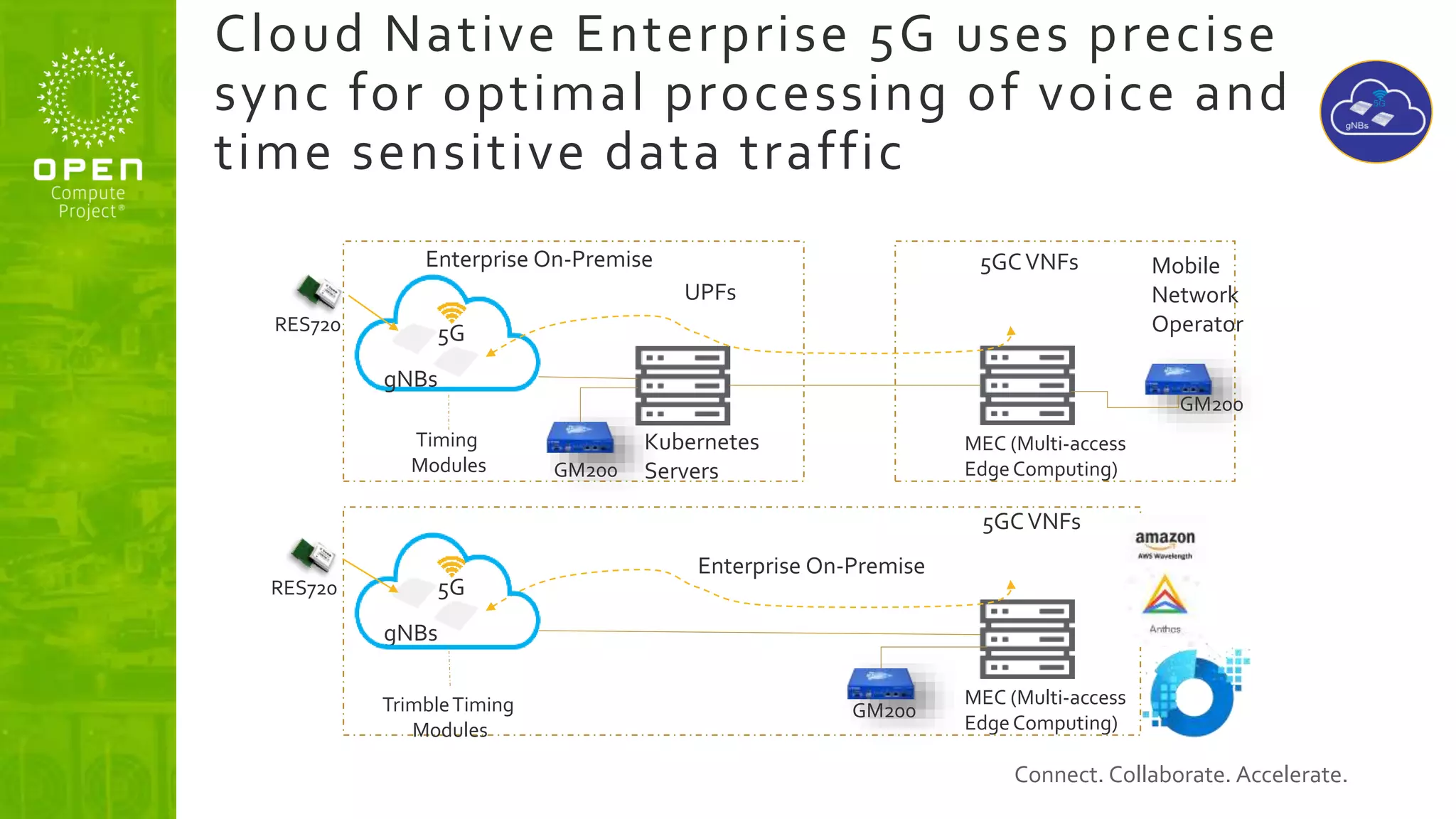
Cloud Native Enterprise 5G uses precise
sync for optimal processing of voice and
time sensitive data traffic
MEC (Multi-access
EdgeComputing)
5GCVNFs
Enterprise On-Premise
5G
gNBs
5G
gNBs
Kubernetes
Servers
UPFs
MEC (Multi-access
EdgeComputing)
5GCVNFs
Enterprise On-Premise Mobile
Network
Operator
GM200
GM200
Timing
Modules
TrimbleTiming
Modules
GM200
RES720
RES720
Connect. Collaborate. Accelerate.
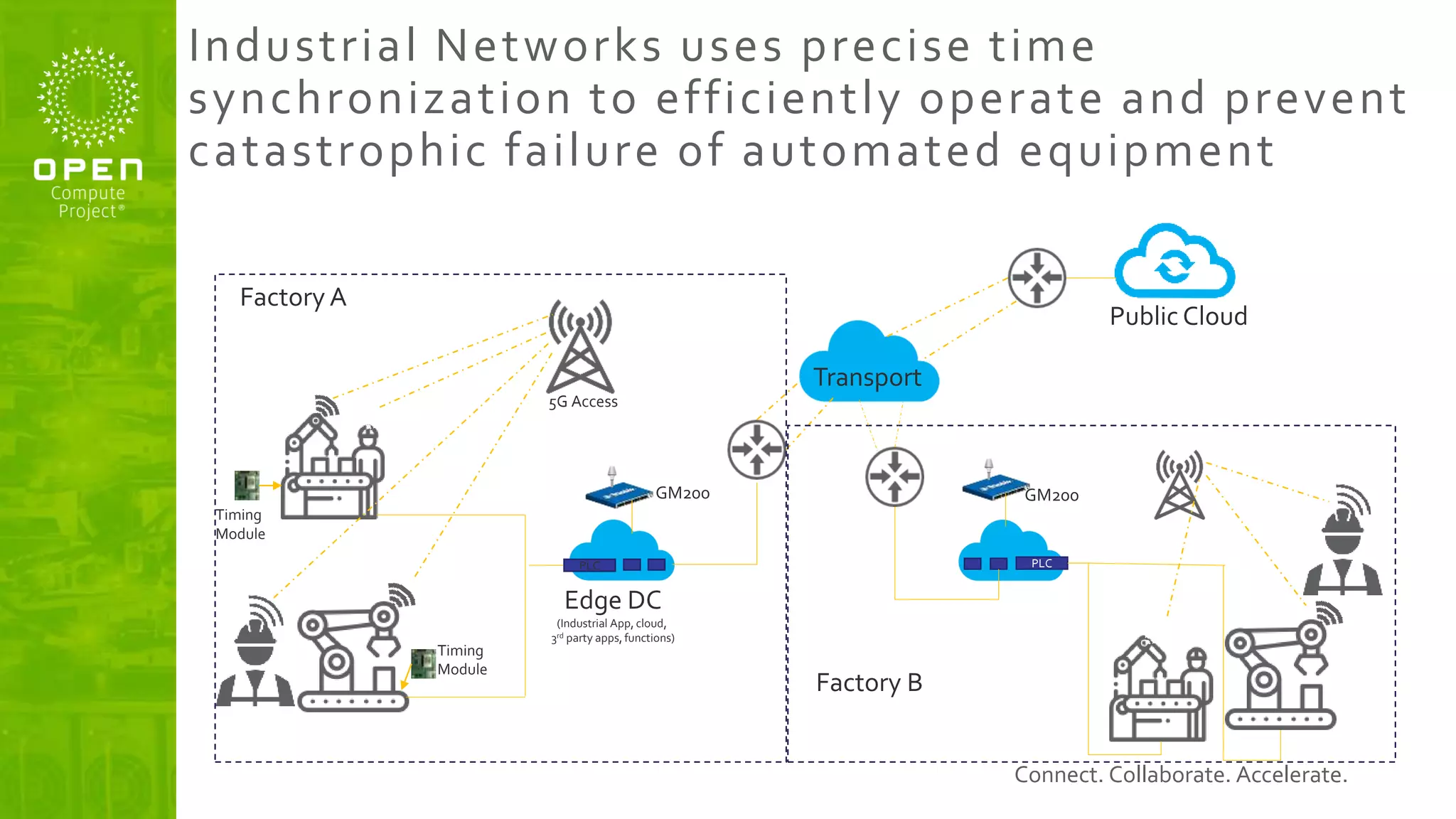
Industrial Networks uses precise time
synchronization to efficiently operate and prevent
catastrophic failure of automated equipment
PLC
Transport
5G Access
Edge DC
(Industrial App, cloud,
3rd party apps, functions)
PLC
PublicCloud
Factory A
Factory B
GM200 GM200
Timing
Module
Timing
Module
Connect. Collaborate. Accelerate.
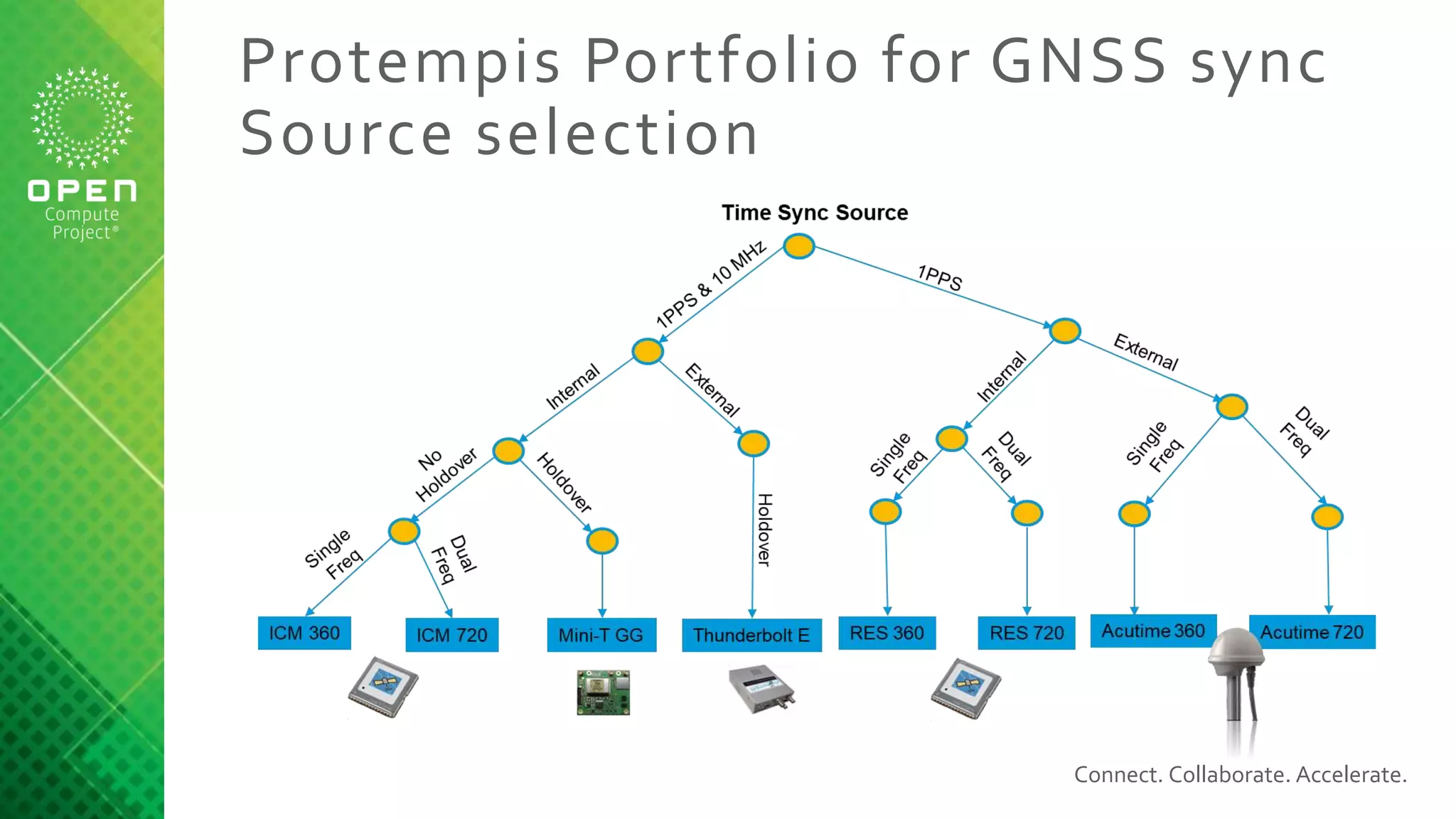
Protempis Portfolio for GNSS sync
Source selection
Connect. Collaborate. Accelerate.
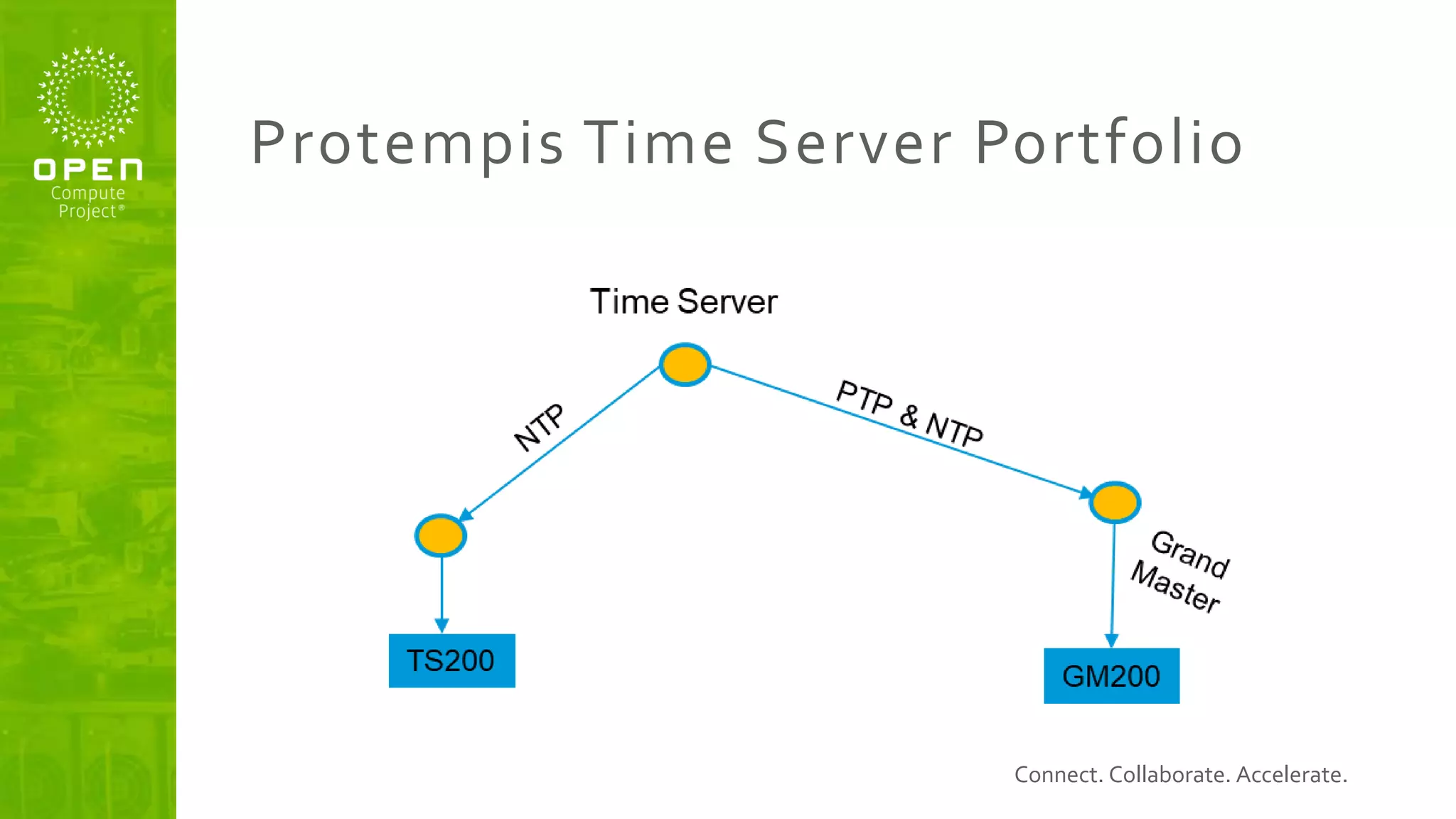
Protempis Time Server Portfolio
Connect. Collaborate. Accelerate.
Thank You
Connect. Collaborate. Accelerate.
Reference Slide
• cTE (defined by ITU-T G.8260) are immune to filters for example,
asymmetry in the transmission medium between network elements,
asymmetries within network elements, the beating effect in near-
synchronous time-stamping, and so on. Ref: G.8271/Y.1366.1 section
IV.2
• The dynamicTE component, dTE(t), is related to random noise
accumulation (e.g., due toT-BC time-stamping or wander accumulated
in the synchronous Ethernet network and injected into the time
synchronization plane when synchronous Ethernet is used in
combination with PTP or due to packet-delay variation experienced by
the timing signal packets).

NextGen Network Synchronization

  • 1.
  • 2.
    Connect. Collaborate. Accelerate. BrandAnnouncement TrimbleTiming and Frequency Division is now Protempis www.protempis.com
  • 3.
    Connect. Collaborate. Accelerate. PreciseTime Synchronization is essential in mission critical applications < 1.5µS < 250µS Factory Automation & Mission Control < 20 µS SmartGrid Fault Protection 5G Edge Infrastructure, CBRS & Private LTE Data Center Intercell URLLC Applications ± .5µS Smart Industry, Healthcare, Entertainment,Transport, Energy, Mfg Sub µS to Sub mS MachineVision Autonomous Vehicle
  • 4.
    Connect. Collaborate. Accelerate. UnderstandingHow Network environment are becoming more deterministic • Time Aware Non-deterministic Network: The network withTime components (e.g. NTP, PTP) but lacksTransport guarantee. Protocol such asTCP provides some form of transport receipt information but no guarantee. • Deterministic Networks: Time and GuaranteedTransport, e.g. Industrial Networks. IEEE DefinesTSN specifications for deterministic Networks. In-time best effort On-time Guaranteed Transport
  • 5.
    Connect. Collaborate. Accelerate. TimeError Budget consideration for the synchronization of Time Aware Non-Deterministic Network • Device level Clock Drift: Clock Drift is measured inTE (Time Error) budget. AT-GM should be <100ns andT-BC <50 ns in TE. • Packet DelayVariation (PDV): Due to queuing mechanism, networking gear may induce significant PDVs. A non PTP aware switch may induce more than 180 ns in PDV. • AccumulatedTime Error: It is measured at device level with TE of incoming port and outgoing port. • Link Asymmetries: AllTE includingTE induced by cables and PHYs etc.
  • 6.
    Connect. Collaborate. Accelerate. Networkare changing from monolithic to microservice and the challenge is how to provide precise sync at container level 2015 NOS Separation of HW and SW Open Networking 2017 NOS Controller/ Orchestrator Software Defined Networking (SDN) 2018 Router/ Switch Router/ Switch Network Device VNF Network Function Virtualization (NFV) Network Virtualization 2019 Server RAN and BBU Functions OpenRAN 2020 Server kubernetes VNFs Microservice architecture Cloud Native Note:Virtualization is defacto for NextGenTelecom Networks
  • 7.
    Connect. Collaborate. Accelerate. Guaranteeingend-to-end time requires identifying and mitigating sources of Time error in the networks T-GM T-BC T-BC T-BC End device or application T-TSC Time Error Generation <100 ns [G.8272] DynamicTime Error (dTE) <20 ns perT-BC ConstantTime Error (cTE) <50 ns perT-BC (typeA) <20 ns perT-BC (type B) cTE generated at link chain Noise generated by end application [ITU-T defines telecom base station application to be measured <150ns] Ref: G.8271/Y.1366.1
  • 8.
    Connect. Collaborate. Accelerate. PTPprovides better time accuracy and in path sync correction over NTP NTP PTP Industry de-facto and used in public networks since antiquity Relatively new, most appropriate for LAN and WANs Traditionally hierarchical design but today’s NTP grand master supports direct connectivity to slave Less hierarchical design, Slave can connect to any clock source whether Grand master or Boundary Clock. Sync Accuracy is milliseconds to seconds Sync accuracy from 10s of nanoseconds to microseconds. NTP lacks on path support PTP provides support through Boundary and Transparent Clock Software based and non-deterministic delays contribute to timing inaccuracy PTP support hardware timestamping and Assisted PatialTiming (APTS).
  • 9.
    Connect. Collaborate. Accelerate. Realtime and near real time traffic in data center environment requires microsecond level end -to-end accuracy to prevent operational failure Edge Computing Edge Computing Smart Grid Connected Cars Smart Factory Connected Applications Connected Oil Platform Connected Rail Connected Transportation Smart City Data Center Mobile Networks Connected Wind Turbine Macro/Small Cells Macro/Small Cells Time Synchronization
  • 10.
    Connect. Collaborate. Accelerate. Acombination of Openservers, grandmaster and boundary clock guarantee localized time accuracy Time-sensitive Application POD Non-real Time Application POD PTP Slave GM200 as T-BC TOR TOR WAN/DCI Border Leaf Real-time Big Data Analytics Non-real time Application Fabric Switch Time Synchronization GM 200 as GM Software base PTP GM200 as BC TS200 NTP Server NTP Clients NTP Clients TOR OpenTime Server TAPTime Card NvidiaConnect6 DX with PPS PPS input
  • 11.
    Connect. Collaborate. Accelerate. PreciseSynchronization is an essential Network design element for both private or public wireless networks Private Wireless Public Networks End to End Synchronization T-GM T-GM T-GM
  • 12.
    Connect. Collaborate. Accelerate. ITU-Tsuggest end-to-end time error budget of 1.5 µs for Wireless Fronthaul Network GM 1 2 3 4 5 6b 7b Sync Cluster < 260 ns Sync Supply chain for all Base stations T-BC max hop 5 6c 7c 8b 9 6a 7a 8a Max < 1.5 µs (preferred <1.1 µs) T-TSC T-TSC T-TSC T-BC T-BC Base Station cooperating Cluster Note: A standard Mobile network must maintain end to end time error budget of <1.1 micros seconds.
  • 13.
    Connect. Collaborate. Accelerate. PreciseSync is common for four different variants of Private/ Public Wireless Networks CBRS/ Midband Spectrum Sharing Cloud Native 5G OpenRAN Legacy PreciseTime Synchronization
  • 14.
    Connect. Collaborate. Accelerate. Acombination of Boundary and Grandmaster deployment helps achieve 1.1 µs at Fronthaul Edge Cloud MPLS Core IXP Core Router PE Internet Data Centers Aggregation C-RAN ROE GM200 CSR/ DCSG DCSG/ CSR Transit T-BC T-BC T-BC PRTC-B ePTRC Co-ordinated PRTC Bullet™ 360 GNSSAntenna Bullet™ 360 GNSSAntenna GM200 T-GM BBU Hoteling CellSite Router (CSR) implements boundary clock, Radio unit can use local clock source and sync with boundary clock (T-BC). RU CSR Edge Cloud T-BC T-TSC 1.1µs
  • 15.
    Connect. Collaborate. Accelerate. Hybrid4G/5G Macro cell deployments require precise sync at the edge CU EPC T-GM Max node = 3 CSR/ DCSG DU DU RU RU FTU FTU RU • FTU (Fiber Transceiver Unit) • DU (Distribution Unit) • RU (Radio Unit) • CU (Central Unit) RU GM 200 Coordinated PRTC GM 200 as standaloneT-BC Embedded or standalone GM 200 as standaloneT-BC if CSR lacksT-BC Bullet™ 360 GNSSAntenna Bullet™ 360 GNSSAntenna Note: Protempis can provide embedded or Standalone sync solutions for RU, DU and CSR 1.1µs
  • 16.
    Connect. Collaborate. Accelerate. Thereare four paths to achieving synchronization in OpenRAN 1. Config LLS-C1: Network Timing Distribution from O-DU to O-RU 2. Config LLS-C2: Network timing distribution from O-DU to O-RU in a switched Network 3. Config LLS-C3: Fronthaul switch as clock source for network timing distribution 4. Config LLS-C4: Local PRTC in O-RU and O- DU and no PTP for time distributions
  • 17.
    Connect. Collaborate. Accelerate. ConfigLLS-C1: Network Timing Distribution from O-DU to O-RU DU (Distributed Unit) CU (Central Unit) Radio Unit (RU) eCPRI/ ROE F1 Interface Ethernet SyncE/1PPS SyncE/PPS EPC/Core High Phy O-RAN 7.2x Ethernet GNSS Timing Module Trimble ICM 360 or 720 Embedded Slave Clock Trimble GM310 Embedded Boundary Clock or Grand Master PTP (IEEE 1588) Standalone Boundary or Grandmaster Clock GM200 GM310 Point to Point Link between O-RU and O-DU. Clock source is O-DU
  • 18.
    Connect. Collaborate. Accelerate. ConfigLLS-C2: Network timing distribution from O-DU to O-RU in a switched Network DU (Distributed Unit) CU (Central Unit) Radio Unit (RU) eCPRI F1 Interface Ethernet SyncE/1PPS SyncE/PPS EPC/Core High Phy O-RAN 7.2x Ethernet GNSS Timing Module Trimble ICM 360 or 720 Embedded Slave Clock Boundary Clock or Grand Master PTP (IEEE 1588) GM200 CSR/DCSG or PTP Unaware Switch RU One or more switch between O-RU and O-DU. Switches can be PTP aware or unaware. Clock source is O-DU.
  • 19.
    Connect. Collaborate. Accelerate. ConfigLLS-C3: Fronthaul switch as clock source for network timing distribution DU (Distributed Unit) CU (Central Unit) Radio Unit (RU) eCPRI F1 Interface Ethernet SyncE/1PPS SyncE/PPS EPC/Core High Phy O-RAN 7.2x Ethernet GNSS Timing Module ICM 360 or 720 Embedded Slave Clock Embedded Ordinary Clock PTP (IEEE 1588) Trimble GM200 GM310 CSR/DCSG RU Grand Master Clock One or more fronthaul switch between O-RU and O-DU. Clock source is Fronthaul Switch.
  • 20.
    Connect. Collaborate. Accelerate. ConfigLLS-C4: Local PRTC in O-RU and O-DU and no PTP for time distributions DU (Distributed Unit) CU (Central Unit) Radio Unit (RU) eCPRI/ ROE F1 Interface Ethernet SyncE/PPS EPC/Core High Phy O-RAN 7.2x Ethernet Local PRTC No PTP is required Disciplined Clock Point to Point link between O-RU and O-DU. No IEEE1588, clock source local PRTC. SyncE/PPS
  • 21.
    Connect. Collaborate. Accelerate. All5G deployments including mid-band spectrums require precise sync since 5G spectrum is TDD 100 GHz 6 GHz 1GHz Mid band High Band 24GHz TDD Low Band 3.5 GHZ 3.5 GHz 3.7GHz 4.2 GHz CBRS C-Band 150 MHz 5G Spectrum 2.3 2.4 GHz Licensed Shared Access (LSA) 66 GHz mmWave band Band-48
  • 22.
    Connect. Collaborate. Accelerate. GNSSAntenna GM200 as T-GM GM200 as T-BC PTP-unaware Switch PTP-unaware Switch Neutral Host SAS EPC MNO GM200 providing optimal sync solutions for CBRS type midband spectrum sharing Enteprise 5G deployments GM200 as T-BC PTP-unaware Switch LSA OAM CBRS Deployment for Enterprise 5G requires precise Sync due to the use of midband spectrum
  • 23.
    Connect. Collaborate. Accelerate. TelecomCloud uses precise sync at the edge for optimal network operations Central DC Edge DC Far Edge DC 1000’s ± 50 2 Virtual RAN, Virtual DU &VirtualCU MEC apps & virtual gateway functions Virtual Mobile network management functions Per Metro Region GM200 as T-BC ICM 360 or RES 720 1.1µs
  • 24.
    Connect. Collaborate. Accelerate. CloudNative Enterprise 5G uses precise sync for optimal processing of voice and time sensitive data traffic MEC (Multi-access EdgeComputing) 5GCVNFs Enterprise On-Premise 5G gNBs 5G gNBs Kubernetes Servers UPFs MEC (Multi-access EdgeComputing) 5GCVNFs Enterprise On-Premise Mobile Network Operator GM200 GM200 Timing Modules TrimbleTiming Modules GM200 RES720 RES720
  • 25.
    Connect. Collaborate. Accelerate. IndustrialNetworks uses precise time synchronization to efficiently operate and prevent catastrophic failure of automated equipment PLC Transport 5G Access Edge DC (Industrial App, cloud, 3rd party apps, functions) PLC PublicCloud Factory A Factory B GM200 GM200 Timing Module Timing Module
  • 26.
    Connect. Collaborate. Accelerate. ProtempisPortfolio for GNSS sync Source selection
  • 27.
  • 28.
  • 29.
    Connect. Collaborate. Accelerate. ReferenceSlide • cTE (defined by ITU-T G.8260) are immune to filters for example, asymmetry in the transmission medium between network elements, asymmetries within network elements, the beating effect in near- synchronous time-stamping, and so on. Ref: G.8271/Y.1366.1 section IV.2 • The dynamicTE component, dTE(t), is related to random noise accumulation (e.g., due toT-BC time-stamping or wander accumulated in the synchronous Ethernet network and injected into the time synchronization plane when synchronous Ethernet is used in combination with PTP or due to packet-delay variation experienced by the timing signal packets).