
Timing is everything:
Navigating Small Cell Timing & Sync
David Chambers
ThinkSmallCell.com

© 2013

Small Cell Americas, Dallas, Dec 2013
About ThinkSmallCell
• Founded Sept 2007 as
ThinkFemtocell
• Independent
news, analysis, insight
into Small Cells
• Based on a belief that
small cell architecture
is the only credible
solution for high data
traffic
© 2013

• David
Chambers, B.Sc.
(Hons), MIET, C.Eng,
Dip.
M., MCIM, Chartered
Marketer
• Career includes
– Telecom software engineer
– Telecom product manager
– Standards (ETSI, 3GPP)
– Chartered Engineer
monthly – Chartered Marketer
newsletter at

Sign up for our free
ThinkSmallCell.com
Small Cell Americas, Dallas, Dec 2013

2
Question #1
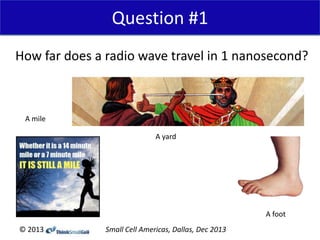
How far does a radio wave travel in 1 nanosecond?

A mile
A yard

A foot

© 2013

Small Cell Americas, Dallas, Dec 2013
Answer #1
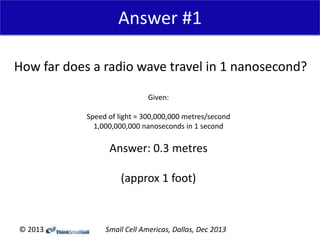
How far does a radio wave travel in 1 nanosecond?
Given:
Speed of light = 300,000,000 metres/second
1,000,000,000 nanoseconds in 1 second

Answer: 0.3 metres
(approx 1 foot)

© 2013

Small Cell Americas, Dallas, Dec 2013
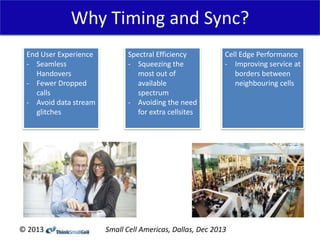
Why Timing and Sync?
End User Experience
- Seamless
Handovers
- Fewer Dropped
calls
- Avoid data stream
glitches

© 2013

Spectral Efficiency
- Squeezing the
most out of
available
spectrum
- Avoiding the need
for extra cellsites

Cell Edge Performance
- Improving service at
borders between
neighbouring cells

Small Cell Americas, Dallas, Dec 2013
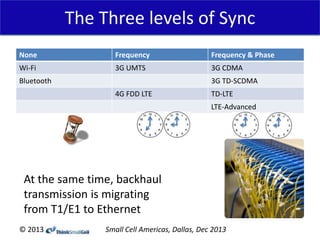
The Three levels of Sync
None

Frequency

Frequency & Phase

Wi-Fi

3G UMTS

3G CDMA

Bluetooth

3G TD-SCDMA
4G FDD LTE

TD-LTE

LTE-Advanced

At the same time, backhaul
transmission is migrating
from T1/E1 to Ethernet
© 2013

Small Cell Americas, Dallas, Dec 2013
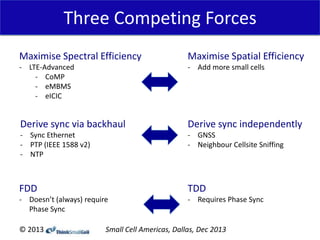
Three Competing Forces
Maximise Spectral Efficiency

Maximise Spatial Efficiency

- LTE-Advanced
- CoMP
- eMBMS
- eICIC

- Add more small cells

Derive sync via backhaul

Derive sync independently

- Sync Ethernet
- PTP (IEEE 1588 v2)
- NTP

- GNSS
- Neighbour Cellsite Sniffing

FDD

TDD

- Doesn’t (always) require
Phase Sync

- Requires Phase Sync

© 2013

Small Cell Americas, Dallas, Dec 2013
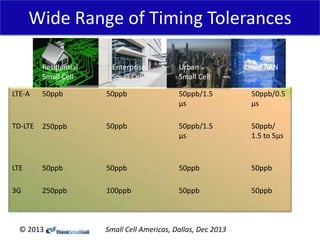
Wide Range of Timing Tolerances
Residential
Small Cell

Enterprise
Small Cell

Urban
Small Cell

Cloud RAN

LTE-A

50ppb

50ppb

50ppb/1.5
μs

50ppb/0.5
μs

TD-LTE

250ppb

50ppb

50ppb/1.5
μs

50ppb/
1.5 to 5μs

LTE

50ppb

50ppb

50ppb

50ppb

3G

250ppb

100ppb

50ppb

50ppb

© 2013

Small Cell Americas, Dallas, Dec 2013
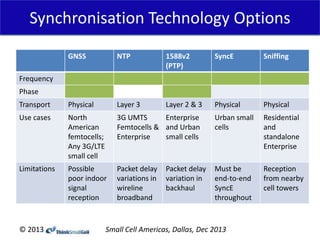
Synchronisation Technology Options
GNSS

NTP

1588v2
(PTP)

SyncE

Sniffing

Transport

Physical

Layer 3

Layer 2 & 3

Physical

Physical

Use cases

North
American
femtocells;
Any 3G/LTE
small cell

3G UMTS
Enterprise
Femtocells & and Urban
Enterprise
small cells

Urban small
cells

Residential
and
standalone
Enterprise

Limitations

Possible
poor indoor
signal
reception

Packet delay
variations in
wireline
broadband

Must be
end-to-end
SyncE
throughout

Reception
from nearby
cell towers

Frequency

Phase

© 2013

Packet delay
variation in
backhaul

Small Cell Americas, Dallas, Dec 2013
GNSS Developments
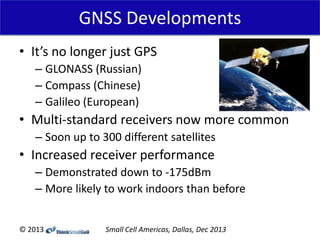
• It’s no longer just GPS
– GLONASS (Russian)
– Compass (Chinese)
– Galileo (European)

• Multi-standard receivers now more common
– Soon up to 300 different satellites

• Increased receiver performance
– Demonstrated down to -175dBm
– More likely to work indoors than before
© 2013

Small Cell Americas, Dallas, Dec 2013
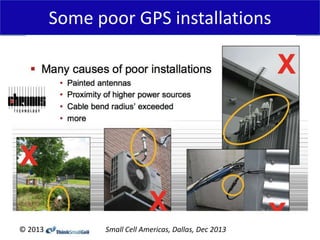
Some poor GPS installations

© 2013

Small Cell Americas, Dallas, Dec 2013
Precise Time Protocol (PTP) 1588v2
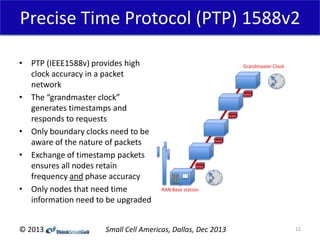
• PTP (IEEE1588v) provides high
clock accuracy in a packet
network
• The “grandmaster clock”
generates timestamps and
responds to requests
• Only boundary clocks need to be
aware of the nature of packets
• Exchange of timestamp packets
ensures all nodes retain
frequency and phase accuracy
• Only nodes that need time
information need to be upgraded
© 2013

Grandmaster Clock
1
12

1

2
3
4

6

5

Packet

Packet

Packet

Packet
1
12

1

2
3
4

6

5

RAN Base station

Small Cell Americas, Dallas, Dec 2013

12
Packet Delay Variation
• Phase timing requires low PDV not latency
– Variation in end-to-end delay
– Asymmetry of delay variation uplink/downlink

• Consequences
– Sync acquisition time, recovery time

• Specifications
– Previously end-to-end
– Recently changed to “per hop”
© 2013

Small Cell Americas, Dallas, Dec 2013
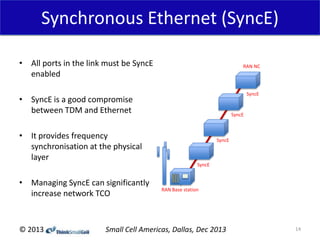
Synchronous Ethernet (SyncE)
• All ports in the link must be SyncE
enabled

RAN NC

SyncE

• SyncE is a good compromise
between TDM and Ethernet

SyncE

• It provides frequency
synchronisation at the physical
layer

SyncE

SyncE

• Managing SyncE can significantly
increase network TCO

© 2013

RAN Base station

Small Cell Americas, Dallas, Dec 2013

14
Question #2
Do signals travel faster/slower/same down
optical fibre than via microwave link?

© 2013

Small Cell Americas, Dallas, Dec 2013
Answer #2
Do signals travel faster/slower/same down
optical fibre than via microwave link?
Given:
Light waves are reflected off
the sides of optical fibre, so travel
further than direct radio transmissions

Answer: Slower

© 2013

Small Cell Americas, Dallas, Dec 2013
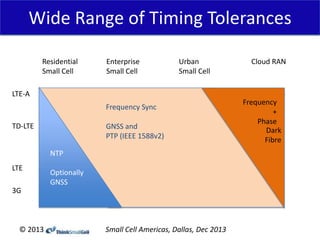
Wide Range of Timing Tolerances
Residential
Small Cell

TD-LTE

Urban
Small Cell

50ppb

50ppb
Frequency Sync

LTE-A

Enterprise
Small Cell

50ppb/1.5
μs

50ppb
GNSS and
PTP (IEEE 1588v2)

50ppb/1.5
μs

50ppb

50ppb

50ppb

100ppb

50ppb

50ppb

250ppb

Cloud RAN

50ppb/0.5
Frequency
μs
+
Phase
50ppb/
Dark
1.5 to 5μs
Fibre

NTP
LTE
3G

50ppb
Optionally
GNSS
250ppb

© 2013

Small Cell Americas, Dallas, Dec 2013
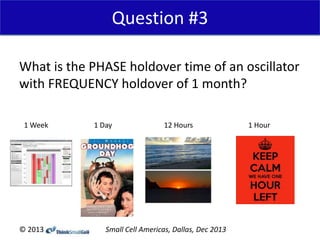
Question #3
What is the PHASE holdover time of an oscillator
with FREQUENCY holdover of 1 month?
1 Week

© 2013

1 Day

12 Hours

Small Cell Americas, Dallas, Dec 2013

1 Hour
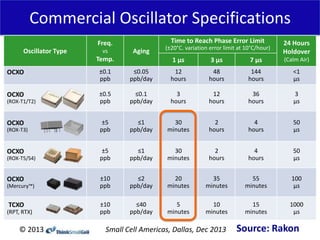
Commercial Oscillator Specifications
Time to Reach Phase Error Limit

Freq.
Oscillator Type

vs

Aging

Temp.

(±20°C. variation error limit at 10°C/hour)

24 Hours
Holdover

1 µs

3 µs

7 µs

(Calm Air)

OCXO

±0.1
ppb

≤0.05
ppb/day

12
hours

48
hours

144
hours

<1
µs

OCXO

±0.5
ppb

≤0.1
ppb/day

3
hours

12
hours

36
hours

3
µs

±5
ppb

≤1
ppb/day

30
minutes

2
hours

4
hours

50
µs

±5
ppb

≤1
ppb/day

30
minutes

2
hours

4
hours

50
µs

±10
ppb

≤2
ppb/day

20
minutes

35
minutes

55
minutes

100
µs

±10
ppb

≤40
ppb/day

5
minutes

10
minutes

15
minutes

1000
µs

(ROX-T1/T2)

OCXO
(ROX-T3)

OCXO
(ROX-T5/S4)

OCXO
(Mercury™)

TCXO
(RPT, RTX)

© 2013

Small Cell Americas, Dallas, Dec 2013

Source: Rakon
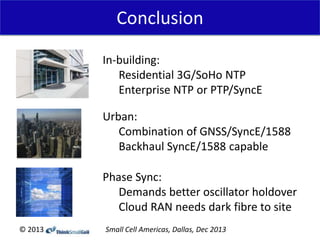
Conclusion
In-building:
Residential 3G/SoHo NTPCloud RAN
Urban
Enterprise NTP or PTP/SyncE
Small Cell
Urban:
Combination of GNSS/SyncE/1588
Backhaul SyncE/1588 capable
Phase Sync:
Demands better oscillator holdover
Cloud RAN needs dark fibre to site
© 2013

Small Cell Americas, Dallas, Dec 2013

Small Cell Timing and Sync Presentation SCA 2013

  • 1.
    Timing is everything: NavigatingSmall Cell Timing & Sync David Chambers ThinkSmallCell.com © 2013 Small Cell Americas, Dallas, Dec 2013
  • 2.
    About ThinkSmallCell • FoundedSept 2007 as ThinkFemtocell • Independent news, analysis, insight into Small Cells • Based on a belief that small cell architecture is the only credible solution for high data traffic © 2013 • David Chambers, B.Sc. (Hons), MIET, C.Eng, Dip. M., MCIM, Chartered Marketer • Career includes – Telecom software engineer – Telecom product manager – Standards (ETSI, 3GPP) – Chartered Engineer monthly – Chartered Marketer newsletter at Sign up for our free ThinkSmallCell.com Small Cell Americas, Dallas, Dec 2013 2
  • 3.
    Question #1 How fardoes a radio wave travel in 1 nanosecond? A mile A yard A foot © 2013 Small Cell Americas, Dallas, Dec 2013
  • 4.
    Answer #1 How fardoes a radio wave travel in 1 nanosecond? Given: Speed of light = 300,000,000 metres/second 1,000,000,000 nanoseconds in 1 second Answer: 0.3 metres (approx 1 foot) © 2013 Small Cell Americas, Dallas, Dec 2013
  • 5.
    Why Timing andSync? End User Experience - Seamless Handovers - Fewer Dropped calls - Avoid data stream glitches © 2013 Spectral Efficiency - Squeezing the most out of available spectrum - Avoiding the need for extra cellsites Cell Edge Performance - Improving service at borders between neighbouring cells Small Cell Americas, Dallas, Dec 2013
  • 6.
    The Three levelsof Sync None Frequency Frequency & Phase Wi-Fi 3G UMTS 3G CDMA Bluetooth 3G TD-SCDMA 4G FDD LTE TD-LTE LTE-Advanced At the same time, backhaul transmission is migrating from T1/E1 to Ethernet © 2013 Small Cell Americas, Dallas, Dec 2013
  • 7.
    Three Competing Forces MaximiseSpectral Efficiency Maximise Spatial Efficiency - LTE-Advanced - CoMP - eMBMS - eICIC - Add more small cells Derive sync via backhaul Derive sync independently - Sync Ethernet - PTP (IEEE 1588 v2) - NTP - GNSS - Neighbour Cellsite Sniffing FDD TDD - Doesn’t (always) require Phase Sync - Requires Phase Sync © 2013 Small Cell Americas, Dallas, Dec 2013
  • 8.
    Wide Range ofTiming Tolerances Residential Small Cell Enterprise Small Cell Urban Small Cell Cloud RAN LTE-A 50ppb 50ppb 50ppb/1.5 μs 50ppb/0.5 μs TD-LTE 250ppb 50ppb 50ppb/1.5 μs 50ppb/ 1.5 to 5μs LTE 50ppb 50ppb 50ppb 50ppb 3G 250ppb 100ppb 50ppb 50ppb © 2013 Small Cell Americas, Dallas, Dec 2013
  • 9.
    Synchronisation Technology Options GNSS NTP 1588v2 (PTP) SyncE Sniffing Transport Physical Layer3 Layer 2 & 3 Physical Physical Use cases North American femtocells; Any 3G/LTE small cell 3G UMTS Enterprise Femtocells & and Urban Enterprise small cells Urban small cells Residential and standalone Enterprise Limitations Possible poor indoor signal reception Packet delay variations in wireline broadband Must be end-to-end SyncE throughout Reception from nearby cell towers Frequency Phase © 2013 Packet delay variation in backhaul Small Cell Americas, Dallas, Dec 2013
  • 10.
    GNSS Developments • It’sno longer just GPS – GLONASS (Russian) – Compass (Chinese) – Galileo (European) • Multi-standard receivers now more common – Soon up to 300 different satellites • Increased receiver performance – Demonstrated down to -175dBm – More likely to work indoors than before © 2013 Small Cell Americas, Dallas, Dec 2013
  • 11.
    Some poor GPSinstallations © 2013 Small Cell Americas, Dallas, Dec 2013
  • 12.
    Precise Time Protocol(PTP) 1588v2 • PTP (IEEE1588v) provides high clock accuracy in a packet network • The “grandmaster clock” generates timestamps and responds to requests • Only boundary clocks need to be aware of the nature of packets • Exchange of timestamp packets ensures all nodes retain frequency and phase accuracy • Only nodes that need time information need to be upgraded © 2013 Grandmaster Clock 1 12 1 2 3 4 6 5 Packet Packet Packet Packet 1 12 1 2 3 4 6 5 RAN Base station Small Cell Americas, Dallas, Dec 2013 12
  • 13.
    Packet Delay Variation •Phase timing requires low PDV not latency – Variation in end-to-end delay – Asymmetry of delay variation uplink/downlink • Consequences – Sync acquisition time, recovery time • Specifications – Previously end-to-end – Recently changed to “per hop” © 2013 Small Cell Americas, Dallas, Dec 2013
  • 14.
    Synchronous Ethernet (SyncE) •All ports in the link must be SyncE enabled RAN NC SyncE • SyncE is a good compromise between TDM and Ethernet SyncE • It provides frequency synchronisation at the physical layer SyncE SyncE • Managing SyncE can significantly increase network TCO © 2013 RAN Base station Small Cell Americas, Dallas, Dec 2013 14
  • 15.
    Question #2 Do signalstravel faster/slower/same down optical fibre than via microwave link? © 2013 Small Cell Americas, Dallas, Dec 2013
  • 16.
    Answer #2 Do signalstravel faster/slower/same down optical fibre than via microwave link? Given: Light waves are reflected off the sides of optical fibre, so travel further than direct radio transmissions Answer: Slower © 2013 Small Cell Americas, Dallas, Dec 2013
  • 17.
    Wide Range ofTiming Tolerances Residential Small Cell TD-LTE Urban Small Cell 50ppb 50ppb Frequency Sync LTE-A Enterprise Small Cell 50ppb/1.5 μs 50ppb GNSS and PTP (IEEE 1588v2) 50ppb/1.5 μs 50ppb 50ppb 50ppb 100ppb 50ppb 50ppb 250ppb Cloud RAN 50ppb/0.5 Frequency μs + Phase 50ppb/ Dark 1.5 to 5μs Fibre NTP LTE 3G 50ppb Optionally GNSS 250ppb © 2013 Small Cell Americas, Dallas, Dec 2013
  • 18.
    Question #3 What isthe PHASE holdover time of an oscillator with FREQUENCY holdover of 1 month? 1 Week © 2013 1 Day 12 Hours Small Cell Americas, Dallas, Dec 2013 1 Hour
  • 19.
    Commercial Oscillator Specifications Timeto Reach Phase Error Limit Freq. Oscillator Type vs Aging Temp. (±20°C. variation error limit at 10°C/hour) 24 Hours Holdover 1 µs 3 µs 7 µs (Calm Air) OCXO ±0.1 ppb ≤0.05 ppb/day 12 hours 48 hours 144 hours <1 µs OCXO ±0.5 ppb ≤0.1 ppb/day 3 hours 12 hours 36 hours 3 µs ±5 ppb ≤1 ppb/day 30 minutes 2 hours 4 hours 50 µs ±5 ppb ≤1 ppb/day 30 minutes 2 hours 4 hours 50 µs ±10 ppb ≤2 ppb/day 20 minutes 35 minutes 55 minutes 100 µs ±10 ppb ≤40 ppb/day 5 minutes 10 minutes 15 minutes 1000 µs (ROX-T1/T2) OCXO (ROX-T3) OCXO (ROX-T5/S4) OCXO (Mercury™) TCXO (RPT, RTX) © 2013 Small Cell Americas, Dallas, Dec 2013 Source: Rakon
  • 20.
    Conclusion In-building: Residential 3G/SoHo NTPCloudRAN Urban Enterprise NTP or PTP/SyncE Small Cell Urban: Combination of GNSS/SyncE/1588 Backhaul SyncE/1588 capable Phase Sync: Demands better oscillator holdover Cloud RAN needs dark fibre to site © 2013 Small Cell Americas, Dallas, Dec 2013