BGP Peering
Test Report
Test Report
August 16, 2019
Contents
1. OcNOS BGP Peering 3
2. Test Methodology 3
3. Overview 3
1. Detailed setup 3
2. Test Procedure 3
4. eBGP with Full IRT (IPv4 & IPv6) 4
1. Network Topology 4
2. Performance 4
3. BGP Configuration 5
5. Appendix 6
1. Environment 6
2. Measurement 6
1. OcNOS BGP Peering
The objective of the test report is to highlight the performance and scalability aspects of OcNOS on to support the
BGP Peering Router Solution full Internet Routing Table(IRT).
2. Test Methodology
In order to complete the tests discussed in the document, OcNOS was installed and configured on two switches.
A traffic generator was then used to simulate the internal network and multiple BGP peers via two routed links.
In order to simulate real world conditions, 10G of data was transmitted from the internal network to OcNOS for
forwarding to the remote network. A number of routes were then advertised from the BGP peers. The time taken
recover from link failure was measure and recorded below.
3. Overview
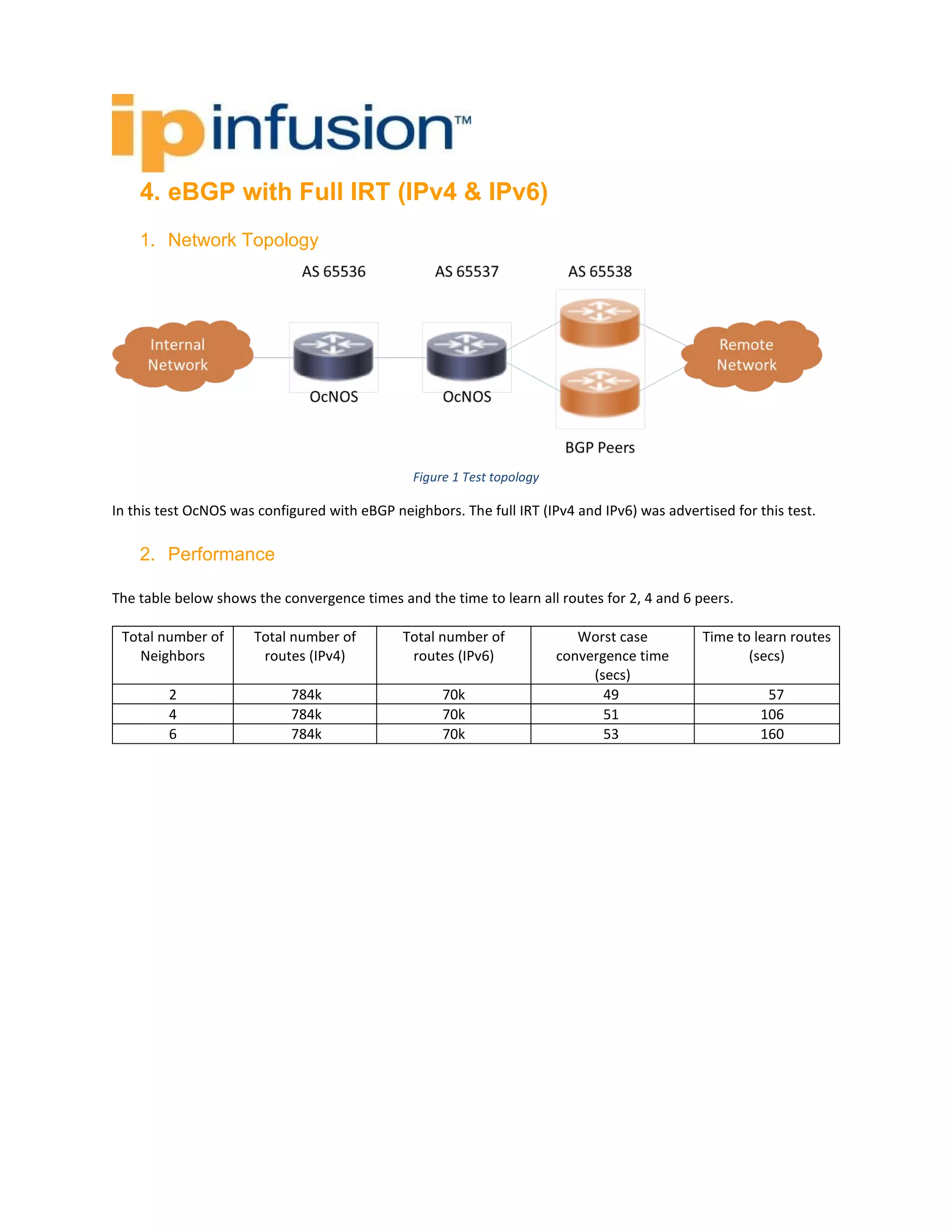
A network topology as shown below was used to simulate a typical customer environment.
The test router running OcNOS learns prefixes from a number of BGP peers connected on the left.
At the same time, the router on the internal network is forwarding traffic to routes learned on the remote
network. Two routers were used In oder to eliminate any inconsistancy indroduced by the traffic generators
emulating the remote peers.
1. Detailed setup
Testing was carried out using the following software and hardware combination.
OcNOS SP 1.0 ED 2.1.1 running on an Edgecore AS5916-54XKS.
The BGP peers and internal and external networks were simulated on a traffic generator.
The configuration is described in further detail below.
2. Test Procedure
A number of prefixes were advertised to OcNOS from 2,4 or 6 BGP peers connected via 2 ports.
In order to simulate user traffic, the router on the internal network forwards 10G (wire rate) of traffic to the
remote network using the paths learned during the test.
4. eBGP with Full IRT (IPv4 & IPv6)
1. Network Topology
Figure 1 Test topology
In this test OcNOS was configured with eBGP neighbors. The full IRT (IPv4 and IPv6) was advertised for this test.
2. Performance
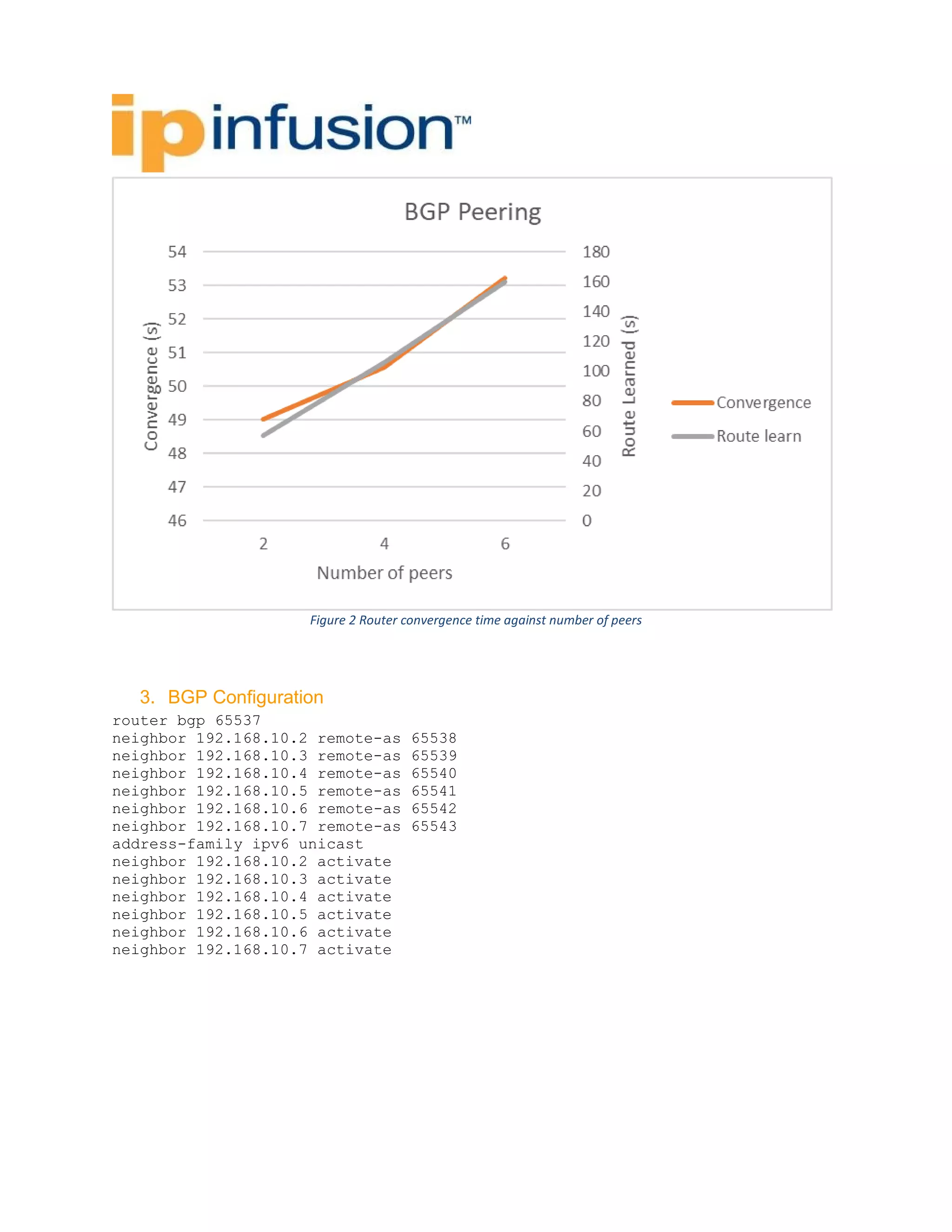
The table below shows the convergence times and the time to learn all routes for 2, 4 and 6 peers.
Total number of
Neighbors
Total number of
routes (IPv4)
Total number of
routes (IPv6)
Worst case
convergence time
(secs)
Time to learn routes
(secs)
2 784k 70k 49 57
4 784k 70k 51 106
6 784k 70k 53 160
Figure 2 Router convergence time against number of peers
3. BGP Configuration
router bgp 65537
neighbor 192.168.10.2 remote-as 65538
neighbor 192.168.10.3 remote-as 65539
neighbor 192.168.10.4 remote-as 65540
neighbor 192.168.10.5 remote-as 65541
neighbor 192.168.10.6 remote-as 65542
neighbor 192.168.10.7 remote-as 65543
address-family ipv6 unicast
neighbor 192.168.10.2 activate
neighbor 192.168.10.3 activate
neighbor 192.168.10.4 activate
neighbor 192.168.10.5 activate
neighbor 192.168.10.6 activate
neighbor 192.168.10.7 activate
5. Appendix
1. Environment
The follow section identifies the software and hardware components used for the test.
Software
Product: OcNOS-SP
Version: SP1.0ED2.1.1
White box hardware
Vendor: Edgecore
Model: AS5916-54XKS-O-AC-F
Kernel: 3.16.7-g6267b3a-ec-as5916-54x
Linux Version: Debian GNU/Linux 8 (jessie)
CPU: 8 core Intel(R) Xeon(R) CPU D-1548 @ 2.00GHz
Memory: 32GB
Storage size: 115G
Traffic Generator
Vendor: IXIA
Chassis: XGS12
Card: XM100GE4QSFP28+
Software: IxNetwork 8.5
2. Measurement
This section describes how each value was calculated
Convergence time
Duration of traffic loss resulting from link failure and switch to alternate path.
Time to learn routes
The time taken to learn all the routes from initialization state of BGP with the other BGP peers.

BGP Peering Test Report - IP Infusion

  • 1.
    BGP Peering Test Report TestReport August 16, 2019
  • 2.
    Contents 1. OcNOS BGPPeering 3 2. Test Methodology 3 3. Overview 3 1. Detailed setup 3 2. Test Procedure 3 4. eBGP with Full IRT (IPv4 & IPv6) 4 1. Network Topology 4 2. Performance 4 3. BGP Configuration 5 5. Appendix 6 1. Environment 6 2. Measurement 6
  • 3.
    1. OcNOS BGPPeering The objective of the test report is to highlight the performance and scalability aspects of OcNOS on to support the BGP Peering Router Solution full Internet Routing Table(IRT). 2. Test Methodology In order to complete the tests discussed in the document, OcNOS was installed and configured on two switches. A traffic generator was then used to simulate the internal network and multiple BGP peers via two routed links. In order to simulate real world conditions, 10G of data was transmitted from the internal network to OcNOS for forwarding to the remote network. A number of routes were then advertised from the BGP peers. The time taken recover from link failure was measure and recorded below. 3. Overview A network topology as shown below was used to simulate a typical customer environment. The test router running OcNOS learns prefixes from a number of BGP peers connected on the left. At the same time, the router on the internal network is forwarding traffic to routes learned on the remote network. Two routers were used In oder to eliminate any inconsistancy indroduced by the traffic generators emulating the remote peers. 1. Detailed setup Testing was carried out using the following software and hardware combination. OcNOS SP 1.0 ED 2.1.1 running on an Edgecore AS5916-54XKS. The BGP peers and internal and external networks were simulated on a traffic generator. The configuration is described in further detail below. 2. Test Procedure A number of prefixes were advertised to OcNOS from 2,4 or 6 BGP peers connected via 2 ports. In order to simulate user traffic, the router on the internal network forwards 10G (wire rate) of traffic to the remote network using the paths learned during the test.
  • 4.
    4. eBGP withFull IRT (IPv4 & IPv6) 1. Network Topology Figure 1 Test topology In this test OcNOS was configured with eBGP neighbors. The full IRT (IPv4 and IPv6) was advertised for this test. 2. Performance The table below shows the convergence times and the time to learn all routes for 2, 4 and 6 peers. Total number of Neighbors Total number of routes (IPv4) Total number of routes (IPv6) Worst case convergence time (secs) Time to learn routes (secs) 2 784k 70k 49 57 4 784k 70k 51 106 6 784k 70k 53 160
  • 5.
    Figure 2 Routerconvergence time against number of peers 3. BGP Configuration router bgp 65537 neighbor 192.168.10.2 remote-as 65538 neighbor 192.168.10.3 remote-as 65539 neighbor 192.168.10.4 remote-as 65540 neighbor 192.168.10.5 remote-as 65541 neighbor 192.168.10.6 remote-as 65542 neighbor 192.168.10.7 remote-as 65543 address-family ipv6 unicast neighbor 192.168.10.2 activate neighbor 192.168.10.3 activate neighbor 192.168.10.4 activate neighbor 192.168.10.5 activate neighbor 192.168.10.6 activate neighbor 192.168.10.7 activate
  • 6.
    5. Appendix 1. Environment Thefollow section identifies the software and hardware components used for the test. Software Product: OcNOS-SP Version: SP1.0ED2.1.1 White box hardware Vendor: Edgecore Model: AS5916-54XKS-O-AC-F Kernel: 3.16.7-g6267b3a-ec-as5916-54x Linux Version: Debian GNU/Linux 8 (jessie) CPU: 8 core Intel(R) Xeon(R) CPU D-1548 @ 2.00GHz Memory: 32GB Storage size: 115G Traffic Generator Vendor: IXIA Chassis: XGS12 Card: XM100GE4QSFP28+ Software: IxNetwork 8.5 2. Measurement This section describes how each value was calculated Convergence time Duration of traffic loss resulting from link failure and switch to alternate path. Time to learn routes The time taken to learn all the routes from initialization state of BGP with the other BGP peers.