Section 2.1
Newton’s First Law of Motion
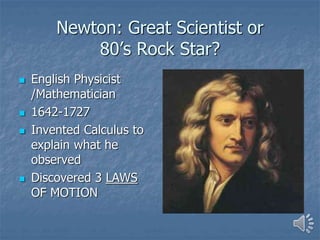
Newton: Great Scientist or
80’s Rock Star?
 English Physicist
/Mathematician
 1642-1727
 Invented Calculus to
explain what he
observed
 Discovered 3 LAWS
OF MOTION
Use the Force, Luke…but only if
you know what it is!
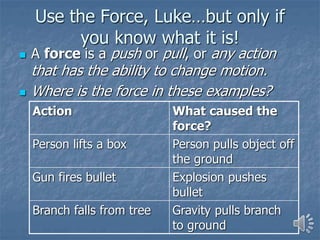
 A force is a push or pull, or any action
that has the ability to change motion.
 Where is the force in these examples?
Action What caused the
force?
Person lifts a box Person pulls object off
the ground
Gun fires bullet Explosion pushes
bullet
Branch falls from tree Gravity pulls branch
to ground
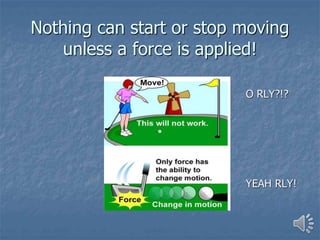
Nothing can start or stop moving
unless a force is applied!
O RLY?!?
YEAH RLY!
?Question?
Can there be a change in the motion of
anything without a force being applied?
NO!
Okay smarty, I think you got it!
Newton’s First Law
An object at rest will stay at rest and an
object in motion will continue in motion
with the same speed and direction
UNLESS acted on by a force.
?Question?
So a space ship is going 75,000 m/s
(or 75 km/s). It takes a left turn at Pluto,
but never changes speed. Was there a
force acting on it??
Yes!
In order to change direction,
A force must be applied!
Which would you rather do?
Lift (move) a bag with
groceries in it
Lift (move) a semi-
truck
Easy choice, right
It is much easier to lift the groceries and
possibly impossible (for you weaklings,
anyway) to lift the truck.
Why is one harder to move than the other?
Mass
You remember mass…it’s the measure of
how much matter an object has.
It turns out, the more mass something
has, the more force is required to move it.
Duh!
Inertia
Inertia is the property of objects to resist
changes in motion.
If something is stationary, it resists
attempts to move it
If something is moving, it resists attempts
to slow it down (or speed it up)
The more mass something has, the more
inertia it has, and this means that more
force is required to increase or decrease
its speed.
Which would you rather do?
Part 2
Stop a bag of
groceries that was
thrown at you
Stop a semi-truck
driving toward you
Put these in order:
Least to greatest inertia
 Baseball bat (900g)
 Bowling ball (7.2kg)
 Pencil (2.6g)
 Person (100kg)
 Paper (0.1g)
The greater an object’s inertia,
the greater the
force needed to change its
motion
Newton’s first law is often referred to
as the law of inertia
Units of Force
 SI unit of mass is kilogram (kg)
 SI unit of force is the NEWTON (N)
1 N of force can accelerate a 1kg object by 1
m/s
4.448 N = 1 lb
(yes, weight is a measure of force)
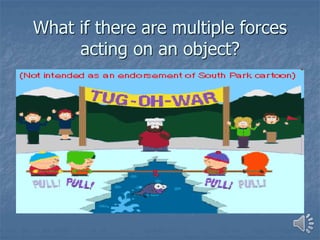
What if there are multiple forces
acting on an object?
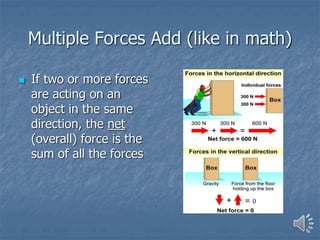
Multiple Forces Add (like in math)
 If two or more forces
are acting on an
object in the same
direction, the net
(overall) force is the
sum of all the forces
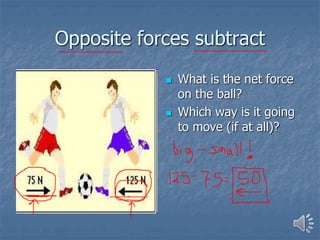
Opposite forces subtract
 What is the net force
on the ball?
 Which way is it going
to move (if at all)?
2.1 Section Review
1. State Newton’s first law in your own
words.
2. How is mass related to inertia?
3. What is the net force and how is it
determined?
Important Vocabulary
 Force
 Newton’s first law
 Newton
 Net force
Newton's 1st law

Newton's 1st law

  • 1.
  • 2.
    Newton: Great Scientistor 80’s Rock Star?  English Physicist /Mathematician  1642-1727  Invented Calculus to explain what he observed  Discovered 3 LAWS OF MOTION
  • 3.
    Use the Force,Luke…but only if you know what it is!  A force is a push or pull, or any action that has the ability to change motion.  Where is the force in these examples? Action What caused the force? Person lifts a box Person pulls object off the ground Gun fires bullet Explosion pushes bullet Branch falls from tree Gravity pulls branch to ground
  • 4.
    Nothing can startor stop moving unless a force is applied! O RLY?!? YEAH RLY!
  • 5.
    ?Question? Can there bea change in the motion of anything without a force being applied?
  • 6.
    NO! Okay smarty, Ithink you got it!
  • 7.
    Newton’s First Law Anobject at rest will stay at rest and an object in motion will continue in motion with the same speed and direction UNLESS acted on by a force.
  • 8.
    ?Question? So a spaceship is going 75,000 m/s (or 75 km/s). It takes a left turn at Pluto, but never changes speed. Was there a force acting on it??
  • 9.
    Yes! In order tochange direction, A force must be applied!
  • 10.
    Which would yourather do? Lift (move) a bag with groceries in it Lift (move) a semi- truck
  • 11.
    Easy choice, right Itis much easier to lift the groceries and possibly impossible (for you weaklings, anyway) to lift the truck. Why is one harder to move than the other?
  • 12.
    Mass You remember mass…it’sthe measure of how much matter an object has. It turns out, the more mass something has, the more force is required to move it. Duh!
  • 13.
    Inertia Inertia is theproperty of objects to resist changes in motion. If something is stationary, it resists attempts to move it If something is moving, it resists attempts to slow it down (or speed it up)
  • 14.
    The more masssomething has, the more inertia it has, and this means that more force is required to increase or decrease its speed.
  • 15.
    Which would yourather do? Part 2 Stop a bag of groceries that was thrown at you Stop a semi-truck driving toward you
  • 16.
    Put these inorder: Least to greatest inertia  Baseball bat (900g)  Bowling ball (7.2kg)  Pencil (2.6g)  Person (100kg)  Paper (0.1g)
  • 17.
    The greater anobject’s inertia, the greater the force needed to change its motion Newton’s first law is often referred to as the law of inertia
  • 18.
    Units of Force SI unit of mass is kilogram (kg)  SI unit of force is the NEWTON (N) 1 N of force can accelerate a 1kg object by 1 m/s 4.448 N = 1 lb (yes, weight is a measure of force)
  • 19.
    What if thereare multiple forces acting on an object?
  • 20.
    Multiple Forces Add(like in math)  If two or more forces are acting on an object in the same direction, the net (overall) force is the sum of all the forces
  • 22.
    Opposite forces subtract What is the net force on the ball?  Which way is it going to move (if at all)?
  • 23.
    2.1 Section Review 1.State Newton’s first law in your own words.
  • 24.
    2. How ismass related to inertia?
  • 25.
    3. What isthe net force and how is it determined?
  • 26.
    Important Vocabulary  Force Newton’s first law  Newton  Net force