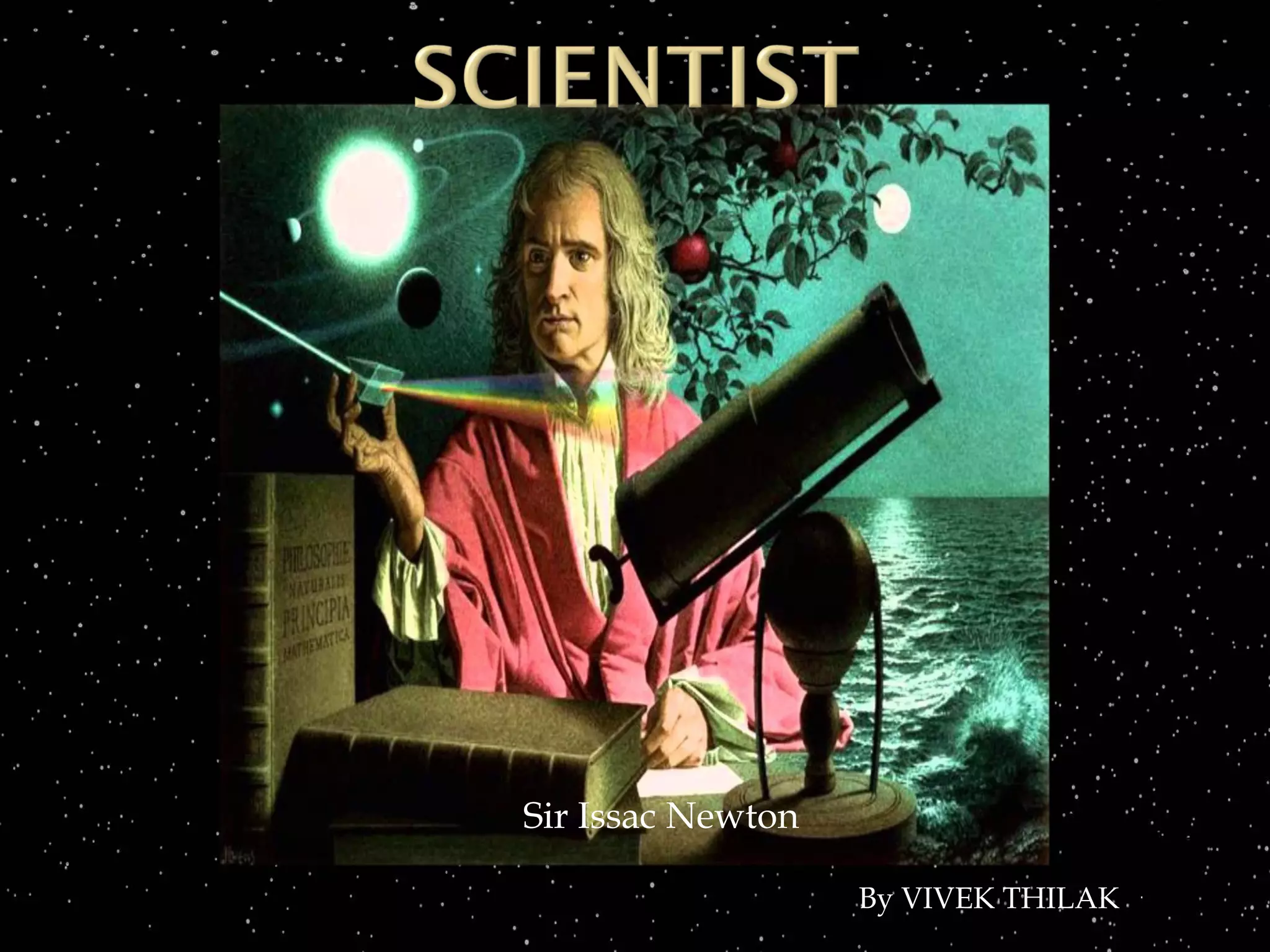
Sir Issac Newton 
By VIVEK THILAK
Born 4 January 1643) 
[OS: 25 December 1642] Woolsthorpe-by-Colsterworth 
Lincolnshire, England 
Died 31 March 1727 (aged 84) 
[OS: 20 March 1726] Kensington, Middlesex, England 
Residence England 
Citizenship English 
Nationality English (British from 1707) 
Fields Physics, mathematics, astronomy, 
natural philosophy, alchemy, 
theology 
Institutions University of Cambridge 
Royal Society 
Alma mater Trinity College, Cambridge 
Academic advisors Isaac Barrow 
Benjamin Pulleyn 
Notable students Roger Cotes 
William Whiston 
Known for Newtonian mechanics 
Universal gravitation 
Calculus 
Optics 
Influences Henry More 
Influenced Nicolas Fatio de Duillier 
John Keill 
Religious stance Monotheism
Sir Isaac Newton, (4 January 1643 – 31 March 1727 [25 December 1642 – 20 March 1726]) 
was an English physicist, mathematician, astronomer, natural philosopher, alchemist, and 
theologian and one of the most influential men in human history. His Philosophiæ Naturalis 
Principia Mathematica, published in 1687, is considered to be the most influential book in the 
history of science. In this work, Newton described universal gravitation and the three laws of 
motion, laying the groundwork for classical mechanics, which dominated the scientific view of 
the physical Universe for the next three centuries and is the basis for modern engineering. 
Newton showed that the motions of objects on Earth and of celestial bodies are governed by 
the same set of natural laws by demonstrating the consistency between Kepler's laws of 
planetary motion and his theory of gravitation, thus removing the last doubts about heliocentric 
and advancing the scientific revolution. 
In mechanics, Newton enunciated the principles of conservation of momentum and angular 
momentum. In optics, he built the first "practical" reflecting telescope and developed a theory of 
color based on the observation that a prism decomposes white light into a visible spectrum. He 
also formulated an empirical law of cooling and studied the speed of sound. 
In mathematics, Newton shares the credit with Gottfried Leibniz for the development of the 
differential and integral calculus. He also demonstrated the generalised binomial theorem, 
developed the so-called "Newton's method" for approximating the zeroes of a function, and 
contributed to the study of power series. 
Newton was also highly religious (though unorthodox), producing more work on Biblical 
hermeneutics than the natural science he is remembered for today. 
Newton's stature among scientists remains at the very top rank, as demonstrated by a 2005 
survey of scientists in Britain's Royal Society asking who had the greater effect on the history of 
science, Newton was deemed much more influential than Albert Einstein
MMaatthheemmaattiiccss 
Newton is generally credited with the generalised binomial theorem, valid for any 
exponent. He discovered Newton's identities, Newton's method, classified cubic 
plane curves (polynomials of degree three in two variables), made substantial 
contributions to the theory of finite differences, and was the first to use fractional 
indices and to employ coordinate geometry to derive solutions to Diophantine 
equations. He approximated partial sums of the harmonic series by logarithms (a 
precursor to Euler's summation formula), and was the first to use power series 
with confidence and to revert power series. He also discovered a new formula for 
calculating pi. 
He was elected Lucasian Professor of Mathematics in 1669. In that day, any fellow 
of Cambridge or Oxford had to be an ordained Anglican priest. However, the terms 
of the Lucasian professorship required that the holder not be active in the church 
(presumably so as to have more time for science). Newton argued that this should 
exempt him from the ordination requirement, and Charles II, whose permission 
was needed, accepted this argument. Thus a conflict between Newton's religious 
views and Anglican orthodoxy was averted.
Optics 
From 1670 to 1672, Newton lectured on optics. During this period he 
investigated the refraction of light, demonstrating that a prism could 
decompose white light into a spectrum of colours, and that a lens and a 
second prism could recompose the multicoloured spectrum into white light. 
He also showed that the coloured light does not change its properties by 
separating out a coloured beam and shining it on various objects. Newton 
noted that regardless of whether it was reflected or scattered or transmitted, it 
stayed the same colour. Thus, he observed that colour is the result of objects 
interacting with already-coloured light rather than objects generating the colour 
themselves. This is known as Newton's theory of colour. 
From this work he concluded that any refracting telescope would suffer from 
the dispersion of light into colours (chromatic aberration), and invented a type 
reflecting telescope (today known as a Newtonian telescope) to bypass that 
problem. By grinding his own mirrors, using Newton's rings to judge the quality 
of the optics for his telescopes, he was able to produce a superior instrument 
to the refracting telescope, due primarily to the wider diameter of the mirror. In 
1671 the Royal Society asked for a demonstration of his reflecting telescope. 
Their interest encouraged him to publish his notes On Colour, which he later 
expanded into his Opticks. When Robert Hooke criticised some of Newton's 
ideas, Newton was so offended that he withdrew from public debate. The two 
men remained enemies until Hooke's death
Mechanics and gravitation 
In 1677, Newton returned to his work on mechanics, i.e., gravitation and its effect on the orbits of 
planets, with reference to Kepler's laws of planetary motion, and consulting with Hooke and 
Flamsteed on the subject. He published his results in De motu corporum in gyrum (1684). This 
contained the beginnings of the laws of motion that would inform the Principia. 
The Philosophiae Naturalis Principia Mathematica (now known as the Principia) was published on 5 
July 1687 with encouragement and financial help from Edmond Halley. In this work Newton stated 
the three universal laws of motion that were not to be improved upon for more than two hundred 
years. He used the Latin word gravitas (weight) for the effect that would become known as gravity, 
and defined the law of universal gravitation. In the same work he presented the first analytical 
determination, based on Boyle's law, of the speed of sound in air. Newton's postulate of an invisible 
force able to act over vast distances led to him being criticised for introducing "occult agencies" into 
science.
Newton's laws of motion 
Law of Inertia 
An object at rest will remain at rest, and an object in 
motion will remain in motion with constant velocity 
unless acted upon by an external force.
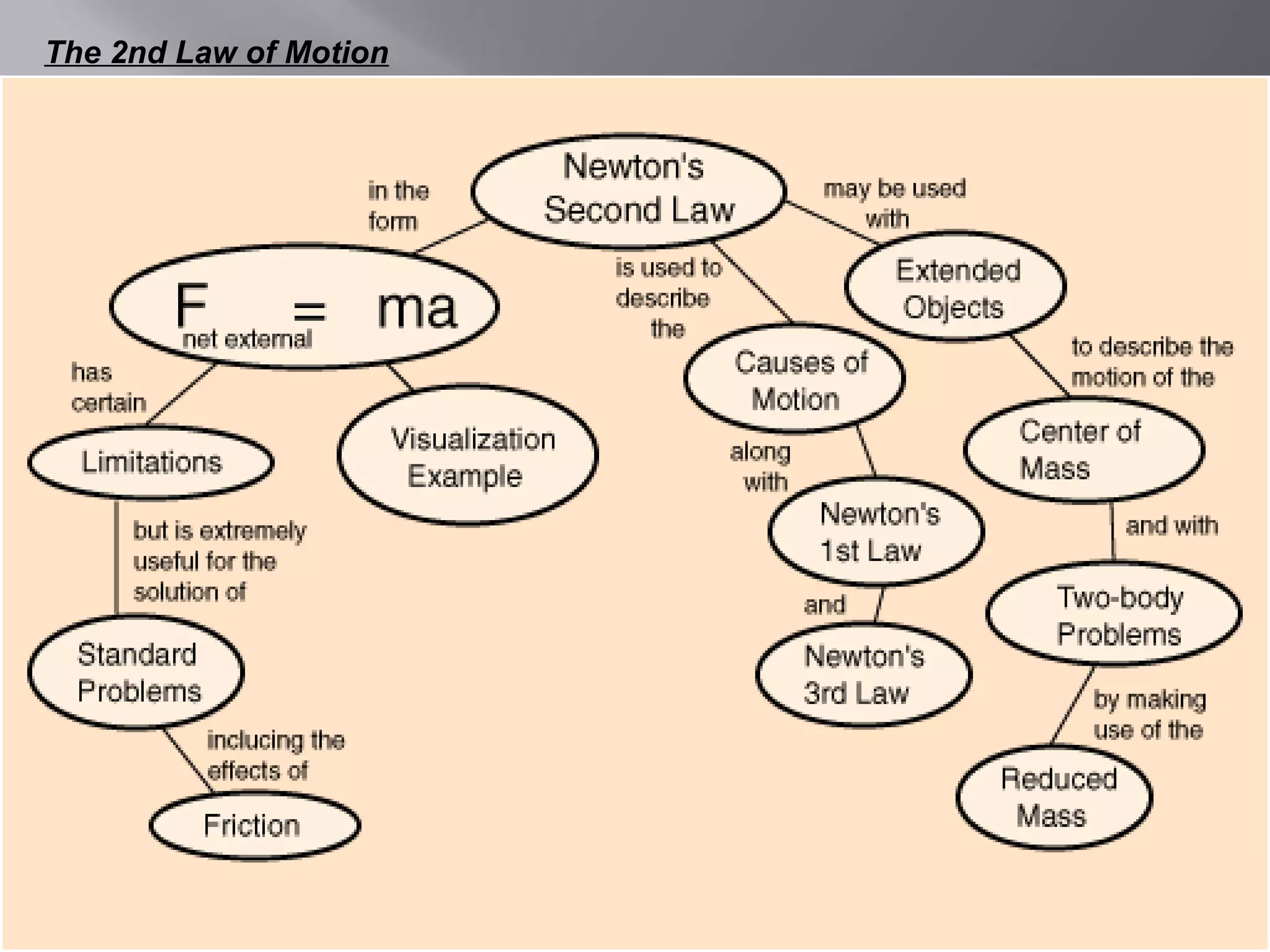
The 2nd Law of Motion
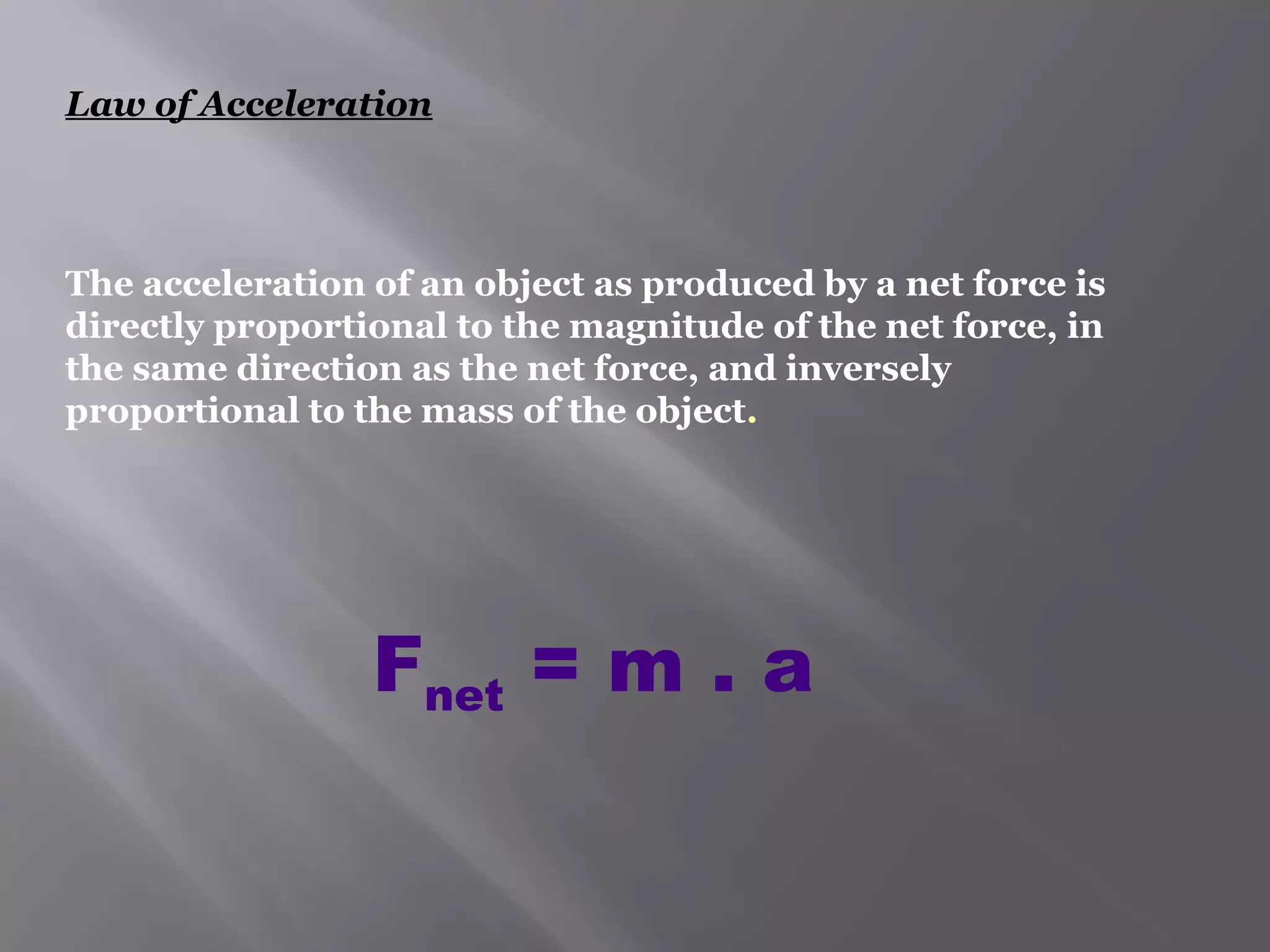
Law of Acceleration 
The acceleration of an object as produced by a net force is 
directly proportional to the magnitude of the net force, in 
the same direction as the net force, and inversely 
proportional to the mass of the object. 
Fnet = m . a
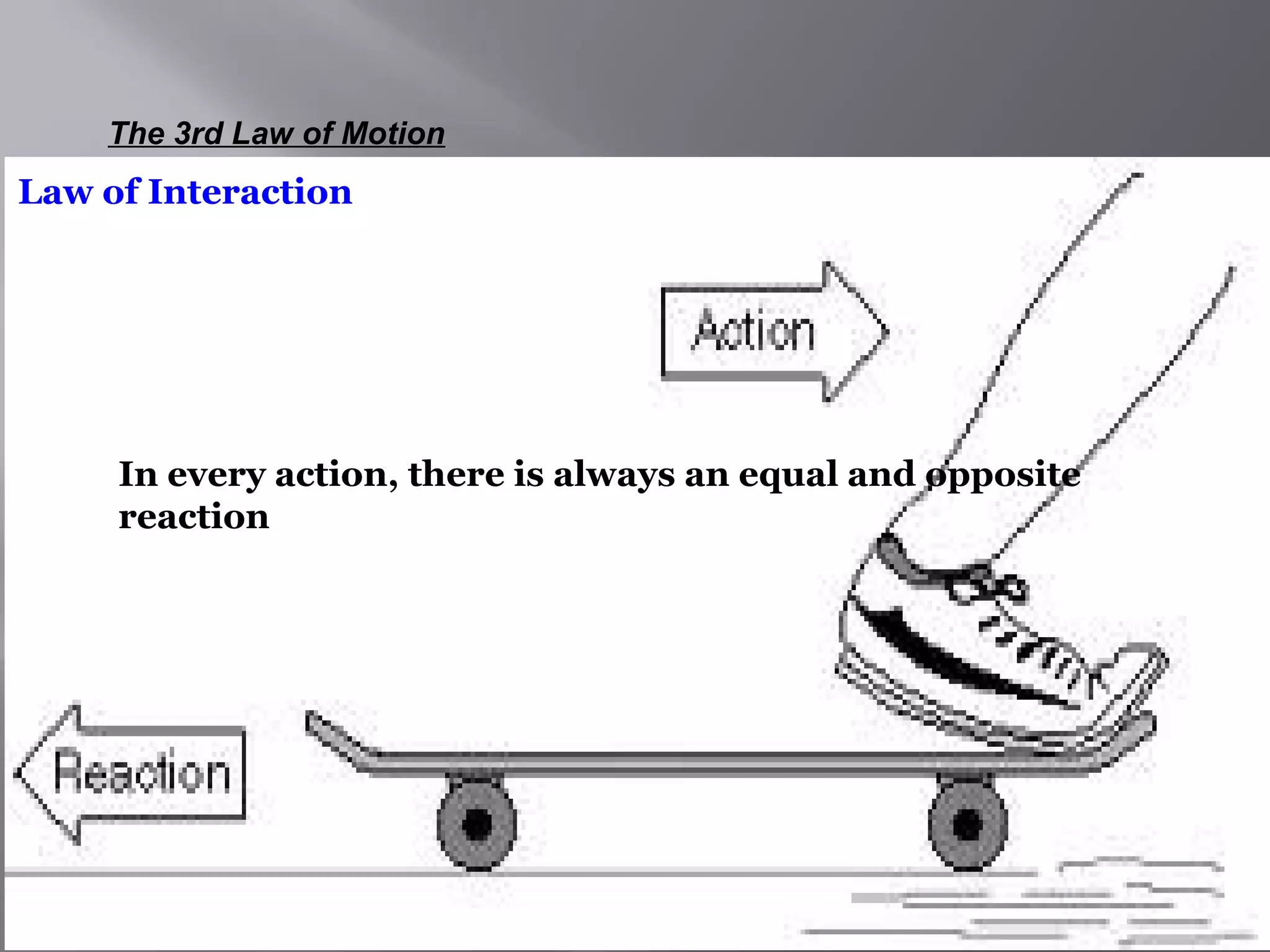
The 3rd Law of Motion 
Law of Interaction 
In every action, there is always an equal and opposite 
reaction
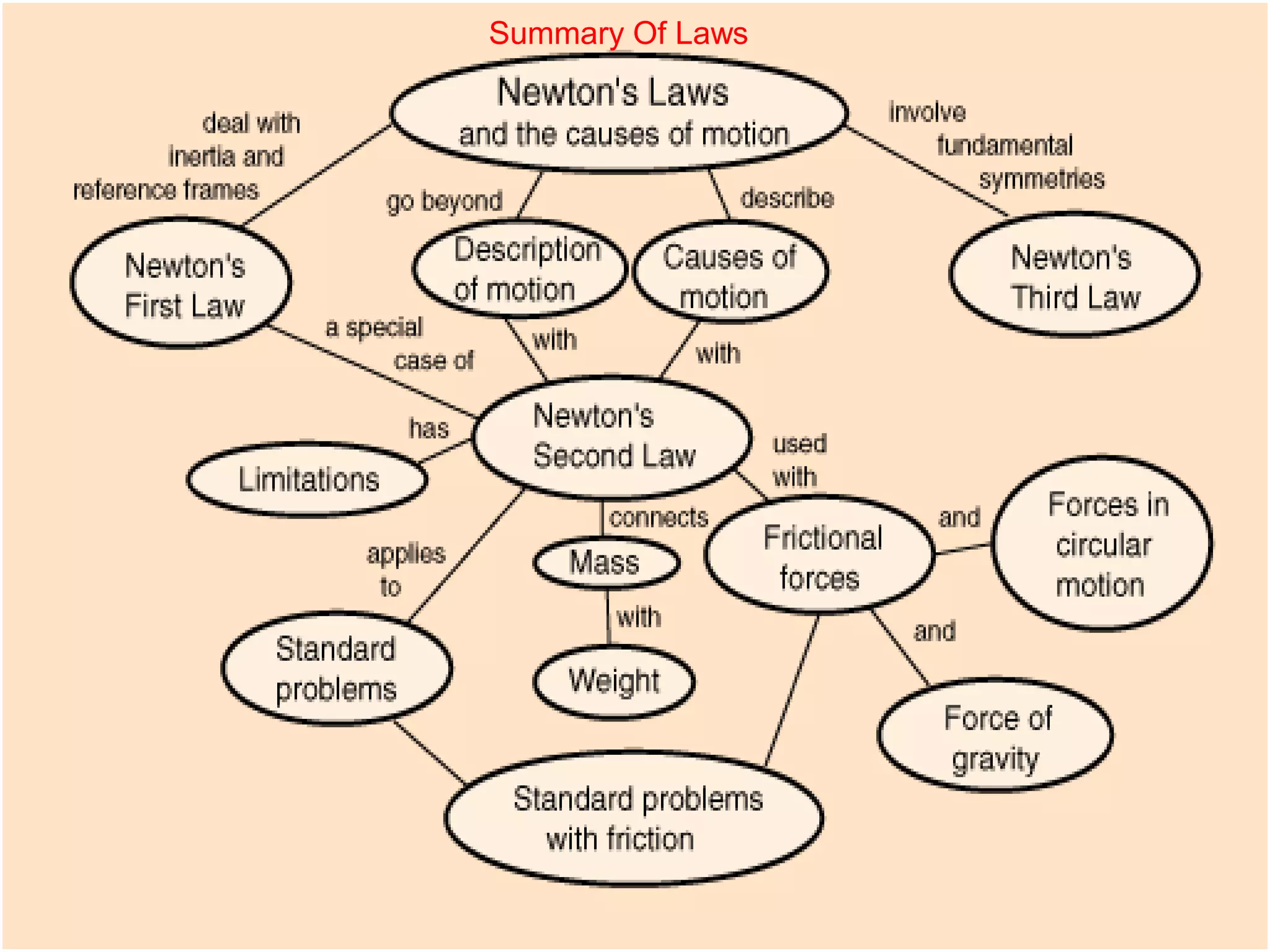
Summary Of Laws
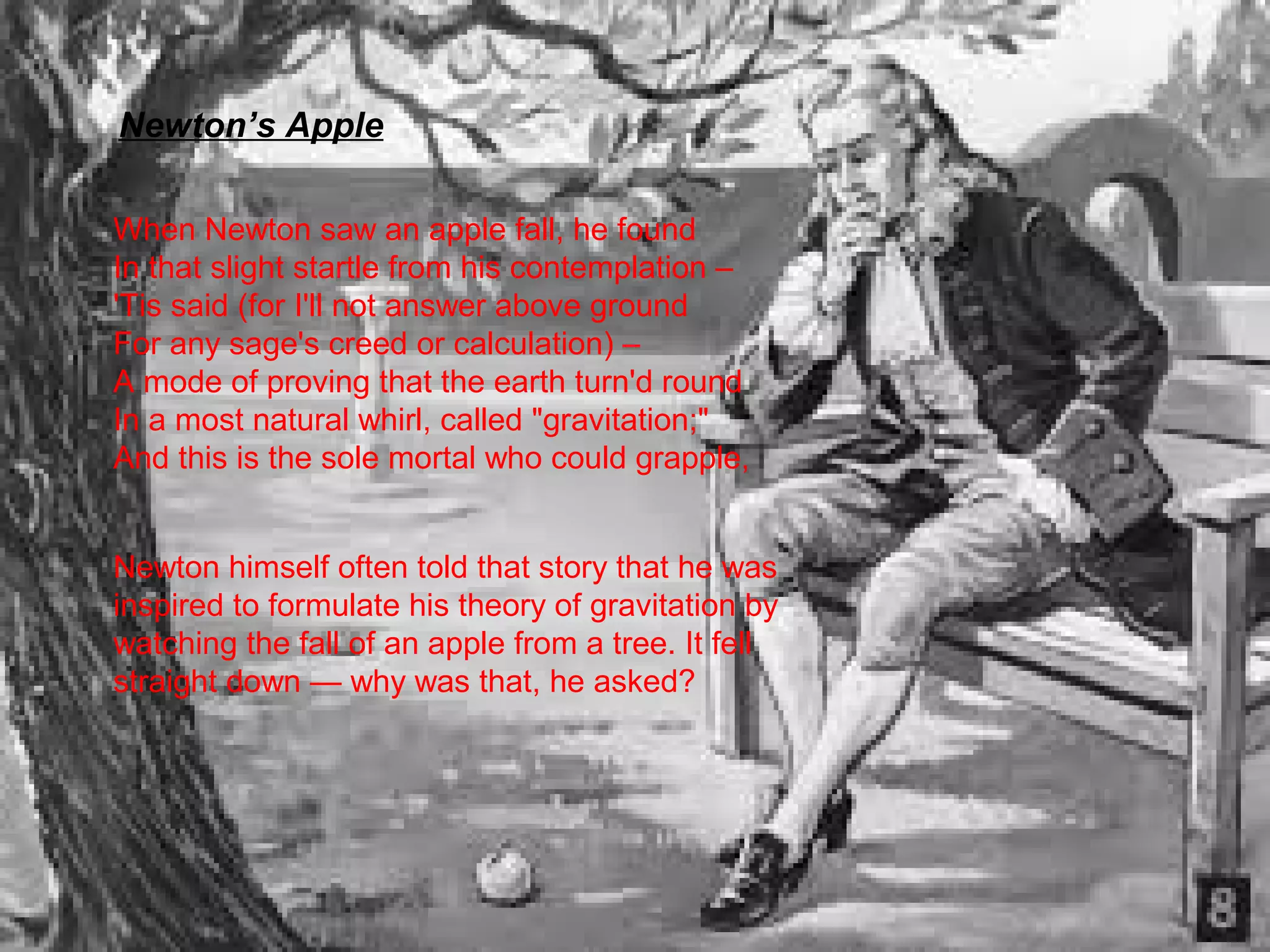
Newton’s Apple 
When Newton saw an apple fall, he found 
In that slight startle from his contemplation – 
'Tis said (for I'll not answer above ground 
For any sage's creed or calculation) – 
A mode of proving that the earth turn'd round 
In a most natural whirl, called "gravitation;" 
And this is the sole mortal who could grapple, 
Newton himself often told that story that he was 
inspired to formulate his theory of gravitation by 
watching the fall of an apple from a tree. It fell 
straight down — why was that, he asked?
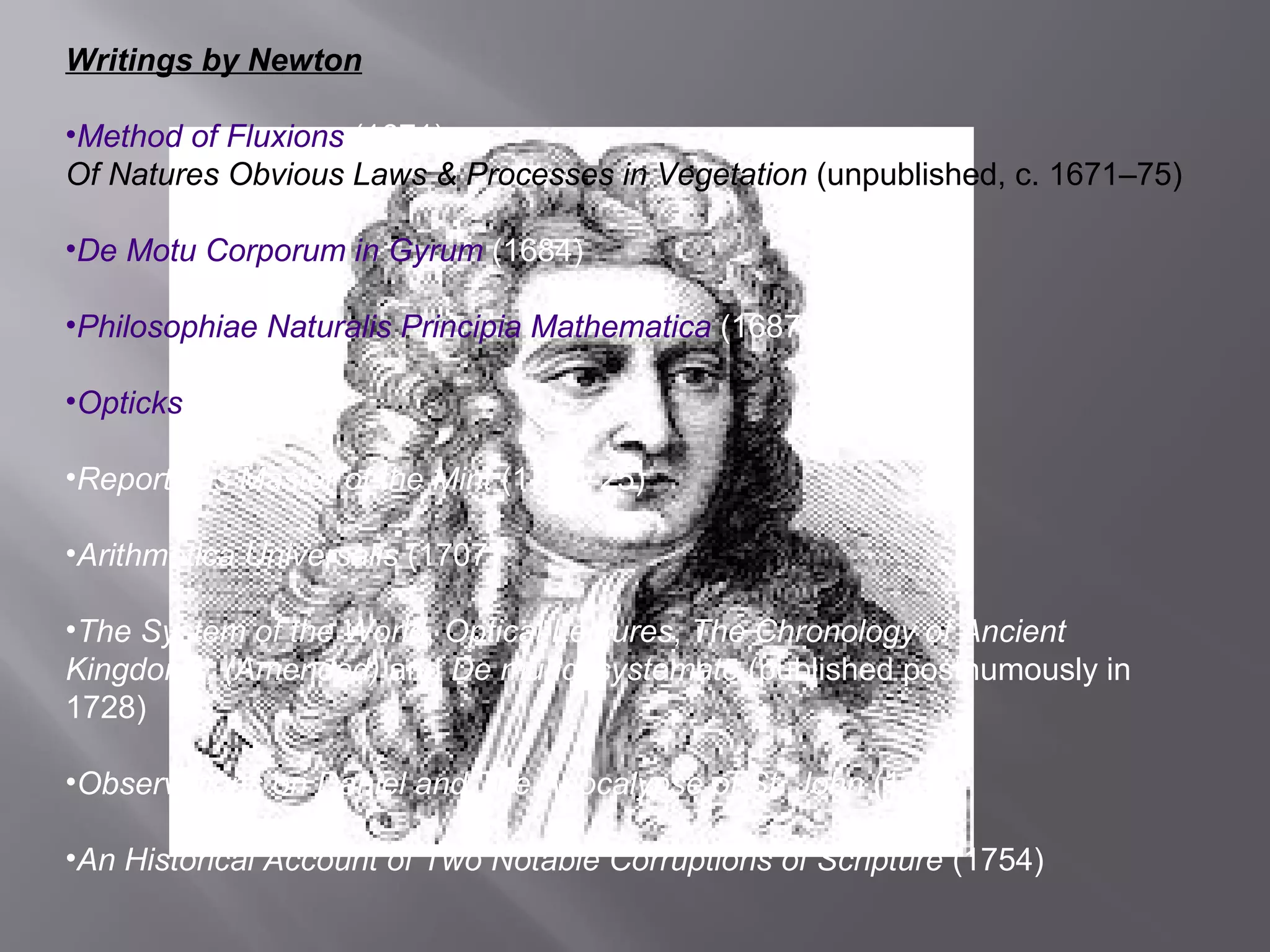
Writings by Newton 
•Method of Fluxions (1671) 
Of Natures Obvious Laws & Processes in Vegetation (unpublished, c. 1671–75) 
•De Motu Corporum in Gyrum (1684) 
•Philosophiae Naturalis Principia Mathematica (1687) 
•Opticks (1704) 
•Reports as Master of the Mint (1701–25) 
•Arithmetica Universalis (1707) 
•The System of the World, Optical Lectures, The Chronology of Ancient 
Kingdoms, (Amended) and De mundi systemate (published posthumously in 
1728) 
•Observations on Daniel and The Apocalypse of St. John (1733) 
•An Historical Account of Two Notable Corruptions of Scripture (1754)
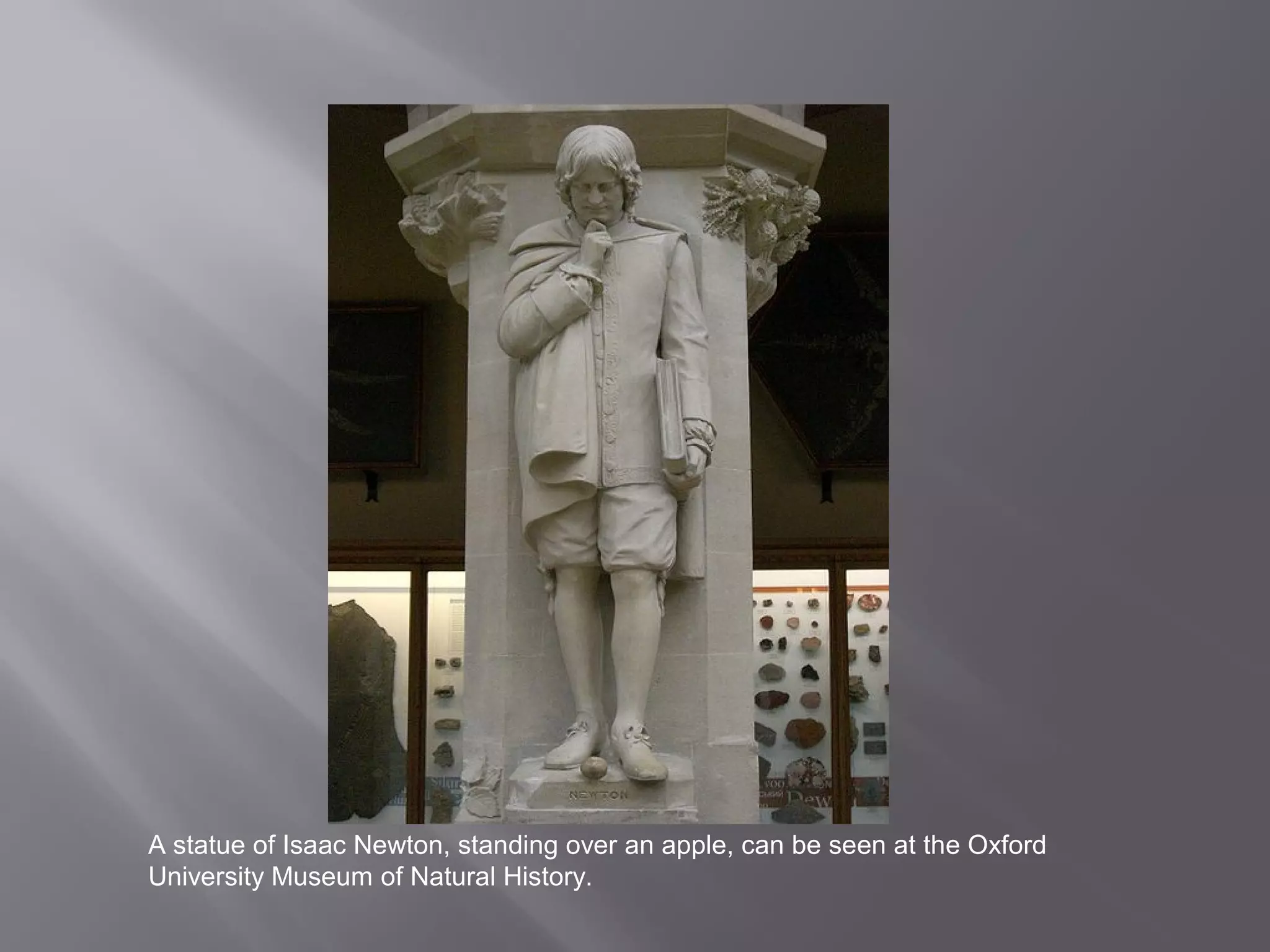
A statue of Isaac Newton, standing over an apple, can be seen at the Oxford 
University Museum of Natural History.
THANK YOU 
THE END

Issac newton new 1

  • 1.
    Sir Issac Newton By VIVEK THILAK
  • 2.
    Born 4 January1643) [OS: 25 December 1642] Woolsthorpe-by-Colsterworth Lincolnshire, England Died 31 March 1727 (aged 84) [OS: 20 March 1726] Kensington, Middlesex, England Residence England Citizenship English Nationality English (British from 1707) Fields Physics, mathematics, astronomy, natural philosophy, alchemy, theology Institutions University of Cambridge Royal Society Alma mater Trinity College, Cambridge Academic advisors Isaac Barrow Benjamin Pulleyn Notable students Roger Cotes William Whiston Known for Newtonian mechanics Universal gravitation Calculus Optics Influences Henry More Influenced Nicolas Fatio de Duillier John Keill Religious stance Monotheism
  • 3.
    Sir Isaac Newton,(4 January 1643 – 31 March 1727 [25 December 1642 – 20 March 1726]) was an English physicist, mathematician, astronomer, natural philosopher, alchemist, and theologian and one of the most influential men in human history. His Philosophiæ Naturalis Principia Mathematica, published in 1687, is considered to be the most influential book in the history of science. In this work, Newton described universal gravitation and the three laws of motion, laying the groundwork for classical mechanics, which dominated the scientific view of the physical Universe for the next three centuries and is the basis for modern engineering. Newton showed that the motions of objects on Earth and of celestial bodies are governed by the same set of natural laws by demonstrating the consistency between Kepler's laws of planetary motion and his theory of gravitation, thus removing the last doubts about heliocentric and advancing the scientific revolution. In mechanics, Newton enunciated the principles of conservation of momentum and angular momentum. In optics, he built the first "practical" reflecting telescope and developed a theory of color based on the observation that a prism decomposes white light into a visible spectrum. He also formulated an empirical law of cooling and studied the speed of sound. In mathematics, Newton shares the credit with Gottfried Leibniz for the development of the differential and integral calculus. He also demonstrated the generalised binomial theorem, developed the so-called "Newton's method" for approximating the zeroes of a function, and contributed to the study of power series. Newton was also highly religious (though unorthodox), producing more work on Biblical hermeneutics than the natural science he is remembered for today. Newton's stature among scientists remains at the very top rank, as demonstrated by a 2005 survey of scientists in Britain's Royal Society asking who had the greater effect on the history of science, Newton was deemed much more influential than Albert Einstein
  • 4.
    MMaatthheemmaattiiccss Newton isgenerally credited with the generalised binomial theorem, valid for any exponent. He discovered Newton's identities, Newton's method, classified cubic plane curves (polynomials of degree three in two variables), made substantial contributions to the theory of finite differences, and was the first to use fractional indices and to employ coordinate geometry to derive solutions to Diophantine equations. He approximated partial sums of the harmonic series by logarithms (a precursor to Euler's summation formula), and was the first to use power series with confidence and to revert power series. He also discovered a new formula for calculating pi. He was elected Lucasian Professor of Mathematics in 1669. In that day, any fellow of Cambridge or Oxford had to be an ordained Anglican priest. However, the terms of the Lucasian professorship required that the holder not be active in the church (presumably so as to have more time for science). Newton argued that this should exempt him from the ordination requirement, and Charles II, whose permission was needed, accepted this argument. Thus a conflict between Newton's religious views and Anglican orthodoxy was averted.
  • 5.
    Optics From 1670to 1672, Newton lectured on optics. During this period he investigated the refraction of light, demonstrating that a prism could decompose white light into a spectrum of colours, and that a lens and a second prism could recompose the multicoloured spectrum into white light. He also showed that the coloured light does not change its properties by separating out a coloured beam and shining it on various objects. Newton noted that regardless of whether it was reflected or scattered or transmitted, it stayed the same colour. Thus, he observed that colour is the result of objects interacting with already-coloured light rather than objects generating the colour themselves. This is known as Newton's theory of colour. From this work he concluded that any refracting telescope would suffer from the dispersion of light into colours (chromatic aberration), and invented a type reflecting telescope (today known as a Newtonian telescope) to bypass that problem. By grinding his own mirrors, using Newton's rings to judge the quality of the optics for his telescopes, he was able to produce a superior instrument to the refracting telescope, due primarily to the wider diameter of the mirror. In 1671 the Royal Society asked for a demonstration of his reflecting telescope. Their interest encouraged him to publish his notes On Colour, which he later expanded into his Opticks. When Robert Hooke criticised some of Newton's ideas, Newton was so offended that he withdrew from public debate. The two men remained enemies until Hooke's death
  • 6.
    Mechanics and gravitation In 1677, Newton returned to his work on mechanics, i.e., gravitation and its effect on the orbits of planets, with reference to Kepler's laws of planetary motion, and consulting with Hooke and Flamsteed on the subject. He published his results in De motu corporum in gyrum (1684). This contained the beginnings of the laws of motion that would inform the Principia. The Philosophiae Naturalis Principia Mathematica (now known as the Principia) was published on 5 July 1687 with encouragement and financial help from Edmond Halley. In this work Newton stated the three universal laws of motion that were not to be improved upon for more than two hundred years. He used the Latin word gravitas (weight) for the effect that would become known as gravity, and defined the law of universal gravitation. In the same work he presented the first analytical determination, based on Boyle's law, of the speed of sound in air. Newton's postulate of an invisible force able to act over vast distances led to him being criticised for introducing "occult agencies" into science.
  • 7.
    Newton's laws ofmotion Law of Inertia An object at rest will remain at rest, and an object in motion will remain in motion with constant velocity unless acted upon by an external force.
  • 8.
    The 2nd Lawof Motion
  • 9.
    Law of Acceleration The acceleration of an object as produced by a net force is directly proportional to the magnitude of the net force, in the same direction as the net force, and inversely proportional to the mass of the object. Fnet = m . a
  • 10.
    The 3rd Lawof Motion Law of Interaction In every action, there is always an equal and opposite reaction
  • 11.
  • 12.
    Newton’s Apple WhenNewton saw an apple fall, he found In that slight startle from his contemplation – 'Tis said (for I'll not answer above ground For any sage's creed or calculation) – A mode of proving that the earth turn'd round In a most natural whirl, called "gravitation;" And this is the sole mortal who could grapple, Newton himself often told that story that he was inspired to formulate his theory of gravitation by watching the fall of an apple from a tree. It fell straight down — why was that, he asked?
  • 13.
    Writings by Newton •Method of Fluxions (1671) Of Natures Obvious Laws & Processes in Vegetation (unpublished, c. 1671–75) •De Motu Corporum in Gyrum (1684) •Philosophiae Naturalis Principia Mathematica (1687) •Opticks (1704) •Reports as Master of the Mint (1701–25) •Arithmetica Universalis (1707) •The System of the World, Optical Lectures, The Chronology of Ancient Kingdoms, (Amended) and De mundi systemate (published posthumously in 1728) •Observations on Daniel and The Apocalypse of St. John (1733) •An Historical Account of Two Notable Corruptions of Scripture (1754)
  • 14.
    A statue ofIsaac Newton, standing over an apple, can be seen at the Oxford University Museum of Natural History.
  • 15.