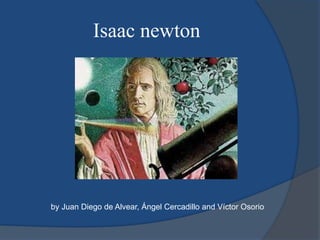
Isaac newton 
by Juan Diego de Alvear, Ángel Cercadillo and Víctor Osorio
Newton’s biography 
 Sir Isaac Newton 25 December 1642 – 20 
March 1726) was an physicist 
and mathematician who is recognised as 
one of the most influential scientists of all 
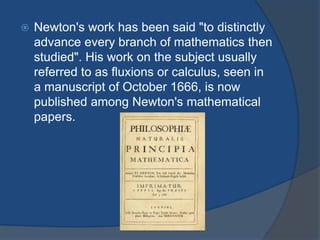
time. His book Philosophiæ Naturalis 
Principia Mathematica ("Mathematical 
Principles of Natural Philosophy"), first 
published in 1687, explained the 
foundations for classical mechanics. 
Newton also made contributions to optical 
devices and shares credit with Gottfried 
Leibniz for the development of calculus.
 By deriving Kepler's laws of planetary 
motion from his mathematical 
description of gravity, and then using the 
same principles to account for the 
trajectories of comets, the tides, 
the precession of the equinoxes, and 
other phenomena, Newton removed the 
last doubts about the validity of 
the heliocentric model of the cosmos
 This work also demonstrated that 
the motion of objects on Earth and 
of celestial bodies could be described by 
the same principles. His prediction that 
the Earth should be shaped as anoblate 
spheroid was later vindicated by the 
measurements of Maupertuis, La 
Condamine, and others, which helped 
convince most Continental 
European scientists of the superiority of 
Newtonian mechanics over the earlier 
system of Descartes.
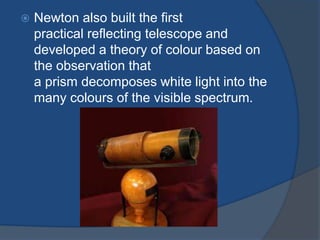
 Newton also built the first 
practical reflecting telescope and 
developed a theory of colour based on 
the observation that 
a prism decomposes white light into the 
many colours of the visible spectrum.
 Newton was a fellow of Trinity College and the 
second Lucasian Professor of Mathematics at 
theUniversity of Cambridge. He was a devout 
but unorthodox Christian and, unusually for a 
member of the Cambridge faculty of the day, 
he refused to take holy orders in the Church of 
England, perhaps because he privately 
rejected the doctrine of the Trinity. Beyond his 
work on the mathematical sciences, Newton 
dedicated much of his time to the study 
of biblical chronology andalchemy, but most of 
his work in those areas remained unpublished 
until long after his death. In his later life, 
Newton became president of the Royal 
Society. He also served the British government 
as Warden and Master of the Royal Mint.
 Isaac Newton was born according to 
the Julian calendar (in use in England at 
the time) on Christmas Day, 25 
December 1642 at Woolsthorpe 
Manor in Woolsthorpe-by-Colsterworth, 
a hamlet in the county of Lincolnshire. 
He was born three months after the 
death of his father, a prosperous farmer 
also named Isaac Newton.
 Newton's work has been said "to distinctly 
advance every branch of mathematics then 
studied". His work on the subject usually 
referred to as fluxions or calculus, seen in 
a manuscript of October 1666, is now 
published among Newton's mathematical 
papers.
 In 1666, Newton observed that the 
spectrum of colours exiting a prism in 
the position of minimum deviation is 
oblong, even when the light ray entering 
the prism is circular, which is to say, the 
prism refracts different colours by 
different angles. This led him to 
conclude that colour is a property 
intrinsic to light—a point which had been 
debated in prior years.
 In 1679, Newton returned to his work on 
mechanics by considering gravitation and 
its effect on the orbits of planets with 
reference to Kepler’s laws of planetary 
motion. This followed stimulation by a brief 
exchange of letters in 1679–80 with Hooke, 
Personal coat of arms of Sir Isaac Newton 
 Newton never married. The French writer 
and philosopher Voltaire, who was in 
London at the time of Newton's funeral, 
said that he "was never sensible to any 
passion, was not subject to the common 
frailties of mankind, nor had any commerce 
with women—a circumstance which was 
assured me by the physician and surgeon 
who attended him in his last moments.
NEWTON’S LAWS 
Isaac Newton (a 17th century scientist) put forth a variety of laws 
that explain why objects move (or don't move) as they do. These 
three laws have become known as Newton's three laws of motion 
 Newton’s first law 
 Newton’s second law 
 Newton’s third law 
 Universal Gravity Theory
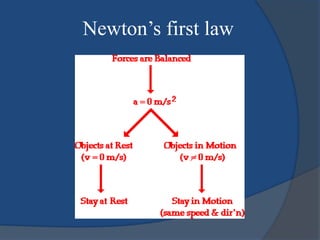
Newton’s first law
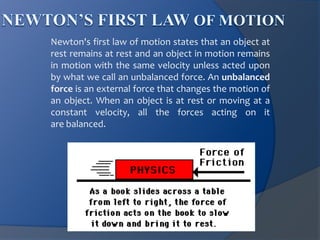
Newton's first law of motion states that an object at 
rest remains at rest and an object in motion remains 
in motion with the same velocity unless acted upon 
by what we call an unbalanced force. An unbalanced 
force is an external force that changes the motion of 
an object. When an object is at rest or moving at a 
constant velocity, all the forces acting on it 
are balanced.
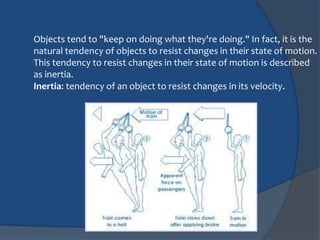
Objects tend to "keep on doing what they're doing." In fact, it is the 
natural tendency of objects to resist changes in their state of motion. 
This tendency to resist changes in their state of motion is described 
as inertia. 
Inertia: tendency of an object to resist changes in its velocity.
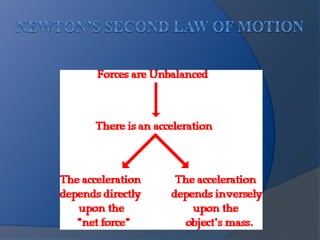
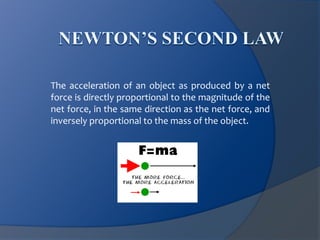
The acceleration of an object as produced by a net 
force is directly proportional to the magnitude of the 
net force, in the same direction as the net force, and 
inversely proportional to the mass of the object.
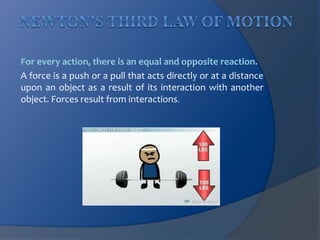
For every action, there is an equal and opposite reaction. 
A force is a push or a pull that acts directly or at a distance 
upon an object as a result of its interaction with another 
object. Forces result from interactions.
Universal Gravitation theory 
 In his 1687 book Philosophiae Naturalis 
Principia Mathematica, regarded as one of 
the most important books ever published, 
Newton established many physical 
principles. The most innovative of them all 
was theory on how two bodies would pull 
from each other for unknown apparent 
reason. This "reason" turned out to be 
gravity, an essential force in understanding 
how the world, and the base of modern 
physics.
 It's rumored that Newton came up with the 
idea while watching apples fall from the trees 
in his mother's garden. He observed how 
things would always fall towards the Earth's 
centre, not anywhere else. During that time, 
alchemy and science weren't different 
concepts, and a famous alchemical principle 
stated that two objects could exert a small 
force on each other, even in a vacuum. The 
young scientist decided to study this strange 
law, and through exhaustive observations & 
calculus, he defined a series of equations that 
measured its effects. These findings were the 
backbone of the "Universal Gravitation 
Theory", named after the Latin word for 
weight: gravitas.
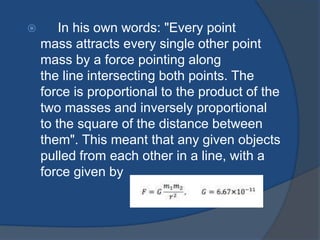
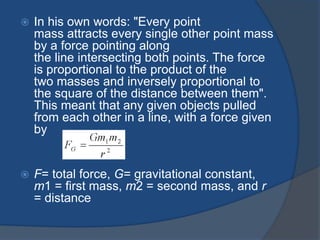
 In his own words: "Every point 
mass attracts every single other point 
mass by a force pointing along 
the line intersecting both points. The 
force is proportional to the product of the 
two masses and inversely proportional 
to the square of the distance between 
them". This meant that any given objects 
pulled from each other in a line, with a 
force given by
 In his own words: "Every point 
mass attracts every single other point mass 
by a force pointing along 
the line intersecting both points. The force 
is proportional to the product of the 
two masses and inversely proportional to 
the square of the distance between them". 
This meant that any given objects pulled 
from each other in a line, with a force given 
by 
 F= total force, G= gravitational constant, 
m1 = first mass, m2 = second mass, and r 
= distance
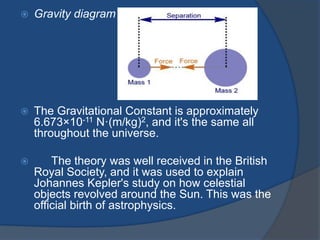
 Gravity diagram 
 The Gravitational Constant is approximately 
6.673×10⁻¹¹ N·(m/kg)2, and it's the same all 
throughout the universe. 
 The theory was well received in the British 
Royal Society, and it was used to explain 
Johannes Kepler's study on how celestial 
objects revolved around the Sun. This was the 
official birth of astrophysics.

Newton’s laws physics and chemistry 4ºA

  • 1.
    Isaac newton byJuan Diego de Alvear, Ángel Cercadillo and Víctor Osorio
  • 2.
    Newton’s biography Sir Isaac Newton 25 December 1642 – 20 March 1726) was an physicist and mathematician who is recognised as one of the most influential scientists of all time. His book Philosophiæ Naturalis Principia Mathematica ("Mathematical Principles of Natural Philosophy"), first published in 1687, explained the foundations for classical mechanics. Newton also made contributions to optical devices and shares credit with Gottfried Leibniz for the development of calculus.
  • 3.
     By derivingKepler's laws of planetary motion from his mathematical description of gravity, and then using the same principles to account for the trajectories of comets, the tides, the precession of the equinoxes, and other phenomena, Newton removed the last doubts about the validity of the heliocentric model of the cosmos
  • 4.
     This workalso demonstrated that the motion of objects on Earth and of celestial bodies could be described by the same principles. His prediction that the Earth should be shaped as anoblate spheroid was later vindicated by the measurements of Maupertuis, La Condamine, and others, which helped convince most Continental European scientists of the superiority of Newtonian mechanics over the earlier system of Descartes.
  • 5.
     Newton alsobuilt the first practical reflecting telescope and developed a theory of colour based on the observation that a prism decomposes white light into the many colours of the visible spectrum.
  • 6.
     Newton wasa fellow of Trinity College and the second Lucasian Professor of Mathematics at theUniversity of Cambridge. He was a devout but unorthodox Christian and, unusually for a member of the Cambridge faculty of the day, he refused to take holy orders in the Church of England, perhaps because he privately rejected the doctrine of the Trinity. Beyond his work on the mathematical sciences, Newton dedicated much of his time to the study of biblical chronology andalchemy, but most of his work in those areas remained unpublished until long after his death. In his later life, Newton became president of the Royal Society. He also served the British government as Warden and Master of the Royal Mint.
  • 7.
     Isaac Newtonwas born according to the Julian calendar (in use in England at the time) on Christmas Day, 25 December 1642 at Woolsthorpe Manor in Woolsthorpe-by-Colsterworth, a hamlet in the county of Lincolnshire. He was born three months after the death of his father, a prosperous farmer also named Isaac Newton.
  • 8.
     Newton's workhas been said "to distinctly advance every branch of mathematics then studied". His work on the subject usually referred to as fluxions or calculus, seen in a manuscript of October 1666, is now published among Newton's mathematical papers.
  • 9.
     In 1666,Newton observed that the spectrum of colours exiting a prism in the position of minimum deviation is oblong, even when the light ray entering the prism is circular, which is to say, the prism refracts different colours by different angles. This led him to conclude that colour is a property intrinsic to light—a point which had been debated in prior years.
  • 10.
     In 1679,Newton returned to his work on mechanics by considering gravitation and its effect on the orbits of planets with reference to Kepler’s laws of planetary motion. This followed stimulation by a brief exchange of letters in 1679–80 with Hooke, Personal coat of arms of Sir Isaac Newton  Newton never married. The French writer and philosopher Voltaire, who was in London at the time of Newton's funeral, said that he "was never sensible to any passion, was not subject to the common frailties of mankind, nor had any commerce with women—a circumstance which was assured me by the physician and surgeon who attended him in his last moments.
  • 11.
    NEWTON’S LAWS IsaacNewton (a 17th century scientist) put forth a variety of laws that explain why objects move (or don't move) as they do. These three laws have become known as Newton's three laws of motion  Newton’s first law  Newton’s second law  Newton’s third law  Universal Gravity Theory
  • 12.
  • 13.
    Newton's first lawof motion states that an object at rest remains at rest and an object in motion remains in motion with the same velocity unless acted upon by what we call an unbalanced force. An unbalanced force is an external force that changes the motion of an object. When an object is at rest or moving at a constant velocity, all the forces acting on it are balanced.
  • 14.
    Objects tend to"keep on doing what they're doing." In fact, it is the natural tendency of objects to resist changes in their state of motion. This tendency to resist changes in their state of motion is described as inertia. Inertia: tendency of an object to resist changes in its velocity.
  • 16.
    The acceleration ofan object as produced by a net force is directly proportional to the magnitude of the net force, in the same direction as the net force, and inversely proportional to the mass of the object.
  • 17.
    For every action,there is an equal and opposite reaction. A force is a push or a pull that acts directly or at a distance upon an object as a result of its interaction with another object. Forces result from interactions.
  • 18.
    Universal Gravitation theory  In his 1687 book Philosophiae Naturalis Principia Mathematica, regarded as one of the most important books ever published, Newton established many physical principles. The most innovative of them all was theory on how two bodies would pull from each other for unknown apparent reason. This "reason" turned out to be gravity, an essential force in understanding how the world, and the base of modern physics.
  • 19.
     It's rumoredthat Newton came up with the idea while watching apples fall from the trees in his mother's garden. He observed how things would always fall towards the Earth's centre, not anywhere else. During that time, alchemy and science weren't different concepts, and a famous alchemical principle stated that two objects could exert a small force on each other, even in a vacuum. The young scientist decided to study this strange law, and through exhaustive observations & calculus, he defined a series of equations that measured its effects. These findings were the backbone of the "Universal Gravitation Theory", named after the Latin word for weight: gravitas.
  • 20.
     In hisown words: "Every point mass attracts every single other point mass by a force pointing along the line intersecting both points. The force is proportional to the product of the two masses and inversely proportional to the square of the distance between them". This meant that any given objects pulled from each other in a line, with a force given by
  • 21.
     In hisown words: "Every point mass attracts every single other point mass by a force pointing along the line intersecting both points. The force is proportional to the product of the two masses and inversely proportional to the square of the distance between them". This meant that any given objects pulled from each other in a line, with a force given by  F= total force, G= gravitational constant, m1 = first mass, m2 = second mass, and r = distance
  • 22.
     Gravity diagram  The Gravitational Constant is approximately 6.673×10⁻¹¹ N·(m/kg)2, and it's the same all throughout the universe.  The theory was well received in the British Royal Society, and it was used to explain Johannes Kepler's study on how celestial objects revolved around the Sun. This was the official birth of astrophysics.