Mass Media
 Mass media is communication whether
written, broadcast, or spoken that
reaches a large audience. This includes
television, radio, advertising, movies, the
internet, newspapers, magazines and so
forth.
Types of mass media
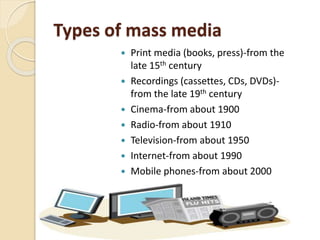
 Print media (books, press)-from the
late 15th century
 Recordings (cassettes, CDs, DVDs)-
from the late 19th century
 Cinema-from about 1900
 Radio-from about 1910
 Television-from about 1950
 Internet-from about 1990
 Mobile phones-from about 2000
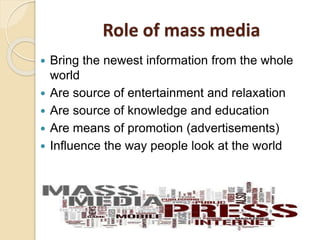
Role of mass media
 Bring the newest information from the whole
world
 Are source of entertainment and relaxation
 Are source of knowledge and education
 Are means of promotion (advertisements)
 Influence the way people look at the world
What can mass media change in
education?
 Our knowledge
 Our behavior
 Our attitude
 Our ways of learning
 Our abilities
Print media in education
 Print media
 Media provides information in two ways-
 Formal: In formal type, it directly imparts
syllabus based education to students.
 Informal: Distance education- Work books and
study materials are of various format.
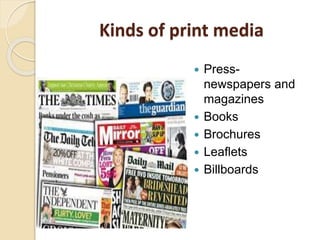
Kinds of print media
 Press-
newspapers and
magazines
 Books
 Brochures
 Leaflets
 Billboards
Newspapers
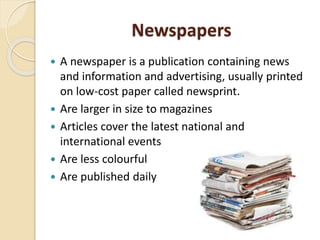
 A newspaper is a publication containing news
and information and advertising, usually printed
on low-cost paper called newsprint.
 Are larger in size to magazines
 Articles cover the latest national and
international events
 Are less colourful
 Are published daily
Newspapers
 There are commercial, financial and public
affairs,
 The radio and TV programmes are printed
there,
 Contain fresher content than magazine
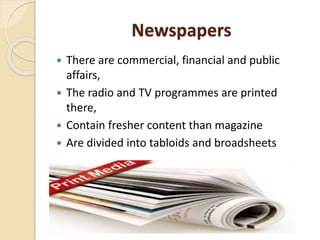
 Are divided into tabloids and broadsheets
Tabloids
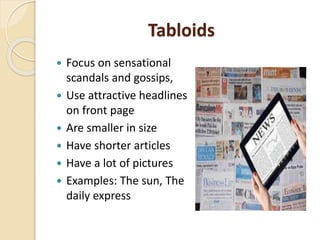
 Focus on sensational
scandals and gossips,
 Use attractive headlines
on front page
 Are smaller in size
 Have shorter articles
 Have a lot of pictures
 Examples: The sun, The
daily express
Broadsheets
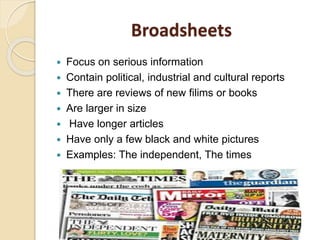
 Focus on serious information
 Contain political, industrial and cultural reports
 There are reviews of new filims or books
 Are larger in size
 Have longer articles
 Have only a few black and white pictures
 Examples: The independent, The times
History of newspapers
 The history newspaper in India began in 1780, with the
publication of the Bengal Gazette from Calcutta.
 James Augustus is considered the "father of Indian press"
as he started the first Indian newspaper from Calcutta, the
`Bengal Gazette` or `Calcutta General Advertise` in January,
1780 which was a weekly publication.
 In 1789, the first newspaper from Bombay (now Mumbai),
the `Bombay Herald` appeared, followed by the `Bombay
Courier` in the following year. Later, this newspaper
merged with the Times of India in 1861.
 The first newspaper published in an Indian language was
the SamacharDarpan in Bengali on May 23, 1818.
 The first Hindi newspaper, the SmacharSudhaVarshan
started its circulation in 1854. Since then, the
prominent Indian languages in which newspapers had
been published over the years are Hindi, Marathi, Tamil,
Malayalam, Telugu, Urdu and Bengali.
 In 2005, the total number of newspapers and
periodicals published in India was around 41705, which
include 4720 dailies and 14743 weeklies.
 India consumed 99 million newspaper copies as of
2008, making it the second largest market in the world
for newspapers.
Current Scenario
 Indian newspaper industry is slated to grow
manifold, with growth rate circling around 6%.
 Market share is projected to grow from Rs 56,300
crore to Rs 92,900 crore by the end of 2013, as
per the research done by the Pricewater house
cooper.
 Indian readership survey 2009 says that almost all
of the English dailies are losing readership at a
rate much faster than the rate of their growth
including the biggies such as Times of India and
HT.
Teaching with newspapers
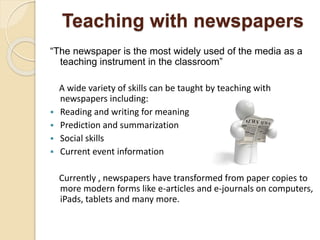
“The newspaper is the most widely used of the media as a
teaching instrument in the classroom”
A wide variety of skills can be taught by teaching with
newspapers including:
 Reading and writing for meaning
 Prediction and summarization
 Social skills
 Current event information
Currently , newspapers have transformed from paper copies to
more modern forms like e-articles and e-journals on computers,
iPads, tablets and many more.
Value for student
 Integrating newspapers helps students learn to read for
meaning
 Students learn to….
 understand media
 inference and sequence of events
 sort and classify
 read maps and graphs
 Expands…
 student vocabulary
 understanding of geography
 Supports…..
 language and literacy development
 learning across the curriculums and subjects
 Keeps students up to date about current events
Value for teachers
 Newspapers are easily obtainable
 Can help to integrate content areas
 Can reuse them
 Easily readable
 Easy resource to keep students up to
date with current events
 Easy resource for any subject matter
 Applicable for every grade level
 Platform to teach social skills
Problems newspapers face..
 Print cost- on the increase
 Classified advertising- does better online
 The recession, from which the industry will never
recover
 ‘News’ in newspapers is by its very nature already old
once published
 Top down model, someone chooses what you read for
you from on high
 Quiet simply it’s a problem of demographics. Especially
younger readers are no longer interested
So in summury…..
 Print media is in a long cycle of decline, and that won’t
end with the recession
 The print demographic is getting older, especially for
the under 30’s, print media simply isn’t on their radar or
is part of their lives
 New and traditional media is converging. Traditional
media outlets online adopting new media practices.
Journalists acting more like bloggers
 In future it will be less about newspapers, televisions
etc but more about generic, trusted media brands.
 newspaper in education

newspaper in education

  • 2.
    Mass Media  Massmedia is communication whether written, broadcast, or spoken that reaches a large audience. This includes television, radio, advertising, movies, the internet, newspapers, magazines and so forth.
  • 3.
    Types of massmedia  Print media (books, press)-from the late 15th century  Recordings (cassettes, CDs, DVDs)- from the late 19th century  Cinema-from about 1900  Radio-from about 1910  Television-from about 1950  Internet-from about 1990  Mobile phones-from about 2000
  • 4.
    Role of massmedia  Bring the newest information from the whole world  Are source of entertainment and relaxation  Are source of knowledge and education  Are means of promotion (advertisements)  Influence the way people look at the world
  • 5.
    What can massmedia change in education?  Our knowledge  Our behavior  Our attitude  Our ways of learning  Our abilities
  • 6.
    Print media ineducation  Print media  Media provides information in two ways-  Formal: In formal type, it directly imparts syllabus based education to students.  Informal: Distance education- Work books and study materials are of various format.
  • 7.
    Kinds of printmedia  Press- newspapers and magazines  Books  Brochures  Leaflets  Billboards
  • 8.
    Newspapers  A newspaperis a publication containing news and information and advertising, usually printed on low-cost paper called newsprint.  Are larger in size to magazines  Articles cover the latest national and international events  Are less colourful  Are published daily
  • 9.
    Newspapers  There arecommercial, financial and public affairs,  The radio and TV programmes are printed there,  Contain fresher content than magazine  Are divided into tabloids and broadsheets
  • 10.
    Tabloids  Focus onsensational scandals and gossips,  Use attractive headlines on front page  Are smaller in size  Have shorter articles  Have a lot of pictures  Examples: The sun, The daily express
  • 11.
    Broadsheets  Focus onserious information  Contain political, industrial and cultural reports  There are reviews of new filims or books  Are larger in size  Have longer articles  Have only a few black and white pictures  Examples: The independent, The times
  • 12.
    History of newspapers The history newspaper in India began in 1780, with the publication of the Bengal Gazette from Calcutta.  James Augustus is considered the "father of Indian press" as he started the first Indian newspaper from Calcutta, the `Bengal Gazette` or `Calcutta General Advertise` in January, 1780 which was a weekly publication.  In 1789, the first newspaper from Bombay (now Mumbai), the `Bombay Herald` appeared, followed by the `Bombay Courier` in the following year. Later, this newspaper merged with the Times of India in 1861.  The first newspaper published in an Indian language was the SamacharDarpan in Bengali on May 23, 1818.
  • 13.
     The firstHindi newspaper, the SmacharSudhaVarshan started its circulation in 1854. Since then, the prominent Indian languages in which newspapers had been published over the years are Hindi, Marathi, Tamil, Malayalam, Telugu, Urdu and Bengali.  In 2005, the total number of newspapers and periodicals published in India was around 41705, which include 4720 dailies and 14743 weeklies.  India consumed 99 million newspaper copies as of 2008, making it the second largest market in the world for newspapers.
  • 14.
    Current Scenario  Indiannewspaper industry is slated to grow manifold, with growth rate circling around 6%.  Market share is projected to grow from Rs 56,300 crore to Rs 92,900 crore by the end of 2013, as per the research done by the Pricewater house cooper.  Indian readership survey 2009 says that almost all of the English dailies are losing readership at a rate much faster than the rate of their growth including the biggies such as Times of India and HT.
  • 15.
    Teaching with newspapers “Thenewspaper is the most widely used of the media as a teaching instrument in the classroom” A wide variety of skills can be taught by teaching with newspapers including:  Reading and writing for meaning  Prediction and summarization  Social skills  Current event information Currently , newspapers have transformed from paper copies to more modern forms like e-articles and e-journals on computers, iPads, tablets and many more.
  • 16.
    Value for student Integrating newspapers helps students learn to read for meaning  Students learn to….  understand media  inference and sequence of events  sort and classify  read maps and graphs  Expands…  student vocabulary  understanding of geography
  • 17.
     Supports…..  languageand literacy development  learning across the curriculums and subjects  Keeps students up to date about current events
  • 18.
    Value for teachers Newspapers are easily obtainable  Can help to integrate content areas  Can reuse them  Easily readable  Easy resource to keep students up to date with current events  Easy resource for any subject matter  Applicable for every grade level  Platform to teach social skills
  • 19.
    Problems newspapers face.. Print cost- on the increase  Classified advertising- does better online  The recession, from which the industry will never recover  ‘News’ in newspapers is by its very nature already old once published  Top down model, someone chooses what you read for you from on high  Quiet simply it’s a problem of demographics. Especially younger readers are no longer interested
  • 20.
    So in summury….. Print media is in a long cycle of decline, and that won’t end with the recession  The print demographic is getting older, especially for the under 30’s, print media simply isn’t on their radar or is part of their lives  New and traditional media is converging. Traditional media outlets online adopting new media practices. Journalists acting more like bloggers  In future it will be less about newspapers, televisions etc but more about generic, trusted media brands.