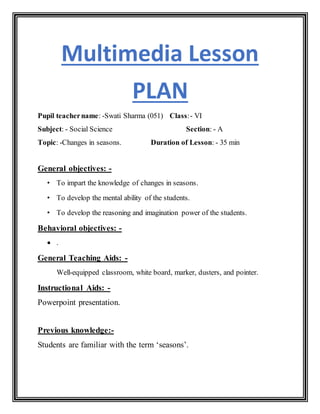
Multimedia Lesson
PLAN
Pupil teachername: -Swati Sharma (051) Class:- VI
Subject: - Social Science Section: - A
Topic: -Changes in seasons. Duration of Lesson: - 35 min
General objectives: -
• To impart the knowledge of changes in seasons.
• To develop the mental ability of the students.
• To develop the reasoning and imagination power of the students.
Behavioral objectives: -
 .
General Teaching Aids: -
Well-equipped classroom, white board, marker, dusters, and pointer.
Instructional Aids: -
Powerpoint presentation.
Previous knowledge:-
Students are familiar with the term ‘seasons’.
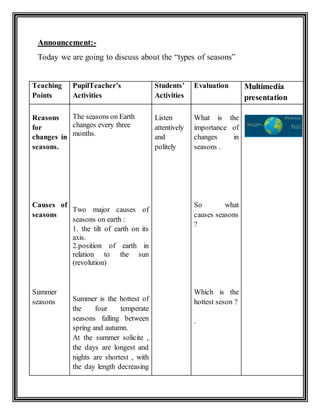
Announcement:-
Today we are going to discuss about the “types of seasons”
Teaching
Points
PupilTeacher’s
Activities
Students’
Activities
Evaluation Multimedia
presentation
Reasons
for
changes in
seasons.
Causes of
seasons
Summer
seasons
The seasons on Earth
changes every three
months.
Two major causes of
seasons on earth :
1. the tilt of earth on its
axis.
2.position of earth in
relation to the sun
(revolution)
Summer is the hottest of
the four temperate
seasons falling between
spring and autumn.
At the summer solicite ,
the days are longest and
nights are shortest , with
the day length decreasing
Listen
attentively
and
politely
What is the
importance of
changes in
seasons .
So what
causes seasons
?
Which is the
hottest seson ?
.
Winter
season
Spring
season
as the seasonprogresses
after the solocite .
When it is summer in the
Northern hemisphere , it
is winter in the southern
hemisphere and vice
versa.
Winter is the coldest
season of the year in
polar and temperate
climates between autumn
and spring .
Winter is caused by the
axis of earth in that
hemisphere being
oriented away from the
sun .
When it is winter in
Northern hemisphere, iit
is summer in Southern
hemisphere and vice
versa
Spring is one of the four
temperate conventional
seasons following winter
and preceding summer .
At the spring equinox ,
days are approximately
12 hours long with the
day length increasing as
the season progresses.
.
What causes
the winter
season?
At what time
does spring
season comes
?
Evaluation;-
Q1. What are the two factors which cause the seasons on earth ?
Q2. Are we closer to the sun in winters or summer ?
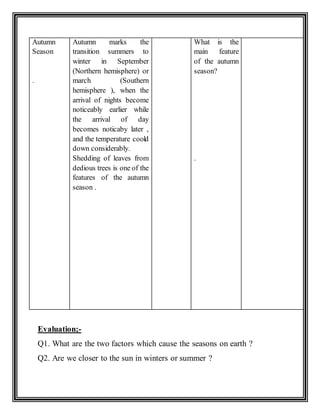
Autumn
Season
.
Autumn marks the
transition summers to
winter in September
(Northern hemisphere) or
march (Southern
hemisphere ), when the
arrival of nights become
noticeably earlier while
the arrival of day
becomes noticaby later ,
and the temperature coold
down considerably.
Shedding of leaves from
dedious trees is one of the
features of the autumn
season .
What is the
main feature
of the autumn
season?
.
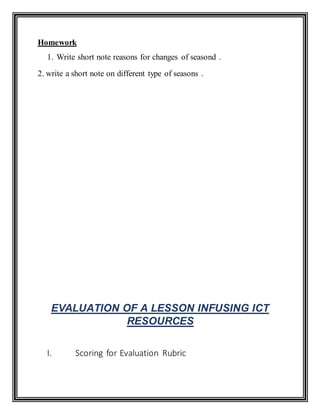
Homework
1. Write short note reasons for changes of seasond .
2. write a short note on different type of seasons .
EVALUATION OF A LESSON INFUSING ICT
RESOURCES
I. Scoring for Evaluation Rubric
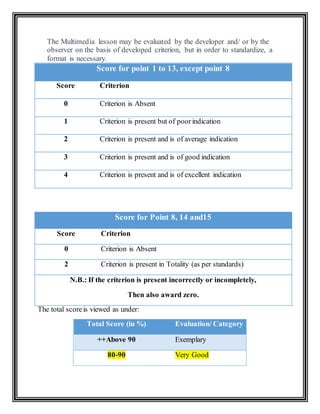
The Multimedia lesson may be evaluated by the developer and/ or by the
observer on the basis of developed criterion, but in order to standardize, a
format is necessary.
Score for point 1 to 13, except point 8
Score Criterion
0 Criterion is Absent
1 Criterion is present but of poorindication
2 Criterion is present and is of average indication
3 Criterion is present and is of good indication
4 Criterion is present and is of excellent indication
Score for Point 8, 14 and15
Score Criterion
0 Criterion is Absent
2 Criterion is present in Totality (as per standards)
N.B.: If the criterion is present incorrectly or incompletely,
Then also award zero.
The total scoreis viewed as under:
Total Score (in %) Evaluation/ Category
++Above 90 Exemplary
80-90 Very Good
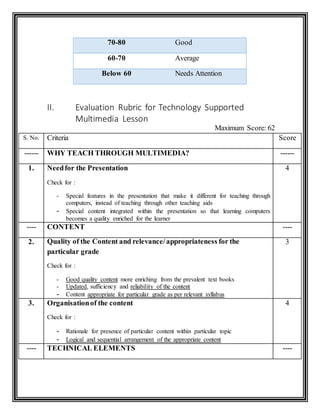
II. Evaluation Rubric for Technology Supported
Multimedia Lesson
Maximum Score: 62
S. No. Criteria Score
------ WHY TEACH THROUGH MULTIMEDIA? ------
1. Needfor the Presentation
Check for :
- Special features in the presentation that make it different for teaching through
computers, instead of teaching through other teaching aids
- Special content integrated within the presentation so that learning computers
becomes a quality enriched for the learner
4
---- CONTENT ----
2. Quality of the Content and relevance/appropriateness for the
particular grade
Check for :
- Good quality content more enriching from the prevalent text books
- Updated, sufficiency and reliability of the content
- Content appropriate for particular grade as per relevant syllabus
3
3. Organisationof the content
Check for :
- Rationale for presence of particular content within particular topic
- Logical and sequential arrangement of the appropriate content
4
---- TECHNICAL ELEMENTS ----
70-80 Good
60-70 Average
Below 60 Needs Attention
4. Overall Visual Appeal
Check for :
- Initial slides to be more attractive
- An attractive background, an appropriate selection of slide layout and design
- Readability of the slides
- Progress of graphics
4
5. SelectionofAppropriate Element of Media
Check for :
- Appropriate element of media as per the requirement of the (sub) topic
4
6. Grammar, punctuation and spelling
Check for :
- Any error in spelling, punctuation or grammar
3
7. Animation Effects and Transition
Check for :
- Adequate and appropriate use of effects
- Balanced transition and animation effects
3
8. Principles for Multimedia Design
(2 marks for each principle)
Check for :
- Multimedia Principle (Students learn more deeply from multimedia
presentations involving words and pictures than from words alone)
2
- Contiguity Principle (score 1 for each)
 Temporal Contiguity Principle (Students learn better when
corresponding words and pictures are presented simultaneously
rather that successively)
 Spatial Contiguity Principle (Students learn better when
corresponding words and pictures are presented near rather than far
from each other on the page or screen)
1
1
- Coherence Principle (Students learn more deeply from multimedia
presentations in which extraneous words, pictures, sounds, and video
are excluded rather than included)
1
- Modality Principle (Students learn more deeply from animation and
narrationthan from animation and on-screen text)
1
- Redundancy Principle (Students learn more deeply from
multimedia presentations consisting of animation and narration than
from animation, narration, and on-screen text)
1
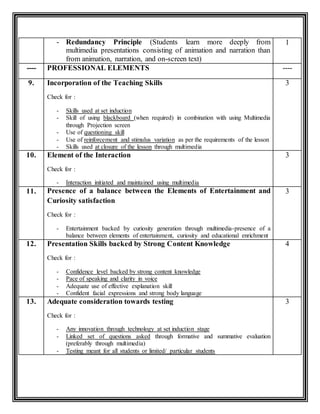
---- PROFESSIONAL ELEMENTS ----
9. Incorporation of the Teaching Skills
Check for :
- Skills used at set induction
- Skill of using blackboard (when required) in combination with using Multimedia
through Projection screen
- Use of questioning skill
- Use of reinforcement and stimulus variation as per the requirements of the lesson
- Skills used at closure of the lesson through multimedia
3
10. Element of the Interaction
Check for :
- Interaction initiated and maintained using multimedia
3
11. Presence of a balance between the Elements of Entertainment and
Curiosity satisfaction
Check for :
- Entertainment backed by curiosity generation through multimedia-presence of a
balance between elements of entertainment, curiosity and educational enrichment
3
12. Presentation Skills backed by Strong Content Knowledge
Check for :
- Confidence level backed by strong content knowledge
- Pace of speaking and clarity in voice
- Adequate use of effective explanation skill
- Confident facial expressions and strong body language
4
13. Adequate consideration towards testing
Check for :
- Any innovation through technology at set induction stage
- Linked set of questions asked through formative and summative evaluation
(preferably through multimedia)
- Testing meant for all students or limited/ particular students
3
14. Content within the guidelines suggested by Fair Use for Educational
Multimedia
2
15. Referencesquotedin Standard style 2
Total Score (Maximum score: 62) 52
Percentage 83
CATEGORY
VERY
GOOD
Suggestions by the Evaluator:
CONCLUSION:-
It has been concluded that overall the performance of the pupil teacher was very
good as the pupil teacher used all the audio/visuals themes and PPTs and hot
potatoes question bank very well. The lesson plan was sequence arranged and
presented in a beautiful manner in which students will show their interest and adapt
it easily. That’s why the pupil teacher has scored 83% which is very good.

Multimedia lesson plan

  • 1.
    Multimedia Lesson PLAN Pupil teachername:-Swati Sharma (051) Class:- VI Subject: - Social Science Section: - A Topic: -Changes in seasons. Duration of Lesson: - 35 min General objectives: - • To impart the knowledge of changes in seasons. • To develop the mental ability of the students. • To develop the reasoning and imagination power of the students. Behavioral objectives: -  . General Teaching Aids: - Well-equipped classroom, white board, marker, dusters, and pointer. Instructional Aids: - Powerpoint presentation. Previous knowledge:- Students are familiar with the term ‘seasons’.
  • 2.
    Announcement:- Today we aregoing to discuss about the “types of seasons” Teaching Points PupilTeacher’s Activities Students’ Activities Evaluation Multimedia presentation Reasons for changes in seasons. Causes of seasons Summer seasons The seasons on Earth changes every three months. Two major causes of seasons on earth : 1. the tilt of earth on its axis. 2.position of earth in relation to the sun (revolution) Summer is the hottest of the four temperate seasons falling between spring and autumn. At the summer solicite , the days are longest and nights are shortest , with the day length decreasing Listen attentively and politely What is the importance of changes in seasons . So what causes seasons ? Which is the hottest seson ? .
  • 3.
    Winter season Spring season as the seasonprogresses afterthe solocite . When it is summer in the Northern hemisphere , it is winter in the southern hemisphere and vice versa. Winter is the coldest season of the year in polar and temperate climates between autumn and spring . Winter is caused by the axis of earth in that hemisphere being oriented away from the sun . When it is winter in Northern hemisphere, iit is summer in Southern hemisphere and vice versa Spring is one of the four temperate conventional seasons following winter and preceding summer . At the spring equinox , days are approximately 12 hours long with the day length increasing as the season progresses. . What causes the winter season? At what time does spring season comes ?
  • 4.
    Evaluation;- Q1. What arethe two factors which cause the seasons on earth ? Q2. Are we closer to the sun in winters or summer ? Autumn Season . Autumn marks the transition summers to winter in September (Northern hemisphere) or march (Southern hemisphere ), when the arrival of nights become noticeably earlier while the arrival of day becomes noticaby later , and the temperature coold down considerably. Shedding of leaves from dedious trees is one of the features of the autumn season . What is the main feature of the autumn season? .
  • 5.
    Homework 1. Write shortnote reasons for changes of seasond . 2. write a short note on different type of seasons . EVALUATION OF A LESSON INFUSING ICT RESOURCES I. Scoring for Evaluation Rubric
  • 6.
    The Multimedia lessonmay be evaluated by the developer and/ or by the observer on the basis of developed criterion, but in order to standardize, a format is necessary. Score for point 1 to 13, except point 8 Score Criterion 0 Criterion is Absent 1 Criterion is present but of poorindication 2 Criterion is present and is of average indication 3 Criterion is present and is of good indication 4 Criterion is present and is of excellent indication Score for Point 8, 14 and15 Score Criterion 0 Criterion is Absent 2 Criterion is present in Totality (as per standards) N.B.: If the criterion is present incorrectly or incompletely, Then also award zero. The total scoreis viewed as under: Total Score (in %) Evaluation/ Category ++Above 90 Exemplary 80-90 Very Good
  • 7.
    II. Evaluation Rubricfor Technology Supported Multimedia Lesson Maximum Score: 62 S. No. Criteria Score ------ WHY TEACH THROUGH MULTIMEDIA? ------ 1. Needfor the Presentation Check for : - Special features in the presentation that make it different for teaching through computers, instead of teaching through other teaching aids - Special content integrated within the presentation so that learning computers becomes a quality enriched for the learner 4 ---- CONTENT ---- 2. Quality of the Content and relevance/appropriateness for the particular grade Check for : - Good quality content more enriching from the prevalent text books - Updated, sufficiency and reliability of the content - Content appropriate for particular grade as per relevant syllabus 3 3. Organisationof the content Check for : - Rationale for presence of particular content within particular topic - Logical and sequential arrangement of the appropriate content 4 ---- TECHNICAL ELEMENTS ---- 70-80 Good 60-70 Average Below 60 Needs Attention
  • 8.
    4. Overall VisualAppeal Check for : - Initial slides to be more attractive - An attractive background, an appropriate selection of slide layout and design - Readability of the slides - Progress of graphics 4 5. SelectionofAppropriate Element of Media Check for : - Appropriate element of media as per the requirement of the (sub) topic 4 6. Grammar, punctuation and spelling Check for : - Any error in spelling, punctuation or grammar 3 7. Animation Effects and Transition Check for : - Adequate and appropriate use of effects - Balanced transition and animation effects 3 8. Principles for Multimedia Design (2 marks for each principle) Check for : - Multimedia Principle (Students learn more deeply from multimedia presentations involving words and pictures than from words alone) 2 - Contiguity Principle (score 1 for each)  Temporal Contiguity Principle (Students learn better when corresponding words and pictures are presented simultaneously rather that successively)  Spatial Contiguity Principle (Students learn better when corresponding words and pictures are presented near rather than far from each other on the page or screen) 1 1 - Coherence Principle (Students learn more deeply from multimedia presentations in which extraneous words, pictures, sounds, and video are excluded rather than included) 1 - Modality Principle (Students learn more deeply from animation and narrationthan from animation and on-screen text) 1
  • 9.
    - Redundancy Principle(Students learn more deeply from multimedia presentations consisting of animation and narration than from animation, narration, and on-screen text) 1 ---- PROFESSIONAL ELEMENTS ---- 9. Incorporation of the Teaching Skills Check for : - Skills used at set induction - Skill of using blackboard (when required) in combination with using Multimedia through Projection screen - Use of questioning skill - Use of reinforcement and stimulus variation as per the requirements of the lesson - Skills used at closure of the lesson through multimedia 3 10. Element of the Interaction Check for : - Interaction initiated and maintained using multimedia 3 11. Presence of a balance between the Elements of Entertainment and Curiosity satisfaction Check for : - Entertainment backed by curiosity generation through multimedia-presence of a balance between elements of entertainment, curiosity and educational enrichment 3 12. Presentation Skills backed by Strong Content Knowledge Check for : - Confidence level backed by strong content knowledge - Pace of speaking and clarity in voice - Adequate use of effective explanation skill - Confident facial expressions and strong body language 4 13. Adequate consideration towards testing Check for : - Any innovation through technology at set induction stage - Linked set of questions asked through formative and summative evaluation (preferably through multimedia) - Testing meant for all students or limited/ particular students 3
  • 10.
    14. Content withinthe guidelines suggested by Fair Use for Educational Multimedia 2 15. Referencesquotedin Standard style 2 Total Score (Maximum score: 62) 52 Percentage 83 CATEGORY VERY GOOD Suggestions by the Evaluator: CONCLUSION:- It has been concluded that overall the performance of the pupil teacher was very good as the pupil teacher used all the audio/visuals themes and PPTs and hot potatoes question bank very well. The lesson plan was sequence arranged and presented in a beautiful manner in which students will show their interest and adapt it easily. That’s why the pupil teacher has scored 83% which is very good.