 MEDIA • Communication channels
through which news,
entertainment,education,data or
promotional messages are disseminated.
 Media includes every broadasting and
narrowcasting medium such as
newspapers,magazines,TV,radio,internet
etc.
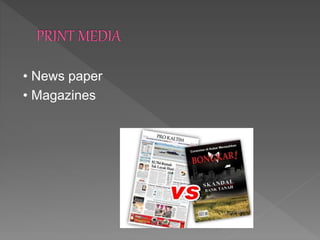
• News paper
• Magazines
 A paper that is printed and distributed usually
daily or weekly and contains news, articles of
opinion, features, and advertising .
 A set of large sheets of paper that have news
stories, information about local events,
advertisements, etc., and that are folded
together and sold every day or every week.
 The paper on which a newspaper is printed.
 Publicity- Its contents are reasonably
accessible to the public.
 Periodicity-It is published at regular
intervals
 Currency-Its information is as up to date as
its publication schedule allows.
 Universality-It covers a range of topics
 THE BEGINNING :Handwritten news sheets,
government bulletin, announcements, and
single item news publications preceded the
newspaper.
 1496: Gutenberg invented the first press
 1690:Boston, the birth, entitled publick
occurences
 1791:freedom of speech and press;became
center of media.
 1880:11,314 different newspapers were
recorded in census
 1910’s: modern newspaper features
emerged
• The first successively published title was THE
WEEKLY NEWS OF 1622.It was followed in the
1640’s and 1650’s by a plethora of different
titles in the similar newsbook format.
• The first true newspaper in english was the
London Gazette of 1666 .For a generation it
was the only officially sanctioned
newspaper,though many periodical titles were
in print by the century’s end.
 In America the first newspaper appeared in Boston in 1690,entitled
“Publick Occurrences”. Published without authority, it was
immediately suppressed, its publisher arrested, and all copies
were destroyed.
 America’s The first successful newspaper was the Boston News-
Letter, begun by postmaster John Campbell in 1704.
 By 1814 there were 346 newspapers.
 1930s and 1940s The New york Times and
the Milwaukee journal sponsor programs that
are dedicated to providing newspapers and
curriculam aides to the classroom teacher.
 Now a days about 900 newspaper
companies provide newspapers to schools in
their local areas.This program started in the
1960s and is called Newspapers In
Education(NIE).
 They are inexpensive
 They are readily obtainable.
 They are versatile.
 They can be used for individual or
cooperative activities.
 They are a source of current information.
 Newspapers introduce students to the
cultural and linguistic aspects.
 They can be used for individual and group
work.
 The content is updated.
 Learners can internalize a full range of world
background knowledge, language
conventions and vocabulary by exposure
through reading.
 The wide selection of online newspapers,
being the digital versions of the printed ones,
help learners have access to the news of the
English Speaking countries at extremely low
cost, high speed and enourmous variety.
 Using news for teaching materials help
learners to improve their reading skills, enrich
the vocabulary, gain some cultural knowledge
and be up-to-date with the current situation in
the whole world.
Prestended by legend

Prestended by legend

  • 2.
     MEDIA •Communication channels through which news, entertainment,education,data or promotional messages are disseminated.  Media includes every broadasting and narrowcasting medium such as newspapers,magazines,TV,radio,internet etc.
  • 3.
  • 4.
     A paperthat is printed and distributed usually daily or weekly and contains news, articles of opinion, features, and advertising .  A set of large sheets of paper that have news stories, information about local events, advertisements, etc., and that are folded together and sold every day or every week.  The paper on which a newspaper is printed.
  • 5.
     Publicity- Itscontents are reasonably accessible to the public.  Periodicity-It is published at regular intervals  Currency-Its information is as up to date as its publication schedule allows.  Universality-It covers a range of topics
  • 6.
     THE BEGINNING:Handwritten news sheets, government bulletin, announcements, and single item news publications preceded the newspaper.  1496: Gutenberg invented the first press  1690:Boston, the birth, entitled publick occurences  1791:freedom of speech and press;became center of media.
  • 7.
     1880:11,314 differentnewspapers were recorded in census  1910’s: modern newspaper features emerged
  • 8.
    • The firstsuccessively published title was THE WEEKLY NEWS OF 1622.It was followed in the 1640’s and 1650’s by a plethora of different titles in the similar newsbook format. • The first true newspaper in english was the London Gazette of 1666 .For a generation it was the only officially sanctioned newspaper,though many periodical titles were in print by the century’s end.
  • 9.
     In Americathe first newspaper appeared in Boston in 1690,entitled “Publick Occurrences”. Published without authority, it was immediately suppressed, its publisher arrested, and all copies were destroyed.  America’s The first successful newspaper was the Boston News- Letter, begun by postmaster John Campbell in 1704.  By 1814 there were 346 newspapers.
  • 10.
     1930s and1940s The New york Times and the Milwaukee journal sponsor programs that are dedicated to providing newspapers and curriculam aides to the classroom teacher.  Now a days about 900 newspaper companies provide newspapers to schools in their local areas.This program started in the 1960s and is called Newspapers In Education(NIE).
  • 11.
     They areinexpensive  They are readily obtainable.  They are versatile.  They can be used for individual or cooperative activities.  They are a source of current information.
  • 12.
     Newspapers introducestudents to the cultural and linguistic aspects.  They can be used for individual and group work.  The content is updated.  Learners can internalize a full range of world background knowledge, language conventions and vocabulary by exposure through reading.
  • 13.
     The wideselection of online newspapers, being the digital versions of the printed ones, help learners have access to the news of the English Speaking countries at extremely low cost, high speed and enourmous variety.  Using news for teaching materials help learners to improve their reading skills, enrich the vocabulary, gain some cultural knowledge and be up-to-date with the current situation in the whole world.