
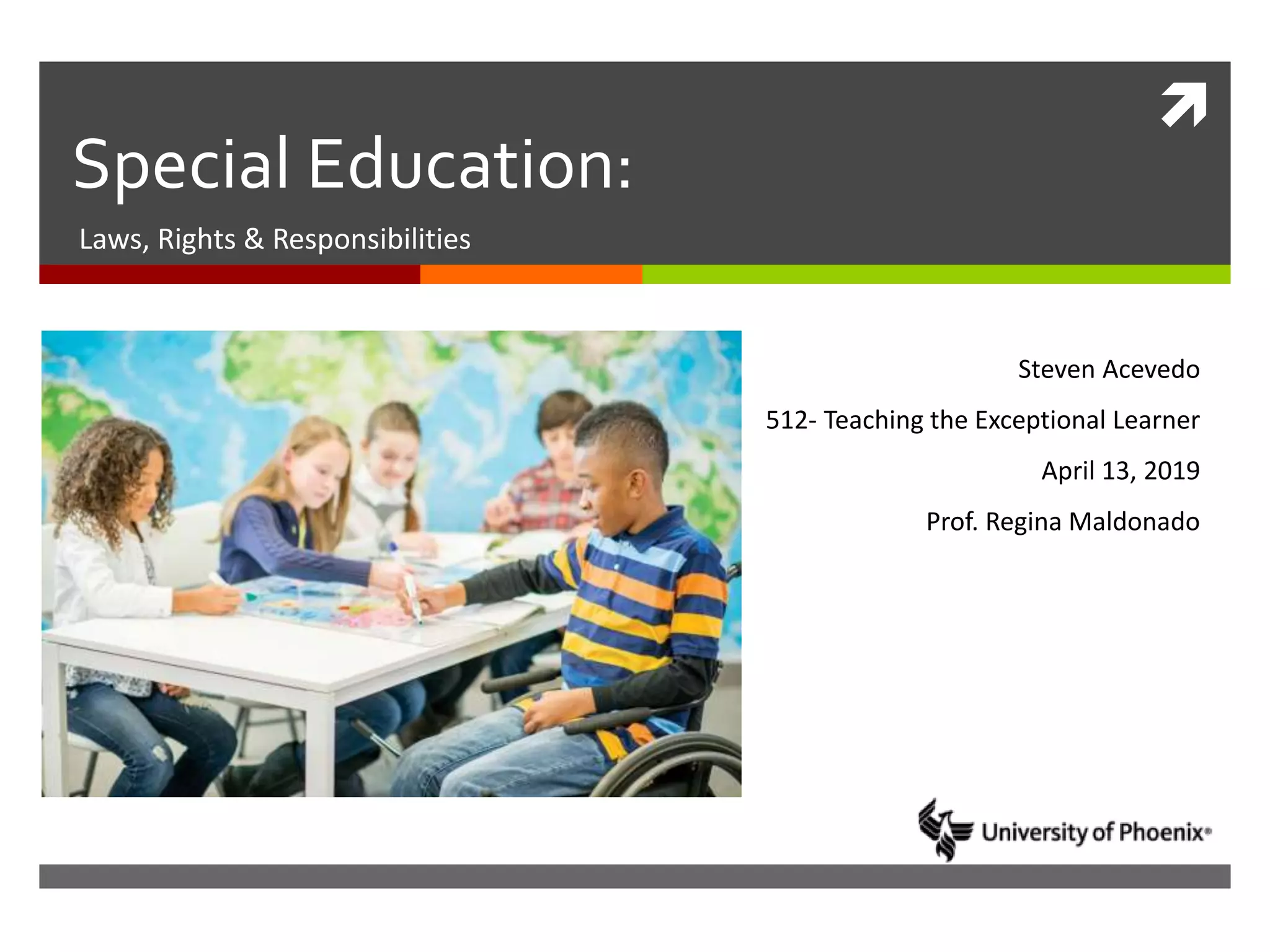
Special Education:
Laws, Rights & Responsibilities
Steven Acevedo
512- Teaching the Exceptional Learner
April 13, 2019
Prof. Regina Maldonado
Introduction to Special Education
Welcome and thank you parents for coming…
 Special Education enables all children to have an equal opportunity to
education. The “study of special education and …responsibility for teaching
students with disabilities, it is important …the field is guided by several
critical concepts, many of them deriving directly from federal special
education law.” (Friend & Bursuck, 2019)
 There are Laws & Rights that we will cover in order to become familiar with
your child’s education
 If you, your child’s teacher or health care provider suspect that your child
may be eligible, it is good to know how to start the process
Laws & Rights
 IDEA (Individuals with Disability Education Act)
Enacted by Congress in 1975. This act was made so that children with disabilities
had a right to an education. The website states, “ In the law, Congress states:
Disability is a natural part of the human experience and in no way diminishes the
right of individuals to participate in or contribute to society. Improving
educational results for children with disabilities is an essential element of our
national policy of ensuring equality of opportunity, full participation, independent
living, and economic self-sufficiency for individuals with disabilities.
(www.sites.ed.gov. 2019)
Laws & Rights
 ADA (Americans with Disabilities Act)
The Americans with Disability Act became law in 1990. The website states:
The ADA is a civil rights law that prohibits discrimination against individuals with
disabilities in all areas of public life, including jobs, schools, transportation, and all public and private
places that are open to the general public. The purpose of the law is to make sure that people with
disabilities have the same rights and opportunities as everyone else. The ADA gives civil rights
protections to individuals with disabilities similar to those provided to individuals on the basis of race,
color, sex, national origin, age, and religion. It guarantees equal opportunity for individuals with
disabilities in public accommodations, employment, transportation, state and local government
services, and telecommunications. The ADA is divided into five titles (or sections) that relate to
different areas of public life.
(www.adata.org. 2019)
Laws & Rights
 Section 504
Under this law:
Section 504 is a civil rights law that prohibits discrimination against individuals with disabilities.
Section 504 ensures that the child with a disability has equal access to an education. The child
may receive accommodations and modifications.
Unlike the Individuals with Disabilities Education Act (IDEA), Section 504 does not require a
public school to provide an individualized educational program (IEP) that is designed to meet a
child's unique needs and provide the child with educational benefit. Under Section 504, fewer
procedural safeguards are available to the child with a disability and the child's parents than
under IDEA. (www.wrightslaw.com. 2019)
Code of Ethics
 NASET or the National Association of Special Education
Teachers established a set of principles and guidelines to
improve the practice and develop a more professional
experience. In the website it states:
Six Principles adopted by the National Association of Special Education
Teachers (NASET) are not laws, but standards of ethical behavior and
conduct. Adherence to this Code of Ethics is a binding condition of
membership in National Association of Special Education Teachers.
(www.naset.org, 2019)
Code of Ethics
NASET’s six principles are:
1. Principle 1: NASET Members nurture the academic, psychological, physical, and social potential of children
with special needs
2. Principle 2: NASET Members apply their professional knowledge to create a professional and supportive
environment for children with special needs.
3. Principle 3:NASET Members commit to their own learning in order to develop their professional
development.
4. Principle 4: NASET Members respect, support, and collaborate with colleagues and other professionals in the
interest of children with special needs with whom they work.
5. Principle 5: NASET Members collaborate with parents of children with special needs and community,
building trust and respecting confidentiality.
6. Principle 6: NASET Members advance the intellectual and ethical foundation of the learning community.
(www.naset.org, 2019)
Professional Standards
 The Council for Exceptional Children or CEC developed
standards, practices and guidelines to ensure individuals with
exceptional needs have access to well-equipped special
educators. Together with the NASET’s Code of Ethics families
can be assured that professional standards of practice are being
upheld to a high standard.
Professional Standards
 The Council for Exceptional Children
1. Maintaining challenging expectations for individuals with exceptionalities to develop the highest
possible learning outcomes and quality of life potential in ways that respect their dignity, culture,
language, and background.
2. Maintaining a high level of professional competence and integrity and exercising professional judgment
to benefit individuals with exceptionalities and their families.
3. Promoting meaningful and inclusive participation of individuals with exceptionalities in their schools
and communities.
4. Practicing collegially with others who are providing services to individuals with exceptionalities.
5. Developing relationships with families based on mutual respect and actively involving families and
individuals with exceptionalities in educational decision making.
6. Using evidence, instructional data, research, and professional knowledge to inform practice.
Professional Standards
 The Council for Exceptional Children (Continued)
7. Protecting and supporting the physical and psychological safety of individuals with exceptionalities.
8. Neither engaging in nor tolerating any practice that harms individuals with exceptionalities.
9. Practicing within the professional ethics, standards, and policies of CEC; upholding laws, regulations,
and policies that influence profes-sional practice; and advocating improvements in the laws,
regulations, and policies.
10. Advocating for professional conditions and resources that will improve learning outcomes of
individuals with exceptionalities.
11. Engaging in the improvement of the profession through active participation in professional
organizations.
12. Participating in the growth and dissemination of professional knowledge and skills.
(cec.sped.org,
2019)

References
Friend, M. & Bursuck, W. (2019). Including students with special needs (8th ed.) University of North
Carolina. Pearsons
Department of Education (2019). Individuals with disability act. About page. Retrieved from https://
sites.ed.gov/idea/about-idea/
Americans with disabilities act national network (2019). The Ada. Retrieved from https://
adata.org/learn-about-ada
Wright, P. & Wright, P (2019). Wrights law. Descrimination: section 504. Retrieved from https://
www.wrightslaw.com/info/sec504.index.htm
Naset (2019). National association of special education teachers. Code of ethics. Retrieved from
https://www.naset.org/index.php?id=2444
Council for exceptional children (2019). Standards. Ethical principals & practice standards. Retrieved
from https://cec.sped.org/Standards/Ethical-Principles-and-Practice-Standards

New Special Education Parents

  • 1.
     Special Education: Laws, Rights& Responsibilities Steven Acevedo 512- Teaching the Exceptional Learner April 13, 2019 Prof. Regina Maldonado
  • 2.
    Introduction to SpecialEducation Welcome and thank you parents for coming…  Special Education enables all children to have an equal opportunity to education. The “study of special education and …responsibility for teaching students with disabilities, it is important …the field is guided by several critical concepts, many of them deriving directly from federal special education law.” (Friend & Bursuck, 2019)  There are Laws & Rights that we will cover in order to become familiar with your child’s education  If you, your child’s teacher or health care provider suspect that your child may be eligible, it is good to know how to start the process
  • 3.
    Laws & Rights IDEA (Individuals with Disability Education Act) Enacted by Congress in 1975. This act was made so that children with disabilities had a right to an education. The website states, “ In the law, Congress states: Disability is a natural part of the human experience and in no way diminishes the right of individuals to participate in or contribute to society. Improving educational results for children with disabilities is an essential element of our national policy of ensuring equality of opportunity, full participation, independent living, and economic self-sufficiency for individuals with disabilities. (www.sites.ed.gov. 2019)
  • 4.
    Laws & Rights ADA (Americans with Disabilities Act) The Americans with Disability Act became law in 1990. The website states: The ADA is a civil rights law that prohibits discrimination against individuals with disabilities in all areas of public life, including jobs, schools, transportation, and all public and private places that are open to the general public. The purpose of the law is to make sure that people with disabilities have the same rights and opportunities as everyone else. The ADA gives civil rights protections to individuals with disabilities similar to those provided to individuals on the basis of race, color, sex, national origin, age, and religion. It guarantees equal opportunity for individuals with disabilities in public accommodations, employment, transportation, state and local government services, and telecommunications. The ADA is divided into five titles (or sections) that relate to different areas of public life. (www.adata.org. 2019)
  • 5.
    Laws & Rights Section 504 Under this law: Section 504 is a civil rights law that prohibits discrimination against individuals with disabilities. Section 504 ensures that the child with a disability has equal access to an education. The child may receive accommodations and modifications. Unlike the Individuals with Disabilities Education Act (IDEA), Section 504 does not require a public school to provide an individualized educational program (IEP) that is designed to meet a child's unique needs and provide the child with educational benefit. Under Section 504, fewer procedural safeguards are available to the child with a disability and the child's parents than under IDEA. (www.wrightslaw.com. 2019)
  • 6.
    Code of Ethics NASET or the National Association of Special Education Teachers established a set of principles and guidelines to improve the practice and develop a more professional experience. In the website it states: Six Principles adopted by the National Association of Special Education Teachers (NASET) are not laws, but standards of ethical behavior and conduct. Adherence to this Code of Ethics is a binding condition of membership in National Association of Special Education Teachers. (www.naset.org, 2019)
  • 7.
    Code of Ethics NASET’ssix principles are: 1. Principle 1: NASET Members nurture the academic, psychological, physical, and social potential of children with special needs 2. Principle 2: NASET Members apply their professional knowledge to create a professional and supportive environment for children with special needs. 3. Principle 3:NASET Members commit to their own learning in order to develop their professional development. 4. Principle 4: NASET Members respect, support, and collaborate with colleagues and other professionals in the interest of children with special needs with whom they work. 5. Principle 5: NASET Members collaborate with parents of children with special needs and community, building trust and respecting confidentiality. 6. Principle 6: NASET Members advance the intellectual and ethical foundation of the learning community. (www.naset.org, 2019)
  • 8.
    Professional Standards  TheCouncil for Exceptional Children or CEC developed standards, practices and guidelines to ensure individuals with exceptional needs have access to well-equipped special educators. Together with the NASET’s Code of Ethics families can be assured that professional standards of practice are being upheld to a high standard.
  • 9.
    Professional Standards  TheCouncil for Exceptional Children 1. Maintaining challenging expectations for individuals with exceptionalities to develop the highest possible learning outcomes and quality of life potential in ways that respect their dignity, culture, language, and background. 2. Maintaining a high level of professional competence and integrity and exercising professional judgment to benefit individuals with exceptionalities and their families. 3. Promoting meaningful and inclusive participation of individuals with exceptionalities in their schools and communities. 4. Practicing collegially with others who are providing services to individuals with exceptionalities. 5. Developing relationships with families based on mutual respect and actively involving families and individuals with exceptionalities in educational decision making. 6. Using evidence, instructional data, research, and professional knowledge to inform practice.
  • 10.
    Professional Standards  TheCouncil for Exceptional Children (Continued) 7. Protecting and supporting the physical and psychological safety of individuals with exceptionalities. 8. Neither engaging in nor tolerating any practice that harms individuals with exceptionalities. 9. Practicing within the professional ethics, standards, and policies of CEC; upholding laws, regulations, and policies that influence profes-sional practice; and advocating improvements in the laws, regulations, and policies. 10. Advocating for professional conditions and resources that will improve learning outcomes of individuals with exceptionalities. 11. Engaging in the improvement of the profession through active participation in professional organizations. 12. Participating in the growth and dissemination of professional knowledge and skills. (cec.sped.org, 2019)
  • 11.
     References Friend, M. &Bursuck, W. (2019). Including students with special needs (8th ed.) University of North Carolina. Pearsons Department of Education (2019). Individuals with disability act. About page. Retrieved from https:// sites.ed.gov/idea/about-idea/ Americans with disabilities act national network (2019). The Ada. Retrieved from https:// adata.org/learn-about-ada Wright, P. & Wright, P (2019). Wrights law. Descrimination: section 504. Retrieved from https:// www.wrightslaw.com/info/sec504.index.htm Naset (2019). National association of special education teachers. Code of ethics. Retrieved from https://www.naset.org/index.php?id=2444 Council for exceptional children (2019). Standards. Ethical principals & practice standards. Retrieved from https://cec.sped.org/Standards/Ethical-Principles-and-Practice-Standards