Chapter Two
Policies, Practices, and Programs
Litigation and Legislation
Affecting Special Education
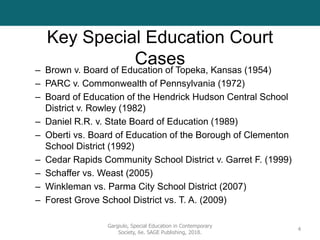
Key Special Education Court
Cases
– Brown v. Board of Education of Topeka, Kansas (1954)
– PARC v. Commonwealth of Pennsylvania (1972)
– Board of Education of the Hendrick Hudson Central School
District v. Rowley (1982)
– Daniel R.R. v. State Board of Education (1989)
– Oberti vs. Board of Education of the Borough of Clementon
School District (1992)
– Cedar Rapids Community School District v. Garret F. (1999)
– Schaffer vs. Weast (2005)
– Winkleman vs. Parma City School District (2007)
– Forest Grove School District vs. T. A. (2009)
Gargiulo, Special Education in Contemporary
Society, 6e. SAGE Publishing, 2018.
4
Key Special Education Legislation
– PL 94-142 (1975)
• Education for all Handicapped Children Act
– PL 99-457 (1986 Amendments to PL 94-142)
• Education of the Handicapped Act Amendments
– PL 101-476 (1990 Amendments to PL 94-142)
• Individuals with Disabilities Education Act (IDEA)
– PL 105-17 (1997 Amendments to IDEA)
• IDEA Act Amendments
– PL 107-110 (2001)
• No Child Left Behind Act
– PL 108-446 (2004)
• Individuals with Disabilities Education Improvement Act
– PL-114-95 (2015)
• Every Student Succeeds Act
Gargiulo, Special Education in Contemporary
Society, 6e. SAGE Publishing, 2018.
5
PL 94-142
The Education for All Handicapped Children Act of
1975
– Called the “Bill of Rights” for children with “legislative
heart of special education,” and the “Parent’s Law.”
– Free Appropriate Public Education (FAPE)
– Least Restrictive Environment (LRE) disabilities, the
– Individualized Education Program (IEP)
– Procedural Due Process
– Nondiscriminatory Assessment
– Parental Participation
Gargiulo, Special Education in Contemporary
Society, 6e. SAGE Publishing, 2018.
6
PL 99-457
Education of the Handicapped Act
Amendments of 1986
• Affected education and services for young
children with special needs and their families
– Preschoolers (age 3-5)
– Children from birth through age 2
– Individualized Family Service Plan (IFSP)
Gargiulo, Special Education in Contemporary
Society, 6e. SAGE Publishing, 2018.
7
PL 101-476
Individuals with Disabilities Education Act
(IDEA)
• 1990 amendments renamed PL 94-142 as the
Individuals with Disabilities Education Act (IDEA)
• Individual Transition Plan (ITP) required by age 16
• Expanded related services
• Added autism and traumatic brain injury as distinct
disability categories
• States held accountable to implement law
Gargiulo, Special Education in Contemporary
Society, 6e. SAGE Publishing, 2018.
8
PL 105-17
IDEA Act Amendments of 1997
• Disciplinary considerations
• IEP changes to support inclusion and transition
• Related services expanded to include orientation
and mobility services
• Mediation procedures developed
• Expanded category of developmental delay
• Evaluation and reevaluation requirements changed
• Federal funding changes
• Performance goals/accountability
Gargiulo, Special Education in Contemporary
Society, 6e. SAGE Publishing, 2018.
9
PL 107-110
No Child Left Behind Act of 2001
• Reauthorization of the Elementary and Secondary Education
Act
• Annual testing for all students in certain grades to
demonstrate adequate yearly progress in mathematics,
reading, and science
• Public access to schools’ performance on tests
• Provides for parental choice in schools that do not meet
annual progress goals
• Schools not making sufficient annual progress offer additional
services to students
• Highly Qualified status for teachers
• Common Core State Standards Initiative
Gargiulo, Special Education in Contemporary
Society, 6e. SAGE Publishing, 2018.
10
PL 108-446
Individuals with Disabilities Education
Improvement Act of 2004
• Special education services aligned with national school
improvement efforts
• IEP changes
• Identification of students with learning disabilities through
Response to Intervention (RTI)
• Highly qualified special education teachers
• Discipline
• Due process
• Evaluation of students
• Assessment participation
Gargiulo, Special Education in Contemporary
Society, 6e. SAGE Publishing, 2018.
11
PL-114-95
Every Student Succeeds Act of 2015
• Reauthorization of the Elementary and
Secondary education Act
• AYP provisions repealed and replaced by a
statewide accountability system
• States can adopt Common Core State
Standards, but not a requirement
• “Highly qualified” teacher status is eliminated
• State intervention for low performing schools
Gargiulo, Special Education in Contemporary
Society, 6e. SAGE Publishing, 2018.
12
Civil Rights Legislation
Section 504 of the Rehabilitation
Act of 1973
• This act employs a broader definition of eligibility
than IDEA and states that no individual can be
excluded, solely because of their disability, from
participating in any program or activity receiving
federal funding, including schools.
• Schools may be required to develop plans to
meet the needs of students who require
accommodations.
• Section 504 covers the entire lifespan not just
the school years.
Gargiulo, Special Education in Contemporary
Society, 6e. SAGE Publishing, 2018.
14
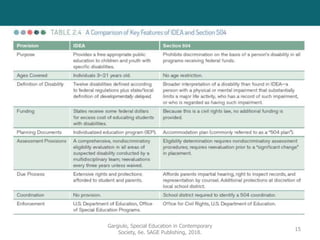
Gargiulo, Special Education in Contemporary
Society, 6e. SAGE Publishing, 2018.
15
PL 101-336
Americans with Disabilities Act (ADA) of 1990
• Designed to eliminate discrimination against people with
disabilities in the pubic and private sectors.
• Expanded definitions of eligibility may include people
with AIDS, substance abuse issues, or any impairment
that limits a major life activity.
• Employers, mass transit systems, and companies who
provide products and services must make “reasonable
accommodations” for people with disabilities.
Gargiulo, Special Education in Contemporary
Society, 6e. SAGE Publishing, 2018.
16
PL 110-325
The Americans with Disabilities Act
Amendments of 2008
• Reauthorization of the ADA; commonly called ADAA
• Became effective January 2009
• Broader interpretation of disability includes additional life
activities (reading, concentrating, thinking) or body
functions (such as immune system or neurological
functioning)
• Interpretation of “substantial limitation” made without
considering the effects of mitigating measures like
medication or medical equipment
Gargiulo, Special Education in Contemporary
Society, 6e. SAGE Publishing, 2018.
17
Identification and Assessment
of Individual Differences
Interindividual Differences
• Differences between students
– Examples: height, sports skill, reading ability
– Students are identified, labeled, and placed in
instructional setting based on interindividual
differences
Gargiulo, Special Education in Contemporary
Society, 6e. SAGE Publishing, 2018.
19
Intraindividual Differences
• Differences within a student
– Examples: individual patterns of strengths and
needs
– Information helps craft a customized
instructional plan tailored to the learner
Gargiulo, Special Education in Contemporary
Society, 6e. SAGE Publishing, 2018.
20
Referral and Assessment for
Special Education
Prereferral and Referral
• Prereferral
• Instructional or behavioral strategies introduced by the
general educator to assist students who are struggling
• Detailed documentation of these intervention efforts provides
a strong justification for the initiation of a formal referral.
• Referral
• Child is formally referred for assessment
• Referral occurs due to unsuccessful results from prereferral
interventions or from child-find.
• IDEA does not require parental consent for referrals;
however, it is wise to notify parents/guardians that a referral
is being initiated
Gargiulo, Special Education in Contemporary
Society, 6e. SAGE Publishing, 2018.
22
Assessment
– The process of gathering information and
identifying a student’s strengths and needs
through a variety of instruments and products;
data used in making decisions
– Parental permission is obtained before
moving forward with an evaluation
– Evaluation is conducted by a multidisciplinary
team to determine if a disability is present
• Norm-referenced and criterion-referenced
assessments
Gargiulo, Special Education in Contemporary
Society, 6e. SAGE Publishing, 2018.
23
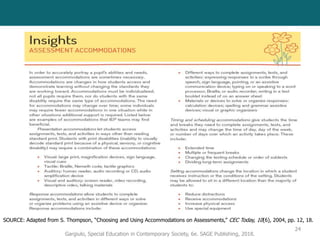
SOURCE: Adapted from S. Thompson, “Choosing and Using Accommodations on Assessments,” CEC Today, 10(6), 2004, pp. 12, 18.
Gargiulo, Special Education in Contemporary Society, 6e. SAGE Publishing, 2018.
24
Designing Individualized
Instructional Programs
Individualized Education Program
(IEP)
• A written document that stipulates who will be
involved in providing a special education, what
services will be offered, where they will be
delivered, and for how long. In addition, an IEP
gauges how successfully goals have been met
• Schools are not reliable if goals are not achieved
• Schools are liable if they do not provide the
services stated in the IEP
• Reviewed at least once annually
Gargiulo, Special Education in Contemporary
Society, 6e. SAGE Publishing, 2018.
26
IEP Team
• Required
– A parent/guardian
– The child’s teachers including a general education
teacher and a special educator
– A representative from the school district
– An individual able to interpret the instructional
implications of the assessments conducted
• When appropriate
– The student
– Other professionals (e.g., speech pathologist)
Gargiulo, Special Education in Contemporary
Society, 6e. SAGE Publishing, 2018.
27
Individualized Family Service Plan
(IFSP)
• Supports infants and toddlers with disabilities
and their families
• Developed based on assessments by
professionals and family input
• Goals developed to reflect the family’s priorities
and needs
• Reviewed every 6 months
Gargiulo, Special Education in Contemporary
Society, 6e. SAGE Publishing, 2018.
28
Service Delivery Options: Where
a Special Education is Provided
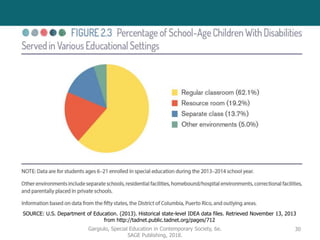
SOURCE: U.S. Department of Education. (2013). Historical state-level IDEA data files. Retrieved November 13, 2013
from http://tadnet.public.tadnet.org/pages/712
Gargiulo, Special Education in Contemporary Society, 6e.
SAGE Publishing, 2018.
30
Least Restrictive Environment
• Principle that each pupil should be educated, to
the maximum extent appropriate, with
classmates who are typical
• The Least Restrictive (LRE) option is the general
education classroom because it provides the
most access to children without disabilities.
• Students may need a more restrictive setting to
meet their unique needs.
• LRE is not a place, but a concept
Gargiulo, Special Education in Contemporary
Society, 6e. SAGE Publishing, 2018.
31
Additional Key Terms
• Mainstreaming
– An early term for the practice of integrating students with special
needs into a general education classroom for all or part of the
school day
• Regular education initiative (REI)
– An approach that advocates that general educators assume
greater responsibility for the education of students with
disabilities
• Full inclusion
– An interpretation of the principle of least restrictive environment
advocating all students with disabilities be educated in the
general education classroom
Gargiulo, Special Education in Contemporary
Society, 6e. SAGE Publishing, 2018.
32
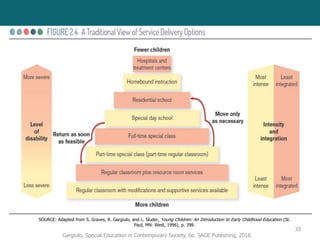
Gargiulo, Special Education in Contemporary Society, 6e. SAGE Publishing, 2018.
33
SOURCE: Adapted from S. Graves, R. Gargiulo, and L. Sluder, Young Children: An Introduction to Early Childhood Education (St.
Paul, MN: West, 1996), p. 398.

Gargiulo6e_PPT02.pptx

  • 2.
  • 3.
  • 4.
    Key Special EducationCourt Cases – Brown v. Board of Education of Topeka, Kansas (1954) – PARC v. Commonwealth of Pennsylvania (1972) – Board of Education of the Hendrick Hudson Central School District v. Rowley (1982) – Daniel R.R. v. State Board of Education (1989) – Oberti vs. Board of Education of the Borough of Clementon School District (1992) – Cedar Rapids Community School District v. Garret F. (1999) – Schaffer vs. Weast (2005) – Winkleman vs. Parma City School District (2007) – Forest Grove School District vs. T. A. (2009) Gargiulo, Special Education in Contemporary Society, 6e. SAGE Publishing, 2018. 4
  • 5.
    Key Special EducationLegislation – PL 94-142 (1975) • Education for all Handicapped Children Act – PL 99-457 (1986 Amendments to PL 94-142) • Education of the Handicapped Act Amendments – PL 101-476 (1990 Amendments to PL 94-142) • Individuals with Disabilities Education Act (IDEA) – PL 105-17 (1997 Amendments to IDEA) • IDEA Act Amendments – PL 107-110 (2001) • No Child Left Behind Act – PL 108-446 (2004) • Individuals with Disabilities Education Improvement Act – PL-114-95 (2015) • Every Student Succeeds Act Gargiulo, Special Education in Contemporary Society, 6e. SAGE Publishing, 2018. 5
  • 6.
    PL 94-142 The Educationfor All Handicapped Children Act of 1975 – Called the “Bill of Rights” for children with “legislative heart of special education,” and the “Parent’s Law.” – Free Appropriate Public Education (FAPE) – Least Restrictive Environment (LRE) disabilities, the – Individualized Education Program (IEP) – Procedural Due Process – Nondiscriminatory Assessment – Parental Participation Gargiulo, Special Education in Contemporary Society, 6e. SAGE Publishing, 2018. 6
  • 7.
    PL 99-457 Education ofthe Handicapped Act Amendments of 1986 • Affected education and services for young children with special needs and their families – Preschoolers (age 3-5) – Children from birth through age 2 – Individualized Family Service Plan (IFSP) Gargiulo, Special Education in Contemporary Society, 6e. SAGE Publishing, 2018. 7
  • 8.
    PL 101-476 Individuals withDisabilities Education Act (IDEA) • 1990 amendments renamed PL 94-142 as the Individuals with Disabilities Education Act (IDEA) • Individual Transition Plan (ITP) required by age 16 • Expanded related services • Added autism and traumatic brain injury as distinct disability categories • States held accountable to implement law Gargiulo, Special Education in Contemporary Society, 6e. SAGE Publishing, 2018. 8
  • 9.
    PL 105-17 IDEA ActAmendments of 1997 • Disciplinary considerations • IEP changes to support inclusion and transition • Related services expanded to include orientation and mobility services • Mediation procedures developed • Expanded category of developmental delay • Evaluation and reevaluation requirements changed • Federal funding changes • Performance goals/accountability Gargiulo, Special Education in Contemporary Society, 6e. SAGE Publishing, 2018. 9
  • 10.
    PL 107-110 No ChildLeft Behind Act of 2001 • Reauthorization of the Elementary and Secondary Education Act • Annual testing for all students in certain grades to demonstrate adequate yearly progress in mathematics, reading, and science • Public access to schools’ performance on tests • Provides for parental choice in schools that do not meet annual progress goals • Schools not making sufficient annual progress offer additional services to students • Highly Qualified status for teachers • Common Core State Standards Initiative Gargiulo, Special Education in Contemporary Society, 6e. SAGE Publishing, 2018. 10
  • 11.
    PL 108-446 Individuals withDisabilities Education Improvement Act of 2004 • Special education services aligned with national school improvement efforts • IEP changes • Identification of students with learning disabilities through Response to Intervention (RTI) • Highly qualified special education teachers • Discipline • Due process • Evaluation of students • Assessment participation Gargiulo, Special Education in Contemporary Society, 6e. SAGE Publishing, 2018. 11
  • 12.
    PL-114-95 Every Student SucceedsAct of 2015 • Reauthorization of the Elementary and Secondary education Act • AYP provisions repealed and replaced by a statewide accountability system • States can adopt Common Core State Standards, but not a requirement • “Highly qualified” teacher status is eliminated • State intervention for low performing schools Gargiulo, Special Education in Contemporary Society, 6e. SAGE Publishing, 2018. 12
  • 13.
  • 14.
    Section 504 ofthe Rehabilitation Act of 1973 • This act employs a broader definition of eligibility than IDEA and states that no individual can be excluded, solely because of their disability, from participating in any program or activity receiving federal funding, including schools. • Schools may be required to develop plans to meet the needs of students who require accommodations. • Section 504 covers the entire lifespan not just the school years. Gargiulo, Special Education in Contemporary Society, 6e. SAGE Publishing, 2018. 14
  • 15.
    Gargiulo, Special Educationin Contemporary Society, 6e. SAGE Publishing, 2018. 15
  • 16.
    PL 101-336 Americans withDisabilities Act (ADA) of 1990 • Designed to eliminate discrimination against people with disabilities in the pubic and private sectors. • Expanded definitions of eligibility may include people with AIDS, substance abuse issues, or any impairment that limits a major life activity. • Employers, mass transit systems, and companies who provide products and services must make “reasonable accommodations” for people with disabilities. Gargiulo, Special Education in Contemporary Society, 6e. SAGE Publishing, 2018. 16
  • 17.
    PL 110-325 The Americanswith Disabilities Act Amendments of 2008 • Reauthorization of the ADA; commonly called ADAA • Became effective January 2009 • Broader interpretation of disability includes additional life activities (reading, concentrating, thinking) or body functions (such as immune system or neurological functioning) • Interpretation of “substantial limitation” made without considering the effects of mitigating measures like medication or medical equipment Gargiulo, Special Education in Contemporary Society, 6e. SAGE Publishing, 2018. 17
  • 18.
    Identification and Assessment ofIndividual Differences
  • 19.
    Interindividual Differences • Differencesbetween students – Examples: height, sports skill, reading ability – Students are identified, labeled, and placed in instructional setting based on interindividual differences Gargiulo, Special Education in Contemporary Society, 6e. SAGE Publishing, 2018. 19
  • 20.
    Intraindividual Differences • Differenceswithin a student – Examples: individual patterns of strengths and needs – Information helps craft a customized instructional plan tailored to the learner Gargiulo, Special Education in Contemporary Society, 6e. SAGE Publishing, 2018. 20
  • 21.
    Referral and Assessmentfor Special Education
  • 22.
    Prereferral and Referral •Prereferral • Instructional or behavioral strategies introduced by the general educator to assist students who are struggling • Detailed documentation of these intervention efforts provides a strong justification for the initiation of a formal referral. • Referral • Child is formally referred for assessment • Referral occurs due to unsuccessful results from prereferral interventions or from child-find. • IDEA does not require parental consent for referrals; however, it is wise to notify parents/guardians that a referral is being initiated Gargiulo, Special Education in Contemporary Society, 6e. SAGE Publishing, 2018. 22
  • 23.
    Assessment – The processof gathering information and identifying a student’s strengths and needs through a variety of instruments and products; data used in making decisions – Parental permission is obtained before moving forward with an evaluation – Evaluation is conducted by a multidisciplinary team to determine if a disability is present • Norm-referenced and criterion-referenced assessments Gargiulo, Special Education in Contemporary Society, 6e. SAGE Publishing, 2018. 23
  • 24.
    SOURCE: Adapted fromS. Thompson, “Choosing and Using Accommodations on Assessments,” CEC Today, 10(6), 2004, pp. 12, 18. Gargiulo, Special Education in Contemporary Society, 6e. SAGE Publishing, 2018. 24
  • 25.
  • 26.
    Individualized Education Program (IEP) •A written document that stipulates who will be involved in providing a special education, what services will be offered, where they will be delivered, and for how long. In addition, an IEP gauges how successfully goals have been met • Schools are not reliable if goals are not achieved • Schools are liable if they do not provide the services stated in the IEP • Reviewed at least once annually Gargiulo, Special Education in Contemporary Society, 6e. SAGE Publishing, 2018. 26
  • 27.
    IEP Team • Required –A parent/guardian – The child’s teachers including a general education teacher and a special educator – A representative from the school district – An individual able to interpret the instructional implications of the assessments conducted • When appropriate – The student – Other professionals (e.g., speech pathologist) Gargiulo, Special Education in Contemporary Society, 6e. SAGE Publishing, 2018. 27
  • 28.
    Individualized Family ServicePlan (IFSP) • Supports infants and toddlers with disabilities and their families • Developed based on assessments by professionals and family input • Goals developed to reflect the family’s priorities and needs • Reviewed every 6 months Gargiulo, Special Education in Contemporary Society, 6e. SAGE Publishing, 2018. 28
  • 29.
    Service Delivery Options:Where a Special Education is Provided
  • 30.
    SOURCE: U.S. Departmentof Education. (2013). Historical state-level IDEA data files. Retrieved November 13, 2013 from http://tadnet.public.tadnet.org/pages/712 Gargiulo, Special Education in Contemporary Society, 6e. SAGE Publishing, 2018. 30
  • 31.
    Least Restrictive Environment •Principle that each pupil should be educated, to the maximum extent appropriate, with classmates who are typical • The Least Restrictive (LRE) option is the general education classroom because it provides the most access to children without disabilities. • Students may need a more restrictive setting to meet their unique needs. • LRE is not a place, but a concept Gargiulo, Special Education in Contemporary Society, 6e. SAGE Publishing, 2018. 31
  • 32.
    Additional Key Terms •Mainstreaming – An early term for the practice of integrating students with special needs into a general education classroom for all or part of the school day • Regular education initiative (REI) – An approach that advocates that general educators assume greater responsibility for the education of students with disabilities • Full inclusion – An interpretation of the principle of least restrictive environment advocating all students with disabilities be educated in the general education classroom Gargiulo, Special Education in Contemporary Society, 6e. SAGE Publishing, 2018. 32
  • 33.
    Gargiulo, Special Educationin Contemporary Society, 6e. SAGE Publishing, 2018. 33 SOURCE: Adapted from S. Graves, R. Gargiulo, and L. Sluder, Young Children: An Introduction to Early Childhood Education (St. Paul, MN: West, 1996), p. 398.

Editor's Notes

  • #2 Edit title, add new author
  • #31 UPDATE CITATION DATE FIGURE 2.3