STATUS OF DISABILITY 
& 
Services for the welfare & 
Rehabilitation for the Persons with 
Disabilities 
in India 
By 
Dr.Asha Deshpande 
Director- Education & Research 
KamayaniPrashikshan & Sanshodhan 
Society, Pune
A disability is a condition or function judged to be significantly 
impaired relative to the usual standard of an individual or their 
group. The term is often used to refer to individual 
functioning, including physical impairment, sensory 
impairment, cognitive impairment, intellectual impairment or 
mental health issue. 
"Disability" means - I) Blindnes II) low vision III) leprosy-cured 
IV) Hearing impairment V) locomotor disability VI) Mental 
retardation VII) Mental illness 
Community Based rehabilitation (CBR) of disables is a 
systematic approach to help disabled persons within their 
own community, by making the best use of local resources 
and helping the community to become aware of their 
responsibility in this regard. Responsibility is also given to the 
disabled themselves, as they are the part of community. The 
aim is to provide services from within the community and with 
the active involvement of the community, family and the local 
administration. This approach is the client-centered approach 
and services are provided according to the felt needs of the 
individual (NIMH 1994).
In India the socio-economic and cultural factors 
create several hurdles in implementing CBR for 
the PWD. 
These constraints are as follows:- 
1. Illiteracy and lack of awareness 
2. Non availability of proper information or 
guidelines 
3. Poverty and over population 
4. Misconceptions & Stigma. 
5. Non acceptance and rejection of disables 
like mentally challenged and mentally ill both at 
urban as well as rural Society 
6. Non-proximity of the Special Schools. 
7. Lack of trained personnel. 
8. Centralization of the services in Urban 
areas -. 
9.[1] scarcity of services In Urban area.
According to the Census 2011, 
there are 21 million persons with 
disabilities in India who constitute 
2.1 percent of the total population. 
This includes persons with visual, 
hearing, speech, locomotor and 
mental disabilities. Seventy five per 
cent of persons with disabilities live in 
rural areas, 49 per cent of disabled 
population is literate and only 34 per 
cent are employed.
NUMBER OF DISABLED POPULATION 
AND TYPE OF DISABILITY IN INDIA 
 Population Percentage 
 (a) In seeing 1.0 
 (b) In speech 0.2 
 (c) In hearing 0.1 
 (d) In movement 0.6 
 (e) Mental 0.2 
 Source : Census of India 2011.
Change in Attitude in Indian Social 
Structure 
Legal framework for CBR in India 
Government of India has enacted three legislations for persons 
with disabilities viz. 
(i) Persons with Disability (Equal Opportunities, Protection of 
Rights and Full Participation) Act, 1995, which provides for 
education, employment, creation of barrier free environment, 
social security, etc. 
(ii) National Trust for Welfare of Persons with Autism, Cerebral 
Pa lsy, Mental Retardation and Multiple Disability Act, 1999 has 
provisions for legal guardianship of the four categories and 
creation of enabling environment for as much independent living 
as possible. 
(iii) Rehabilitation Council of India Act, 1992 deals with the 
development of manpower for providing rehabilitation services.
India ratifies UN Convention on the Rights of Persons with 
Disabilities on 29 March 2007 
 The Union Cabinet OF India has signed and ratified the United 
Nations "Convention on the Rights of Persons with Disabilities" 
excluding the Optional Protocol. 
By signing and ratifying the UN Convention, India will be re-affirming 
its commitment towards International Policy Framework 
in respect of the Persons with disabilities. Also, it would enhance 
the prestige in the international community. 
 The general principles of the Convention are as under:- 
(i) Respect for inherent dignity, individual autonomy including the 
freedom to make one's own choices, and independence of persons; 
(ii) Non-discrimination; 
(iii) Full and effective participation and inclusion in society; 
(iv) Respect for difference and acceptance of persons with 
disabilities as part of human diversity and humanity; 
(v) Equality of opportunity; 
(vi) Accessibility; 
(vii) Equality between men and women; 
(viii) Respect for the evolving capacities of children with disabilities 
and respect for the right of children with disabilities to preserve 
their identities.
Extensive infrastructure 
Institute for the Physically Handicapped, New Delhi. 
National Institute of Visually Handicapped, Dehradun 
National Institute for Orthopaedically Handicapped, 
Kolkata 
National Institute for Mentally Handicapped, 
Secunderabad. 
National Institute for Hearing Handicapped, Mumbai 
National Institute of Rehabilitation Training & 
Research, Cuttack. 
National Institute for Empowerment of Persons with 
Multiple Disabilities, Chennai.
120 District Disability Rehabilitation Centres 
(DDRCs) providing various kinds of rehabilitation 
services to persons with disabilities are to be 
formed. Besides, 250 private institutions are 
conducting training courses for rehabilitation 
professionals. 
National Handicapped and Finance Development 
Corporation (NHFDC) has been providing loans on 
concessional terms for undertaking self-employment 
ventures by the persons with 
disabilities through State Channelizing Agencies. 
Panchayati Raj Institutions at Village level, 
Intermediary level and District level have been 
entrusted with the welfare of persons with 
disabilities.
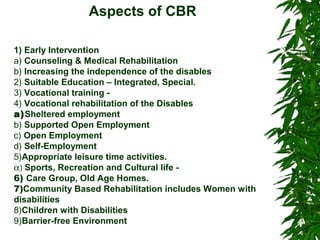
Aspects of CBR 
1) Early Intervention 
a) Counseling & Medical Rehabilitation 
b) Increasing the independence of the disables 
2) Suitable Education – Integrated, Special. 
3) Vocational training - 
4) Vocational rehabilitation of the Disables 
a)Sheltered employment 
b) Supported Open Employment 
c) Open Employment 
d) Self-Employment 
5)Appropriate leisure time activities. 
a) Sports, Recreation and Cultural life - 
6) Care Group, Old Age Homes. 
7)Community Based Rehabilitation includes Women with 
disabilities 
8)Children with Disabilities 
9)Barrier-free Environment
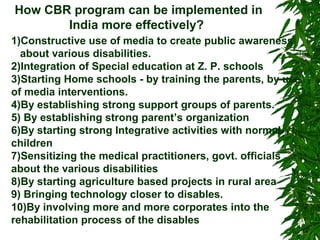
How CBR program can be implemented in 
India more effectively? 
1)Constructive use of media to create public awareness 
about various disabilities. 
2)Integration of Special education at Z. P. schools 
3)Starting Home schools - by training the parents, by use 
of media interventions. 
4)By establishing strong support groups of parents. 
5) By establishing strong parent’s organization 
6)By starting strong Integrative activities with normal 
children 
7)Sensitizing the medical practitioners, govt. officials 
about the various disabilities 
8)By starting agriculture based projects in rural area 
9) Bringing technology closer to disables. 
10)By involving more and more corporates into the 
rehabilitation process of the disables
THANK YOU

Ppt disables person

  • 1.
    STATUS OF DISABILITY & Services for the welfare & Rehabilitation for the Persons with Disabilities in India By Dr.Asha Deshpande Director- Education & Research KamayaniPrashikshan & Sanshodhan Society, Pune
  • 2.
    A disability isa condition or function judged to be significantly impaired relative to the usual standard of an individual or their group. The term is often used to refer to individual functioning, including physical impairment, sensory impairment, cognitive impairment, intellectual impairment or mental health issue. "Disability" means - I) Blindnes II) low vision III) leprosy-cured IV) Hearing impairment V) locomotor disability VI) Mental retardation VII) Mental illness Community Based rehabilitation (CBR) of disables is a systematic approach to help disabled persons within their own community, by making the best use of local resources and helping the community to become aware of their responsibility in this regard. Responsibility is also given to the disabled themselves, as they are the part of community. The aim is to provide services from within the community and with the active involvement of the community, family and the local administration. This approach is the client-centered approach and services are provided according to the felt needs of the individual (NIMH 1994).
  • 3.
    In India thesocio-economic and cultural factors create several hurdles in implementing CBR for the PWD. These constraints are as follows:- 1. Illiteracy and lack of awareness 2. Non availability of proper information or guidelines 3. Poverty and over population 4. Misconceptions & Stigma. 5. Non acceptance and rejection of disables like mentally challenged and mentally ill both at urban as well as rural Society 6. Non-proximity of the Special Schools. 7. Lack of trained personnel. 8. Centralization of the services in Urban areas -. 9.[1] scarcity of services In Urban area.
  • 4.
    According to theCensus 2011, there are 21 million persons with disabilities in India who constitute 2.1 percent of the total population. This includes persons with visual, hearing, speech, locomotor and mental disabilities. Seventy five per cent of persons with disabilities live in rural areas, 49 per cent of disabled population is literate and only 34 per cent are employed.
  • 5.
    NUMBER OF DISABLEDPOPULATION AND TYPE OF DISABILITY IN INDIA  Population Percentage  (a) In seeing 1.0  (b) In speech 0.2  (c) In hearing 0.1  (d) In movement 0.6  (e) Mental 0.2  Source : Census of India 2011.
  • 6.
    Change in Attitudein Indian Social Structure Legal framework for CBR in India Government of India has enacted three legislations for persons with disabilities viz. (i) Persons with Disability (Equal Opportunities, Protection of Rights and Full Participation) Act, 1995, which provides for education, employment, creation of barrier free environment, social security, etc. (ii) National Trust for Welfare of Persons with Autism, Cerebral Pa lsy, Mental Retardation and Multiple Disability Act, 1999 has provisions for legal guardianship of the four categories and creation of enabling environment for as much independent living as possible. (iii) Rehabilitation Council of India Act, 1992 deals with the development of manpower for providing rehabilitation services.
  • 7.
    India ratifies UNConvention on the Rights of Persons with Disabilities on 29 March 2007  The Union Cabinet OF India has signed and ratified the United Nations "Convention on the Rights of Persons with Disabilities" excluding the Optional Protocol. By signing and ratifying the UN Convention, India will be re-affirming its commitment towards International Policy Framework in respect of the Persons with disabilities. Also, it would enhance the prestige in the international community.  The general principles of the Convention are as under:- (i) Respect for inherent dignity, individual autonomy including the freedom to make one's own choices, and independence of persons; (ii) Non-discrimination; (iii) Full and effective participation and inclusion in society; (iv) Respect for difference and acceptance of persons with disabilities as part of human diversity and humanity; (v) Equality of opportunity; (vi) Accessibility; (vii) Equality between men and women; (viii) Respect for the evolving capacities of children with disabilities and respect for the right of children with disabilities to preserve their identities.
  • 8.
    Extensive infrastructure Institutefor the Physically Handicapped, New Delhi. National Institute of Visually Handicapped, Dehradun National Institute for Orthopaedically Handicapped, Kolkata National Institute for Mentally Handicapped, Secunderabad. National Institute for Hearing Handicapped, Mumbai National Institute of Rehabilitation Training & Research, Cuttack. National Institute for Empowerment of Persons with Multiple Disabilities, Chennai.
  • 9.
    120 District DisabilityRehabilitation Centres (DDRCs) providing various kinds of rehabilitation services to persons with disabilities are to be formed. Besides, 250 private institutions are conducting training courses for rehabilitation professionals. National Handicapped and Finance Development Corporation (NHFDC) has been providing loans on concessional terms for undertaking self-employment ventures by the persons with disabilities through State Channelizing Agencies. Panchayati Raj Institutions at Village level, Intermediary level and District level have been entrusted with the welfare of persons with disabilities.
  • 10.
    Aspects of CBR 1) Early Intervention a) Counseling & Medical Rehabilitation b) Increasing the independence of the disables 2) Suitable Education – Integrated, Special. 3) Vocational training - 4) Vocational rehabilitation of the Disables a)Sheltered employment b) Supported Open Employment c) Open Employment d) Self-Employment 5)Appropriate leisure time activities. a) Sports, Recreation and Cultural life - 6) Care Group, Old Age Homes. 7)Community Based Rehabilitation includes Women with disabilities 8)Children with Disabilities 9)Barrier-free Environment
  • 11.
    How CBR programcan be implemented in India more effectively? 1)Constructive use of media to create public awareness about various disabilities. 2)Integration of Special education at Z. P. schools 3)Starting Home schools - by training the parents, by use of media interventions. 4)By establishing strong support groups of parents. 5) By establishing strong parent’s organization 6)By starting strong Integrative activities with normal children 7)Sensitizing the medical practitioners, govt. officials about the various disabilities 8)By starting agriculture based projects in rural area 9) Bringing technology closer to disables. 10)By involving more and more corporates into the rehabilitation process of the disables
  • 12.