Learner Rights and
Teacher Responsibilities
August Hubert • August 14,
2021
What is Special
Education?
● Special Education also known as
SPED
● “Special education refers to a
range of services that help kids
with disabilities learn”
(Morin,2021).
● Individualized Education
Program (IEP)
Georgia:
● Least Restrictive Environment (LRE)
● Georgia Learning Resources System
(GLRS)
● Evaluations and Reevaluations
Special Education Laws & Policies at the State Level
Special Education
Laws & Policies at
the Federal Level ● Individuals with Disabilities
Act (IDEA)
● Child Find Mandate
● Education for All Handicaped
Children Act (EHA)
● Respect Students
● Do not discriminate
● Accommodations/Modifications are
met
● Attend trainings frequently
Expectations of the Profession
Code of Ethics for
Educators
CEC Code of Ethics for Special
Educators:
● Develop highest level of education
possible
● Maintain high level of competency
● Engage in professional activities
● Use objective professional judgment
● Strive to advance knowledge
● Follows policies and standards
● Does not participate in unethical or
illegal acts
Advocating to meet the needs
of all learners:
● Work to improve
government policies
● Try and get other
educators to increase
their knowledge on
special education
students
● Keep record of
inaccuracies in meeting
students needs
CEC Professional Standards for Advocacy
Professional
Standards of
Practice to
Promote Learners
Meeting their full
Potential
● Positive, safe, and culturally
appropriate classroom
environment
● Understands different learners
require different levels of help
● Content Knowledge
Practices to demonstrate respect for learners as individuals with
differing personal and family backgrounds and various skills, abilities,
and interests
● Using culturally appropriate
resources
● Differentiating classwork
assignments
● Brings multiple perspectives to the
students to learn from
● Begin with a positive
communication before calling with
a negative event
● Speak to colleagues who have had
the student in the past
● Speak to the family about what
works best for their child
● Speak to the learner to see what
you can do differently to help
Collaboration with Learners, Families, and Colleagues
References
● Morin, A. (2021, May 6). What is special
education? Understood.
https://www.understood.org/articles/en/
understanding-special-education.
● GaDOE. (n.d.). Special-education-rules //
. Special Education Services and
Supports.
https://www.gadoe.org/Curriculum-
Instruction-and-Assessment/Special-
Education-Services/Pages/Special-
Education-Rules.aspx.
● U.S. Department of Education. (2020,
November 24). About idea. Individuals
with Disabilities Education Act.
https://sites.ed.gov/idea/about-idea/.
● Wright, P., & Wright, P. (2019). The
child Find MANDATE: What does it mean
to you? Wrightslaw.
https://www.wrightslaw.com/info/child.fi
nd.mandate.htm.
● Brandman University. (2020). 4 laws that
shaped special education in the U.S.
www.brandman.edu.
https://www.brandman.edu/news-and-
events/blog/special-education-laws.

Learner rights and teacher responsibilities

  • 1.
    Learner Rights and TeacherResponsibilities August Hubert • August 14, 2021
  • 2.
    What is Special Education? ●Special Education also known as SPED ● “Special education refers to a range of services that help kids with disabilities learn” (Morin,2021). ● Individualized Education Program (IEP)
  • 3.
    Georgia: ● Least RestrictiveEnvironment (LRE) ● Georgia Learning Resources System (GLRS) ● Evaluations and Reevaluations Special Education Laws & Policies at the State Level
  • 4.
    Special Education Laws &Policies at the Federal Level ● Individuals with Disabilities Act (IDEA) ● Child Find Mandate ● Education for All Handicaped Children Act (EHA)
  • 5.
    ● Respect Students ●Do not discriminate ● Accommodations/Modifications are met ● Attend trainings frequently Expectations of the Profession
  • 6.
    Code of Ethicsfor Educators CEC Code of Ethics for Special Educators: ● Develop highest level of education possible ● Maintain high level of competency ● Engage in professional activities ● Use objective professional judgment ● Strive to advance knowledge ● Follows policies and standards ● Does not participate in unethical or illegal acts
  • 7.
    Advocating to meetthe needs of all learners: ● Work to improve government policies ● Try and get other educators to increase their knowledge on special education students ● Keep record of inaccuracies in meeting students needs CEC Professional Standards for Advocacy
  • 8.
    Professional Standards of Practice to PromoteLearners Meeting their full Potential ● Positive, safe, and culturally appropriate classroom environment ● Understands different learners require different levels of help ● Content Knowledge
  • 9.
    Practices to demonstraterespect for learners as individuals with differing personal and family backgrounds and various skills, abilities, and interests ● Using culturally appropriate resources ● Differentiating classwork assignments ● Brings multiple perspectives to the students to learn from
  • 10.
    ● Begin witha positive communication before calling with a negative event ● Speak to colleagues who have had the student in the past ● Speak to the family about what works best for their child ● Speak to the learner to see what you can do differently to help Collaboration with Learners, Families, and Colleagues
  • 11.
    References ● Morin, A.(2021, May 6). What is special education? Understood. https://www.understood.org/articles/en/ understanding-special-education. ● GaDOE. (n.d.). Special-education-rules // . Special Education Services and Supports. https://www.gadoe.org/Curriculum- Instruction-and-Assessment/Special- Education-Services/Pages/Special- Education-Rules.aspx. ● U.S. Department of Education. (2020, November 24). About idea. Individuals with Disabilities Education Act. https://sites.ed.gov/idea/about-idea/. ● Wright, P., & Wright, P. (2019). The child Find MANDATE: What does it mean to you? Wrightslaw. https://www.wrightslaw.com/info/child.fi nd.mandate.htm. ● Brandman University. (2020). 4 laws that shaped special education in the U.S. www.brandman.edu. https://www.brandman.edu/news-and- events/blog/special-education-laws.

Editor's Notes

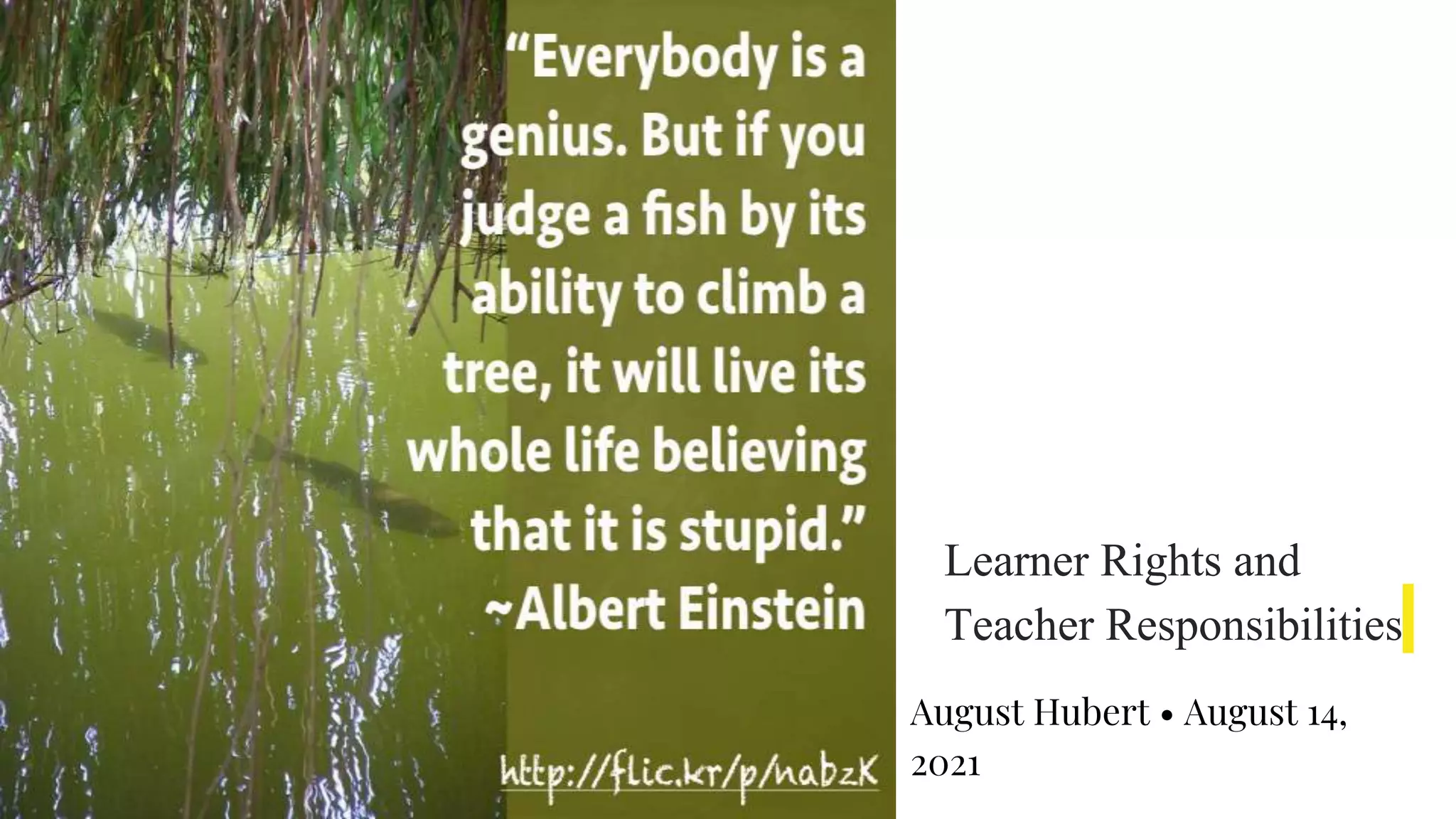
  • #2 Today we will be discussing learner rights and teacher responsibilities in relation to special education students. The quote on the screen is by Albert Einstein and it states that “Everybody is a genius. But if you judge a fish by its ability to climb a tree, it will live its whole life believing that it is stupid”. I chose this quote for this presentation because if we judge a special education student by how they do compared to their peers without accommodations or modifications, we will never be able to see their true genius that lies within.
  • #3 So what exactly is special education? Special education goes by a few names one of the most common acronyms for it is SPED. In Morin’s article about special education she states that “special education refers to a range of services that help kids with disabilities learn” (2021). This is true because once a student is listed as a special education student, there options for ways to accommodate or meet their needs is greatly increased. Before a student is fully listed as a special education student there is testing that takes placed so that a individualized education program or IEP can be created. The IEP will list out modifications and accommodations that can help special education students succeed in the classroom.
  • #4 In the state of Georgia, there are three policies I want to highlight during this presentation. The first is the least restrictive environment or LRE policy. The LRE policy focuses on what environment the student is placed in to learn. If the student is in a secluded classroom this can only occur if “the nature or severity of the disability is such that education in regular classes with the use of supplementary aids and services cannot be achieved satisfactorily. [34 C.F.R. § 300.114(a)(2)(ii)]” (GaDOE, 2010). The LRE helps define the situations that may cause a special education student to be in a secluded classroom rather than in the classroom with their peers. Another policy I wanted to highlight is the Georgia Learning Resources System or the GLRS. The GLRS focuses on making sure that all staff and faculty within the school system are trained on how to approach situations that may occur with special education students. The last state level policy I want to highlight today is the evaluations and reevaluations policy in Georgia. The first evaluation occurs so that students can begin receiving special education services and the policy also details how long the school system has to test/evaluate the student for services needed. The reevaluation portion of this policy states that the special education student must be evaluated every three years to adjust accommodations/modifications or dissolve special education needs depending on the situation.
  • #5 Previously, I highlighted policies for special education students in the state of Georgia but now we will be looking at the federal laws and policies in regards to our special education students. The first act I would like to discuss is the Individuals with Disabilities Act (IDEA). The IDEA is “law that makes available a free appropriate public education to eligible children with disabilities throughout the nation and ensures special education and related services to those children” (U.S. Department of Education, 2020). A part of the IDEA is another law known as the Child Find Mandate. The Child Find Mandate “requires all school districts TO identify, locate and evaluate all children with disabilities, regardless of the severity of their disabilities” (Wright & Wright, 2019). The last federal law/policy I would like to highlight is the Education for All Handicaped Children Act. The EHA “requires that all public schools accepting federal funds must provide equal access to education for children with physical and/or mental disabilities” (Brandman University, 2020).
  • #6 A few expectations of the teaching profession in relation to special education students is to respect the students, do not discriminate against a student, make sure all accommodations and/or modifications are met, and attend trainings frequently. If a teacher does not follow these expectations, there is a greater chance of the special education student not meeting their educational goals while in that teachers classroom.
  • #7 The CEC code of ethics for special educators has a few ethical codes that special educators must follow in order to meet the needs of the special education students. The special education educators must create the highest level of education possible, maintain a high level of competency, engage in professional activities, use objective professional judgment when needed, strive to advance their knowledge on special education, follow the policies, follow the standards, and agrees to not participate in any unethical or illegal acts. All of these are important in making sure that your special education child is well taken care of while in our care.
  • #8 The CEC Professional Standards for Advocacy of special education students has a section that focuses on advocating to meet the needs of all learners which includes special education students. Under this section there are a few things that they want educators to do to be the students advocate. Educators need to work on improving government policies that may be negatively affecting their learners, try to get other educators to increase their knowledge about their learners needs, and keep record of inaccuracies that may occur or keep the educator from meeting students needs. These inaccuracies need to be reported to their superiors so that the proper people can fix the issue.
  • #9 When researching the professional standards of practice to promote learners meeting their full potential, it was not an easy feat. A lot of websites focused on the three main issues listed on the slide. Educators must create a positive, safe, and culturally appropriate classroom environment so that students can meet their full potential. If students feel unsafe or inadequate due to the educator being incentive to their culture, they will not meet their full potential. Another thing mentioned often was that educators need to understand different learners require different levels of help so that they can find ways to meet the needs of all their students. Lastly, content knowledge is very important to help students meet their full potential. If an educator is not knowledgeable on their content then they will not be able to teach the content to the students to the best of their abilities.
  • #10 Practices to demonstrate respect for learners as individuals with differing personal and family backgrounds and various skills, abilities, and interest revolve around creating an environment that capitalizes on their differences. Using culturally appropriate resources when able to and differentiating classwork assignments are a few ways to do this for your multiple types of learners. Another way that educators can do this is by bringing multiple perspectives to the students to learn from. For example, while teaching about WWII bring in perspectives from the nazis, jews, and people who were close to hitler so that they see multiple perspectives about the war.
  • #11 Collaboration with learners, families, and colleagues is very important when it comes down to meeting the needs of our special learners. As an educator, when communicating with the learners family begin with a positive communication before a negative event occurs that you have to call home to discuss. This creates a relationship between yourself and the family before a negative situation occurs. Speaking to colleagues about the students they have had in the past, talking to the family about the learner, and asking the learner what you can do to help are all important to meeting the needs of our learners.