CoreyThompson
UniversityofPhoenix
MTE/512
August5,2019
 Introduction of Special Education
 At least three relevant laws and policies at the state and
federal level
 Expectations of the profession
 Codes of ethics
 Professional standards of practice, including:
 Practices for advocating to meet the needs of all learners
 Practices to promote learners meeting their full potential
 Practices to demonstrate respect for learners as individuals with
differing personal and family backgrounds and various skills,
abilities, and interests
 Practices to demonstrate collaboration with learners,
families, and colleagues
 Getting to know:
 I.D.E.A. Act, or Individuals with Disabilities Education Act of 2004,
 Two primary purposes of the I.D.E.A.,
 provide education to children with unique learning needs and
 Prepare them to have further education, employment, and independent
living skills. The second purpose is to make the I.D.E.A. Act protect the rights
of children with disabilities and parents (Wright, 2019).
 Did you know:
 The I.D.E.A. was a realignment of the Elementary and Secondary
Education Act of 1965 and the No Child Left Behind Act, NCLB, in 2001.
 Improvements were made to decrease labeling to one specific
demographic and decrease high drop out rates.
 High expectations were made for all students with specific learning
needs to receive full access to the general education in a regular
classroom.
INTRODUCTION OF SPECIAL EDUCATION
On the Federal Level (Binding in all states)
 The Individual with Disabilities Education Act (I.D.E.A)
 Section 504 of the Rehabilitation Act of 1973
 The Family Educational and Privacy Rights Act.
(UnderstandingSpecialEducation, 2016)
On the State Level
 State Government can mandate or create more protection than IDEA, not
less.
 For every state-imposed requirement must have a rationale that is
connected to the Federal level.
AT LEAST THREE RELEVANT LAWS AND
POLICIES AT THE STATE AND FEDERAL LEVEL
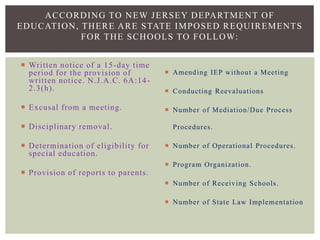
 Written notice of a 15-day time
period for the provision of
written notice. N.J.A.C. 6A:14-
2.3(h).
 Excusal from a meeting.
 Disciplinary removal.
 Determination of eligibility for
special education.
 Provision of reports to parents.
 Amending IEP without a Meeting
 Conducting Reevaluations
 Number of Mediation/Due Process
Procedures.
 Number of Operational Procedures.
 Program Organization.
 Number of Receiving Schools.
 Number of State Law Implementation
ACCORDING TO NEW JERSEY DEPARTMENT OF
EDUCATION, THERE ARE STATE IMPOSED REQUIREMENTS
FOR THE SCHOOLS TO FOLLOW:
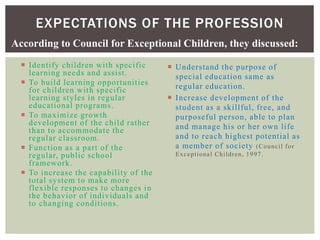
 Identify children with specific
learning needs and assist.
 To build learning opportunities
for children with specific
learning styles in regular
educational programs.
 To maximize growth
development of the child rather
than to accommodate the
regular classroom.
 Function as a part of the
regular, public school
framework.
 To increase the capability of the
total system to make more
flexible responses to changes in
the behavior of individuals and
to changing conditions.
 Understand the purpose of
special education same as
regular education.
 Increase development of the
student as a skillful, free, and
purposeful person, able to plan
and manage his or her own life
and to reach highest potential as
a member of society (Council for
Exceptional Children, 1997.
EXPECTATIONS OF THE PROFESSION
According to Council for Exceptional Children, they discussed:
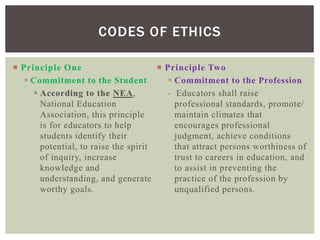
 Principle One
 Commitment to the Student
 According to the NEA,
National Education
Association, this principle
is for educators to help
students identify their
potential, to raise the spirit
of inquiry, increase
knowledge and
understanding, and generate
worthy goals.
 Principle Two
 Commitment to the Profession
 Educators shall raise
professional standards, promote/
maintain climates that
encourages professional
judgment, achieve conditions
that attract persons worthiness of
trust to careers in education, and
to assist in preventing the
practice of the profession by
unqualified persons.
CODES OF ETHICS
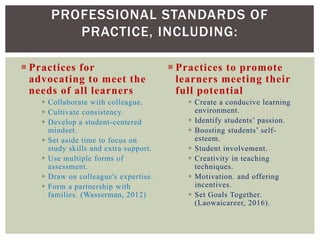
 Practices for
advocating to meet the
needs of all learners
 Collaborate with colleague.
 Cultivate consistency.
 Develop a student-centered
mindset.
 Set aside time to focus on
study skills and extra support.
 Use multiple forms of
assessment.
 Draw on colleague's expertise.
 Form a partnership with
families. (Wasserman, 2012)
 Practices to promote
learners meeting their
full potential
 Create a conducive learning
environment.
 Identify students’ passion.
 Boosting students’ self-
esteem.
 Student involvement.
 Creativity in teaching
techniques.
 Motivation. and offering
incentives.
 Set Goals Together.
(Laowaicareer, 2016).
PROFESSIONAL STANDARDS OF
PRACTICE, INCLUDING:
 Practices to demonstrate respect for learners as
individuals with differing personal and family
backgrounds and various skills, abilities, and
interests
Encourage eye to eye and shake hand interactions.
Be kind to others
Explore positives in all learners.
Use names like “scholar,” “student,” and “learner
"during interactions with students (GettingSmart,
2015).
PROFESSIONAL STANDARDS OF
PRACTICE, INCLUDING:
 Open Communications
 Parent-teacher relationship
(Special Education Guide, 2019)
 Digital Collaboration
 Professional establishes personal and
professional learning network, PLN,
Twitter and other social media
accounts.
 Collegial Collaboration
 Teach and model with students how
to collaborate
(Niehoff, 2018)
 Organize schoolwide projects
and challenges
 Forming a partnership between
students, staff, and community.
 Student Reflection:
 Give students chances to reflect and
increase social-emotional skills
through the collaboration process.
 Community Collaboration
 Increased community values on
students being connected with their
communities to others that are
engaged in their neighborhoods.
 Teach/ model community and
volunteer services to learn and
experience empathy for others.
 Engage in real-world challenges
along with relevant academic
standards (Niehoff, 2018)
PRACTICES TO DEMONSTRATE COLLABORATION WITH
LEARNERS, FAMILIES, AND COLLEAGUES
 Council for Exceptional
Children.(1997).Special Education in the
Schools. CEC Policy Manual, Section Three
(pp. 71--92). Retrieved from
https://www.cec.sped.org/Policy-and-
Advocacy/CEC-Professional-
Policies/Special-Education-in-the-Schools.
 GettingSmart. (2015). For The School
Supply List: 25 Ways to Promote Effort,
Attitude and Respect. Retrieved from
https://www.gettingsmart.com/2016/09/25 -
ways-to-promote-effort-attitude-and-respect/
 Laowaicareer. (2016).Motivating students to
reach their full potential. Retrieved from
https://www.laowaicareer.com/blog/motivati
ng-students-to-reach-their-full-potential/
 National Education Association. (2019).
Code of Ethics. Principle 1& 2.Retrieved
from http://www.nea.org/home/30442.htm .
 New J ersey Department of Education. (2019).
State-Imposed Requirement. Retrieved from
https://www.nj.gov/education/specialed/rules.p
df.
 Special Education Guide.(2019).The
Parent-Teacher Partnership.Retrieved
from
https://www.specialeducationguide.com/p
re-k-12/the-parent-teacher-partnership/
 Wasserman, L. (2012/4/24). Education
Week Teacher. Strategies for Meeting All
Students' Needs. Retrieved from
https://www.edweek.org/tm/articles/2012/
04/24/tln_wasserman_strategies.html
 Wright, P; Esq. (2019). WrightLaw. The
History of Special Education Law.
Individuals with Disabilities Education
Improvement Act of 2004. Retrieved from
https://www.wrightslaw.com/law/art/histo
ry.spec.ed.law.htm.
REFERENCES

Learner Rights and Teacher Responsibilities 8-5-2019_update2

  • 1.
  • 2.
     Introduction ofSpecial Education  At least three relevant laws and policies at the state and federal level  Expectations of the profession  Codes of ethics  Professional standards of practice, including:  Practices for advocating to meet the needs of all learners  Practices to promote learners meeting their full potential  Practices to demonstrate respect for learners as individuals with differing personal and family backgrounds and various skills, abilities, and interests  Practices to demonstrate collaboration with learners, families, and colleagues
  • 3.
     Getting toknow:  I.D.E.A. Act, or Individuals with Disabilities Education Act of 2004,  Two primary purposes of the I.D.E.A.,  provide education to children with unique learning needs and  Prepare them to have further education, employment, and independent living skills. The second purpose is to make the I.D.E.A. Act protect the rights of children with disabilities and parents (Wright, 2019).  Did you know:  The I.D.E.A. was a realignment of the Elementary and Secondary Education Act of 1965 and the No Child Left Behind Act, NCLB, in 2001.  Improvements were made to decrease labeling to one specific demographic and decrease high drop out rates.  High expectations were made for all students with specific learning needs to receive full access to the general education in a regular classroom. INTRODUCTION OF SPECIAL EDUCATION
  • 4.
    On the FederalLevel (Binding in all states)  The Individual with Disabilities Education Act (I.D.E.A)  Section 504 of the Rehabilitation Act of 1973  The Family Educational and Privacy Rights Act. (UnderstandingSpecialEducation, 2016) On the State Level  State Government can mandate or create more protection than IDEA, not less.  For every state-imposed requirement must have a rationale that is connected to the Federal level. AT LEAST THREE RELEVANT LAWS AND POLICIES AT THE STATE AND FEDERAL LEVEL
  • 5.
     Written noticeof a 15-day time period for the provision of written notice. N.J.A.C. 6A:14- 2.3(h).  Excusal from a meeting.  Disciplinary removal.  Determination of eligibility for special education.  Provision of reports to parents.  Amending IEP without a Meeting  Conducting Reevaluations  Number of Mediation/Due Process Procedures.  Number of Operational Procedures.  Program Organization.  Number of Receiving Schools.  Number of State Law Implementation ACCORDING TO NEW JERSEY DEPARTMENT OF EDUCATION, THERE ARE STATE IMPOSED REQUIREMENTS FOR THE SCHOOLS TO FOLLOW:
  • 6.
     Identify childrenwith specific learning needs and assist.  To build learning opportunities for children with specific learning styles in regular educational programs.  To maximize growth development of the child rather than to accommodate the regular classroom.  Function as a part of the regular, public school framework.  To increase the capability of the total system to make more flexible responses to changes in the behavior of individuals and to changing conditions.  Understand the purpose of special education same as regular education.  Increase development of the student as a skillful, free, and purposeful person, able to plan and manage his or her own life and to reach highest potential as a member of society (Council for Exceptional Children, 1997. EXPECTATIONS OF THE PROFESSION According to Council for Exceptional Children, they discussed:
  • 7.
     Principle One Commitment to the Student  According to the NEA, National Education Association, this principle is for educators to help students identify their potential, to raise the spirit of inquiry, increase knowledge and understanding, and generate worthy goals.  Principle Two  Commitment to the Profession  Educators shall raise professional standards, promote/ maintain climates that encourages professional judgment, achieve conditions that attract persons worthiness of trust to careers in education, and to assist in preventing the practice of the profession by unqualified persons. CODES OF ETHICS
  • 8.
     Practices for advocatingto meet the needs of all learners  Collaborate with colleague.  Cultivate consistency.  Develop a student-centered mindset.  Set aside time to focus on study skills and extra support.  Use multiple forms of assessment.  Draw on colleague's expertise.  Form a partnership with families. (Wasserman, 2012)  Practices to promote learners meeting their full potential  Create a conducive learning environment.  Identify students’ passion.  Boosting students’ self- esteem.  Student involvement.  Creativity in teaching techniques.  Motivation. and offering incentives.  Set Goals Together. (Laowaicareer, 2016). PROFESSIONAL STANDARDS OF PRACTICE, INCLUDING:
  • 9.
     Practices todemonstrate respect for learners as individuals with differing personal and family backgrounds and various skills, abilities, and interests Encourage eye to eye and shake hand interactions. Be kind to others Explore positives in all learners. Use names like “scholar,” “student,” and “learner "during interactions with students (GettingSmart, 2015). PROFESSIONAL STANDARDS OF PRACTICE, INCLUDING:
  • 10.
     Open Communications Parent-teacher relationship (Special Education Guide, 2019)  Digital Collaboration  Professional establishes personal and professional learning network, PLN, Twitter and other social media accounts.  Collegial Collaboration  Teach and model with students how to collaborate (Niehoff, 2018)  Organize schoolwide projects and challenges  Forming a partnership between students, staff, and community.  Student Reflection:  Give students chances to reflect and increase social-emotional skills through the collaboration process.  Community Collaboration  Increased community values on students being connected with their communities to others that are engaged in their neighborhoods.  Teach/ model community and volunteer services to learn and experience empathy for others.  Engage in real-world challenges along with relevant academic standards (Niehoff, 2018) PRACTICES TO DEMONSTRATE COLLABORATION WITH LEARNERS, FAMILIES, AND COLLEAGUES
  • 11.
     Council forExceptional Children.(1997).Special Education in the Schools. CEC Policy Manual, Section Three (pp. 71--92). Retrieved from https://www.cec.sped.org/Policy-and- Advocacy/CEC-Professional- Policies/Special-Education-in-the-Schools.  GettingSmart. (2015). For The School Supply List: 25 Ways to Promote Effort, Attitude and Respect. Retrieved from https://www.gettingsmart.com/2016/09/25 - ways-to-promote-effort-attitude-and-respect/  Laowaicareer. (2016).Motivating students to reach their full potential. Retrieved from https://www.laowaicareer.com/blog/motivati ng-students-to-reach-their-full-potential/  National Education Association. (2019). Code of Ethics. Principle 1& 2.Retrieved from http://www.nea.org/home/30442.htm .  New J ersey Department of Education. (2019). State-Imposed Requirement. Retrieved from https://www.nj.gov/education/specialed/rules.p df.  Special Education Guide.(2019).The Parent-Teacher Partnership.Retrieved from https://www.specialeducationguide.com/p re-k-12/the-parent-teacher-partnership/  Wasserman, L. (2012/4/24). Education Week Teacher. Strategies for Meeting All Students' Needs. Retrieved from https://www.edweek.org/tm/articles/2012/ 04/24/tln_wasserman_strategies.html  Wright, P; Esq. (2019). WrightLaw. The History of Special Education Law. Individuals with Disabilities Education Improvement Act of 2004. Retrieved from https://www.wrightslaw.com/law/art/histo ry.spec.ed.law.htm. REFERENCES

Editor's Notes

  • #3 In this Presentation, we will discuss the following: Introduction of special education At least three relevant laws and policies at the state and federal level Expectations of the profession Codes of ethics Professional standards of practice, including: Practices for advocating to meet the needs of all learners Practices to promote learners meeting their full potential Practices to demonstrate respect for learners as individuals with differing personal and family backgrounds and various skills, abilities, and interests Practices to demonstrate collaboration with learners, families, and colleagues 
  • #4 Special Education teachers, or teachers in general, must be aware of the law as each student labeled must be challenge to higher expectations as well as meeting their individual learning needs. Wright, P; Esq. (2019). WrightLaw. The History of Special Education Law. Individuals with Disabilities Education Improvement Act of 2004. Retrieved from https://www.wrightslaw.com/law/art/history.spec.ed.law.htm.
  • #5 UnderstandingSpecialEducation. (2016). Understanding IEP Law and Special Education. Retrieved from https://www.understandingspecialeducation.com/about-us.html.
  • #6 New Jersey Department of Education. (2019). State-Imposed Requirement. Retrieved from https://www.nj.gov/education/specialed/rules.pdf.
  • #7 Council for Exceptional Children.(1997).Special Education in the Schools. CEC Policy Manual, Section Three (pp. 71--92). Retrieved from https://www.cec.sped.org/Policy-and-Advocacy/CEC-Professional-Policies/Special-Education-in-the-Schools
  • #8 According to the NEA, National Education Association, Code of Ethic has two principles for professional development such as Principle One referring to educators to helping students with their potential, to raise the spirit of inquiry, increase knowledge and understanding, and generate worthy goals. Principle Two refers to Educators to raise professional standards, promote/ maintain climates that encourages professional judgment, achieve conditions that attract persons worthiness of trust to careers in education, and to assist in preventing the practice of the profession by unqualified persons. National Education Association. (2019 ). Code of Ethics. Principle 1& 2.Retrieved from http://www.nea.org/home/30442.htm
  • #9 Wasserman, L. (2012/4/24). Education Week Teacher. Strategies for Meeting All Students' Needs. Retrieved from https://www.edweek.org/tm/articles/2012/04/24/tln_wasserman_strategies.html Laowaicareer. (2016).Motivating students to reach their full potential. Retrieved from https://www.laowaicareer.com/blog/motivating-students-to-reach-their-full-potential/
  • #10 GettingSmart. (2015). For The School Supply List: 25 Ways to Promote Effort, Attitude and Respect https://www.gettingsmart.com/2016/09/25-ways-to-promote-effort-attitude-and-respect/
  • #11 Special Education Guide.(2019).The Parent-Teacher Partnership. Retrieved from https://www.specialeducationguide.com/pre-k-12/the-parent-teacher-partnership/ Niehoff, M.(2018/2/26). Getting Smart. 3 Ways To Model Collaboration and Partnership in Schools and Classrooms. Retrieved from https://www.gettingsmart.com/2018/02/3-ways-to-model-collaboration-and-partnership-in-schools-and-classrooms/