CHAPTER 6:
THE WHY AND HOW
OF SCHOOL AND
COMMUNITY
PARTNERSHIP
1
• Explain what school and community
partnership means.
• Explain the legal and sociological bases
of school and community partnership.
• Examples of school-community
partnerships.
2
OBJECTIVES:
3
OPPORTUNITIES FOR
SCHOOL-COMMUNITY
PARTNERSHIP
Partnership implies two
parties helping each other.
Both parties benefit. This
means that if a school-
community partnership
exists, both parties benefit
from the relationship.
5
WHAT CAN THE COMMUNITY DO FOR SCHOOLS?
Here are examples of what a community can do for schools:
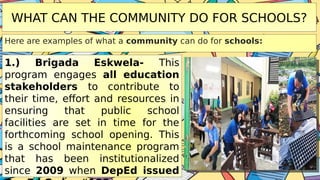
1.) Brigada Eskwela- This
program engages all education
stakeholders to contribute to
their time, effort and resources in
ensuring that public school
facilities are set in time for the
forthcoming school opening. This
is a school maintenance program
that has been institutionalized
since 2009 when DepEd issued
WHAT CAN THE COMMUNITY DO FOR SCHOOLS?
Here are examples of what a community can do for schools:
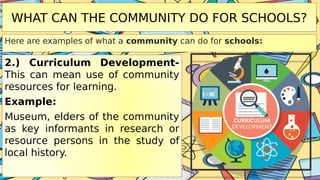
2.) Curriculum Development-
This can mean use of community
resources for learning.
Example:
Museum, elders of the community
as key informants in research or
resource persons in the study of
local history.
WHAT CAN THE COMMUNITY DO FOR SCHOOLS?
Here are examples of what a community can do for schools:
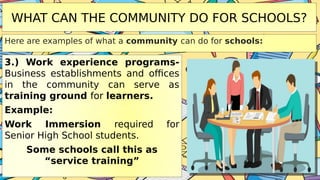
3.) Work experience programs-
Business establishments and offices
in the community can serve as
training ground for learners.
Example:
Work Immersion required for
Senior High School students.
Some schools call this as
“service training”
WHAT CAN THE COMMUNITY DO FOR SCHOOLS?
Here are examples of what a community can do for schools:
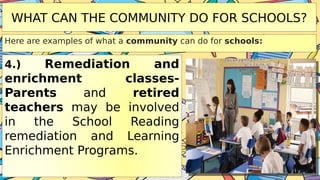
4.) Remediation and
enrichment classes-
Parents and retired
teachers may be involved
in the School Reading
remediation and Learning
Enrichment Programs.
WHAT CAN THE COMMUNITY DO FOR SCHOOLS?
Here are examples of what a community can do for schools:
5.) Youth Development
Programs- The young may
involve themselves in youth
development programs and
develop their skills and
talents, learn how to deal
positively with peers and adults
and as resources in the
communities.
WHAT CAN THE COMMUNITY DO FOR SCHOOLS?
Here are examples of what a community can do for schools:
6.) Community Service-
Examples of community service are
students participating in tutorial
programs, community reforestation
programs, clean up drive for a river,
assisting in medical mission; school
head involved in planning local
celebrations, teachers managing
programs, projects, activities; school
band playing in fiesta parade.
WHAT CAN SCHOOLS DO FOR
COMMUNITIES IN RETURN?
Schools may allow the community to use school
resources. Here are concrete examples by the DepEd
Primer on School-Community Partnership:
Classroom used by community organizations for
meetings.
School used as a polling place and venue for
medical mission which it may co-sponsor with the
Rural Health Unit.
School used by Rural Health Unit for mothers class
on child care.
WHAT CAN SCHOOLS DO FOR
COMMUNITIES IN RETURN?
Schools may allow the community to use school
resources. Here are concrete examples by the DepEd
Primer on School-Community Partnership:
School facilities used for community
assemblies.
School basketball court used for Local
celebrations and barangay sports league.
School conduct livelihood skills-training
programs for parents and out-of-schools youths
EXAMPLE:
ST. MARY’S COLLEGE QUEZON
CITY
LEARNING FROM THE EXPERIENCES
OF SCHOOL AND COMMUNITY
PARTNERS
EXAMPLE:
ST. MARY’S COLLEGE QUEZON
CITY
LEARNING FROM THE EXPERIENCES
OF SCHOOL AND COMMUNITY
PARTNERS
SOCIOLOGICAL BASIS OF SCHOOL-
COMMUNITY PARTNERSHIP?
• The functionalist theory states that institutions must
perform their respective functions for the stability of
society. Other institutions must come in, if one institution
fails to do the part for the sake of society.
• The school cannot do it all, “It takes a village to
educate a child”, It has to work in partnership with
other institutions in the community such as the church,
government organizations and non-government
organizations. With the breakdown of families, schools
face greater challenge in educating the young.
SOCIOLOGICAL BASIS OF SCHOOL-
COMMUNITY PARTNERSHIP?
• The school, the church and other social
institutions come in to assist parents and families to
fulfill their irreplaceable obligation.
• The negative effect of uncontrolled and
unregulated use of technology on the young.
While the use of technology has brought a lot of
convenience of its uncontrolled and unregulated use
by tech-savvy kids expose these kids to all sort of
information not necessarily favorable for their
LEGAL BASES FOR PARENTS AND
COMMUNITY INVOLVEMENT
• RA 9115,Governance of Basic Education Act,
Section E (10) explicitly that one of the responsibilities
of school heads is “establishing school and community
networks and encouraging the active participation
of teachers organizations, non-academic personnel
of public schools, and parent-teacher-community
associations.”
• Section 3 (f) of the same act encourages “local
initiatives for the improvements of school and
learning centers and to provide by means which
improvements may be achieved and sustained.”
LEGAL BASES FOR PARENTS AND
COMMUNITY INVOLVEMENT
• Batas Pambansa Blg. 232, also known as the
Education Act of 1982, Section 7.
• Another law, RA. 8525, Adopt A-School Program Act,
also provides for school-community partnership. It allows
“private entities to assist a public school, whether
elementary, secondary or tertiary in, but not limited to
the following areas: staff and faculty development for
training and further education; construction of facilities,
provision of books, publication and other instructional
materials; and modernization of instructional
technologies.”
LEGAL BASES FOR PARENTS AND
COMMUNITY INVOLVEMENT
• RA 9155, states that partnership between school and
community also ensures that:
1) Educational programs, projects and services take into
account the interests of all members of the
community (Sec 3, d);
2) The school and learning centers reflects the values of
the community by allowing teachers/learning
facilitators and other staff to have the flexibility to
serve the needs of all learners (Sec 3, e); and
LEGAL BASES FOR PARENTS AND
COMMUNITY INVOLVEMENT
3) Local initiatives for the improvement of school and
learning centers are encouraged and the means by
which these improvements may be achieved and
sustained are provided (Sec 3, f).
• So schools and communities function better when
they work as a team.
22
23

SCHOOL_COMMUNITY_PARTNERSHIP.pptx.pdf

  • 1.
    CHAPTER 6: THE WHYAND HOW OF SCHOOL AND COMMUNITY PARTNERSHIP 1
  • 2.
    • Explain whatschool and community partnership means. • Explain the legal and sociological bases of school and community partnership. • Examples of school-community partnerships. 2 OBJECTIVES:
  • 3.
  • 4.
    OPPORTUNITIES FOR SCHOOL-COMMUNITY PARTNERSHIP Partnership impliestwo parties helping each other. Both parties benefit. This means that if a school- community partnership exists, both parties benefit from the relationship.
  • 5.
  • 6.
    WHAT CAN THECOMMUNITY DO FOR SCHOOLS? Here are examples of what a community can do for schools: 1.) Brigada Eskwela- This program engages all education stakeholders to contribute to their time, effort and resources in ensuring that public school facilities are set in time for the forthcoming school opening. This is a school maintenance program that has been institutionalized since 2009 when DepEd issued
  • 7.
    WHAT CAN THECOMMUNITY DO FOR SCHOOLS? Here are examples of what a community can do for schools: 2.) Curriculum Development- This can mean use of community resources for learning. Example: Museum, elders of the community as key informants in research or resource persons in the study of local history.
  • 8.
    WHAT CAN THECOMMUNITY DO FOR SCHOOLS? Here are examples of what a community can do for schools: 3.) Work experience programs- Business establishments and offices in the community can serve as training ground for learners. Example: Work Immersion required for Senior High School students. Some schools call this as “service training”
  • 9.
    WHAT CAN THECOMMUNITY DO FOR SCHOOLS? Here are examples of what a community can do for schools: 4.) Remediation and enrichment classes- Parents and retired teachers may be involved in the School Reading remediation and Learning Enrichment Programs.
  • 10.
    WHAT CAN THECOMMUNITY DO FOR SCHOOLS? Here are examples of what a community can do for schools: 5.) Youth Development Programs- The young may involve themselves in youth development programs and develop their skills and talents, learn how to deal positively with peers and adults and as resources in the communities.
  • 11.
    WHAT CAN THECOMMUNITY DO FOR SCHOOLS? Here are examples of what a community can do for schools: 6.) Community Service- Examples of community service are students participating in tutorial programs, community reforestation programs, clean up drive for a river, assisting in medical mission; school head involved in planning local celebrations, teachers managing programs, projects, activities; school band playing in fiesta parade.
  • 12.
    WHAT CAN SCHOOLSDO FOR COMMUNITIES IN RETURN? Schools may allow the community to use school resources. Here are concrete examples by the DepEd Primer on School-Community Partnership: Classroom used by community organizations for meetings. School used as a polling place and venue for medical mission which it may co-sponsor with the Rural Health Unit. School used by Rural Health Unit for mothers class on child care.
  • 13.
    WHAT CAN SCHOOLSDO FOR COMMUNITIES IN RETURN? Schools may allow the community to use school resources. Here are concrete examples by the DepEd Primer on School-Community Partnership: School facilities used for community assemblies. School basketball court used for Local celebrations and barangay sports league. School conduct livelihood skills-training programs for parents and out-of-schools youths
  • 14.
    EXAMPLE: ST. MARY’S COLLEGEQUEZON CITY LEARNING FROM THE EXPERIENCES OF SCHOOL AND COMMUNITY PARTNERS
  • 15.
    EXAMPLE: ST. MARY’S COLLEGEQUEZON CITY LEARNING FROM THE EXPERIENCES OF SCHOOL AND COMMUNITY PARTNERS
  • 16.
    SOCIOLOGICAL BASIS OFSCHOOL- COMMUNITY PARTNERSHIP? • The functionalist theory states that institutions must perform their respective functions for the stability of society. Other institutions must come in, if one institution fails to do the part for the sake of society. • The school cannot do it all, “It takes a village to educate a child”, It has to work in partnership with other institutions in the community such as the church, government organizations and non-government organizations. With the breakdown of families, schools face greater challenge in educating the young.
  • 17.
    SOCIOLOGICAL BASIS OFSCHOOL- COMMUNITY PARTNERSHIP? • The school, the church and other social institutions come in to assist parents and families to fulfill their irreplaceable obligation. • The negative effect of uncontrolled and unregulated use of technology on the young. While the use of technology has brought a lot of convenience of its uncontrolled and unregulated use by tech-savvy kids expose these kids to all sort of information not necessarily favorable for their
  • 18.
    LEGAL BASES FORPARENTS AND COMMUNITY INVOLVEMENT • RA 9115,Governance of Basic Education Act, Section E (10) explicitly that one of the responsibilities of school heads is “establishing school and community networks and encouraging the active participation of teachers organizations, non-academic personnel of public schools, and parent-teacher-community associations.” • Section 3 (f) of the same act encourages “local initiatives for the improvements of school and learning centers and to provide by means which improvements may be achieved and sustained.”
  • 19.
    LEGAL BASES FORPARENTS AND COMMUNITY INVOLVEMENT • Batas Pambansa Blg. 232, also known as the Education Act of 1982, Section 7. • Another law, RA. 8525, Adopt A-School Program Act, also provides for school-community partnership. It allows “private entities to assist a public school, whether elementary, secondary or tertiary in, but not limited to the following areas: staff and faculty development for training and further education; construction of facilities, provision of books, publication and other instructional materials; and modernization of instructional technologies.”
  • 20.
    LEGAL BASES FORPARENTS AND COMMUNITY INVOLVEMENT • RA 9155, states that partnership between school and community also ensures that: 1) Educational programs, projects and services take into account the interests of all members of the community (Sec 3, d); 2) The school and learning centers reflects the values of the community by allowing teachers/learning facilitators and other staff to have the flexibility to serve the needs of all learners (Sec 3, e); and
  • 21.
    LEGAL BASES FORPARENTS AND COMMUNITY INVOLVEMENT 3) Local initiatives for the improvement of school and learning centers are encouraged and the means by which these improvements may be achieved and sustained are provided (Sec 3, f). • So schools and communities function better when they work as a team.
  • 22.
  • 23.