Disability
   and
Legislation


  Mrs E.A.Draffan
The
      Laws


http://www.flickr.com/photos/martinofranchi/2925760927/
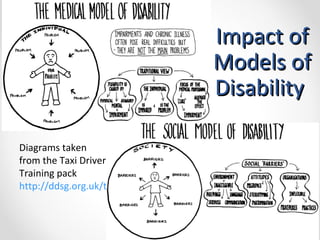
Impact of
                                             Models of
                                             Disability

Diagrams taken
from the Taxi Driver
Training pack
http://ddsg.org.uk/taxi/medical-model.html
One Act for all discrimination?


                   YouTube http://youtu.be/UuIdq_ftQY8
Easy to read?    Statistics
Over 10 million disabled people in Britain, of
whom 5 million are over state pension age.

Disability increases with age: 10% of adults 16-
24yrs are disabled,     33% between 50 - 65yrs are
disabled.

By 2020 58% of people over the age of 50 will have
a long term health condition.

The World Health Organisation predicts that
depression will be the leading cause of disability
by 2020.
How long
before some
of this group
   become
 disabled?
Definition of a disabled person?
“You’re disabled under the Equality Act 2010 if
you have a physical or mental impairment that
has a ‘substantial’ and ‘long-term’ negative
effect on your ability to do normal daily
activities.” https://
www.gov.uk/definition-of-disability-under-equality-act-201
(The Equality Act 2010 doesn’t apply to
Northern Ireland)


                    Useful logo?
Disability Rights
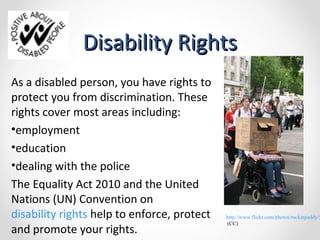
As a disabled person, you have rights to
protect you from discrimination. These
rights cover most areas including:
•employment
•education
•dealing with the police
The Equality Act 2010 and the United
Nations (UN) Convention on
disability rights help to enforce, protect   http://www.flickr.com/photos/rockinpaddy/5
                                              (CC)
and promote your rights.
Reasonable Adjustments?
• Sections 20 and 29(7) of the Equality Act create
  and elaborate a duty for service providers to
  make "reasonable adjustments" to enable
  disabled persons to access their services. Section
  20(6) says that with respect to services relating to
  the provision of information:
“the steps which it is reasonable for [an information
  service provider] to have to take include steps for
  ensuring that in the circumstances concerned the
  information is provided in an accessible format.”
http
   ://www.seqlegal.com/blog/website-accessibility-and-equality-act
Auxiliary aids and services to be
 included in pre-16 education
            provisions
 From 1st September 2012 schools and LEAs have
 a duty to provide an auxiliary aid or service
 where reasonable. Previously, the reasonable
 adjustment duty for auxiliary aids and services
 did not apply to the pre-16 education provisions.
It is not just about the Law –
 think about the Standards!


BSI Documentary - Web accessibility - World Standards Day 14
Oct 2010 http://youtu.be/awldEoQ-aNQ - BS 8878 : 2010
Improving Information for
      Disabled People
• Ensure that disabled people are involved from the
  start - Ensure your information meets users’ needs
• Provide information through a range of channels and
  formats - Clearly signpost other services
• Always define responsibility for information
  provision
THEN


                                 http://webaim.org/resources/designers/
Make sure it looks good!


               http://webaim.org/resources/designers/
Make sure customers can
reach your information!


              http://webaim.org/resources/designers/
Make interaction easy!


These last four graphics come thanks to WebAim and are
available in text format http://webaim.org/resources/designers/
Perceptions
“There is still a perception that disabled people are
incapable and uninterested in using ICT and therefore
there is no point in making it easy for them to use.
Hopefully one of the legacies of the paralympics is that
people with disabilities will now be seen as capable and
keen to do everything and no barrier
should be put in their way.”
Peter Abrahams
http://www.it-analysis.com/blogs/Abrahams_Accessibility/
2012/9/what_did_the_paralympics_teach_us_.html

http://www.flickr.com/photos/blackbeltjones/7939593048/
Thank you
• Resources
   o European http://www.eaccessplus.eu/
   o UK – Equality and Human Rights
     Commission
     http://www.equalityhumanrights.com/
   o Accessibility training links
     http://access.ecs.soton.ac.uk/blog/training/

Disability and Legislation

  • 1.
    Disability and Legislation Mrs E.A.Draffan
  • 2.
    The Laws http://www.flickr.com/photos/martinofranchi/2925760927/
  • 3.
    Impact of Models of Disability Diagrams taken from the Taxi Driver Training pack http://ddsg.org.uk/taxi/medical-model.html
  • 4.
    One Act forall discrimination? YouTube http://youtu.be/UuIdq_ftQY8
  • 5.
    Easy to read? Statistics Over 10 million disabled people in Britain, of whom 5 million are over state pension age. Disability increases with age: 10% of adults 16- 24yrs are disabled, 33% between 50 - 65yrs are disabled. By 2020 58% of people over the age of 50 will have a long term health condition. The World Health Organisation predicts that depression will be the leading cause of disability by 2020.
  • 6.
    How long before some ofthis group become disabled?
  • 7.
    Definition of adisabled person? “You’re disabled under the Equality Act 2010 if you have a physical or mental impairment that has a ‘substantial’ and ‘long-term’ negative effect on your ability to do normal daily activities.” https:// www.gov.uk/definition-of-disability-under-equality-act-201 (The Equality Act 2010 doesn’t apply to Northern Ireland) Useful logo?
  • 8.
    Disability Rights As adisabled person, you have rights to protect you from discrimination. These rights cover most areas including: •employment •education •dealing with the police The Equality Act 2010 and the United Nations (UN) Convention on disability rights help to enforce, protect http://www.flickr.com/photos/rockinpaddy/5 (CC) and promote your rights.
  • 9.
    Reasonable Adjustments? • Sections20 and 29(7) of the Equality Act create and elaborate a duty for service providers to make "reasonable adjustments" to enable disabled persons to access their services. Section 20(6) says that with respect to services relating to the provision of information: “the steps which it is reasonable for [an information service provider] to have to take include steps for ensuring that in the circumstances concerned the information is provided in an accessible format.” http ://www.seqlegal.com/blog/website-accessibility-and-equality-act
  • 10.
    Auxiliary aids andservices to be included in pre-16 education provisions From 1st September 2012 schools and LEAs have a duty to provide an auxiliary aid or service where reasonable. Previously, the reasonable adjustment duty for auxiliary aids and services did not apply to the pre-16 education provisions.
  • 11.
    It is notjust about the Law – think about the Standards! BSI Documentary - Web accessibility - World Standards Day 14 Oct 2010 http://youtu.be/awldEoQ-aNQ - BS 8878 : 2010
  • 12.
    Improving Information for Disabled People • Ensure that disabled people are involved from the start - Ensure your information meets users’ needs • Provide information through a range of channels and formats - Clearly signpost other services • Always define responsibility for information provision THEN http://webaim.org/resources/designers/
  • 13.
    Make sure itlooks good! http://webaim.org/resources/designers/
  • 14.
    Make sure customerscan reach your information! http://webaim.org/resources/designers/
  • 15.
    Make interaction easy! Theselast four graphics come thanks to WebAim and are available in text format http://webaim.org/resources/designers/
  • 16.
    Perceptions “There is stilla perception that disabled people are incapable and uninterested in using ICT and therefore there is no point in making it easy for them to use. Hopefully one of the legacies of the paralympics is that people with disabilities will now be seen as capable and keen to do everything and no barrier should be put in their way.” Peter Abrahams http://www.it-analysis.com/blogs/Abrahams_Accessibility/ 2012/9/what_did_the_paralympics_teach_us_.html http://www.flickr.com/photos/blackbeltjones/7939593048/
  • 17.
    Thank you • Resources o European http://www.eaccessplus.eu/ o UK – Equality and Human Rights Commission http://www.equalityhumanrights.com/ o Accessibility training links http://access.ecs.soton.ac.uk/blog/training/

Editor's Notes

  • #3 Acts of Parliament Equality Act (2010) Childcare Act (2006) Care Standards Act (2000) Data Protection Act (1998) Education Act (1996) Learning and Skills Act (2000) Children, Schools and Families Act (2010) The Copyright, Designs and Patents Act 1988 as amended (inter alia) by the Copyright (Visually Impaired Persons) Act 2002; The Human Rights Act (1998) Chronically Sick and Disabled Persons Act (1970) National Assistance Act 1948 Disabled Persons Act 1986 NHS and Community Act 1990
  • #5 YouTube http://youtu.be/UuIdq_ftQY8
  • #6 There are over 6.9 million disabled people of working age which represents 19% of the working population.[1] There are over 10 million disabled people in Britain, of whom 5 million are over state pension age.[2] There are two million people with sight problems in the UK.[3] [1] Disability Rights Commission, July 2008 [2] Family Resources Survey (FRS) Disability prevalence estimates 2007/8 [3] RNIB
  • #7 Age structure of UK 2013 – graph format. http://www.neighbourhood.statistics.gov.uk/HTMLDocs/dvc1/UKPyramid.html
  • #8 What ‘substantial’ and ‘long-term’ mean ‘ substantial’ is more than minor or trivial - eg it takes much longer than it usually would to complete a daily task like getting dressed ‘ long-term’ means 12 months or more - eg a breathing condition that develops as a result of a lung infection There are special rules about recurring or fluctuating conditions, for example, arthritis. For more details about the special rules download the ‘Equality Act Guidance’. Download ‘Equality Act Guidance’ (PDF, 789KB) Progressive conditions A progressive condition is a condition that gets worse over time. People with progressive conditions can be classed as disabled. However, you automatically meet the disability definition under the Equality Act 2010 from the day you’re diagnosed with HIV infection, cancer or multiple sclerosis. What isn’t counted as a disability Some conditions aren’t covered by the disability definition. These include addiction to non–prescribed drugs or alcohol. To find out about the conditions which aren’t covered, download the ‘Equality Act Guidance’. Download ‘Equality Act Guidance’ (PDF, 789KB)
  • #9 Can you ever treat a disabled person less favourably? The Equality Act 2010 recognises that in a limited number of circumstances it is not always possible to give disabled people exactly the same service as other people. Less favourable treatment may be possible if the service provider believes that one of the following circumstances applies; -Where the treatment is necessary in order to avoid endangering the health or safety of any person. -Where the disabled person is incapable of entering into a legally enforceable agreement or of giving informed consent. - If you would otherwise be unable to provide the service to the disabled person or other members of the public. -Where greater expense is involved in providing a special service for a disabled customer. -When an adjustment would fundamentally alter the nature of a business or service. Code of Practice on employment http://www.drc-gb.org/whatwedo/publicationdetails.asp?id=227&section=2&all=1 With grateful thanks to the DRC for the picture on this slide.
  • #10 The Disability Discrimination Act (DDA) does not apply specifically to education, but contains references to service provision, which could relate to making content accessible in learning environments. It states that: A service provider must not discriminate against a disabled person by refusing to provide that service if it is already provided to the public, or by making it impossible or unreasonably difficult for a disabled person to make use of any service. (Services covered by the Act include: access to and use of means of communication, or information services). Where a service provider has a practice, policy or procedure which makes it impossible or unreasonably difficult for a disabled person to make use of that service, reasonable steps should be taken in order to change that practice, policy or procedure so that it no longer has that effect. Reasonable steps should be taken to provide auxiliary aids, such as provision of information on an audio tape, or a sign language interpreter.
  • #11 The commencement order bringing the duty into force in September 2012 is SI 2012/2148.
  • #14 available in accessible format from http://webaim.org/resources/designers/
  • #15 available in accessible format from http://webaim.org/resources/designers/
  • #16 available in accessible format from http://webaim.org/resources/designers/