NEW SEED BILL
2004
V.SANDEEP VARMA
RAM- 11-42
A BILL
 to provide for regulating the quality of
seeds for sale, import and  export and to
facilitate production and supply of seeds
of quality and for matters connected
therewith or incidental thereto.                  
SEEDS ACT ----1966
SEED RULES ----1968
SEED (CONTROL) ORDER ----1983
DEFICIENCES OF THESE ACTS ARE :
Registration of seed variety not compulsory.
Non-notified varieties are not covered.
Commercial crops and plantation crops are not covered.
Certification only through State Seed Certification
agencies.
No provision for regulation of transgenic materials.
Penalties for infringement are very mild.
PRELIMINARY
1.Short title, extent, application and commencement.
2.Definitions
THE CENTRAL SEED COMMITTEE, REGISTRATION AND
OTHER SUB-COMMITTEES
3. Constitution of the Central Seed Committee
4. Composition of the Committee
5. Powers and functions of the Committee
6. Power of Committee to specify minimum limits of germination,
purity, seed health, etc.
7. Registration and other Sub-Committees of the Committee and
their functions
8. Procedure of the Committee and its Sub-Committees
9. Secretary and other officers of the Committee
10.Meetings of the Committee
11.State Seed Committee
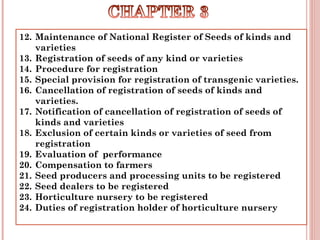
12. Maintenance of National Register of Seeds of kinds and
varieties
13. Registration of seeds of any kind or varieties
14. Procedure for registration
15. Special provision for registration of transgenic varieties.
16. Cancellation of registration of seeds of kinds and
varieties.
17. Notification of cancellation of registration of seeds of
kinds and varieties
18. Exclusion of certain kinds or varieties of seed from
registration
19. Evaluation of  performance
20. Compensation to farmers
21. Seed producers and processing units to be registered
22. Seed dealers to be registered
23. Horticulture nursery to be registered
24. Duties of registration holder of horticulture nursery
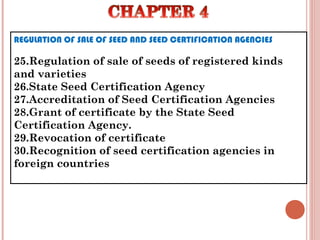
REGULATION OF SALE OF SEED AND SEED CERTIFICATION AGENCIES
25.Regulation of sale of seeds of registered kinds
and varieties
26.State Seed Certification Agency
27.Accreditation of Seed Certification Agencies
28.Grant of certificate by the State Seed
Certification Agency.
29.Revocation of certificate
30.Recognition of seed certification agencies in
foreign countries
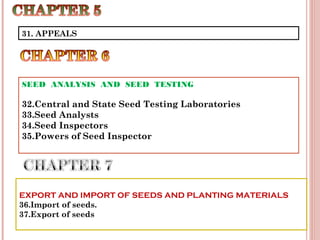
31. APPEALS
SEED  ANALYSIS  AND  SEED  TESTING
32.Central and State Seed Testing Laboratories
33.Seed Analysts
34.Seed Inspectors
35.Powers of Seed Inspector
EXPORT AND IMPORT OF SEEDS AND PLANTING MATERIALS
36.Import of seeds.
37.Export of seeds
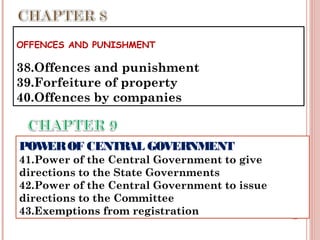
OFFENCES AND PUNISHMENT
38.Offences and punishment
39.Forfeiture of property
40.Offences by companies
POWEROF CENTRAL GOVERNMENT
41.Power of the Central Government to give
directions to the State Governments
42.Power of the Central Government to issue
directions to the Committee
43.Exemptions from registration
MISCELLANEOUS
44.Protection of action taken in good faith
45.Power to remove difficulties
46.Power of Central Government to make rules
47.Power of the Committee to make regulations
48.Rules and regulations to be laid before
Parliament
49.Repeal and savings
SHORT TITLE, EXTENT, APPLICATION AND COMMENCEMENT
(1) This Act may be called  the Seeds Act, 2004.
(2)        It extends to the whole of India .
(3)        This Act, shall apply to-
every dealer; and
every producer of seed except when the
seed is produced by him for his own use
and not for sale.
(4)        It shall come into force on such date as the
Central Government may, by notification, appoint.
Definitions.
(1)        “Agriculture" includes horticulture, forestry and cultivation of
plantation, medicinal and aromatic plants
(2)        “Central Seed Testing Laboratory” means the Central Seed Testing
Laboratory established or declared as such under sub-section (1) of section 32;
(3)        "Certification Agency" means an agency established under section 26
or accredited under section 27 or recognised under section 30;
(5)        “Committee” means the Central Seed Committee constituted under
sub-section (1) of section 3;
(6)        “Container” means a box, bottle, casket, tin, barrel, case, receptacle,
sack, bag, wrapper or other thing in which any article or thing is placed or
packed;
(7)        “Dealer” means a person who carries on the business of buying
and  selling,  exporting,  or importing seed, and includes an agent of a dealer;
(8)    “Export” means taking out of India by land, sea or air;
(9)   “Farmer” means any person who cultivates crops either by cultivating the
land himself or through any other person  but does not include any individual,
company, trader or dealer who engages in the procurement and sale of seeds
on a commercial basis;
(11)      “import" means bringing into India by land, sea or air;
(12)      “kind” means one or more related species or sub-species of crop plants
each individually or collectively known by one common name such as cabbage,
maize, paddy and wheat;
(13)    "notification" means a notification published in the Official Gazette;
(14)      “prescribed” means prescribed by rules made under this Act;
(15)      “producer” means a person, group of persons, firm or organisation who
grows or organizes the production of seeds;
(16)      “registered kind or variety”, in relation to any seed, means any kind, or
variety thereof, registered under section 13;
 (17) “misbranded” - A seed shall be deemed to be misbranded if-
(i)  it is a substitute for, or resembles in a manner likely to deceive, another
variety of seed under the name of which it is sold, and is not plainly and
conspicuously labeled so as to indicate its true nature;
(ii)  it is falsely stated to be the product of any place or country;
(iii) the package containing it, or the label on the package bears any statement,
design or device regarding the quality or the kind or variety of seed contained
therein, which is false or misleading in any material particular or if the package
is otherwise deceptive with respect to its contents;
(iv) it is not registered in the manner required by or under this Act;
(v) its label contains any reference to registration other than the registration
number;
(vi) its label does not contain a warning or caution which may be necessary, and
sufficient, if complied with, to protect human, animal and plant life and health
or to avoid serious prejudice to the environment;
 
(18)  “Registration Sub-Committee” means the Registration Sub-Committee
constituted under sub-section (1) of section 7;
(19)   “regulation” means  a regulation made by the Committee under this
Act;
(20)      “seed” means any type of living embryo or propagule capable of
regeneration and giving rise to a plant of agriculture which is true to such
type;
(21)     "Seed Analyst" means a Seed Analyst appointed under section 33;
(22)      "Seed Inspector" means a Seed Inspector appointed under section
34;
(23)    “seed processing” means the process by which seeds and planting
materials are dried, threshed, shelled, ginned or delinted (in cotton),
cleaned, graded or treated;
(24)    “spurious seed” means any seed which is not genuine or true to type;
(25)      “State Government” ,in relation to a Union territory, means
the  administrator thereof;
(26)      “State Seed Testing Laboratory”, in relation to any State, means the
State Seed Laboratory established or declared as such under sub-section (2)
of section 32 for that State;
THE CENTRAL SEED COMMITTEE, REGISTRATION AND  
OTHER SUB-COMMITTEES
Constitution of Central Seed Committee.
 (1)    The Central Government shall, by notification, constitute, for the
purpose of this Act, a Committee to be called the Central Seed Committee.
Composition of the Committee.
4.(1)    The Committee shall consist of a Chairperson, members, ex-officio and
other members, to be nominated by the Central Government.
(2)        The Secretary to the Government of India in the Department of
Agriculture and Co-operation, Ministry of Agriculture, shall be
Chairperson, ex officio.
A person shall be disqualified for being nominated or appointed as a member if
he-
(i)         has been convicted and sentenced to imprisonment for an offence
which, in the opinion of the Central Government, involves moral turpitude; or
(ii)        is  an undischarged insolvent; or
(iii)       is of unsound mind and stands so declared by a competent court.
Powers and functions of the Committee.
 
(a)        seed programming and planning;
(b)        seed development and production;
(c)        export and import of seeds;
(d)        standards for registration, certification and seed testing;
(e)        seed registration and its enforcement;
(f)         such other matters as may be specified by the Central      Government.
Powers of Committee to specify minimum limits of germination,
purity, seed health, etc.
  The Committee may, by notification, specify–
(a)       the minimum limits of germination, genetic and physical purity, and
seed health, with respect to any seed of any kind of variety;
(b)   the mark or label to indicate that such seed conforms to the minimum
limits of germination, genetic and physical purity, and seed health specified
under clause (a), and other particulars, such as expected performance of the
seed in accordance with the information provided by the producer under section
14 which such mark or label may contain.
Registration and other Sub-Committees of the Committee and their
functions.
(1)   The Committee shall constitute a Sub-Committee to be called the
Registration Sub-Committee consisting of a Chairman and such number of
other members, to assist him in the discharge of the functions of the
Committee, as may be prescribed.
(2)   It shall be the duty of the Registration Sub-Committee-
(a)   to register seeds of varieties after scrutinizing their claims as
made in the application in such manner as may be prescribed;
(b)   to perform such other functions as are assigned to it by the
Committee.
Procedure of the Committee and its Sub-Committees.
  The Committee may, subject to the previous approval of the Central
Government, make regulations for the purpose of regulating its own
procedure and the procedure of any Sub-Committee thereof.
Secretary and other officers of the Committee.
9.   The Central Government shall –
(a)       appoint a person to be the Secretary of the Committee; and
(b)   provide the Committee with such technical and other officers and
employees as may be necessary for the efficient performance
Meetings of the Committee.
10. (1) The Committee shall meet as and when necessary at such time
and place and shall observe such procedure in regard to transaction of
business at its meetings (including the quorum at meetings) as may be
provided by regulations.
(2)        The Chairperson or, in his absence, the Agricultural
Commissioner or, in the absence of both the Chairperson and the
Agriculture Commissioner, any member chosen by the members present
from amongst themselves, shall preside at a meeting of the Committee.
State Seed Committee.
11.   Every State Government shall establish a State Seed Committee to –
(a)   advise the Committee on registration of regional or local seeds of any
kind or variety;
(b)   advise the State Government on registration of seed producing units,
seed processing units, seed dealers and horticulture nurseries;
(c)   maintain, in each district, a list of seed dealers, seed producers, seed
processing units and horticulture nurseries;
(d)        seek information from persons engaged in the production, supply,
distribution, trade or commerce in seeds of any kind or variety regarding
stocks, prices, sales and other information in the manner as may be
prescribed;
(e)        advise the State Government and the Committee on all matters
arising out of the administration and implementation of this Act; and
(f)         carry out  other functions assigned to, by, or under this Act.
REGISTRATION OF KINDS AND VARIETIES OF SEEDS, ETC
Maintenance of National Register of Seeds of kinds and varieties
 For the purposes of this Act, a register of all kinds and varieties of seed to
be called the National Register of Seeds  shall be kept by the Registration
Sub-Committee wherein all specifications, as may be prescribed, shall be
maintained.
Registration of seeds of any kind or varieties
Procedure for registration
Special provision for registration of transgenic varieties
Cancellation of registration of seeds of kinds and varieties
Notification of cancellation of registration of seeds of kinds and
varieties
Exclusion of certain kinds or varieties of seed from registration.
(1 ) If prevention of commercial exploitation of such kind or variety is
necessary to protect public order or public morality or human, animal or
plant life and health, or to avoid serious prejudice to the environment.
 (2)  A kind or variety of seed containing any technology, which is harmful, or
potentially harmful, shall not be registered.
Evaluation of  performance
The Committee may, for conducting trials to assess performance, accredit
centers of the Indian Council of Agricultural Research, State Agricultural
Universities and such other organizations fulfilling the eligibility
requirements as may be prescribed, to conduct trials to evaluate the
performance of any kind or variety of seed.
Compensation to farmers
Seed producers and processing units to be registered
No producer shall grow or organize the production of seed unless he is
registered as such by the State Government under this Act.
 
(2)        No person shall  maintain  a seed processing unit  unless such unit
is  registered by the State Government under this Act.
Regulation of sale of seeds of registered kinds and varieties.
 No person shall himself, or by any other person on his behalf, carry on the
business of selling, keeping for sale, offering to sell, import or export or
otherwise supply any kind of seed of any registered kind or variety unless-
(a)                such seed is identifiable as to its kind or variety;
(b)               such seed conforms to the minimum limit of germination and
genetic, physical purity, seed health specified under clause (a) of section 6;
(c)                the container of such seed bears in the prescribed manner, the
mark or label bearing the correct particulars thereof, specified under clause
(b) of section 6;
(d)               the container of such seed, in the case of transgenic varieties,
bears a declaration to this effect as specified in sub-clause (2) of section 15;
(e)                he complies with such other requirements as may be prescribed.
State Seed Certification Agency.
Accreditation of seed certification agencies.
27. (1)    The Committee may in consultation with the State Government
and the State Seed Committee, accredit –
(a)      organizations to carry out  certification, on the fulfillment of such
criteria, as may be prescribed, or
(b)     individuals or seed producing organisations to carry out self-
certification, in such manner as may be prescribed.
(2)        The accredited individuals and seed producing organisations
shall be subject to such inspection and control of the Committee, the
concerned State Government and State Seed Certification Agency, as
may be prescribed.
(3)        The accreditation may be withdrawn by the Committee, for
reasons to be recorded in writing and after giving to the concerned
organization or individual, as the case may be, a reasonable opportunity
of being heard.
Grant of certificate by the State Seed Certification Agency.
    Any person selling, keeping for sale, offering to sell, bartering or
otherwise supplying any seed of any registered kind or variety may, if he
desires to have such seed certified by the State Seed Certification Agency,
apply to that Agency for the grant of a certificate for the purpose.
  Revocation of certificate.
     If the State Seed Certification Agency is satisfied, either on a reference
made to it in this behalf or otherwise, that-     
(a)  the certificate granted by it under section 28  has been obtained
by misrepresentation as to an essential fact; or
(b) the holder of the  certificate has, without reasonable cause, failed
to comply with the conditions subject to which the certificate has been
granted then, without prejudice to any other penalty to which the holder of
the certificate may be liable under this Act, the State Seed Certification
Agency may, after giving the holder of the certificate an opportunity of
showing cause, revoke the certificate.
Recognition of seed certification agencies in foreign countries.
    The Central Government may, on the recommendation of the Committee
and by notification, recognise any seed certification agency established in any
foreign country, for the purposes of this Act.
APPEALS
(1)   Any person aggrieved by a decision of the Registration Sub-Committee
under section 14, 16,27,28 OR 29 may, within thirty days from the date on
which the decision is communicated to him prefer an appeal to such authority
(hereinafter referred to as the appellate authority)  as the Central Government
may think fit to constitute:
            Provided that the appellate authority may entertain an appeal after the
expiry of the said period of thirty days if it is satisfied that the appellant was
prevented by sufficient cause from filing the appeal in time.
(2) The form and manner in which an appeal may be preferred under sub-
section (1), the fee payable for such appeal and the procedure to be followed by
the appellate authority shall be such as may be prescribed.
(3) On receipt of an appeal preferred under sub-section (1), the appellate
authority shall, after giving the appellant and the other party an opportunity of
being heard, dispose of the appeal as expeditiously as possible.
Central  and State Seed Testing Laboratories.
       Every Seed Testing Laboratory referred to in sub-section (1) shall have
as many Seed Analysts as the Central and state Government may consider
necessary.
Seed Analysts.
  In case of the Central Seed Laboratory, the Central Government and in
other cases the State Government may, by notification, appoint such persons
as the Government thinks  fit and having the prescribed qualifications to be
Seed Analysts and define the local limits of their jurisdiction.
Seed Inspectors.
  The State Government may, by notification, appoint such persons as it
thinks fit, having the prescribed qualifications, to be Seed Inspectors and
define the areas within which they shall exercise jurisdiction.
   Every Seed Inspector shall be subordinate to such authority as the State
Government may specify in this behalf.
Powers of Seed Inspectors.
(1)   The Seed Inspector may-
(a) take samples of any seed of any  kind or variety from-
(i)  any person selling such seed; or
(ii) any person who is in the course of conveying, delivering or preparing
to deliver such seed to a purchaser or a consignee; or
(iii) a purchaser or a consignee after delivery of such seed to him;
(b) send such sample for analysis to the Seed Analyst of the area within which
such sample has been taken;
       
(c)  examine any record, register, document or any other material object found
(2)        The power conferred by this section includes the power to break-open any
container in which any seed of any  kind or variety may be contained or
to break-open the door of any premises where any such seed may be kept for
sale:
           
(3)        Where the Seed Inspector takes any action under clause (a) of sub-section
(1), he shall, as far as possible, call not less than two persons to be
present at the time when such action is taken and take their signatures on a
memorandum to be prepared in such form and manner as may be prescribed.
Import of seeds.
36. (1)All import of seeds –
(a)shall be subject to the provisions of the Plants, Fruits and Seeds
(Regulation of Import into India) Order, 1989, or any corresponding order
made under section 3 of the Destructive Insects and Pests Act, 1914;
(b) shall  conform to minimum limits of germination, genetic and
physical purity, and seed health as prescribed under section 6; and
(2) The Central Government may, by notification, permit to import an
unregistered variety in such quantity and subject to fulfilling such
conditions as may be specified in that notification for research purposes.
Export of seeds.
37.   The Central Government may, on the advice of the Committee,
restrict, by notification, the export of seeds of any  kind or variety if it is
deemed that such export may adversely affect the food security of the
country, or if it is felt that the reasonable requirements of the public will
not be met, or on such other grounds as may be prescribed. 
Offences and punishment.
 
 (1)   If any person –
(a) contravenes any provision of this Act or any rule made thereunder;
(b)imports, sells, stocks or exhibits for sale or barter; and or otherwise
supplies any seed of any kind or variety deemed to be misbranded ; or
(c)imports, sells, stocks or exhibits for sale ,supplies any seed of any
kind or variety without a certificate of registration
he shall, on conviction, be punishable – with fine which shall not be less
than five thousand rupees but which may extend to twenty five thousand rupees.
(2)        If any person sells any seed which does not conform to the standards of
physical purity, germination or health or does not maintain any records required
to be maintained under this Act or the rules made thereunder he shall, on
conviction, be punishable with fine which shall not be less than five thousand
rupees but which may extend to twenty- five thousand rupees
Forfeiture of property.
39.       When any person has been convicted under this Act for the contravention
of any of the provisions of this Act or the rules made thereunder, the seed in
respect of which the contravention has been committed shall be forfeited to the
Central Government.
Offences by companies.
40.(1)  Where an offence under this Act has been committed by a
company, every person who at the time the offence was committed was in
charge of, and was responsible to the company for the conduct of the
business of the company, as well as the company, shall be deemed to be
guilty of the offence and shall be liable to be proceeded against and
punished accordingly:
         
(2)   Not withstanding anything contained in sub-section (1), where an
offence under this Act has been committed by a company and it is proved
that the offence has been committed with the consent or connivance of, or
is attributable to any neglect on the part of, any director, manager,
secretary or other officer of the company, such director, manager,
secretary or other officer shall also be deemed to be guilty of that offence
and shall be liable to be proceeded against and punished accordingly.
Explanation. – For the purpose of this section,-
(a)  “company” means any body corporate and includes a firm or other
association of individuals; and
(b)   “director”, in relation to a firm, means a partner in the firm.
Power of Central Government to give directions to the State Governments.
Power of Central Government to issue directions to the Committee.
 The decision of the Central Government whether a question is one of policy or not
shall be final.
Exemption from registration
Nothing in this Act shall restrict the right of the farmer to save, use, exchange,
share or sell his farm seeds and planting material, except that he shall not sell such
seed or planting material under a brand name or which does not conform to the
minimum limit of germination, physical purity, genetic purity prescribed under
clause (a) or clause (b) of section 6.
The Central Government may, by notification, and subject to conditions, if any, as it
may specify therein, exempt from all or any of the provisions of this Act or the rules
made thereunder, any educational, scientific or research or extension organization.
Protection of action taken in good faith
Power to remove difficulties
Power of Central Government to make rules
Power of the Committee to make regulations
Rules and regulations to be laid before Parliament
Repeal and savings
Ignorance of these legislations will create impediments in
addressing the seed related litigations. As the seed prices
increase through the greater use of certified seed that
has been bought in rather than farm saved , there will be
a need to increase the statutory efficiency with an
acceptable standards to ensure availability of quality
seed to the farmer in time and in requisite quantity.
NEW SEEDD BILL 2004

NEW SEEDD BILL 2004

  • 2.
  • 3.
    A BILL  to providefor regulating the quality of seeds for sale, import and  export and to facilitate production and supply of seeds of quality and for matters connected therewith or incidental thereto.                  
  • 4.
    SEEDS ACT ----1966 SEEDRULES ----1968 SEED (CONTROL) ORDER ----1983 DEFICIENCES OF THESE ACTS ARE : Registration of seed variety not compulsory. Non-notified varieties are not covered. Commercial crops and plantation crops are not covered. Certification only through State Seed Certification agencies. No provision for regulation of transgenic materials. Penalties for infringement are very mild.
  • 5.
    PRELIMINARY 1.Short title, extent,application and commencement. 2.Definitions THE CENTRAL SEED COMMITTEE, REGISTRATION AND OTHER SUB-COMMITTEES 3. Constitution of the Central Seed Committee 4. Composition of the Committee 5. Powers and functions of the Committee 6. Power of Committee to specify minimum limits of germination, purity, seed health, etc. 7. Registration and other Sub-Committees of the Committee and their functions 8. Procedure of the Committee and its Sub-Committees 9. Secretary and other officers of the Committee 10.Meetings of the Committee 11.State Seed Committee
  • 6.
    12. Maintenance ofNational Register of Seeds of kinds and varieties 13. Registration of seeds of any kind or varieties 14. Procedure for registration 15. Special provision for registration of transgenic varieties. 16. Cancellation of registration of seeds of kinds and varieties. 17. Notification of cancellation of registration of seeds of kinds and varieties 18. Exclusion of certain kinds or varieties of seed from registration 19. Evaluation of  performance 20. Compensation to farmers 21. Seed producers and processing units to be registered 22. Seed dealers to be registered 23. Horticulture nursery to be registered 24. Duties of registration holder of horticulture nursery
  • 7.
    REGULATION OF SALEOF SEED AND SEED CERTIFICATION AGENCIES 25.Regulation of sale of seeds of registered kinds and varieties 26.State Seed Certification Agency 27.Accreditation of Seed Certification Agencies 28.Grant of certificate by the State Seed Certification Agency. 29.Revocation of certificate 30.Recognition of seed certification agencies in foreign countries
  • 8.
    31. APPEALS SEED  ANALYSIS  AND  SEED  TESTING 32.Central andState Seed Testing Laboratories 33.Seed Analysts 34.Seed Inspectors 35.Powers of Seed Inspector EXPORT AND IMPORT OF SEEDS AND PLANTING MATERIALS 36.Import of seeds. 37.Export of seeds
  • 9.
    OFFENCES AND PUNISHMENT 38.Offencesand punishment 39.Forfeiture of property 40.Offences by companies POWEROF CENTRAL GOVERNMENT 41.Power of the Central Government to give directions to the State Governments 42.Power of the Central Government to issue directions to the Committee 43.Exemptions from registration
  • 10.
    MISCELLANEOUS 44.Protection of actiontaken in good faith 45.Power to remove difficulties 46.Power of Central Government to make rules 47.Power of the Committee to make regulations 48.Rules and regulations to be laid before Parliament 49.Repeal and savings
  • 11.
    SHORT TITLE, EXTENT,APPLICATION AND COMMENCEMENT (1) This Act may be called  the Seeds Act, 2004. (2)        It extends to the whole of India . (3)        This Act, shall apply to- every dealer; and every producer of seed except when the seed is produced by him for his own use and not for sale. (4)        It shall come into force on such date as the Central Government may, by notification, appoint.
  • 12.
    Definitions. (1)        “Agriculture" includes horticulture,forestry and cultivation of plantation, medicinal and aromatic plants (2)        “Central Seed Testing Laboratory” means the Central Seed Testing Laboratory established or declared as such under sub-section (1) of section 32; (3)        "Certification Agency" means an agency established under section 26 or accredited under section 27 or recognised under section 30; (5)        “Committee” means the Central Seed Committee constituted under sub-section (1) of section 3; (6)        “Container” means a box, bottle, casket, tin, barrel, case, receptacle, sack, bag, wrapper or other thing in which any article or thing is placed or packed; (7)        “Dealer” means a person who carries on the business of buying and  selling,  exporting,  or importing seed, and includes an agent of a dealer; (8)    “Export” means taking out of India by land, sea or air;
  • 13.
    (9)   “Farmer” means anyperson who cultivates crops either by cultivating the land himself or through any other person  but does not include any individual, company, trader or dealer who engages in the procurement and sale of seeds on a commercial basis; (11)      “import" means bringing into India by land, sea or air; (12)      “kind” means one or more related species or sub-species of crop plants each individually or collectively known by one common name such as cabbage, maize, paddy and wheat; (13)    "notification" means a notification published in the Official Gazette; (14)      “prescribed” means prescribed by rules made under this Act; (15)      “producer” means a person, group of persons, firm or organisation who grows or organizes the production of seeds; (16)      “registered kind or variety”, in relation to any seed, means any kind, or variety thereof, registered under section 13;
  • 14.
     (17) “misbranded” - Aseed shall be deemed to be misbranded if- (i)  it is a substitute for, or resembles in a manner likely to deceive, another variety of seed under the name of which it is sold, and is not plainly and conspicuously labeled so as to indicate its true nature; (ii)  it is falsely stated to be the product of any place or country; (iii) the package containing it, or the label on the package bears any statement, design or device regarding the quality or the kind or variety of seed contained therein, which is false or misleading in any material particular or if the package is otherwise deceptive with respect to its contents; (iv) it is not registered in the manner required by or under this Act; (v) its label contains any reference to registration other than the registration number; (vi) its label does not contain a warning or caution which may be necessary, and sufficient, if complied with, to protect human, animal and plant life and health or to avoid serious prejudice to the environment;
  • 15.
      (18)  “Registration Sub-Committee” meansthe Registration Sub-Committee constituted under sub-section (1) of section 7; (19)   “regulation” means  a regulation made by the Committee under this Act; (20)      “seed” means any type of living embryo or propagule capable of regeneration and giving rise to a plant of agriculture which is true to such type; (21)     "Seed Analyst" means a Seed Analyst appointed under section 33; (22)      "Seed Inspector" means a Seed Inspector appointed under section 34; (23)    “seed processing” means the process by which seeds and planting materials are dried, threshed, shelled, ginned or delinted (in cotton), cleaned, graded or treated; (24)    “spurious seed” means any seed which is not genuine or true to type; (25)      “State Government” ,in relation to a Union territory, means the  administrator thereof; (26)      “State Seed Testing Laboratory”, in relation to any State, means the State Seed Laboratory established or declared as such under sub-section (2) of section 32 for that State;
  • 16.
    THE CENTRAL SEEDCOMMITTEE, REGISTRATION AND   OTHER SUB-COMMITTEES Constitution of Central Seed Committee.  (1)    The Central Government shall, by notification, constitute, for the purpose of this Act, a Committee to be called the Central Seed Committee. Composition of the Committee. 4.(1)    The Committee shall consist of a Chairperson, members, ex-officio and other members, to be nominated by the Central Government. (2)        The Secretary to the Government of India in the Department of Agriculture and Co-operation, Ministry of Agriculture, shall be Chairperson, ex officio. A person shall be disqualified for being nominated or appointed as a member if he- (i)         has been convicted and sentenced to imprisonment for an offence which, in the opinion of the Central Government, involves moral turpitude; or (ii)        is  an undischarged insolvent; or (iii)       is of unsound mind and stands so declared by a competent court.
  • 17.
    Powers and functionsof the Committee.   (a)        seed programming and planning; (b)        seed development and production; (c)        export and import of seeds; (d)        standards for registration, certification and seed testing; (e)        seed registration and its enforcement; (f)         such other matters as may be specified by the Central      Government. Powers of Committee to specify minimum limits of germination, purity, seed health, etc.   The Committee may, by notification, specify– (a)       the minimum limits of germination, genetic and physical purity, and seed health, with respect to any seed of any kind of variety; (b)   the mark or label to indicate that such seed conforms to the minimum limits of germination, genetic and physical purity, and seed health specified under clause (a), and other particulars, such as expected performance of the seed in accordance with the information provided by the producer under section 14 which such mark or label may contain.
  • 18.
    Registration and otherSub-Committees of the Committee and their functions. (1)   The Committee shall constitute a Sub-Committee to be called the Registration Sub-Committee consisting of a Chairman and such number of other members, to assist him in the discharge of the functions of the Committee, as may be prescribed. (2)   It shall be the duty of the Registration Sub-Committee- (a)   to register seeds of varieties after scrutinizing their claims as made in the application in such manner as may be prescribed; (b)   to perform such other functions as are assigned to it by the Committee. Procedure of the Committee and its Sub-Committees.   The Committee may, subject to the previous approval of the Central Government, make regulations for the purpose of regulating its own procedure and the procedure of any Sub-Committee thereof.
  • 19.
    Secretary and otherofficers of the Committee. 9.   The Central Government shall – (a)       appoint a person to be the Secretary of the Committee; and (b)   provide the Committee with such technical and other officers and employees as may be necessary for the efficient performance Meetings of the Committee. 10. (1) The Committee shall meet as and when necessary at such time and place and shall observe such procedure in regard to transaction of business at its meetings (including the quorum at meetings) as may be provided by regulations. (2)        The Chairperson or, in his absence, the Agricultural Commissioner or, in the absence of both the Chairperson and the Agriculture Commissioner, any member chosen by the members present from amongst themselves, shall preside at a meeting of the Committee.
  • 20.
    State Seed Committee. 11.   EveryState Government shall establish a State Seed Committee to – (a)   advise the Committee on registration of regional or local seeds of any kind or variety; (b)   advise the State Government on registration of seed producing units, seed processing units, seed dealers and horticulture nurseries; (c)   maintain, in each district, a list of seed dealers, seed producers, seed processing units and horticulture nurseries; (d)        seek information from persons engaged in the production, supply, distribution, trade or commerce in seeds of any kind or variety regarding stocks, prices, sales and other information in the manner as may be prescribed; (e)        advise the State Government and the Committee on all matters arising out of the administration and implementation of this Act; and (f)         carry out  other functions assigned to, by, or under this Act.
  • 21.
    REGISTRATION OF KINDSAND VARIETIES OF SEEDS, ETC Maintenance of National Register of Seeds of kinds and varieties  For the purposes of this Act, a register of all kinds and varieties of seed to be called the National Register of Seeds  shall be kept by the Registration Sub-Committee wherein all specifications, as may be prescribed, shall be maintained. Registration of seeds of any kind or varieties Procedure for registration Special provision for registration of transgenic varieties Cancellation of registration of seeds of kinds and varieties Notification of cancellation of registration of seeds of kinds and varieties
  • 22.
    Exclusion of certainkinds or varieties of seed from registration. (1 ) If prevention of commercial exploitation of such kind or variety is necessary to protect public order or public morality or human, animal or plant life and health, or to avoid serious prejudice to the environment.  (2)  A kind or variety of seed containing any technology, which is harmful, or potentially harmful, shall not be registered. Evaluation of  performance The Committee may, for conducting trials to assess performance, accredit centers of the Indian Council of Agricultural Research, State Agricultural Universities and such other organizations fulfilling the eligibility requirements as may be prescribed, to conduct trials to evaluate the performance of any kind or variety of seed. Compensation to farmers Seed producers and processing units to be registered No producer shall grow or organize the production of seed unless he is registered as such by the State Government under this Act.   (2)        No person shall  maintain  a seed processing unit  unless such unit is  registered by the State Government under this Act.
  • 23.
    Regulation of saleof seeds of registered kinds and varieties.  No person shall himself, or by any other person on his behalf, carry on the business of selling, keeping for sale, offering to sell, import or export or otherwise supply any kind of seed of any registered kind or variety unless- (a)                such seed is identifiable as to its kind or variety; (b)               such seed conforms to the minimum limit of germination and genetic, physical purity, seed health specified under clause (a) of section 6; (c)                the container of such seed bears in the prescribed manner, the mark or label bearing the correct particulars thereof, specified under clause (b) of section 6; (d)               the container of such seed, in the case of transgenic varieties, bears a declaration to this effect as specified in sub-clause (2) of section 15; (e)                he complies with such other requirements as may be prescribed. State Seed Certification Agency.
  • 24.
    Accreditation of seedcertification agencies. 27. (1)    The Committee may in consultation with the State Government and the State Seed Committee, accredit – (a)      organizations to carry out  certification, on the fulfillment of such criteria, as may be prescribed, or (b)     individuals or seed producing organisations to carry out self- certification, in such manner as may be prescribed. (2)        The accredited individuals and seed producing organisations shall be subject to such inspection and control of the Committee, the concerned State Government and State Seed Certification Agency, as may be prescribed. (3)        The accreditation may be withdrawn by the Committee, for reasons to be recorded in writing and after giving to the concerned organization or individual, as the case may be, a reasonable opportunity of being heard.
  • 25.
    Grant of certificateby the State Seed Certification Agency.     Any person selling, keeping for sale, offering to sell, bartering or otherwise supplying any seed of any registered kind or variety may, if he desires to have such seed certified by the State Seed Certification Agency, apply to that Agency for the grant of a certificate for the purpose.   Revocation of certificate.      If the State Seed Certification Agency is satisfied, either on a reference made to it in this behalf or otherwise, that-      (a)  the certificate granted by it under section 28  has been obtained by misrepresentation as to an essential fact; or (b) the holder of the  certificate has, without reasonable cause, failed to comply with the conditions subject to which the certificate has been granted then, without prejudice to any other penalty to which the holder of the certificate may be liable under this Act, the State Seed Certification Agency may, after giving the holder of the certificate an opportunity of showing cause, revoke the certificate. Recognition of seed certification agencies in foreign countries.     The Central Government may, on the recommendation of the Committee and by notification, recognise any seed certification agency established in any foreign country, for the purposes of this Act.
  • 26.
    APPEALS (1)   Any person aggrievedby a decision of the Registration Sub-Committee under section 14, 16,27,28 OR 29 may, within thirty days from the date on which the decision is communicated to him prefer an appeal to such authority (hereinafter referred to as the appellate authority)  as the Central Government may think fit to constitute:             Provided that the appellate authority may entertain an appeal after the expiry of the said period of thirty days if it is satisfied that the appellant was prevented by sufficient cause from filing the appeal in time. (2) The form and manner in which an appeal may be preferred under sub- section (1), the fee payable for such appeal and the procedure to be followed by the appellate authority shall be such as may be prescribed. (3) On receipt of an appeal preferred under sub-section (1), the appellate authority shall, after giving the appellant and the other party an opportunity of being heard, dispose of the appeal as expeditiously as possible.
  • 27.
    Central  and State SeedTesting Laboratories.        Every Seed Testing Laboratory referred to in sub-section (1) shall have as many Seed Analysts as the Central and state Government may consider necessary. Seed Analysts.   In case of the Central Seed Laboratory, the Central Government and in other cases the State Government may, by notification, appoint such persons as the Government thinks  fit and having the prescribed qualifications to be Seed Analysts and define the local limits of their jurisdiction. Seed Inspectors.   The State Government may, by notification, appoint such persons as it thinks fit, having the prescribed qualifications, to be Seed Inspectors and define the areas within which they shall exercise jurisdiction.    Every Seed Inspector shall be subordinate to such authority as the State Government may specify in this behalf.
  • 28.
    Powers of SeedInspectors. (1)   The Seed Inspector may- (a) take samples of any seed of any  kind or variety from- (i)  any person selling such seed; or (ii) any person who is in the course of conveying, delivering or preparing to deliver such seed to a purchaser or a consignee; or (iii) a purchaser or a consignee after delivery of such seed to him; (b) send such sample for analysis to the Seed Analyst of the area within which such sample has been taken;         (c)  examine any record, register, document or any other material object found (2)        The power conferred by this section includes the power to break-open any container in which any seed of any  kind or variety may be contained or to break-open the door of any premises where any such seed may be kept for sale:             (3)        Where the Seed Inspector takes any action under clause (a) of sub-section (1), he shall, as far as possible, call not less than two persons to be present at the time when such action is taken and take their signatures on a memorandum to be prepared in such form and manner as may be prescribed.
  • 29.
    Import of seeds. 36. (1)Allimport of seeds – (a)shall be subject to the provisions of the Plants, Fruits and Seeds (Regulation of Import into India) Order, 1989, or any corresponding order made under section 3 of the Destructive Insects and Pests Act, 1914; (b) shall  conform to minimum limits of germination, genetic and physical purity, and seed health as prescribed under section 6; and (2) The Central Government may, by notification, permit to import an unregistered variety in such quantity and subject to fulfilling such conditions as may be specified in that notification for research purposes. Export of seeds. 37.   The Central Government may, on the advice of the Committee, restrict, by notification, the export of seeds of any  kind or variety if it is deemed that such export may adversely affect the food security of the country, or if it is felt that the reasonable requirements of the public will not be met, or on such other grounds as may be prescribed. 
  • 30.
    Offences and punishment.    (1)   Ifany person – (a) contravenes any provision of this Act or any rule made thereunder; (b)imports, sells, stocks or exhibits for sale or barter; and or otherwise supplies any seed of any kind or variety deemed to be misbranded ; or (c)imports, sells, stocks or exhibits for sale ,supplies any seed of any kind or variety without a certificate of registration he shall, on conviction, be punishable – with fine which shall not be less than five thousand rupees but which may extend to twenty five thousand rupees. (2)        If any person sells any seed which does not conform to the standards of physical purity, germination or health or does not maintain any records required to be maintained under this Act or the rules made thereunder he shall, on conviction, be punishable with fine which shall not be less than five thousand rupees but which may extend to twenty- five thousand rupees Forfeiture of property. 39.       When any person has been convicted under this Act for the contravention of any of the provisions of this Act or the rules made thereunder, the seed in respect of which the contravention has been committed shall be forfeited to the Central Government.
  • 31.
    Offences by companies. 40.(1)  Wherean offence under this Act has been committed by a company, every person who at the time the offence was committed was in charge of, and was responsible to the company for the conduct of the business of the company, as well as the company, shall be deemed to be guilty of the offence and shall be liable to be proceeded against and punished accordingly:           (2)   Not withstanding anything contained in sub-section (1), where an offence under this Act has been committed by a company and it is proved that the offence has been committed with the consent or connivance of, or is attributable to any neglect on the part of, any director, manager, secretary or other officer of the company, such director, manager, secretary or other officer shall also be deemed to be guilty of that offence and shall be liable to be proceeded against and punished accordingly. Explanation. – For the purpose of this section,- (a)  “company” means any body corporate and includes a firm or other association of individuals; and (b)   “director”, in relation to a firm, means a partner in the firm.
  • 32.
    Power of CentralGovernment to give directions to the State Governments. Power of Central Government to issue directions to the Committee.  The decision of the Central Government whether a question is one of policy or not shall be final. Exemption from registration Nothing in this Act shall restrict the right of the farmer to save, use, exchange, share or sell his farm seeds and planting material, except that he shall not sell such seed or planting material under a brand name or which does not conform to the minimum limit of germination, physical purity, genetic purity prescribed under clause (a) or clause (b) of section 6. The Central Government may, by notification, and subject to conditions, if any, as it may specify therein, exempt from all or any of the provisions of this Act or the rules made thereunder, any educational, scientific or research or extension organization.
  • 33.
    Protection of actiontaken in good faith Power to remove difficulties Power of Central Government to make rules Power of the Committee to make regulations Rules and regulations to be laid before Parliament Repeal and savings
  • 34.
    Ignorance of theselegislations will create impediments in addressing the seed related litigations. As the seed prices increase through the greater use of certified seed that has been bought in rather than farm saved , there will be a need to increase the statutory efficiency with an acceptable standards to ensure availability of quality seed to the farmer in time and in requisite quantity.