Indian Seed Act 1966
Assignment
Subject : GPB811 Plant Genetics Resourcesand their Utilization
Presented by : Mr. Indranil Bhattacharjee
Student I.D. No.: 17PHGPB102
Sam Higginbottom University of Agriculture, Technology & Sciences
Allahabad-211007
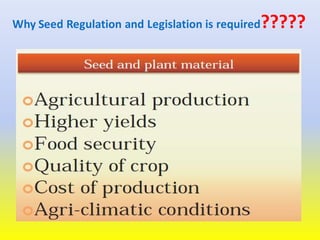
Why Seed Regulation and Legislation is required?????
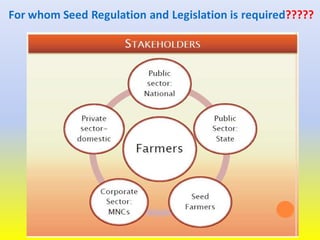
For whom Seed Regulation and Legislation is required?????
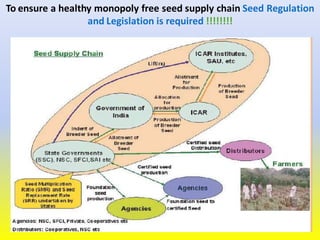
To ensure a healthy monopoly free seed supply chain Seed Regulation
and Legislation is required !!!!!!!!
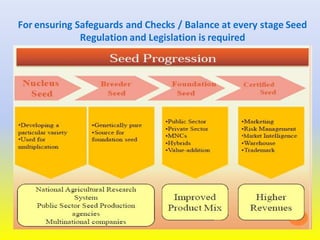
For ensuring Safeguards and Checks / Balance at every stage Seed
Regulation and Legislation is required
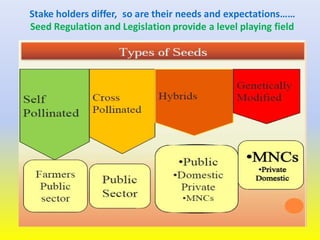
Stake holders differ, so are their needs and expectations……
Seed Regulation and Legislation provide a level playing field
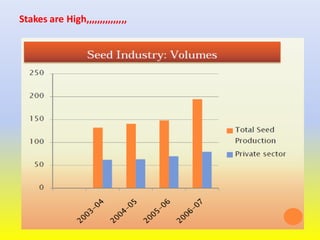
Stakes are High,,,,,,,,,,,,,,,
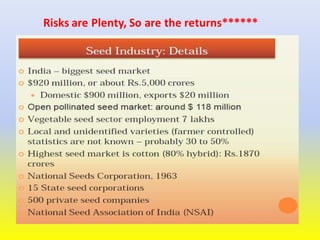
Risks are Plenty, So are the returns******
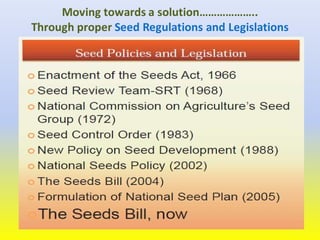
Moving towards a solution………………..
Through proper Seed Regulations and Legislations
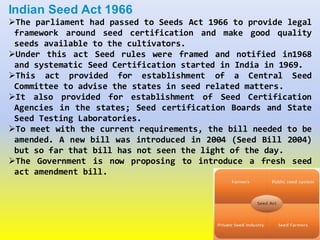
Indian Seed Act 1966
The parliament had passed to Seeds Act 1966 to provide legal
framework around seed certification and make good quality
seeds available to the cultivators.
Under this act Seed rules were framed and notified in1968
and systematic Seed Certification started in India in 1969.
This act provided for establishment of a Central Seed
Committee to advise the states in seed related matters.
It also provided for establishment of Seed Certification
Agencies in the states; Seed certification Boards and State
Seed Testing Laboratories.
To meet with the current requirements, the bill needed to be
amended. A new bill was introduced in 2004 (Seed Bill 2004)
but so far that bill has not seen the light of the day.
The Government is now proposing to introduce a fresh seed
act amendment bill.
The Seeds Act 1966 has total 25 clauses which are summarized below:
1.This act applies to whole of India including Jammu & Kashmir.
2.It covers seeds of food crops, oil crops, cotton seeds, seeds of cattle
fodder and all types of vegetative propagating material.
3.It provides for establishment of a Central Seed Committee (comprising
eight members) to advise the Central and State Governments on matters
arising out of the administration of this act and carry out other functions
assigned to it by the Act
4.It provides establishing a Central Seed Laboratory as well as State
Seed Laboratory to carry out seed analysis of notified variety
5.It empowers the Central Seed Committee to notify any variety found
suitable as per the Act after notification in the Official Gazette
6.It empowers the committee to fix the minimum limits of germination
and purity of seed for a variety to be notified as well as for marking or
labelling a seed lot to be sold commercially
7.Regulation of sale of seeds of notified varieties by compulsory
truthful labeling revealing the true identity of the variety, germination
as well as purity
8.Constituting a certification agency for undertaking the process of
certification
9.Power of certification agency to recommend notification of suitable
variety and grant of notification certificate provided the seed meets
minimum limits of germination and purity.
10.Empowerment to the agency for revocation of certificate if the agency
is convinced that holder has obtained certificate by misrepresentation or
not complied with the conditions
11.Provision for an appeal by the holder on payment basis to express
before an appellate in India authority, his limitations for not complying
with the conditions
12.Appointment of a seed analyst to undertake seed testing.
13..Appointment of seed inspector who is deemed to be a public servant
within the meaning or section 21 of the Indian Penal Code (45 of 1860)
14.Empowerment of seed inspector to draw samples from any seller or a
purchaser and verify the quality by sending samples to a seed analyst in
the seed testing laboratory
15.Laying-out of procedure for seed sample collection and other rules.
The clause also entrust inspector with the power to break open any seed
container or door of any premises where such seed may be kept for sale,
under those circumstances when owner refuses to cooperate. The whole
operation has to be done in presence of two witnesses with their
signatures on a memorandum
16.Responsibility of Seed analyst to report the results in a specified format
after analysis of the seed samples to Seed Inspector as well as the seller/
purchaser. Complainant if dissatisfied with the result can apply to the court
for sending samples to Central Seed Testing Laboratory. Central seed
laboratory shall thereupon send its report to the court in the prescribed
format within one month from the date of receipt of the sample.
17.Restriction on import and export of seeds of notified varieties. Any variety
imported or exported should meet the minimum limits of seed germination and
purity marked or labeled on the container truly
18.Recognition of seed certification agencies of foreign countries for the
purpose of this act.
19.Penalty or punishment or both for those who do not comply with the
provisions of the act and also prevent seed inspectors from executing his power
20.Forfeiture of property (seeds) belonging to any person convicted under this
act due to contravention of the procedures under this act
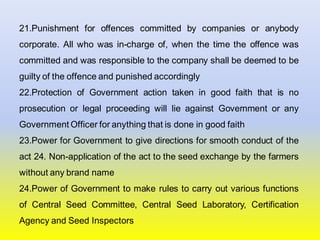
21.Punishment for offences committed by companies or anybody
corporate. All who was in-charge of, when the time the offence was
committed and was responsible to the company shall be deemed to be
guilty of the offence and punished accordingly
22.Protection of Government action taken in good faith that is no
prosecution or legal proceeding will lie against Government or any
Government Officer for anything that is done in good faith
23.Power for Government to give directions for smooth conduct of the
act 24. Non-application of the act to the seed exchange by the farmers
without any brand name
24.Power of Government to make rules to carry out various functions
of Central Seed Committee, Central Seed Laboratory, Certification
Agency and Seed Inspectors
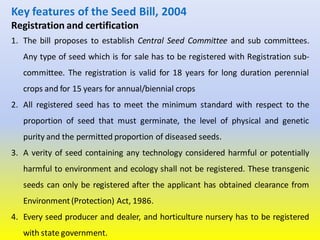
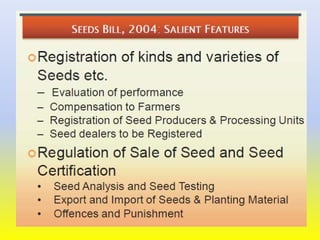
Key features of the Seed Bill, 2004
Registration and certification
1. The bill proposes to establish Central Seed Committee and sub committees.
Any type of seed which is for sale has to be registered with Registration sub-
committee. The registration is valid for 18 years for long duration perennial
crops and for 15 years for annual/biennial crops
2. All registered seed has to meet the minimum standard with respect to the
proportion of seed that must germinate, the level of physical and genetic
purity and the permitted proportion of diseased seeds.
3. A verity of seed containing any technology considered harmful or potentially
harmful to environment and ecology shall not be registered. These transgenic
seeds can only be registered after the applicant has obtained clearance from
Environment (Protection) Act, 1986.
4. Every seed producer and dealer, and horticulture nursery has to be registered
with state government.
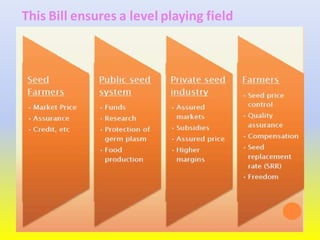
This Bill ensures a level playing field
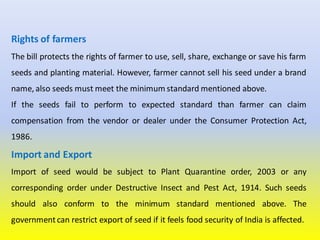
Rights of farmers
The bill protects the rights of farmer to use, sell, share, exchange or save his farm
seeds and planting material. However, farmer cannot sell his seed under a brand
name, also seeds must meet the minimum standard mentioned above.
If the seeds fail to perform to expected standard than farmer can claim
compensation from the vendor or dealer under the Consumer Protection Act,
1986.
Import and Export
Import of seed would be subject to Plant Quarantine order, 2003 or any
corresponding order under Destructive Insect and Pest Act, 1914. Such seeds
should also conform to the minimum standard mentioned above. The
government can restrict export of seed if it feels food security of India is affected.
Current Scenario of Seed & PGRFA Sector
Currently, agriculture is growing at the rate of 1.2% much lower than the GDP
growth rate of approximately 7.5. The proposed Seed Bill is expected to give a
boost to the agriculture sector. The passage of this bill is quintessential for the
government to fulfil its commitment of doubling farmer’s income. The bill is
important as it will bring competition among players in the sector and promote
healthy crops. The bill seeks to update Seeds Act, 1966 in order to address
change in technology and structure of seed sector.
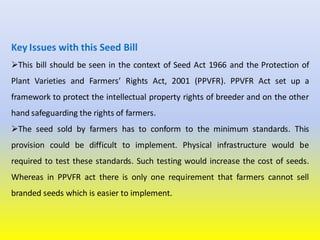
Key Issues with this Seed Bill
This bill should be seen in the context of Seed Act 1966 and the Protection of
Plant Varieties and Farmers’ Rights Act, 2001 (PPVFR). PPVFR Act set up a
framework to protect the intellectual property rights of breeder and on the other
hand safeguarding the rights of farmers.
The seed sold by farmers has to conform to the minimum standards. This
provision could be difficult to implement. Physical infrastructure would be
required to test these standards. Such testing would increase the cost of seeds.
Whereas in PPVFR act there is only one requirement that farmers cannot sell
branded seeds which is easier to implement.
Key Issues with this Seed Bill
Farmers have to approach consumer court in order to claim compensation.
This in contradiction with PPVFR act which permits farmers to claim
compensation through the Authority established under this act. Because of
the various factors that affect the performance of crops like climate, fertilizers,
water etc. It would be difficult to prove that underperformance of crop was on
account of the poor quality of seeds.
The bill does not provide for the mechanism to trace back the packet of seed
to the vendoror dealer.
There is no specification of the quality assurance systems.
Self-certification may lead to false declaration by companies. To prevent this,
only government agency should be allowed to conduct trials and grant
certificates.
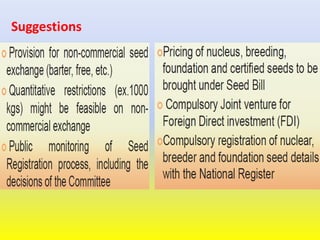
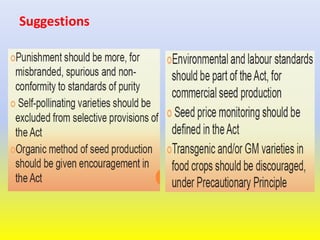
Suggestions
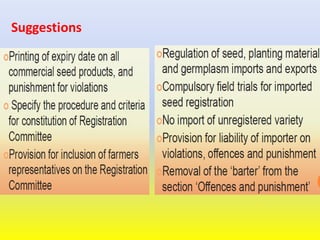
Suggestions
Suggestions
Current Status
The bill was revived in 2014 after a decade but was again put on hold in
2015 after the backlash against the provisions relating to genetically
modified (GM) seeds. This bill if passed has the potential to boost the
agricultural growth. Recently NITI aayog advocated for massive research in
the field of improving seeds verities including GM ones.
09 seed act

09 seed act

  • 1.
    Indian Seed Act1966 Assignment Subject : GPB811 Plant Genetics Resourcesand their Utilization Presented by : Mr. Indranil Bhattacharjee Student I.D. No.: 17PHGPB102 Sam Higginbottom University of Agriculture, Technology & Sciences Allahabad-211007
  • 2.
    Why Seed Regulationand Legislation is required?????
  • 3.
    For whom SeedRegulation and Legislation is required?????
  • 4.
    To ensure ahealthy monopoly free seed supply chain Seed Regulation and Legislation is required !!!!!!!!
  • 5.
    For ensuring Safeguardsand Checks / Balance at every stage Seed Regulation and Legislation is required
  • 6.
    Stake holders differ,so are their needs and expectations…… Seed Regulation and Legislation provide a level playing field
  • 7.
  • 8.
    Risks are Plenty,So are the returns******
  • 9.
    Moving towards asolution……………….. Through proper Seed Regulations and Legislations
  • 10.
    Indian Seed Act1966 The parliament had passed to Seeds Act 1966 to provide legal framework around seed certification and make good quality seeds available to the cultivators. Under this act Seed rules were framed and notified in1968 and systematic Seed Certification started in India in 1969. This act provided for establishment of a Central Seed Committee to advise the states in seed related matters. It also provided for establishment of Seed Certification Agencies in the states; Seed certification Boards and State Seed Testing Laboratories. To meet with the current requirements, the bill needed to be amended. A new bill was introduced in 2004 (Seed Bill 2004) but so far that bill has not seen the light of the day. The Government is now proposing to introduce a fresh seed act amendment bill.
  • 11.
    The Seeds Act1966 has total 25 clauses which are summarized below: 1.This act applies to whole of India including Jammu & Kashmir. 2.It covers seeds of food crops, oil crops, cotton seeds, seeds of cattle fodder and all types of vegetative propagating material. 3.It provides for establishment of a Central Seed Committee (comprising eight members) to advise the Central and State Governments on matters arising out of the administration of this act and carry out other functions assigned to it by the Act 4.It provides establishing a Central Seed Laboratory as well as State Seed Laboratory to carry out seed analysis of notified variety
  • 12.
    5.It empowers theCentral Seed Committee to notify any variety found suitable as per the Act after notification in the Official Gazette 6.It empowers the committee to fix the minimum limits of germination and purity of seed for a variety to be notified as well as for marking or labelling a seed lot to be sold commercially 7.Regulation of sale of seeds of notified varieties by compulsory truthful labeling revealing the true identity of the variety, germination as well as purity 8.Constituting a certification agency for undertaking the process of certification
  • 13.
    9.Power of certificationagency to recommend notification of suitable variety and grant of notification certificate provided the seed meets minimum limits of germination and purity. 10.Empowerment to the agency for revocation of certificate if the agency is convinced that holder has obtained certificate by misrepresentation or not complied with the conditions 11.Provision for an appeal by the holder on payment basis to express before an appellate in India authority, his limitations for not complying with the conditions 12.Appointment of a seed analyst to undertake seed testing. 13..Appointment of seed inspector who is deemed to be a public servant within the meaning or section 21 of the Indian Penal Code (45 of 1860)
  • 14.
    14.Empowerment of seedinspector to draw samples from any seller or a purchaser and verify the quality by sending samples to a seed analyst in the seed testing laboratory 15.Laying-out of procedure for seed sample collection and other rules. The clause also entrust inspector with the power to break open any seed container or door of any premises where such seed may be kept for sale, under those circumstances when owner refuses to cooperate. The whole operation has to be done in presence of two witnesses with their signatures on a memorandum 16.Responsibility of Seed analyst to report the results in a specified format after analysis of the seed samples to Seed Inspector as well as the seller/ purchaser. Complainant if dissatisfied with the result can apply to the court for sending samples to Central Seed Testing Laboratory. Central seed laboratory shall thereupon send its report to the court in the prescribed format within one month from the date of receipt of the sample.
  • 15.
    17.Restriction on importand export of seeds of notified varieties. Any variety imported or exported should meet the minimum limits of seed germination and purity marked or labeled on the container truly 18.Recognition of seed certification agencies of foreign countries for the purpose of this act. 19.Penalty or punishment or both for those who do not comply with the provisions of the act and also prevent seed inspectors from executing his power 20.Forfeiture of property (seeds) belonging to any person convicted under this act due to contravention of the procedures under this act
  • 16.
    21.Punishment for offencescommitted by companies or anybody corporate. All who was in-charge of, when the time the offence was committed and was responsible to the company shall be deemed to be guilty of the offence and punished accordingly 22.Protection of Government action taken in good faith that is no prosecution or legal proceeding will lie against Government or any Government Officer for anything that is done in good faith 23.Power for Government to give directions for smooth conduct of the act 24. Non-application of the act to the seed exchange by the farmers without any brand name 24.Power of Government to make rules to carry out various functions of Central Seed Committee, Central Seed Laboratory, Certification Agency and Seed Inspectors
  • 18.
    Key features ofthe Seed Bill, 2004 Registration and certification 1. The bill proposes to establish Central Seed Committee and sub committees. Any type of seed which is for sale has to be registered with Registration sub- committee. The registration is valid for 18 years for long duration perennial crops and for 15 years for annual/biennial crops 2. All registered seed has to meet the minimum standard with respect to the proportion of seed that must germinate, the level of physical and genetic purity and the permitted proportion of diseased seeds. 3. A verity of seed containing any technology considered harmful or potentially harmful to environment and ecology shall not be registered. These transgenic seeds can only be registered after the applicant has obtained clearance from Environment (Protection) Act, 1986. 4. Every seed producer and dealer, and horticulture nursery has to be registered with state government.
  • 19.
    This Bill ensuresa level playing field
  • 20.
    Rights of farmers Thebill protects the rights of farmer to use, sell, share, exchange or save his farm seeds and planting material. However, farmer cannot sell his seed under a brand name, also seeds must meet the minimum standard mentioned above. If the seeds fail to perform to expected standard than farmer can claim compensation from the vendor or dealer under the Consumer Protection Act, 1986. Import and Export Import of seed would be subject to Plant Quarantine order, 2003 or any corresponding order under Destructive Insect and Pest Act, 1914. Such seeds should also conform to the minimum standard mentioned above. The government can restrict export of seed if it feels food security of India is affected.
  • 22.
    Current Scenario ofSeed & PGRFA Sector Currently, agriculture is growing at the rate of 1.2% much lower than the GDP growth rate of approximately 7.5. The proposed Seed Bill is expected to give a boost to the agriculture sector. The passage of this bill is quintessential for the government to fulfil its commitment of doubling farmer’s income. The bill is important as it will bring competition among players in the sector and promote healthy crops. The bill seeks to update Seeds Act, 1966 in order to address change in technology and structure of seed sector.
  • 23.
    Key Issues withthis Seed Bill This bill should be seen in the context of Seed Act 1966 and the Protection of Plant Varieties and Farmers’ Rights Act, 2001 (PPVFR). PPVFR Act set up a framework to protect the intellectual property rights of breeder and on the other hand safeguarding the rights of farmers. The seed sold by farmers has to conform to the minimum standards. This provision could be difficult to implement. Physical infrastructure would be required to test these standards. Such testing would increase the cost of seeds. Whereas in PPVFR act there is only one requirement that farmers cannot sell branded seeds which is easier to implement.
  • 25.
    Key Issues withthis Seed Bill Farmers have to approach consumer court in order to claim compensation. This in contradiction with PPVFR act which permits farmers to claim compensation through the Authority established under this act. Because of the various factors that affect the performance of crops like climate, fertilizers, water etc. It would be difficult to prove that underperformance of crop was on account of the poor quality of seeds. The bill does not provide for the mechanism to trace back the packet of seed to the vendoror dealer. There is no specification of the quality assurance systems. Self-certification may lead to false declaration by companies. To prevent this, only government agency should be allowed to conduct trials and grant certificates.
  • 27.
  • 28.
  • 29.
  • 30.
    Current Status The billwas revived in 2014 after a decade but was again put on hold in 2015 after the backlash against the provisions relating to genetically modified (GM) seeds. This bill if passed has the potential to boost the agricultural growth. Recently NITI aayog advocated for massive research in the field of improving seeds verities including GM ones.