Topic: Text as a Connected Discourse
Reading and Writing
Introduction
Contents
01
Connected
Discourse
02
Text
03
Reading
04
Writing
05
Types of Reading
06
Reading and writing are both important;
you can’t have one without the other.
Reading and Writing Skills
Reading and writing in general only
helps absorb information, and enhance
leisure or school related writing tasks. It
has also made life itself so much easier
because reading and writing are so
beneficial for school and for life. How
much you read and write today, will
somehow affect your future job, family,
position, or even your salary.
What is a Text?
A text can be defined as an object that can be read,
whether it is a work of literature, a lesson written on the
blackboard, or a street sign. It is a coherent set of signs
that transmits some kind of informative message.
What is a Text?
- In literary studies, text usually refers
to the written material. We use the
term text when we are
discussing novels, short stories, and
dramas. Even the content of a letter,
bill, poster or similar entities that
contain written material can be called
a text.
What is Discourse?
The term discourse has many meanings and
definitions. Discourse was first interpreted as
dialogue – an interaction between a speaker and a
listener. Thus, discourse referred to authentic daily
communications, mainly oral, included in the wide
communicative context.
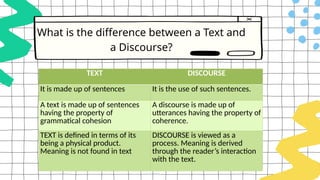
What is the difference between a Text and
a Discourse?
TEXT DISCOURSE
It is made up of sentences It is the use of such sentences.
A text is made up of sentences
having the property of
grammatical cohesion
A discourse is made up of
utterances having the property of
coherence.
TEXT is defined in terms of its
being a physical product.
Meaning is not found in text
DISCOURSE is viewed as a
process. Meaning is derived
through the reader’s interaction
with the text.
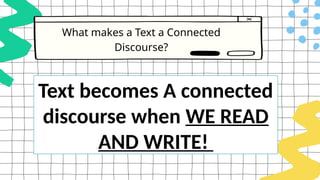
What makes a Text a Connected
Discourse?
Text becomes A connected
discourse when WE READ
AND WRITE!
What is Reading?
Key concept Reading is the third of
the four language skills,
which are:
Listening, Speaking,
Reading, and Writing.
What is Reading?
Key concept
READING is a cognitive process of
decoding symbols to derive meaning
from a text. It is always an interaction
between the text and the reader. We
read to gain and share information
and ideas, whether for academic,
personal, or professional purposes.
What is Reading?
Key concept
Reading can be silent (in our
head) or oral/aloud (so that
other people can hear).
Why is reading important?
1.Reading is fundamental to functioning
in today's society.
2. Reading is a vital skill in finding a good
job.
3.it develops the mind.
4. It is how we discover new things.
5. Reading develops the imagination.
6. Reading develops the creative side of
people
7. Reading is fundamental in developing a
good self-image.
Why is reading important?
8. Good reading skills, especially in
a phonics reading program, improve
spelling.
9. Reading is important because
words - spoken and written - are the
building blocks of life.
Types of
Reading
1. Scanning
- This is looking over a text quickly to get
a specific piece of information.
2. Skimming
- Looking over the text quickly to get a general
idea of the content. Your eyesmove quite fast,
taking in titles of chapters, their beginnings and
ends, and thefirst sentences of paragraphs.
3. Sub-vocalization
- This is reading very slowly and methodically,
either saying the words out loud or at least with a
‘voice’ in your head. It is painstaking but very slow.
We tend to use it when trying out a recipe for the
first time, or carrying out instructions as to how to
assemble something we’ve bought.
4. Light Reading
This is reading fairly quickly without concentrating
too hard or worrying about every single word. We
often use it when reading an enjoyable novel.
5. Study Reading
Study reading involves thinking about what is
being read so that it is understood and can be
recalled. It needs to be worked at, with time for
reflection, thought, analysis, criticism, comparison,
notes made, points highlighted and emphasized,
arguments followed and evaluated, the whole
summarized.
What is Writing?
Key concept
"Writing" is the process of using
symbols (letters of the alphabet,
punctuation and spaces) to
communicate thoughts and ideas in
a readable form.
What is Writing?
Key concept
Generally, we write using a
pen/pencil (handwriting) or a
keyboard (typing).
What is Writing?
Key concept
A writer may write for personal
enjoyment or use, or for an
audience of one person or more.
The audience may be known
(targeted) or unknown.
What is Writing?
Key concept
A writer may write for personal
enjoyment or use, or for an
audience of one person or more.
The audience may be known
(targeted) or unknown.
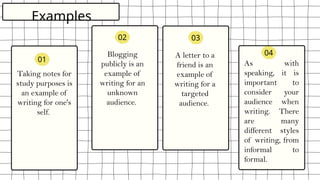
Taking notes for
study purposes is
an example of
writing for one's
self.
Blogging
publicly is an
example of
writing for an
unknown
audience.
A letter to a
friend is an
example of
writing for a
targeted
audience.
As with
speaking, it is
important to
consider your
audience when
writing. There
are many
different styles
of writing, from
informal to
formal.
01
02 03
04
Examples
Why is writing important?
• Writing is the primary basis upon which
your work, your learning, and your
intellect will be judged—in college, in
the workplace, and in the community.
• Writing expresses who you are as a
person.
• Writing is portable and permanent. It
makes your thinking visible.
• Writing helps you move easily among
facts, inferences, and opinions without
getting confused—and without confusing
your reader.
Why is writing important?
• Writing promotes your ability to pose
worthwhile questions.
• Writing fosters your ability to explain a
complex position to readers, and to
yourself.
• Writing helps others give you feedback.
• Writing helps you refine your ideas when
you give others feedback.
Why is writing important?
• Writing requires that you anticipate your
readers’ needs. Your ability to do so
demonstrates your intellectual flexibility
and maturity.
• Writing ideas down preserves them so
that you can reflect upon them later.
• Writing out your ideas permits you to
evaluate the adequacy of your argument.
• Writing stimulates you to extend a line of
thought beyond your first impressions or
gut responses.
Why is writing important?
• Writing equips you with the
communication and thinking skills you
need to participate effectively in
democracy.
• Writing is an essential job skill.

Week-1-Text-as-a-Connected-Discourse-2 (1).pptx

  • 1.
    Topic: Text asa Connected Discourse Reading and Writing
  • 2.
  • 3.
    Reading and writingare both important; you can’t have one without the other. Reading and Writing Skills Reading and writing in general only helps absorb information, and enhance leisure or school related writing tasks. It has also made life itself so much easier because reading and writing are so beneficial for school and for life. How much you read and write today, will somehow affect your future job, family, position, or even your salary.
  • 4.
    What is aText? A text can be defined as an object that can be read, whether it is a work of literature, a lesson written on the blackboard, or a street sign. It is a coherent set of signs that transmits some kind of informative message.
  • 5.
    What is aText? - In literary studies, text usually refers to the written material. We use the term text when we are discussing novels, short stories, and dramas. Even the content of a letter, bill, poster or similar entities that contain written material can be called a text.
  • 6.
    What is Discourse? Theterm discourse has many meanings and definitions. Discourse was first interpreted as dialogue – an interaction between a speaker and a listener. Thus, discourse referred to authentic daily communications, mainly oral, included in the wide communicative context.
  • 7.
    What is thedifference between a Text and a Discourse? TEXT DISCOURSE It is made up of sentences It is the use of such sentences. A text is made up of sentences having the property of grammatical cohesion A discourse is made up of utterances having the property of coherence. TEXT is defined in terms of its being a physical product. Meaning is not found in text DISCOURSE is viewed as a process. Meaning is derived through the reader’s interaction with the text.
  • 8.
    What makes aText a Connected Discourse? Text becomes A connected discourse when WE READ AND WRITE!
  • 9.
    What is Reading? Keyconcept Reading is the third of the four language skills, which are: Listening, Speaking, Reading, and Writing.
  • 10.
    What is Reading? Keyconcept READING is a cognitive process of decoding symbols to derive meaning from a text. It is always an interaction between the text and the reader. We read to gain and share information and ideas, whether for academic, personal, or professional purposes.
  • 11.
    What is Reading? Keyconcept Reading can be silent (in our head) or oral/aloud (so that other people can hear).
  • 12.
    Why is readingimportant? 1.Reading is fundamental to functioning in today's society. 2. Reading is a vital skill in finding a good job. 3.it develops the mind. 4. It is how we discover new things. 5. Reading develops the imagination. 6. Reading develops the creative side of people 7. Reading is fundamental in developing a good self-image.
  • 13.
    Why is readingimportant? 8. Good reading skills, especially in a phonics reading program, improve spelling. 9. Reading is important because words - spoken and written - are the building blocks of life.
  • 14.
  • 15.
    1. Scanning - Thisis looking over a text quickly to get a specific piece of information.
  • 16.
    2. Skimming - Lookingover the text quickly to get a general idea of the content. Your eyesmove quite fast, taking in titles of chapters, their beginnings and ends, and thefirst sentences of paragraphs.
  • 17.
    3. Sub-vocalization - Thisis reading very slowly and methodically, either saying the words out loud or at least with a ‘voice’ in your head. It is painstaking but very slow. We tend to use it when trying out a recipe for the first time, or carrying out instructions as to how to assemble something we’ve bought.
  • 18.
    4. Light Reading Thisis reading fairly quickly without concentrating too hard or worrying about every single word. We often use it when reading an enjoyable novel.
  • 19.
    5. Study Reading Studyreading involves thinking about what is being read so that it is understood and can be recalled. It needs to be worked at, with time for reflection, thought, analysis, criticism, comparison, notes made, points highlighted and emphasized, arguments followed and evaluated, the whole summarized.
  • 20.
    What is Writing? Keyconcept "Writing" is the process of using symbols (letters of the alphabet, punctuation and spaces) to communicate thoughts and ideas in a readable form.
  • 21.
    What is Writing? Keyconcept Generally, we write using a pen/pencil (handwriting) or a keyboard (typing).
  • 22.
    What is Writing? Keyconcept A writer may write for personal enjoyment or use, or for an audience of one person or more. The audience may be known (targeted) or unknown.
  • 23.
    What is Writing? Keyconcept A writer may write for personal enjoyment or use, or for an audience of one person or more. The audience may be known (targeted) or unknown.
  • 24.
    Taking notes for studypurposes is an example of writing for one's self. Blogging publicly is an example of writing for an unknown audience. A letter to a friend is an example of writing for a targeted audience. As with speaking, it is important to consider your audience when writing. There are many different styles of writing, from informal to formal. 01 02 03 04 Examples
  • 25.
    Why is writingimportant? • Writing is the primary basis upon which your work, your learning, and your intellect will be judged—in college, in the workplace, and in the community. • Writing expresses who you are as a person. • Writing is portable and permanent. It makes your thinking visible. • Writing helps you move easily among facts, inferences, and opinions without getting confused—and without confusing your reader.
  • 26.
    Why is writingimportant? • Writing promotes your ability to pose worthwhile questions. • Writing fosters your ability to explain a complex position to readers, and to yourself. • Writing helps others give you feedback. • Writing helps you refine your ideas when you give others feedback.
  • 27.
    Why is writingimportant? • Writing requires that you anticipate your readers’ needs. Your ability to do so demonstrates your intellectual flexibility and maturity. • Writing ideas down preserves them so that you can reflect upon them later. • Writing out your ideas permits you to evaluate the adequacy of your argument. • Writing stimulates you to extend a line of thought beyond your first impressions or gut responses.
  • 28.
    Why is writingimportant? • Writing equips you with the communication and thinking skills you need to participate effectively in democracy. • Writing is an essential job skill.