New & Digital Literacies
with the iPad
Jim Harmon
@jimharmon
Euclid City Schools
http://tinyurl.com/ipadlit
What are “new” literacies?
• Made possible with new technology
• Different scholars define it differently
• New technologies appear
• New social practices for literacy emerge
• Might include
• social media
• blogging
• video creation & sharing
• augmented reality
Why the iPad?
• It is a content creation device
• It is a desirable device
• It allows for differentiation of instruction
How does the use of iPads
affect student literacies?
The scenario
• Three sections of sophomore English w/
iPads (w/teacher “A”)
• Six sections of sophomore English w/out
iPads (w/teachers “B” & “C”)
• Mapped curriculum & common formative
assessments
• Data collected included:
• A pre- & post self assessment
• Three benchmark (MAP) tests
• Ohio standardized test results (OGT)
Assessment Results
• Students with iPads:
• Had a an average RIT score 5 points higher
on MAP tests than their peers
• Both Reading and Language Usage tests
• Five points = one full grade level
• Scored higher than peers on Ohio writing
standardized test
• Were 5% more likely to pass Ohio reading
and writing standardized tests
Students’ Self Perceptions
• Students with iPads:
• Were more realistic in identifying their own
literacy abilities
• Were less likely to identify technology as a
support to do well in English class
• Were 4% more likely to regularly attend class
Ohio Graduation Test Passage Rates
0
10
20
30
40
50
60
70
80
90
100
85 92
79 84
Reading Test
Writing Test
With iPads
Without iPads
For district results, visit ode.state.oh.us
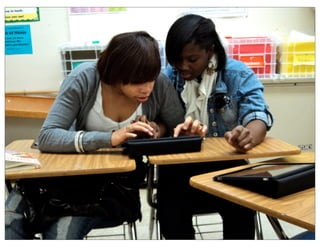
What students said:
• “I think it is more effective when you get
to use technology to read. It's more
interesting, fun, and different.”
• “I think using an iPad to read or write is
great. I think it helps me to read and write
more because the technology is awesome.
I honestly think I will read and write a lot
more.”
Average RIT Scores: Spring 2011
150
175
200
225
250
219.22
220.53214.81
215.74
Reading Test
Language Test
With iPads
Without iPads
For more on MAP testing visit nwea.org
What students said:
• “I believe from my experience that it
would motivate others to want to read
and write more.”
• “The iPads make things fun but I would write
with or without the iPads.”
• “It helps me improve my comprehension and
improves my motivation to read and write
more; not just more, but more clearly and
fluently.”
Students without iPads
• What one thing motivates you to attend
English class?
Students with iPads
• What one thing motivates you to attend
English class?
Lessons learned
• The iPads became ubiquitous to students in
spite of it not being a 1:1
• Students who did not use iPads were more
likely to identify technology as a support in
English class
• The use of Apps allowed for differentiation
of learning for students
• Proficient readers/writers experienced no
negative effects from iPad integration
Lessons learned
• Although students who used iPads did not
rate themselves higher than their peers in
reading and writing ability, they performed
better on assessments that measured these
skills
• This suggests that
• the students without iPad access had an
inflated view of their own abilities
• the use of the iPad may have provided a more
realistic and regular sense of the literate “self”
What does this mean for teachers?
• Teachers open to new tools provide more
opportunities for differentiating instruction/
learning
• If teachers don’t lead the way, who will?
• iPads excel in kinesthetic/tactile learning
• Far more interactive than traditional
technologies
• iPads get students excited to learn and “do”
• Not to mention teachers
Apps for New Literacies
• iBooks (reading comprehension)
• Subtext (reading comprehension)
• Blogger (content generation/publishing/writing applications)
• Keynote (content generation/publishing/writing applications)
• Google Drive & Docs (content generation/writing
applications)
• Puppet Pals HD/Toontastic (reading comprehension)
Future Directions
• Sharing data and best practices through
iTunesU
• Classroom experience and shared
experience
• Co-taught model 2012-13 w/special
education teacher
• Continue to mentor teachers in tech use
Curated Resources
scoop.it/t/ipad-literacy
Other curated lists:
• http://www.scoop.it/t/digital-fluency
• http://www.scoop.it/t/digital-literacies-review
• http://www.scoop.it/t/trending-education
Twitter accounts for New &
Digital Literacy
• @jimharmon
• @trendingedtech
• @Edudemic
• @edutopia
• @hpitler
• @elemenous

New & digital literacies

  • 2.
    New & DigitalLiteracies with the iPad Jim Harmon @jimharmon Euclid City Schools http://tinyurl.com/ipadlit
  • 3.
    What are “new”literacies? • Made possible with new technology • Different scholars define it differently • New technologies appear • New social practices for literacy emerge • Might include • social media • blogging • video creation & sharing • augmented reality
  • 4.
    Why the iPad? •It is a content creation device • It is a desirable device • It allows for differentiation of instruction
  • 5.
    How does theuse of iPads affect student literacies?
  • 6.
    The scenario • Threesections of sophomore English w/ iPads (w/teacher “A”) • Six sections of sophomore English w/out iPads (w/teachers “B” & “C”) • Mapped curriculum & common formative assessments • Data collected included: • A pre- & post self assessment • Three benchmark (MAP) tests • Ohio standardized test results (OGT)
  • 8.
    Assessment Results • Studentswith iPads: • Had a an average RIT score 5 points higher on MAP tests than their peers • Both Reading and Language Usage tests • Five points = one full grade level • Scored higher than peers on Ohio writing standardized test • Were 5% more likely to pass Ohio reading and writing standardized tests
  • 10.
    Students’ Self Perceptions •Students with iPads: • Were more realistic in identifying their own literacy abilities • Were less likely to identify technology as a support to do well in English class • Were 4% more likely to regularly attend class
  • 11.
    Ohio Graduation TestPassage Rates 0 10 20 30 40 50 60 70 80 90 100 85 92 79 84 Reading Test Writing Test With iPads Without iPads For district results, visit ode.state.oh.us
  • 12.
    What students said: •“I think it is more effective when you get to use technology to read. It's more interesting, fun, and different.” • “I think using an iPad to read or write is great. I think it helps me to read and write more because the technology is awesome. I honestly think I will read and write a lot more.”
  • 13.
    Average RIT Scores:Spring 2011 150 175 200 225 250 219.22 220.53214.81 215.74 Reading Test Language Test With iPads Without iPads For more on MAP testing visit nwea.org
  • 14.
    What students said: •“I believe from my experience that it would motivate others to want to read and write more.” • “The iPads make things fun but I would write with or without the iPads.” • “It helps me improve my comprehension and improves my motivation to read and write more; not just more, but more clearly and fluently.”
  • 15.
    Students without iPads •What one thing motivates you to attend English class?
  • 16.
    Students with iPads •What one thing motivates you to attend English class?
  • 18.
    Lessons learned • TheiPads became ubiquitous to students in spite of it not being a 1:1 • Students who did not use iPads were more likely to identify technology as a support in English class • The use of Apps allowed for differentiation of learning for students • Proficient readers/writers experienced no negative effects from iPad integration
  • 20.
    Lessons learned • Althoughstudents who used iPads did not rate themselves higher than their peers in reading and writing ability, they performed better on assessments that measured these skills • This suggests that • the students without iPad access had an inflated view of their own abilities • the use of the iPad may have provided a more realistic and regular sense of the literate “self”
  • 22.
    What does thismean for teachers? • Teachers open to new tools provide more opportunities for differentiating instruction/ learning • If teachers don’t lead the way, who will? • iPads excel in kinesthetic/tactile learning • Far more interactive than traditional technologies • iPads get students excited to learn and “do” • Not to mention teachers
  • 24.
    Apps for NewLiteracies • iBooks (reading comprehension) • Subtext (reading comprehension) • Blogger (content generation/publishing/writing applications) • Keynote (content generation/publishing/writing applications) • Google Drive & Docs (content generation/writing applications) • Puppet Pals HD/Toontastic (reading comprehension)
  • 26.
    Future Directions • Sharingdata and best practices through iTunesU • Classroom experience and shared experience • Co-taught model 2012-13 w/special education teacher • Continue to mentor teachers in tech use
  • 28.
  • 29.
    Other curated lists: •http://www.scoop.it/t/digital-fluency • http://www.scoop.it/t/digital-literacies-review • http://www.scoop.it/t/trending-education
  • 30.
    Twitter accounts forNew & Digital Literacy • @jimharmon • @trendingedtech • @Edudemic • @edutopia • @hpitler • @elemenous