Inverting Journalism
iPad and iTunes U revolutionize the way we educate students
Nicole	Kraft	
Assistant	Professor	(clinical)	
@nicole_kraft
Main Points
• The college
classroom must
train students like
an entry-level job
• Learning cannot stop
when class sessions
are done.
• Don’t assume
these students
learn like you did.
@Nicole_Kraft
McMillan & Dwyer (1989)
• As a result of educator/student interactions within a
particular course, both parties anticipate that some learning
will occur, some change in behavior will have taken place
and some personal growth will be evident.
• To facilitate such change, educators should ask, to ask 'Do I
need to change my style of teaching to match the learning
needs of these students?'
• Investigate the possibility of matching teaching style with
the students' learning styles.
@Nicole_Kraft
@Nicole_Kraft
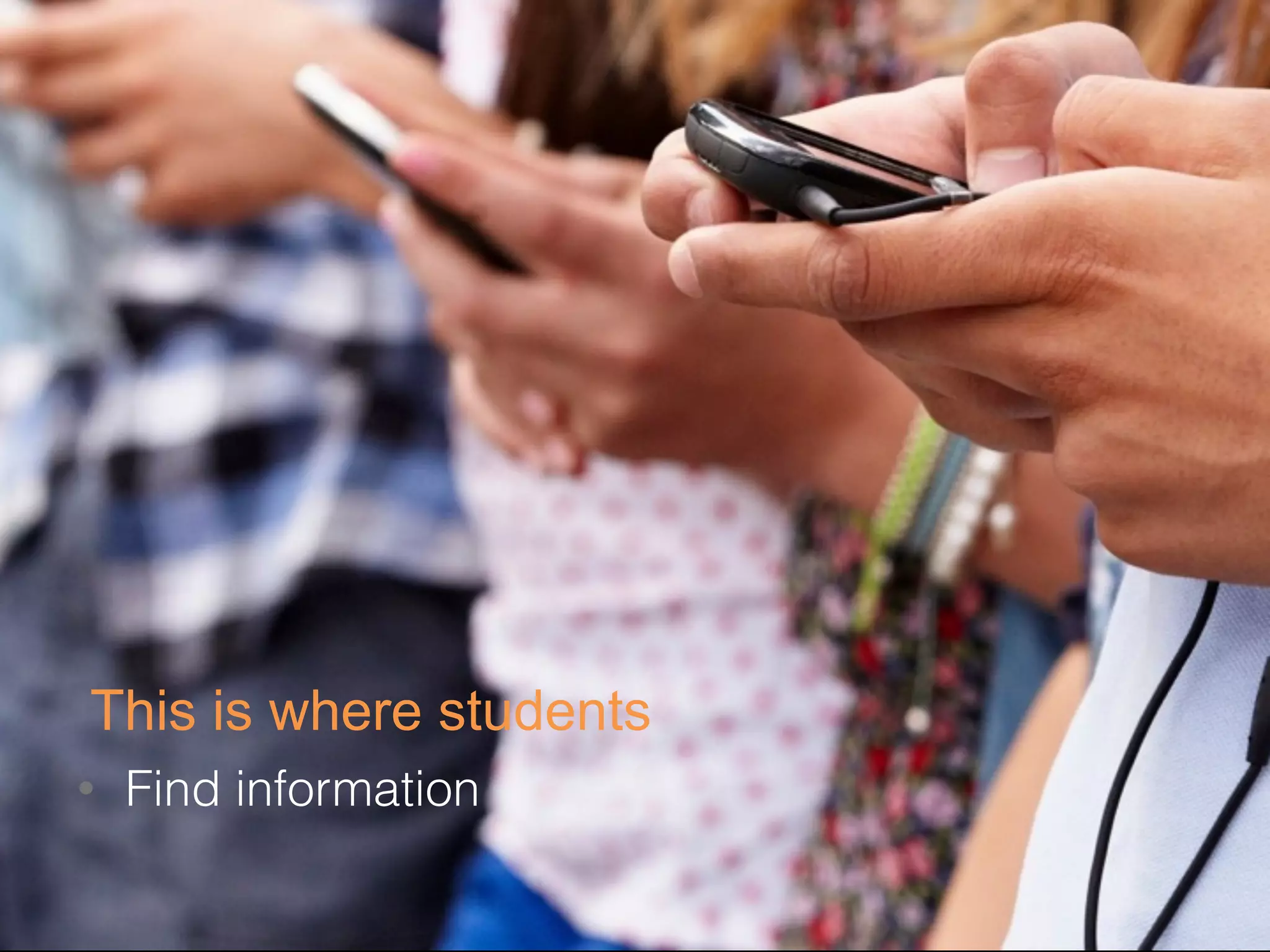
• Find information
This is where students
• Seek out learning
• Become engaged
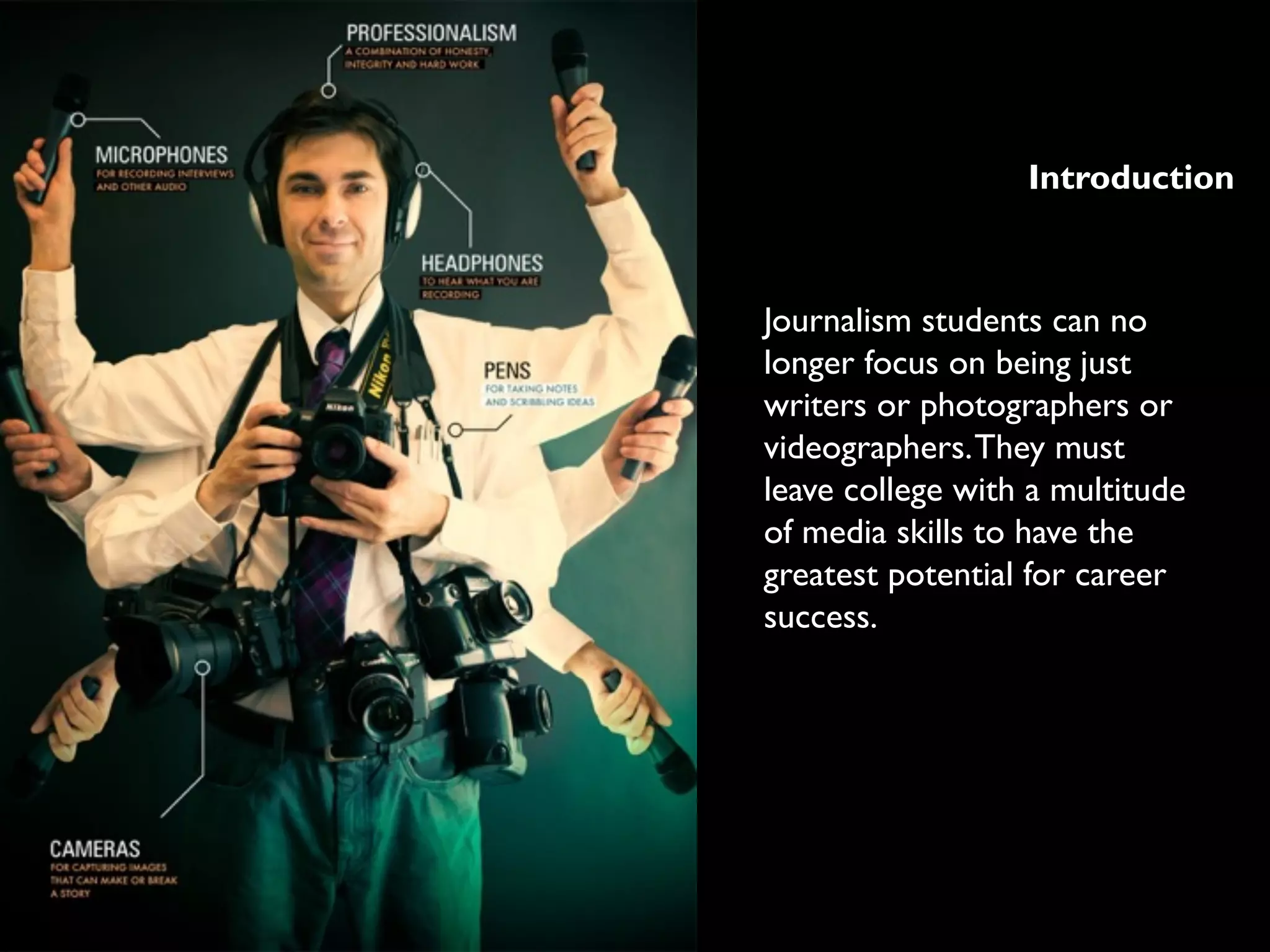
Introduction
Journalism students can no
longer focus on being just
writers or photographers or
videographers.They must
leave college with a multitude
of media skills to have the
greatest potential for career
success.
iPad and supporting apps have created
a “one-stop shop” of journalistic that
enable students to develop those skills,
including notebooks, recording devices,
research platforms and writing.
We conducted a yearlong
study of beginning journalism
students utilizing one-to-one
iPads to examine the impact
of iPads and appropriate
apps in a “flipped” journalism
classroom environment
(where lectures are
homework, and skill
development and execution
are done in class.
@Nicole_Kraft
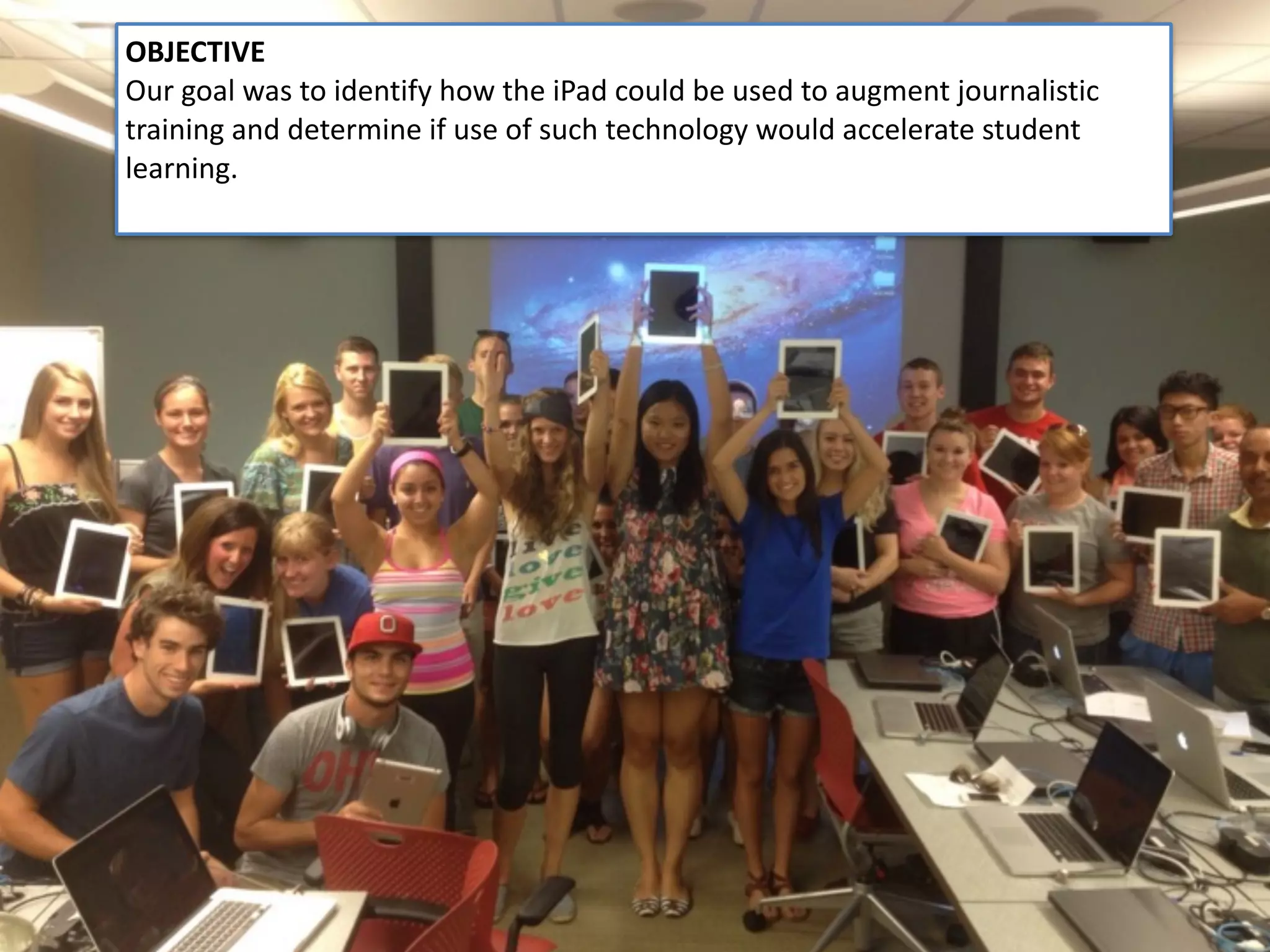
OBJECTIVE	
Our	goal	was	to	identify	how	the	iPad	could	be	used	to	augment	journalistic	
training	and	determine	if	use	of	such	technology	would	accelerate	student	
learning.
@Nicole_Kraft
My Courses
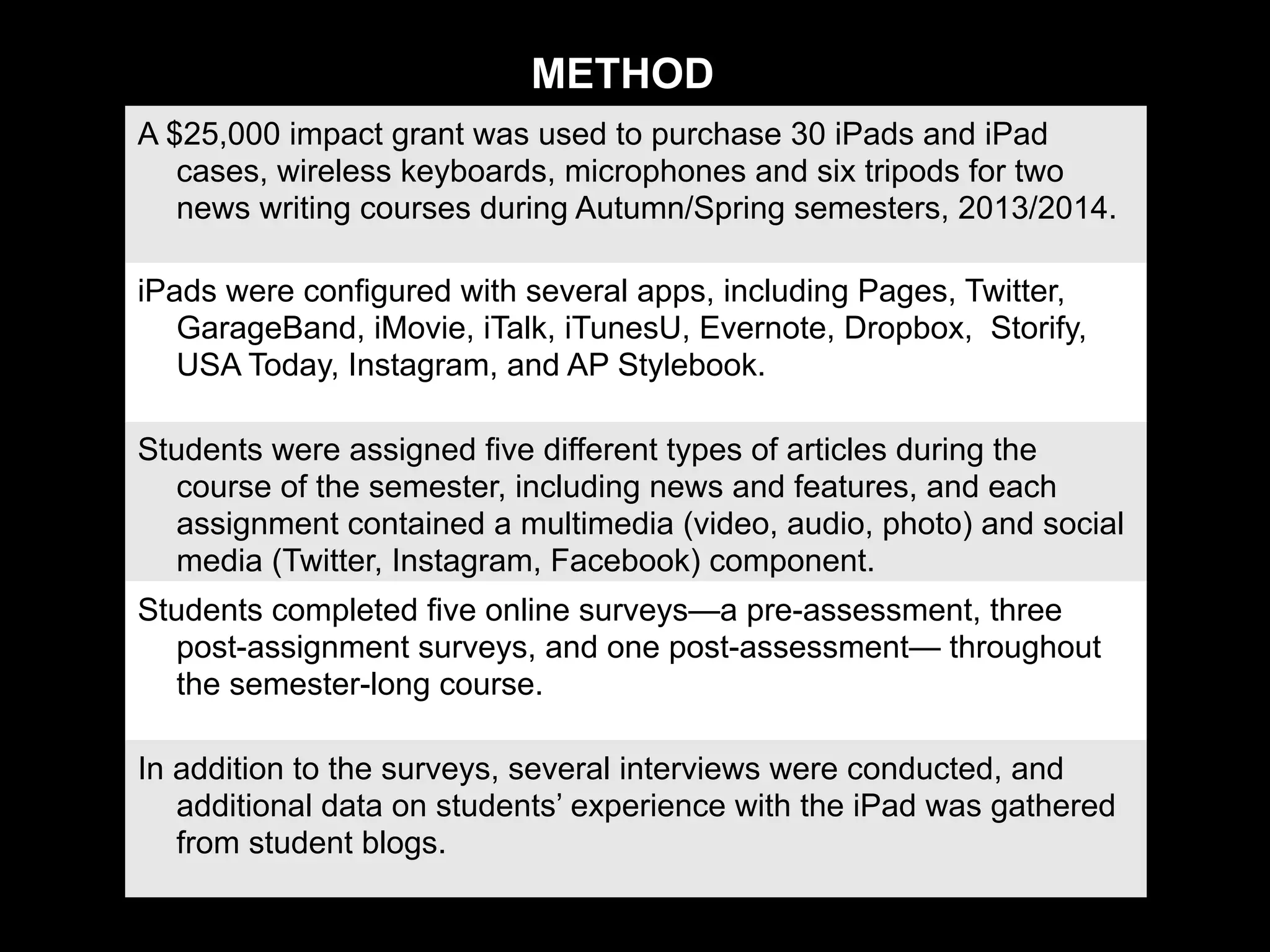
METHOD
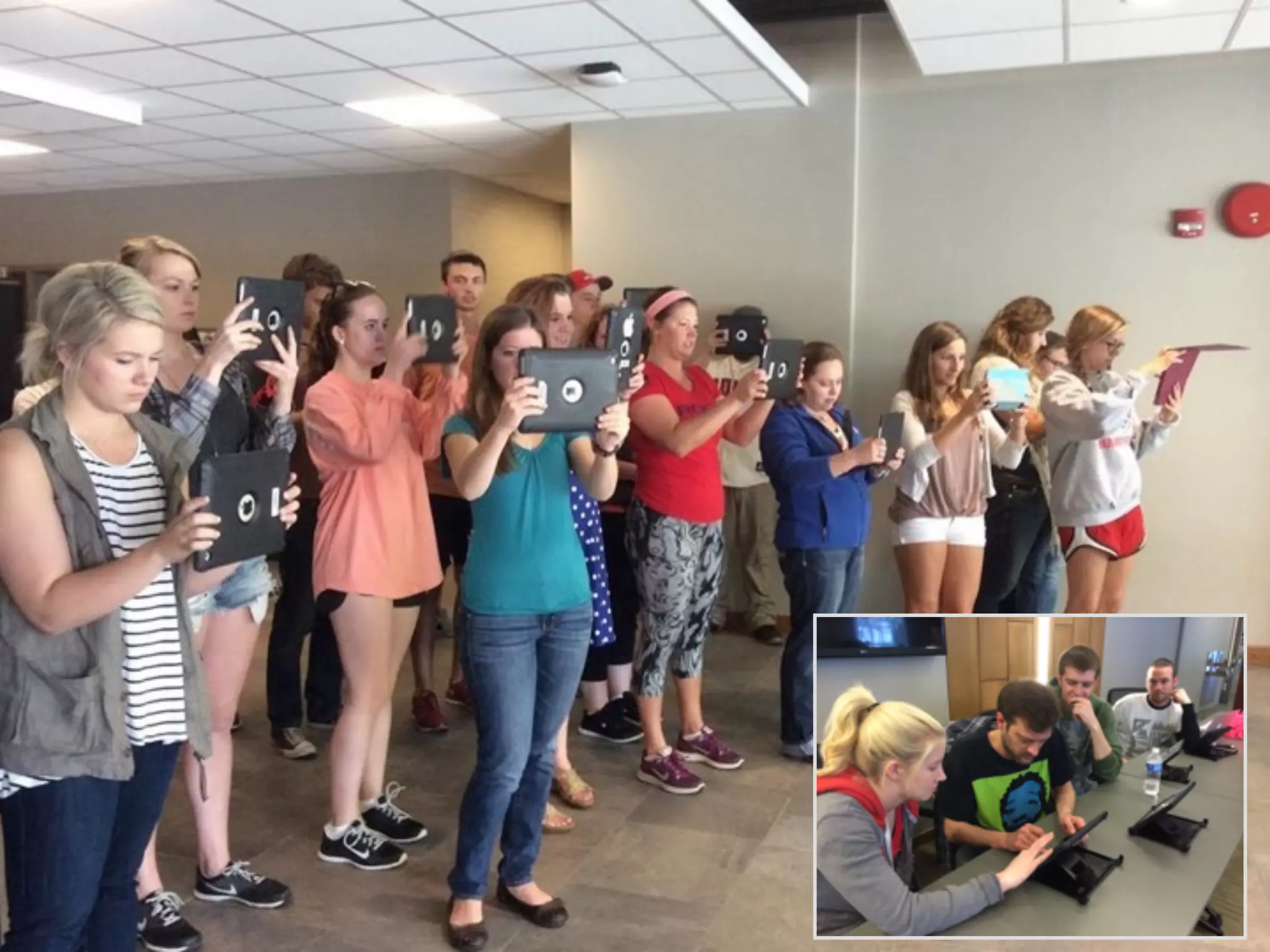
A $25,000 impact grant was used to purchase 30 iPads and iPad
cases, wireless keyboards, microphones and six tripods for two
news writing courses during Autumn/Spring semesters, 2013/2014.
iPads were configured with several apps, including Pages, Twitter,
GarageBand, iMovie, iTalk, iTunesU, Evernote, Dropbox, Storify,
USA Today, Instagram, and AP Stylebook.
Students were assigned five different types of articles during the
course of the semester, including news and features, and each
assignment contained a multimedia (video, audio, photo) and social
media (Twitter, Instagram, Facebook) component.
Students completed five online surveys—a pre-assessment, three
post-assignment surveys, and one post-assessment— throughout
the semester-long course.
In addition to the surveys, several interviews were conducted, and
additional data on students’ experience with the iPad was gathered
from student blogs.
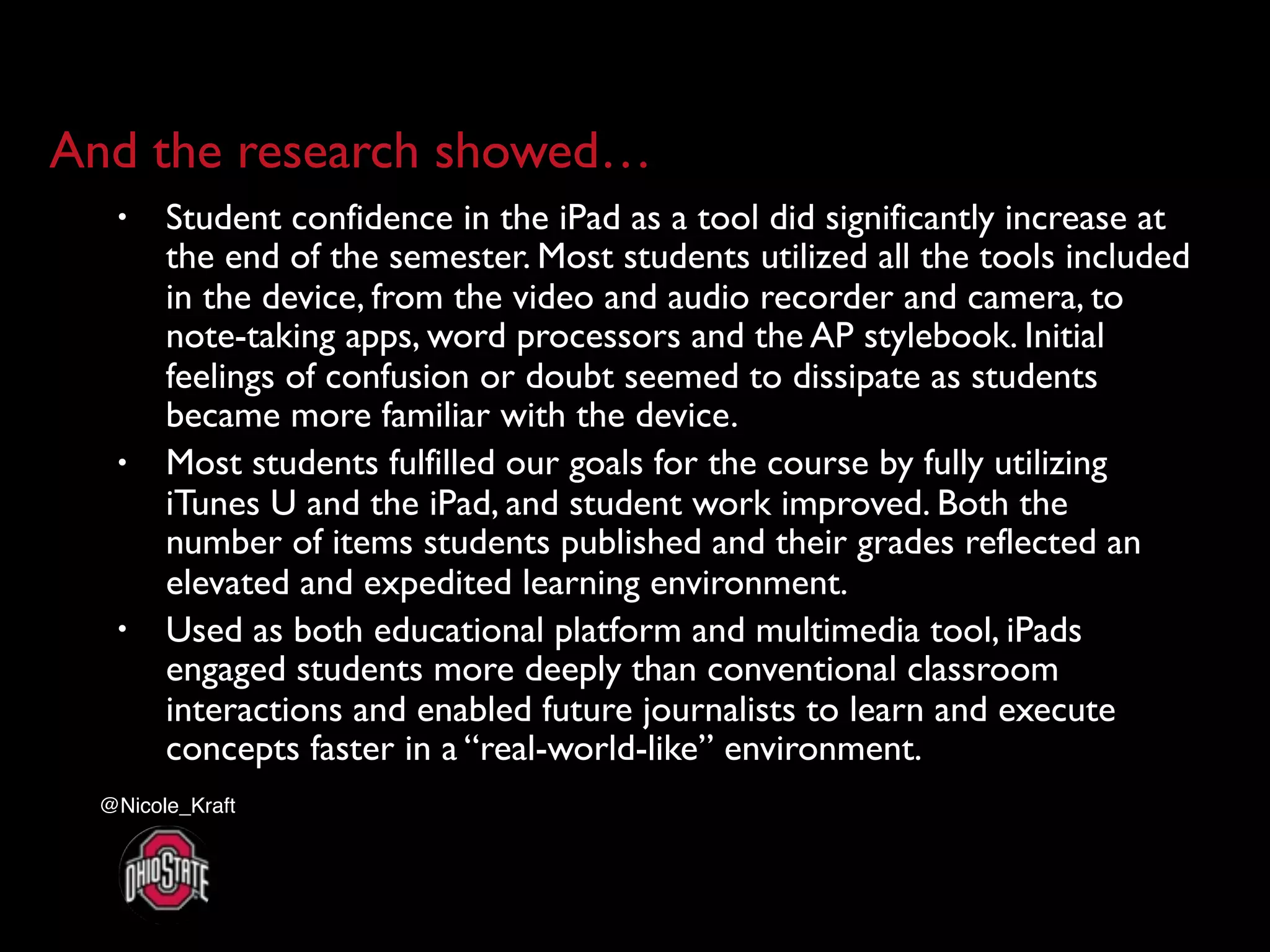
And the research showed…
• Student confidence in the iPad as a tool did significantly increase at
the end of the semester. Most students utilized all the tools included
in the device, from the video and audio recorder and camera, to
note-taking apps, word processors and the AP stylebook. Initial
feelings of confusion or doubt seemed to dissipate as students
became more familiar with the device.
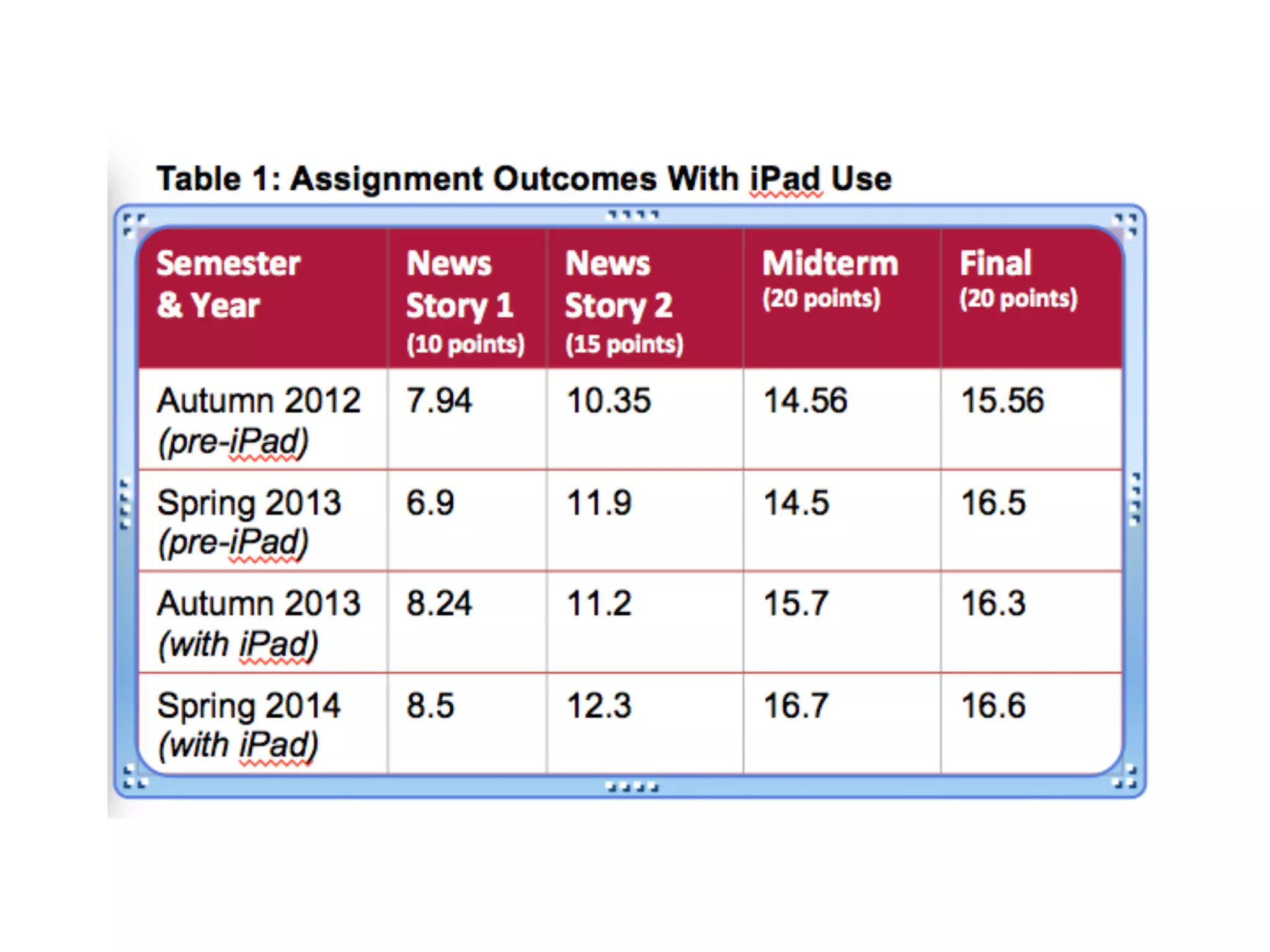
• Most students fulfilled our goals for the course by fully utilizing
iTunes U and the iPad, and student work improved. Both the
number of items students published and their grades reflected an
elevated and expedited learning environment.
• Used as both educational platform and multimedia tool, iPads
engaged students more deeply than conventional classroom
interactions and enabled future journalists to learn and execute
concepts faster in a “real-world-like” environment.
@Nicole_Kraft
• Students reported higher perceptions of their writing and reporting
abilities at the end of the semester. Student knowledge of how social
media is used in journalism, personal experience with social media, and
knowledge of journalism technologies also increased by the end of the
semester.
• While students did increase their iPad use for the second assignment,
iPad use dropped for the third assignment.We believe this was a result of
increased difficulty of assignments, prompting students to go with the
technology with which they were most comfortable.
• Students reported positive experiences with the device’s portability and
the convenience of having multiple tools in one. Camera/video quality
and note-taking resources were also commonly reported as advantages.
• Some students reported that the device felt bulky and awkward when
shooting photos, and a few had difficulties getting used to the digital
keyboard.A few comments were made about difficulties multi-tasking and
a general sense of unfamiliarity.
And the research showed…
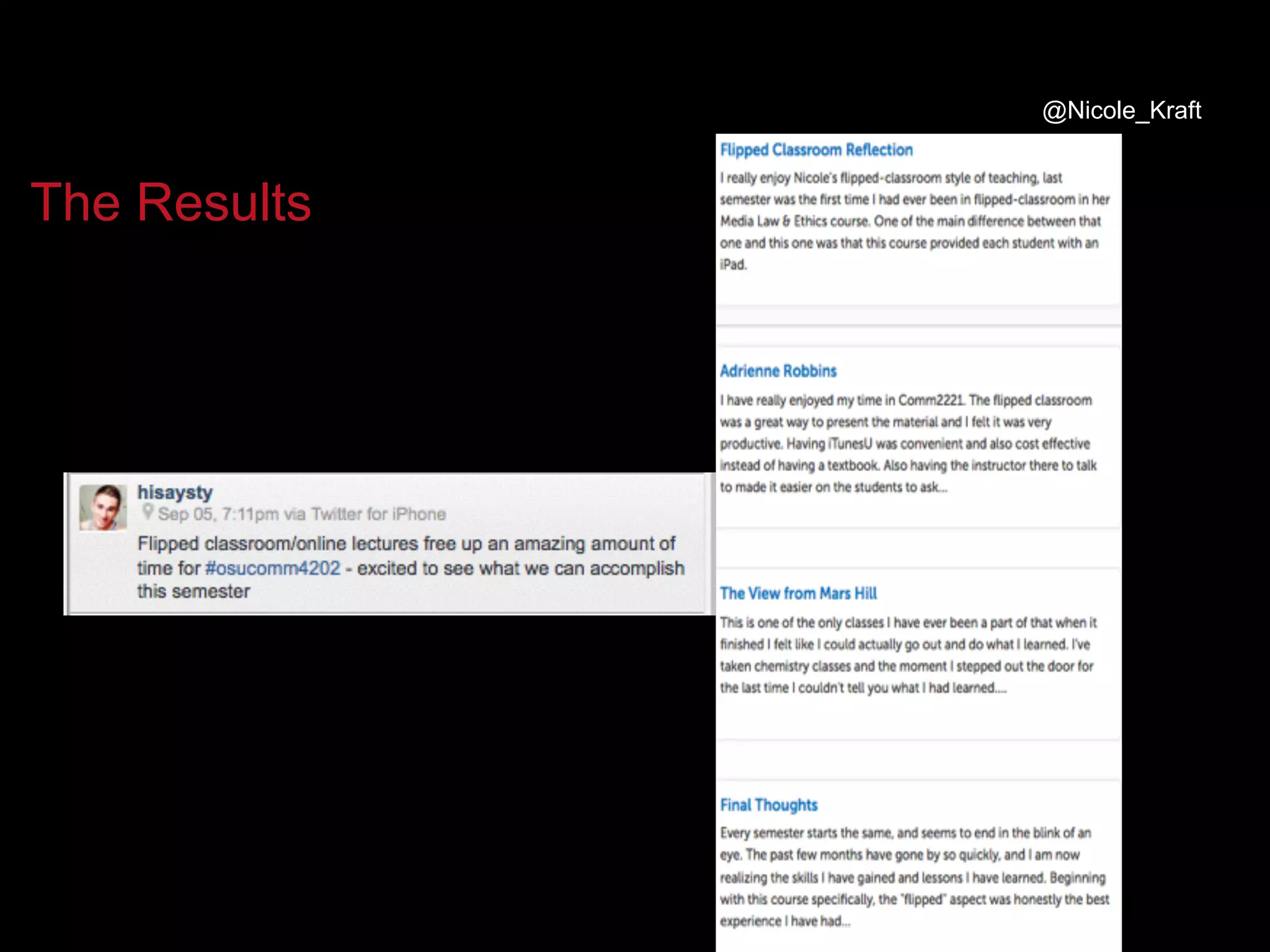
The Results
@Nicole_Kraft
Students Speak
@Nicole_Kraft
@Nicole_Kraft
Thank you!

Inverting Journalism

  • 1.
    Inverting Journalism iPad andiTunes U revolutionize the way we educate students Nicole Kraft Assistant Professor (clinical) @nicole_kraft
  • 2.
    Main Points • Thecollege classroom must train students like an entry-level job • Learning cannot stop when class sessions are done. • Don’t assume these students learn like you did. @Nicole_Kraft
  • 5.
    McMillan & Dwyer(1989) • As a result of educator/student interactions within a particular course, both parties anticipate that some learning will occur, some change in behavior will have taken place and some personal growth will be evident. • To facilitate such change, educators should ask, to ask 'Do I need to change my style of teaching to match the learning needs of these students?' • Investigate the possibility of matching teaching style with the students' learning styles. @Nicole_Kraft
  • 6.
  • 7.
    • Seek outlearning
  • 8.
  • 9.
    Introduction Journalism students canno longer focus on being just writers or photographers or videographers.They must leave college with a multitude of media skills to have the greatest potential for career success.
  • 10.
    iPad and supportingapps have created a “one-stop shop” of journalistic that enable students to develop those skills, including notebooks, recording devices, research platforms and writing.
  • 11.
    We conducted ayearlong study of beginning journalism students utilizing one-to-one iPads to examine the impact of iPads and appropriate apps in a “flipped” journalism classroom environment (where lectures are homework, and skill development and execution are done in class.
  • 12.
  • 13.
  • 14.
    METHOD A $25,000 impactgrant was used to purchase 30 iPads and iPad cases, wireless keyboards, microphones and six tripods for two news writing courses during Autumn/Spring semesters, 2013/2014. iPads were configured with several apps, including Pages, Twitter, GarageBand, iMovie, iTalk, iTunesU, Evernote, Dropbox, Storify, USA Today, Instagram, and AP Stylebook. Students were assigned five different types of articles during the course of the semester, including news and features, and each assignment contained a multimedia (video, audio, photo) and social media (Twitter, Instagram, Facebook) component. Students completed five online surveys—a pre-assessment, three post-assignment surveys, and one post-assessment— throughout the semester-long course. In addition to the surveys, several interviews were conducted, and additional data on students’ experience with the iPad was gathered from student blogs.
  • 18.
    And the researchshowed… • Student confidence in the iPad as a tool did significantly increase at the end of the semester. Most students utilized all the tools included in the device, from the video and audio recorder and camera, to note-taking apps, word processors and the AP stylebook. Initial feelings of confusion or doubt seemed to dissipate as students became more familiar with the device. • Most students fulfilled our goals for the course by fully utilizing iTunes U and the iPad, and student work improved. Both the number of items students published and their grades reflected an elevated and expedited learning environment. • Used as both educational platform and multimedia tool, iPads engaged students more deeply than conventional classroom interactions and enabled future journalists to learn and execute concepts faster in a “real-world-like” environment. @Nicole_Kraft
  • 19.
    • Students reportedhigher perceptions of their writing and reporting abilities at the end of the semester. Student knowledge of how social media is used in journalism, personal experience with social media, and knowledge of journalism technologies also increased by the end of the semester. • While students did increase their iPad use for the second assignment, iPad use dropped for the third assignment.We believe this was a result of increased difficulty of assignments, prompting students to go with the technology with which they were most comfortable. • Students reported positive experiences with the device’s portability and the convenience of having multiple tools in one. Camera/video quality and note-taking resources were also commonly reported as advantages. • Some students reported that the device felt bulky and awkward when shooting photos, and a few had difficulties getting used to the digital keyboard.A few comments were made about difficulties multi-tasking and a general sense of unfamiliarity. And the research showed…
  • 21.
  • 22.
  • 23.
  • 24.