Alessandra Buonanno
Max Planck Institute for Gravitational Physics
(Albert Einstein Institute)
Department of Physics, University of Maryland
“Waves on the Lake: The Astrophysics behind Gravitational Waves”
Lake Como School of Gravitational Waves, May 28 - June 1, 2018
The Analytical/Numerical Relativity Interface
behind Gravitational Waves: Lecture III
Outline
•Lecture I: Motivations and actual development of inspiral, merger
and ringdown waveforms
•Lecture II: Using waveform models to infer astrophysics and
cosmology with gravitational-wave observations
•Lecture III: Using waveform models to probe dynamical gravity and
extreme matter with gravitational-wave observations
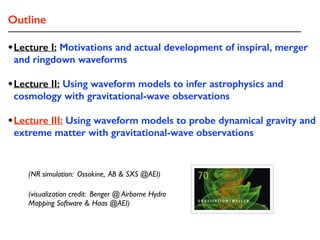
(visualization credit: Benger @ Airborne Hydro
Mapping Software & Haas @AEI)
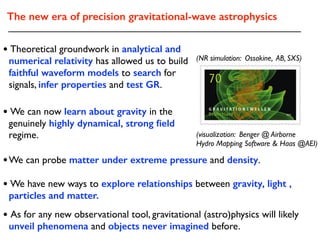
(NR simulation: Ossokine, AB & SXS @AEI)
• UMD/AEI graduate course on GW Physics & Astrophysics taught
in Winter-Spring 2017: http://www.aei.mpg.de/2000472.
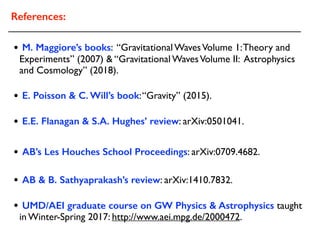
References:
• AB’s Les Houches School Proceedings: arXiv:0709.4682.
• E.E. Flanagan & S.A. Hughes’ review: arXiv:0501041.
• M. Maggiore’s books: “Gravitational WavesVolume 1:Theory and
Experiments” (2007) & “Gravitational WavesVolume II: Astrophysics
and Cosmology” (2018).
• E. Poisson & C. Will’s book:“Gravity” (2015).
• AB & B. Sathyaprakash’s review: arXiv:1410.7832.
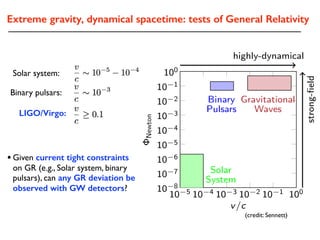
•Given current tight constraints
on GR (e.g., Solar system, binary
pulsars), can any GR deviation be
observed with GW detectors?
highly-dynamical
strong-field
10 5 10 4 10 3 10 2 10 1 10010 8
10 7
10 6
10 5
10 4
10 3
10 2
10 1
100
Solar
System
Binary
Pulsars
Gravitational
Waves
v/c
Newton
(credit: Sennett)
Solar system:
Binary pulsars:
LIGO/Virgo:
Extreme gravity, dynamical spacetime: tests of General Relativity
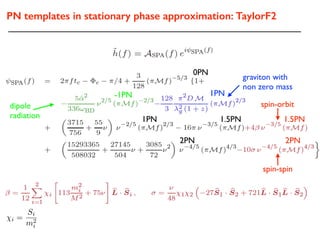
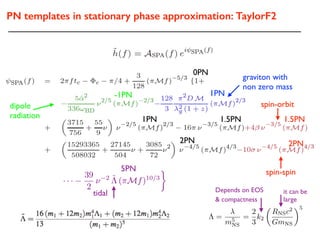
PN templates in stationary phase approximation: TaylorF2
i =
Si
m2
i
1PN 1.5PN
2PN
spin-orbit
1.5PN
spin-spin
2PN
0PN
graviton with
non zero mass
1PN
dipole
radiation
-1PN
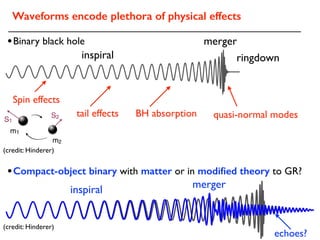
Waveforms encode plethora of physical effects
BH absorptiontail effects
merger
ringdown
•Binary black hole
Spin effects
inspiral
(credit: Hinderer)
•Compact-object binary with matter or in modified theory to GR?
quasi-normal modes
echoes?
(credit: Hinderer)
mergerinspiral
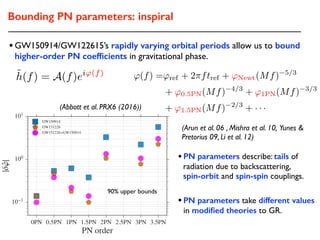
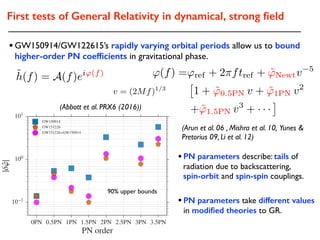
•GW150914/GW122615’s rapidly varying orbital periods allow us to bound
higher-order PN coefficients in gravitational phase.
0PN 0.5PN 1PN 1.5PN 2PN 2.5PN 3PN 3.5PN
PN order
10 1
100
101
|ˆ'|
GW150914
GW151226
GW151226+GW150914
(Arun et al. 06 , Mishra et al. 10, Yunes &
Pretorius 09, Li et al. 12)
•PN parameters describe: tails of
radiation due to backscattering,
spin-orbit and spin-spin couplings.
(Abbott et al. PRX6 (2016))
•PN parameters take different values
in modified theories to GR.
'(f) ='ref + 2⇡ftref + 'Newt(Mf) 5/3
+ '0.5PN(Mf) 4/3
+ '1PN(Mf) 3/3
+ '1.5PN(Mf) 2/3
+ · · ·
˜h(f) = A(f)ei'(f)
90% upper bounds
Bounding PN parameters: inspiral
•GW150914/GW122615’s rapidly varying orbital periods allow us to bound
higher-order PN coefficients in gravitational phase.
First tests of General Relativity in dynamical, strong field
0PN 0.5PN 1PN 1.5PN 2PN 2.5PN 3PN 3.5PN
PN order
10 1
100
101
|ˆ'|
GW150914
GW151226
GW151226+GW150914
(Arun et al. 06 , Mishra et al. 10, Yunes &
Pretorius 09, Li et al. 12)
•PN parameters describe: tails of
radiation due to backscattering,
spin-orbit and spin-spin couplings.
(Abbott et al. PRX6 (2016))
•PN parameters take different values
in modified theories to GR.
'(f) ='ref + 2⇡ftref + ˜'Newtv 5
⇥
1 + ˜'0.5PN v + ˜'1PN v2
+ ˜'1.5PN v3
+ · · ·
⇤
˜h(f) = A(f)ei'(f)
v = (2Mf)1/3
90% upper bounds
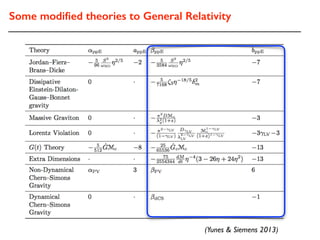
Some modified theories to General Relativity
(Yunes & Siemens 2013)
20 50 100 150 200 250 300
Frequency (Hz)
1.00
0.10
0.01
|hGW(f)|/1022(Hz)
inspiral intermediate
merger
ringdown
low frequency high frequency
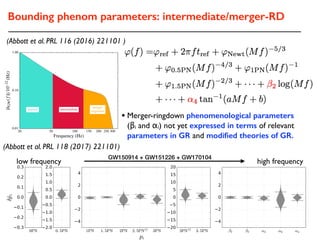
• Merger-ringdown phenomenological parameters
(βi and αi) not yet expressed in terms of relevant
parameters in GR and modified theories of GR.
Bounding phenom parameters: intermediate/merger-RD
(Abbott et al. PRL 116 (2016) 221101 )
GW150914 + GW151226 + GW170104
(Abbott et al. PRL 118 (2017) 221101)
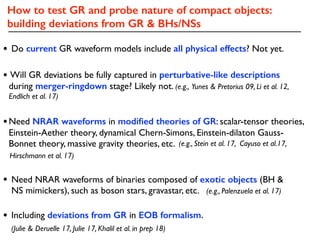
How to test GR and probe nature of compact objects:
building deviations from GR & BHs/NSs
• Will GR deviations be fully captured in perturbative-like descriptions
during merger-ringdown stage? Likely not. (e.g., Yunes & Pretorius 09, Li et al. 12,
Endlich et al. 17)
• Need NRAR waveforms of binaries composed of exotic objects (BH &
NS mimickers), such as boson stars, gravastar, etc. (e.g., Palenzuela et al. 17)
•Need NRAR waveforms in modified theories of GR: scalar-tensor theories,
Einstein-Aether theory, dynamical Chern-Simons, Einstein-dilaton Gauss-
Bonnet theory, massive gravity theories, etc. (e.g., Stein et al. 17, Cayuso et al.17,
Hirschmann et al. 17)
• Do current GR waveform models include all physical effects? Not yet.
• Including deviations from GR in EOB formalism.
(Julie & Deruelle 17, Julie 17, Khalil et al. in prep 18)
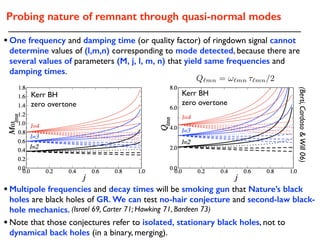
Q`mn = !`mn ⌧`mn/2
(Berti,Cardoso&Will06)
zero overtone
Kerr BH
zero overtone
Kerr BH
Probing nature of remnant through quasi-normal modes
•One frequency and damping time (or quality factor) of ringdown signal cannot
determine values of (l,m,n) corresponding to mode detected, because there are
several values of parameters (M, j, l, m, n) that yield same frequencies and
damping times.
•Multipole frequencies and decay times will be smoking gun that Nature’s black
holes are black holes of GR. We can test no-hair conjecture and second-law black-
hole mechanics. (Israel 69, Carter 71; Hawking 71, Bardeen 73)
•Note that those conjectures refer to isolated, stationary black holes, not to
dynamical back holes (in a binary, merging).
Black-hole spectroscopy using damped sinusoids
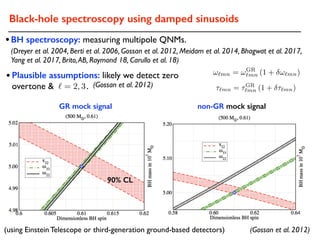
•BH spectroscopy: measuring multipole QNMs.
(Dreyer et al. 2004, Berti et al. 2006, Gossan et al. 2012, Meidam et al. 2014, Bhagwat et al. 2017,
Yang et al. 2017, Brito,AB, Raymond 18, Carullo et al. 18)
(Gossan et al. 2012)
!`mn = !GR
`mn (1 + !`mn)
⌧`mn = ⌧GR
`mn (1 + ⌧`mn)
non-GR mock signalGR mock signal
•Plausible assumptions: likely we detect zero
overtone & .
90% CL
` = 2, 3
(using Einstein Telescope or third-generation ground-based detectors)
(Gossan et al. 2012)
Probing remnant of GW150914 through quasi-normal modes
(Abbott et al. PRL 116 (2016) 221101 )
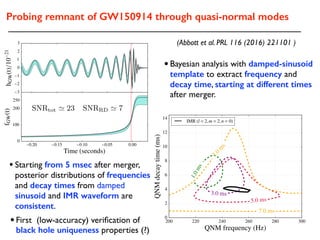
• Bayesian analysis with damped-sinusoid
template to extract frequency and
decay time, starting at different times
after merger.
200 220 240 260 280 300
QNM frequency (Hz)
0
2
4
6
8
10
12
14
QNMdecaytime(ms)
1.0ms
3.0 ms
5.0 ms
7.0 ms7.0
m
s
IMR (l = 2,m = 2,n = 0)
• Starting from 5 msec after merger,
posterior distributions of frequencies
and decay times from damped
sinusoid and IMR waveform are
consistent.
•First (low-accuracy) verification of
black hole uniqueness properties (?)
SNRtot ' 23 SNRRD ' 7
(Abbott et al. PRL 116 (2016) 221101 )
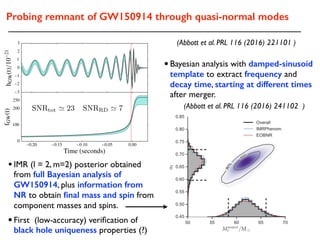
• Bayesian analysis with damped-sinusoid
template to extract frequency and
decay time, starting at different times
after merger.
•IMR (l = 2, m=2) posterior obtained
from full Bayesian analysis of
GW150914, plus information from
NR to obtain final mass and spin from
component masses and spins.
SNRtot ' 23 SNRRD ' 7
•First (low-accuracy) verification of
black hole uniqueness properties (?)
Probing remnant of GW150914 through quasi-normal modes
(Abbott et al. PRL 116 (2016) 241102 )
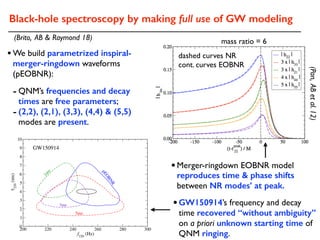
Black-hole spectroscopy by making full use of GW modeling
•We build parametrized inspiral-
merger-ringdown waveforms
(pEOBNR):
- QNM’s frequencies and decay
times are free parameters;
- (2,2), (2,1), (3,3), (4,4) & (5,5)
modes are present.
mass ratio = 6(Brito, AB & Raymond 18)
•Merger-ringdown EOBNR model
reproduces time & phase shifts
between NR modes’ at peak.
200 220 240 260 280 300
f220
(Hz)
0
1
2
3
4
5
6
7
8
9
10
τ220
(ms)
GW150914
pEOBNR
3ms
5ms
1m
s
•GW150914’s frequency and decay
time recovered “without ambiguity”
on a priori unknown starting time of
QNM ringing.
dashed curves NR
cont. curves EOBNR
(Pan,ABetal.12)
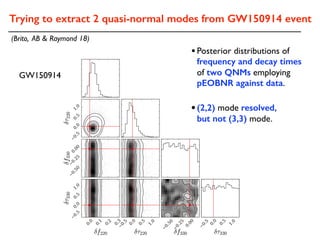
Trying to extract 2 quasi-normal modes from GW150914 event
(Brito, AB & Raymond 18)
•(2,2) mode resolved,
but not (3,3) mode.
GW150914
•Posterior distributions of
frequency and decay times
of two QNMs employing
pEOBNR against data.
0 10 20 30 40 50 60 70 80 90 100
Number of events
0.1
1
10
errorat2σ(%)
δf220
δf330
δτ220
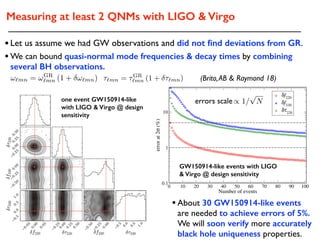
•We can bound quasi-normal mode frequencies & decay times by combining
several BH observations.
one event GW150914-like
with LIGO & Virgo @ design
sensitivity
(Brito,AB & Raymond 18)
•Let us assume we had GW observations and did not find deviations from GR.
GW150914-like events with LIGO
& Virgo @ design sensitivity
•About 30 GW150914-like events
are needed to achieve errors of 5%.
We will soon verify more accurately
black hole uniqueness properties.
!`mn = !GR
`mn (1 + !`mn) ⌧`mn = ⌧GR
`mn (1 + ⌧`mn)
Measuring at least 2 QNMs with LIGO & Virgo
errors scale/ 1/
p
N
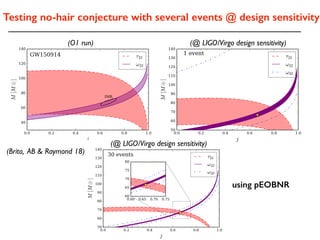
Testing no-hair conjecture with several events @ design sensitivity
(O1 run) (@ LIGO/Virgo design sensitivity)
(Brito, AB & Raymond 18)
using pEOBNR
(@ LIGO/Virgo design sensitivity)
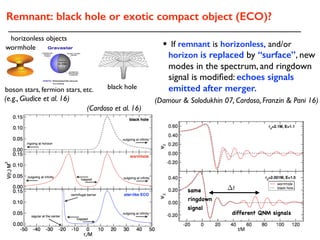
(Cardosoetal.16)
same 

ringdown

signal
different QNM signals
t
(Damour & Solodukhin 07, Cardoso, Franzin & Pani 16)
• If remnant is horizonless, and/or
horizon is replaced by “surface”, new
modes in the spectrum, and ringdown
signal is modified: echoes signals
emitted after merger.
Remnant: black hole or exotic compact object (ECO)?
horizonless objects
black hole
(Cardoso et al. 16)
wormhole
boson stars, fermion stars, etc.
(e.g., Giudice et al. 16)
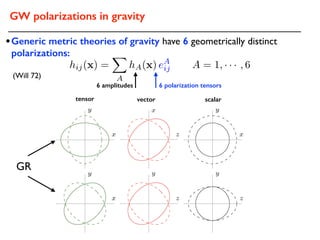
GW polarizations in gravity
•Generic metric theories of gravity have 6 geometrically distinct
polarizations:
tensor vector scalar
6 polarization tensors6 amplitudes
(Will 72)
hij(x) =
X
A
hA(x) eA
ij A = 1, · · · , 6
GR
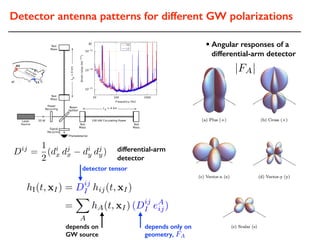
Detector antenna patterns for different GW polarizations
detector tensor
Photodetector
Beam
Splitter
Power
Recycling
Laser
Source
100 kW Circulating Power
b)
a)
Signal
Recycling
Test
Mass
Test
Mass
Test
Mass
Test
Mass
Lx = 4 km
20 W
H1
L1
10 ms light
travel time
Ly=4km
depends on
GW source
depends only on
geometry,
• Angular responses of a
differential-arm detector
differential-arm
detector
FA
|FA|
hI(t, xI) = Dij
I hij(t, xI)
=
X
A
hA(t, xI) (Dij
I eA
ij)
Dij
=
1
2
(di
x dj
x di
y dj
y)
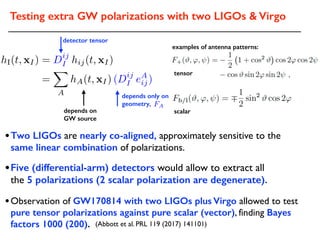
Testing extra GW polarizations with two LIGOs & Virgo
detector tensor
depends on
GW source
depends only on
geometry, FA
•Two LIGOs are nearly co-aligned, approximately sensitive to the
same linear combination of polarizations.
•Five (differential-arm) detectors would allow to extract all
the 5 polarizations (2 scalar polarization are degenerate).
•Observation of GW170814 with two LIGOs plus Virgo allowed to test
pure tensor polarizations against pure scalar (vector), finding Bayes
factors 1000 (200). (Abbott et al. PRL 119 (2017) 141101)
examples of antenna patterns:
tensor
scalar
hI(t, xI) = Dij
I hij(t, xI)
=
X
A
hA(t, xI) (Dij
I eA
ij)
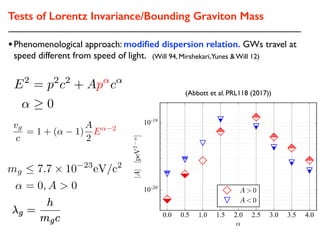
Tests of Lorentz Invariance/Bounding Graviton Mass
(Will 94, Mirshekari,Yunes & Will 12)
vg
c
= 1 + (↵ 1)
A
2
E↵ 2
E2
= p2
c2
+ Ap↵
c↵
↵ 0
mg  7.7 ⇥ 10 23
eV/c2
↵ = 0, A > 0
(Abbott et al. PRL118 (2017))
•Phenomenological approach: modified dispersion relation. GWs travel at
speed different from speed of light.
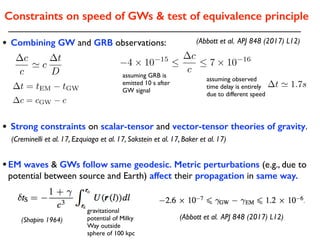
Constraints on speed of GWs & test of equivalence principle
(Abbott et al. APJ 848 (2017) L12)
• Strong constraints on scalar-tensor and vector-tensor theories of gravity.
• Combining GW and GRB observations:
(Creminelli et al. 17, Ezquiaga et al. 17, Sakstein et al. 17, Baker et al. 17)
c
c
' c
t
D
t = tEM tGW
c = cGW c
4 ⇥ 10 15

c
c
 7 ⇥ 10 16
assuming GRB is
emitted 10 s after
GW signal
assuming observed
time delay is entirely
due to different speed
t ' 1.7s
•EM waves & GWs follow same geodesic. Metric perturbations (e.g., due to
potential between source and Earth) affect their propagation in same way.
gravitational
potential of Milky
Way outside
sphere of 100 kpc
(Abbott et al. APJ 848 (2017) L12)(Shapiro 1964)
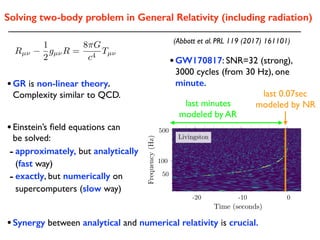
•GR is non-linear theory.
Complexity similar to QCD.
- approximately, but analytically
(fast way)
- exactly, but numerically on
supercomputers (slow way)
•Einstein’s field equations can
be solved:
•Synergy between analytical and numerical relativity is crucial.
•GW170817: SNR=32 (strong),
3000 cycles (from 30 Hz), one
minute.
last 0.07sec
modeled by NRlast minutes
modeled by AR
(Abbott et al. PRL 119 (2017) 161101)
Solving two-body problem in General Relativity (including radiation)
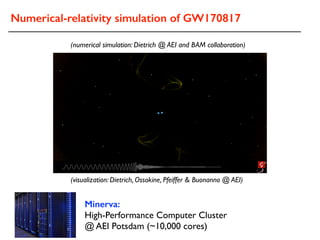
Numerical-relativity simulation of GW170817
(visualization: Dietrich, Ossokine, Pfeiffer & Buonanno @ AEI)
(numerical simulation: Dietrich @ AEI and BAM collaboration)
Minerva:
High-Performance Computer Cluster
@ AEI Potsdam (~10,000 cores)
mergerinspiral
post-merger
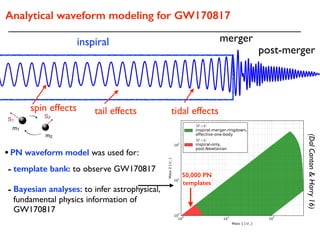
•PN waveform model was used for:
- template bank: to observe GW170817
- Bayesian analyses: to infer astrophysical,
fundamental physics information of
GW170817
Analytical waveform modeling for GW170817
(DalCanton&Harry16)
50,000 PN
templates
tail effects tidal effectsspin effects
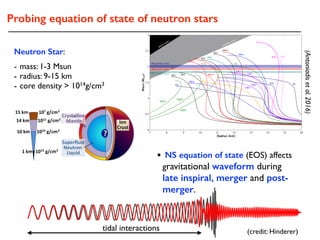
Probing equation of state of neutron stars
(Antoniadisetal.2016)
tidal interactions (credit: Hinderer)
Neutron Star:
- mass: 1-3 Msun
- radius: 9-15 km
- core density > 1014g/cm3
• NS equation of state (EOS) affects
gravitational waveform during
late inspiral, merger and post-
merger.
10 50 100 500 1000 5000
10 25
10 24
10 23
10 22
10 21
f Hz
BH BH
Initial LIGO
AdvancedLIGO
Einstein Telescope
10 50 100 500 1000 5000
10 25
10 24
10 23
10 22
10 21
f Hz
NS NS EOS HB
Initial LIGO
AdvancedLIGO
Einstein Telescope
NS-NS
post
merger
effectively point-particle tidal effects
BH-BH
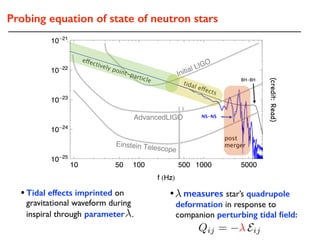
Probing equation of state of neutron stars
(credit:Read)
• measures star’s quadrupole
deformation in response to
companion perturbing tidal field:
•Tidal effects imprinted on
gravitational waveform during
inspiral through parameter .
Qij = Eij
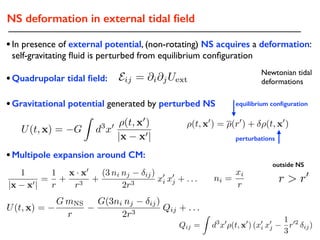
NS deformation in external tidal field
⇢(t, x0
) = ⇢(r0
) + ⇢(t, x0
)
1
|x x0|
=
1
r
+
x · x0
r3
+
(3 ni nj ij)
2r3
x0
i x0
j + . . . ni =
xi
r
•Gravitational potential generated by perturbed NS
•In presence of external potential, (non-rotating) NS acquires a deformation:
self-gravitating fluid is perturbed from equilibrium configuration
•Quadrupolar tidal field:
equilibrium configuration
perturbations
•Multipole expansion around CM:
r > r0
outside NS
Qij =
Z
d3
x0
⇢(t, x0
) (x0
i x0
j
1
3
r02
ij)
Newtonian tidal
deformationsEij = @i@jUext
U(t, x) = G
Z
d3
x0 ⇢(t, x0
)
|x x0|
U(t, x) =
G mNS
r
G(3ni nj ij)
2r3
Qij + . . .
NS deformation in external tidal field (contd.)
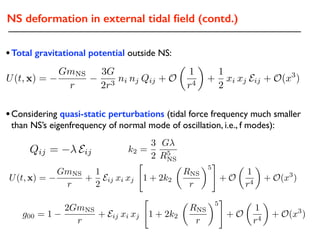
•Total gravitational potential outside NS:
•Considering quasi-static perturbations (tidal force frequency much smaller
than NS’s eigenfrequency of normal mode of oscillation, i.e., f modes):
Qij = Eij k2 =
3
2
G
R5
NS
U(t, x) =
GmNS
r
+
1
2
Eij xi xj
"
1 + 2k2
✓
RNS
r
◆5
#
+ O
✓
1
r4
◆
+ O(x3
)
g00 = 1
2GmNS
r
+ Eij xi xj
"
1 + 2k2
✓
RNS
r
◆5
#
+ O
✓
1
r4
◆
+ O(x3
)
U(t, x) =
GmNS
r
3G
2r3
ni nj Qij + O
✓
1
r4
◆
+
1
2
xi xj Eij + O(x3
)
PN templates in stationary phase approximation: TaylorF2
i =
Si
m2
i
1PN 1.5PN
2PN
spin-orbit
1.5PN
0PN
graviton with
non zero mass
1PN
dipole
radiation
-1PN
· · ·
39
2
⌫ 2 ˜⇤ (⇡Mf)10/3
spin-spin
2PN
tidal
5PN
⇤ =
m5
NS
=
2
3
k2
✓
RNSc2
GmNS
◆5
it can be
large
Depends on EOS
& compactness
Probing equation of state of neutron stars
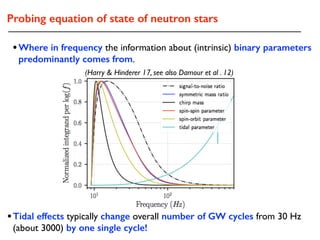
•Where in frequency the information about (intrinsic) binary parameters
predominantly comes from.
(Harry & Hinderer 17, see also Damour et al . 12)
•Tidal effects typically change overall number of GW cycles from 30 Hz
(about 3000) by one single cycle!
(Dietrich & Hinderer 17) time
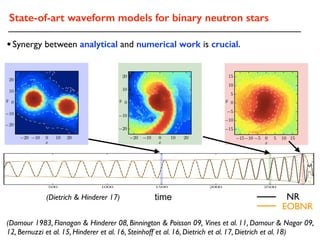
State-of-art waveform models for binary neutron stars
•Synergy between analytical and numerical work is crucial.
(Damour 1983, Flanagan & Hinderer 08, Binnington & Poisson 09, Vines et al. 11, Damour & Nagar 09,
12, Bernuzzi et al. 15, Hinderer et al. 16, Steinhoff et al. 16, Dietrich et al. 17, Dietrich et al. 18)
NR
EOBNR
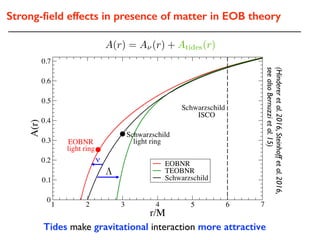
Strong-field effects in presence of matter in EOB theory
(Hindereretal.2016,Steinhoffetal.2016,
seealsoBernuzzietal.15)
Tides make gravitational interaction more attractive
1 2 3 4 5 6 7
r/M
0
0.1
0.2
0.3
0.4
0.5
0.6
0.7
A(r)
EOBNR
TEOBNR
Schwarzschild
ν
EOBNR
Schwarzschild
Schwarzschild
λ
light ring
light ring
ISCO
A(r) = A⌫(r) + Atides(r)
⇤
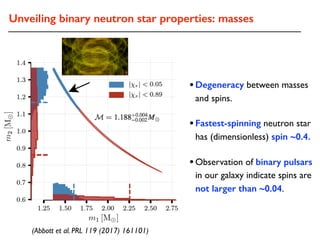
(Abbott et al. PRL 119 (2017) 161101)
•Observation of binary pulsars
in our galaxy indicate spins are
not larger than ~0.04.
•Fastest-spinning neutron star
has (dimensionless) spin ~0.4.
Unveiling binary neutron star properties: masses
•Degeneracy between masses
and spins.
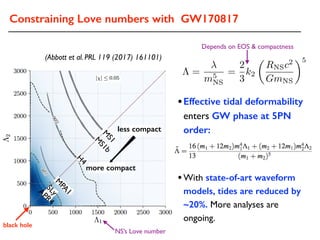
Constraining Love numbers with GW170817
(Abbott et al. PRL 119 (2017) 161101)
black hole
⇤ =
m5
NS
=
2
3
k2
✓
RNSc2
GmNS
◆5
Depends on EOS & compactness
NS’s Love number
M
S1
M
S1b
H
4
M
PA1
APR4SLy
less compact
more compact
•Effective tidal deformability
enters GW phase at 5PN
order:
•With state-of-art waveform
models, tides are reduced by
~20%. More analyses are
ongoing.
0.04 0.05 0.06 0.07 0.08 0.09
MΩ
0.00
0.05
0.10
0.15
8.6 7.5 6.5 5.8 5.3 4.8
r / M
k2
eff
k2
k3
eff k3
k4
eff
k4
NSBH mass ratio 2
Γ=2 polytropic
CNS=0.14444
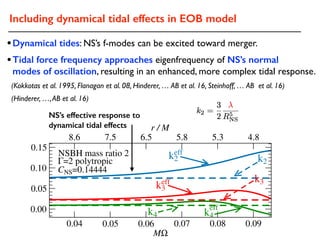
•Dynamical tides: NS’s f-modes can be excited toward merger.
(Kokkotas et al. 1995, Flanagan et al. 08, Hinderer, … AB et al. 16, Steinhoff, … AB et al. 16)
(Hinderer, …,AB et al. 16)
NS’s effective response to
dynamical tidal effects
Including dynamical tidal effects in EOB model
•Tidal force frequency approaches eigenfrequency of NS’s normal
modes of oscillation, resulting in an enhanced, more complex tidal response.
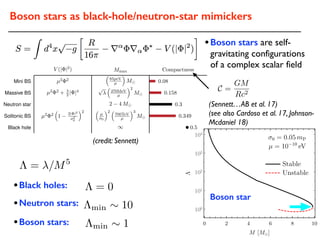
Boson stars as black-hole/neutron-star mimickers
(Sennett…AB et al. 17)
(see also Cardoso et al. 17, Johnson-
Mcdaniel 18)
•Boson stars are self-
gravitating configurations
of a complex scalar field
•Black holes:
•Boson stars:
⇤ = 0
⇤min ⇠ 1
•Neutron stars:
⇤ = /M5
(credit: Sennett)
0 2 4 6 8 10
100
101
102
103
104
C =
GM
Rc2
⇤min ⇠ 10
Boson star
0.08
0.158
0.3
0.349
0.5
CompactnessV (| |2) Mmax
Mini BS µ2 2
⇣
85peV
µ
⌘
M
Massive BS µ2 2 + 2 | |4
p ⇣
270MeV
µ
⌘2
M
Neutron star 2 4 M
Solitonic BS µ2 2
⇣
1 2| |2
2
0
⌘2 ⇣
µ
0
⌘2 ⇣
700TeV
µ
⌘3
M
Black hole 1
The new era of precision gravitational-wave astrophysics
• We can now learn about gravity in the
genuinely highly dynamical, strong field
regime.
• Theoretical groundwork in analytical and
numerical relativity has allowed us to build
faithful waveform models to search for
signals, infer properties and test GR.
• We have new ways to explore relationships between gravity, light ,
particles and matter.
• As for any new observational tool, gravitational (astro)physics will likely
unveil phenomena and objects never imagined before.
(visualization: Benger @ Airborne
Hydro Mapping Software & Haas @AEI)
(NR simulation: Ossokine, AB, SXS)
•We can probe matter under extreme pressure and density.

The Analytical/Numerical Relativity Interface behind Gravitational Waves: Lecture III - Alessandra Buonanno

  • 1.
    Alessandra Buonanno Max PlanckInstitute for Gravitational Physics (Albert Einstein Institute) Department of Physics, University of Maryland “Waves on the Lake: The Astrophysics behind Gravitational Waves” Lake Como School of Gravitational Waves, May 28 - June 1, 2018 The Analytical/Numerical Relativity Interface behind Gravitational Waves: Lecture III
  • 2.
    Outline •Lecture I: Motivationsand actual development of inspiral, merger and ringdown waveforms •Lecture II: Using waveform models to infer astrophysics and cosmology with gravitational-wave observations •Lecture III: Using waveform models to probe dynamical gravity and extreme matter with gravitational-wave observations (visualization credit: Benger @ Airborne Hydro Mapping Software & Haas @AEI) (NR simulation: Ossokine, AB & SXS @AEI)
  • 3.
    • UMD/AEI graduatecourse on GW Physics & Astrophysics taught in Winter-Spring 2017: http://www.aei.mpg.de/2000472. References: • AB’s Les Houches School Proceedings: arXiv:0709.4682. • E.E. Flanagan & S.A. Hughes’ review: arXiv:0501041. • M. Maggiore’s books: “Gravitational WavesVolume 1:Theory and Experiments” (2007) & “Gravitational WavesVolume II: Astrophysics and Cosmology” (2018). • E. Poisson & C. Will’s book:“Gravity” (2015). • AB & B. Sathyaprakash’s review: arXiv:1410.7832.
  • 4.
    •Given current tightconstraints on GR (e.g., Solar system, binary pulsars), can any GR deviation be observed with GW detectors? highly-dynamical strong-field 10 5 10 4 10 3 10 2 10 1 10010 8 10 7 10 6 10 5 10 4 10 3 10 2 10 1 100 Solar System Binary Pulsars Gravitational Waves v/c Newton (credit: Sennett) Solar system: Binary pulsars: LIGO/Virgo: Extreme gravity, dynamical spacetime: tests of General Relativity
  • 5.
    PN templates instationary phase approximation: TaylorF2 i = Si m2 i 1PN 1.5PN 2PN spin-orbit 1.5PN spin-spin 2PN 0PN graviton with non zero mass 1PN dipole radiation -1PN
  • 6.
    Waveforms encode plethoraof physical effects BH absorptiontail effects merger ringdown •Binary black hole Spin effects inspiral (credit: Hinderer) •Compact-object binary with matter or in modified theory to GR? quasi-normal modes echoes? (credit: Hinderer) mergerinspiral
  • 7.
    •GW150914/GW122615’s rapidly varyingorbital periods allow us to bound higher-order PN coefficients in gravitational phase. 0PN 0.5PN 1PN 1.5PN 2PN 2.5PN 3PN 3.5PN PN order 10 1 100 101 |ˆ'| GW150914 GW151226 GW151226+GW150914 (Arun et al. 06 , Mishra et al. 10, Yunes & Pretorius 09, Li et al. 12) •PN parameters describe: tails of radiation due to backscattering, spin-orbit and spin-spin couplings. (Abbott et al. PRX6 (2016)) •PN parameters take different values in modified theories to GR. '(f) ='ref + 2⇡ftref + 'Newt(Mf) 5/3 + '0.5PN(Mf) 4/3 + '1PN(Mf) 3/3 + '1.5PN(Mf) 2/3 + · · · ˜h(f) = A(f)ei'(f) 90% upper bounds Bounding PN parameters: inspiral
  • 8.
    •GW150914/GW122615’s rapidly varyingorbital periods allow us to bound higher-order PN coefficients in gravitational phase. First tests of General Relativity in dynamical, strong field 0PN 0.5PN 1PN 1.5PN 2PN 2.5PN 3PN 3.5PN PN order 10 1 100 101 |ˆ'| GW150914 GW151226 GW151226+GW150914 (Arun et al. 06 , Mishra et al. 10, Yunes & Pretorius 09, Li et al. 12) •PN parameters describe: tails of radiation due to backscattering, spin-orbit and spin-spin couplings. (Abbott et al. PRX6 (2016)) •PN parameters take different values in modified theories to GR. '(f) ='ref + 2⇡ftref + ˜'Newtv 5 ⇥ 1 + ˜'0.5PN v + ˜'1PN v2 + ˜'1.5PN v3 + · · · ⇤ ˜h(f) = A(f)ei'(f) v = (2Mf)1/3 90% upper bounds
  • 9.
    Some modified theoriesto General Relativity (Yunes & Siemens 2013)
  • 10.
    20 50 100150 200 250 300 Frequency (Hz) 1.00 0.10 0.01 |hGW(f)|/1022(Hz) inspiral intermediate merger ringdown low frequency high frequency • Merger-ringdown phenomenological parameters (βi and αi) not yet expressed in terms of relevant parameters in GR and modified theories of GR. Bounding phenom parameters: intermediate/merger-RD (Abbott et al. PRL 116 (2016) 221101 ) GW150914 + GW151226 + GW170104 (Abbott et al. PRL 118 (2017) 221101)
  • 11.
    How to testGR and probe nature of compact objects: building deviations from GR & BHs/NSs • Will GR deviations be fully captured in perturbative-like descriptions during merger-ringdown stage? Likely not. (e.g., Yunes & Pretorius 09, Li et al. 12, Endlich et al. 17) • Need NRAR waveforms of binaries composed of exotic objects (BH & NS mimickers), such as boson stars, gravastar, etc. (e.g., Palenzuela et al. 17) •Need NRAR waveforms in modified theories of GR: scalar-tensor theories, Einstein-Aether theory, dynamical Chern-Simons, Einstein-dilaton Gauss- Bonnet theory, massive gravity theories, etc. (e.g., Stein et al. 17, Cayuso et al.17, Hirschmann et al. 17) • Do current GR waveform models include all physical effects? Not yet. • Including deviations from GR in EOB formalism. (Julie & Deruelle 17, Julie 17, Khalil et al. in prep 18)
  • 12.
    Q`mn = !`mn⌧`mn/2 (Berti,Cardoso&Will06) zero overtone Kerr BH zero overtone Kerr BH Probing nature of remnant through quasi-normal modes •One frequency and damping time (or quality factor) of ringdown signal cannot determine values of (l,m,n) corresponding to mode detected, because there are several values of parameters (M, j, l, m, n) that yield same frequencies and damping times. •Multipole frequencies and decay times will be smoking gun that Nature’s black holes are black holes of GR. We can test no-hair conjecture and second-law black- hole mechanics. (Israel 69, Carter 71; Hawking 71, Bardeen 73) •Note that those conjectures refer to isolated, stationary black holes, not to dynamical back holes (in a binary, merging).
  • 13.
    Black-hole spectroscopy usingdamped sinusoids •BH spectroscopy: measuring multipole QNMs. (Dreyer et al. 2004, Berti et al. 2006, Gossan et al. 2012, Meidam et al. 2014, Bhagwat et al. 2017, Yang et al. 2017, Brito,AB, Raymond 18, Carullo et al. 18) (Gossan et al. 2012) !`mn = !GR `mn (1 + !`mn) ⌧`mn = ⌧GR `mn (1 + ⌧`mn) non-GR mock signalGR mock signal •Plausible assumptions: likely we detect zero overtone & . 90% CL ` = 2, 3 (using Einstein Telescope or third-generation ground-based detectors) (Gossan et al. 2012)
  • 14.
    Probing remnant ofGW150914 through quasi-normal modes (Abbott et al. PRL 116 (2016) 221101 ) • Bayesian analysis with damped-sinusoid template to extract frequency and decay time, starting at different times after merger. 200 220 240 260 280 300 QNM frequency (Hz) 0 2 4 6 8 10 12 14 QNMdecaytime(ms) 1.0ms 3.0 ms 5.0 ms 7.0 ms7.0 m s IMR (l = 2,m = 2,n = 0) • Starting from 5 msec after merger, posterior distributions of frequencies and decay times from damped sinusoid and IMR waveform are consistent. •First (low-accuracy) verification of black hole uniqueness properties (?) SNRtot ' 23 SNRRD ' 7
  • 15.
    (Abbott et al.PRL 116 (2016) 221101 ) • Bayesian analysis with damped-sinusoid template to extract frequency and decay time, starting at different times after merger. •IMR (l = 2, m=2) posterior obtained from full Bayesian analysis of GW150914, plus information from NR to obtain final mass and spin from component masses and spins. SNRtot ' 23 SNRRD ' 7 •First (low-accuracy) verification of black hole uniqueness properties (?) Probing remnant of GW150914 through quasi-normal modes (Abbott et al. PRL 116 (2016) 241102 )
  • 16.
    Black-hole spectroscopy bymaking full use of GW modeling •We build parametrized inspiral- merger-ringdown waveforms (pEOBNR): - QNM’s frequencies and decay times are free parameters; - (2,2), (2,1), (3,3), (4,4) & (5,5) modes are present. mass ratio = 6(Brito, AB & Raymond 18) •Merger-ringdown EOBNR model reproduces time & phase shifts between NR modes’ at peak. 200 220 240 260 280 300 f220 (Hz) 0 1 2 3 4 5 6 7 8 9 10 τ220 (ms) GW150914 pEOBNR 3ms 5ms 1m s •GW150914’s frequency and decay time recovered “without ambiguity” on a priori unknown starting time of QNM ringing. dashed curves NR cont. curves EOBNR (Pan,ABetal.12)
  • 17.
    Trying to extract2 quasi-normal modes from GW150914 event (Brito, AB & Raymond 18) •(2,2) mode resolved, but not (3,3) mode. GW150914 •Posterior distributions of frequency and decay times of two QNMs employing pEOBNR against data.
  • 18.
    0 10 2030 40 50 60 70 80 90 100 Number of events 0.1 1 10 errorat2σ(%) δf220 δf330 δτ220 •We can bound quasi-normal mode frequencies & decay times by combining several BH observations. one event GW150914-like with LIGO & Virgo @ design sensitivity (Brito,AB & Raymond 18) •Let us assume we had GW observations and did not find deviations from GR. GW150914-like events with LIGO & Virgo @ design sensitivity •About 30 GW150914-like events are needed to achieve errors of 5%. We will soon verify more accurately black hole uniqueness properties. !`mn = !GR `mn (1 + !`mn) ⌧`mn = ⌧GR `mn (1 + ⌧`mn) Measuring at least 2 QNMs with LIGO & Virgo errors scale/ 1/ p N
  • 19.
    Testing no-hair conjecturewith several events @ design sensitivity (O1 run) (@ LIGO/Virgo design sensitivity) (Brito, AB & Raymond 18) using pEOBNR (@ LIGO/Virgo design sensitivity)
  • 20.
    (Cardosoetal.16) same ringdown signal different QNMsignals t (Damour & Solodukhin 07, Cardoso, Franzin & Pani 16) • If remnant is horizonless, and/or horizon is replaced by “surface”, new modes in the spectrum, and ringdown signal is modified: echoes signals emitted after merger. Remnant: black hole or exotic compact object (ECO)? horizonless objects black hole (Cardoso et al. 16) wormhole boson stars, fermion stars, etc. (e.g., Giudice et al. 16)
  • 21.
    GW polarizations ingravity •Generic metric theories of gravity have 6 geometrically distinct polarizations: tensor vector scalar 6 polarization tensors6 amplitudes (Will 72) hij(x) = X A hA(x) eA ij A = 1, · · · , 6 GR
  • 22.
    Detector antenna patternsfor different GW polarizations detector tensor Photodetector Beam Splitter Power Recycling Laser Source 100 kW Circulating Power b) a) Signal Recycling Test Mass Test Mass Test Mass Test Mass Lx = 4 km 20 W H1 L1 10 ms light travel time Ly=4km depends on GW source depends only on geometry, • Angular responses of a differential-arm detector differential-arm detector FA |FA| hI(t, xI) = Dij I hij(t, xI) = X A hA(t, xI) (Dij I eA ij) Dij = 1 2 (di x dj x di y dj y)
  • 23.
    Testing extra GWpolarizations with two LIGOs & Virgo detector tensor depends on GW source depends only on geometry, FA •Two LIGOs are nearly co-aligned, approximately sensitive to the same linear combination of polarizations. •Five (differential-arm) detectors would allow to extract all the 5 polarizations (2 scalar polarization are degenerate). •Observation of GW170814 with two LIGOs plus Virgo allowed to test pure tensor polarizations against pure scalar (vector), finding Bayes factors 1000 (200). (Abbott et al. PRL 119 (2017) 141101) examples of antenna patterns: tensor scalar hI(t, xI) = Dij I hij(t, xI) = X A hA(t, xI) (Dij I eA ij)
  • 24.
    Tests of LorentzInvariance/Bounding Graviton Mass (Will 94, Mirshekari,Yunes & Will 12) vg c = 1 + (↵ 1) A 2 E↵ 2 E2 = p2 c2 + Ap↵ c↵ ↵ 0 mg  7.7 ⇥ 10 23 eV/c2 ↵ = 0, A > 0 (Abbott et al. PRL118 (2017)) •Phenomenological approach: modified dispersion relation. GWs travel at speed different from speed of light.
  • 25.
    Constraints on speedof GWs & test of equivalence principle (Abbott et al. APJ 848 (2017) L12) • Strong constraints on scalar-tensor and vector-tensor theories of gravity. • Combining GW and GRB observations: (Creminelli et al. 17, Ezquiaga et al. 17, Sakstein et al. 17, Baker et al. 17) c c ' c t D t = tEM tGW c = cGW c 4 ⇥ 10 15  c c  7 ⇥ 10 16 assuming GRB is emitted 10 s after GW signal assuming observed time delay is entirely due to different speed t ' 1.7s •EM waves & GWs follow same geodesic. Metric perturbations (e.g., due to potential between source and Earth) affect their propagation in same way. gravitational potential of Milky Way outside sphere of 100 kpc (Abbott et al. APJ 848 (2017) L12)(Shapiro 1964)
  • 26.
    •GR is non-lineartheory. Complexity similar to QCD. - approximately, but analytically (fast way) - exactly, but numerically on supercomputers (slow way) •Einstein’s field equations can be solved: •Synergy between analytical and numerical relativity is crucial. •GW170817: SNR=32 (strong), 3000 cycles (from 30 Hz), one minute. last 0.07sec modeled by NRlast minutes modeled by AR (Abbott et al. PRL 119 (2017) 161101) Solving two-body problem in General Relativity (including radiation)
  • 27.
    Numerical-relativity simulation ofGW170817 (visualization: Dietrich, Ossokine, Pfeiffer & Buonanno @ AEI) (numerical simulation: Dietrich @ AEI and BAM collaboration) Minerva: High-Performance Computer Cluster @ AEI Potsdam (~10,000 cores)
  • 28.
    mergerinspiral post-merger •PN waveform modelwas used for: - template bank: to observe GW170817 - Bayesian analyses: to infer astrophysical, fundamental physics information of GW170817 Analytical waveform modeling for GW170817 (DalCanton&Harry16) 50,000 PN templates tail effects tidal effectsspin effects
  • 29.
    Probing equation ofstate of neutron stars (Antoniadisetal.2016) tidal interactions (credit: Hinderer) Neutron Star: - mass: 1-3 Msun - radius: 9-15 km - core density > 1014g/cm3 • NS equation of state (EOS) affects gravitational waveform during late inspiral, merger and post- merger.
  • 30.
    10 50 100500 1000 5000 10 25 10 24 10 23 10 22 10 21 f Hz BH BH Initial LIGO AdvancedLIGO Einstein Telescope 10 50 100 500 1000 5000 10 25 10 24 10 23 10 22 10 21 f Hz NS NS EOS HB Initial LIGO AdvancedLIGO Einstein Telescope NS-NS post merger effectively point-particle tidal effects BH-BH Probing equation of state of neutron stars (credit:Read) • measures star’s quadrupole deformation in response to companion perturbing tidal field: •Tidal effects imprinted on gravitational waveform during inspiral through parameter . Qij = Eij
  • 31.
    NS deformation inexternal tidal field ⇢(t, x0 ) = ⇢(r0 ) + ⇢(t, x0 ) 1 |x x0| = 1 r + x · x0 r3 + (3 ni nj ij) 2r3 x0 i x0 j + . . . ni = xi r •Gravitational potential generated by perturbed NS •In presence of external potential, (non-rotating) NS acquires a deformation: self-gravitating fluid is perturbed from equilibrium configuration •Quadrupolar tidal field: equilibrium configuration perturbations •Multipole expansion around CM: r > r0 outside NS Qij = Z d3 x0 ⇢(t, x0 ) (x0 i x0 j 1 3 r02 ij) Newtonian tidal deformationsEij = @i@jUext U(t, x) = G Z d3 x0 ⇢(t, x0 ) |x x0| U(t, x) = G mNS r G(3ni nj ij) 2r3 Qij + . . .
  • 32.
    NS deformation inexternal tidal field (contd.) •Total gravitational potential outside NS: •Considering quasi-static perturbations (tidal force frequency much smaller than NS’s eigenfrequency of normal mode of oscillation, i.e., f modes): Qij = Eij k2 = 3 2 G R5 NS U(t, x) = GmNS r + 1 2 Eij xi xj " 1 + 2k2 ✓ RNS r ◆5 # + O ✓ 1 r4 ◆ + O(x3 ) g00 = 1 2GmNS r + Eij xi xj " 1 + 2k2 ✓ RNS r ◆5 # + O ✓ 1 r4 ◆ + O(x3 ) U(t, x) = GmNS r 3G 2r3 ni nj Qij + O ✓ 1 r4 ◆ + 1 2 xi xj Eij + O(x3 )
  • 33.
    PN templates instationary phase approximation: TaylorF2 i = Si m2 i 1PN 1.5PN 2PN spin-orbit 1.5PN 0PN graviton with non zero mass 1PN dipole radiation -1PN · · · 39 2 ⌫ 2 ˜⇤ (⇡Mf)10/3 spin-spin 2PN tidal 5PN ⇤ = m5 NS = 2 3 k2 ✓ RNSc2 GmNS ◆5 it can be large Depends on EOS & compactness
  • 34.
    Probing equation ofstate of neutron stars •Where in frequency the information about (intrinsic) binary parameters predominantly comes from. (Harry & Hinderer 17, see also Damour et al . 12) •Tidal effects typically change overall number of GW cycles from 30 Hz (about 3000) by one single cycle!
  • 35.
    (Dietrich & Hinderer17) time State-of-art waveform models for binary neutron stars •Synergy between analytical and numerical work is crucial. (Damour 1983, Flanagan & Hinderer 08, Binnington & Poisson 09, Vines et al. 11, Damour & Nagar 09, 12, Bernuzzi et al. 15, Hinderer et al. 16, Steinhoff et al. 16, Dietrich et al. 17, Dietrich et al. 18) NR EOBNR
  • 36.
    Strong-field effects inpresence of matter in EOB theory (Hindereretal.2016,Steinhoffetal.2016, seealsoBernuzzietal.15) Tides make gravitational interaction more attractive 1 2 3 4 5 6 7 r/M 0 0.1 0.2 0.3 0.4 0.5 0.6 0.7 A(r) EOBNR TEOBNR Schwarzschild ν EOBNR Schwarzschild Schwarzschild λ light ring light ring ISCO A(r) = A⌫(r) + Atides(r) ⇤
  • 37.
    (Abbott et al.PRL 119 (2017) 161101) •Observation of binary pulsars in our galaxy indicate spins are not larger than ~0.04. •Fastest-spinning neutron star has (dimensionless) spin ~0.4. Unveiling binary neutron star properties: masses •Degeneracy between masses and spins.
  • 38.
    Constraining Love numberswith GW170817 (Abbott et al. PRL 119 (2017) 161101) black hole ⇤ = m5 NS = 2 3 k2 ✓ RNSc2 GmNS ◆5 Depends on EOS & compactness NS’s Love number M S1 M S1b H 4 M PA1 APR4SLy less compact more compact •Effective tidal deformability enters GW phase at 5PN order: •With state-of-art waveform models, tides are reduced by ~20%. More analyses are ongoing.
  • 39.
    0.04 0.05 0.060.07 0.08 0.09 MΩ 0.00 0.05 0.10 0.15 8.6 7.5 6.5 5.8 5.3 4.8 r / M k2 eff k2 k3 eff k3 k4 eff k4 NSBH mass ratio 2 Γ=2 polytropic CNS=0.14444 •Dynamical tides: NS’s f-modes can be excited toward merger. (Kokkotas et al. 1995, Flanagan et al. 08, Hinderer, … AB et al. 16, Steinhoff, … AB et al. 16) (Hinderer, …,AB et al. 16) NS’s effective response to dynamical tidal effects Including dynamical tidal effects in EOB model •Tidal force frequency approaches eigenfrequency of NS’s normal modes of oscillation, resulting in an enhanced, more complex tidal response.
  • 40.
    Boson stars asblack-hole/neutron-star mimickers (Sennett…AB et al. 17) (see also Cardoso et al. 17, Johnson- Mcdaniel 18) •Boson stars are self- gravitating configurations of a complex scalar field •Black holes: •Boson stars: ⇤ = 0 ⇤min ⇠ 1 •Neutron stars: ⇤ = /M5 (credit: Sennett) 0 2 4 6 8 10 100 101 102 103 104 C = GM Rc2 ⇤min ⇠ 10 Boson star 0.08 0.158 0.3 0.349 0.5 CompactnessV (| |2) Mmax Mini BS µ2 2 ⇣ 85peV µ ⌘ M Massive BS µ2 2 + 2 | |4 p ⇣ 270MeV µ ⌘2 M Neutron star 2 4 M Solitonic BS µ2 2 ⇣ 1 2| |2 2 0 ⌘2 ⇣ µ 0 ⌘2 ⇣ 700TeV µ ⌘3 M Black hole 1
  • 41.
    The new eraof precision gravitational-wave astrophysics • We can now learn about gravity in the genuinely highly dynamical, strong field regime. • Theoretical groundwork in analytical and numerical relativity has allowed us to build faithful waveform models to search for signals, infer properties and test GR. • We have new ways to explore relationships between gravity, light , particles and matter. • As for any new observational tool, gravitational (astro)physics will likely unveil phenomena and objects never imagined before. (visualization: Benger @ Airborne Hydro Mapping Software & Haas @AEI) (NR simulation: Ossokine, AB, SXS) •We can probe matter under extreme pressure and density.