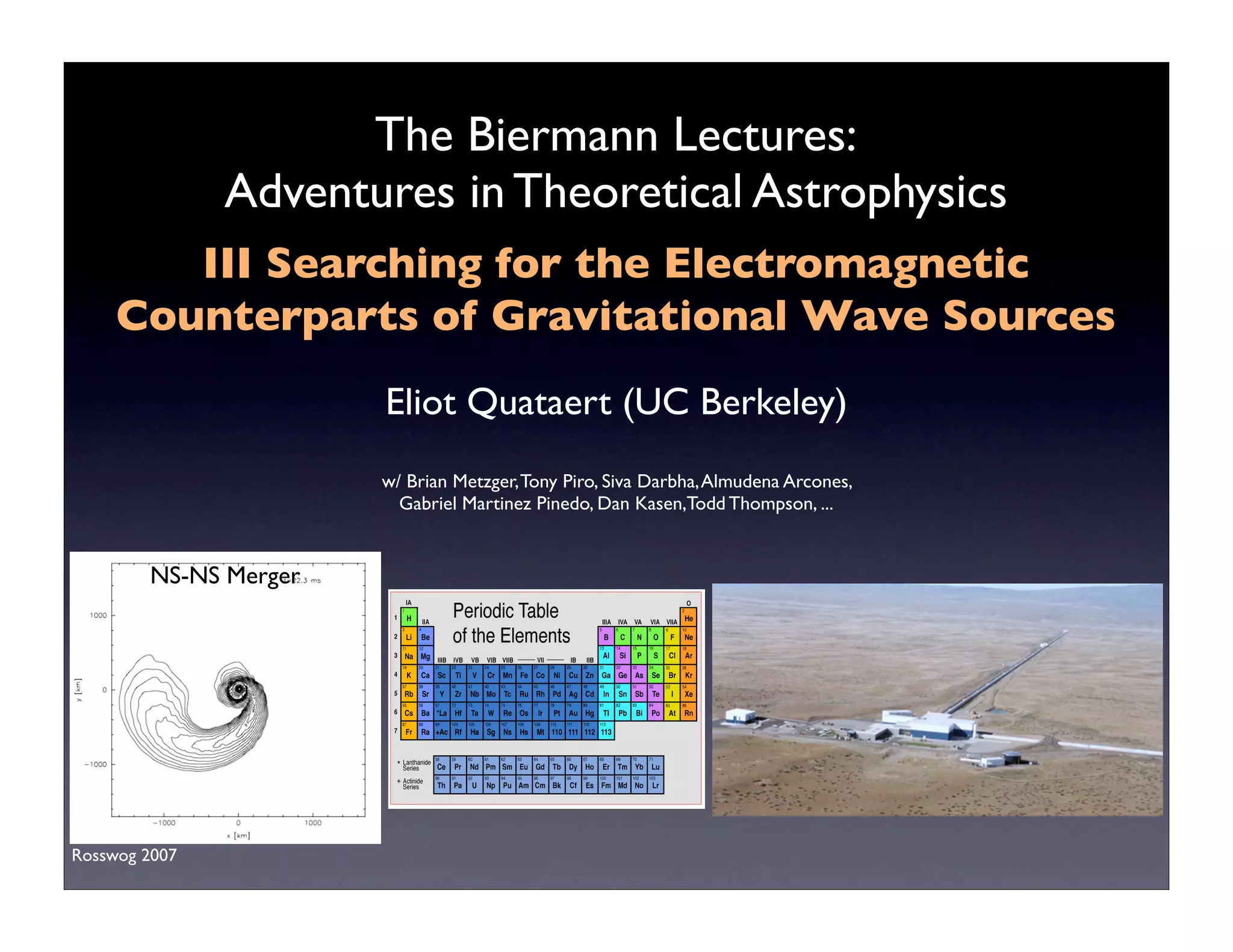
The Biermann Lectures: 
Adventures in Theoretical Astrophysics 
III Searching for the Electromagnetic 
Counterparts of Gravitational Wave Sources 
Eliot Quataert (UC Berkeley) 
w/ Brian Metzger, Tony Piro, Siva Darbha, Almudena Arcones, 
Gabriel Martinez Pinedo, Dan Kasen,Todd Thompson, ... 
NS-NS Merger 
Rosswog 2007
Overview 
• Context: kHz Gravitational Wave Astrophysics 
Likely Astrophysical Sources 
• Why worry about EM Counterparts? 
• Compact Object Mergers: GWs & Gamma-Ray Bursts 
• EM Counterparts & Transient Surveys 
NS-NS Merger 
Rosswog 2007
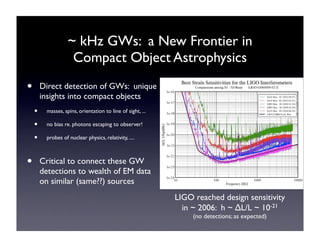
~ kHz GWs: a New Frontier in 
Compact Object Astrophysics 
LIGO reached design sensitivity 
in ~ 2006: h ~ ΔL/L ~ 10-21 
(no detections; as expected) 
• Direct detection of GWs: unique 
insights into compact objects 
• masses, spins, orientation to line of sight, ... 
• no bias re. photons escaping to observer! 
• probes of nuclear physics, relativity, .... 
• Critical to connect these GW 
detections to wealth of EM data 
on similar (same??) sources
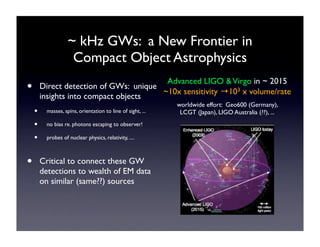
~ kHz GWs: a New Frontier in 
Compact Object Astrophysics 
Advanced LIGO & Virgo in ~ 2015 
~10x sensitivity →103 x volume/rate 
worldwide effort: Geo600 (Germany), 
LCGT (Japan), LIGO Australia (??), ... 
• Direct detection of GWs: unique 
insights into compact objects 
• masses, spins, orientation to line of sight, ... 
• no bias re. photons escaping to observer! 
• probes of nuclear physics, relativity, .... 
• Critical to connect these GW 
detections to wealth of EM data 
on similar (same??) sources
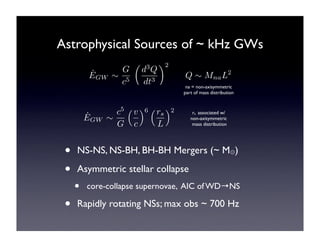
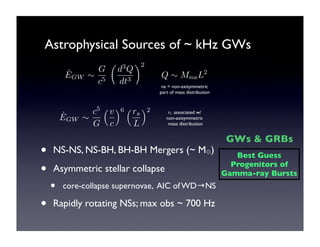
Astrophysical Sources of ~ kHz GWs 
˙E 
GW ! 
G 
c5 
! 
d3Q 
dt3 
"2 
Q ! MnaL2 
na = non-axisymmetric 
part of mass distribution 
˙E 
GW ! 
c5 
G 
!v 
c 
"6 !rs 
L 
"2 rs associated w/ 
non-axisymmetric 
mass distribution 
• NS-NS, NS-BH, BH-BH Mergers (~ M⊙) 
• Asymmetric stellar collapse 
• core-collapse supernovae, AIC of WD→NS 
• Rapidly rotating NSs; max obs ~ 700 Hz
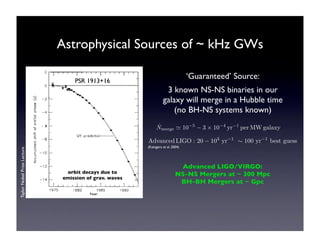
Astrophysical Sources of ~ kHz GWs 
merge ! 10−5 − 3 × 10⁻⁴ yr−1 perMWgalaxy 
Advanced LIGO/VIRGO: 
NS-NS Mergers at ~ 300 Mpc 
BH-BH Mergers at ~ Gpc 
Taylor Nobel Prize Lecture 
orbit decays due to 
emission of grav. waves 
‘Guaranteed’ Source: 
3 known NS-NS binaries in our 
galaxy will merge in a Hubble time 
(no BH-NS systems known) 
˙N 
(Kalogera et al. 2004) 
PSR 1913+16 
Advanced LIGO : 20 − 103 yr−1 " 100 yr−1 best guess
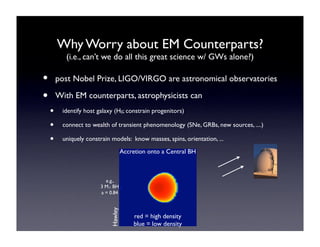
Why Worry about EM Counterparts? 
(i.e., can’t we do all this great science w/ GWs alone?) 
• post Nobel Prize, LIGO/VIRGO are astronomical observatories 
• With EM counterparts, astrophysicists can 
• identify host galaxy (H0; constrain progenitors) 
• connect to wealth of transient phenomenology (SNe, GRBs, new sources, ....) 
• uniquely constrain models: know masses, spins, orientation, ... 
Hawley 
Accretion onto a Central BH 
red = high density 
blue = low density 
• 
e.g., 
3 M⊙ BH 
a = 0.84
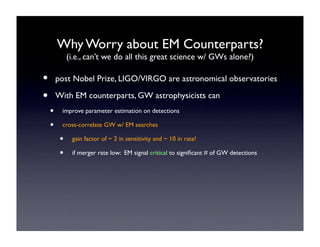
Why Worry about EM Counterparts? 
(i.e., can’t we do all this great science w/ GWs alone?) 
• post Nobel Prize, LIGO/VIRGO are astronomical observatories 
• With EM counterparts, GW astrophysicists can 
• improve parameter estimation on detections 
• cross-correlate GW w/ EM searches 
• gain factor of ~ 2 in sensitivity and ~ 10 in rate! 
• if merger rate low: EM signal critical to significant # of GW detections 
•
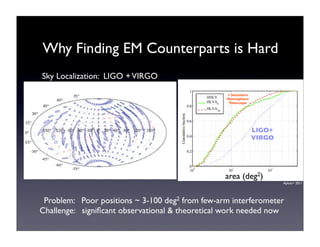
Why Finding EM Counterparts is Hard 
Sky Localization: LIGO + VIRGO 
LIGO+ 
VIRGO 
Aylott+ 2011 
+ Southern 
Hemisphere 
Telescope 
area (deg2) 
Problem: Poor positions ~ 3-100 deg2 from few-arm interferometer 
Challenge: significant observational & theoretical work needed now
Astrophysical Sources of ~ kHz GWs 
˙E 
GW ! 
G 
c5 
! 
d3Q 
dt3 
"2 
Q ! MnaL2 
na = non-axisymmetric 
part of mass distribution 
˙E 
GW ! 
c5 
G 
!v 
c 
"6 !rs 
L 
"2 rs associated w/ 
non-axisymmetric 
mass distribution 
• NS-NS, NS-BH, BH-BH Mergers (~ M⊙) 
• Asymmetric stellar collapse 
• core-collapse supernovae, AIC of WD→NS 
• Rapidly rotating NSs; max obs ~ 700 Hz 
GWs & GRBs 
Best Guess 
Progenitors of 
Gamma-ray Bursts
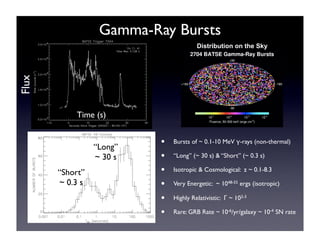
Gamma-Ray Bursts 
• Bursts of ~ 0.1-10 MeV γ-rays (non-thermal) 
• “Long” (~ 30 s) & “Short” (~ 0.3 s) 
• Isotropic & Cosmological: z ~ 0.1-8.3 
• Very Energetic: ~ 1048-55 ergs (isotropic) 
• Highly Relativistic: Γ ~ 102-3 
• Rare: GRB Rate ~ 10-6/yr/galaxy ~ 10-4 SN rate 
“Short” 
~ 0.3 s 
“Long” 
~ 30 s 
Distribution on the Sky 
Flux 
Time (s)
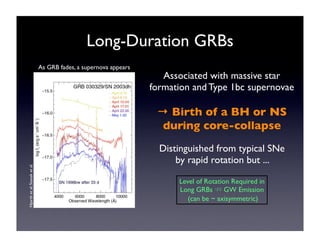
Long-Duration GRBs 
Hjorth et al; Stanek et al. 
As GRB fades, a supernova appears 
Associated with massive star 
formation and Type 1bc supernovae 
→ Birth of a BH or NS 
during core-collapse 
Distinguished from typical SNe 
by rapid rotation but ... 
Level of Rotation Required in 
Long GRBs ⇏ GW Emission 
(can be ~ axisymmetric)
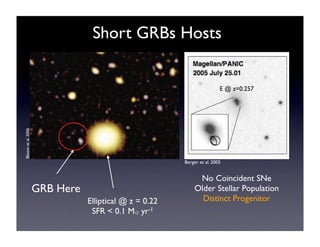
Short GRBs Hosts 
GRB Here 
Bloom et al. 2006 
Elliptical @ z = 0.22 
SFR < 0.1 M⊙ yr-1 
E @ z=0.257 
Berger et al. 2005 
No Coincident SNe 
Older Stellar Population 
Distinct Progenitor
NS-NS & NS-BH Mergers 
(Paczynski 1986; Goodman 1986; Eichler et al. 1989; Narayan et al. 1992 ....) 
NS-NS Merger 
t = 0.7 ms 
t = 3 ms 
Shabata & Taniguchi 2006 
Merger Leaves Behind 
Disk ~ 10-3-0.1 M⊙ 
(mostly free neutrons initially) 
density contours & velocity vectors 
consistent w/ short GRB durations
NS-NS & NS-BH Mergers 
(Paczynski 1986; Goodman 1986; Eichler et al. 1989; Narayan et al. 1992 ....) 
NS-NS Merger 
t = 0.7 ms 
t = 3 ms 
Shabata & Taniguchi 2006 
density contours & velocity vectors 
3 known NS-NS binaries in MW 
will merge in a Hubble time 
(Kalogera et al. 2004) 
short grb rate ~ 10-6 yr-1per MW 
˙N 
merge ! 10−5 − 3 × 10⁻⁴ yr−1 perMWgalaxy 
⇒ emission beamed 
(or not all mergers ⇒ GRB) 
EM counterpart to GW detection 
unlikely GRB; need ~ isotropic emission
The Evolution of the Remnant Disk 
ang momentum conservation → disk spreads (& cools) 
Local Disk Mass (M⊙) 
Radius (cm) 
1D time-dependent Models 
(α-viscosity; realistic ν-microphysics) 
➝ only neutrino 
cooling impt 
Lphoton ≲ LEdd 
(undetectable at ~ 100 Mpc!)
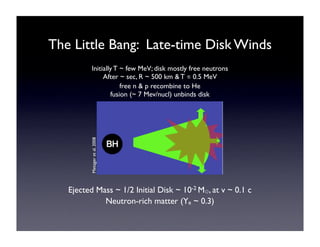
The Little Bang: Late-time Disk Winds 
Initially T ~ few MeV; disk mostly free neutrons 
After ~ sec, R ~ 500 km & T ≲ 0.5 MeV 
free n & p recombine to He 
fusion (~ 7 Mev/nucl) unbinds disk 
Ejected Mass ~ 1/2 Initial Disk ~ 10-2 M⊙, at v ~ 0.1 c 
Neutron-rich matter (Ye ~ 0.3) 
Metzger et al. 2008
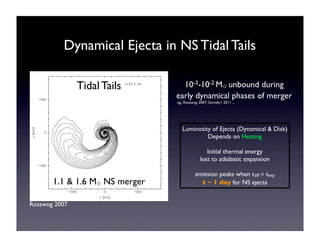
Dynamical Ejecta in NS Tidal Tails 
1.1 & 1.6 M⊙ NS merger 
Rosswog 2007 
Tidal Tails 10-3-10-2 M⊙ unbound during 
early dynamical phases of merger 
eg., Rosswog 2007; Goriely+ 2011 ... 
Luminosity of Ejecta (Dynamical & Disk) 
Depends on Heating 
Initial thermal energy 
lost to adiabatic expansion 
emission peaks when tdiff ≲ texp 
t ~ 1 day for NS ejecta
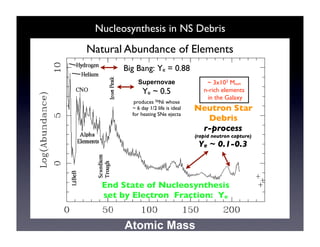
Nucleosynthesis in NS Debris 
Natural Abundance of Elements 
Big Bang: Ye = 0.88 
Supernovae 
Ye ~ 0.5 
~ 3x10³ Msun 
n-rich elements 
in the Galaxy 
Neutron Star 
produces 56Ni whose 
~ 6 day 1/2 life is ideal 
for heating SNe ejecta 
Atomic Mass 
Debris 
r-process 
(rapid neutron capture) 
Ye ~ 0.1-0.3 
End State of Nucleosynthesis 
set by Electron Fraction: Ye
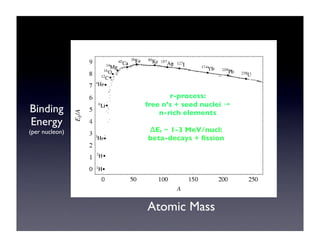
Binding 
Energy 
(per nucleon) 
r-process: 
free n’s + seed nuclei → 
n-rich elements 
ΔEr ~ 1-3 MeV/nucl: 
beta-decays + fission 
Atomic Mass
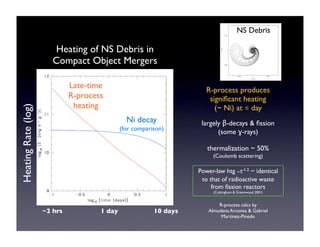
Heating of NS Debris in 
Compact Object Mergers 
Heating Rate (log) 
NS Debris 
R-process produces 
significant heating 
(~ Ni) at ≲ day 
largely β-decays & fission 
(some ɣ-rays) 
thermalization ~ 50% 
(Coulomb scattering) 
R-process calcs by 
Almudena Arcones & Gabriel 
Martinez-Pinedo 
Ni decay 
(for comparison) 
Late-time 
R-process 
heating 
~2 hrs 1 day 10 days 
Power-law htg ∝t-1.2 ~ identical 
to that of radioactive waste 
from fission reactors 
(Cottingham & Greenwood 2001)
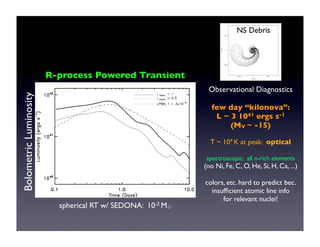
R-process Powered Transient 
NS Debris 
Bolometric Luminosity 
Observational Diagnostics 
few day “kilonova”: 
L ~ 3 1041 ergs s-1 
(MV ~ -15) 
T ~ 104 K at peak: optical 
spectroscopic: all n-rich elements 
(no Ni, Fe, C, O, He, Si, H, Ca, ...) 
colors, etc. hard to predict bec. 
insufficient atomic line info 
for relevant nuclei! 
spherical RT w/ SEDONA: 10-2 M⊙
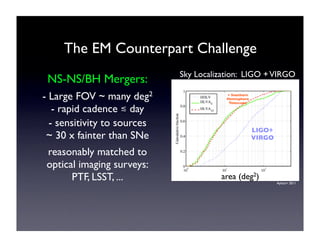
The EM Counterpart Challenge 
Sky Localization: LIGO + VIRGO 
LIGO+ 
VIRGO 
+ Southern 
Hemisphere 
Telescope 
Aylott+ 2011 
area (deg2) 
NS-NS/BH Mergers: 
- Large FOV ~ many deg2 
- rapid cadence ≲ day 
- sensitivity to sources 
~ 30 x fainter than SNe 
reasonably matched to 
optical imaging surveys: 
PTF, LSST, ...
NS-NS Merger 
EM Counterpart 
0 
10 
1 
10 
2 
Luminous Supernovae 
Core−Collapse 
Supernovae 
10 
−24 
−22 
−20 
−18 
−16 
−14 
−12 
−10 
−8 
−6 
Characteristic Timescale [day] 
] 
V 
Peak Luminosity [M 
Thermonuclear 
Supernovae 
Classical Novae 
Luminous 
Red 
Novae 
.Ia Explosions 
Ca−rich 
Transients 
45 
10 
44 
10 
43 
10 
42 
10 
41 
10 
40 
10 
39 
10 
38 
10 
Peak Luminosity [erg s−1] 
Optical Transients circa 2004 
Kasliwal (2011) PTF
NS-NS Merger 
EM Counterpart 
‘Blind’ Detection 
PTF: ~1 yr-1 
LSST: ~103 yr-1 
0 
10 
PTF11bij 
PTF09dav 
1 
10 
Luminous Supernovae 
PTF09cnd 
Core−Collapse 
Supernovae 
M85 OT 
2 
10 
−24 
−22 
−20 
−18 
−16 
−14 
−12 
−10 
−8 
−6 
SN2005ap SN2008es 
SN2005E 
PTF10acbp 
Characteristic Timescale [day] 
] 
V 
Peak Luminosity [M 
V838 Mon 
M31 RV 
SCP06F6 
SN2006gy 
SN2007bi 
SN2008S 
NGC300OT 
SN2008ha 
SN2002bj 
PTF10iuv 
PTF10bhp 
PTF10fqs 
PTF09atu 
PTF10cwr PTF09cwl 
Thermonuclear 
Supernovae 
Classical Novae 
Luminous 
Red 
Novae 
.Ia Explosions 
Ca−rich 
Transients 
P60−M81OT−071213 
P60−M82OT−081119 
45 
10 
44 
10 
43 
10 
42 
10 
41 
10 
40 
10 
39 
10 
38 
10 
Peak Luminosity [erg s−1] 
Optical Transients circa 2011 
Kasliwal (2011) PTF
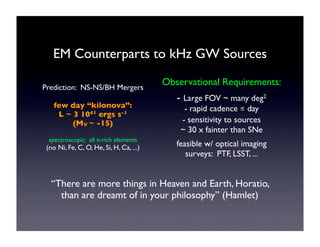
EM Counterparts to kHz GW Sources 
Observational Requirements: 
- Large FOV ~ many deg2 
- rapid cadence ≲ day 
- sensitivity to sources 
~ 30 x fainter than SNe 
feasible w/ optical imaging 
surveys: PTF, LSST, ... 
Prediction: NS-NS/BH Mergers 
few day “kilonova”: 
L ~ 3 1041 ergs s-1 
(MV ~ -15) 
spectroscopic: all n-rich elements 
(no Ni, Fe, C, O, He, Si, H, Ca, ...) 
“There are more things in Heaven and Earth, Horatio, 
than are dreamt of in your philosophy” (Hamlet)
The Biermann Lectures: 
Adventures in Theoretical Astrophysics 
• work on a range of problems: ‘model building’ & studying key processes 
• Compact Object Astrophysics 
• gamma-ray bursts, transients, accretion theory, the Galactic Center 
• Galaxy Formation 
• massive black hole growth, galactic winds, ‘feedback’, star formation in galaxies 
• Plasma Astrophysics 
• plasma instabilities (disks, galaxy clusters, ...), plasma turbulence (incl solar wind) 
• Stellar Astrophysics 
Thanks for your hospitality! 
• stellar seismology, tides

Biermann AstroPhysic

  • 1.
    The Biermann Lectures: Adventures in Theoretical Astrophysics III Searching for the Electromagnetic Counterparts of Gravitational Wave Sources Eliot Quataert (UC Berkeley) w/ Brian Metzger, Tony Piro, Siva Darbha, Almudena Arcones, Gabriel Martinez Pinedo, Dan Kasen,Todd Thompson, ... NS-NS Merger Rosswog 2007
  • 2.
    Overview • Context:kHz Gravitational Wave Astrophysics Likely Astrophysical Sources • Why worry about EM Counterparts? • Compact Object Mergers: GWs & Gamma-Ray Bursts • EM Counterparts & Transient Surveys NS-NS Merger Rosswog 2007
  • 3.
    ~ kHz GWs:a New Frontier in Compact Object Astrophysics LIGO reached design sensitivity in ~ 2006: h ~ ΔL/L ~ 10-21 (no detections; as expected) • Direct detection of GWs: unique insights into compact objects • masses, spins, orientation to line of sight, ... • no bias re. photons escaping to observer! • probes of nuclear physics, relativity, .... • Critical to connect these GW detections to wealth of EM data on similar (same??) sources
  • 4.
    ~ kHz GWs:a New Frontier in Compact Object Astrophysics Advanced LIGO & Virgo in ~ 2015 ~10x sensitivity →103 x volume/rate worldwide effort: Geo600 (Germany), LCGT (Japan), LIGO Australia (??), ... • Direct detection of GWs: unique insights into compact objects • masses, spins, orientation to line of sight, ... • no bias re. photons escaping to observer! • probes of nuclear physics, relativity, .... • Critical to connect these GW detections to wealth of EM data on similar (same??) sources
  • 5.
    Astrophysical Sources of~ kHz GWs ˙E GW ! G c5 ! d3Q dt3 "2 Q ! MnaL2 na = non-axisymmetric part of mass distribution ˙E GW ! c5 G !v c "6 !rs L "2 rs associated w/ non-axisymmetric mass distribution • NS-NS, NS-BH, BH-BH Mergers (~ M⊙) • Asymmetric stellar collapse • core-collapse supernovae, AIC of WD→NS • Rapidly rotating NSs; max obs ~ 700 Hz
  • 6.
    Astrophysical Sources of~ kHz GWs merge ! 10−5 − 3 × 10⁻⁴ yr−1 perMWgalaxy Advanced LIGO/VIRGO: NS-NS Mergers at ~ 300 Mpc BH-BH Mergers at ~ Gpc Taylor Nobel Prize Lecture orbit decays due to emission of grav. waves ‘Guaranteed’ Source: 3 known NS-NS binaries in our galaxy will merge in a Hubble time (no BH-NS systems known) ˙N (Kalogera et al. 2004) PSR 1913+16 Advanced LIGO : 20 − 103 yr−1 " 100 yr−1 best guess
  • 7.
    Why Worry aboutEM Counterparts? (i.e., can’t we do all this great science w/ GWs alone?) • post Nobel Prize, LIGO/VIRGO are astronomical observatories • With EM counterparts, astrophysicists can • identify host galaxy (H0; constrain progenitors) • connect to wealth of transient phenomenology (SNe, GRBs, new sources, ....) • uniquely constrain models: know masses, spins, orientation, ... Hawley Accretion onto a Central BH red = high density blue = low density • e.g., 3 M⊙ BH a = 0.84
  • 8.
    Why Worry aboutEM Counterparts? (i.e., can’t we do all this great science w/ GWs alone?) • post Nobel Prize, LIGO/VIRGO are astronomical observatories • With EM counterparts, GW astrophysicists can • improve parameter estimation on detections • cross-correlate GW w/ EM searches • gain factor of ~ 2 in sensitivity and ~ 10 in rate! • if merger rate low: EM signal critical to significant # of GW detections •
  • 9.
    Why Finding EMCounterparts is Hard Sky Localization: LIGO + VIRGO LIGO+ VIRGO Aylott+ 2011 + Southern Hemisphere Telescope area (deg2) Problem: Poor positions ~ 3-100 deg2 from few-arm interferometer Challenge: significant observational & theoretical work needed now
  • 10.
    Astrophysical Sources of~ kHz GWs ˙E GW ! G c5 ! d3Q dt3 "2 Q ! MnaL2 na = non-axisymmetric part of mass distribution ˙E GW ! c5 G !v c "6 !rs L "2 rs associated w/ non-axisymmetric mass distribution • NS-NS, NS-BH, BH-BH Mergers (~ M⊙) • Asymmetric stellar collapse • core-collapse supernovae, AIC of WD→NS • Rapidly rotating NSs; max obs ~ 700 Hz GWs & GRBs Best Guess Progenitors of Gamma-ray Bursts
  • 11.
    Gamma-Ray Bursts •Bursts of ~ 0.1-10 MeV γ-rays (non-thermal) • “Long” (~ 30 s) & “Short” (~ 0.3 s) • Isotropic & Cosmological: z ~ 0.1-8.3 • Very Energetic: ~ 1048-55 ergs (isotropic) • Highly Relativistic: Γ ~ 102-3 • Rare: GRB Rate ~ 10-6/yr/galaxy ~ 10-4 SN rate “Short” ~ 0.3 s “Long” ~ 30 s Distribution on the Sky Flux Time (s)
  • 12.
    Long-Duration GRBs Hjorthet al; Stanek et al. As GRB fades, a supernova appears Associated with massive star formation and Type 1bc supernovae → Birth of a BH or NS during core-collapse Distinguished from typical SNe by rapid rotation but ... Level of Rotation Required in Long GRBs ⇏ GW Emission (can be ~ axisymmetric)
  • 13.
    Short GRBs Hosts GRB Here Bloom et al. 2006 Elliptical @ z = 0.22 SFR < 0.1 M⊙ yr-1 E @ z=0.257 Berger et al. 2005 No Coincident SNe Older Stellar Population Distinct Progenitor
  • 14.
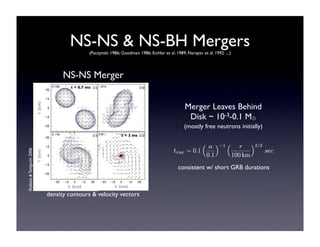
    NS-NS & NS-BHMergers (Paczynski 1986; Goodman 1986; Eichler et al. 1989; Narayan et al. 1992 ....) NS-NS Merger t = 0.7 ms t = 3 ms Shabata & Taniguchi 2006 Merger Leaves Behind Disk ~ 10-3-0.1 M⊙ (mostly free neutrons initially) density contours & velocity vectors consistent w/ short GRB durations
  • 15.
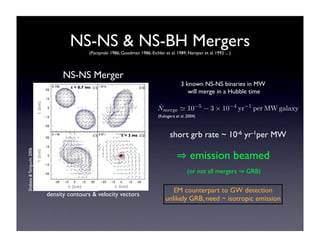
    NS-NS & NS-BHMergers (Paczynski 1986; Goodman 1986; Eichler et al. 1989; Narayan et al. 1992 ....) NS-NS Merger t = 0.7 ms t = 3 ms Shabata & Taniguchi 2006 density contours & velocity vectors 3 known NS-NS binaries in MW will merge in a Hubble time (Kalogera et al. 2004) short grb rate ~ 10-6 yr-1per MW ˙N merge ! 10−5 − 3 × 10⁻⁴ yr−1 perMWgalaxy ⇒ emission beamed (or not all mergers ⇒ GRB) EM counterpart to GW detection unlikely GRB; need ~ isotropic emission
  • 16.
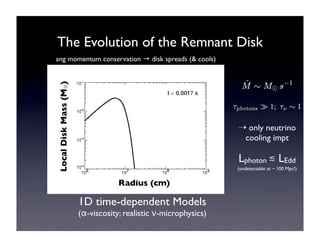
    The Evolution ofthe Remnant Disk ang momentum conservation → disk spreads (& cools) Local Disk Mass (M⊙) Radius (cm) 1D time-dependent Models (α-viscosity; realistic ν-microphysics) ➝ only neutrino cooling impt Lphoton ≲ LEdd (undetectable at ~ 100 Mpc!)
  • 17.
    The Little Bang:Late-time Disk Winds Initially T ~ few MeV; disk mostly free neutrons After ~ sec, R ~ 500 km & T ≲ 0.5 MeV free n & p recombine to He fusion (~ 7 Mev/nucl) unbinds disk Ejected Mass ~ 1/2 Initial Disk ~ 10-2 M⊙, at v ~ 0.1 c Neutron-rich matter (Ye ~ 0.3) Metzger et al. 2008
  • 18.
    Dynamical Ejecta inNS Tidal Tails 1.1 & 1.6 M⊙ NS merger Rosswog 2007 Tidal Tails 10-3-10-2 M⊙ unbound during early dynamical phases of merger eg., Rosswog 2007; Goriely+ 2011 ... Luminosity of Ejecta (Dynamical & Disk) Depends on Heating Initial thermal energy lost to adiabatic expansion emission peaks when tdiff ≲ texp t ~ 1 day for NS ejecta
  • 19.
    Nucleosynthesis in NSDebris Natural Abundance of Elements Big Bang: Ye = 0.88 Supernovae Ye ~ 0.5 ~ 3x10³ Msun n-rich elements in the Galaxy Neutron Star produces 56Ni whose ~ 6 day 1/2 life is ideal for heating SNe ejecta Atomic Mass Debris r-process (rapid neutron capture) Ye ~ 0.1-0.3 End State of Nucleosynthesis set by Electron Fraction: Ye
  • 20.
    Binding Energy (pernucleon) r-process: free n’s + seed nuclei → n-rich elements ΔEr ~ 1-3 MeV/nucl: beta-decays + fission Atomic Mass
  • 21.
    Heating of NSDebris in Compact Object Mergers Heating Rate (log) NS Debris R-process produces significant heating (~ Ni) at ≲ day largely β-decays & fission (some ɣ-rays) thermalization ~ 50% (Coulomb scattering) R-process calcs by Almudena Arcones & Gabriel Martinez-Pinedo Ni decay (for comparison) Late-time R-process heating ~2 hrs 1 day 10 days Power-law htg ∝t-1.2 ~ identical to that of radioactive waste from fission reactors (Cottingham & Greenwood 2001)
  • 22.
    R-process Powered Transient NS Debris Bolometric Luminosity Observational Diagnostics few day “kilonova”: L ~ 3 1041 ergs s-1 (MV ~ -15) T ~ 104 K at peak: optical spectroscopic: all n-rich elements (no Ni, Fe, C, O, He, Si, H, Ca, ...) colors, etc. hard to predict bec. insufficient atomic line info for relevant nuclei! spherical RT w/ SEDONA: 10-2 M⊙
  • 23.
    The EM CounterpartChallenge Sky Localization: LIGO + VIRGO LIGO+ VIRGO + Southern Hemisphere Telescope Aylott+ 2011 area (deg2) NS-NS/BH Mergers: - Large FOV ~ many deg2 - rapid cadence ≲ day - sensitivity to sources ~ 30 x fainter than SNe reasonably matched to optical imaging surveys: PTF, LSST, ...
  • 24.
    NS-NS Merger EMCounterpart 0 10 1 10 2 Luminous Supernovae Core−Collapse Supernovae 10 −24 −22 −20 −18 −16 −14 −12 −10 −8 −6 Characteristic Timescale [day] ] V Peak Luminosity [M Thermonuclear Supernovae Classical Novae Luminous Red Novae .Ia Explosions Ca−rich Transients 45 10 44 10 43 10 42 10 41 10 40 10 39 10 38 10 Peak Luminosity [erg s−1] Optical Transients circa 2004 Kasliwal (2011) PTF
  • 25.
    NS-NS Merger EMCounterpart ‘Blind’ Detection PTF: ~1 yr-1 LSST: ~103 yr-1 0 10 PTF11bij PTF09dav 1 10 Luminous Supernovae PTF09cnd Core−Collapse Supernovae M85 OT 2 10 −24 −22 −20 −18 −16 −14 −12 −10 −8 −6 SN2005ap SN2008es SN2005E PTF10acbp Characteristic Timescale [day] ] V Peak Luminosity [M V838 Mon M31 RV SCP06F6 SN2006gy SN2007bi SN2008S NGC300OT SN2008ha SN2002bj PTF10iuv PTF10bhp PTF10fqs PTF09atu PTF10cwr PTF09cwl Thermonuclear Supernovae Classical Novae Luminous Red Novae .Ia Explosions Ca−rich Transients P60−M81OT−071213 P60−M82OT−081119 45 10 44 10 43 10 42 10 41 10 40 10 39 10 38 10 Peak Luminosity [erg s−1] Optical Transients circa 2011 Kasliwal (2011) PTF
  • 26.
    EM Counterparts tokHz GW Sources Observational Requirements: - Large FOV ~ many deg2 - rapid cadence ≲ day - sensitivity to sources ~ 30 x fainter than SNe feasible w/ optical imaging surveys: PTF, LSST, ... Prediction: NS-NS/BH Mergers few day “kilonova”: L ~ 3 1041 ergs s-1 (MV ~ -15) spectroscopic: all n-rich elements (no Ni, Fe, C, O, He, Si, H, Ca, ...) “There are more things in Heaven and Earth, Horatio, than are dreamt of in your philosophy” (Hamlet)
  • 27.
    The Biermann Lectures: Adventures in Theoretical Astrophysics • work on a range of problems: ‘model building’ & studying key processes • Compact Object Astrophysics • gamma-ray bursts, transients, accretion theory, the Galactic Center • Galaxy Formation • massive black hole growth, galactic winds, ‘feedback’, star formation in galaxies • Plasma Astrophysics • plasma instabilities (disks, galaxy clusters, ...), plasma turbulence (incl solar wind) • Stellar Astrophysics Thanks for your hospitality! • stellar seismology, tides