Producing Science with the Palomar
Transient Factory
Branimir Sesar (MPIA, formerly Caltech)
Survey Goals
(Law et al. 2009, Rau et al. 2009)
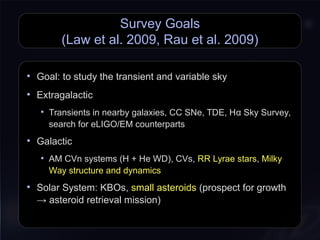
• Goal: to study the transient and variable sky
• Extragalactic
• Transients in nearby galaxies, CC SNe, TDE, Hα Sky Survey,
search for eLIGO/EM counterparts
• Galactic
• AM CVn systems (H + He WD), CVs, RR Lyrae stars, Milky
Way structure and dynamics
• Solar System: KBOs, small asteroids (prospect for growth
→ asteroid retrieval mission)
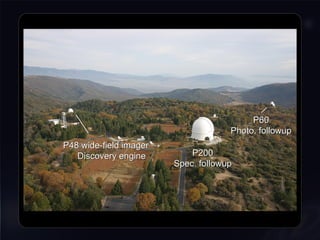
P48 wide-field imager →
Discovery engine
P48 wide-field imager →
Discovery engine P200
Spec. followup
P200
Spec. followup
P60
Photo. followup
P60
Photo. followup
P48 wide-field imager →
Discovery engine
P48 wide-field imager →
Discovery engine
P200
Spec. followup
P200
Spec. followup
P60
Photo. followup
P60
Photo. followup
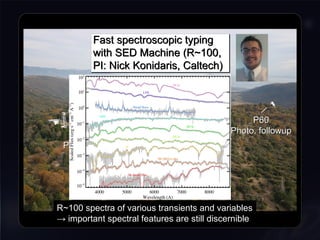
Fast spectroscopic typing
with SED Machine (R~100,
PI: Nick Konidaris, Caltech)
Fast spectroscopic typing
with SED Machine (R~100,
PI: Nick Konidaris, Caltech)
R~100 spectra of various transients and variables
→ important spectral features are still discernible
R~100 spectra of various transients and variables
→ important spectral features are still discernible
P48 Overview
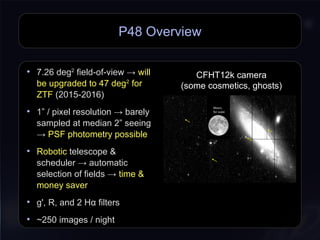
• 7.26 deg2
field-of-view → will
be upgraded to 47 deg2
for
ZTF (2015-2016)
• 1” / pixel resolution → barely
sampled at median 2” seeing
→ PSF photometry possible
• Robotic telescope &
scheduler → automatic
selection of fields → time &
money saver
• g', R, and 2 Hα filters
• ~250 images / night
CFHT12k camera
(some cosmetics, ghosts)
CFHT12k camera
(some cosmetics, ghosts)
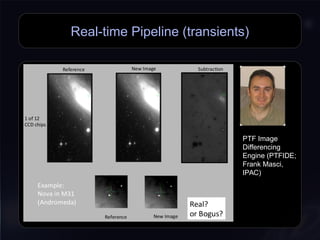
PTF Image
Differencing
Engine (PTFIDE;
Frank Masci,
IPAC)
PTF Image
Differencing
Engine (PTFIDE;
Frank Masci,
IPAC)
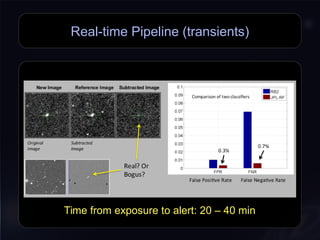
Real-time Pipeline (transients)
Time from exposure to alert: 20 – 40 minTime from exposure to alert: 20 – 40 min
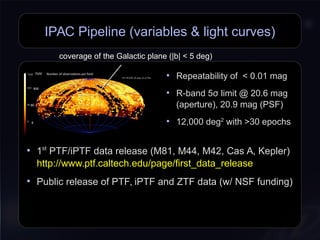
IPAC Pipeline (variables & light curves)
• Repeatability of < 0.01 mag
• R-band 5σ limit @ 20.6 mag
(aperture), 20.9 mag (PSF)
• 12,000 deg2
with >30 epochs
• 1st
PTF/iPTF data release (M81, M44, M42, Cas A, Kepler)
http://www.ptf.caltech.edu/page/first_data_release
• Public release of PTF, iPTF and ZTF data (w/ NSF funding)
coverage of the Galactic plane (|b| < 5 deg)coverage of the Galactic plane (|b| < 5 deg)
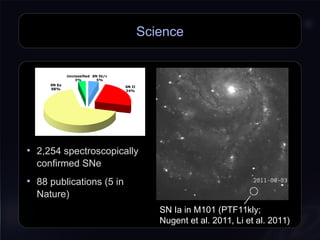
Science
• 2,254 spectroscopically
confirmed SNe
• 88 publications (5 in
Nature)
SN Ia in M101 (PTF11kly;
Nugent et al. 2011, Li et al. 2011)
SN Ia in M101 (PTF11kly;
Nugent et al. 2011, Li et al. 2011)
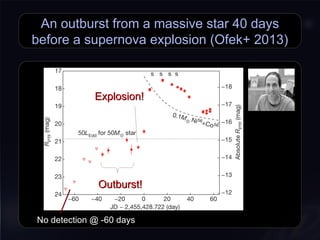
An outburst from a massive star 40 days
before a supernova explosion (Ofek+ 2013)
No detection @ -60 daysNo detection @ -60 days
Outburst!Outburst!
Explosion!Explosion!
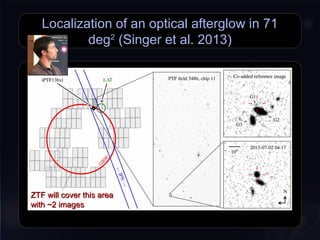
Localization of an optical afterglow in 71
deg2
(Singer et al. 2013)
ZTF will cover this area
with ~2 images
ZTF will cover this area
with ~2 images
GRB 130702A to iPTF13bxl Timeline
• 00:05 Fermi GMB trigger (UT July 2nd)
• 01:05 position refined by human (GBM group)
• 03:08 Sun sets at Palomar
• 04:17 PTF starts observations
• 04:17 PTF starts observations (10 fields, 2x60-s per field; 72 square degrees)
• 4214 "candidates": 44 were known asteroids, 1744 were coincident with stars (r<21) → 43
viable candidates
• Human inspection reduced this to 6 excellent candidates
• iPTF13bxh core of a bright galaxy, iPTF13bxr known quasar, iPTF13bxt was close to a
star in SDSS
• Remaining candidates: iPTFbxl(RB2=0.86), iPTFbxk (RB2=0.83) and iPTFbxj (RB2=0.49)
• Sunrise in California
GRB 130702A to iPTF13bxl Timeline
• 00:50 Swift observations for iPTF13bxl requested → X-ray
source detected
• 04:10 Robotic observations of these candidates at P60 →
iPTFbxl showed decline relative to first P48 observation (!)
• 04:24 Spectral observations on the Palomar 200-inch →
spectrum is featureless (!!)
• 08:24 Announced iPTF13bxl as afterglow (ATEL, GCN)
• 17:34 LAT localization (3.2 square degrees)
• 19:03 IPN announces annulus of width 0.9 degrees
• 23:17 Magellan observations led to z=0.145
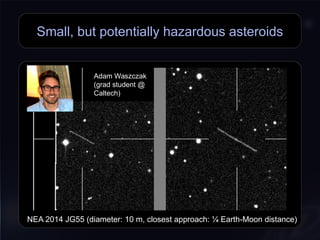
Small, but potentially hazardous asteroids
Adam Waszczak
(grad student @
Caltech)
Adam Waszczak
(grad student @
Caltech)
NEA 2014 JG55 (diameter: 10 m, closest approach: ¼ Earth-Moon distance)NEA 2014 JG55 (diameter: 10 m, closest approach: ¼ Earth-Moon distance)
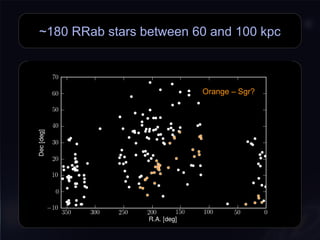
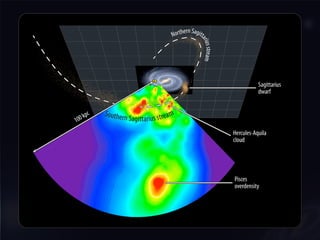
~180 RRab stars between 60 and 100 kpc
Orange – Sgr?Orange – Sgr?
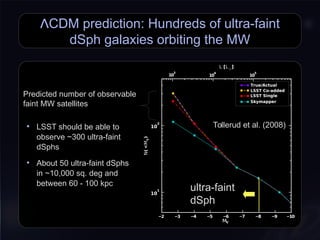
ΛCDM prediction: Hundreds of ultra-faint
dSph galaxies orbiting the MW
ultra-faint
dSph
ultra-faint
dSph
Tollerud et al. (2008)Tollerud et al. (2008)
Predicted number of observable
faint MW satellites
Predicted number of observable
faint MW satellites
• LSST should be able to
observe ~300 ultra-faint
dSphs
• About 50 ultra-faint dSphs
in ~10,000 sq. deg and
between 60 - 100 kpc
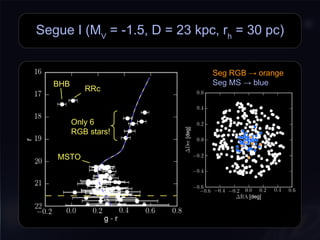
Segue I (MV
= -1.5, D = 23 kpc, rh
= 30 pc)
MSTOMSTO
RRcRRc
BHBBHB
Only 6
RGB stars!
Only 6
RGB stars!
Seg RGB → orange
Seg MS → blue
Seg RGB → orange
Seg MS → blue
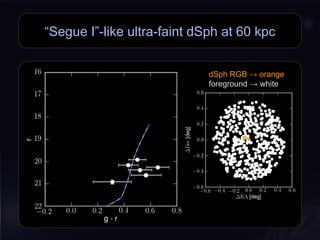
“Segue I”-like ultra-faint dSph at 60 kpc
dSph RGB → orange
foreground → white
dSph RGB → orange
foreground → white
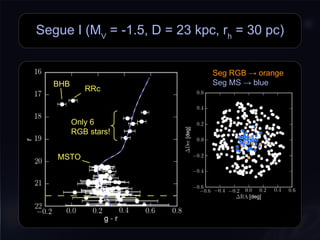
Segue I (MV
= -1.5, D = 23 kpc, rh
= 30 pc)
MSTOMSTO
RRcRRc
BHBBHB
Only 6
RGB stars!
Only 6
RGB stars!
Seg RGB → orange
Seg MS → blue
Seg RGB → orange
Seg MS → blue
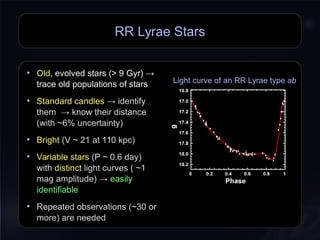
RR Lyrae Stars
• Old, evolved stars (> 9 Gyr) →
trace old populations of stars
• Standard candles → identify
them → know their distance
(with ~6% uncertainty)
• Bright (V ~ 21 at 110 kpc)
• Variable stars (P ~ 0.6 day)
with distinct light curves ( ~1
mag amplitude) → easily
identifiable
• Repeated observations (~30 or
more) are needed
Light curve of an RR Lyrae type abLight curve of an RR Lyrae type ab
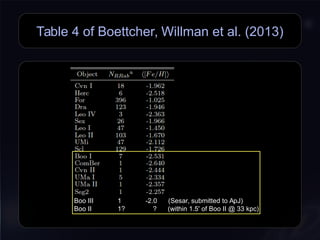
Table 4 of Boettcher, Willman et al. (2013)
Boo III 1 -2.0 (Sesar, submitted to ApJ)
Boo II 1? ? (within 1.5' of Boo II @ 33 kpc)
Boo III 1 -2.0 (Sesar, submitted to ApJ)
Boo II 1? ? (within 1.5' of Boo II @ 33 kpc)
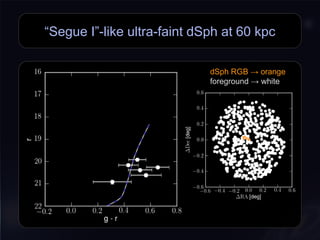
“Segue I”-like ultra-faint dSph at 60 kpc
dSph RGB → orange
foreground → white
dSph RGB → orange
foreground → white
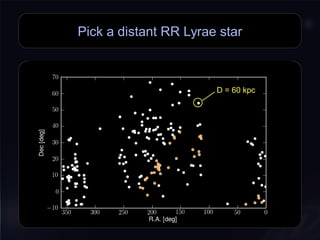
Pick a distant RR Lyrae star
D = 60 kpcD = 60 kpc
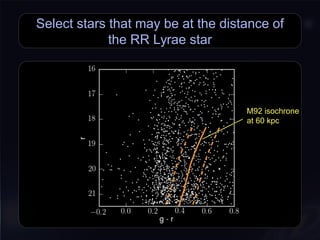
Select stars that may be at the distance of
the RR Lyrae star
M92 isochrone
at 60 kpc
M92 isochrone
at 60 kpc
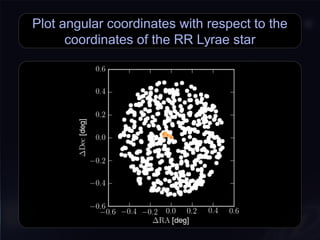
Plot angular coordinates with respect to the
coordinates of the RR Lyrae star
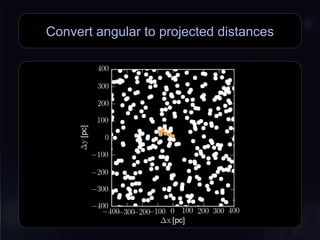
Convert angular to projected distances
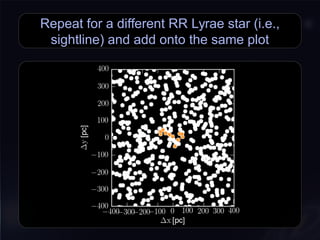
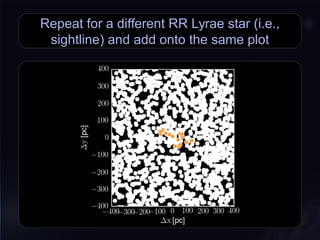
Repeat for a different RR Lyrae star (i.e.,
sightline) and add onto the same plot
Repeat for a different RR Lyrae star (i.e.,
sightline) and add onto the same plot
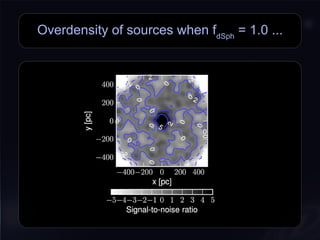
Overdensity of sources when fdSph
= 1.0 ...
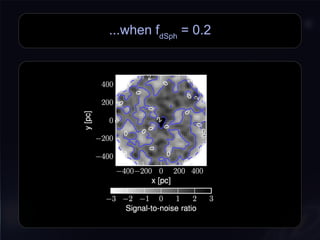
...when fdSph
= 0.2
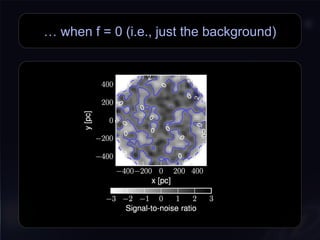
… when f = 0 (i.e., just the background)
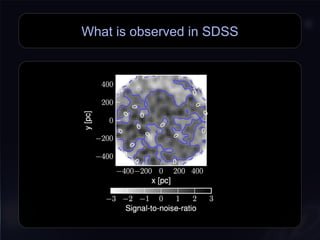
What is observed in SDSS
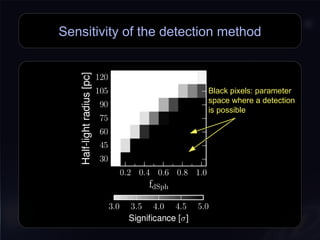
Sensitivity of the detection method
Black pixels: parameter
space where a detection
is possible
Black pixels: parameter
space where a detection
is possible
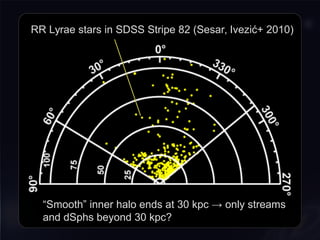
RR Lyrae stars in SDSS Stripe 82 (Sesar, Ivezić+ 2010)RR Lyrae stars in SDSS Stripe 82 (Sesar, Ivezić+ 2010)
“Smooth” inner halo ends at 30 kpc → only streams
and dSphs beyond 30 kpc?
“Smooth” inner halo ends at 30 kpc → only streams
and dSphs beyond 30 kpc?
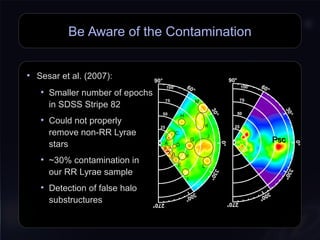
Be Aware of the Contamination
• Sesar et al. (2007):
• Smaller number of epochs
in SDSS Stripe 82
• Could not properly
remove non-RR Lyrae
stars
• ~30% contamination in
our RR Lyrae sample
• Detection of false halo
substructures
PscPsc
Producing science with_ptf

Producing science with_ptf

  • 1.
    Producing Science withthe Palomar Transient Factory Branimir Sesar (MPIA, formerly Caltech)
  • 2.
    Survey Goals (Law etal. 2009, Rau et al. 2009) • Goal: to study the transient and variable sky • Extragalactic • Transients in nearby galaxies, CC SNe, TDE, Hα Sky Survey, search for eLIGO/EM counterparts • Galactic • AM CVn systems (H + He WD), CVs, RR Lyrae stars, Milky Way structure and dynamics • Solar System: KBOs, small asteroids (prospect for growth → asteroid retrieval mission)
  • 3.
    P48 wide-field imager→ Discovery engine P48 wide-field imager → Discovery engine P200 Spec. followup P200 Spec. followup P60 Photo. followup P60 Photo. followup
  • 4.
    P48 wide-field imager→ Discovery engine P48 wide-field imager → Discovery engine P200 Spec. followup P200 Spec. followup P60 Photo. followup P60 Photo. followup Fast spectroscopic typing with SED Machine (R~100, PI: Nick Konidaris, Caltech) Fast spectroscopic typing with SED Machine (R~100, PI: Nick Konidaris, Caltech) R~100 spectra of various transients and variables → important spectral features are still discernible R~100 spectra of various transients and variables → important spectral features are still discernible
  • 5.
    P48 Overview • 7.26deg2 field-of-view → will be upgraded to 47 deg2 for ZTF (2015-2016) • 1” / pixel resolution → barely sampled at median 2” seeing → PSF photometry possible • Robotic telescope & scheduler → automatic selection of fields → time & money saver • g', R, and 2 Hα filters • ~250 images / night CFHT12k camera (some cosmetics, ghosts) CFHT12k camera (some cosmetics, ghosts)
  • 6.
    PTF Image Differencing Engine (PTFIDE; FrankMasci, IPAC) PTF Image Differencing Engine (PTFIDE; Frank Masci, IPAC) Real-time Pipeline (transients)
  • 7.
    Real-time Pipeline (transients) Timefrom exposure to alert: 20 – 40 minTime from exposure to alert: 20 – 40 min
  • 8.
    IPAC Pipeline (variables& light curves) • Repeatability of < 0.01 mag • R-band 5σ limit @ 20.6 mag (aperture), 20.9 mag (PSF) • 12,000 deg2 with >30 epochs • 1st PTF/iPTF data release (M81, M44, M42, Cas A, Kepler) http://www.ptf.caltech.edu/page/first_data_release • Public release of PTF, iPTF and ZTF data (w/ NSF funding) coverage of the Galactic plane (|b| < 5 deg)coverage of the Galactic plane (|b| < 5 deg)
  • 9.
    Science • 2,254 spectroscopically confirmedSNe • 88 publications (5 in Nature) SN Ia in M101 (PTF11kly; Nugent et al. 2011, Li et al. 2011) SN Ia in M101 (PTF11kly; Nugent et al. 2011, Li et al. 2011)
  • 10.
    An outburst froma massive star 40 days before a supernova explosion (Ofek+ 2013) No detection @ -60 daysNo detection @ -60 days Outburst!Outburst! Explosion!Explosion!
  • 11.
    Localization of anoptical afterglow in 71 deg2 (Singer et al. 2013) ZTF will cover this area with ~2 images ZTF will cover this area with ~2 images
  • 12.
    GRB 130702A toiPTF13bxl Timeline • 00:05 Fermi GMB trigger (UT July 2nd) • 01:05 position refined by human (GBM group) • 03:08 Sun sets at Palomar • 04:17 PTF starts observations • 04:17 PTF starts observations (10 fields, 2x60-s per field; 72 square degrees) • 4214 "candidates": 44 were known asteroids, 1744 were coincident with stars (r<21) → 43 viable candidates • Human inspection reduced this to 6 excellent candidates • iPTF13bxh core of a bright galaxy, iPTF13bxr known quasar, iPTF13bxt was close to a star in SDSS • Remaining candidates: iPTFbxl(RB2=0.86), iPTFbxk (RB2=0.83) and iPTFbxj (RB2=0.49) • Sunrise in California
  • 13.
    GRB 130702A toiPTF13bxl Timeline • 00:50 Swift observations for iPTF13bxl requested → X-ray source detected • 04:10 Robotic observations of these candidates at P60 → iPTFbxl showed decline relative to first P48 observation (!) • 04:24 Spectral observations on the Palomar 200-inch → spectrum is featureless (!!) • 08:24 Announced iPTF13bxl as afterglow (ATEL, GCN) • 17:34 LAT localization (3.2 square degrees) • 19:03 IPN announces annulus of width 0.9 degrees • 23:17 Magellan observations led to z=0.145
  • 14.
    Small, but potentiallyhazardous asteroids Adam Waszczak (grad student @ Caltech) Adam Waszczak (grad student @ Caltech) NEA 2014 JG55 (diameter: 10 m, closest approach: ¼ Earth-Moon distance)NEA 2014 JG55 (diameter: 10 m, closest approach: ¼ Earth-Moon distance)
  • 15.
    ~180 RRab starsbetween 60 and 100 kpc Orange – Sgr?Orange – Sgr?
  • 16.
    ΛCDM prediction: Hundredsof ultra-faint dSph galaxies orbiting the MW ultra-faint dSph ultra-faint dSph Tollerud et al. (2008)Tollerud et al. (2008) Predicted number of observable faint MW satellites Predicted number of observable faint MW satellites • LSST should be able to observe ~300 ultra-faint dSphs • About 50 ultra-faint dSphs in ~10,000 sq. deg and between 60 - 100 kpc
  • 17.
    Segue I (MV =-1.5, D = 23 kpc, rh = 30 pc) MSTOMSTO RRcRRc BHBBHB Only 6 RGB stars! Only 6 RGB stars! Seg RGB → orange Seg MS → blue Seg RGB → orange Seg MS → blue
  • 18.
    “Segue I”-like ultra-faintdSph at 60 kpc dSph RGB → orange foreground → white dSph RGB → orange foreground → white
  • 19.
    Segue I (MV =-1.5, D = 23 kpc, rh = 30 pc) MSTOMSTO RRcRRc BHBBHB Only 6 RGB stars! Only 6 RGB stars! Seg RGB → orange Seg MS → blue Seg RGB → orange Seg MS → blue
  • 20.
    RR Lyrae Stars •Old, evolved stars (> 9 Gyr) → trace old populations of stars • Standard candles → identify them → know their distance (with ~6% uncertainty) • Bright (V ~ 21 at 110 kpc) • Variable stars (P ~ 0.6 day) with distinct light curves ( ~1 mag amplitude) → easily identifiable • Repeated observations (~30 or more) are needed Light curve of an RR Lyrae type abLight curve of an RR Lyrae type ab
  • 21.
    Table 4 ofBoettcher, Willman et al. (2013) Boo III 1 -2.0 (Sesar, submitted to ApJ) Boo II 1? ? (within 1.5' of Boo II @ 33 kpc) Boo III 1 -2.0 (Sesar, submitted to ApJ) Boo II 1? ? (within 1.5' of Boo II @ 33 kpc)
  • 22.
    “Segue I”-like ultra-faintdSph at 60 kpc dSph RGB → orange foreground → white dSph RGB → orange foreground → white
  • 23.
    Pick a distantRR Lyrae star D = 60 kpcD = 60 kpc
  • 24.
    Select stars thatmay be at the distance of the RR Lyrae star M92 isochrone at 60 kpc M92 isochrone at 60 kpc
  • 25.
    Plot angular coordinateswith respect to the coordinates of the RR Lyrae star
  • 26.
    Convert angular toprojected distances
  • 27.
    Repeat for adifferent RR Lyrae star (i.e., sightline) and add onto the same plot
  • 28.
    Repeat for adifferent RR Lyrae star (i.e., sightline) and add onto the same plot
  • 29.
    Overdensity of sourceswhen fdSph = 1.0 ...
  • 30.
  • 31.
    … when f= 0 (i.e., just the background)
  • 32.
  • 33.
    Sensitivity of thedetection method Black pixels: parameter space where a detection is possible Black pixels: parameter space where a detection is possible
  • 34.
    RR Lyrae starsin SDSS Stripe 82 (Sesar, Ivezić+ 2010)RR Lyrae stars in SDSS Stripe 82 (Sesar, Ivezić+ 2010) “Smooth” inner halo ends at 30 kpc → only streams and dSphs beyond 30 kpc? “Smooth” inner halo ends at 30 kpc → only streams and dSphs beyond 30 kpc?
  • 35.
    Be Aware ofthe Contamination • Sesar et al. (2007): • Smaller number of epochs in SDSS Stripe 82 • Could not properly remove non-RR Lyrae stars • ~30% contamination in our RR Lyrae sample • Detection of false halo substructures PscPsc