WELCOME
TRYTYTTYRFVGF G
The RC Oscillator Circuit
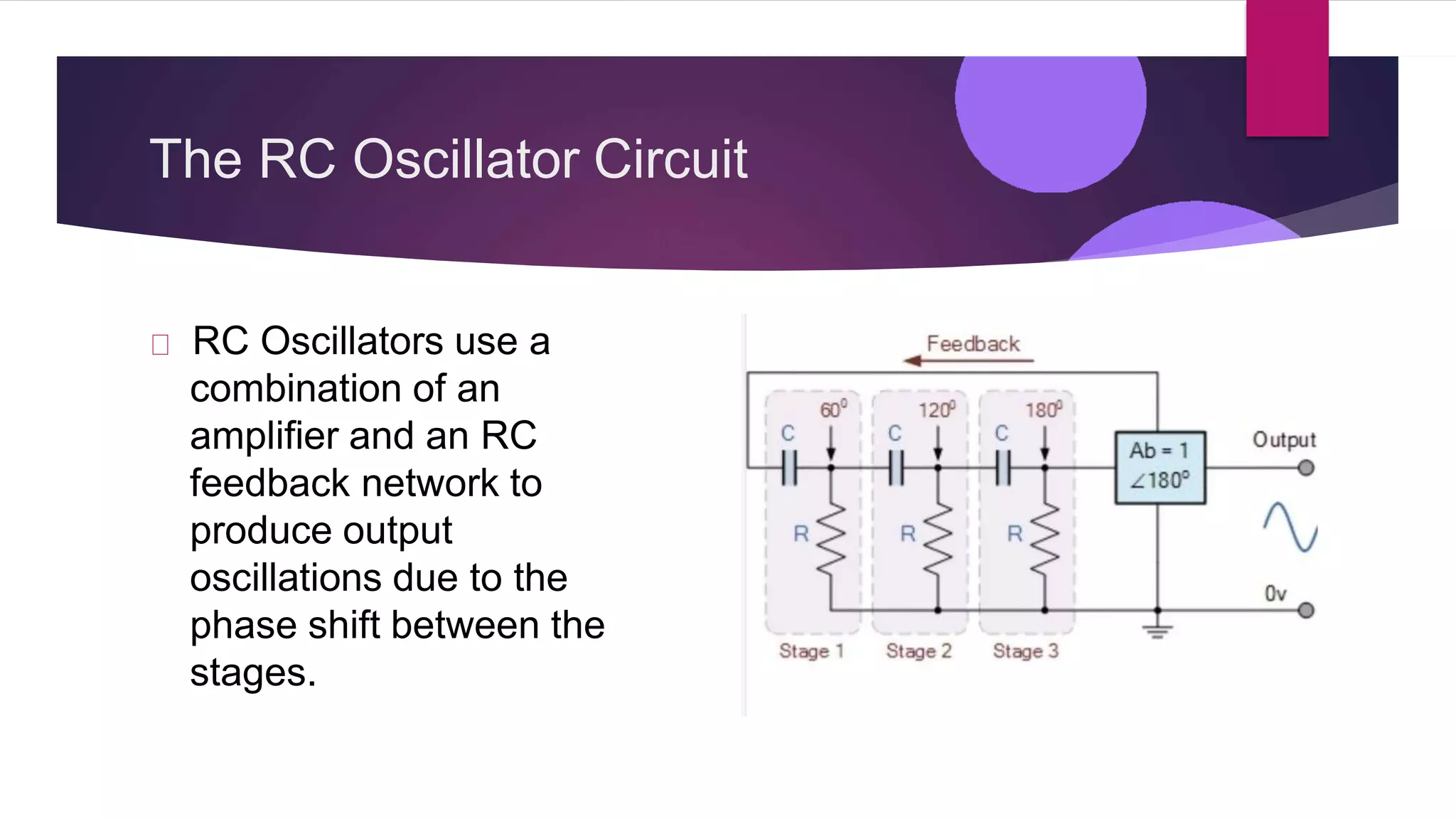
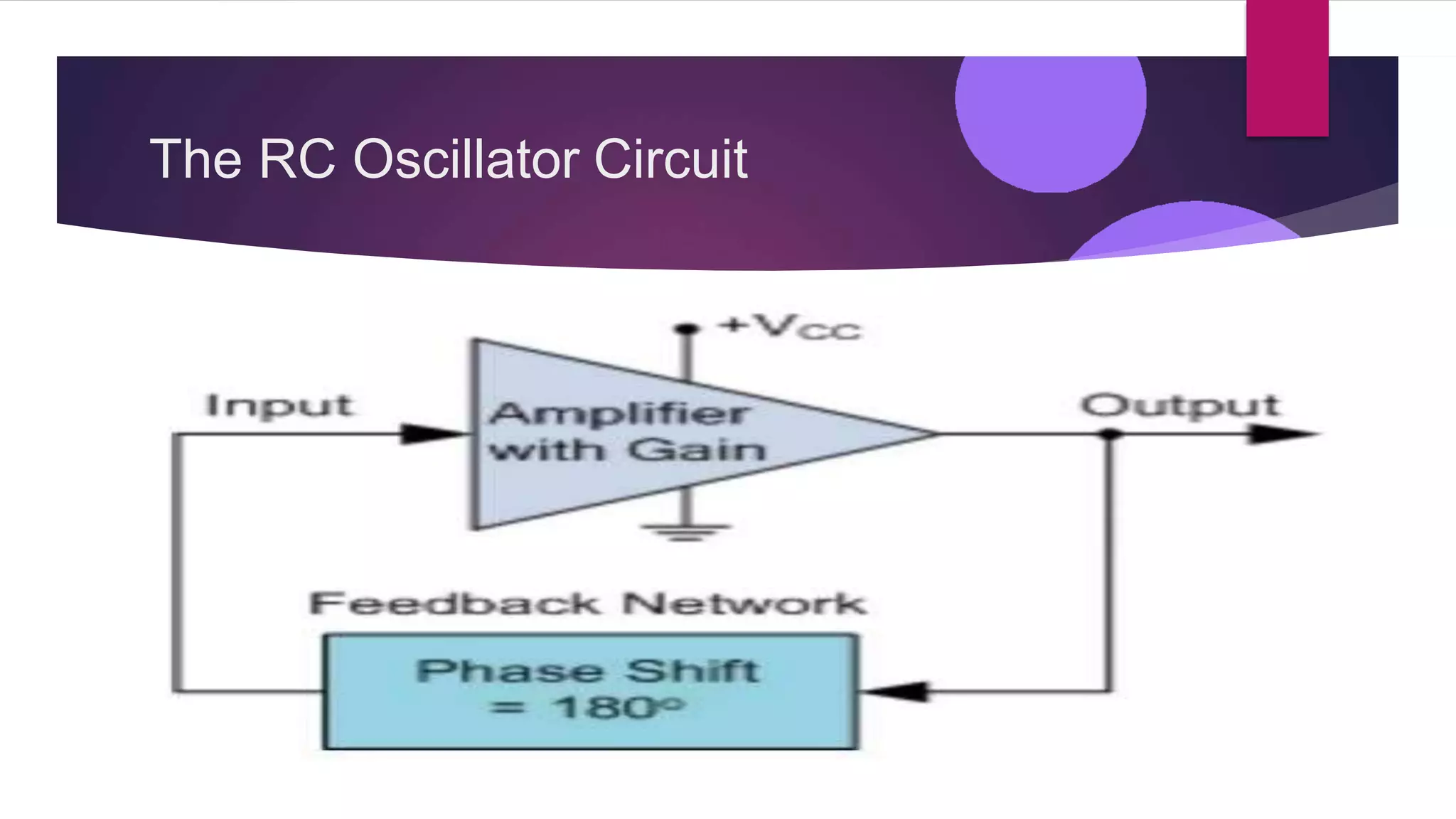
RC Oscillators use a
combination of an
amplifier and an RC
feedback network to
produce output
oscillations due to the
phase shift between the
stages.
The RC Oscillator Circuit
For an RC oscillator to sustain its oscillations
indefinitely, sufficient feedback of the correct phase,
that is positive (in-phase) Feedback must be provided
along with the voltage gain of the single transistor
amplifier being used to inject adequate loop gain into
the closed-loop circuit in order to maintain oscillations
allowing it to oscillates continuously at the selected
frequency.
The RC Oscillator Circuit
However in reality it is difficult to obtain exactly 90o of
phase shift for each RC stage so we must therefore
use more RC stages cascaded together to obtain the
required value at the oscillation frequency. The amount
of actual phase shift in the circuit depends upon the
values of the resistor (R) and the capacitor (C), at the
chosen frequency of oscillations with the phase
angle ( φ ) being
The RC Oscillator Circuit
The oscillator itself can be tuned to operate in the
frequency range of 20-100 MHz using digital control
signals and this fits the current sensor implementation.
The RC Oscillator Circuit
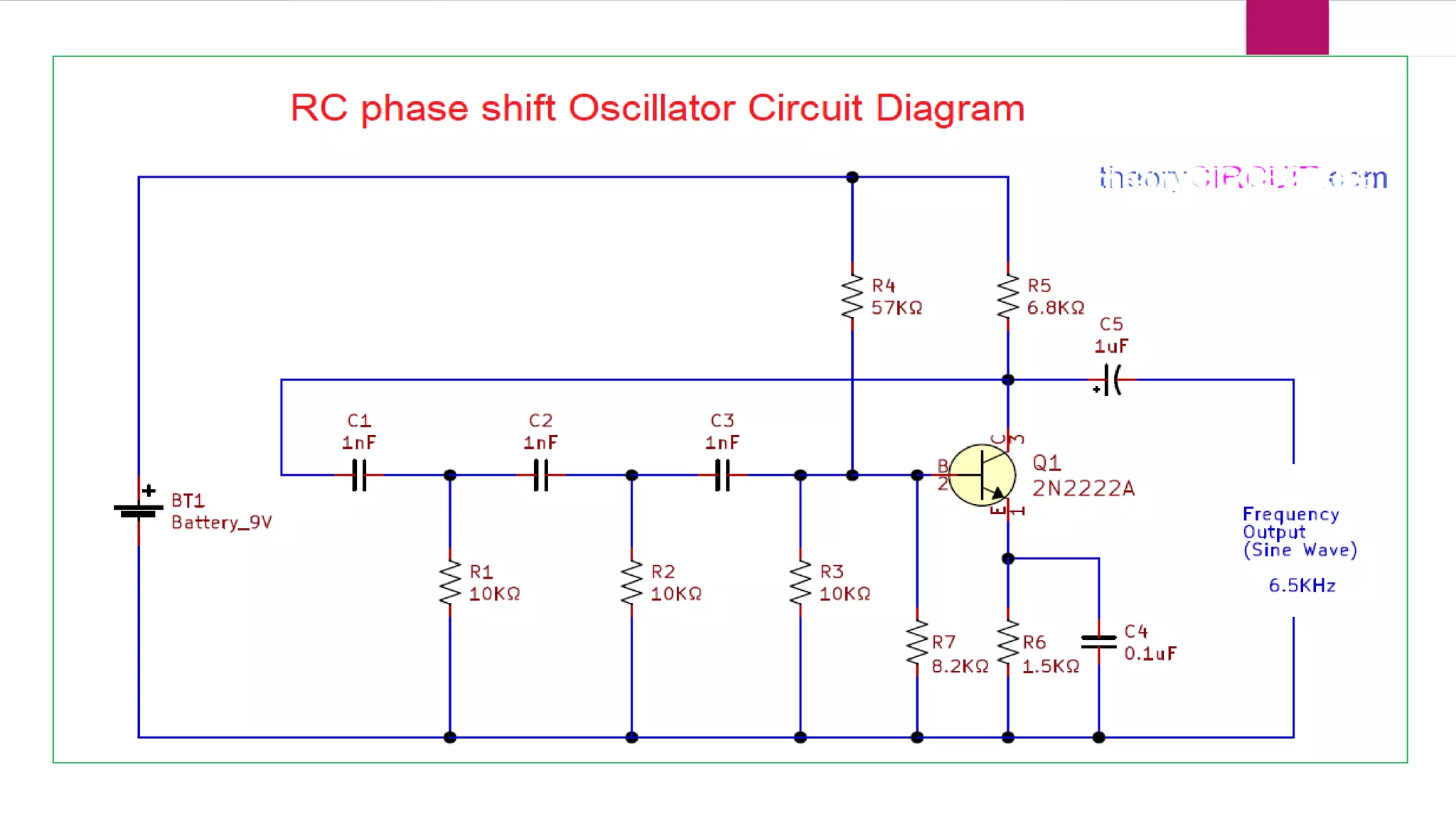
RC phase shift oscillator is used for generating
signals power a wide frequency ra nge. The
frequency can be varied from few Hz to 200 Hz by
employing one set of resistor with three capacitor
ganged together to vary over a capacitance range in
the 1:10 ratio.
The RC Oscillator Circuit
The frequency of oscillation is determined by the
Barkhausen criterion, which says that the circuit will
only oscillate at frequencies for which the phase shift
around the feedback loop is equal to 360° (2π radians)
or a multiple of 360°, and the loop gain (the
amplification around the feedback loop) is equal to
one.
Rc oscillator circuit

Rc oscillator circuit

  • 2.
  • 3.
  • 4.
    The RC OscillatorCircuit RC Oscillators use a combination of an amplifier and an RC feedback network to produce output oscillations due to the phase shift between the stages.
  • 5.
    The RC OscillatorCircuit For an RC oscillator to sustain its oscillations indefinitely, sufficient feedback of the correct phase, that is positive (in-phase) Feedback must be provided along with the voltage gain of the single transistor amplifier being used to inject adequate loop gain into the closed-loop circuit in order to maintain oscillations allowing it to oscillates continuously at the selected frequency.
  • 6.
    The RC OscillatorCircuit However in reality it is difficult to obtain exactly 90o of phase shift for each RC stage so we must therefore use more RC stages cascaded together to obtain the required value at the oscillation frequency. The amount of actual phase shift in the circuit depends upon the values of the resistor (R) and the capacitor (C), at the chosen frequency of oscillations with the phase angle ( φ ) being
  • 7.
  • 8.
    The RC OscillatorCircuit The oscillator itself can be tuned to operate in the frequency range of 20-100 MHz using digital control signals and this fits the current sensor implementation.
  • 9.
    The RC OscillatorCircuit RC phase shift oscillator is used for generating signals power a wide frequency ra nge. The frequency can be varied from few Hz to 200 Hz by employing one set of resistor with three capacitor ganged together to vary over a capacitance range in the 1:10 ratio.
  • 10.
    The RC OscillatorCircuit The frequency of oscillation is determined by the Barkhausen criterion, which says that the circuit will only oscillate at frequencies for which the phase shift around the feedback loop is equal to 360° (2π radians) or a multiple of 360°, and the loop gain (the amplification around the feedback loop) is equal to one.