Neurotrophic Factors
DR HARI RAM SEDAI
1ST
YEAR RESIDENT
PSYCHIATRY/NMCTH
Contents
INTRODUCTION
HISTORY
NEUROTROPHIN FAMILY
NEUROTROPHIN RECEPTORS
NEUROTROPHIN METABOLISM
PSYCHIATRIC IMPLICATIONS
Introduction
Neurotrophins are unique family of polypeptide growth factors that
influence the proliferation, differentiation, survival and death of
neuronal and non-neuronal cells
Actions of Neurotrophins depend on:
Level of availability
Affinity to transmembrane receptors
Downstream signalling cascades
Biological roles of Neurotrophic factors
Synaptic connections
Synapse structure
Neurotransmitter release
Long-term potentiation (LTP)
Mechanosensation
Pain
Regulation of:
History
• Victor Hamburger
• American Neuroembryologist
• Proposed that differentiation, specialization of
nerve cells depends on their final destination
in the body
193
4
• Rita Levi Motalcini
• Italian neurohistologist
• Failure of neurons to thrive in the absence of
target tissue was a degenerative process
rather than failure of differentiation as
proposed earlier
195
1
• Yves Alain Barde and Hans Thoenen
discovered BDNF
• Was shown to promote survival of a
subpopulation of dorsal root ganglion
neurons and subsequently purified from pig
brain
198
2
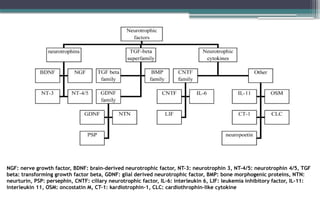
NGF: nerve growth factor, BDNF: brain-derived neurotrophic factor, NT-3: neurotrophin 3, NT-4/5: neurotrophin 4/5, TGF
beta: transforming growth factor beta, GDNF: glial derived neurotrophic factor, BMP: bone morphogenic proteins, NTN:
neurturin, PSP: persephin, CNTF: ciliary neurotrophic factor, IL-6: interleukin 6, LIF: leukemia inhibitory factor, IL-11:
interleukin 11, OSM: oncostatin M, CT-1: kardiotrophin-1, CLC: cardiothrophin-like cytokine
Neurotrophin Family
Nerve Growth Factor (NGF)
Brain Derived Neurotrophic Factor (BDNF)
Neurotrophin-3 (NT-3)
Neurotrophin-4 (NT-4)
Biosynthesis of Neurotrophic Factors
• Neurotrophins are initially synthesized as proneurotrophins that
are cleaved to release the mature active proteins
• Proneurotrophin cleavage and processing can occur at multiple
sites, including the Golgi apparatus by furin
• Dense core vesicle by proconvertases, and extracellularly by
plasmin or selective matrix metalloproteinases
Nerve Growth Factor(NGF)
• NGF was the first identified neurotrophic factor
• In the peripheral nervous system, it acts on sympathetic neurons
and sensory neurons involved in nociception and temperature
sensation
• In the central nervous system, NGF promotes the survival and
functioning of cholinergic neurons in the basal forebrain
• These neurons project to the hippocampus and are believed to be
important for memory processes
Brain Derived Neurotrophic Factor (BDNF)
• BDNF are highly expressed in cortical and hippocampal structures
• Linked to the survival and functioning of multiple neuronal
populations
• BDNF is present in much higher concentrations after stress, injury,
neural stimulation and exercise
• BDNF is highly responsive to activity dependent plasticity
Neurotrophin Receptors
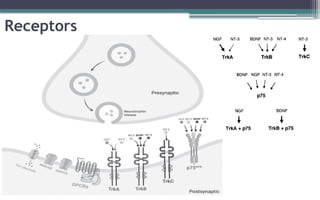
Two different receptors:
• Tropomyosin Related kinase (Trk)
• p75 Neurotrophin Receptor (p75 NTR)
• Contains Tyrosine kinase receptor
Consists of:
• Extracellular ligand-binding region
• Single transmembrane domain
• Highly conserved intracellular
tyrosine kinase domain
Tropomyosin-Related kinase (Trk) Receptor
p75 Neurotrophin Receptor (p75NTR)
• Tumor necrosis factor (TNF) receptor superfamily member
Consists of:
• Extracellular ligand binding region
• Single transmembrane domain
• Intracellular portion containing protein association region
Receptors
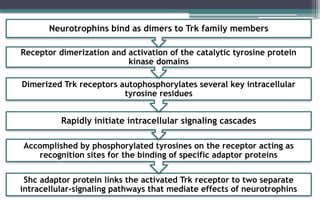
Shc adaptor protein links the activated Trk receptor to two separate
intracellular-signaling pathways that mediate effects of neurotrophins
Accomplished by phosphorylated tyrosines on the receptor acting as
recognition sites for the binding of specific adaptor proteins
Rapidly initiate intracellular signaling cascades
Dimerized Trk receptors autophosphorylates several key intracellular
tyrosine residues
Receptor dimerization and activation of the catalytic tyrosine protein
kinase domains
Neurotrophins bind as dimers to Trk family members
Causes induction of the cyclic adenosine monophosphate (cAMP), response
element–binding protein (CREB), transcription factor and mammalian target of
rapamycin complex (mTORC)
Also leads to increases in Ras and mitogen activated protein kinase (MAPK)
Activates Akt (protein kinase B) which has multiple effects on the cell’s
apoptotic pathways
Increase in phosphotidylinositol-3-kinase activity
Primary survival pathway involves Shc, linking the Trk receptor activation
CREB produces a multitude of effects on the cell
cycle, neurite outgrowth, and synaptic plasticity
mTORC has been shown to regulate learning and
memory by promoting localized activity dependent
translation
Neurotrophin Hypothesis
• It states that neurons compete for limited quantities of neurotrophins
in target regions, which leads to selective neuronal survival
• Levels of target derived neurotrophins and neurotrophin receptors
will determine efficacy of survival and responsiveness of the neurons
• The ability to form high affinity binding sites allows for greater
responsiveness under limiting quantities of trophic factors
• Lack of trophic support or incorrect targeting of axons to the wrong
target results in programmed cell death
Neurotrophic Factors And Development
Two predictions originate from the neurotrophic hypothesis
• First, the efficacy of neuronal survival will depend upon the
amounts of trophic factors produced during development
• Second, specific receptor expression in responsive cell populations
will dictate neuronal responsiveness
• Neurons can release neurotrophins that act on themselves
(autocrine transmission) or can be anterogradely transported down
axons and act on neighboring neurons
• Neurotrophins promote cell survival and differentiation during
neural development & also can induce cell death
• P75NTR serves as a pro-apoptotic receptor during developmental
cell death and after injury to the nervous system
• Increases in p75NTR expression are responsible for apoptosis in
embryonic retinas and sympathetic neurons
• Whereas BDNF binding to p75NTR in sympathetic neurons causes
rapid cell death, NGF binding to the TrkA receptor on the same
neurons provides a survival signal
Neurotrophins And Synaptic Plasticity
• BDNF’s role in modulating synaptic plasticity is seen in the
hippocampus, prefrontal cortex, and striatum
• BDNF– TrkB signalling plays a key role in synaptic plasticity in the
adult brain
• Neurotrophins have also been shown to evoke a chemical form of
LTP
• Brief application of exogenous BDNF produces long-lasting
synaptic enhancement in hippocampus
• BDNF can modulate synaptic strengthening and neurotransmission
as well as promote axonal and dendritic growth and differentiation
• Exogenous proBDNF application induces synaptic depression at the
neuromuscular synapse, suggesting that proBDNF opposes the
actions of mature BDNF on synaptic plasticity
Neurotrophins And Metabolism
• BDNF and TrkB have key roles in the central control of satiety and
energy balance regulation
• Selective deletion of BDNF in the anterior PVH leads to significant
hyperphagia and weight gain
• BDNF–TrkB has also been implicated in the regulation of energy
expenditure, which involves basal metabolism, physical activity,
and thermoregulation
• Human genetic studies have directly linked mutations in BDNF and
TrkB with obesity and increased body mass index
• Randomized controlled study of human BDNF Met allele carriers
taking antipsychotics showed that the BDNF Met allele is a risk
factor for antipsychotic associated obesity and insulin resistance
Correlates To Neurodegenerative Disorders
Neurotrophins have been implicated in the pathophysiology of a
wide variety of neurodegenerative and neuronal injury disorders
Due to:
• Decreased availability of neurotrophins for the affected neurons
• Fewer neurotrophin receptors on the affected neurons
• Decreased neuronal survival
 Alzheimer's Disease:
• Reduced levels of BDNF and NGF have been observed in Alzheimer's
disease
• This reduction may contribute to neuronal death and cognitive
decline, as these neurotrophins play a role in neuron survival and
synaptic plasticity, especially in brain regions involved in memory like
the hippocampus
 Parkinson's Disease:
• In Parkinson's disease, reductions in Glial cell line-derived
neurotrophic factor (GDNF) can lead to the degeneration of
dopaminergic neurons in the substantia nigra
 Huntington's Disease
• BDNF levels are also implicated in Huntington's disease (HD)
• Decrease in BDNF transport to the striatum may accelerate neuron
loss and disease progression in HD
• Addition of NGF or BDNF to vulnerable regions of the brain, such as
the entorhinal cortex or hippocampus, increases spatial learning
and memory retention
Correlates To Psychiatric Disorders
Profound effects of neurotrophic factors on
synaptic connections, synaptic plasticity, and
neurotransmission is associated with psychiatric
disorders:
• Anxiety disorders
• Depression
Major Depressive Disorder
• Fundamental dysregulation of synaptic plasticity and neuronal survival
in regions of the brain such as the hippocampus
• In animal models, restraint stress leads to decreased expression of
BDNF in the hippocampus
• Chronic physical or psychosocial stress leads to atrophy and death of
hippocampal neurons especially in the CA3 region
• MRI studies have shown that patients with depression or post-
traumatic stress disorder exhibit a small decrease in hippocampal
volume
• Exogenously administered BDNF in the hippocampus had
antidepressant effects in two animal models of depression
comparable to those of chronic treatment with pharmacologic
antidepressants
• Serotonin and norepinephrine reuptake inhibitor antidepressants
upregulate BDNF and CREB, a cAMP-dependent transcription
factor
• Antidepressant treatments also lead to increases in expression of
TrkB receptors in the hippocampus
Anxiety Disorderes
• BDNF has been shown to be involved in anxiety like behaviors in animal
models, and numerous types of stressors have been found to cause
reduced expression of BDNF
• In a severe and prolonged state of stress, with sustained increase of
glucocorticoid (GC) hormone levels due to the activation of the HPA axis,
neuroplastic changes occur & decrease in the BDNF hippocampal levels
• BDNF and other neurotrophic factors are believed to counteract the
negative impact of stress hormones on hippocampal volume
Therapeutic Potential Of Neurotrophins
• Recent clinical trials have provided limits in designing therapeutic
strategies to use neurotrophic factors for neurodegenerative and
psychiatric disorders
• Long-term ECT has been shown to increase BDNF transcription and
elicit the sprouting of hippocampal neurons
• Development of neutralizing antibodies against NGF and their
administration to reduce pain thresholds has proven to be
efficacious in many clinical pain conditions
• The neurotrophin hypothesis has shaped our understanding of
mental illness as being more than a chemical imbalance,
highlighting the role of brain structure and plasticity in psychiatric
symptoms
• It has also opened the door to exploring treatments that might
directly influence neurotrophin levels and neuronal growth
Reference
• Kaplan & Sadock’s Comprehensive Textbook Of Psychiatry, 11th
edition
• Neurotrophins: Roles in Neuronal Development and Function
Eric J Huang and Louis F Reichardt, Annu Rev Neurosci. 2001

Neurotrophic Factors

  • 1.
    Neurotrophic Factors DR HARIRAM SEDAI 1ST YEAR RESIDENT PSYCHIATRY/NMCTH
  • 2.
  • 3.
    Introduction Neurotrophins are uniquefamily of polypeptide growth factors that influence the proliferation, differentiation, survival and death of neuronal and non-neuronal cells Actions of Neurotrophins depend on: Level of availability Affinity to transmembrane receptors Downstream signalling cascades
  • 4.
    Biological roles ofNeurotrophic factors Synaptic connections Synapse structure Neurotransmitter release Long-term potentiation (LTP) Mechanosensation Pain Regulation of:
  • 5.
    History • Victor Hamburger •American Neuroembryologist • Proposed that differentiation, specialization of nerve cells depends on their final destination in the body 193 4 • Rita Levi Motalcini • Italian neurohistologist • Failure of neurons to thrive in the absence of target tissue was a degenerative process rather than failure of differentiation as proposed earlier 195 1
  • 6.
    • Yves AlainBarde and Hans Thoenen discovered BDNF • Was shown to promote survival of a subpopulation of dorsal root ganglion neurons and subsequently purified from pig brain 198 2
  • 7.
    NGF: nerve growthfactor, BDNF: brain-derived neurotrophic factor, NT-3: neurotrophin 3, NT-4/5: neurotrophin 4/5, TGF beta: transforming growth factor beta, GDNF: glial derived neurotrophic factor, BMP: bone morphogenic proteins, NTN: neurturin, PSP: persephin, CNTF: ciliary neurotrophic factor, IL-6: interleukin 6, LIF: leukemia inhibitory factor, IL-11: interleukin 11, OSM: oncostatin M, CT-1: kardiotrophin-1, CLC: cardiothrophin-like cytokine
  • 8.
    Neurotrophin Family Nerve GrowthFactor (NGF) Brain Derived Neurotrophic Factor (BDNF) Neurotrophin-3 (NT-3) Neurotrophin-4 (NT-4)
  • 9.
    Biosynthesis of NeurotrophicFactors • Neurotrophins are initially synthesized as proneurotrophins that are cleaved to release the mature active proteins • Proneurotrophin cleavage and processing can occur at multiple sites, including the Golgi apparatus by furin • Dense core vesicle by proconvertases, and extracellularly by plasmin or selective matrix metalloproteinases
  • 11.
    Nerve Growth Factor(NGF) •NGF was the first identified neurotrophic factor • In the peripheral nervous system, it acts on sympathetic neurons and sensory neurons involved in nociception and temperature sensation • In the central nervous system, NGF promotes the survival and functioning of cholinergic neurons in the basal forebrain • These neurons project to the hippocampus and are believed to be important for memory processes
  • 12.
    Brain Derived NeurotrophicFactor (BDNF) • BDNF are highly expressed in cortical and hippocampal structures • Linked to the survival and functioning of multiple neuronal populations • BDNF is present in much higher concentrations after stress, injury, neural stimulation and exercise • BDNF is highly responsive to activity dependent plasticity
  • 13.
    Neurotrophin Receptors Two differentreceptors: • Tropomyosin Related kinase (Trk) • p75 Neurotrophin Receptor (p75 NTR)
  • 14.
    • Contains Tyrosinekinase receptor Consists of: • Extracellular ligand-binding region • Single transmembrane domain • Highly conserved intracellular tyrosine kinase domain Tropomyosin-Related kinase (Trk) Receptor
  • 15.
    p75 Neurotrophin Receptor(p75NTR) • Tumor necrosis factor (TNF) receptor superfamily member Consists of: • Extracellular ligand binding region • Single transmembrane domain • Intracellular portion containing protein association region
  • 16.
  • 18.
    Shc adaptor proteinlinks the activated Trk receptor to two separate intracellular-signaling pathways that mediate effects of neurotrophins Accomplished by phosphorylated tyrosines on the receptor acting as recognition sites for the binding of specific adaptor proteins Rapidly initiate intracellular signaling cascades Dimerized Trk receptors autophosphorylates several key intracellular tyrosine residues Receptor dimerization and activation of the catalytic tyrosine protein kinase domains Neurotrophins bind as dimers to Trk family members
  • 19.
    Causes induction ofthe cyclic adenosine monophosphate (cAMP), response element–binding protein (CREB), transcription factor and mammalian target of rapamycin complex (mTORC) Also leads to increases in Ras and mitogen activated protein kinase (MAPK) Activates Akt (protein kinase B) which has multiple effects on the cell’s apoptotic pathways Increase in phosphotidylinositol-3-kinase activity Primary survival pathway involves Shc, linking the Trk receptor activation
  • 20.
    CREB produces amultitude of effects on the cell cycle, neurite outgrowth, and synaptic plasticity mTORC has been shown to regulate learning and memory by promoting localized activity dependent translation
  • 21.
    Neurotrophin Hypothesis • Itstates that neurons compete for limited quantities of neurotrophins in target regions, which leads to selective neuronal survival • Levels of target derived neurotrophins and neurotrophin receptors will determine efficacy of survival and responsiveness of the neurons • The ability to form high affinity binding sites allows for greater responsiveness under limiting quantities of trophic factors • Lack of trophic support or incorrect targeting of axons to the wrong target results in programmed cell death
  • 22.
    Neurotrophic Factors AndDevelopment Two predictions originate from the neurotrophic hypothesis • First, the efficacy of neuronal survival will depend upon the amounts of trophic factors produced during development • Second, specific receptor expression in responsive cell populations will dictate neuronal responsiveness • Neurons can release neurotrophins that act on themselves (autocrine transmission) or can be anterogradely transported down axons and act on neighboring neurons
  • 23.
    • Neurotrophins promotecell survival and differentiation during neural development & also can induce cell death • P75NTR serves as a pro-apoptotic receptor during developmental cell death and after injury to the nervous system • Increases in p75NTR expression are responsible for apoptosis in embryonic retinas and sympathetic neurons • Whereas BDNF binding to p75NTR in sympathetic neurons causes rapid cell death, NGF binding to the TrkA receptor on the same neurons provides a survival signal
  • 24.
    Neurotrophins And SynapticPlasticity • BDNF’s role in modulating synaptic plasticity is seen in the hippocampus, prefrontal cortex, and striatum • BDNF– TrkB signalling plays a key role in synaptic plasticity in the adult brain • Neurotrophins have also been shown to evoke a chemical form of LTP • Brief application of exogenous BDNF produces long-lasting synaptic enhancement in hippocampus
  • 25.
    • BDNF canmodulate synaptic strengthening and neurotransmission as well as promote axonal and dendritic growth and differentiation • Exogenous proBDNF application induces synaptic depression at the neuromuscular synapse, suggesting that proBDNF opposes the actions of mature BDNF on synaptic plasticity
  • 26.
    Neurotrophins And Metabolism •BDNF and TrkB have key roles in the central control of satiety and energy balance regulation • Selective deletion of BDNF in the anterior PVH leads to significant hyperphagia and weight gain • BDNF–TrkB has also been implicated in the regulation of energy expenditure, which involves basal metabolism, physical activity, and thermoregulation
  • 27.
    • Human geneticstudies have directly linked mutations in BDNF and TrkB with obesity and increased body mass index • Randomized controlled study of human BDNF Met allele carriers taking antipsychotics showed that the BDNF Met allele is a risk factor for antipsychotic associated obesity and insulin resistance
  • 28.
    Correlates To NeurodegenerativeDisorders Neurotrophins have been implicated in the pathophysiology of a wide variety of neurodegenerative and neuronal injury disorders Due to: • Decreased availability of neurotrophins for the affected neurons • Fewer neurotrophin receptors on the affected neurons • Decreased neuronal survival
  • 29.
     Alzheimer's Disease: •Reduced levels of BDNF and NGF have been observed in Alzheimer's disease • This reduction may contribute to neuronal death and cognitive decline, as these neurotrophins play a role in neuron survival and synaptic plasticity, especially in brain regions involved in memory like the hippocampus  Parkinson's Disease: • In Parkinson's disease, reductions in Glial cell line-derived neurotrophic factor (GDNF) can lead to the degeneration of dopaminergic neurons in the substantia nigra
  • 30.
     Huntington's Disease •BDNF levels are also implicated in Huntington's disease (HD) • Decrease in BDNF transport to the striatum may accelerate neuron loss and disease progression in HD • Addition of NGF or BDNF to vulnerable regions of the brain, such as the entorhinal cortex or hippocampus, increases spatial learning and memory retention
  • 31.
    Correlates To PsychiatricDisorders Profound effects of neurotrophic factors on synaptic connections, synaptic plasticity, and neurotransmission is associated with psychiatric disorders: • Anxiety disorders • Depression
  • 32.
    Major Depressive Disorder •Fundamental dysregulation of synaptic plasticity and neuronal survival in regions of the brain such as the hippocampus • In animal models, restraint stress leads to decreased expression of BDNF in the hippocampus • Chronic physical or psychosocial stress leads to atrophy and death of hippocampal neurons especially in the CA3 region • MRI studies have shown that patients with depression or post- traumatic stress disorder exhibit a small decrease in hippocampal volume
  • 33.
    • Exogenously administeredBDNF in the hippocampus had antidepressant effects in two animal models of depression comparable to those of chronic treatment with pharmacologic antidepressants • Serotonin and norepinephrine reuptake inhibitor antidepressants upregulate BDNF and CREB, a cAMP-dependent transcription factor • Antidepressant treatments also lead to increases in expression of TrkB receptors in the hippocampus
  • 35.
    Anxiety Disorderes • BDNFhas been shown to be involved in anxiety like behaviors in animal models, and numerous types of stressors have been found to cause reduced expression of BDNF • In a severe and prolonged state of stress, with sustained increase of glucocorticoid (GC) hormone levels due to the activation of the HPA axis, neuroplastic changes occur & decrease in the BDNF hippocampal levels • BDNF and other neurotrophic factors are believed to counteract the negative impact of stress hormones on hippocampal volume
  • 36.
    Therapeutic Potential OfNeurotrophins • Recent clinical trials have provided limits in designing therapeutic strategies to use neurotrophic factors for neurodegenerative and psychiatric disorders • Long-term ECT has been shown to increase BDNF transcription and elicit the sprouting of hippocampal neurons • Development of neutralizing antibodies against NGF and their administration to reduce pain thresholds has proven to be efficacious in many clinical pain conditions
  • 37.
    • The neurotrophinhypothesis has shaped our understanding of mental illness as being more than a chemical imbalance, highlighting the role of brain structure and plasticity in psychiatric symptoms • It has also opened the door to exploring treatments that might directly influence neurotrophin levels and neuronal growth
  • 38.
    Reference • Kaplan &Sadock’s Comprehensive Textbook Of Psychiatry, 11th edition • Neurotrophins: Roles in Neuronal Development and Function Eric J Huang and Louis F Reichardt, Annu Rev Neurosci. 2001

Editor's Notes

  • #3 Neurotrophins are a group of proteins that are essential for the development and function of neurons Larger in size as compared to Neuropeptides (12 to 14 kDA) Downstream signalling cascades- drives the cells to respond to signals (controls overall acticity of cells..aka signal transduction pathways
  • #4 Long term potentiation- strengthens synaptic conncetion, help to encode & stabalize memory
  • #11 Nociception is the process by which the nervous system senses and responds to harmful stimuli, such as tissue damage and extreme temperatures:
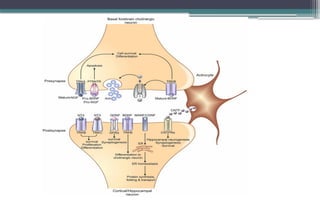
  • #15 NT-3/NT-4- NEUROTROPHIN RECEPTORS MAPK- Mitogen activated protein kinase ERK- Extracellular related kinase PI3K- Phosphatidylinositol-3-kinase ART- Proktein kinase b
  • #17 Neurotrophins are released at the presynaptic side and bind selectively to specific tropomyosin-related kinase (Trk) receptors All neurotrophins bind to p75 neurotrophin receptor (p75NTR) Neurotrophin-3 (NT-3) and neurotrophin-4 (NT-4) bind to multiple Trk receptors Nerve growth factor (NGF) binds to TrkA brain-derived neurotrophic factor (BDNF) binds specifically to TrkB
  • #18 CNTF- Ciliary neurotrophic factor GDNF- Glial cell line derived neurotrophic factor CDNF- Cerebral dopamine neurotrophic factor TRKA- Tropomyosin related kinase MANF- Mesencephalic neurotrophic factor CDNF/MANF- neuroprotective effects agains aBeta induced neuronal cell death- supress er stress
  • #19 Shc adaptor protein links the activated Trk receptor to two separate intracellular-signaling pathways that mediate most of the biologic effects of neurotrophins
  • #24 Paradoxically, they can also induce cell death
  • #26 1.Precursor of BDNF, proBDNF, has been shown to facilitate LTD in hippocampal slices by activation of p75NTR 2.Exogenous proBDNF application induces synaptic depression at the neuromuscular synapse, suggesting that proBDNF opposes the actions of mature BDNF on synaptic plasticity
  • #27 PVH- Paraventricular hypothalamus
  • #33 It is unclear though whether the atrophy and/or death of these neurons is directly related to the decreased availability of BDNF
  • #34 Together, these studies provide a framework to examine further the neurotrophin system as a potential therapeutic target for the treatment of depression CREB- cyclic amp response element binding protein