NEUROTROPHIC
FACTORS
Presented by:
Dr. Akul Gupta
Junior Resident
Department of Psychiatry
Teerthanker Mahaveer Medical College and Research Centre
History
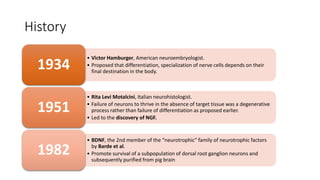
• Victor Hamburger, American neuroembryologist.
• Proposed that differentiation, specialization of nerve cells depends on their
final destination in the body.
1934
• Rita Levi Motalcini, Italian neurohistologist.
• Failure of neurons to thrive in the absence of target tissue was a degenerative
process rather than failure of differentiation as proposed earlier.
• Led to the discovery of NGF.
1951
• BDNF, the 2nd member of the “neurotrophic” family of neurotrophic factors
by Barde et al.
• Promote survival of a subpopulation of dorsal root ganglion neurons and
subsequently purified from pig brain
1982
Introduction
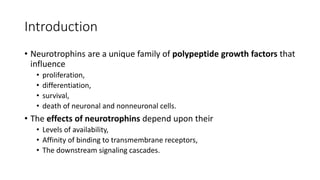
• Neurotrophins are a unique family of polypeptide growth factors that
influence
• proliferation,
• differentiation,
• survival,
• death of neuronal and nonneuronal cells.
• The effects of neurotrophins depend upon their
• Levels of availability,
• Affinity of binding to transmembrane receptors,
• The downstream signaling cascades.
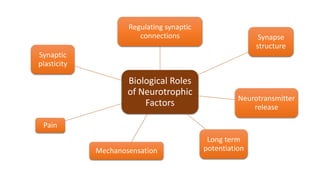
Biological Roles
of Neurotrophic
Factors
Regulating synaptic
connections Synapse
structure
Neurotransmitter
release
Long term
potentiation
Mechanosensation
Pain
Synaptic
plasticity
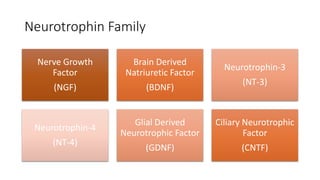
Neurotrophin Family
Nerve Growth
Factor
(NGF)
Brain Derived
Natriuretic Factor
(BDNF)
Neurotrophin-3
(NT-3)
Neurotrophin-4
(NT-4)
Glial Derived
Neurotrophic Factor
(GDNF)
Ciliary Neurotrophic
Factor
(CNTF)
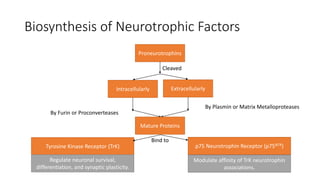
Biosynthesis of Neurotrophic Factors
Proneurotrophins
Cleaved
Intracellularly Extracellularly
By Furin or Proconverteases
By Plasmin or Matrix Metalloproteases
Mature Proteins
Bind to
Tyrosine Kinase Receptor (TrK) p75 Neurotrophin Receptor (p75NTR)
Regulate neuronal survival,
differentiation, and synaptic plasticity.
Modulate affinity of TrK neurotrophin
associations.
Neurotrophin receptors
• Neurotrophins are unique in exerting their cellular effects through the
actions of two different receptors:
• Trk receptor
• Trk receptors consist of an extracellular ligand-binding region, a single
transmembrane domain, and a highly conserved intracellular tyrosine kinase domain.
• p75NTR receptor
• The p75NTR receptor consists of an extracellular ligand binding region, a single
transmembrane domain, and an intracellular portion containing a protein-association
region termed the death domain
• There are no sequence similarities between Trk and p75 receptors in their
either ligand binding or cytoplasmic domains.
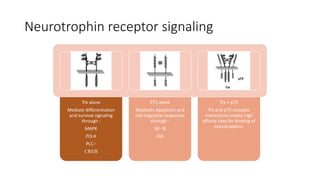
Neurotrophin receptor signaling
Trk alone
Mediate differentiation
and survival signaling
through :
MAPK
PI3-K
PLC-ᵞ
CREB
P75 alone
Mediates Apoptotic and
cell migration responses
through :
NF-ᵏB
JNK
Trk + p75
Trk and p75 receptor
interactions create high
affinity sites for binding of
neurotrophins.
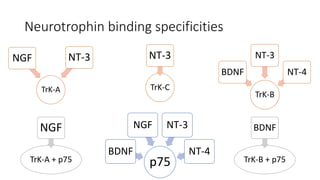
Neurotrophin binding specificities
TrK-A
NGF NT-3
TrK-B
BDNF
NT-3
NT-4
TrK-C
NT-3
p75
BDNF
NGF NT-3
NT-4
TrK-A + p75
NGF
TrK-B + p75
BDNF
The Neurotrophin Hypothesis
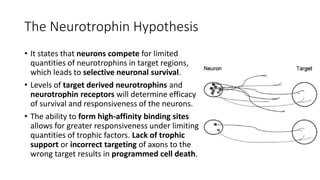
• It states that neurons compete for limited
quantities of neurotrophins in target regions,
which leads to selective neuronal survival.
• Levels of target derived neurotrophins and
neurotrophin receptors will determine efficacy
of survival and responsiveness of the neurons.
• The ability to form high-affinity binding sites
allows for greater responsiveness under limiting
quantities of trophic factors. Lack of trophic
support or incorrect targeting of axons to the
wrong target results in programmed cell death.
Neurotrophic factors and development
• Two predictions emanate from the neurotrophic hypothesis:
• First, the efficacy of neuronal survival will depend upon the amounts of
trophic factors produced during development.
• Second, specific receptor expression in responsive cell populations will
dictate neuronal responsiveness.
• It is clear now that neurons can release neurotrophins that act on
themselves (autocrine transmission) or can be anterogradely
transported down axons and act on neighboring neurons.
• Neurotrophins promote cell survival and differentiation during
neural development. Paradoxically, they can also induce cell death.
p75NTR serves as a proapoptotic receptor during developmental cell
death and after injury to the nervous system.
• The biological action of the neurotrophins can be regulated by
proteolytic cleavage, with pro-forms preferentially activating p75NTR
to mediate apoptosis and mature forms selectively activating Trk
receptors to promote survival.
• Neurons must establish connections with the proper target. In the
event of mistargeting, neurons may undergo apoptosis if the
appropriate set of trophic factors or receptors is not encountered.
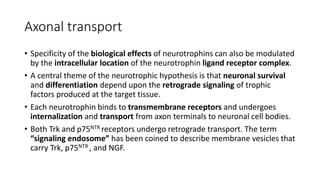
Axonal transport
• Specificity of the biological effects of neurotrophins can also be modulated
by the intracellular location of the neurotrophin ligand receptor complex.
• A central theme of the neurotrophic hypothesis is that neuronal survival
and differentiation depend upon the retrograde signaling of trophic
factors produced at the target tissue.
• Each neurotrophin binds to transmembrane receptors and undergoes
internalization and transport from axon terminals to neuronal cell bodies.
• Both Trk and p75NTR receptors undergo retrograde transport. The term
“signaling endosome” has been coined to describe membrane vesicles that
carry Trk, p75NTR , and NGF.
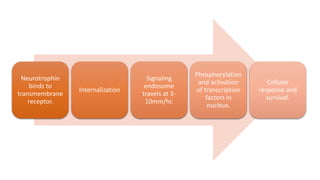
Neurotrophin
binds to
transmembrane
receptor.
Internalization
Signaling
endosome
travels at 3-
10mm/hr.
Phosphorylation
and activation
of transcription
factors in
nucleus.
Cellular
response and
survival.
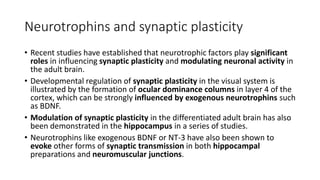
Neurotrophins and synaptic plasticity
• Recent studies have established that neurotrophic factors play significant
roles in influencing synaptic plasticity and modulating neuronal activity in
the adult brain.
• Developmental regulation of synaptic plasticity in the visual system is
illustrated by the formation of ocular dominance columns in layer 4 of the
cortex, which can be strongly influenced by exogenous neurotrophins such
as BDNF.
• Modulation of synaptic plasticity in the differentiated adult brain has also
been demonstrated in the hippocampus in a series of studies.
• Neurotrophins like exogenous BDNF or NT-3 have also been shown to
evoke other forms of synaptic transmission in both hippocampal
preparations and neuromuscular junctions.
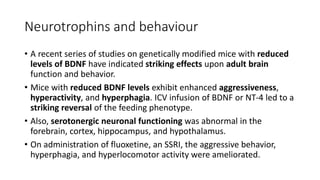
Neurotrophins and behaviour
• A recent series of studies on genetically modified mice with reduced
levels of BDNF have indicated striking effects upon adult brain
function and behavior.
• Mice with reduced BDNF levels exhibit enhanced aggressiveness,
hyperactivity, and hyperphagia. ICV infusion of BDNF or NT-4 led to a
striking reversal of the feeding phenotype.
• Also, serotonergic neuronal functioning was abnormal in the
forebrain, cortex, hippocampus, and hypothalamus.
• On administration of fluoxetine, an SSRI, the aggressive behavior,
hyperphagia, and hyperlocomotor activity were ameliorated.
• This study and other conditional BDNF mice demonstrated that the
feeding phenotype and the other behavioral abnormalities were
mediated by the functioning of BDNF in the CNS as compared to any
peripheral actions of the neurotrophin.
• Abnormal behaviors elicited by partial deletion of BDNF indicate a
significant role for this neurotrophin in higher-order behaviors, which
have clinical correlates to psychiatric disorders, especially those
associated with alteration in central serotonergic functioning.
Other neurotrophic factors
• Glial-derived neurotrophic factor (GDNF) is one of the most potent
trophic factors for dopaminergic neurons and has shown to maintain
the survival of dopaminergic neurons in the midbrain as well as
neurons in the myenteric plexus in the gut.
• Due to its trophic effects on dopaminergic neurons, it has been
considered a potential therapeutic agent for Parkinson disease.
• Ciliary neurotrophic factor (CNTF) maintains the survival of ciliary
neurons as well as motor neurons. CNTF has been investigated as a
therapeutic agent for motor neuron diseases such as ALS.
Clinical significance
• Neurotrophic factors regulate numerous neuronal functions in
development, adult life and in response to injury.
• Few human diseases affecting the nervous system have been shown
to be caused by a defect in the neurotrophins or their receptors.
Modulation of neuronal survival and axonal growth was the initial
rationale for potential clinical correlates to Alzheimer disease,
Parkinson disease, HD, and ALS as well as spinal cord injury.
• The additional effects of neurotrophic factors on synaptic
connections, synaptic plasticity, and neurotransmission have formed
the basis for their association with psychiatric disorders such as
depression and substance abuse.
• The hypothesis underlying these clinical and therapeutic correlations
assumes that these disease states result in either:
• Decreased availability of neurotrophins for the affected neurons,
• Decreased number of neurotrophin receptors on the affected neurons, and/or
• Decreased neuronal survival.
• These deficits can be ameliorated by the addition of neurotrophic factors.
• For example in Huntington’s disease, which is characterized by progressive
death of medium spiny neurons in the striatum, the pathogenic effects of
mutant huntingtin protein are explained through a decrease in BDNF
levels brought on by lower anterograde transport from the cortex to the
striatum.
• In Alzheimer disease, addition of ICV NGF or BDNF to vulnerable regions of
the brain, such as the entorhinal cortex or hippocampus, can increase
spatial learning and memory retention.
• Thus, exogenous neurotrophic factors could provide symptomatic
treatment, rather than a cure for the core pathophysiology of these
nervous system disorders.
Neurodegenerative disorders
• The initial clinical correlation to Alzheimer disease was made in the
1980s
• Animal studies showed that cholinergic neurons in the basal forebrain
could be rescued with NGF, resulting in concomitant improvements
in memory function.
• In motor neuron degeneration, BDNF and CNTF showed increase in
the number of motor neurons and improved motor performance.
• These studies led to the therapeutic strategy to attempt to treat
degenerative diseases with neurotrophins.
• In the 1990s, great effort was focused on studying whether
neurotrophic factors could be used as a treatment strategy for ALS.
• Subcutaneous or intrathecal delivered BDNF, CNTF, and NGF had
minimal beneficial effect and was associated with side effects such as
fever, pain, anorexia and gastrointestinal symptoms.
• Recent studies and gene expression profiling suggest that striatal-
specific atrophy in HD may be a consequence of a decrease in
cortical BDNF by mutant huntingtin.
• Although clinical trials have been disappointing, there is growing
evidence that several specific neurodegenerative diseases would
benefit if we can deliver adequate quantities of neurotrophins to
CNS without peripheral side-effects.
Significance in Psychiatric Disorders
• The profound effects of neurotrophic factors on synaptic connections,
synaptic plasticity, and neurotransmission have formed the basis for their
association with psychiatric disorders, such as anxiety disorders,
depression, and substance abuse.
• It has become clear that neurotrophins can produce long-term changes by
regulating transcriptional programs on the functioning of adult neurons.
• The strongest evidence for a role of neurotrophins has come from the
pathophysiology of depression, especially those associated with stress.
Major Depressive Disorder
• There are several lines of evidence suggesting a role of neurotrophins in
depression.
• Structural remodeling (decrease in hippocampal volume) and synaptic
plasticity involved in the cellular pathophysiology of depression make
BDNF an attractive candidate molecule to mediate these alterations.
• Exogenous BDNF in the hippocampus had antidepressant effects in animal
models of depression similar to chronic treatment with pharmacological
antidepressants.
• SSRIs & SNRIs upregulate CREB and BDNF in a time course that
corresponds to therapeutic action (10 to 20 days).
• Two other antidepressant treatments, MAOIs and ECT, upregulate BDNF
transcription.
• Ketamine could also mediate a rapid antidepressant response through a
BDNF-dependent mechanism.
• Conversely, exogenously administered BDNF in the mesolimbic dopamine
system appears to have an opposite effect—increasing depression-like
behavior.
• Removal of BDNF in this dopamine circuit appears to have antidepressant
effects on a social defeat paradigm.
• These studies provide a framework to examine further the neurotrophin
system as a potential therapeutic target for the treatment of depression.
Other psychiatric disorders
PSYCHIATRIC
DISORDERS
NEUROTROPHIC FACTORS
Bipolar Affective
Disorder
Decreased BDNF
Lithium & Valproate increase BDNF in the corticolimbic
pathway
Anxiety BDNF increases the susceptibility to stress and anxiety
Schizophrenia Mixed results
Substance Abuse Increased BDNF -> LTP & synaptic plasticity ->
increased drug seeking behaviour
Neurotrophins and Genetics
• A single nucleotide polymorphism (SNP) in the BDNF gene is related
to psychiatric disorders.
• SNP leads to a single amino acid change from valine (Val) to
methionine (Met) at position 66 in BNDF gene resulting in improper
folding of BDNF protein. This causes greater risk of bipolar affective
disorder, schizophrenia, depression and anxiety.
• This polymorphism is common with an allele frequency of 20-30 %.
• Humans that are heterozygous for the Met allele have
• Smaller hippocampal volumes
• Perform poorly on hippocampal dependent memory tasks.
Future directions
• Physical delivery of sufficient quantities to target neurons by development
of small molecules that readily cross the BBB to activate or potentiate the
actions of neurotrophins is an approach that is in its infancy.
• New strategies for local and regulated application of neurotrophins
through stereotactic injection of viral vectors or engineered progenitor
cells.
• The activation of the neurotrophin system through other receptor
signalling systems like small molecules that elicit neurotrophic effects for
the treatment of neurodegenerative diseases by selective targeting of
neurons that express specific GPCRs and Trk receptors.
• Further understanding of the core pathophysiological mechanism for
neurodegenerative and psychiatric disorders will benefit the development
of rational therapies that involve engaging the neurotrophin system.
Summary
• Neurotrophic factors are polypeptide growth factors influencing
proliferation, differentiation, survival & death of neuronal and nonneuronal
cells
• Expansion in the research during the last 20 years, sparked by the discovery
of BDNF has lead to their implication in pathophysiology of mood disorders
• Prospect of neurotrophic factors being used in the clinical therapy of
neurodegenerative disorders remains uncertain.
• With the inability to cross BBB, treatment strategies, similar to
antidepressants which enhance or support the synthesis or release of
endogenous neurotrophic factors, are likely to become widespread in the
future.
Neurotrophic Factors Presentation.pptx

Neurotrophic Factors Presentation.pptx

  • 1.
    NEUROTROPHIC FACTORS Presented by: Dr. AkulGupta Junior Resident Department of Psychiatry Teerthanker Mahaveer Medical College and Research Centre
  • 2.
    History • Victor Hamburger,American neuroembryologist. • Proposed that differentiation, specialization of nerve cells depends on their final destination in the body. 1934 • Rita Levi Motalcini, Italian neurohistologist. • Failure of neurons to thrive in the absence of target tissue was a degenerative process rather than failure of differentiation as proposed earlier. • Led to the discovery of NGF. 1951 • BDNF, the 2nd member of the “neurotrophic” family of neurotrophic factors by Barde et al. • Promote survival of a subpopulation of dorsal root ganglion neurons and subsequently purified from pig brain 1982
  • 3.
    Introduction • Neurotrophins area unique family of polypeptide growth factors that influence • proliferation, • differentiation, • survival, • death of neuronal and nonneuronal cells. • The effects of neurotrophins depend upon their • Levels of availability, • Affinity of binding to transmembrane receptors, • The downstream signaling cascades.
  • 4.
    Biological Roles of Neurotrophic Factors Regulatingsynaptic connections Synapse structure Neurotransmitter release Long term potentiation Mechanosensation Pain Synaptic plasticity
  • 5.
    Neurotrophin Family Nerve Growth Factor (NGF) BrainDerived Natriuretic Factor (BDNF) Neurotrophin-3 (NT-3) Neurotrophin-4 (NT-4) Glial Derived Neurotrophic Factor (GDNF) Ciliary Neurotrophic Factor (CNTF)
  • 6.
    Biosynthesis of NeurotrophicFactors Proneurotrophins Cleaved Intracellularly Extracellularly By Furin or Proconverteases By Plasmin or Matrix Metalloproteases Mature Proteins Bind to Tyrosine Kinase Receptor (TrK) p75 Neurotrophin Receptor (p75NTR) Regulate neuronal survival, differentiation, and synaptic plasticity. Modulate affinity of TrK neurotrophin associations.
  • 7.
    Neurotrophin receptors • Neurotrophinsare unique in exerting their cellular effects through the actions of two different receptors: • Trk receptor • Trk receptors consist of an extracellular ligand-binding region, a single transmembrane domain, and a highly conserved intracellular tyrosine kinase domain. • p75NTR receptor • The p75NTR receptor consists of an extracellular ligand binding region, a single transmembrane domain, and an intracellular portion containing a protein-association region termed the death domain • There are no sequence similarities between Trk and p75 receptors in their either ligand binding or cytoplasmic domains.
  • 8.
    Neurotrophin receptor signaling Trkalone Mediate differentiation and survival signaling through : MAPK PI3-K PLC-ᵞ CREB P75 alone Mediates Apoptotic and cell migration responses through : NF-ᵏB JNK Trk + p75 Trk and p75 receptor interactions create high affinity sites for binding of neurotrophins.
  • 9.
    Neurotrophin binding specificities TrK-A NGFNT-3 TrK-B BDNF NT-3 NT-4 TrK-C NT-3 p75 BDNF NGF NT-3 NT-4 TrK-A + p75 NGF TrK-B + p75 BDNF
  • 10.
    The Neurotrophin Hypothesis •It states that neurons compete for limited quantities of neurotrophins in target regions, which leads to selective neuronal survival. • Levels of target derived neurotrophins and neurotrophin receptors will determine efficacy of survival and responsiveness of the neurons. • The ability to form high-affinity binding sites allows for greater responsiveness under limiting quantities of trophic factors. Lack of trophic support or incorrect targeting of axons to the wrong target results in programmed cell death.
  • 11.
    Neurotrophic factors anddevelopment • Two predictions emanate from the neurotrophic hypothesis: • First, the efficacy of neuronal survival will depend upon the amounts of trophic factors produced during development. • Second, specific receptor expression in responsive cell populations will dictate neuronal responsiveness. • It is clear now that neurons can release neurotrophins that act on themselves (autocrine transmission) or can be anterogradely transported down axons and act on neighboring neurons.
  • 12.
    • Neurotrophins promotecell survival and differentiation during neural development. Paradoxically, they can also induce cell death. p75NTR serves as a proapoptotic receptor during developmental cell death and after injury to the nervous system. • The biological action of the neurotrophins can be regulated by proteolytic cleavage, with pro-forms preferentially activating p75NTR to mediate apoptosis and mature forms selectively activating Trk receptors to promote survival. • Neurons must establish connections with the proper target. In the event of mistargeting, neurons may undergo apoptosis if the appropriate set of trophic factors or receptors is not encountered.
  • 13.
    Axonal transport • Specificityof the biological effects of neurotrophins can also be modulated by the intracellular location of the neurotrophin ligand receptor complex. • A central theme of the neurotrophic hypothesis is that neuronal survival and differentiation depend upon the retrograde signaling of trophic factors produced at the target tissue. • Each neurotrophin binds to transmembrane receptors and undergoes internalization and transport from axon terminals to neuronal cell bodies. • Both Trk and p75NTR receptors undergo retrograde transport. The term “signaling endosome” has been coined to describe membrane vesicles that carry Trk, p75NTR , and NGF.
  • 14.
    Neurotrophin binds to transmembrane receptor. Internalization Signaling endosome travels at3- 10mm/hr. Phosphorylation and activation of transcription factors in nucleus. Cellular response and survival.
  • 15.
    Neurotrophins and synapticplasticity • Recent studies have established that neurotrophic factors play significant roles in influencing synaptic plasticity and modulating neuronal activity in the adult brain. • Developmental regulation of synaptic plasticity in the visual system is illustrated by the formation of ocular dominance columns in layer 4 of the cortex, which can be strongly influenced by exogenous neurotrophins such as BDNF. • Modulation of synaptic plasticity in the differentiated adult brain has also been demonstrated in the hippocampus in a series of studies. • Neurotrophins like exogenous BDNF or NT-3 have also been shown to evoke other forms of synaptic transmission in both hippocampal preparations and neuromuscular junctions.
  • 16.
    Neurotrophins and behaviour •A recent series of studies on genetically modified mice with reduced levels of BDNF have indicated striking effects upon adult brain function and behavior. • Mice with reduced BDNF levels exhibit enhanced aggressiveness, hyperactivity, and hyperphagia. ICV infusion of BDNF or NT-4 led to a striking reversal of the feeding phenotype. • Also, serotonergic neuronal functioning was abnormal in the forebrain, cortex, hippocampus, and hypothalamus. • On administration of fluoxetine, an SSRI, the aggressive behavior, hyperphagia, and hyperlocomotor activity were ameliorated.
  • 17.
    • This studyand other conditional BDNF mice demonstrated that the feeding phenotype and the other behavioral abnormalities were mediated by the functioning of BDNF in the CNS as compared to any peripheral actions of the neurotrophin. • Abnormal behaviors elicited by partial deletion of BDNF indicate a significant role for this neurotrophin in higher-order behaviors, which have clinical correlates to psychiatric disorders, especially those associated with alteration in central serotonergic functioning.
  • 18.
    Other neurotrophic factors •Glial-derived neurotrophic factor (GDNF) is one of the most potent trophic factors for dopaminergic neurons and has shown to maintain the survival of dopaminergic neurons in the midbrain as well as neurons in the myenteric plexus in the gut. • Due to its trophic effects on dopaminergic neurons, it has been considered a potential therapeutic agent for Parkinson disease. • Ciliary neurotrophic factor (CNTF) maintains the survival of ciliary neurons as well as motor neurons. CNTF has been investigated as a therapeutic agent for motor neuron diseases such as ALS.
  • 19.
    Clinical significance • Neurotrophicfactors regulate numerous neuronal functions in development, adult life and in response to injury. • Few human diseases affecting the nervous system have been shown to be caused by a defect in the neurotrophins or their receptors. Modulation of neuronal survival and axonal growth was the initial rationale for potential clinical correlates to Alzheimer disease, Parkinson disease, HD, and ALS as well as spinal cord injury. • The additional effects of neurotrophic factors on synaptic connections, synaptic plasticity, and neurotransmission have formed the basis for their association with psychiatric disorders such as depression and substance abuse.
  • 20.
    • The hypothesisunderlying these clinical and therapeutic correlations assumes that these disease states result in either: • Decreased availability of neurotrophins for the affected neurons, • Decreased number of neurotrophin receptors on the affected neurons, and/or • Decreased neuronal survival. • These deficits can be ameliorated by the addition of neurotrophic factors. • For example in Huntington’s disease, which is characterized by progressive death of medium spiny neurons in the striatum, the pathogenic effects of mutant huntingtin protein are explained through a decrease in BDNF levels brought on by lower anterograde transport from the cortex to the striatum. • In Alzheimer disease, addition of ICV NGF or BDNF to vulnerable regions of the brain, such as the entorhinal cortex or hippocampus, can increase spatial learning and memory retention. • Thus, exogenous neurotrophic factors could provide symptomatic treatment, rather than a cure for the core pathophysiology of these nervous system disorders.
  • 21.
    Neurodegenerative disorders • Theinitial clinical correlation to Alzheimer disease was made in the 1980s • Animal studies showed that cholinergic neurons in the basal forebrain could be rescued with NGF, resulting in concomitant improvements in memory function. • In motor neuron degeneration, BDNF and CNTF showed increase in the number of motor neurons and improved motor performance. • These studies led to the therapeutic strategy to attempt to treat degenerative diseases with neurotrophins.
  • 22.
    • In the1990s, great effort was focused on studying whether neurotrophic factors could be used as a treatment strategy for ALS. • Subcutaneous or intrathecal delivered BDNF, CNTF, and NGF had minimal beneficial effect and was associated with side effects such as fever, pain, anorexia and gastrointestinal symptoms. • Recent studies and gene expression profiling suggest that striatal- specific atrophy in HD may be a consequence of a decrease in cortical BDNF by mutant huntingtin. • Although clinical trials have been disappointing, there is growing evidence that several specific neurodegenerative diseases would benefit if we can deliver adequate quantities of neurotrophins to CNS without peripheral side-effects.
  • 23.
    Significance in PsychiatricDisorders • The profound effects of neurotrophic factors on synaptic connections, synaptic plasticity, and neurotransmission have formed the basis for their association with psychiatric disorders, such as anxiety disorders, depression, and substance abuse. • It has become clear that neurotrophins can produce long-term changes by regulating transcriptional programs on the functioning of adult neurons. • The strongest evidence for a role of neurotrophins has come from the pathophysiology of depression, especially those associated with stress.
  • 24.
    Major Depressive Disorder •There are several lines of evidence suggesting a role of neurotrophins in depression. • Structural remodeling (decrease in hippocampal volume) and synaptic plasticity involved in the cellular pathophysiology of depression make BDNF an attractive candidate molecule to mediate these alterations. • Exogenous BDNF in the hippocampus had antidepressant effects in animal models of depression similar to chronic treatment with pharmacological antidepressants.
  • 25.
    • SSRIs &SNRIs upregulate CREB and BDNF in a time course that corresponds to therapeutic action (10 to 20 days). • Two other antidepressant treatments, MAOIs and ECT, upregulate BDNF transcription. • Ketamine could also mediate a rapid antidepressant response through a BDNF-dependent mechanism. • Conversely, exogenously administered BDNF in the mesolimbic dopamine system appears to have an opposite effect—increasing depression-like behavior. • Removal of BDNF in this dopamine circuit appears to have antidepressant effects on a social defeat paradigm. • These studies provide a framework to examine further the neurotrophin system as a potential therapeutic target for the treatment of depression.
  • 26.
    Other psychiatric disorders PSYCHIATRIC DISORDERS NEUROTROPHICFACTORS Bipolar Affective Disorder Decreased BDNF Lithium & Valproate increase BDNF in the corticolimbic pathway Anxiety BDNF increases the susceptibility to stress and anxiety Schizophrenia Mixed results Substance Abuse Increased BDNF -> LTP & synaptic plasticity -> increased drug seeking behaviour
  • 27.
    Neurotrophins and Genetics •A single nucleotide polymorphism (SNP) in the BDNF gene is related to psychiatric disorders. • SNP leads to a single amino acid change from valine (Val) to methionine (Met) at position 66 in BNDF gene resulting in improper folding of BDNF protein. This causes greater risk of bipolar affective disorder, schizophrenia, depression and anxiety. • This polymorphism is common with an allele frequency of 20-30 %. • Humans that are heterozygous for the Met allele have • Smaller hippocampal volumes • Perform poorly on hippocampal dependent memory tasks.
  • 28.
    Future directions • Physicaldelivery of sufficient quantities to target neurons by development of small molecules that readily cross the BBB to activate or potentiate the actions of neurotrophins is an approach that is in its infancy. • New strategies for local and regulated application of neurotrophins through stereotactic injection of viral vectors or engineered progenitor cells. • The activation of the neurotrophin system through other receptor signalling systems like small molecules that elicit neurotrophic effects for the treatment of neurodegenerative diseases by selective targeting of neurons that express specific GPCRs and Trk receptors. • Further understanding of the core pathophysiological mechanism for neurodegenerative and psychiatric disorders will benefit the development of rational therapies that involve engaging the neurotrophin system.
  • 29.
    Summary • Neurotrophic factorsare polypeptide growth factors influencing proliferation, differentiation, survival & death of neuronal and nonneuronal cells • Expansion in the research during the last 20 years, sparked by the discovery of BDNF has lead to their implication in pathophysiology of mood disorders • Prospect of neurotrophic factors being used in the clinical therapy of neurodegenerative disorders remains uncertain. • With the inability to cross BBB, treatment strategies, similar to antidepressants which enhance or support the synthesis or release of endogenous neurotrophic factors, are likely to become widespread in the future.