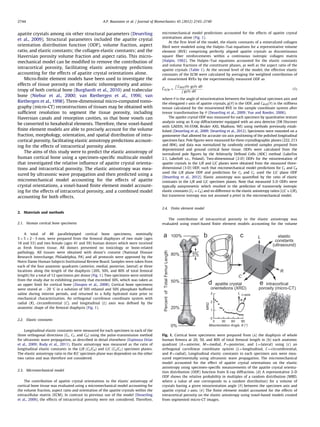
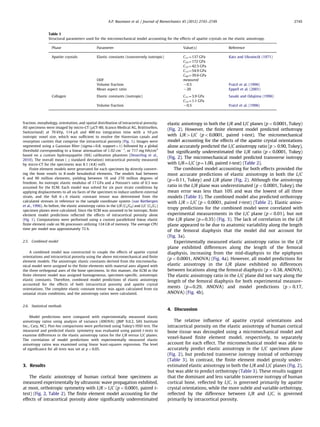
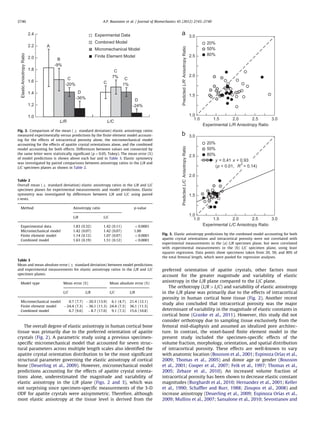
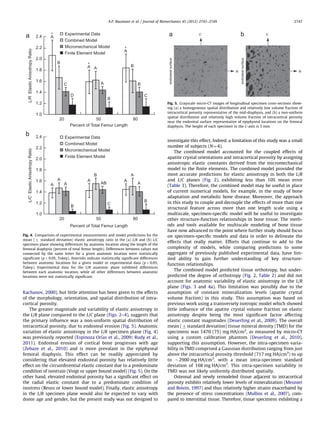
This study investigated the relative influences of apatite crystal orientations and intracortical porosity on the elastic anisotropy of human cortical bone. Experimental measurements of elastic constants from human femoral bone specimens exhibited orthotropic elasticity. Predictions from a micromechanical model accounting for apatite crystal orientations accurately captured the transverse isotropy observed in the longitudinal-circumferential plane but underestimated orthotropy. A finite element model accounting for intracortical porosity predicted orthotropy but underestimated elastic anisotropy. Only a combined model accounting for both apatite crystal orientations and intracortical porosity provided predictions within 10% of experimental measurements, suggesting both microstructural features contribute significantly to cortical bone's elastic