
Adreena Lind
July 8, 2013
Psychology 390
Steve Lazarre
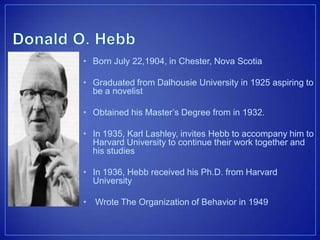
• Born July 22,1904, in Chester, Nova Scotia
• Graduated from Dalhousie University in 1925 aspiring to
be a novelist
• Obtained his Master’s Degree from in 1932.
• In 1935, Karl Lashley, invites Hebb to accompany him to
Harvard University to continue their work together and
his studies
• In 1936, Hebb received his Ph.D. from Harvard
University
• Wrote The Organization of Behavior in 1949
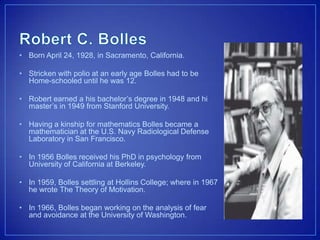
• Born April 24, 1928, in Sacramento, California.
• Stricken with polio at an early age Bolles had to be
Home-schooled until he was 12.
• Robert earned a his bachelor’s degree in 1948 and hi
master’s in 1949 from Stanford University.
• Having a kinship for mathematics Bolles became a
mathematician at the U.S. Navy Radiological Defense
Laboratory in San Francisco.
• In 1956 Bolles received his PhD in psychology from
University of California at Berkeley.
• In 1959, Bolles settling at Hollins College; where in 1967
he wrote The Theory of Motivation.
• In 1966, Bolles began working on the analysis of fear
and avoidance at the University of Washington.
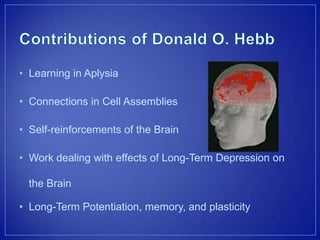
• Learning in Aplysia
• Connections in Cell Assemblies
• Self-reinforcements of the Brain
• Work dealing with effects of Long-Term Depression on
the Brain
• Long-Term Potentiation, memory, and plasticity
• Emphasized the anticipation of goals
• Negated the Hullian Drive Theory
• Recognizing that motivation and learning were
connected
• Perception of stimuli draws corresponding
response
• Debunked the empiricist of cognitive abilities as
random
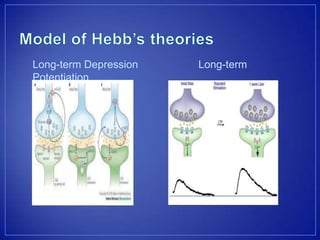
Long-term Depression Long-term
Potentiation
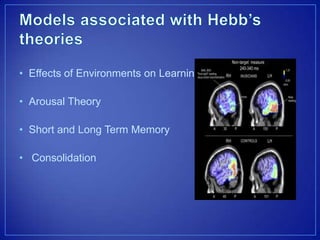
• Effects of Environments on Learning
• Arousal Theory
• Short and Long Term Memory
• Consolidation
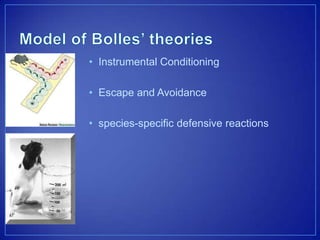
• Instrumental Conditioning
• Escape and Avoidance
• species-specific defensive reactions
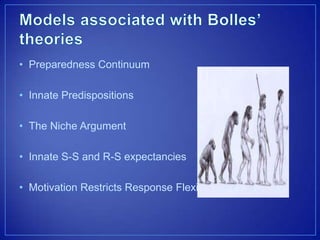
• Preparedness Continuum
• Innate Predispositions
• The Niche Argument
• Innate S-S and R-S expectancies
• Motivation Restricts Response Flexibility
Bolles, Robert C. (1967). Theory of Motivation. New York:
Harper & Row.
Bouton, M. E., & Fanselow, M. S. (1996, July). Robert C.
Bolles (1928 - 1994). American Psychologist , Vol. 51(7), 1.
Olson, M.H. & Hergenhahn, B.R. (2013). An Introduction to
Theories of Learning (9th ed.). Upper Saddle River, NJ:
Pearson.
Raymond M. Klein (1999) Canadian Journal of
Experimental: The Hebb Legacy Psychology retrieved from
http://www.cpa.ca/cpasite/userfiles/documents/publications/
cjep/special_eng.html database.

Neurophysiological and evolutionary

  • 1.
    Adreena Lind July 8,2013 Psychology 390 Steve Lazarre
  • 3.
    • Born July22,1904, in Chester, Nova Scotia • Graduated from Dalhousie University in 1925 aspiring to be a novelist • Obtained his Master’s Degree from in 1932. • In 1935, Karl Lashley, invites Hebb to accompany him to Harvard University to continue their work together and his studies • In 1936, Hebb received his Ph.D. from Harvard University • Wrote The Organization of Behavior in 1949
  • 4.
    • Born April24, 1928, in Sacramento, California. • Stricken with polio at an early age Bolles had to be Home-schooled until he was 12. • Robert earned a his bachelor’s degree in 1948 and hi master’s in 1949 from Stanford University. • Having a kinship for mathematics Bolles became a mathematician at the U.S. Navy Radiological Defense Laboratory in San Francisco. • In 1956 Bolles received his PhD in psychology from University of California at Berkeley. • In 1959, Bolles settling at Hollins College; where in 1967 he wrote The Theory of Motivation. • In 1966, Bolles began working on the analysis of fear and avoidance at the University of Washington.
  • 5.
    • Learning inAplysia • Connections in Cell Assemblies • Self-reinforcements of the Brain • Work dealing with effects of Long-Term Depression on the Brain • Long-Term Potentiation, memory, and plasticity
  • 6.
    • Emphasized theanticipation of goals • Negated the Hullian Drive Theory • Recognizing that motivation and learning were connected • Perception of stimuli draws corresponding response • Debunked the empiricist of cognitive abilities as random
  • 7.
  • 8.
    • Effects ofEnvironments on Learning • Arousal Theory • Short and Long Term Memory • Consolidation
  • 9.
    • Instrumental Conditioning •Escape and Avoidance • species-specific defensive reactions
  • 10.
    • Preparedness Continuum •Innate Predispositions • The Niche Argument • Innate S-S and R-S expectancies • Motivation Restricts Response Flexibility
  • 13.
    Bolles, Robert C.(1967). Theory of Motivation. New York: Harper & Row. Bouton, M. E., & Fanselow, M. S. (1996, July). Robert C. Bolles (1928 - 1994). American Psychologist , Vol. 51(7), 1. Olson, M.H. & Hergenhahn, B.R. (2013). An Introduction to Theories of Learning (9th ed.). Upper Saddle River, NJ: Pearson. Raymond M. Klein (1999) Canadian Journal of Experimental: The Hebb Legacy Psychology retrieved from http://www.cpa.ca/cpasite/userfiles/documents/publications/ cjep/special_eng.html database.

Editor's Notes

  • #3 These two schools of thought provide a glimpse of cognition and learning from different perspective, but are not as different as they appear. Neurophysiological and Evolutionary theories may seem to be on opposite ends of the psychological spectrum, but it truth both field have a great deal in common. For instance, both Neurophysiological and Evolutionary theories share a common characteristic for wanting answered questions of how human beings came to be. Furthermore, Neurophysiological and Evolutionary theories require a technical eye, data analyses and delving deep to find the most undeniable explanation. Neurophysiological theorist seeks to find the psychological and physiological correlation of intelligence, perception, and other cognitive process. Evolutionary theorists want to comprehend cognitive processes through analysis of living organisms and track growth and development based on organic findings. Essentially, both school of thought hope to answer the same question about human existence, behavior, and thought. Both schools of thought are needed; one the look at the past and know where and organism has been and the other to know the possibilities of how it can change and develop in the future. This is how psychology will expand; by known the history, present, and developing perditions for the future of understand.
  • #4 Donald Hebb was one of the most revolutionary neurophysiologists; a former student of the Pavlovian theories he became highly influenced by Gestalt and the brain science influence on cognitive behaviors and psychology. Hebb received his bachelor's degree from Dalhousie University, albeit with very lower scores, his mother’s alma mater (Olsen & Hergenhahn, p. 343). After graduation, Donald Hebb began teaching in the town where he had grow up and became the school’s principal (Klein, p. 1999). After sometime he decided that psychology needed much improvement. At age twenty three, he was admitted to the Psychology Department at McGill University in Montreal as a part-time graduate psychology student thanks to his mother and in spite of his grades (Olsen & Hergenhahn, p. 344). This was the turning that guide him to the path for success in disciplines of behavioral psychology and neuroscience. He continued his passion for psychology and neuroscience and continued his research until his death in 1985 (Klein, p. 1999).
  • #5 During this period he developed a love for mathematics. At the age of 21, Robert C. Bolles had obtained in Bachelor’s and Master’s degrees in mathematics from Stanford University. He earned his Bachelor’s degree in 1948 and his master’s in 1949 (Olsen & Hergenhahn, p.382). With multiple degrees in mathematics Bolles was hired to work for the United States Naval Radiological Defense Laboratory in San Francisco. After meeting his future friend and colleague John Garcia, he decided to study psychology at the University of California in Berkeley. This is where Robert met and was able to work with Edward Tolman and David Krech(Bouton & Fanselow, p. 733). This is also where Bolles conducted the early experiments that sparked his interests in evolutionary learning theory, alongside colleague Lewis Petrinovich. According to Bouton & Fanselow (1996) “He helped shape an era, and his life tells that era's story very well” (p. 733). Bolles was an influential part of psychology and one of the great evolutionary theorists of the twentieth century.
  • #6 One of Donald Hebb’s major theoretical contributions to psychology was the development of the concept of cell assembly, which is the neural group associated with an environmental object and phase sequence. Hebb concluded that when the neural group that is associated with a specific object is engaged while the idea of the object is still experienced (Olsen & Hergenhanh p. 348). This basically means that events that typically occur together in the environment become represented on the neural level as a phase sequence; this is human perception at work.During his time at the University of Montreal, Hebb was able to study patients with the effects of serious brain damage and coronal injuries under the supervision of Wilder at Montreal Neurological Institute. He observed at brain injuries and saw how the surgeries were able to correct and help the patients. He was particularly interested in lesions on the frontal lobes. He discovered that removing large amounts of brain tissue did not affect the patients’ memory or intelligence. His interest also focused on intelligence and behavior. Hebb created intelligence tests that have been used for humans and animals (Olsen & Hergenhanh p. 347).Cell Assembliesare the network of neurons that is activated repeatedly during cognitive activity;this structure permits a nerve cellto pass electrical or chemical signal to another, these cell connections among cellular participants are joined together and made stronger (Olsen & Hergenhanh, 2013).Hebb theorized that life experience was necessary for the creation of these groupings as well. After the cell assemblies have been formed they can function on their own as memories or thoughts. Cells assemblies then begin interacting with other cell groups, which there by creates the phase sequences.
  • #7 Robert C. Bolles contributed a great deal to psychology. Bolles understood that by taking a humanistic perspective of the test subjects (animals) behavior and responses to stimuli would be greatly beneficial to understand human evolution, behavior, and cognition( Bouton & Fanselow, p. 733). Bolles's book, Theory of Motivation, written at Hollins College, in Virginia, in 1967. His book identified a broad range of data and is said to have “marked the downfall of Hullian drive theory” (Bouton & Fanselow, p. 733). Bolles’ book, emphasized the anticipation of goals, and displayed the biological and historical perspective of motivated behavior. He spoke on the role of cognition when dealing with motivation; recognizing that motivation and learning were connected, and could not function without the other (Bouton & Fanselow, p. 733). Additionally, Bolles expanded on the idea that in order for an organism to succeed (survive) he or she must to learn what he or she needs. In other words behaviors are genetically innate to each species to aid in ensuring the survival of the future generations of the species. According to Oslen and Hergenhahn (2013) Bolles emphasized the importanceof how the organism perceive the events before it in order for it to determine an appropriate response, (p. 387).
  • #8 Hebb suggested that cell assemblies develop when the network of neurons that are activated repeatedly (during cognitive activity) permits a nerve cell to pass electrical or chemical signal to another, these cell connections among cellular participants are joined together and made stronger to create the grouping of the cell bodies (Olsen & Hergenhanh, 2013).The Hebbian theory suggests the adaptation of neurons in the brain are a learning process. This theory represents the biological neuroscience perspective of psychology and works to identify the basic mechanism of synaptic plasticity. The is caused by an increase in synaptic efficacy, which increase because the presynaptic cells experience recurring stimulation from the postsynaptic cells (Olsen & Hergenhanh, 2013).The idea is that two cells thatare repeatedly active (repeatedlyfiring to another cell) simultaneously tend to become associated. Eventually this creates a dynamic where when one cell response the other will as well (Olsen & Hergenhanh, 2013)
  • #9 The messages the brain processes while a person learns is sent to the short-term memory bank also known as part of the synapses. This is where memories are held for a short time or disregarded if not needed. The more a person uses a memory or material learned this memory would become a long-term memory also part of the synapses. The processes of material from what a person learns are sent through the frontal lobe. Both the left and the right side of the frontal lobe are part of learning and memorization. Additionally, sensory environments have a tremendous effect on the learning experience and ability to develop cognitive abilities (Olsen & Hergenhanh p. 347). Enriched environments (environments with various stimuli to encourage cognition) produce heightened motor-sensory skills and problem solving ability; while restrictive environments cause complications with rudimentary learning processes, such as spatial recognition (Olsen & Hergenhanh p. 346). According to Olsen and Hergenhanh (2013), “Greater sensory diversity provided by the enriched environment allowed the build up of numerous complex neural circuits and netwroks,” (p. 348). Furthermore, Hebb established the notion of an optimal level of arousal; this essentially draws on the idea that in order to full grasp and retain new information one must be neither overly stimulated nor under stimulated. He also suggested that certain skills required a certain degree of arousal in order to performance the task adequately (Olsen & Hergenhanh p. 350).
  • #10 Bolles and his college preformed an experiment with two groups of rats while at Berkeley; using their famous T-maze. The experiment was designed to point out response biases that were naturally set in place based on the situations that the rats were placed in. One group of rats was trained to turn left while the second group was trained to turn to the right. In his experiment with the T-maze; Bolles identified that the natural instinct to run to the stable incentive (water) cause the thirsty rats to be more responsive during the initially test and move more readily through the maze. While in the additional trials where the hungry rats were made to dart back and forth they proved to be more successful. This is because the rats pictured the water as fixed and associated it with their natural experience of water in the wild (Olsen & Hergenhahn, 2013). This also suggests that the rats that looked for food showed an instinct to hunt for their food and were more readily motivated because of the stimuli during the trial (as well as for the food). Additionally, Bolles contended that generally organisms exhibit a degree of flexibility and exploration in order to obtaining its needs, but when this is not sufficient innate expectancies provide a way out of environmental trouble (Olsen & Hergenhahn, p. 386). In this case the rat would exhibit what is known as a species-specific defensive reactions; this is basically a “by any means necessary technique,” (Olsen & Hergenhahn, p. 386”. The rat will screech, crawl, or run to be free of whatever danger it encounters.
  • #11 Survival is based on multiple factors based on the individual abilities are a given species. Not all species are able to preform the task of another species of animal. Robert Bolles believed that the concept known as preparedness continuum, which is basically the explanation of why certain associations are learned less likely to be learned than others (Olsen & Hergenhahn, 2013). When motivation is not present the appropriate response is also unlikely to be present. For example in the case of the rats were if there were no incentive for the rats or move in either direction than it is unlikely they would develop an understanding for what the task is and why it needs to be done (Olsen & Hergenhahn, 2013). Additionally, learning is an essential aspect of survival are closely related. All organisms must learn and develop a method (a niche) that is beneficial to its survival. the niche argument stems from the concept that in order to comprehend signal during potentially harmful situations and select important components of the local environments. Once these signals are learned, instrumental and operant conditioning allow organisms to learn appropriate reactions to those signals (Olsen & Hergenhahn, 2013). These process not only influence the nature of the organisms' world, but also determine the range of abilities and drive that their descendants will also have; their natural instincts (Olsen & Hergenhahn, 2013).
  • #12 With the vast expansion of media and technology there has also been an increase in study of this “social” and cognitive environment. For example in western cultural and society it is common for a household to have two or three televisions, computers, or mobile devices developmental. People often hear how television affects the emotional response of children. From a psychological standpoint when analyzing media and children look to the work of behaviorist B.F. Skinner. When children are overstimulated after observing the visual cues from an inappropriate (violent) program he or she may act out in an aggressive way. This is similar to Bandura’s experiment with children that observed an adult yell at and hit a “Bopo - the clown” inflatable toy. The children began to mimic the observed behaviors that each had recently witness (Olsen & Hergenhanh, 2013). From an evolutionary perspective the constant use of media devices may not have dire implication,as of yet, because the development have only occurred over a small span in human development, but it does limit specific cues that human beings have in order to properly communicate (Olsen & Hergenhanh, 2013). For example often time a person will receive a text message and not know exactly how to answer; this is because there is not facial recognition or audible exchanges to indicate a particular mood or feeling.Additionally, from a neurological view constant influx of images and sensory overload can cause shorted attention spans and depleted ability to focus (Olsen & Hergenhanh, 2013). For example, when an individual is overly stimulated or under stimulated that person will be unlikely to focus, if a child or adult is constantly bombarded with fast pace images the reality of real-time may prove insufficient to holding the individual’s attention (Olsen & Hergenhanh, 2013).
  • #13 Neurophysiological and Evolutionary theorists deal with complex issues and endless questions about humanity and cognition. Evolutionary theorists seem to look to the past in order to answer psychological developmental questions. Analysis of evolution is an open book to the past; spanning from prehistoric up to the modern day (Olsen and Hergenhahn, 2013). Neurophysiological theorists seek to decode the vast workings of the human body, brain and their connection to behavior and cognition by means of advancing technology (Olsen & Hergenhahn, 2013). Neurophysiological theorists seem to always be looking to the future, but both schools of thought are needed to provide a complete concept of understanding and knowledge to know what direct psychology and humanity will take as it moves one step closer to those answers.