WHAT IS AUTISM?
Adreena Lind
Abnormal Psychology 410
January 25, 2014
Pr. Jennifer Parsons-Rivera
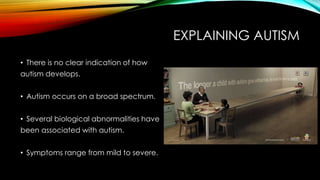
EXPLAINING AUTISM
• There is no clear indication of how
autism develops.
• Autism occurs on a broad spectrum.
• Several biological abnormalities have
been associated with autism.
• Symptoms range from mild to severe.
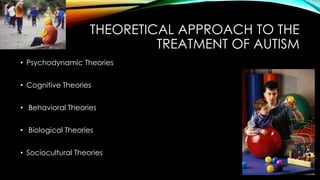
THEORETICAL APPROACH TO THE
TREATMENT OF AUTISM
• Psychodynamic Theories
• Cognitive Theories
• Behavioral Theories
• Biological Theories
• Sociocultural Theories
REFERENCES
Hansell, J. & Damour, L. (2008). Abnormal Psychology (2nd ed.). Hoboken, NJ: Wiley
Health (n.d.) Psychodynamic Intervention retrieved from
http://www.health.gov.au/internet/main/publishing.nsf/Content/FE478B6B8CE5C636CA257BF0001FA0E5/$File/autrpsy.pdf
database.
Images:
Tim McPherson (2009) Autism retrieved from http://adsoftheworld.com/media/print/treehouse_table database. (Slide 2)
Icare4Autism (2014) Easy At-Home “Sensory-Motor Enrichment Exercises” retrieved from http://www.icare4autism.org/wp-
content/uploads/2013/05/ICare-pic-5-20-131.jpeg database. (Slide 3, bottom left)
Home (n.d) Choosing the Right High School for a High Functioning Child with autism retrieved from
http://www.autismkey.com/choosing-the-right-school-for-a-high-functioning-child-with-autism/ database. (Slide 3, top right)

Autism: What is Autism?

  • 1.
    WHAT IS AUTISM? AdreenaLind Abnormal Psychology 410 January 25, 2014 Pr. Jennifer Parsons-Rivera
  • 2.
    EXPLAINING AUTISM • Thereis no clear indication of how autism develops. • Autism occurs on a broad spectrum. • Several biological abnormalities have been associated with autism. • Symptoms range from mild to severe.
  • 3.
    THEORETICAL APPROACH TOTHE TREATMENT OF AUTISM • Psychodynamic Theories • Cognitive Theories • Behavioral Theories • Biological Theories • Sociocultural Theories
  • 4.
    REFERENCES Hansell, J. &Damour, L. (2008). Abnormal Psychology (2nd ed.). Hoboken, NJ: Wiley Health (n.d.) Psychodynamic Intervention retrieved from http://www.health.gov.au/internet/main/publishing.nsf/Content/FE478B6B8CE5C636CA257BF0001FA0E5/$File/autrpsy.pdf database. Images: Tim McPherson (2009) Autism retrieved from http://adsoftheworld.com/media/print/treehouse_table database. (Slide 2) Icare4Autism (2014) Easy At-Home “Sensory-Motor Enrichment Exercises” retrieved from http://www.icare4autism.org/wp- content/uploads/2013/05/ICare-pic-5-20-131.jpeg database. (Slide 3, bottom left) Home (n.d) Choosing the Right High School for a High Functioning Child with autism retrieved from http://www.autismkey.com/choosing-the-right-school-for-a-high-functioning-child-with-autism/ database. (Slide 3, top right)

Editor's Notes

  • #2 Autism is a cognitive and behavioral disorder that often leads to strong social and learning deficiencies for the individual (Hansell & Damour, 2008). Autism is often first recognizable in early childhood between the ages of two and five, but may not diagnosed until later on. Typical symptoms of this disorder include difficulty in typical milestone achievements such as toilet training, name (auditory) recognition, communication with others, making eye contact, forming interpersonal relationships, understanding auditory concepts, as well as understanding facial expressions (Hansell & Damour, 2008).
  • #3 There are many theories that work to explain how autism develops and can how it effects each person individually. Autism is a perplexing and complicated disorder; one that is more of an umbrella name for multiple symptoms and leaning/behavioral impairments. For example, the psychodynamic perspective early on associated autism with a lack of warmth and love from the child’s caregiver(s) and the best treatment was presumed to be removal of the child from his or her unloving parents and placed in institutional homes (Health, n.d.). This was This idea could also in some ways be an example of the sociocultural influence of the child’s environment. The emotional frigidity of the parents causes the child to turn inward rather than be subjected to his or her parents (Hansell & Damour, 2008). There was also some correlation that based similarities between the behaviors of autistic children and children that had experienced violence and trauma that the social environment could be the root of the disorder (Health, n.d). However, stronger evidence points to biological factors and neurological factors as the cause for autism.It was later realized that biological fact play a much greater role in the development of autism (Hansell & Damour, 2008). An example of this can be seen in the abnormal size in the development of neurons in the limbic system, which is often seen in individuals with autism (Hansell & Damour, 2008). Additionally it is recognized that there is some generationally correlation; children that show symptoms of autism early on often have relative that also have the disorder (Hansell & Damour, 2008).
  • #4 Most treatments for autism rely on an all-inclusive system of cognitive and learning therapies, psychodynamic theory, and behavioral therapy and is some severe cases medication can also be used. Unlike in the past, clinicians realize that it is very unlikely that this disorder is the result of unloving parents (Hansell & Damour, 2008). In recent years, clinicians have developed treatment options that focus on helping both the autistic child as well as work to assistance the family in coping with the emotional toll of this disorder. Although there is no single cure for autism with the help of therapeutic specialists, who seek to promote motor-skill, social achievement, and the promotion of language abilities through therapy there is tremendous potential for the child to progress in areas of difficulty (Hansell & Damour, 2008).