DETECTION OF MOVING OBJECTS
IN A VIDEO USING
HOPFIELD NEURAL NETWORK
Presented By:
Neha Dudhoria
Abhishikha
Adarsh Pilania
Mentor:
Amlan Ray Chaudhuri
Why are we doing it?
Moving objects detection in video streams is a key
fundamental and critical task in many computer vision
applications.
Object detection in videos involves verifying the
presence of an object in image sequences and possibly
locating it precisely for recognition.
Why are we doing it?
Object tracking is to monitor an object’s spatial and
temporal changes during a video sequence, including its
presence, position, size, shape.
Object tracking from video sequence is the process of
locating moving objects in time using a camera. An
algorithm analyses the video frames and outputs the
location of moving targets within the video frame. The
main steps involved in this process are object detection,
tracking, and analysis of tracked objects
OBJECTIVE
 The main objective of this project is to devise a
method by which moving objects can be detected in a
video.
 Change detection is the process of identifying
differences in the state of an object or phenomenon by
observing it at different times. The goal of our study is
to utilize Hopfield Neural Network to address these
tasks.
HOPFIELD NEURAL NETWORK
A Hopfield network is a form of recurrent
artificial neural network invented by John
Hopfield in 1982.
It can be seen as a fully connected single layer
auto associative network.
Hopfield nets serve as content addressable
memory systems with binary threshold nodes.
INTRODUCTION
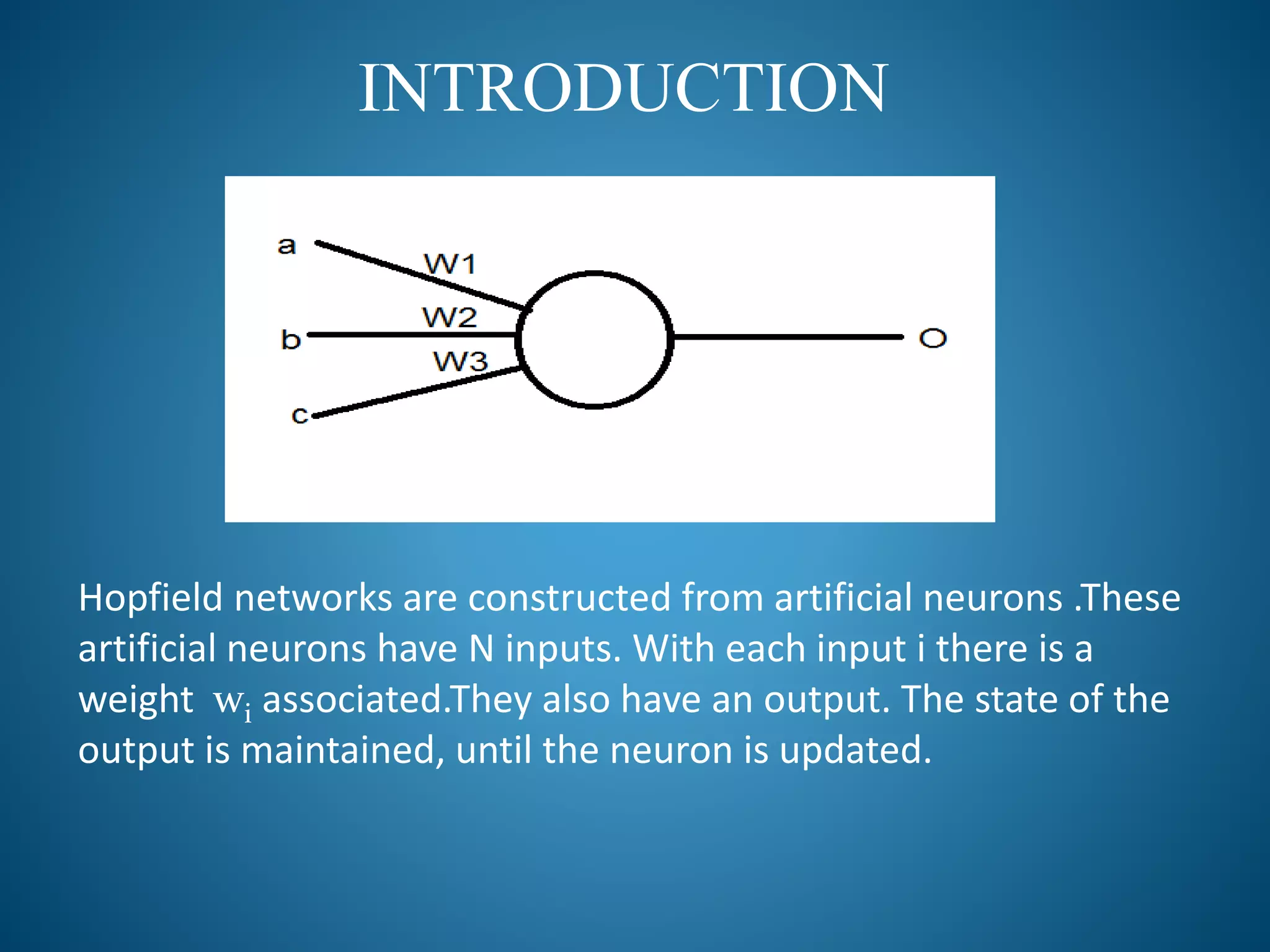
Hopfield networks are constructed from artificial neurons .These
artificial neurons have N inputs. With each input i there is a
weight wi associated.They also have an output. The state of the
output is maintained, until the neuron is updated.
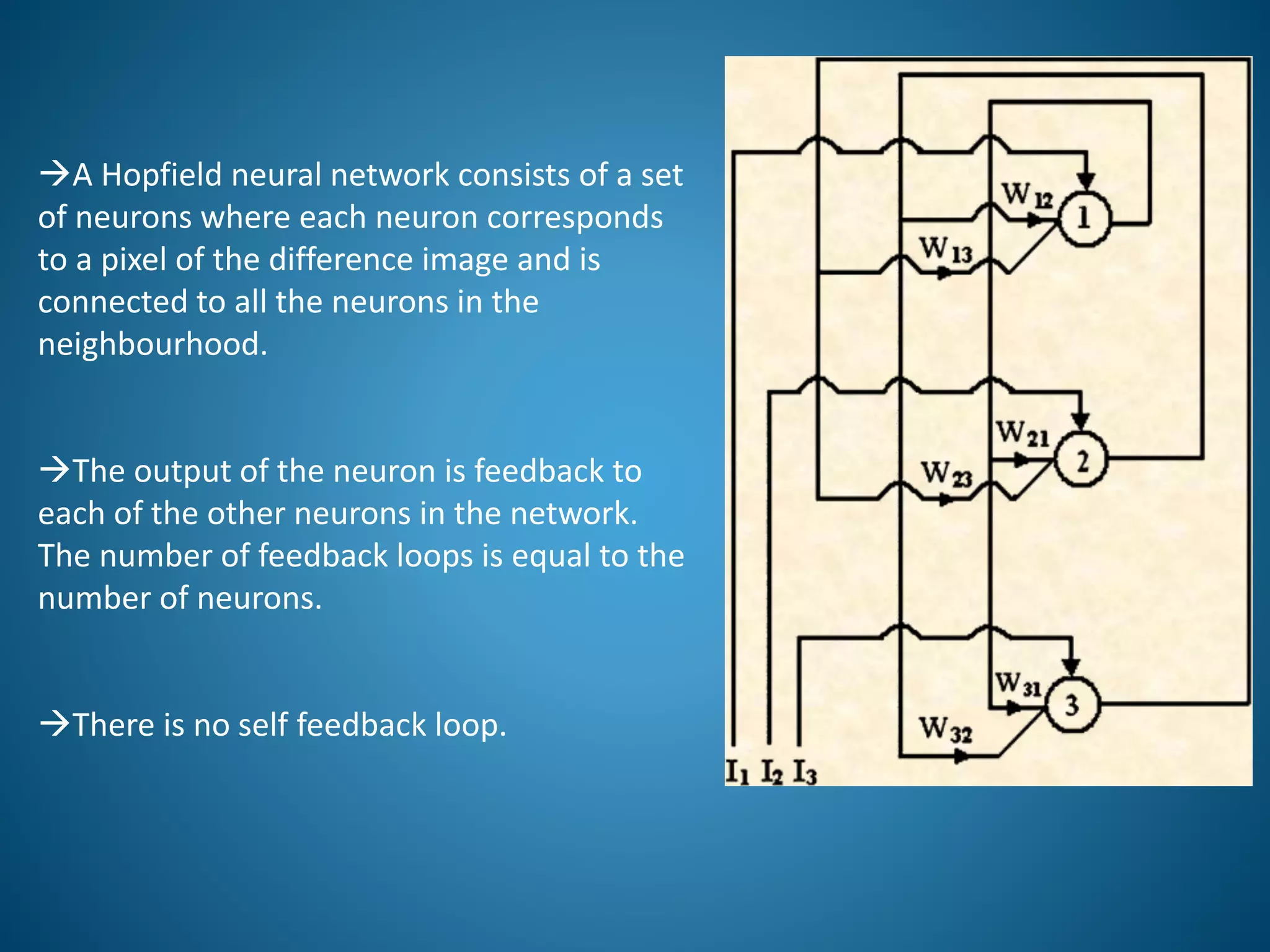
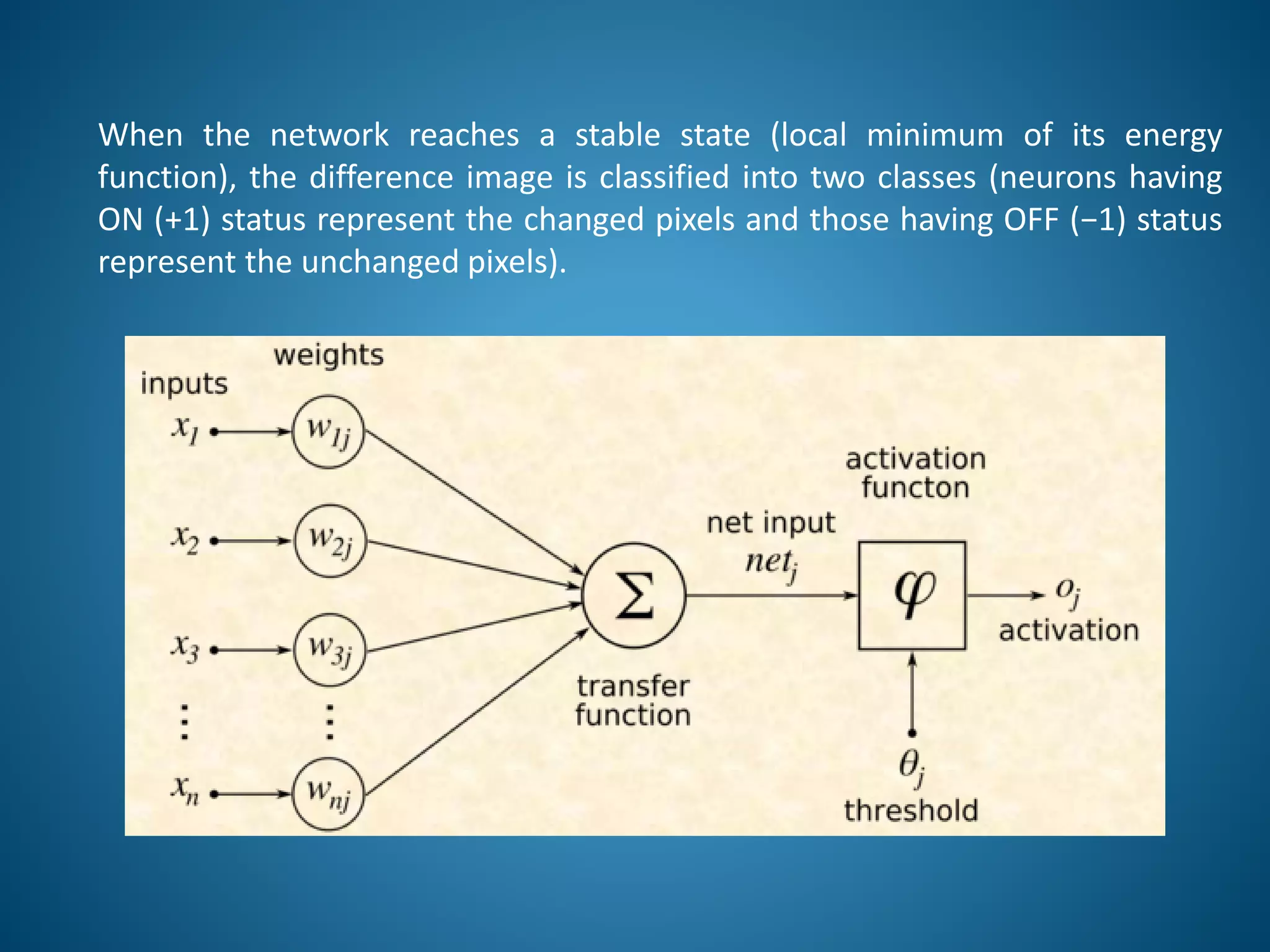
A Hopfield neural network consists of a set
of neurons where each neuron corresponds
to a pixel of the difference image and is
connected to all the neurons in the
neighbourhood.
The output of the neuron is feedback to
each of the other neurons in the network.
The number of feedback loops is equal to the
number of neurons.
There is no self feedback loop.
PROPERTIES OF HOPFIELD NETWORK
A recurrent network with all nodes connected to all
other nodes.
Nodes have binary outputs(either 0,1 or 1,-1)
Weights between the nodes are symmetric
No connection from node to itself is allowed
Nodes are updates asynchronously(the nodes are
selected at random)
The network has no hidden layers or nodes.
PROPOSED WORK
A video stream is primarily divided into several
frames and our goal can be achieved if we can
identify the image portion which has changed over
time and that which has not changed.
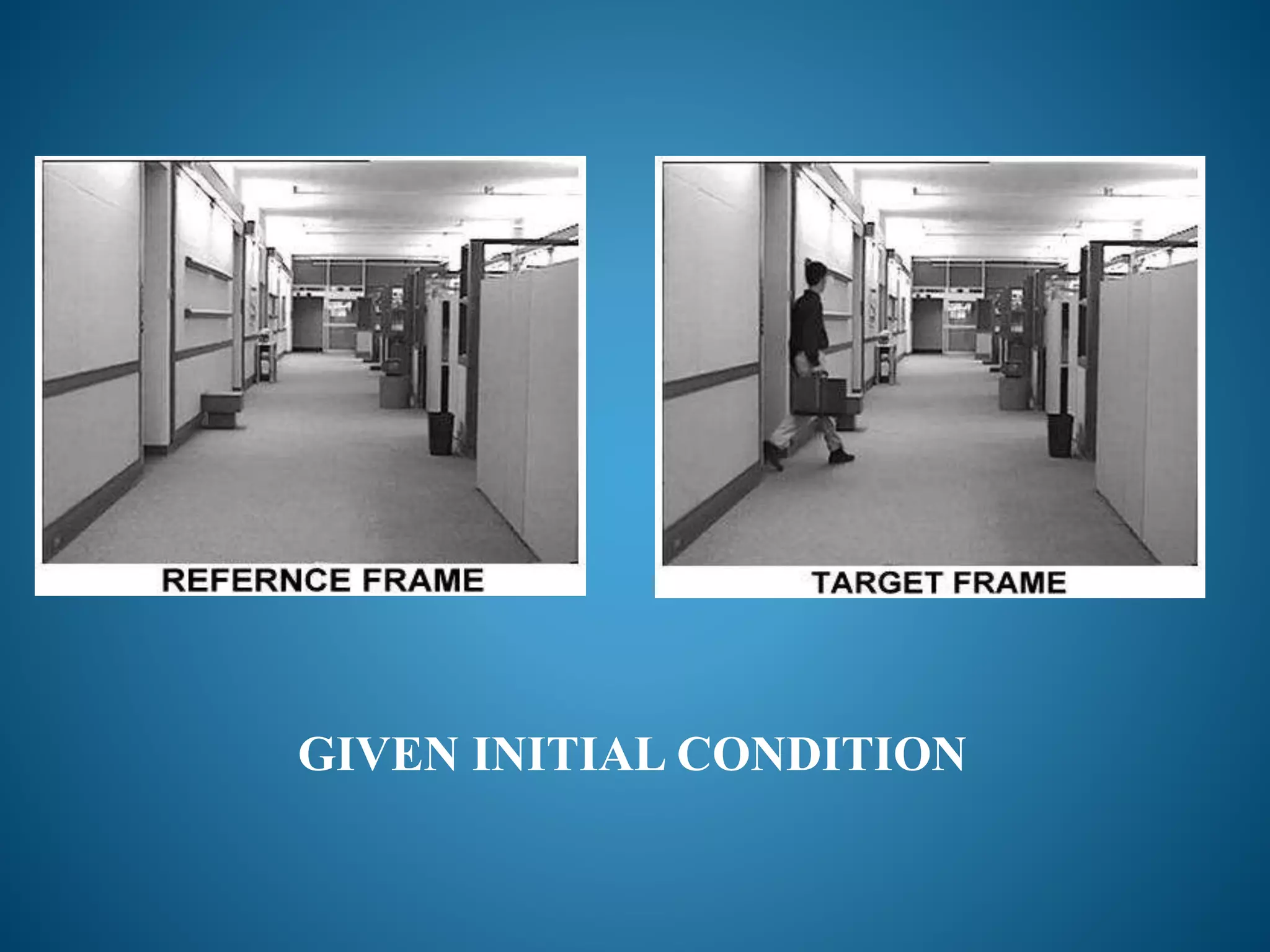
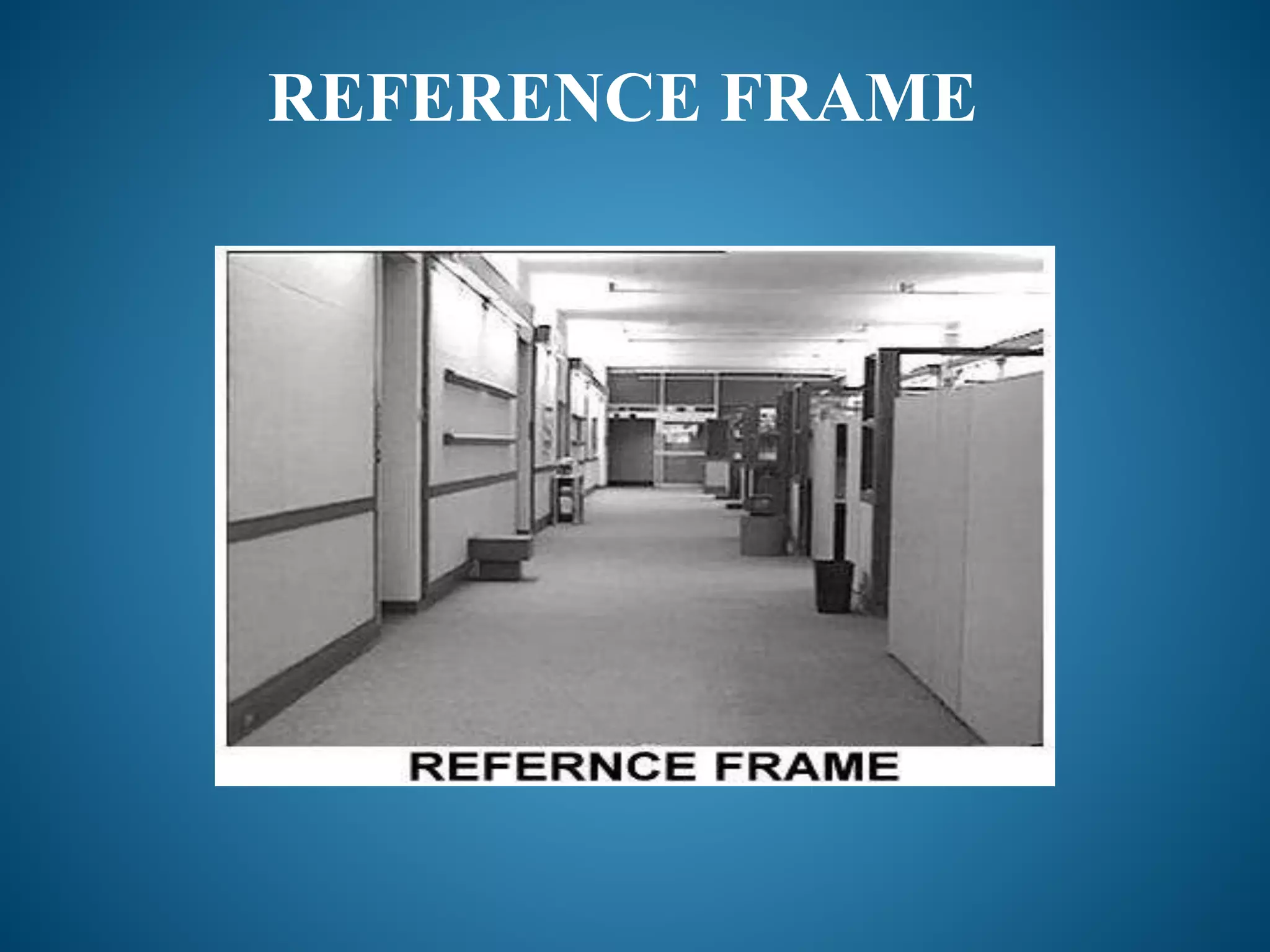
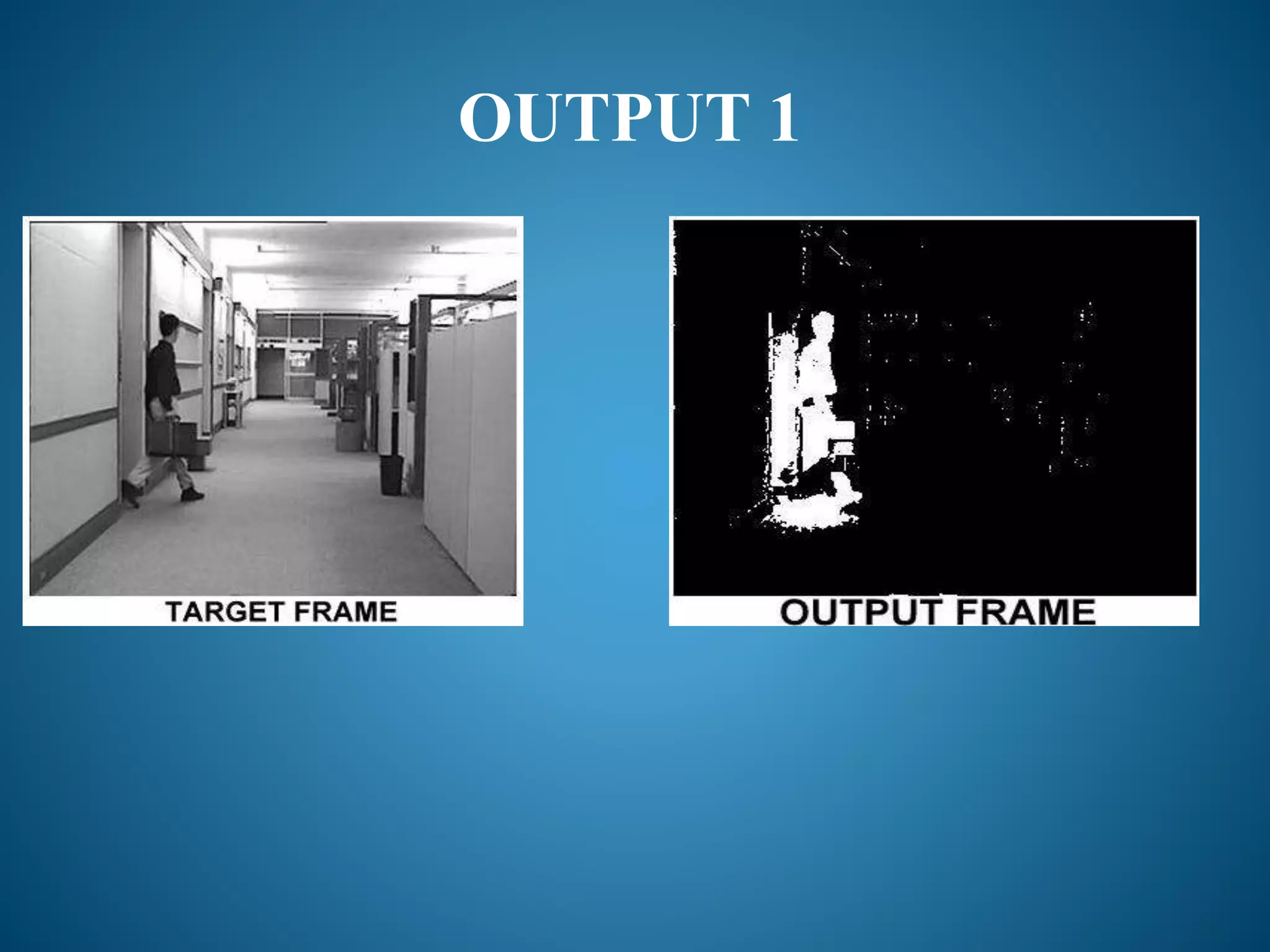
A difference frame is obtained from the reference
frame and target frame.
GIVEN INITIAL CONDITION
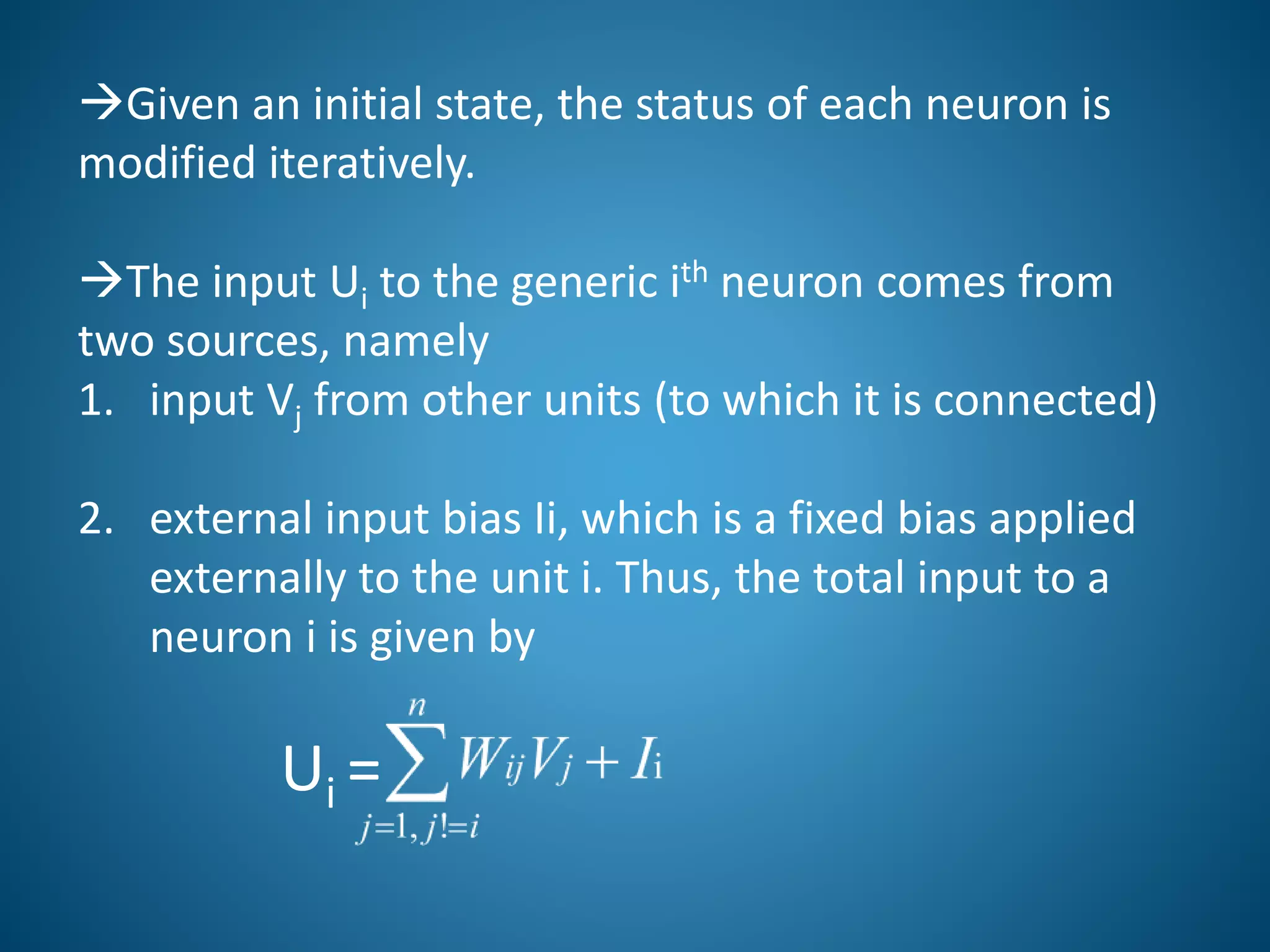
Given an initial state, the status of each neuron is
modified iteratively.
The input Ui to the generic ith neuron comes from
two sources, namely
1. input Vj from other units (to which it is connected)
2. external input bias Ii, which is a fixed bias applied
externally to the unit i. Thus, the total input to a
neuron i is given by
Ui =
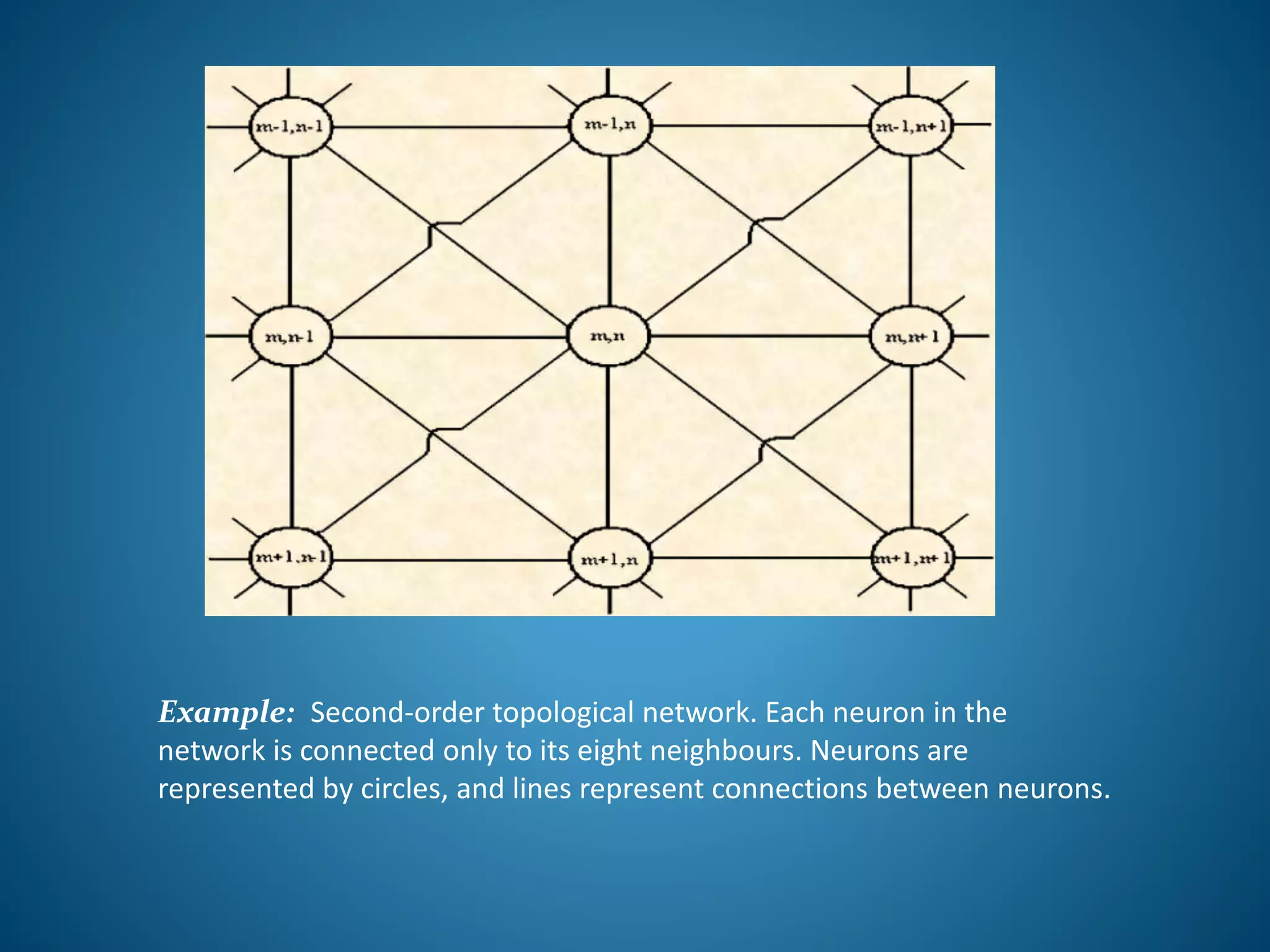
Example: Second-order topological network. Each neuron in the
network is connected only to its eight neighbours. Neurons are
represented by circles, and lines represent connections between neurons.
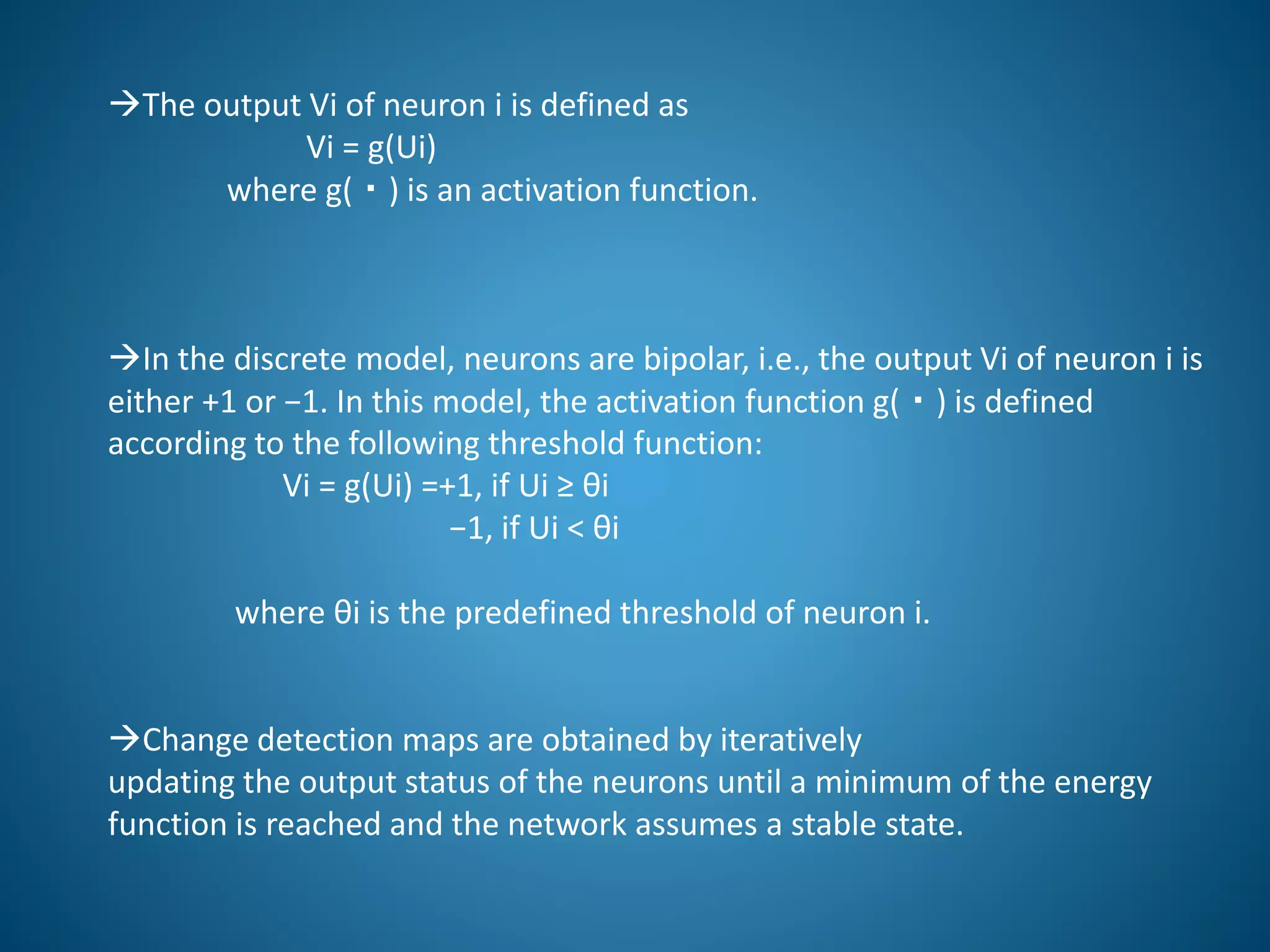
The output Vi of neuron i is defined as
Vi = g(Ui)
where g(・) is an activation function.
In the discrete model, neurons are bipolar, i.e., the output Vi of neuron i is
either +1 or −1. In this model, the activation function g(・) is defined
according to the following threshold function:
Vi = g(Ui) =+1, if Ui ≥ θi
−1, if Ui < θi
where θi is the predefined threshold of neuron i.
Change detection maps are obtained by iteratively
updating the output status of the neurons until a minimum of the energy
function is reached and the network assumes a stable state.
ENERGY
Hopfield defined the energy function of the network by using
the network architecture, i.e., the number of neurons, their output
functions, threshold values, connection between neurons, and the strength
of the connections. Thus, the energy function represents the complete status
of the network.
Hopfield has also shown that, at each iteration of the processing of the
network, the energy value decreases and the network reaches a stable state
when its energy value reaches a minimum.
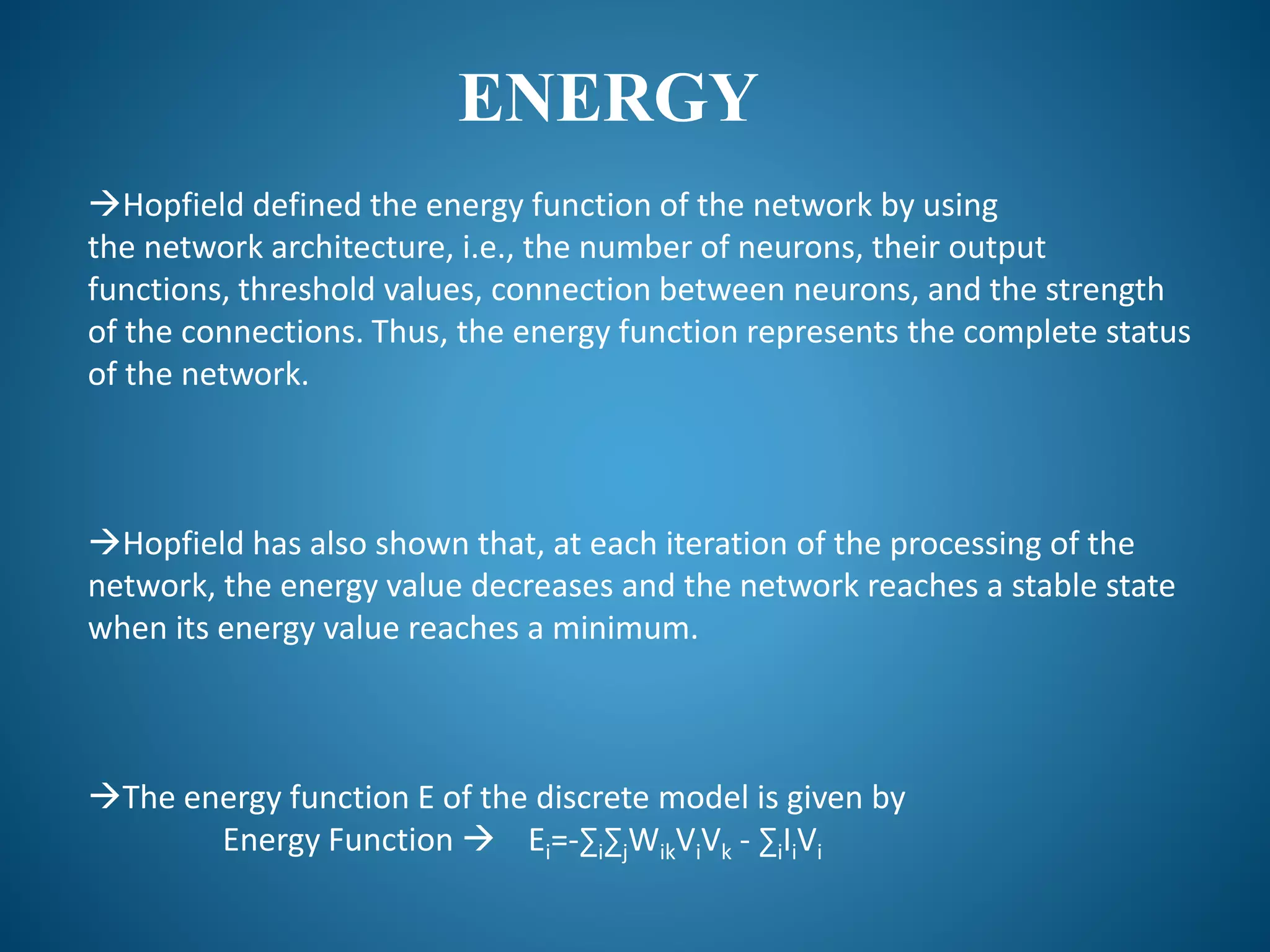
The energy function E of the discrete model is given by
Energy Function  Ei=-∑i∑jWikViVk - ∑iIiVi
When the network reaches a stable state (local minimum of its energy
function), the difference image is classified into two classes (neurons having
ON (+1) status represent the changed pixels and those having OFF (−1) status
represent the unchanged pixels).
REFERENCE FRAME
OUTPUT 1
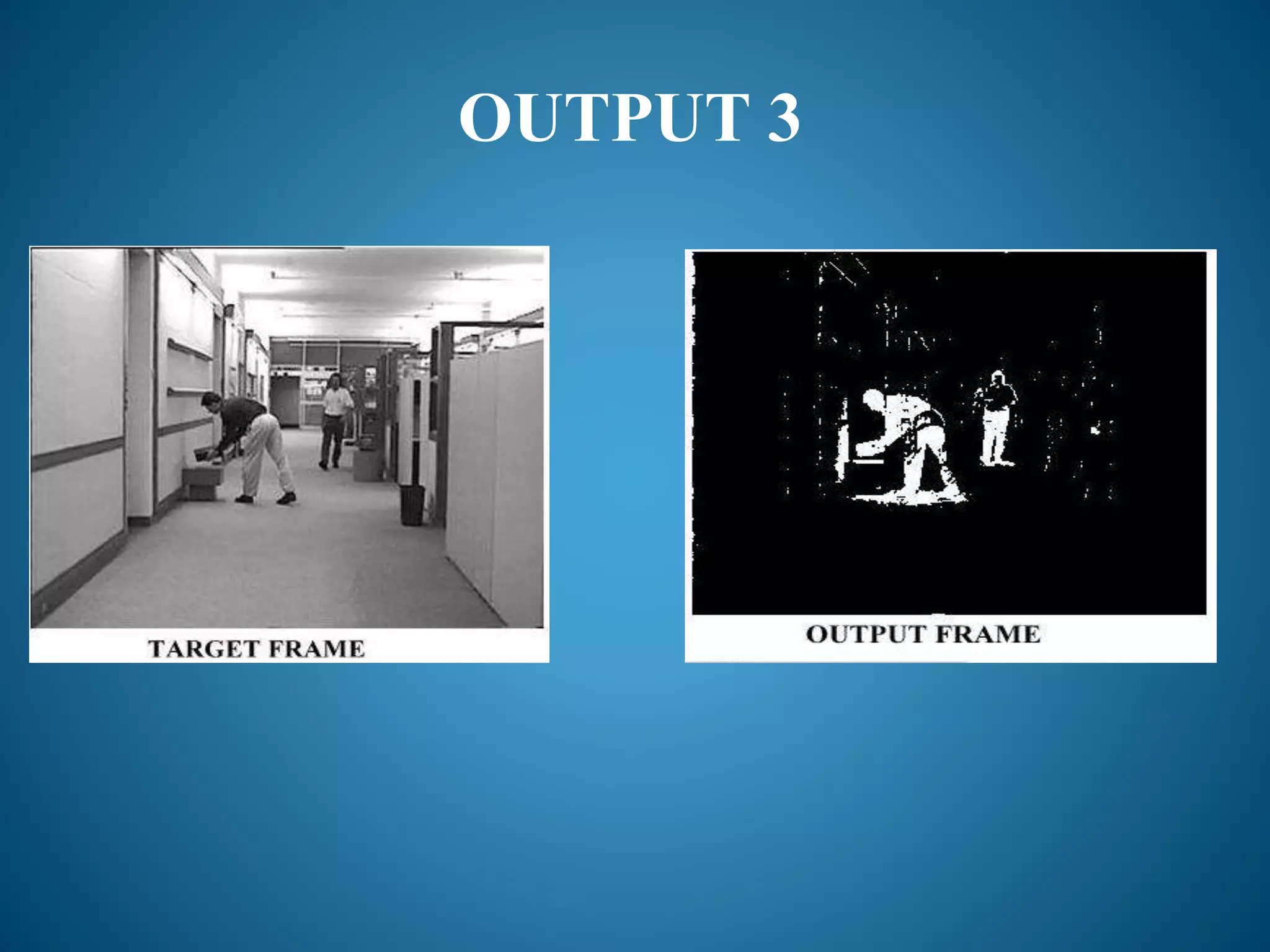
OUTPUT 2
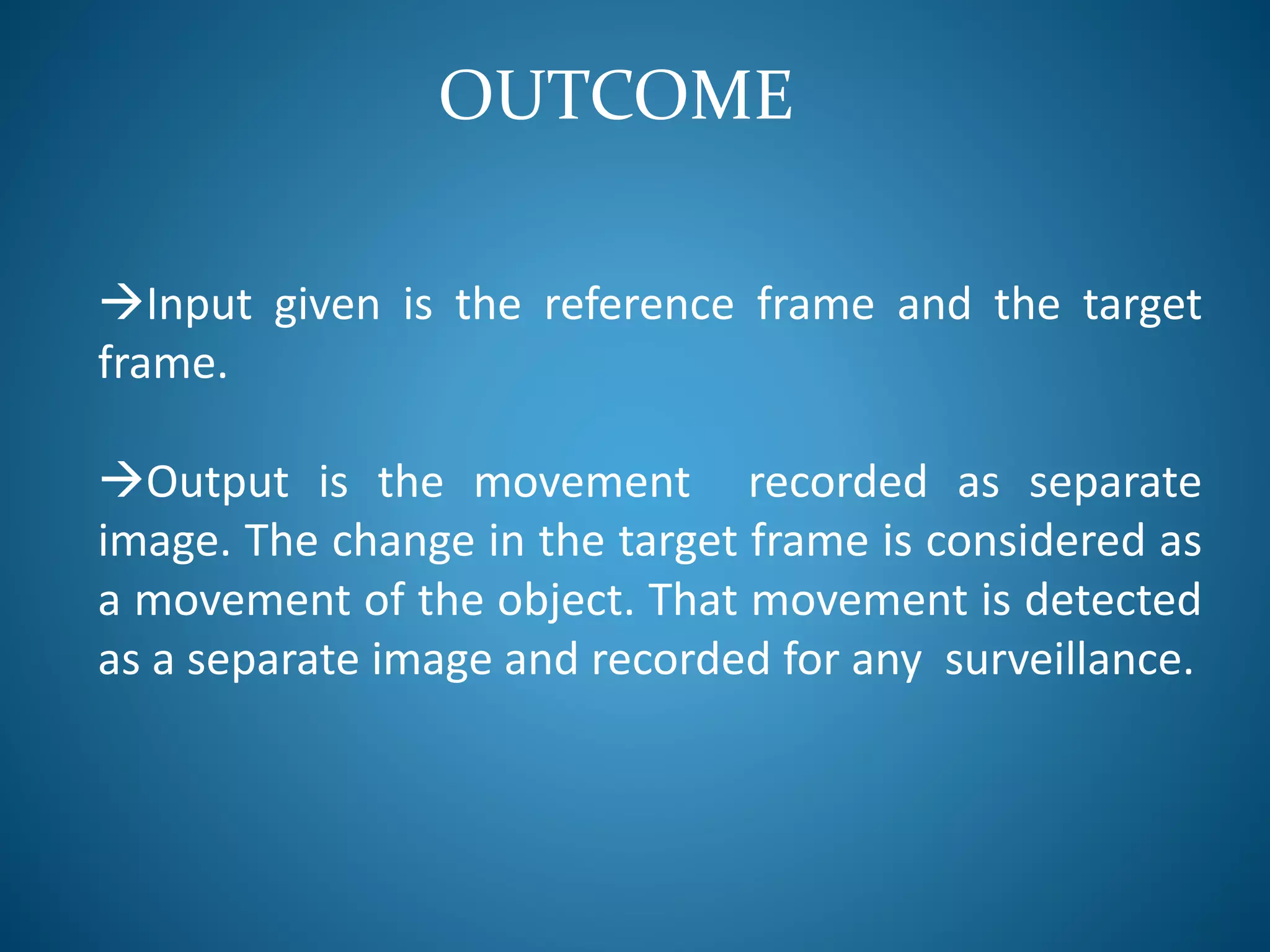
OUTPUT 3
OUTCOME
Input given is the reference frame and the target
frame.
Output is the movement recorded as separate
image. The change in the target frame is considered as
a movement of the object. That movement is detected
as a separate image and recorded for any surveillance.
APPLICATIONS
Video surveillance
People tracking
Gesture recognition in human-machine interface
Traffic monitoring
REFERENCES
1. R. Bogush, N. Brovko and S.Maltsev. Background
Reconstruction Based on Iterative Algorithm for Video
Surveillance Systems.
2. Manisha Chate, S.Amudha and Vinaya Gohokar. Object
Detection and tracking in Video Sequences.
3. S. Gopal and C. Woodcock, “Remote sensing of forest change
using artificial neural networks,” IEEE Trans. Geosci. Remote
Sens., vol. 34,
THANK YOU

hopfield neural network

  • 1.
    DETECTION OF MOVINGOBJECTS IN A VIDEO USING HOPFIELD NEURAL NETWORK Presented By: Neha Dudhoria Abhishikha Adarsh Pilania Mentor: Amlan Ray Chaudhuri
  • 2.
    Why are wedoing it? Moving objects detection in video streams is a key fundamental and critical task in many computer vision applications. Object detection in videos involves verifying the presence of an object in image sequences and possibly locating it precisely for recognition.
  • 3.
    Why are wedoing it? Object tracking is to monitor an object’s spatial and temporal changes during a video sequence, including its presence, position, size, shape. Object tracking from video sequence is the process of locating moving objects in time using a camera. An algorithm analyses the video frames and outputs the location of moving targets within the video frame. The main steps involved in this process are object detection, tracking, and analysis of tracked objects
  • 4.
    OBJECTIVE  The mainobjective of this project is to devise a method by which moving objects can be detected in a video.  Change detection is the process of identifying differences in the state of an object or phenomenon by observing it at different times. The goal of our study is to utilize Hopfield Neural Network to address these tasks.
  • 5.
    HOPFIELD NEURAL NETWORK AHopfield network is a form of recurrent artificial neural network invented by John Hopfield in 1982. It can be seen as a fully connected single layer auto associative network. Hopfield nets serve as content addressable memory systems with binary threshold nodes.
  • 6.
    INTRODUCTION Hopfield networks areconstructed from artificial neurons .These artificial neurons have N inputs. With each input i there is a weight wi associated.They also have an output. The state of the output is maintained, until the neuron is updated.
  • 7.
    A Hopfield neuralnetwork consists of a set of neurons where each neuron corresponds to a pixel of the difference image and is connected to all the neurons in the neighbourhood. The output of the neuron is feedback to each of the other neurons in the network. The number of feedback loops is equal to the number of neurons. There is no self feedback loop.
  • 8.
    PROPERTIES OF HOPFIELDNETWORK A recurrent network with all nodes connected to all other nodes. Nodes have binary outputs(either 0,1 or 1,-1) Weights between the nodes are symmetric No connection from node to itself is allowed Nodes are updates asynchronously(the nodes are selected at random) The network has no hidden layers or nodes.
  • 9.
    PROPOSED WORK A videostream is primarily divided into several frames and our goal can be achieved if we can identify the image portion which has changed over time and that which has not changed. A difference frame is obtained from the reference frame and target frame.
  • 10.
  • 11.
    Given an initialstate, the status of each neuron is modified iteratively. The input Ui to the generic ith neuron comes from two sources, namely 1. input Vj from other units (to which it is connected) 2. external input bias Ii, which is a fixed bias applied externally to the unit i. Thus, the total input to a neuron i is given by Ui =
  • 12.
    Example: Second-order topologicalnetwork. Each neuron in the network is connected only to its eight neighbours. Neurons are represented by circles, and lines represent connections between neurons.
  • 13.
    The output Viof neuron i is defined as Vi = g(Ui) where g(・) is an activation function. In the discrete model, neurons are bipolar, i.e., the output Vi of neuron i is either +1 or −1. In this model, the activation function g(・) is defined according to the following threshold function: Vi = g(Ui) =+1, if Ui ≥ θi −1, if Ui < θi where θi is the predefined threshold of neuron i. Change detection maps are obtained by iteratively updating the output status of the neurons until a minimum of the energy function is reached and the network assumes a stable state.
  • 14.
    ENERGY Hopfield defined theenergy function of the network by using the network architecture, i.e., the number of neurons, their output functions, threshold values, connection between neurons, and the strength of the connections. Thus, the energy function represents the complete status of the network. Hopfield has also shown that, at each iteration of the processing of the network, the energy value decreases and the network reaches a stable state when its energy value reaches a minimum. The energy function E of the discrete model is given by Energy Function  Ei=-∑i∑jWikViVk - ∑iIiVi
  • 15.
    When the networkreaches a stable state (local minimum of its energy function), the difference image is classified into two classes (neurons having ON (+1) status represent the changed pixels and those having OFF (−1) status represent the unchanged pixels).
  • 16.
  • 17.
  • 18.
  • 19.
  • 20.
    OUTCOME Input given isthe reference frame and the target frame. Output is the movement recorded as separate image. The change in the target frame is considered as a movement of the object. That movement is detected as a separate image and recorded for any surveillance.
  • 21.
    APPLICATIONS Video surveillance People tracking Gesturerecognition in human-machine interface Traffic monitoring
  • 22.
    REFERENCES 1. R. Bogush,N. Brovko and S.Maltsev. Background Reconstruction Based on Iterative Algorithm for Video Surveillance Systems. 2. Manisha Chate, S.Amudha and Vinaya Gohokar. Object Detection and tracking in Video Sequences. 3. S. Gopal and C. Woodcock, “Remote sensing of forest change using artificial neural networks,” IEEE Trans. Geosci. Remote Sens., vol. 34,
  • 23.