NEURO-ELECTRIC PROSTHESIS
Presented by
FIONA VERMA
Masters in Prosthetics & Orthotics
2023-2024
01/30/2025
CONTENTS
2
S.No Topic Slide no
1. Introduction 3-5
2.
2.1
Brain-machine interface neuro-prosthetic devices
Review of literature
6
7
3.
3.1
Neural signal recordings
Non-invasive recordings
8
9 & 10
4.
4.1
4.2
4.3
Signal processing and prosthetic control
Filtering, amplifying and digitizing
Processing and decoding
Controlling prosthetic actuators
11 & 12
13 &14
15
16
5. Current advance sin Neuro-prostheses 17 & 18
6. References 19
7. Thank you 20
01/30/2025
1. INTRODUCTION
Neural-Machine Control Interfaces:
A neural–machine interface that can provide motor commands to operate the prosthesis and
serve as a conduit to provide sensory feedback that is needed.
Three types of neural interfaces are currently being investigated:
(1) Brain– machine interfaces / Brain-computer interfaces
(2) Peripheral nerve interfaces
(3) Targeted reinnervation (TMR)
3
01/30/2025
1 . I N T R O D U C T I O N ( C O N T. . )
4
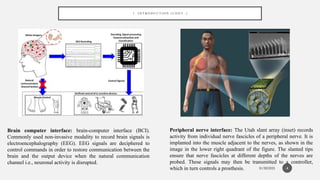
Peripheral nerve interface: The Utah slant array (inset) records
activity from individual nerve fascicles of a peripheral nerve. It is
implanted into the muscle adjacent to the nerves, as shown in the
image in the lower right quadrant of the figure. The slanted tips
ensure that nerve fascicles at different depths of the nerves are
probed. These signals may then be transmitted to a controller,
which in turn controls a prosthesis.
Brain computer interface: brain-computer interface (BCI).
Commonly used non-invasive modality to record brain signals is
electroencephalography (EEG). EEG signals are deciphered to
control commands in order to restore communication between the
brain and the output device when the natural communication
channel i.e., neuronal activity is disrupted.
01/30/2025
1. INTRODUCTION (CONT..)
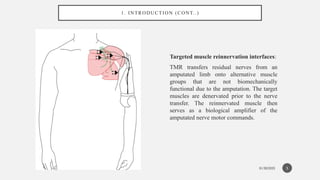
Targeted muscle reinnervation interfaces:
TMR transfers residual nerves from an
amputated limb onto alternative muscle
groups that are not biomechanically
functional due to the amputation. The target
muscles are denervated prior to the nerve
transfer. The reinnervated muscle then
serves as a biological amplifier of the
amputated nerve motor commands.
5
01/30/2025
2. BRAIN-MACHINE INTERFACE NEURO-PROSTHETIC
DEVICES
• The advent of digital signal processing and high-speed computation has opened the
possibility of restoring lost upper-extremity function through brain-machine interface
(BMI) neuroprosthetic devices.
• By capturing brain activity, predicting underlying intentions from that activity, and
controlling a prosthetic device accordingly.
• Presently, BMI devices can guide robotic arms and, in some cases, activate paralyzed
extremities with volitional control in a limited way in a laboratory environment.
6
01/30/2025
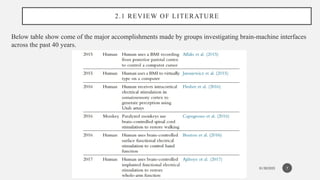
Below table show come of the major accomplishments made by groups investigating brain-machine interfaces
across the past 40 years.
7
2.1 REVIEW OF LITERATURE
01/30/2025
3. NEURAL SIGNAL RECORDINGS
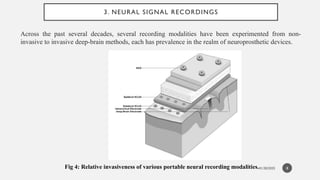
Across the past several decades, several recording modalities have been experimented from non-
invasive to invasive deep-brain methods, each has prevalence in the realm of neuroprosthetic devices.
8
Fig 4: Relative invasiveness of various portable neural recording modalities.
01/30/2025
3 . 1 N O N - I N VA S I V E R E C O R D I N G
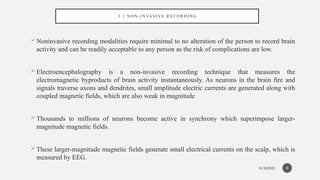
Noninvasive recording modalities require minimal to no alteration of the person to record brain
activity and can be readily acceptable to any person as the risk of complications are low.
Electroencephalography is a non-invasive recording technique that measures the
electromagnetic byproducts of brain activity instantaneously. As neurons in the brain fire and
signals traverse axons and dendrites, small amplitude electric currents are generated along with
coupled magnetic fields, which are also weak in magnitude
Thousands to millions of neurons become active in synchrony which superimpose larger-
magnitude magnetic fields.
These larger-magnitude magnetic fields generate small electrical currents on the scalp, which is
measured by EEG.
9
01/30/2025
3.1 NON-INVASIVE R ECORDING (CONT.)
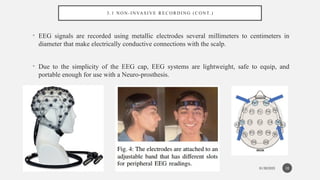
• EEG signals are recorded using metallic electrodes several millimeters to centimeters in
diameter that make electrically conductive connections with the scalp.
• Due to the simplicity of the EEG cap, EEG systems are lightweight, safe to equip, and
portable enough for use with a Neuro-prosthesis.
10
01/30/2025
4. SIGNAL PROCESSING AND PROSTHETIC CONTROL
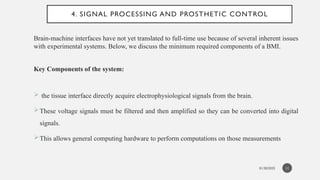
Brain-machine interfaces have not yet translated to full-time use because of several inherent issues
with experimental systems. Below, we discuss the minimum required components of a BMI.
Key Components of the system:
 the tissue interface directly acquire electrophysiological signals from the brain.
These voltage signals must be filtered and then amplified so they can be converted into digital
signals.
This allows general computing hardware to perform computations on those measurements
11
01/30/2025
4. SIGNAL PROCESSING AND PROSTHETIC CONTROL (CONT.)
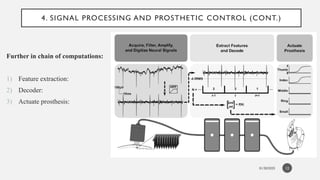
Further in chain of computations:
1) Feature extraction:
2) Decoder:
3) Actuate prosthesis:
12
01/30/2025
4.1 FILTERING, AMPLIFYING AND DIGITIZING
Filtering:
• Typically referred to as the analog front-end (AFE) , experimental AFEs first filter and
amplify the incoming neural signals.
• The first filter in the chain is a band-pass filter that eliminates frequencies outside of those
relevant to brain activity.
• Typical BMI, AFEs s inherently filter out frequencies below approximately 0.1Hz and above
approximately 10 kHz.
13
01/30/2025
4 . 1 FI LT E R I N G , A M PL I FY I N G A N D D I G I T I Z I N G
Amplifying:
• In addition to reducing noise, front-end filters also amplify their neural signal inputs.
• Amplification is necessary to bring the neural signals, which are typically on the order of tens to
hundreds of microvolts in amplitude, to voltages at which the downstream electronic circuits
generally operate, which are on the order of volts
Analog-to-digital converter (ADC):
• The ADC receives the filtered and amplified analog neural signal and periodically converts it to a
digital one for use with computers.
14
01/30/2025
4.2 PROCESSING AND DECODING
• Once neural signals are digitized, BMIs employ computational algorithms that convert the
recorded brain activity into a person’s intentions.
• These algorithms are called decoders as they decode the encoded neural information into a
more usable control signal.
• The encoded information for intra-cortical recordings is often some representation of each
electrode’s spiking or firing rate, broadly called features in the machine learning
community, which are extracted
• The different effectors that can be controlled by these neural features which include robotic
arms or neuro-prosthesis.
15
01/30/2025
4.3 CONTROLLING PROSTHETIC ACTUATORS
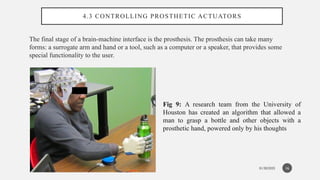
The final stage of a brain-machine interface is the prosthesis. The prosthesis can take many
forms: a surrogate arm and hand or a tool, such as a computer or a speaker, that provides some
special functionality to the user.
16
Fig 9: A research team from the University of
Houston has created an algorithm that allowed a
man to grasp a bottle and other objects with a
prosthetic hand, powered only by his thoughts
01/30/2025
4.3 CONTROLLING PROSTHETIC ACTUATORS(CONT.)
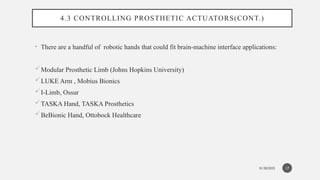
• There are a handful of robotic hands that could fit brain-machine interface applications:
Modular Prosthetic Limb (Johns Hopkins University)
LUKE Arm , Mobius Bionics
I-Limb, Ossur
TASKA Hand, TASKA Prosthetics
BeBionic Hand, Ottobock Healthcare
17
01/30/2025
5. ADVANCES IN NEURO-PROSTHESIS
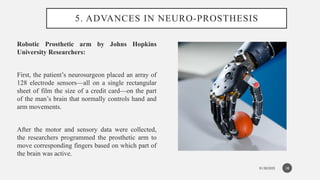
Robotic Prosthetic arm by Johns Hopkins
University Researchers:
First, the patient’s neurosurgeon placed an array of
128 electrode sensors—all on a single rectangular
sheet of film the size of a credit card—on the part
of the man’s brain that normally controls hand and
arm movements.
After the motor and sensory data were collected,
the researchers programmed the prosthetic arm to
move corresponding fingers based on which part of
the brain was active.
18
01/30/2025
5. ADVANCES IN NEURO-PROSTHESIS (CONT.)
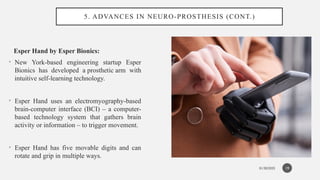
Esper Hand by Esper Bionics:
• New York-based engineering startup Esper
Bionics has developed a prosthetic arm with
intuitive self-learning technology.
• Esper Hand uses an electromyography-based
brain-computer interface (BCI) – a computer-
based technology system that gathers brain
activity or information – to trigger movement.
• Esper Hand has five movable digits and can
rotate and grip in multiple ways.
19
01/30/2025 20
THANK YOU

NEURO-ELECTRIC PROSTHESIS- NEUROPROSTHESIS

  • 1.
    NEURO-ELECTRIC PROSTHESIS Presented by FIONAVERMA Masters in Prosthetics & Orthotics 2023-2024
  • 2.
    01/30/2025 CONTENTS 2 S.No Topic Slideno 1. Introduction 3-5 2. 2.1 Brain-machine interface neuro-prosthetic devices Review of literature 6 7 3. 3.1 Neural signal recordings Non-invasive recordings 8 9 & 10 4. 4.1 4.2 4.3 Signal processing and prosthetic control Filtering, amplifying and digitizing Processing and decoding Controlling prosthetic actuators 11 & 12 13 &14 15 16 5. Current advance sin Neuro-prostheses 17 & 18 6. References 19 7. Thank you 20
  • 3.
    01/30/2025 1. INTRODUCTION Neural-Machine ControlInterfaces: A neural–machine interface that can provide motor commands to operate the prosthesis and serve as a conduit to provide sensory feedback that is needed. Three types of neural interfaces are currently being investigated: (1) Brain– machine interfaces / Brain-computer interfaces (2) Peripheral nerve interfaces (3) Targeted reinnervation (TMR) 3
  • 4.
    01/30/2025 1 . IN T R O D U C T I O N ( C O N T. . ) 4 Peripheral nerve interface: The Utah slant array (inset) records activity from individual nerve fascicles of a peripheral nerve. It is implanted into the muscle adjacent to the nerves, as shown in the image in the lower right quadrant of the figure. The slanted tips ensure that nerve fascicles at different depths of the nerves are probed. These signals may then be transmitted to a controller, which in turn controls a prosthesis. Brain computer interface: brain-computer interface (BCI). Commonly used non-invasive modality to record brain signals is electroencephalography (EEG). EEG signals are deciphered to control commands in order to restore communication between the brain and the output device when the natural communication channel i.e., neuronal activity is disrupted.
  • 5.
    01/30/2025 1. INTRODUCTION (CONT..) Targetedmuscle reinnervation interfaces: TMR transfers residual nerves from an amputated limb onto alternative muscle groups that are not biomechanically functional due to the amputation. The target muscles are denervated prior to the nerve transfer. The reinnervated muscle then serves as a biological amplifier of the amputated nerve motor commands. 5
  • 6.
    01/30/2025 2. BRAIN-MACHINE INTERFACENEURO-PROSTHETIC DEVICES • The advent of digital signal processing and high-speed computation has opened the possibility of restoring lost upper-extremity function through brain-machine interface (BMI) neuroprosthetic devices. • By capturing brain activity, predicting underlying intentions from that activity, and controlling a prosthetic device accordingly. • Presently, BMI devices can guide robotic arms and, in some cases, activate paralyzed extremities with volitional control in a limited way in a laboratory environment. 6
  • 7.
    01/30/2025 Below table showcome of the major accomplishments made by groups investigating brain-machine interfaces across the past 40 years. 7 2.1 REVIEW OF LITERATURE
  • 8.
    01/30/2025 3. NEURAL SIGNALRECORDINGS Across the past several decades, several recording modalities have been experimented from non- invasive to invasive deep-brain methods, each has prevalence in the realm of neuroprosthetic devices. 8 Fig 4: Relative invasiveness of various portable neural recording modalities.
  • 9.
    01/30/2025 3 . 1N O N - I N VA S I V E R E C O R D I N G Noninvasive recording modalities require minimal to no alteration of the person to record brain activity and can be readily acceptable to any person as the risk of complications are low. Electroencephalography is a non-invasive recording technique that measures the electromagnetic byproducts of brain activity instantaneously. As neurons in the brain fire and signals traverse axons and dendrites, small amplitude electric currents are generated along with coupled magnetic fields, which are also weak in magnitude Thousands to millions of neurons become active in synchrony which superimpose larger- magnitude magnetic fields. These larger-magnitude magnetic fields generate small electrical currents on the scalp, which is measured by EEG. 9
  • 10.
    01/30/2025 3.1 NON-INVASIVE RECORDING (CONT.) • EEG signals are recorded using metallic electrodes several millimeters to centimeters in diameter that make electrically conductive connections with the scalp. • Due to the simplicity of the EEG cap, EEG systems are lightweight, safe to equip, and portable enough for use with a Neuro-prosthesis. 10
  • 11.
    01/30/2025 4. SIGNAL PROCESSINGAND PROSTHETIC CONTROL Brain-machine interfaces have not yet translated to full-time use because of several inherent issues with experimental systems. Below, we discuss the minimum required components of a BMI. Key Components of the system:  the tissue interface directly acquire electrophysiological signals from the brain. These voltage signals must be filtered and then amplified so they can be converted into digital signals. This allows general computing hardware to perform computations on those measurements 11
  • 12.
    01/30/2025 4. SIGNAL PROCESSINGAND PROSTHETIC CONTROL (CONT.) Further in chain of computations: 1) Feature extraction: 2) Decoder: 3) Actuate prosthesis: 12
  • 13.
    01/30/2025 4.1 FILTERING, AMPLIFYINGAND DIGITIZING Filtering: • Typically referred to as the analog front-end (AFE) , experimental AFEs first filter and amplify the incoming neural signals. • The first filter in the chain is a band-pass filter that eliminates frequencies outside of those relevant to brain activity. • Typical BMI, AFEs s inherently filter out frequencies below approximately 0.1Hz and above approximately 10 kHz. 13
  • 14.
    01/30/2025 4 . 1FI LT E R I N G , A M PL I FY I N G A N D D I G I T I Z I N G Amplifying: • In addition to reducing noise, front-end filters also amplify their neural signal inputs. • Amplification is necessary to bring the neural signals, which are typically on the order of tens to hundreds of microvolts in amplitude, to voltages at which the downstream electronic circuits generally operate, which are on the order of volts Analog-to-digital converter (ADC): • The ADC receives the filtered and amplified analog neural signal and periodically converts it to a digital one for use with computers. 14
  • 15.
    01/30/2025 4.2 PROCESSING ANDDECODING • Once neural signals are digitized, BMIs employ computational algorithms that convert the recorded brain activity into a person’s intentions. • These algorithms are called decoders as they decode the encoded neural information into a more usable control signal. • The encoded information for intra-cortical recordings is often some representation of each electrode’s spiking or firing rate, broadly called features in the machine learning community, which are extracted • The different effectors that can be controlled by these neural features which include robotic arms or neuro-prosthesis. 15
  • 16.
    01/30/2025 4.3 CONTROLLING PROSTHETICACTUATORS The final stage of a brain-machine interface is the prosthesis. The prosthesis can take many forms: a surrogate arm and hand or a tool, such as a computer or a speaker, that provides some special functionality to the user. 16 Fig 9: A research team from the University of Houston has created an algorithm that allowed a man to grasp a bottle and other objects with a prosthetic hand, powered only by his thoughts
  • 17.
    01/30/2025 4.3 CONTROLLING PROSTHETICACTUATORS(CONT.) • There are a handful of robotic hands that could fit brain-machine interface applications: Modular Prosthetic Limb (Johns Hopkins University) LUKE Arm , Mobius Bionics I-Limb, Ossur TASKA Hand, TASKA Prosthetics BeBionic Hand, Ottobock Healthcare 17
  • 18.
    01/30/2025 5. ADVANCES INNEURO-PROSTHESIS Robotic Prosthetic arm by Johns Hopkins University Researchers: First, the patient’s neurosurgeon placed an array of 128 electrode sensors—all on a single rectangular sheet of film the size of a credit card—on the part of the man’s brain that normally controls hand and arm movements. After the motor and sensory data were collected, the researchers programmed the prosthetic arm to move corresponding fingers based on which part of the brain was active. 18
  • 19.
    01/30/2025 5. ADVANCES INNEURO-PROSTHESIS (CONT.) Esper Hand by Esper Bionics: • New York-based engineering startup Esper Bionics has developed a prosthetic arm with intuitive self-learning technology. • Esper Hand uses an electromyography-based brain-computer interface (BCI) – a computer- based technology system that gathers brain activity or information – to trigger movement. • Esper Hand has five movable digits and can rotate and grip in multiple ways. 19
  • 20.

Editor's Notes

  • #4 In peripheral nerve interfaces, electrodes are directly connected to the residual nerves of the amputee, and the electric signal from the nerve is used to control the artificial limb.- the neuroelectric signal is very small, difficult to record, and difficult to separate from EMGs of the surrounding muscle.
  • #5 Targeted muscle reinnervation (TMR) is a new technique that improves the function of myoelectric upper limb prostheses by creating new myositis. TMR with multiple nerve transfers provides simultaneous, intuitive control of multiple degrees of freedom via the motoneuron activity originally associated with the amputated muscles. Great success has been achieved in clinical practice for myoelectric prosthesis control.
  • #7 from studies in animals to present human clinical trials. Going forward, the promise of the field is encouraging
  • #8 The least invasive procedure is placing array of small electrodes on the surface of dura-mater. Implanting the electrodes beneath dura and in direct contact with the surface of brain is more invasive- these types of invasive recordings are called epidural and subdural electrocorticography.
  • #9 Without crossing the skin barrier, noninvasive recordings avoid many of the infection, scarring, and surgical risks that are inherent to more invasive recording method
  • #11 Current clinical and experimental BMIs require a lab cart with all of the computers, require that the user remain tethered to the recording system with all of the high-bandwidth data being recorded, and consume hundreds of watts (several car batteries worth) of electrical power to run the necessary computations. This allows general computing hardware to perform computations on those measurements
  • #12 The first in the chain of computations is feature extraction, which extracts the components from neural signals, known as neural features, that are easiest to use to make predictions. The second is the prediction algorithm that converts the neural features into a behavioral prediction, usually referred to as a “decoder.” Finally, those behavioral predictions are transmitted to a prosthesis to perform the intended command of the user.
  • #13 Any electromagnetic interference from radio, Wi-Fi, or cellular signals and the baseline voltage of the body’s tissue are therefore attenuated by this first stage filter.
  • #14 The rate at which conversions occur can be controlled The resolution of the conversions can also be controlled with hardware customizations and is generally set to 16 bits.
  • #15 . BMIs often predict positions and velocities from the neural features to control these effectors, but in cases where limb movements are being predicted,
  • #16 there are a number of different decoding algorithms to translate the observed neural data into a command signal. Ultimately, the goal of the prosthesis is to execute the intentions of the user.
  • #18 Thinking” about finger movements caused electrical activity in the brain, which moved the prosthetic digits.
  • #19 The 380-gram arm is made from a combination of polyoxymethylene plastic, fluoroplastics, nylon, aluminium, steel, titan, bronze and three types different types of silicone. It comes in four sizes and five colours.