MATERIALS FOR UPPER EXTREMITY FRACTURE
SPLINTS
INTERMITTENT PNEUMATIC COMPRESSION
&
PENUMATIC DEVICES
FIONA VERMA
MASTERS IN PROSTHETICS & ORTHOTICS
2023-2024
UPPER EXTREMITY ORTHOTICS
Contents
1. Materials for splinting
• Types of low temperature thermoplastic materials
• Open Vs closed cell forms
• Klarity thermoplastics
2. Intermittent pneumatic compression (IPC) in fracture healing
• Mechanical effect of IPC
• Effect of cyclic loading
• Effect of cyclic pneumatic soft tissue compression on humans
3. Pneumatic actuators for upper limb rehabilitation
• Introduction to pneumatic actuators
• Upper limb rehabilitation support device using a pneumatic cylinder
2
3
Materials for splinting
• Thermoplastics are materials that become moldable when heated. Earliest low-temperature thermoplastic was Prenyl
developed in 1964, followed by orthoplast, polyform and Aquaplast.
• There are two basic categories of low-temperature thermoplastics materials:
1) Polycaprolactone (PCL) based- more plastic group
2) Polyisoprene based- more rubber group
Examples of Different low-temperature thermoplastic materials are:
 Orthoplast
 Synergy
 Ezeform
 Ultraform
 Polyflex II
 Aquaplast
Cont..
 NCM preferred
 NCM spectrum
 Orfit
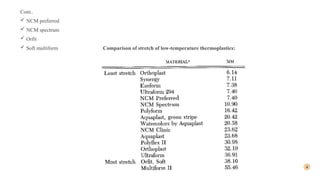
 Soft multiform Comparison of stretch of low-temperature thermoplastics:
4
5
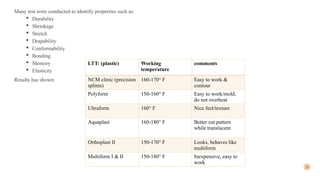
Many test were conducted to identify properties such as:
 Durability
 Shrinkage
 Stretch
 Drapability
 Conformability
 Bonding
 Memory
 Elasticity
Results has shown:
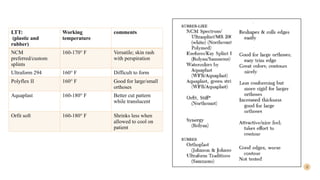
LTT: (plastic) Working
temperature
comments
NCM clinic (precision
splints)
160-170° F Easy to work &
contour
Polyform 150-160° F Easy to work/mold;
do not overheat
Ultraform 160° F Nice feel/texture
Aquaplast 160-180° F Better cut pattern
while translucent
Orthoplast II 150-170° F Looks, behaves like
multiform
Multiform I & II 150-180° F Inexpensive, easy to
work
6
LTT:
(plastic and
rubber)
Working
temperature
comments
NCM
preferred/custom
splints
160-170° F Versatile; skin rash
with perspiration
Ultraform 294 160° F Difficult to form
Polyflex II 160° F Good for large/small
orthoses
Aquaplast 160-180° F Better cut pattern
while translucent
Orfit soft 160-180° F Shrinks less when
allowed to cool on
patient
7
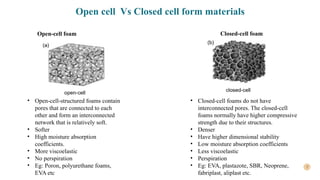
Open cell Vs Closed cell form materials
Open-cell foam Closed-cell foam
• Open-cell-structured foams contain
pores that are connected to each
other and form an interconnected
network that is relatively soft.
• Softer
• High moisture absorption
coefficients.
• More viscoelastic
• No perspiration
• Eg: Poron, polyurethane foams,
EVA etc
• Closed-cell foams do not have
interconnected pores. The closed-cell
foams normally have higher compressive
strength due to their structures.
• Denser
• Have higher dimensional stability
• Low moisture absorption coefficients
• Less viscoelastic
• Perspiration
• Eg: EVA, plastazote, SBR, Neoprene,
fabriplast, aliplast etc.
8
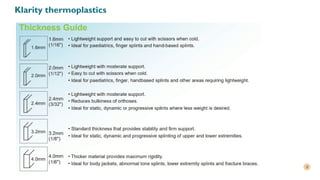
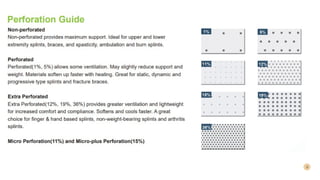
Klarity thermoplastics
9
10
Thermoplastic characteristics:
• Drape/ conformability- the ease with which a material conforms to a surface when heated
• Resistance to stretch (RTS)- the extent to which a material resists pulling or stretching when heated
• Bonding – the degree to which a material will stick to itself when heated
Examples for certain types of thermoplastics for specific orthosis:
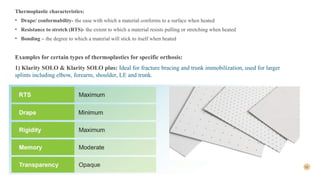
1) Klarity SOLO & Klarity SOLO plus: Ideal for fracture bracing and trunk immobilization, used for larger
splints including elbow, forearm, shoulder, LE and trunk.
11
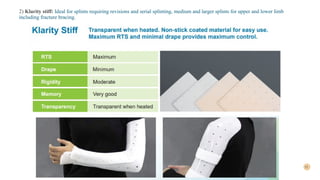
2) Klarity stiff: Ideal for splints requiring revisions and serial splinting, medium and larger splints for upper and lower limb
including fracture bracing.
12
Intermittent pneumatic compression in fracture healing
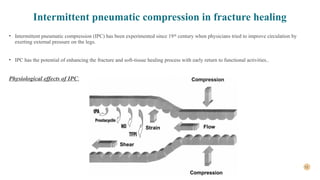
• Intermittent pneumatic compression (IPC) has been experimented since 19th
century when physicians tried to improve circulation by
exerting external pressure on the legs.
• IPC has the potential of enhancing the fracture and soft-tissue healing process with early return to functional activities..
Physiological effects of IPC:
13
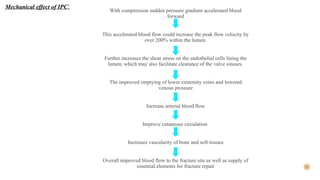
With compression sudden pressure gradient accelerated blood
forward
This accelerated blood flow could increase the peak flow velocity by
over 200% within the lumen.
Further increases the shear stress on the endothelial cells lining the
lumen, which may also facilitate clearance of the valve sinuses.
The improved emptying of lower extremity veins and lowered
venous pressure
Increase arterial blood flow
Improve cutaneous circulation
Increases vascularity of bone and soft tissues
Overall improved blood flow to the fracture site as well as supply of
essential elements for fracture repair
Mechanical effect of IPC:
14
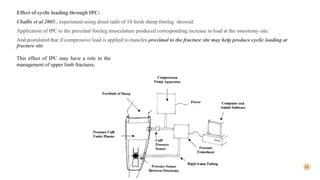
Effect of cyclic loading through IPC:
Challis et al 2005., experiment using distal radii of 10 fresh sheep foreleg showed:
Application of IPC to the proximal foreleg musculature produced corresponding increase in load at the osteotomy site.
And postulated that if compressive load is applied to muscles proximal to the fracture site may help produce cyclic loading at
fracture site
This effect of IPC may have a role in the
management of upper limb fractures.
15
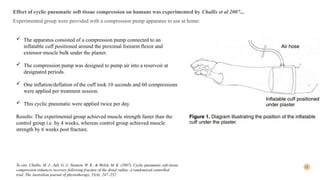
Effect of cyclic pneumatic soft tissue compression on humans was experimented by Challis et al 2007..,
Experimented group were provided with a compression pump apparatus to use at home:
 The apparatus consisted of a compression pump connected to an
inflatable cuff positioned around the proximal forearm flexor and
extensor muscle bulk under the plaster.
 The compression pump was designed to pump air into a reservoir at
designated periods.
 One inflation/deflation of the cuff took 10 seconds and 60 compressions
were applied per treatment session.
 This cyclic pneumatic were applied twice per day.
Results: The experimental group achieved muscle strength faster than the
control group i.e. by 4 weeks, whereas control group achieved muscle
strength by 6 weeks post fracture.
To cite: Challis, M. J., Jull, G. J., Stanton, W. R., & Welsh, M. K. (2007). Cyclic pneumatic soft-tissue
compression enhances recovery following fracture of the distal radius: a randomized controlled
trial. The Australian journal of physiotherapy, 53(4), 247–252
16
Pneumatic Actuators
for
Upper Limb Rehabilitation
17
Rehabilitation Equipment
• Rehabilitation equipment is a mechatronic or robotic system capable of providing support to the therapist during application
of programs and customized recovery programs.
• Generally, a rehabilitation equipment includes:
 Actuator
 Energy supply module
 Proprioceptive and exteroceptive sensors
 Microcontroller
• A particular advantage of rehabilitation equipment is allowing the patients to conduct semi-autonomous rehabilitation
sessions, even at their own home, thus reducing the necessity of employing a full-time physical therapist.
18
Pneumatic devices for Rehabilitation
• Pneumatic systems use compressed air as the driver unit for actuating the mechanism of the device. It is an external
mechanism to aid the movement of the upper limb as well as provide it with the power it lacks.
• Pneumatic actuators are attractive for robotic rehabilitation applications because they are lightweight, powerful, and
compliant.
• The goal is to achieve the best possible motor, cognitive and functional recovery for people with impairments following
various diseases such as SCI, stroke etc.
• Pneumatic actuators uses air as main energy source, due to the compressibility of air, these actuators are able to absorb
unwanted forces.
• Currently, there are three kinds of pneumatic actuators that are commonly used in robotics: pneumatic cylinders, pneumatic
muscles, and pneumatic motors.
19
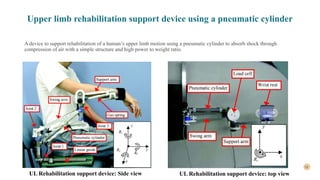
Upper limb rehabilitation support device using a pneumatic cylinder
A device to support rehabilitation of a human’s upper limb motion using a pneumatic cylinder to absorb shock through
compression of air with a simple structure and high power to weight ratio.
UL Rehabilitation support device: Side view UL Rehabilitation support device: top view
20
Cont..
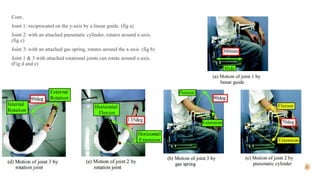
Joint 1: reciprocated on the y-axis by a linear guide. (fig a)
Joint 2: with an attached pneumatic cylinder, rotates around x-axis.
(fig c)
Joint 3: with an attached gas spring, rotates around the x-axis. (fig b)
Joint 1 & 3 with attached rotational joints can rotate around z-axis.
(Fig d and e)
21
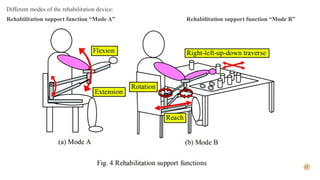
Different modes of the rehabilitation device:
Rehabilitation support function “Mode A” Rehabilitation support function “Mode B”
22
Cont..
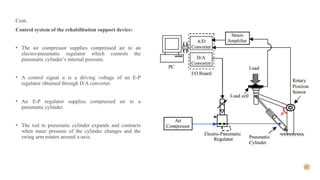
Control system of the rehabilitation support device:
• The air compressor supplies compressed air to an
electro-pneumatic regulator which controls the
pneumatic cylinder’s internal pressure.
• A control signal u is a driving voltage of an E-P
regulator obtained through D/A converter.
• An E-P regulator supplies compressed air to a
pneumatic cylinder.
• The rod in pneumatic cylinder expands and contracts
when inner pressure of the cylinder changes and the
swing arm rotates around x-axis.
23
References
1. Challis, M. J., Jull, G. J., Stanton, W. R., & Welsh, M. K. (2007). Cyclic pneumatic soft-tissue compression enhances
recovery following fracture of the distal radius: a randomized controlled trial. The Australian journal of
physiotherapy, 53(4), 247–252
2. Chen, A. H., Frangos, S. G., Kilaru, S., & Sumpio, B. E. (2001). Intermittent pneumatic compression devices --
physiological mechanisms of action. European journal of vascular and endovascular surgery : the official journal of
the European Society for Vascular Surgery, 21(5), 383–392.
3. Breger-Lee, D. E., & Buford, W. L., Jr (1991). Update in splinting materials and methods. Hand clinics, 7(3), 569–585
4. Kouichi Kirihara, Norihiko Saga and Naoki Saito, "Upper limb rehabilitation support device using a pneumatic
cylinder," 2008 34th Annual Conference of IEEE Industrial Electronics, Orlando, FL, USA, 2008, pp. 1287-1292.
THANKYOU!

MATERIALS FOR UPPER EXTREMITY FRACTURE SPLINTS & PENUMATIC DEVICES

  • 1.
    MATERIALS FOR UPPEREXTREMITY FRACTURE SPLINTS INTERMITTENT PNEUMATIC COMPRESSION & PENUMATIC DEVICES FIONA VERMA MASTERS IN PROSTHETICS & ORTHOTICS 2023-2024 UPPER EXTREMITY ORTHOTICS
  • 2.
    Contents 1. Materials forsplinting • Types of low temperature thermoplastic materials • Open Vs closed cell forms • Klarity thermoplastics 2. Intermittent pneumatic compression (IPC) in fracture healing • Mechanical effect of IPC • Effect of cyclic loading • Effect of cyclic pneumatic soft tissue compression on humans 3. Pneumatic actuators for upper limb rehabilitation • Introduction to pneumatic actuators • Upper limb rehabilitation support device using a pneumatic cylinder 2
  • 3.
    3 Materials for splinting •Thermoplastics are materials that become moldable when heated. Earliest low-temperature thermoplastic was Prenyl developed in 1964, followed by orthoplast, polyform and Aquaplast. • There are two basic categories of low-temperature thermoplastics materials: 1) Polycaprolactone (PCL) based- more plastic group 2) Polyisoprene based- more rubber group Examples of Different low-temperature thermoplastic materials are:  Orthoplast  Synergy  Ezeform  Ultraform  Polyflex II  Aquaplast
  • 4.
    Cont..  NCM preferred NCM spectrum  Orfit  Soft multiform Comparison of stretch of low-temperature thermoplastics: 4
  • 5.
    5 Many test wereconducted to identify properties such as:  Durability  Shrinkage  Stretch  Drapability  Conformability  Bonding  Memory  Elasticity Results has shown: LTT: (plastic) Working temperature comments NCM clinic (precision splints) 160-170° F Easy to work & contour Polyform 150-160° F Easy to work/mold; do not overheat Ultraform 160° F Nice feel/texture Aquaplast 160-180° F Better cut pattern while translucent Orthoplast II 150-170° F Looks, behaves like multiform Multiform I & II 150-180° F Inexpensive, easy to work
  • 6.
    6 LTT: (plastic and rubber) Working temperature comments NCM preferred/custom splints 160-170° FVersatile; skin rash with perspiration Ultraform 294 160° F Difficult to form Polyflex II 160° F Good for large/small orthoses Aquaplast 160-180° F Better cut pattern while translucent Orfit soft 160-180° F Shrinks less when allowed to cool on patient
  • 7.
    7 Open cell VsClosed cell form materials Open-cell foam Closed-cell foam • Open-cell-structured foams contain pores that are connected to each other and form an interconnected network that is relatively soft. • Softer • High moisture absorption coefficients. • More viscoelastic • No perspiration • Eg: Poron, polyurethane foams, EVA etc • Closed-cell foams do not have interconnected pores. The closed-cell foams normally have higher compressive strength due to their structures. • Denser • Have higher dimensional stability • Low moisture absorption coefficients • Less viscoelastic • Perspiration • Eg: EVA, plastazote, SBR, Neoprene, fabriplast, aliplast etc.
  • 8.
  • 9.
  • 10.
    10 Thermoplastic characteristics: • Drape/conformability- the ease with which a material conforms to a surface when heated • Resistance to stretch (RTS)- the extent to which a material resists pulling or stretching when heated • Bonding – the degree to which a material will stick to itself when heated Examples for certain types of thermoplastics for specific orthosis: 1) Klarity SOLO & Klarity SOLO plus: Ideal for fracture bracing and trunk immobilization, used for larger splints including elbow, forearm, shoulder, LE and trunk.
  • 11.
    11 2) Klarity stiff:Ideal for splints requiring revisions and serial splinting, medium and larger splints for upper and lower limb including fracture bracing.
  • 12.
    12 Intermittent pneumatic compressionin fracture healing • Intermittent pneumatic compression (IPC) has been experimented since 19th century when physicians tried to improve circulation by exerting external pressure on the legs. • IPC has the potential of enhancing the fracture and soft-tissue healing process with early return to functional activities.. Physiological effects of IPC:
  • 13.
    13 With compression suddenpressure gradient accelerated blood forward This accelerated blood flow could increase the peak flow velocity by over 200% within the lumen. Further increases the shear stress on the endothelial cells lining the lumen, which may also facilitate clearance of the valve sinuses. The improved emptying of lower extremity veins and lowered venous pressure Increase arterial blood flow Improve cutaneous circulation Increases vascularity of bone and soft tissues Overall improved blood flow to the fracture site as well as supply of essential elements for fracture repair Mechanical effect of IPC:
  • 14.
    14 Effect of cyclicloading through IPC: Challis et al 2005., experiment using distal radii of 10 fresh sheep foreleg showed: Application of IPC to the proximal foreleg musculature produced corresponding increase in load at the osteotomy site. And postulated that if compressive load is applied to muscles proximal to the fracture site may help produce cyclic loading at fracture site This effect of IPC may have a role in the management of upper limb fractures.
  • 15.
    15 Effect of cyclicpneumatic soft tissue compression on humans was experimented by Challis et al 2007.., Experimented group were provided with a compression pump apparatus to use at home:  The apparatus consisted of a compression pump connected to an inflatable cuff positioned around the proximal forearm flexor and extensor muscle bulk under the plaster.  The compression pump was designed to pump air into a reservoir at designated periods.  One inflation/deflation of the cuff took 10 seconds and 60 compressions were applied per treatment session.  This cyclic pneumatic were applied twice per day. Results: The experimental group achieved muscle strength faster than the control group i.e. by 4 weeks, whereas control group achieved muscle strength by 6 weeks post fracture. To cite: Challis, M. J., Jull, G. J., Stanton, W. R., & Welsh, M. K. (2007). Cyclic pneumatic soft-tissue compression enhances recovery following fracture of the distal radius: a randomized controlled trial. The Australian journal of physiotherapy, 53(4), 247–252
  • 16.
  • 17.
    17 Rehabilitation Equipment • Rehabilitationequipment is a mechatronic or robotic system capable of providing support to the therapist during application of programs and customized recovery programs. • Generally, a rehabilitation equipment includes:  Actuator  Energy supply module  Proprioceptive and exteroceptive sensors  Microcontroller • A particular advantage of rehabilitation equipment is allowing the patients to conduct semi-autonomous rehabilitation sessions, even at their own home, thus reducing the necessity of employing a full-time physical therapist.
  • 18.
    18 Pneumatic devices forRehabilitation • Pneumatic systems use compressed air as the driver unit for actuating the mechanism of the device. It is an external mechanism to aid the movement of the upper limb as well as provide it with the power it lacks. • Pneumatic actuators are attractive for robotic rehabilitation applications because they are lightweight, powerful, and compliant. • The goal is to achieve the best possible motor, cognitive and functional recovery for people with impairments following various diseases such as SCI, stroke etc. • Pneumatic actuators uses air as main energy source, due to the compressibility of air, these actuators are able to absorb unwanted forces. • Currently, there are three kinds of pneumatic actuators that are commonly used in robotics: pneumatic cylinders, pneumatic muscles, and pneumatic motors.
  • 19.
    19 Upper limb rehabilitationsupport device using a pneumatic cylinder A device to support rehabilitation of a human’s upper limb motion using a pneumatic cylinder to absorb shock through compression of air with a simple structure and high power to weight ratio. UL Rehabilitation support device: Side view UL Rehabilitation support device: top view
  • 20.
    20 Cont.. Joint 1: reciprocatedon the y-axis by a linear guide. (fig a) Joint 2: with an attached pneumatic cylinder, rotates around x-axis. (fig c) Joint 3: with an attached gas spring, rotates around the x-axis. (fig b) Joint 1 & 3 with attached rotational joints can rotate around z-axis. (Fig d and e)
  • 21.
    21 Different modes ofthe rehabilitation device: Rehabilitation support function “Mode A” Rehabilitation support function “Mode B”
  • 22.
    22 Cont.. Control system ofthe rehabilitation support device: • The air compressor supplies compressed air to an electro-pneumatic regulator which controls the pneumatic cylinder’s internal pressure. • A control signal u is a driving voltage of an E-P regulator obtained through D/A converter. • An E-P regulator supplies compressed air to a pneumatic cylinder. • The rod in pneumatic cylinder expands and contracts when inner pressure of the cylinder changes and the swing arm rotates around x-axis.
  • 23.
    23 References 1. Challis, M.J., Jull, G. J., Stanton, W. R., & Welsh, M. K. (2007). Cyclic pneumatic soft-tissue compression enhances recovery following fracture of the distal radius: a randomized controlled trial. The Australian journal of physiotherapy, 53(4), 247–252 2. Chen, A. H., Frangos, S. G., Kilaru, S., & Sumpio, B. E. (2001). Intermittent pneumatic compression devices -- physiological mechanisms of action. European journal of vascular and endovascular surgery : the official journal of the European Society for Vascular Surgery, 21(5), 383–392. 3. Breger-Lee, D. E., & Buford, W. L., Jr (1991). Update in splinting materials and methods. Hand clinics, 7(3), 569–585 4. Kouichi Kirihara, Norihiko Saga and Naoki Saito, "Upper limb rehabilitation support device using a pneumatic cylinder," 2008 34th Annual Conference of IEEE Industrial Electronics, Orlando, FL, USA, 2008, pp. 1287-1292.
  • 24.

Editor's Notes

  • #3 Prior to thermoplastics-wood,steel,aluminium etc were used.In 1960s, high temp therplastic such as royalite or lexiglass were used (500 deg F) and then molded Thermoplastics are closed cell structures and cause sweating resutls in heat rashes. Use of perforated materials can counteract some problems PCI- plastic like-low resistance to stretch. PISO- rubber like –high resistance to stretch
  • #4 (ncm-north coast medical) Test: 3x 1.5 inch rectangle was cut from each material & a hole punched approximately ¼ inch from one end. Each rectangle was heated 160 deg F for 3 mins, hug & small 50g wt on other end is attached. The resulted stretcher hole was measured. The stretch of the hole illustrates the moldability of the heated material. Moldability reflects the ability of a given material to conform to the anatomy of the region of interest. Materials with most stretch were: multiform II, followed by Orfit soft. Orthoplast II and polyflex II.
  • #6 Test1- stretch test, test 2: conformability/drape test, test 3: stain rate, material fatque, shape, deformation through cyclic loading
  • #7 Open pores have solid edges and open faces and fluid flow is possible to penetrate among them (permeability), closed pores are connected via solid faces with no interconnectivity among them. Plastazote and aliplast are use to fabricate wrist splints, thump splints and elbow splints Open cell behave like aspring when compressed return to original shape, breathable, flexible and easily confirm.
  • #10 3.2mm 65° to 70°C water for 2 minutes 1.5-2 minutes of working time 5-7 minutes of hardening time Karity SOLO 1% perforation sheet is ideal for making pre-formed splints
  • #12 Physicians have experimented with the concept of iPC to improve BC in diseases such as arteriosclerosis, DVT, Peripheral vascular disease, Raynaulds disease foot ulcers. But how IPC works is unclear so the exact physiological mechanism of action are unknown. Previous usage if IPC- cyclic positive and negative pressure improved arterial circulation in patients with arteriosclerosis and to prevent DVT and later on its potential role in fracture and soft tissue healing has also been investigated as per modern treatment goals (faster union and return to functions) but its physiological mechanism of action was unknown. There is significant increase of biochemical mediators :in immunoreactive tPA (tissue plasminogen activator, NO- nitric oxide, TFPI-tissue factor pathway inhibitor overall enhance fibrinolysis, vasodilation etc. NO is a potent inhibitor of smooth muscle cell contraction which causes vasodilation
  • #13 1)When compression is applied, the sudden pressure gradient at the compression zone accelerates the blood forward with subsequent collapse of the lumen of the vessel at the compression zone, effectively facilitating venous return. 2)if the pressure is applied sequentially,  3)The higher flow velocity / which may also facilitate clearance of the valve sinuses. Overall increased vascularity in blood flow in the bones at fractured site would increase the supply of essential elements such as growth factors, proteins, oxygen and other components for fracture repair. This finding has been supported by formation of abundant callus at fracture site, bone mineral density increased & bone mineral content following IPC.
  • #14 For the first condition, the pump in the apparatus was preset to pump air into the reservoir of the apparatus for 2 seconds. After 2 seconds, a solenoid valve released the pressurized air into the cuff surrounding the forelimb musculature. After a preset deflation period (3 seconds in this first condition), the pump in the apparatus began pressurizing the reservoir again. In this way, one cycle of cuff inflation and deflation took 5 seconds. The cuff inflation and deflation was repeated five times so that five inflations of the cuff were recorded for each condition. Pressure transducer converts input mechanical pressure into electrical output signal. Result: application of cyclic pneumatic pressure to the musculature proximal to a fracture of the distal radius resulted in cyclic loading of the fracture site. This conceivably could lead to a noninvasive and low-cost treatment for healing fractures especially while they are immobilized in a plaster cast.
  • #15 This preliminary randomised controlled trial has found a faster recovery of muscle strength as a result of a short period of daily cyclic pneumatic soft-tissue compression which mechanically stimulated distal radial fractures during the period of immobilisation, suggesting enhanced fracture healing.
  • #17 sensors necessary for providing information on the status of the machine and the machine-environment interaction, a microcontroller processing the data received from the sensors and generating commands for the motor, as well as a dedicated man-machine interface.
  • #18 The OT demonstrates and facilitates motions that give a constant laod to patients limbs and moves their limbs, slowly repeating the flexion and extension. The machine can substitute for the OT motion in rehab.
  • #19 UL rehabilitation support device with wide operating range-compact and has a link mechanism. Hydraulic can be bulky & complex thus penumatic cylinder are used to absorb shock using compressibility of air. This device has 5 Dof by virtue of its link mechanism and consists of 3 joints. Joint1 reciprocates on y-axis by a linear guide to support UL for reach actions. Joint 3 attached to gas spring rotates around x-axis & joint 2 attached with a pneumatic cylinder rotates around x-axis to support flexion-extension of the arm.
  • #20 Join1- to support the upper limb for the reach action, 2: to support flexion and extension of the arm. Joint 2 operated actively by a pneumatic cylinder but other joints are operated individually by the patient.
  • #21 Mode A- supports patients UL Flex & Ext. mode B is a function to recover practical function of UL so device supports training that operates the UL on the desk therapist adjust training in consideration of level of patients trouble. Rotation angle (mode a) used when patient has trouble operating the arm to resist gravity to train on desk.
  • #22 Patients with paralysis who remain independent & with decreased muscular power becoz of other disease, aging etc will use the device (4kg setup-portable & easy to use at home). The rotation angle is measured using rotary position sensor through A/D conerter Compliance control system is applied to change the stiffness of joint 2 & has a position control system in the force feedback loop. The target value of position control is corrected by the value of load cell. The load cell installed at joint 2 measures the power that the person is adding through A/D converter.