
Neural Network for Real-
TimeTraffic Signal Control
By SnehalTakawale (Roll No.TI24)
Guided by Prof. Pranjali Kuche.
Agenda
• Introduction
• PreviousWork
• RealTime Computing
• Artificial Neural Networks(NN)
• Real TimeTraffic Signal control using NN
• Hybrid Multi-Agent System
• Simulation
• Simulation Benchmarking
• Advantages
• Limitations
• Conclusion
2
Introduction
• Urbanization leads traffic issues
• Traffic signals are used for controlling the traffic issues
• Traffic signals being controlled by many methods
• Time based
• Cycle timing
• Split timing
• Causes delay during peak periods
3
Previous Work
• Simultaneous Perturbation Stochastic Approximation (SPSA)
Neural Network
• Green Link Determining (GLIDE)
4
RealTime Computing
• Guaranteed response within strict time constraint
• Huge processing power
• E.g. Anti-Lock Braking System(ABS)
5
Artificial Neural Networks (ANN)
• Similar to Central Nervous System, end systems act as neurons
• Also known as Intelligent Network
• Capable of machine learning/pattern recognition
• Sensors or other data feeds are used for learning
6
RealTimeTraffic Signal Control using NN
7
Fig. 1 : Traffic Control Loop[1]
Hybrid Multi-agent System
• The newly designed multi-agent system
• Multi-agent stands for the multiple end systems or sensors for
feeding and processing data
• Hybrid system is designed with the help of Simultaneous
Perturbation Stochastic Approximation(SPSA) algorithm and
Green Link Determining (GLIDE) 8
Continuous Learning of the System
• Initially, system learns traffic patterns from multi-agent system
• In next stage, weighted learning is followed
• Fuzzy logic is applied for fluctuating neurons
• Evolutionary Algorithm Fuzzy Relation generator (EAFRG) is used
to generate new fuzzy relations based on the reinforcements
received by the agents 9
Input to generate signal logic
10Fig. 2 : Chromosome Structure[1]
Simulation
• Traffic simulation platform PARAMICS
• traffic microsimulation software developed by Quadstone Paramics
• Observed parameters:
• Mean delay
• Mean stoppage time
• Hybrid multi-agent system 11
Simulation (Contd.)
• 25 agents, programmed using PARAMICS Java API
• Sampling interval of 10 seconds
• Simulation for 3 hours, 6 hours and 24 hours to conclude infinite
horizon problem.
12
Simulation Benchmarks
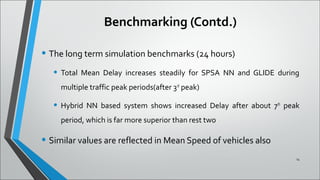
• Benchmarking is done on the basis of Total Mean Delay and
Mean Speed
• For the short term test (3 h),
• GLIDE > Hybrid NN > SPSA NN
• Here GLIDE is state- of-the-art adaptive traffic signal control systems
widely used in many countries
• For mid range simulation(6 h)
• Hybrid NN > SPSA NN > GLIDE
13
Benchmarking (Contd.)
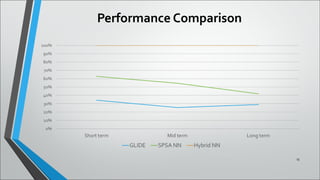
• The long term simulation benchmarks (24 hours)
• Total Mean Delay increases steadily for SPSA NN and GLIDE during
multiple traffic peak periods(after 3rd
peak)
• Hybrid NN based system shows increased Delay after about 7th
peak
period, which is far more superior than rest two
• Similar values are reflected in Mean Speed of vehicles also
14
Performance Comparison
15
Advantages
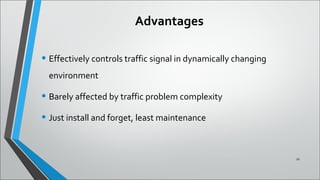
• Effectively controls traffic signal in dynamically changing
environment
• Barely affected by traffic problem complexity
• Just install and forget, least maintenance
16
Limitations
• May not be suitable for all countries, where peak traffic is much
less than the regular traffic
• High initial investment
• Implementation and offline optimizations are time consuming
17
Conclusion
• This Neural Network for Real Time Traffic Signal Control works almost
flawlessly with the hybrid multi-agent system, and is capable of easing the
load of traffic control from Government bodies by automating the process.
18
References
• [1] S. Chiu and S. Chand, ‘Neural Network for real time traffic signal control’,
in Proc. 32nd IEEE Conf. Decision Control, pp. 1987–1902, 2006.
• [2] S. Mikami andY. Kakazu, ‘Genetic reinforcement learning for cooperative
traffic signal control’, in Proc. 1st IEEE Conf. Evol. Comput., vol. 1, pp. 223–
228, 2011.
19
ThankYou…
20

Neural network for real time traffic signal control

  • 1.
    Neural Network forReal- TimeTraffic Signal Control By SnehalTakawale (Roll No.TI24) Guided by Prof. Pranjali Kuche.
  • 2.
    Agenda • Introduction • PreviousWork •RealTime Computing • Artificial Neural Networks(NN) • Real TimeTraffic Signal control using NN • Hybrid Multi-Agent System • Simulation • Simulation Benchmarking • Advantages • Limitations • Conclusion 2
  • 3.
    Introduction • Urbanization leadstraffic issues • Traffic signals are used for controlling the traffic issues • Traffic signals being controlled by many methods • Time based • Cycle timing • Split timing • Causes delay during peak periods 3
  • 4.
    Previous Work • SimultaneousPerturbation Stochastic Approximation (SPSA) Neural Network • Green Link Determining (GLIDE) 4
  • 5.
    RealTime Computing • Guaranteedresponse within strict time constraint • Huge processing power • E.g. Anti-Lock Braking System(ABS) 5
  • 6.
    Artificial Neural Networks(ANN) • Similar to Central Nervous System, end systems act as neurons • Also known as Intelligent Network • Capable of machine learning/pattern recognition • Sensors or other data feeds are used for learning 6
  • 7.
    RealTimeTraffic Signal Controlusing NN 7 Fig. 1 : Traffic Control Loop[1]
  • 8.
    Hybrid Multi-agent System •The newly designed multi-agent system • Multi-agent stands for the multiple end systems or sensors for feeding and processing data • Hybrid system is designed with the help of Simultaneous Perturbation Stochastic Approximation(SPSA) algorithm and Green Link Determining (GLIDE) 8
  • 9.
    Continuous Learning ofthe System • Initially, system learns traffic patterns from multi-agent system • In next stage, weighted learning is followed • Fuzzy logic is applied for fluctuating neurons • Evolutionary Algorithm Fuzzy Relation generator (EAFRG) is used to generate new fuzzy relations based on the reinforcements received by the agents 9
  • 10.
    Input to generatesignal logic 10Fig. 2 : Chromosome Structure[1]
  • 11.
    Simulation • Traffic simulationplatform PARAMICS • traffic microsimulation software developed by Quadstone Paramics • Observed parameters: • Mean delay • Mean stoppage time • Hybrid multi-agent system 11
  • 12.
    Simulation (Contd.) • 25agents, programmed using PARAMICS Java API • Sampling interval of 10 seconds • Simulation for 3 hours, 6 hours and 24 hours to conclude infinite horizon problem. 12
  • 13.
    Simulation Benchmarks • Benchmarkingis done on the basis of Total Mean Delay and Mean Speed • For the short term test (3 h), • GLIDE > Hybrid NN > SPSA NN • Here GLIDE is state- of-the-art adaptive traffic signal control systems widely used in many countries • For mid range simulation(6 h) • Hybrid NN > SPSA NN > GLIDE 13
  • 14.
    Benchmarking (Contd.) • Thelong term simulation benchmarks (24 hours) • Total Mean Delay increases steadily for SPSA NN and GLIDE during multiple traffic peak periods(after 3rd peak) • Hybrid NN based system shows increased Delay after about 7th peak period, which is far more superior than rest two • Similar values are reflected in Mean Speed of vehicles also 14
  • 15.
  • 16.
    Advantages • Effectively controlstraffic signal in dynamically changing environment • Barely affected by traffic problem complexity • Just install and forget, least maintenance 16
  • 17.
    Limitations • May notbe suitable for all countries, where peak traffic is much less than the regular traffic • High initial investment • Implementation and offline optimizations are time consuming 17
  • 18.
    Conclusion • This NeuralNetwork for Real Time Traffic Signal Control works almost flawlessly with the hybrid multi-agent system, and is capable of easing the load of traffic control from Government bodies by automating the process. 18
  • 19.
    References • [1] S.Chiu and S. Chand, ‘Neural Network for real time traffic signal control’, in Proc. 32nd IEEE Conf. Decision Control, pp. 1987–1902, 2006. • [2] S. Mikami andY. Kakazu, ‘Genetic reinforcement learning for cooperative traffic signal control’, in Proc. 1st IEEE Conf. Evol. Comput., vol. 1, pp. 223– 228, 2011. 19
  • 20.

Editor's Notes

  • #5 SPSA is an algorithmic method for optimizing systems with multiple unknown parameters
  • #9 GLIDE is the local name of Sydney Coordinated Adaptive Traffic System (SCATS) and is one of the state- of-the-art adaptive traffic signal control systems widely used in many countries
  • #11 Chromosome structure
  • #12 SPSA-NN hybrid