“A Deep Reinforcement
Learning Network for
Traffic Light Cycle Control”
• Name:-Priti jha
• Roll no:-3434
• Branch:-Computer B
• C Number:-C22017111041
• Seminar guide:- Hitendra Khairnar
Motivation
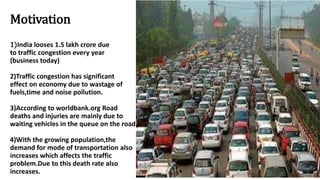
1)India looses 1.5 lakh crore due
to traffic congestion every year
(business today)
2)Traffic congestion has significant
effect on economy due to wastage of
fuels,time and noise pollution.
3)According to worldbank.org Road
deaths and injuries are mainly due to
waiting vehicles in the queue on the road..
4)With the growing population,the
demand for mode of transportation also
increases which affects the traffic
problem.Due to this death rate also
increases.
Solution:
• Making smart self driving vehicles which can communicate with each
other to control the traffic flow in the city.(It's not yet build)
• Making an intelligent system to dynamically change the duration of
traffic lights in the city in order to integrate the system and manage
the congestion. (This majorly helps at intersection which is required
to make the whole system intelligent)
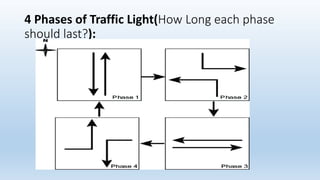
4 Phases of Traffic Light(How Long each phase
should last?):
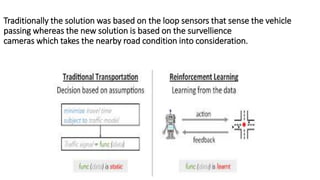
Traditionally the solution was based on the loop sensors that sense the vehicle
passing whereas the new solution is based on the survellience
cameras which takes the nearby road condition into consideration.
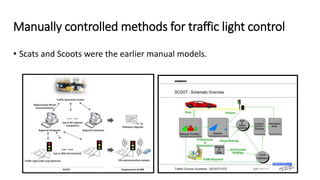
Manually controlled methods for traffic light control
• Scats and Scoots were the earlier manual models.
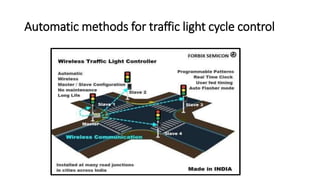
Automatic methods for traffic light cycle control
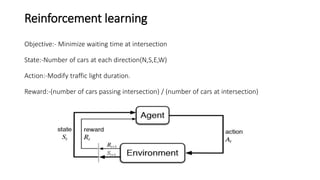
Reinforcement learning
Objective:- Minimize waiting time at intersection
State:-Number of cars at each direction(N,S,E,W)
Action:-Modify traffic light duration.
Reward:-(number of cars passing intersection) / (number of cars at intersection)
Reinforcement learning
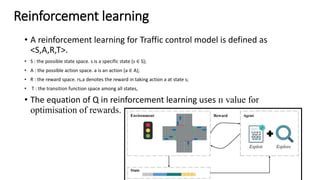
• A reinforcement learning for Traffic control model is defined as
<S,A,R,T>.
• S : the possible state space. s is a specific state (s ∈ S);
• A : the possible action space. a is an action (a ∈ A);
• R : the reward space. rs,a denotes the reward in taking action a at state s;
• T : the transition function space among all states,
• The equation of Q in reinforcement learning uses ᴨ value for
optimisation of rewards.
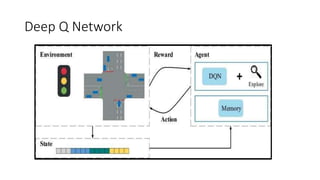
Deep Q Network
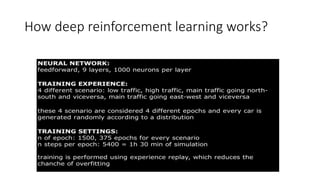
How deep reinforcement learning works?
Thank you!!!!!!!!!!!!!!!!!

Deep reinforcement learning for traffic light cycle control

  • 1.
    “A Deep Reinforcement LearningNetwork for Traffic Light Cycle Control” • Name:-Priti jha • Roll no:-3434 • Branch:-Computer B • C Number:-C22017111041 • Seminar guide:- Hitendra Khairnar
  • 2.
    Motivation 1)India looses 1.5lakh crore due to traffic congestion every year (business today) 2)Traffic congestion has significant effect on economy due to wastage of fuels,time and noise pollution. 3)According to worldbank.org Road deaths and injuries are mainly due to waiting vehicles in the queue on the road.. 4)With the growing population,the demand for mode of transportation also increases which affects the traffic problem.Due to this death rate also increases.
  • 3.
    Solution: • Making smartself driving vehicles which can communicate with each other to control the traffic flow in the city.(It's not yet build) • Making an intelligent system to dynamically change the duration of traffic lights in the city in order to integrate the system and manage the congestion. (This majorly helps at intersection which is required to make the whole system intelligent)
  • 4.
    4 Phases ofTraffic Light(How Long each phase should last?):
  • 5.
    Traditionally the solutionwas based on the loop sensors that sense the vehicle passing whereas the new solution is based on the survellience cameras which takes the nearby road condition into consideration.
  • 6.
    Manually controlled methodsfor traffic light control • Scats and Scoots were the earlier manual models.
  • 7.
    Automatic methods fortraffic light cycle control
  • 8.
    Reinforcement learning Objective:- Minimizewaiting time at intersection State:-Number of cars at each direction(N,S,E,W) Action:-Modify traffic light duration. Reward:-(number of cars passing intersection) / (number of cars at intersection)
  • 9.
    Reinforcement learning • Areinforcement learning for Traffic control model is defined as <S,A,R,T>. • S : the possible state space. s is a specific state (s ∈ S); • A : the possible action space. a is an action (a ∈ A); • R : the reward space. rs,a denotes the reward in taking action a at state s; • T : the transition function space among all states, • The equation of Q in reinforcement learning uses ᴨ value for optimisation of rewards.
  • 10.
  • 11.
    How deep reinforcementlearning works?
  • 12.