Mobile Game Programming:
Artificial Neural Network
jintaeks@gmail.com
Division of Digital Contents, DongSeo University.
December 2016
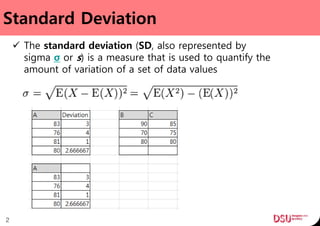
Standard Deviation
 The standard deviation (SD, also represented by
sigma σ or s) is a measure that is used to quantify the
amount of variation of a set of data values
2
Root mean square
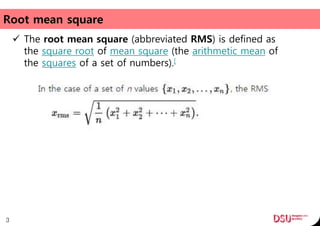
 The root mean square (abbreviated RMS) is defined as
the square root of mean square (the arithmetic mean of
the squares of a set of numbers).[
3
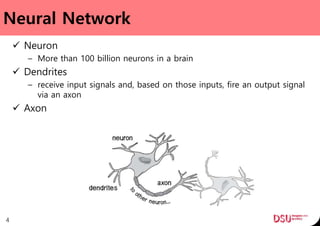
Neural Network
 Neuron
– More than 100 billion neurons in a brain
 Dendrites
– receive input signals and, based on those inputs, fire an output signal
via an axon
 Axon
4
Learning
 Supervised Learning
 Unsupervised Learning
 Reinforcement Learning
5
 Supervised Learning —Essentially, a strategy that involves a
teacher that is smarter than the network itself. For example,
let’s take the facial recognition example. The teacher shows
the network a bunch of faces, and the teacher already knows
the name associated with each face. The network makes its
guesses, then the teacher provides the network with the
answers. The network can then compare its answers to the
known “correct” ones and make adjustments according to its
errors.
6
 Unsupervised Learning —Required when there isn’t an
example data set with known answers. Imagine searching for a
hidden pattern in a data set. An application of this is
clustering, i.e. dividing a set of elements into groups
according to some unknown pattern.
 Reinforcement Learning —A strategy built on observation.
Think of a little mouse running through a maze. If it turns left,
it gets a piece of cheese; if it turns right, it receives a little
shock. Presumably, the mouse will learn over time to turn left.
Its neural network makes a decision with an outcome (turn
left or right) and observes its environment (yum or ouch). If
the observation is negative, the network can adjust its weights
in order to make a different decision the next time.
Reinforcement learning is common in robotics.
7
Standard Uses of Neural Networks
 Pattern Recognition
– it’s probably the most common application. Examples are facial
recognition, optical character recognition, etc.
 Control
– You may have read about recent research advances in self driving
cars. Neural networks are often used to manage steering decisions of
physical vehicles (or simulated ones).
 Anomaly Detection
– Because neural networks are so good at recognizing patterns, they
can also be trained to generate an output when something occurs
that doesn’t fit the pattern.
8
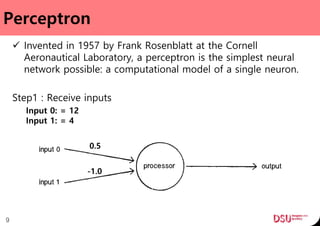
Perceptron
 Invented in 1957 by Frank Rosenblatt at the Cornell
Aeronautical Laboratory, a perceptron is the simplest neural
network possible: a computational model of a single neuron.
Step1 : Receive inputs
Input 0: = 12
Input 1: = 4
9
0.5
-1.0
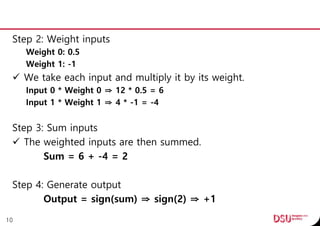
Step 2: Weight inputs
Weight 0: 0.5
Weight 1: -1
 We take each input and multiply it by its weight.
Input 0 * Weight 0 ⇒ 12 * 0.5 = 6
Input 1 * Weight 1 ⇒ 4 * -1 = -4
Step 3: Sum inputs
 The weighted inputs are then summed.
Sum = 6 + -4 = 2
Step 4: Generate output
Output = sign(sum) ⇒ sign(2) ⇒ +1
10
The Perceptron Algorithm:
1. For every input, multiply that input by its weight.
2. Sum all of the weighted inputs.
3. Compute the output of the perceptron based on that sum
passed through an activation function (the sign of the sum).
float inputs[] = {12 , 4};
float weights[] = {0.5,-1};
float sum = 0;
for (int i = 0; i < inputs.length; i++) {
sum += inputs[i]*weights[i];
}
11
The Perceptron Algorithm:
1. For every input, multiply that input by its weight.
2. Sum all of the weighted inputs.
3. Compute the output of the perceptron based on that sum
passed through an activation function (the sign of the sum).
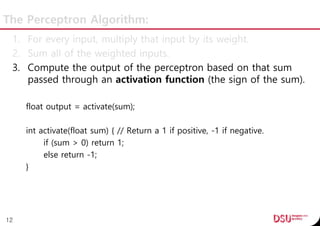
float output = activate(sum);
int activate(float sum) { // Return a 1 if positive, -1 if negative.
if (sum > 0) return 1;
else return -1;
}
12
Simple Pattern Recognition using a Perceptron
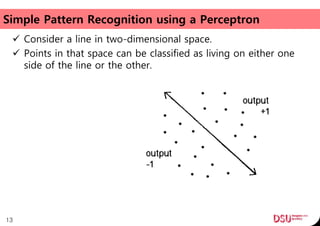
 Consider a line in two-dimensional space.
 Points in that space can be classified as living on either one
side of the line or the other.
13
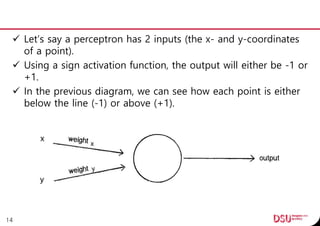
 Let’s say a perceptron has 2 inputs (the x- and y-coordinates
of a point).
 Using a sign activation function, the output will either be -1 or
+1.
 In the previous diagram, we can see how each point is either
below the line (-1) or above (+1).
14
Bias
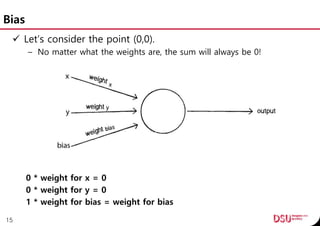
 Let’s consider the point (0,0).
– No matter what the weights are, the sum will always be 0!
0 * weight for x = 0
0 * weight for y = 0
1 * weight for bias = weight for bias
15
Coding the Perceptron
class Perceptron
{
private:
//The Perceptron stores its weights and learning constants.
float* spWeights;
int mWeightsSize = 0;
float c = 0.01; // learning constant
16
Initialize
Perceptron(int n)
{
mWeightsSize = n;
spWeights = new float[ n ];
//Weights start off random.
for (int i = 0; i < mWeightsSize; i++) {
spWeights[ i ] = random( -1, 1 );
}
}
17
Feed forward
int feedforward(float inputs[])
{
float sum = 0;
for (int i = 0; i < mWeightsSize; i++) {
sum += inputs[ i ] * spWeights[ i ];
}
return activate(sum);
}
//Output is a +1 or -1.
int activate(float sum)
{
if (sum > 0) return 1;
else return -1;
}
18
Use the Perceptron
Perceptron p = new Perceptron(3);
float point[] = {50,-12,1}; // The input is 3 values: x,y and bias.
int result = p.feedforward(point);
19
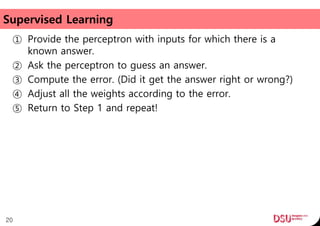
Supervised Learning
① Provide the perceptron with inputs for which there is a
known answer.
② Ask the perceptron to guess an answer.
③ Compute the error. (Did it get the answer right or wrong?)
④ Adjust all the weights according to the error.
⑤ Return to Step 1 and repeat!
20
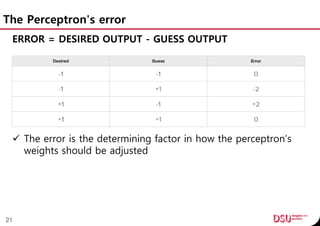
The Perceptron's error
ERROR = DESIRED OUTPUT - GUESS OUTPUT
 The error is the determining factor in how the perceptron’s
weights should be adjusted
21
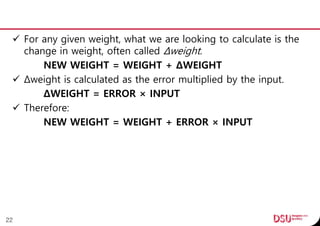
 For any given weight, what we are looking to calculate is the
change in weight, often called Δweight.
NEW WEIGHT = WEIGHT + ΔWEIGHT
 Δweight is calculated as the error multiplied by the input.
ΔWEIGHT = ERROR × INPUT
 Therefore:
NEW WEIGHT = WEIGHT + ERROR × INPUT
22
Learning Constant
NEW WEIGHT = WEIGHT + ERROR * INPUT * LEARNING CONSTANT
 With a small learning constant, the weights will be adjusted
slowly, requiring more training time but allowing the network
to make very small adjustments that could improve the
network’s overall accuracy.
float c = 0.01; // learning constant
//Train the network against known data.
void train(float inputs[], int desired) {
int guess = feedforward(inputs);
float error = desired - guess;
for (int i = 0; i < mWeightsSize; i++) {
spWeights[ i ] += c * error * inputs[ i ];
}
}
23
Trainer
 To train the perceptron, we need a set of inputs with a
known answer.
class Trainer
{
public:
//A "Trainer" object stores the inputs and the correct answer.
float mInputs[ 3 ];
int mAnswer;
void SetData( float x, float y, int a )
{
mInputs[ 0 ] = x;
mInputs[ 1 ] = y;
//Note that the Trainer has the bias input built into its array.
mInputs[ 2 ] = 1;
mAnswer = a;
}24
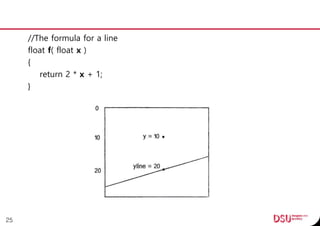
//The formula for a line
float f( float x )
{
return 2 * x + 1;
}
25
void Setup()
{
srand( time( 0 ) );
//size( 640, 360 );
spPerceptron.reset( new Perceptron( 3 ) );
// Make 2,000 training points.
for( int i = 0; i < gTrainerSize; i++ ) {
float x = random( -gWidth / 2, gWidth / 2 );
float y = random( -gHeight / 2, gHeight / 2 );
//Is the correct answer 1 or - 1 ?
int answer = 1;
if( y < f( x ) ) answer = -1;
gTraining[ i ].SetData( x, y, answer );
}
}26
void Training()
{
for( int i = 0; i < gTrainerSize; i++ ) {
spPerceptron->train( gTraining[ i ].mInputs, gTraining[ i
].mAnswer );
}
}
void main()
{
Setup();
Training();
}
27
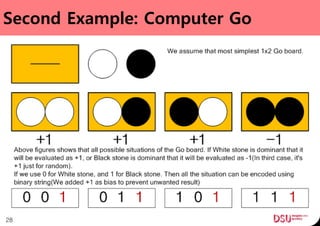
Second Example: Computer Go
28
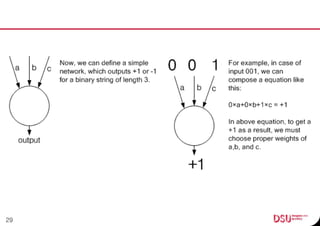
29
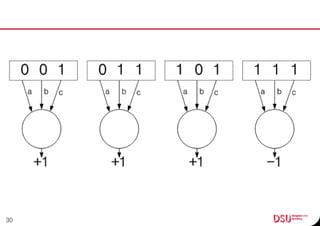
30
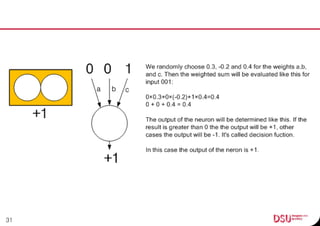
31
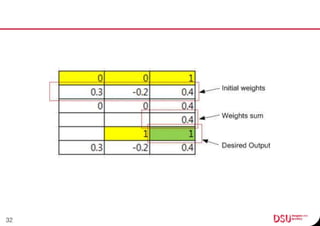
32
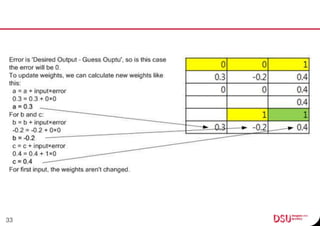
33
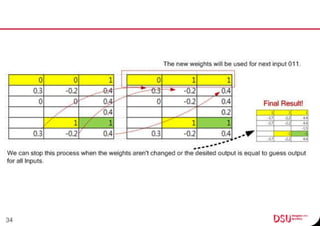
34
Practice
 Calculate weights of the Perceptron for Go by using paper
and pencil.
35
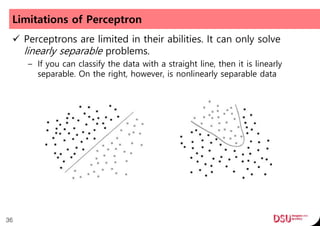
Limitations of Perceptron
 Perceptrons are limited in their abilities. It can only solve
linearly separable problems.
– If you can classify the data with a straight line, then it is linearly
separable. On the right, however, is nonlinearly separable data
36
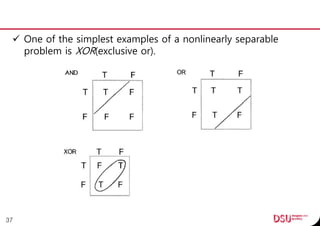
 One of the simplest examples of a nonlinearly separable
problem is XOR(exclusive or).
37
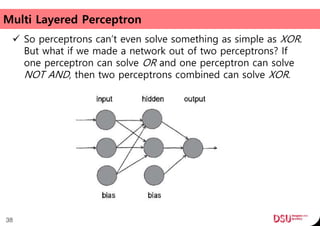
Multi Layered Perceptron
 So perceptrons can’t even solve something as simple as XOR.
But what if we made a network out of two perceptrons? If
one perceptron can solve OR and one perceptron can solve
NOT AND, then two perceptrons combined can solve XOR.
38
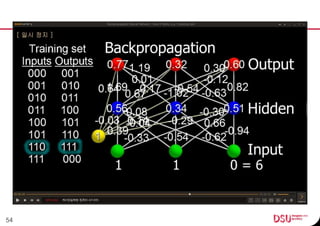
Backpropagation
 The output of the network is generated in the same manner
as a perceptron. The inputs multiplied by the weights are
summed and fed forward through the network.
 The difference here is that they pass through additional layers
of neurons before reaching the output. Training the network
(i.e. adjusting the weights) also involves taking the
error(desired result guess).
 The error, however, must be fed backwards through the
network. The final error ultimately adjusts the weights of all
the connections.
39
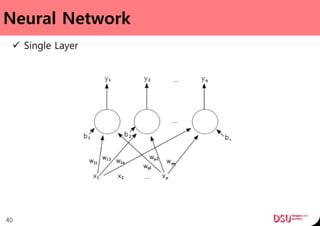
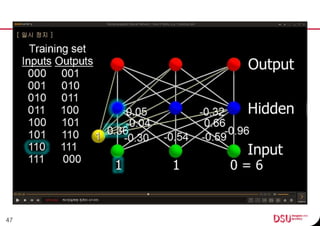
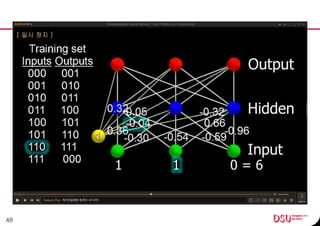
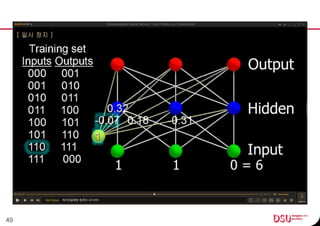
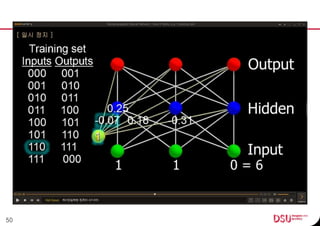
Neural Network
 Single Layer
40
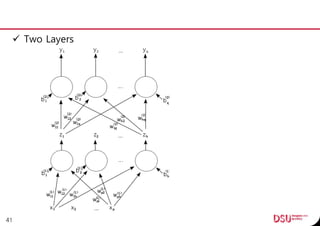
 Two Layers
41
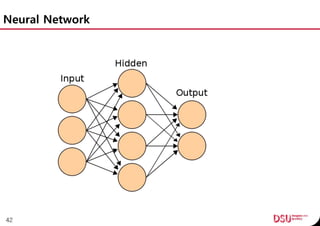
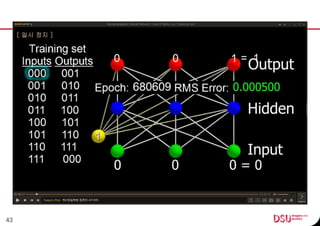
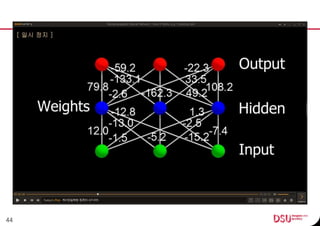
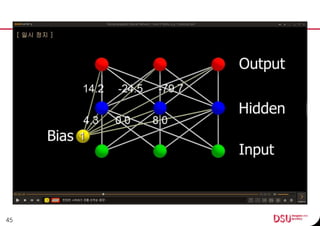
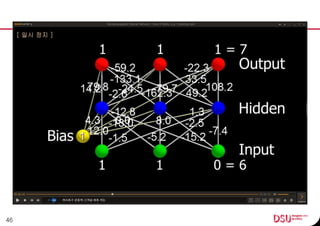
Neural Network
42
43
44
45
46
47
48
49
50
51
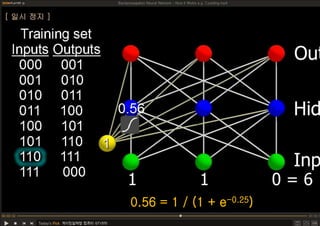
0.56 = 1 / (1 + e-0.25)
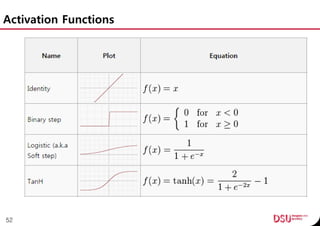
Activation Functions
52
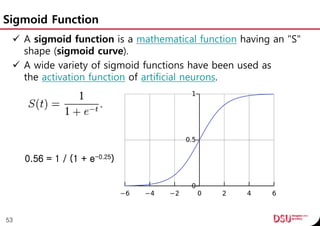
Sigmoid Function
 A sigmoid function is a mathematical function having an "S"
shape (sigmoid curve).
 A wide variety of sigmoid functions have been used as
the activation function of artificial neurons.
53
0.56 = 1 / (1 + e-0.25)
54
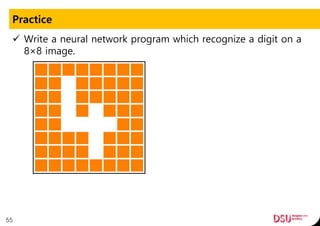
Practice
 Write a neural network program which recognize a digit on a
8×8 image.
55
References
 http://natureofcode.com/book/chapter-10-neural-networks/
 http://rimstar.org/science_electronics_projects/backpropagatio
n_neural_network_software_3_layer.htm
 https://en.wikipedia.org/wiki/Sigmoid_function
 https://www.youtube.com/watch?v=WZDMNM36PsM
56
Neural network 20161210_jintaekseo

Neural network 20161210_jintaekseo

  • 1.
    Mobile Game Programming: ArtificialNeural Network jintaeks@gmail.com Division of Digital Contents, DongSeo University. December 2016
  • 2.
    Standard Deviation  Thestandard deviation (SD, also represented by sigma σ or s) is a measure that is used to quantify the amount of variation of a set of data values 2
  • 3.
    Root mean square The root mean square (abbreviated RMS) is defined as the square root of mean square (the arithmetic mean of the squares of a set of numbers).[ 3
  • 4.
    Neural Network  Neuron –More than 100 billion neurons in a brain  Dendrites – receive input signals and, based on those inputs, fire an output signal via an axon  Axon 4
  • 5.
    Learning  Supervised Learning Unsupervised Learning  Reinforcement Learning 5
  • 6.
     Supervised Learning—Essentially, a strategy that involves a teacher that is smarter than the network itself. For example, let’s take the facial recognition example. The teacher shows the network a bunch of faces, and the teacher already knows the name associated with each face. The network makes its guesses, then the teacher provides the network with the answers. The network can then compare its answers to the known “correct” ones and make adjustments according to its errors. 6
  • 7.
     Unsupervised Learning—Required when there isn’t an example data set with known answers. Imagine searching for a hidden pattern in a data set. An application of this is clustering, i.e. dividing a set of elements into groups according to some unknown pattern.  Reinforcement Learning —A strategy built on observation. Think of a little mouse running through a maze. If it turns left, it gets a piece of cheese; if it turns right, it receives a little shock. Presumably, the mouse will learn over time to turn left. Its neural network makes a decision with an outcome (turn left or right) and observes its environment (yum or ouch). If the observation is negative, the network can adjust its weights in order to make a different decision the next time. Reinforcement learning is common in robotics. 7
  • 8.
    Standard Uses ofNeural Networks  Pattern Recognition – it’s probably the most common application. Examples are facial recognition, optical character recognition, etc.  Control – You may have read about recent research advances in self driving cars. Neural networks are often used to manage steering decisions of physical vehicles (or simulated ones).  Anomaly Detection – Because neural networks are so good at recognizing patterns, they can also be trained to generate an output when something occurs that doesn’t fit the pattern. 8
  • 9.
    Perceptron  Invented in1957 by Frank Rosenblatt at the Cornell Aeronautical Laboratory, a perceptron is the simplest neural network possible: a computational model of a single neuron. Step1 : Receive inputs Input 0: = 12 Input 1: = 4 9 0.5 -1.0
  • 10.
    Step 2: Weightinputs Weight 0: 0.5 Weight 1: -1  We take each input and multiply it by its weight. Input 0 * Weight 0 ⇒ 12 * 0.5 = 6 Input 1 * Weight 1 ⇒ 4 * -1 = -4 Step 3: Sum inputs  The weighted inputs are then summed. Sum = 6 + -4 = 2 Step 4: Generate output Output = sign(sum) ⇒ sign(2) ⇒ +1 10
  • 11.
    The Perceptron Algorithm: 1.For every input, multiply that input by its weight. 2. Sum all of the weighted inputs. 3. Compute the output of the perceptron based on that sum passed through an activation function (the sign of the sum). float inputs[] = {12 , 4}; float weights[] = {0.5,-1}; float sum = 0; for (int i = 0; i < inputs.length; i++) { sum += inputs[i]*weights[i]; } 11
  • 12.
    The Perceptron Algorithm: 1.For every input, multiply that input by its weight. 2. Sum all of the weighted inputs. 3. Compute the output of the perceptron based on that sum passed through an activation function (the sign of the sum). float output = activate(sum); int activate(float sum) { // Return a 1 if positive, -1 if negative. if (sum > 0) return 1; else return -1; } 12
  • 13.
    Simple Pattern Recognitionusing a Perceptron  Consider a line in two-dimensional space.  Points in that space can be classified as living on either one side of the line or the other. 13
  • 14.
     Let’s saya perceptron has 2 inputs (the x- and y-coordinates of a point).  Using a sign activation function, the output will either be -1 or +1.  In the previous diagram, we can see how each point is either below the line (-1) or above (+1). 14
  • 15.
    Bias  Let’s considerthe point (0,0). – No matter what the weights are, the sum will always be 0! 0 * weight for x = 0 0 * weight for y = 0 1 * weight for bias = weight for bias 15
  • 16.
    Coding the Perceptron classPerceptron { private: //The Perceptron stores its weights and learning constants. float* spWeights; int mWeightsSize = 0; float c = 0.01; // learning constant 16
  • 17.
    Initialize Perceptron(int n) { mWeightsSize =n; spWeights = new float[ n ]; //Weights start off random. for (int i = 0; i < mWeightsSize; i++) { spWeights[ i ] = random( -1, 1 ); } } 17
  • 18.
    Feed forward int feedforward(floatinputs[]) { float sum = 0; for (int i = 0; i < mWeightsSize; i++) { sum += inputs[ i ] * spWeights[ i ]; } return activate(sum); } //Output is a +1 or -1. int activate(float sum) { if (sum > 0) return 1; else return -1; } 18
  • 19.
    Use the Perceptron Perceptronp = new Perceptron(3); float point[] = {50,-12,1}; // The input is 3 values: x,y and bias. int result = p.feedforward(point); 19
  • 20.
    Supervised Learning ① Providethe perceptron with inputs for which there is a known answer. ② Ask the perceptron to guess an answer. ③ Compute the error. (Did it get the answer right or wrong?) ④ Adjust all the weights according to the error. ⑤ Return to Step 1 and repeat! 20
  • 21.
    The Perceptron's error ERROR= DESIRED OUTPUT - GUESS OUTPUT  The error is the determining factor in how the perceptron’s weights should be adjusted 21
  • 22.
     For anygiven weight, what we are looking to calculate is the change in weight, often called Δweight. NEW WEIGHT = WEIGHT + ΔWEIGHT  Δweight is calculated as the error multiplied by the input. ΔWEIGHT = ERROR × INPUT  Therefore: NEW WEIGHT = WEIGHT + ERROR × INPUT 22
  • 23.
    Learning Constant NEW WEIGHT= WEIGHT + ERROR * INPUT * LEARNING CONSTANT  With a small learning constant, the weights will be adjusted slowly, requiring more training time but allowing the network to make very small adjustments that could improve the network’s overall accuracy. float c = 0.01; // learning constant //Train the network against known data. void train(float inputs[], int desired) { int guess = feedforward(inputs); float error = desired - guess; for (int i = 0; i < mWeightsSize; i++) { spWeights[ i ] += c * error * inputs[ i ]; } } 23
  • 24.
    Trainer  To trainthe perceptron, we need a set of inputs with a known answer. class Trainer { public: //A "Trainer" object stores the inputs and the correct answer. float mInputs[ 3 ]; int mAnswer; void SetData( float x, float y, int a ) { mInputs[ 0 ] = x; mInputs[ 1 ] = y; //Note that the Trainer has the bias input built into its array. mInputs[ 2 ] = 1; mAnswer = a; }24
  • 25.
    //The formula fora line float f( float x ) { return 2 * x + 1; } 25
  • 26.
    void Setup() { srand( time(0 ) ); //size( 640, 360 ); spPerceptron.reset( new Perceptron( 3 ) ); // Make 2,000 training points. for( int i = 0; i < gTrainerSize; i++ ) { float x = random( -gWidth / 2, gWidth / 2 ); float y = random( -gHeight / 2, gHeight / 2 ); //Is the correct answer 1 or - 1 ? int answer = 1; if( y < f( x ) ) answer = -1; gTraining[ i ].SetData( x, y, answer ); } }26
  • 27.
    void Training() { for( inti = 0; i < gTrainerSize; i++ ) { spPerceptron->train( gTraining[ i ].mInputs, gTraining[ i ].mAnswer ); } } void main() { Setup(); Training(); } 27
  • 28.
  • 29.
  • 30.
  • 31.
  • 32.
  • 33.
  • 34.
  • 35.
    Practice  Calculate weightsof the Perceptron for Go by using paper and pencil. 35
  • 36.
    Limitations of Perceptron Perceptrons are limited in their abilities. It can only solve linearly separable problems. – If you can classify the data with a straight line, then it is linearly separable. On the right, however, is nonlinearly separable data 36
  • 37.
     One ofthe simplest examples of a nonlinearly separable problem is XOR(exclusive or). 37
  • 38.
    Multi Layered Perceptron So perceptrons can’t even solve something as simple as XOR. But what if we made a network out of two perceptrons? If one perceptron can solve OR and one perceptron can solve NOT AND, then two perceptrons combined can solve XOR. 38
  • 39.
    Backpropagation  The outputof the network is generated in the same manner as a perceptron. The inputs multiplied by the weights are summed and fed forward through the network.  The difference here is that they pass through additional layers of neurons before reaching the output. Training the network (i.e. adjusting the weights) also involves taking the error(desired result guess).  The error, however, must be fed backwards through the network. The final error ultimately adjusts the weights of all the connections. 39
  • 40.
  • 41.
  • 42.
  • 43.
  • 44.
  • 45.
  • 46.
  • 47.
  • 48.
  • 49.
  • 50.
  • 51.
    51 0.56 = 1/ (1 + e-0.25)
  • 52.
  • 53.
    Sigmoid Function  Asigmoid function is a mathematical function having an "S" shape (sigmoid curve).  A wide variety of sigmoid functions have been used as the activation function of artificial neurons. 53 0.56 = 1 / (1 + e-0.25)
  • 54.
  • 55.
    Practice  Write aneural network program which recognize a digit on a 8×8 image. 55
  • 56.

Editor's Notes

  • #6 Supervised Learning —Essentially, a strategy that involves a teacher that is smarter than the network itself. For example, let’s take the facial recognition example. The teacher shows the network a bunch of faces, and the teacher already knows the name associated with each face. The network makes its guesses, then the teacher provides the network with the answers. The network can then compare its answers to the known “correct” ones and make adjustments according to its errors. Unsupervised Learning —Required when there isn’t an example data set with known answers. Imagine searching for a hidden pattern in a data set. An application of this is clustering, i.e. dividing a set of elements into groups according to some unknown pattern. Reinforcement Learning —A strategy built on observation. Think of a little mouse running through a maze. If it turns left, it gets a piece of cheese; if it turns right, it receives a little shock. Presumably, the mouse will learn over time to turn left. Its neural network makes a decision with an outcome (turn left or right) and observes its environment (yum or ouch). If the observation is negative, the network can adjust its weights in order to make a different decision the next time. Reinforcement learning is common in robotics.
  • #7 Supervised Learning —Essentially, a strategy that involves a teacher that is smarter than the network itself. For example, let’s take the facial recognition example. The teacher shows the network a bunch of faces, and the teacher already knows the name associated with each face. The network makes its guesses, then the teacher provides the network with the answers. The network can then compare its answers to the known “correct” ones and make adjustments according to its errors. Unsupervised Learning —Required when there isn’t an example data set with known answers. Imagine searching for a hidden pattern in a data set. An application of this is clustering, i.e. dividing a set of elements into groups according to some unknown pattern. Reinforcement Learning —A strategy built on observation. Think of a little mouse running through a maze. If it turns left, it gets a piece of cheese; if it turns right, it receives a little shock. Presumably, the mouse will learn over time to turn left. Its neural network makes a decision with an outcome (turn left or right) and observes its environment (yum or ouch). If the observation is negative, the network can adjust its weights in order to make a different decision the next time. Reinforcement learning is common in robotics.
  • #8 Supervised Learning —Essentially, a strategy that involves a teacher that is smarter than the network itself. For example, let’s take the facial recognition example. The teacher shows the network a bunch of faces, and the teacher already knows the name associated with each face. The network makes its guesses, then the teacher provides the network with the answers. The network can then compare its answers to the known “correct” ones and make adjustments according to its errors. Unsupervised Learning —Required when there isn’t an example data set with known answers. Imagine searching for a hidden pattern in a data set. An application of this is clustering, i.e. dividing a set of elements into groups according to some unknown pattern. Reinforcement Learning —A strategy built on observation. Think of a little mouse running through a maze. If it turns left, it gets a piece of cheese; if it turns right, it receives a little shock. Presumably, the mouse will learn over time to turn left. Its neural network makes a decision with an outcome (turn left or right) and observes its environment (yum or ouch). If the observation is negative, the network can adjust its weights in order to make a different decision the next time. Reinforcement learning is common in robotics.