StackStack
Mobile Game ProgrammingMobile Game Programming
jintaeks@gmail.com
Division of Digital Contents, Dongseo Univ.
September 8, 2016
Presentation Outline
 ADT
 Data Structure
 Stack
 Implementation of a stack
– KStack
– template KStack
 Algorithms with stack
– Base conversion of numeral system
– Evaluation of postfix notation
– Conversion from infix to postfix notation
2
Abstract Data Type(ADT)
 an abstract data type (  ADT) is a mathematical model for   
data types where a data type is defined by its behavior 
(semantics) from the point of view of a user of the 
data.
 possible values, possible operations on data of this
type, and the behavior of these operations.
 Example: integers
– Values …, -2, -1, 0, 1, 2, …
– Operations
• Addition
• Subtraction
• Multiplication
• Division
• Greater than, etc…
3
ADT examples
 Some common ADTs, which have proved useful in a great
variety of applications, are:
– Container, List, Set, Multiset
– Map, Multimap, Graph, Stack
– Queue, Priority queue
– Double-ended queue
– Double-ended priority queue
4
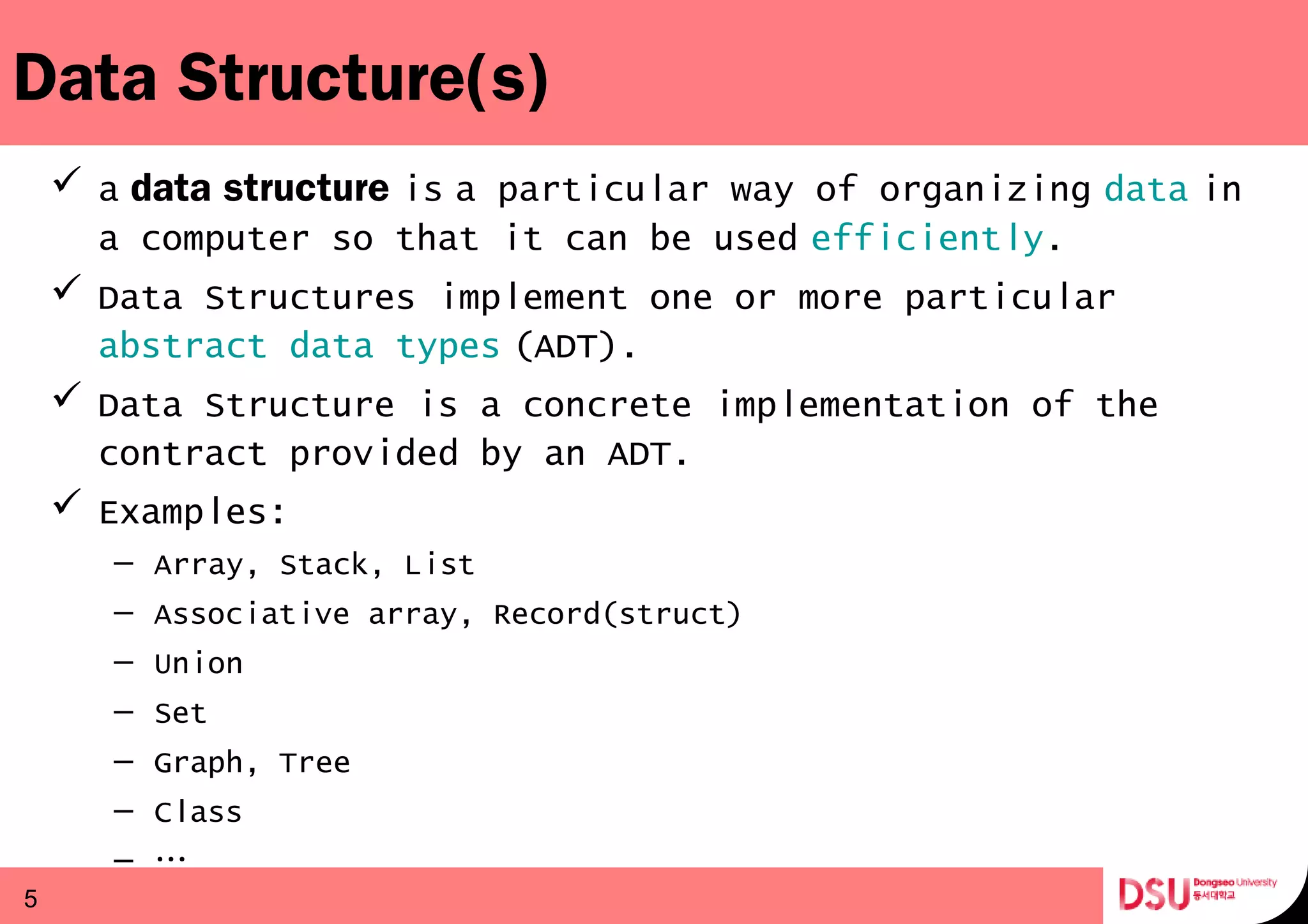
Data Structure(s)
 a data structure is a particular way of organizing     data in 
a computer so that it can be used efficiently.
 Data Structures implement one or more particular 
abstract data types (ADT). 
 Data Structure is a concrete implementation of the
contract provided by an ADT.
 Examples:
– Array, Stack, List
– Associative array, Record(struct)
– Union
– Set
– Graph, Tree
– Class
– …
5
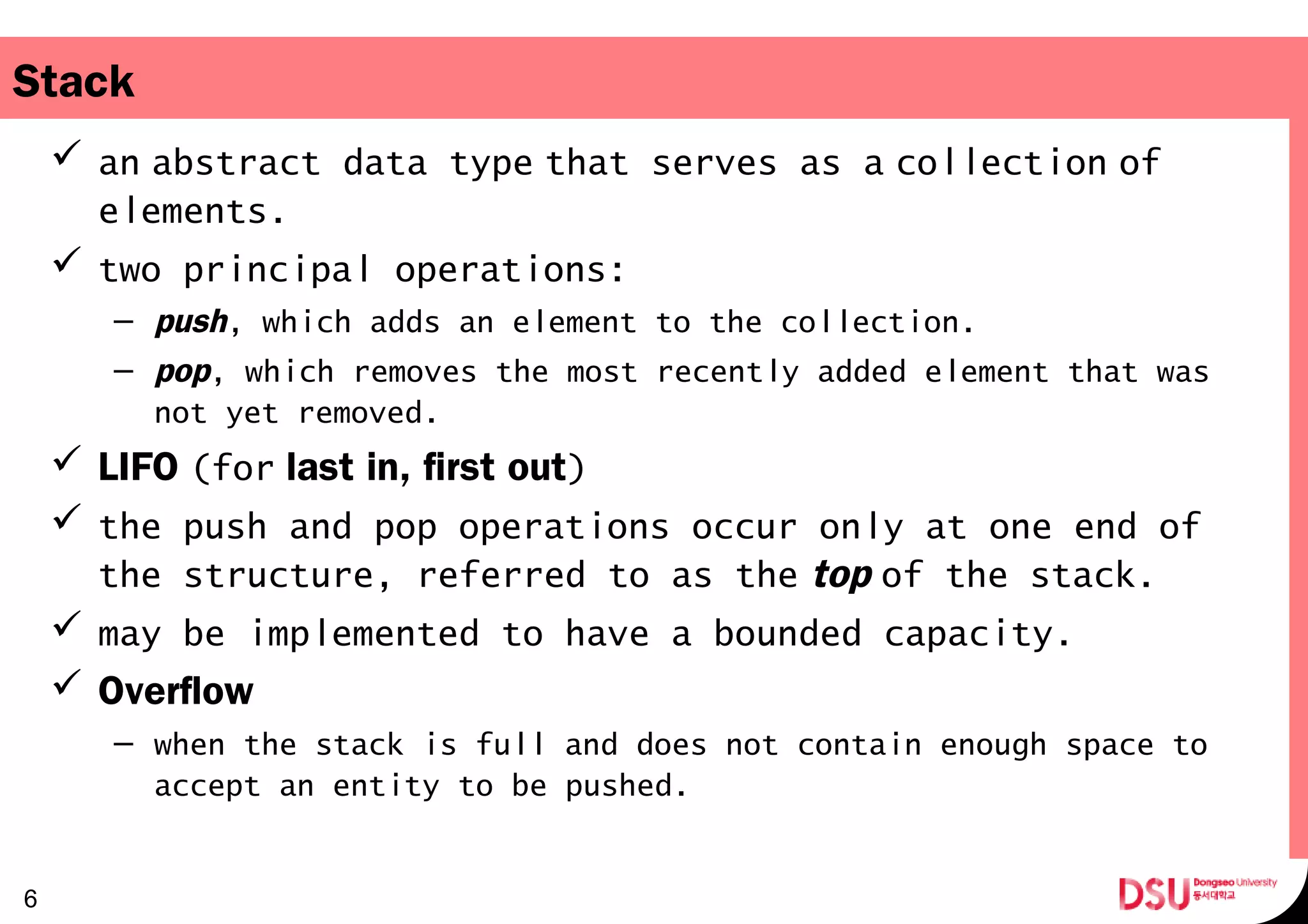
Stack
 an abstract data type that serves as a collection of       
elements.
 two principal operations:
– push, which adds an element to the collection.
– pop, which removes the most recently added element that was
not yet removed.
 LIFO (for   last in, first out)
 the push and pop operations occur only at one end of
the structure, referred to as the top of the stack. 
 may be implemented to have a bounded capacity.
 Overflow
– when the stack is full and does not contain enough space to
accept an entity to be pushed.
6
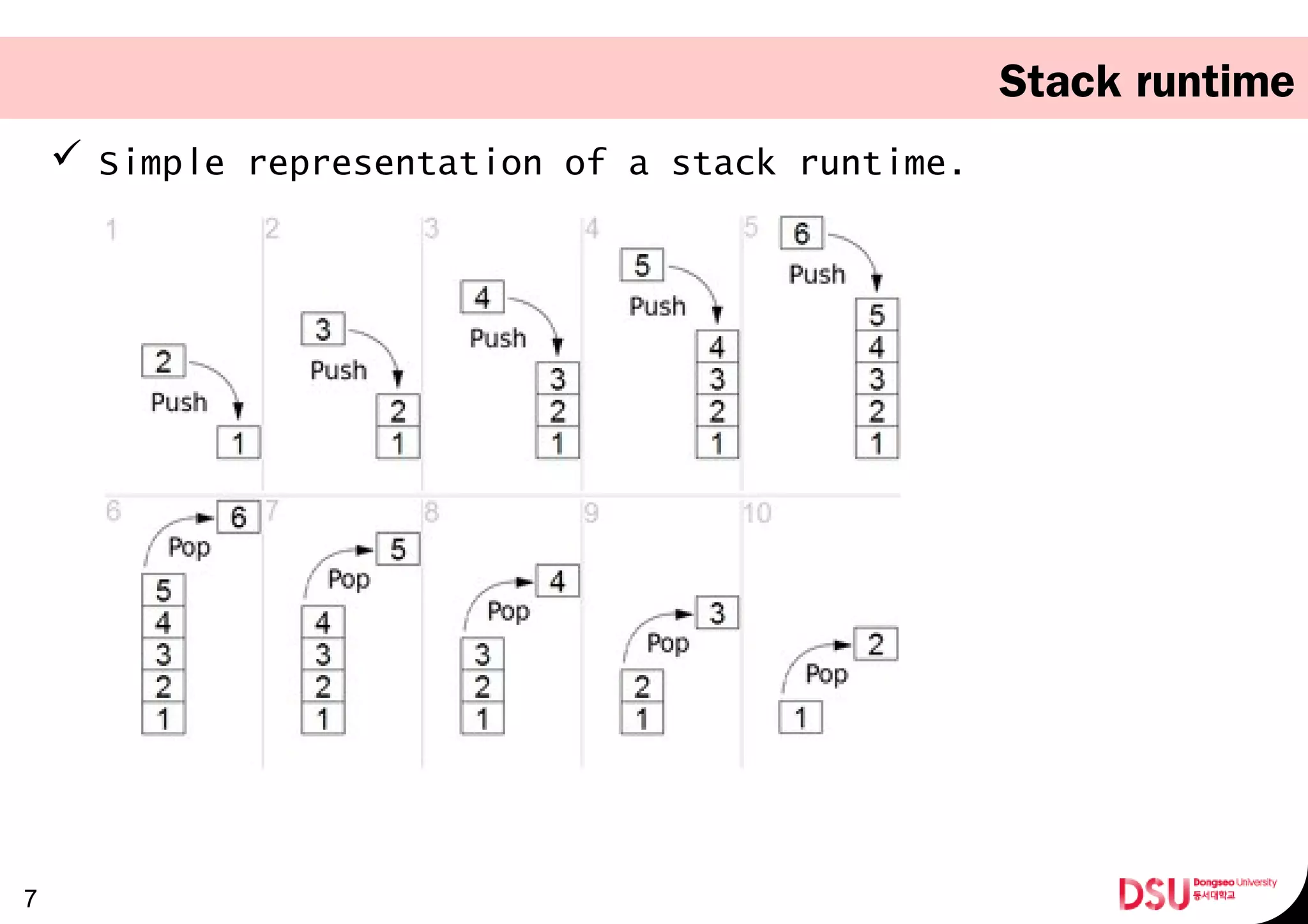
Stack runtime
 Simple representation of a stack runtime.
7
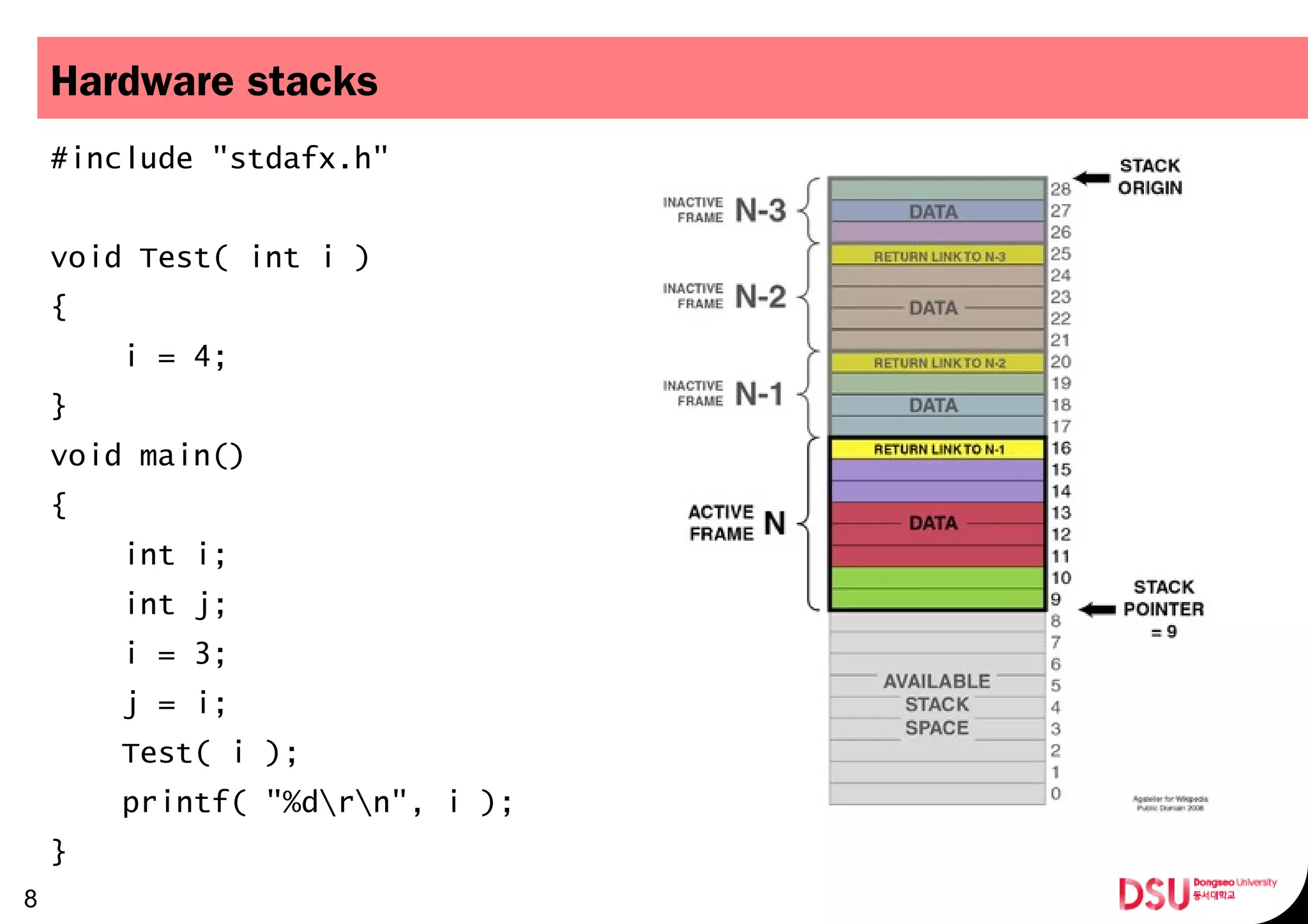
Hardware stacks
#include "stdafx.h"
void Test( int i )
{
i = 4;
}
void main()
{
int i;
int j;
i = 3;
j = i;
Test( i );
printf( "%drn", i );
}
8
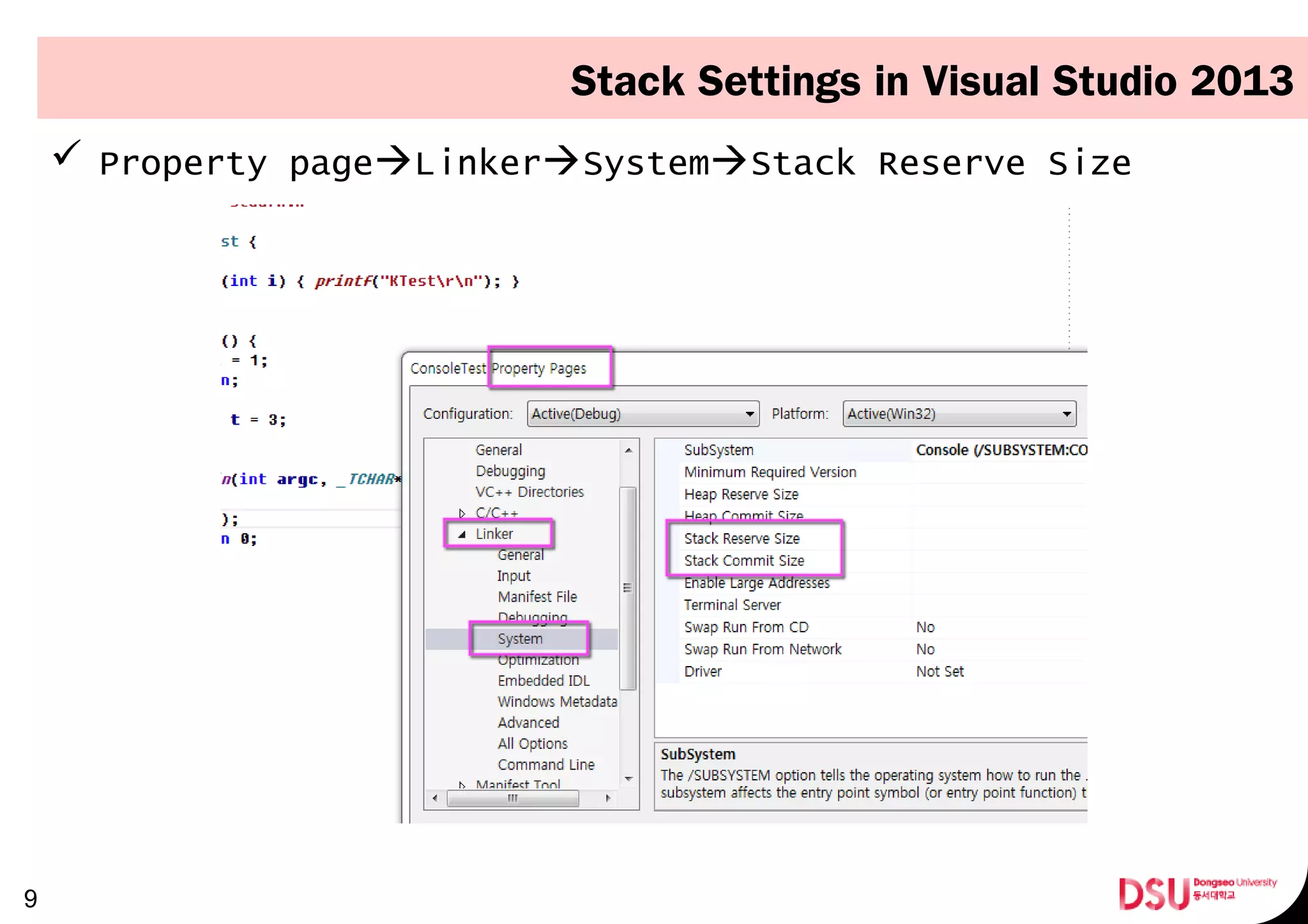
Stack Settings in Visual Studio 2013
 Property pageLinkerSystemStack Reserve Size
9
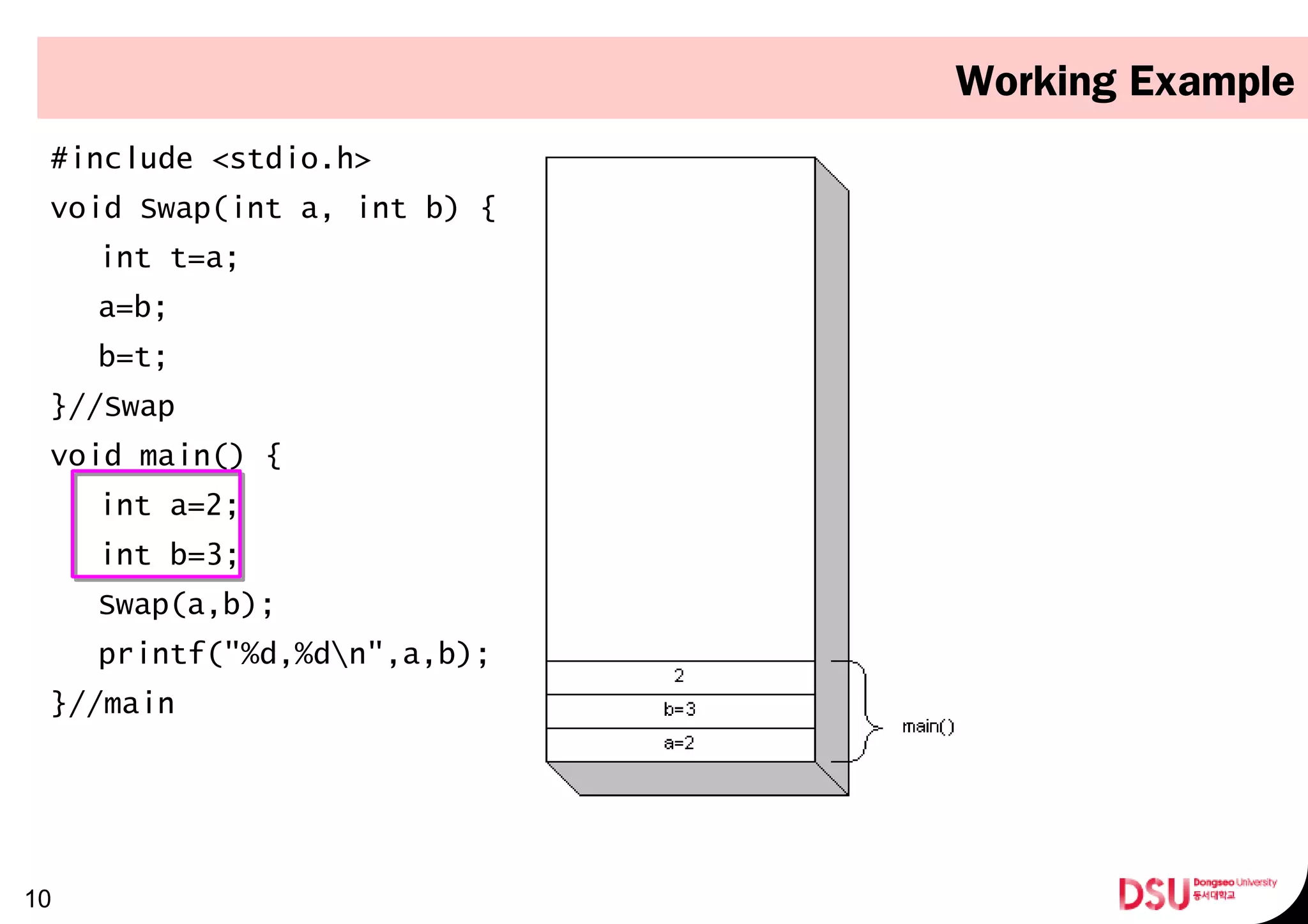
Working Example
#include <stdio.h>
void Swap(int a, int b) {
int t=a;
a=b;
b=t;
}//Swap
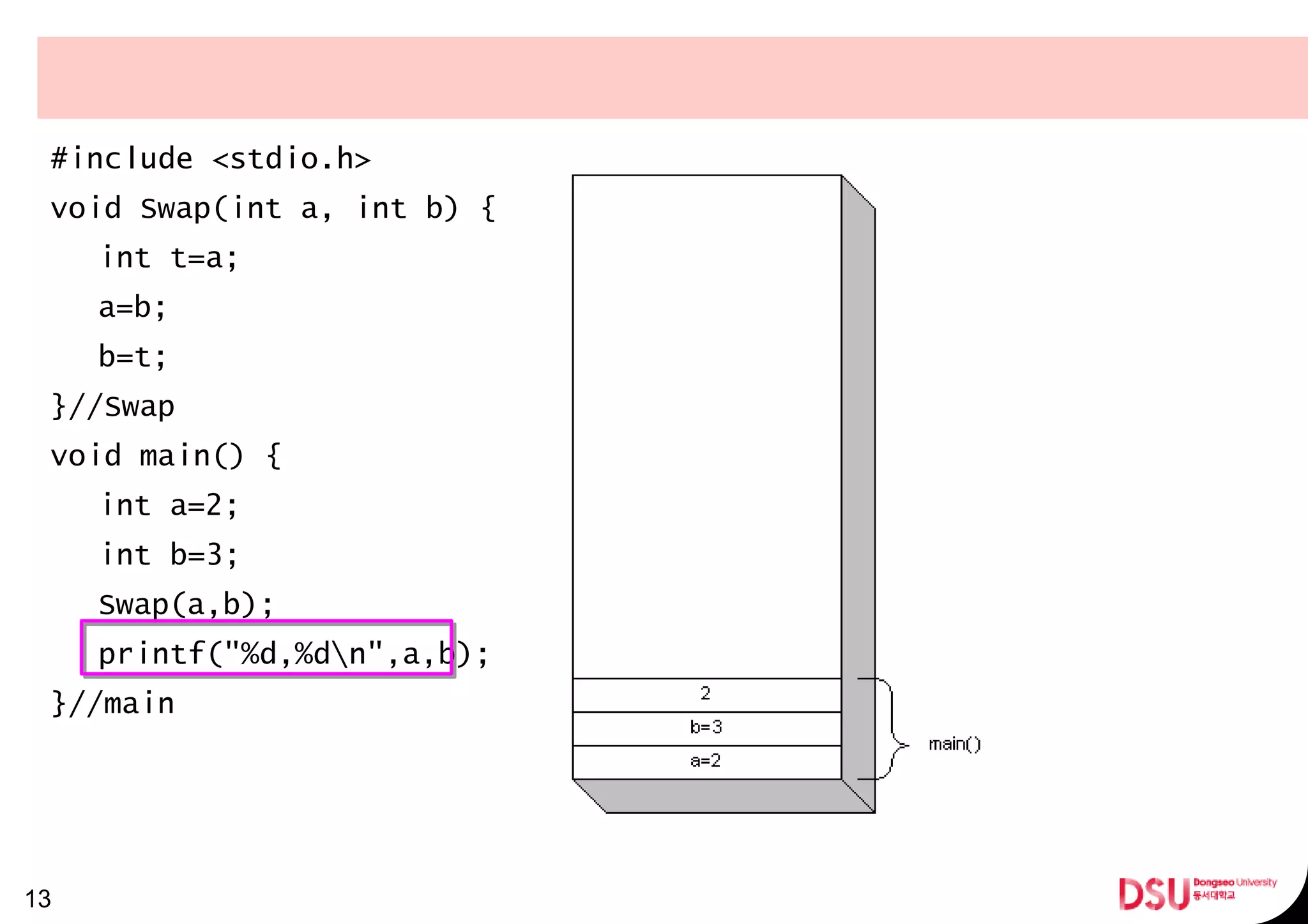
void main() {
int a=2;
int b=3;
Swap(a,b);
printf("%d,%dn",a,b);
}//main
10
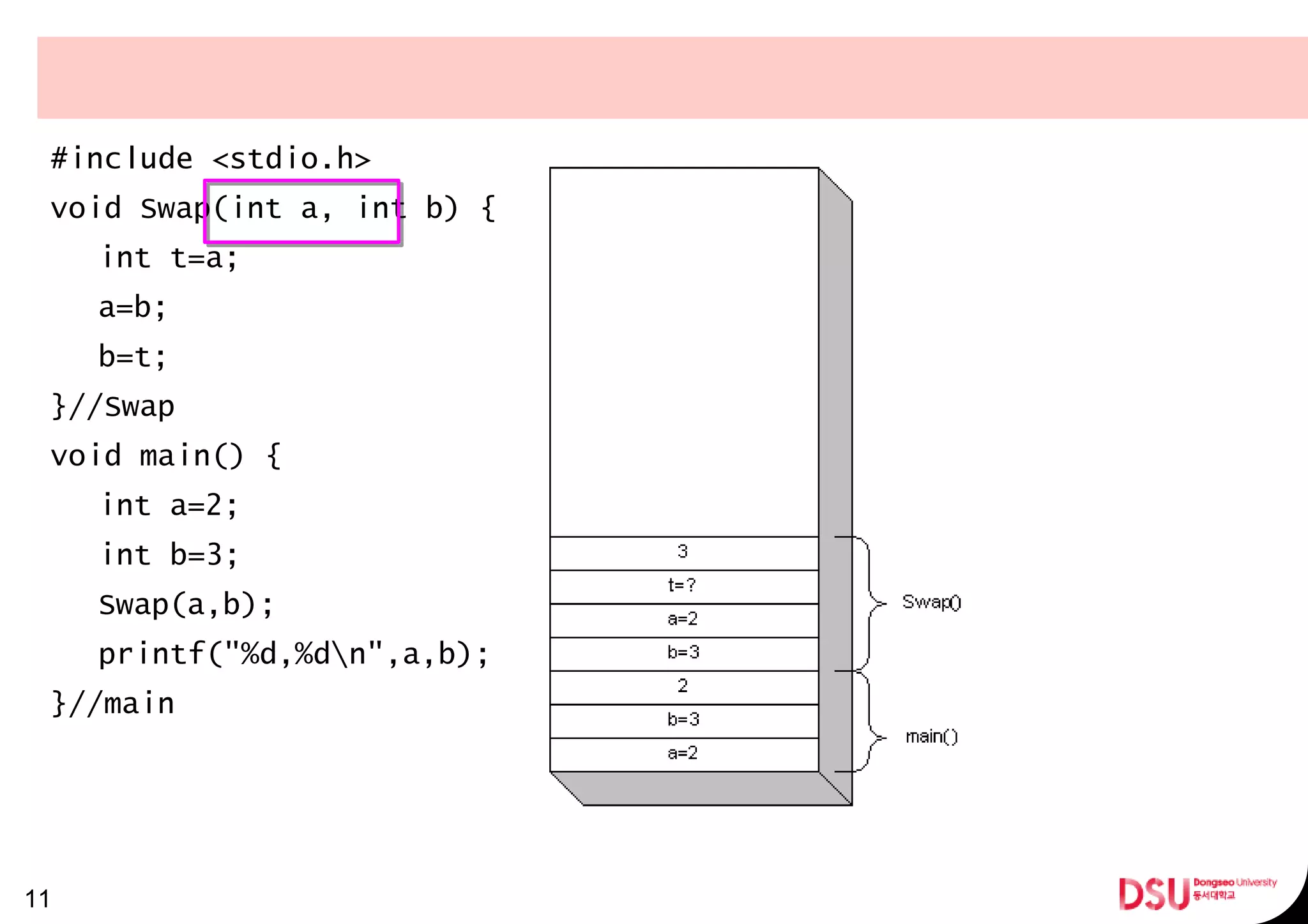
#include <stdio.h>
void Swap(int a, int b) {
int t=a;
a=b;
b=t;
}//Swap
void main() {
int a=2;
int b=3;
Swap(a,b);
printf("%d,%dn",a,b);
}//main
11
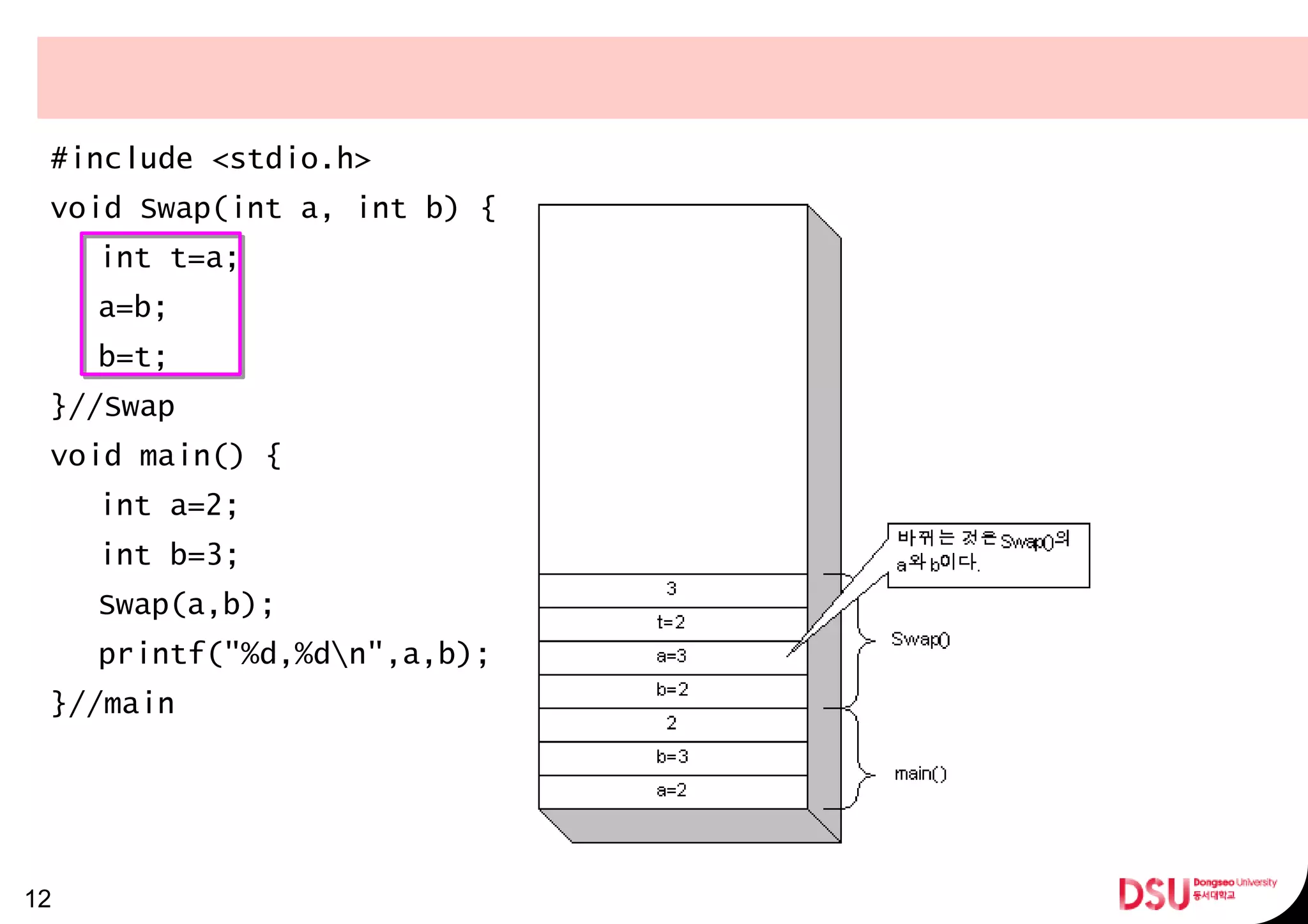
#include <stdio.h>
void Swap(int a, int b) {
int t=a;
a=b;
b=t;
}//Swap
void main() {
int a=2;
int b=3;
Swap(a,b);
printf("%d,%dn",a,b);
}//main
12
#include <stdio.h>
void Swap(int a, int b) {
int t=a;
a=b;
b=t;
}//Swap
void main() {
int a=2;
int b=3;
Swap(a,b);
printf("%d,%dn",a,b);
}//main
13
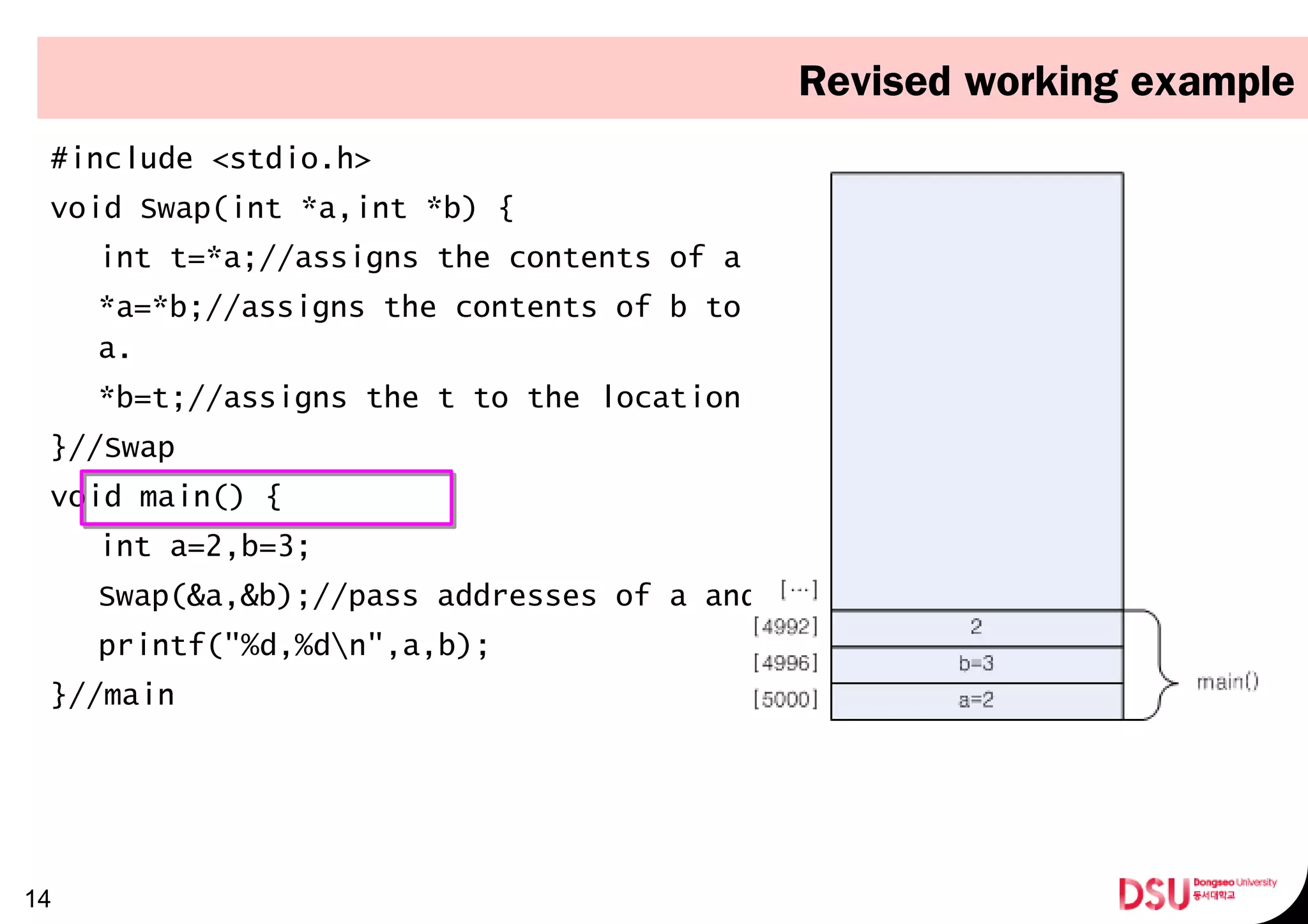
Revised working example
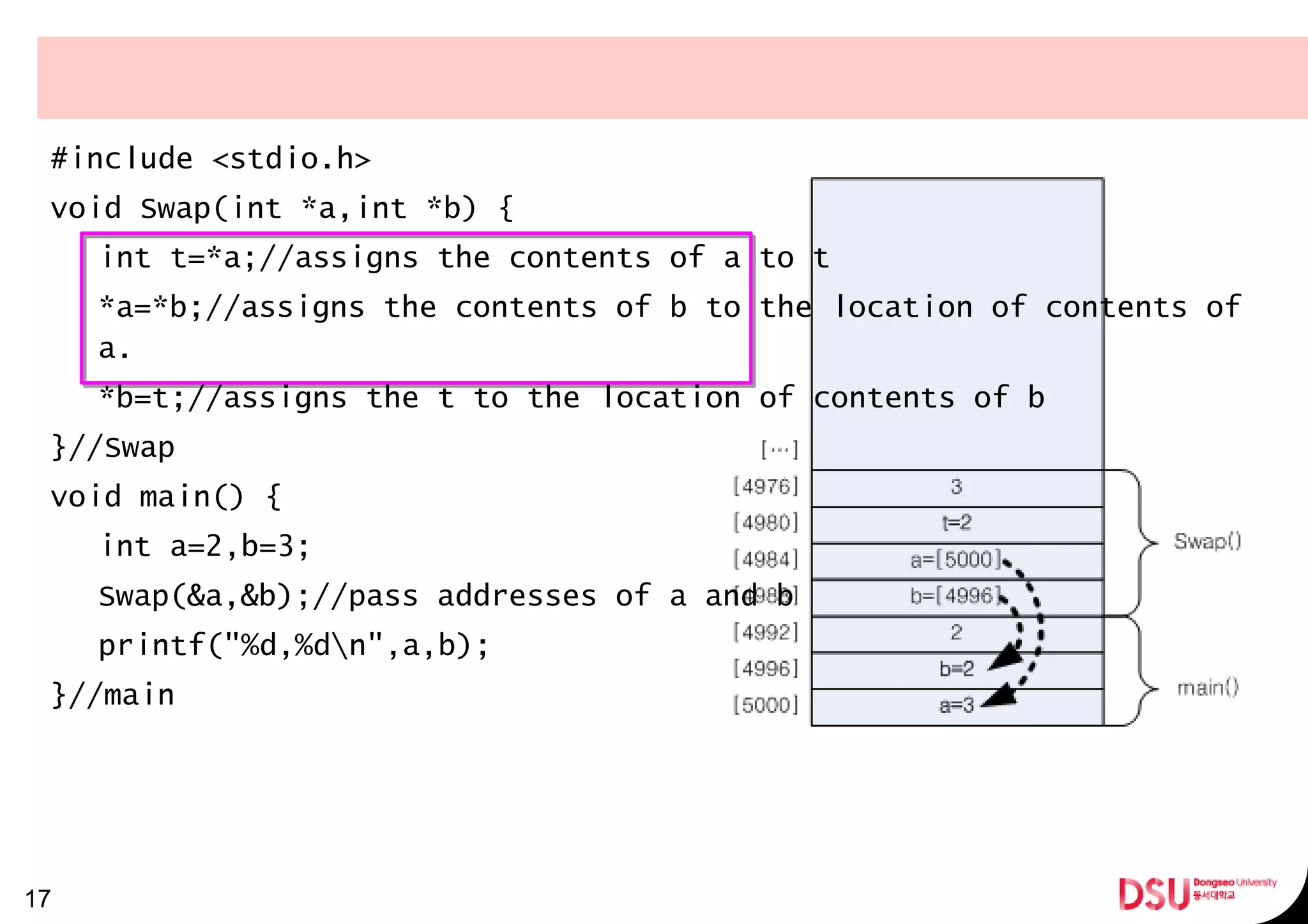
#include <stdio.h>
void Swap(int *a,int *b) {
int t=*a;//assigns the contents of a to t
*a=*b;//assigns the contents of b to the location of contents of
a.
*b=t;//assigns the t to the location of contents of b
}//Swap
void main() {
int a=2,b=3;
Swap(&a,&b);//pass addresses of a and b
printf("%d,%dn",a,b);
}//main
14
15
#include <stdio.h>
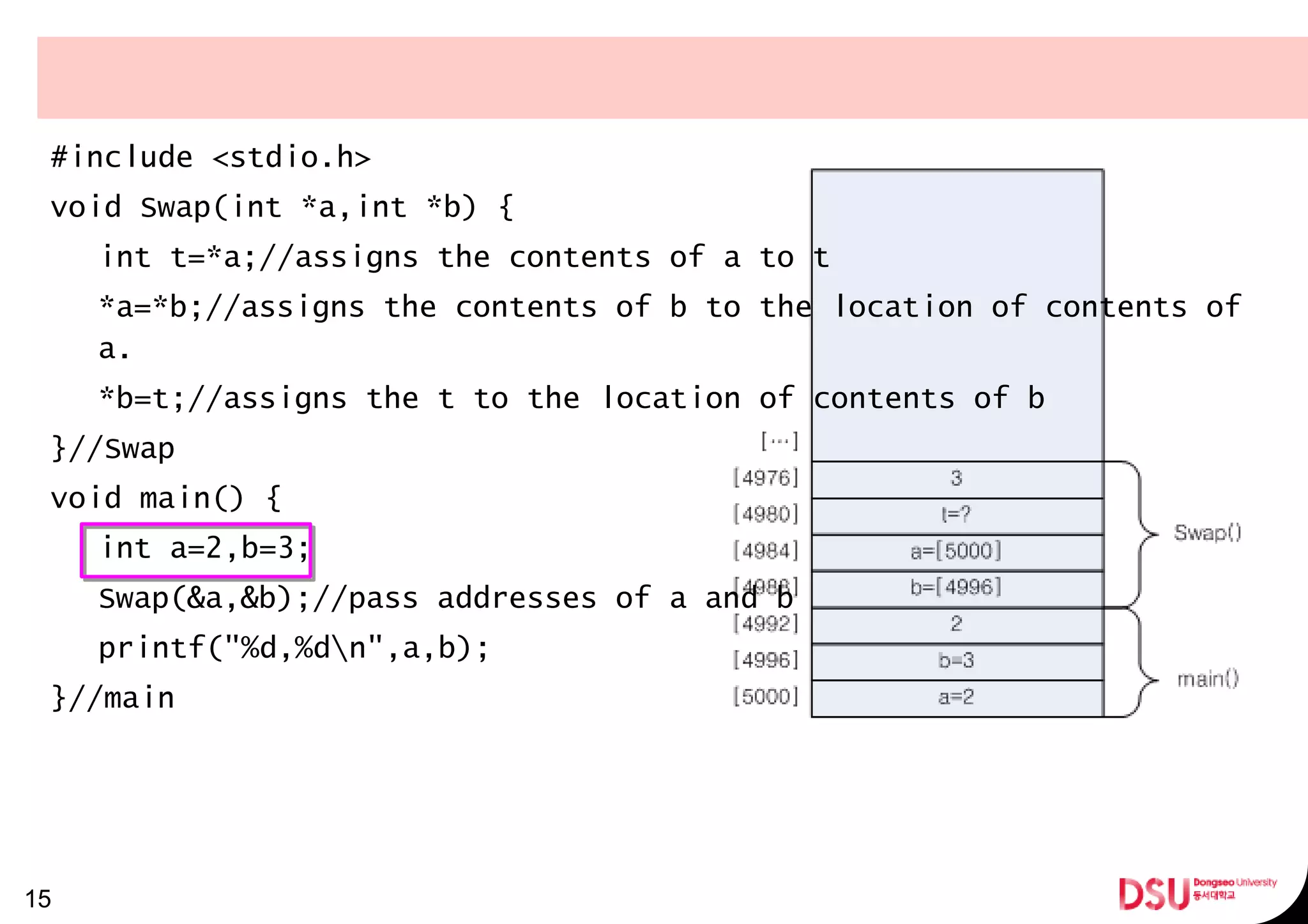
void Swap(int *a,int *b) {
int t=*a;//assigns the contents of a to t
*a=*b;//assigns the contents of b to the location of contents of
a.
*b=t;//assigns the t to the location of contents of b
}//Swap
void main() {
int a=2,b=3;
Swap(&a,&b);//pass addresses of a and b
printf("%d,%dn",a,b);
}//main
16
#include <stdio.h>
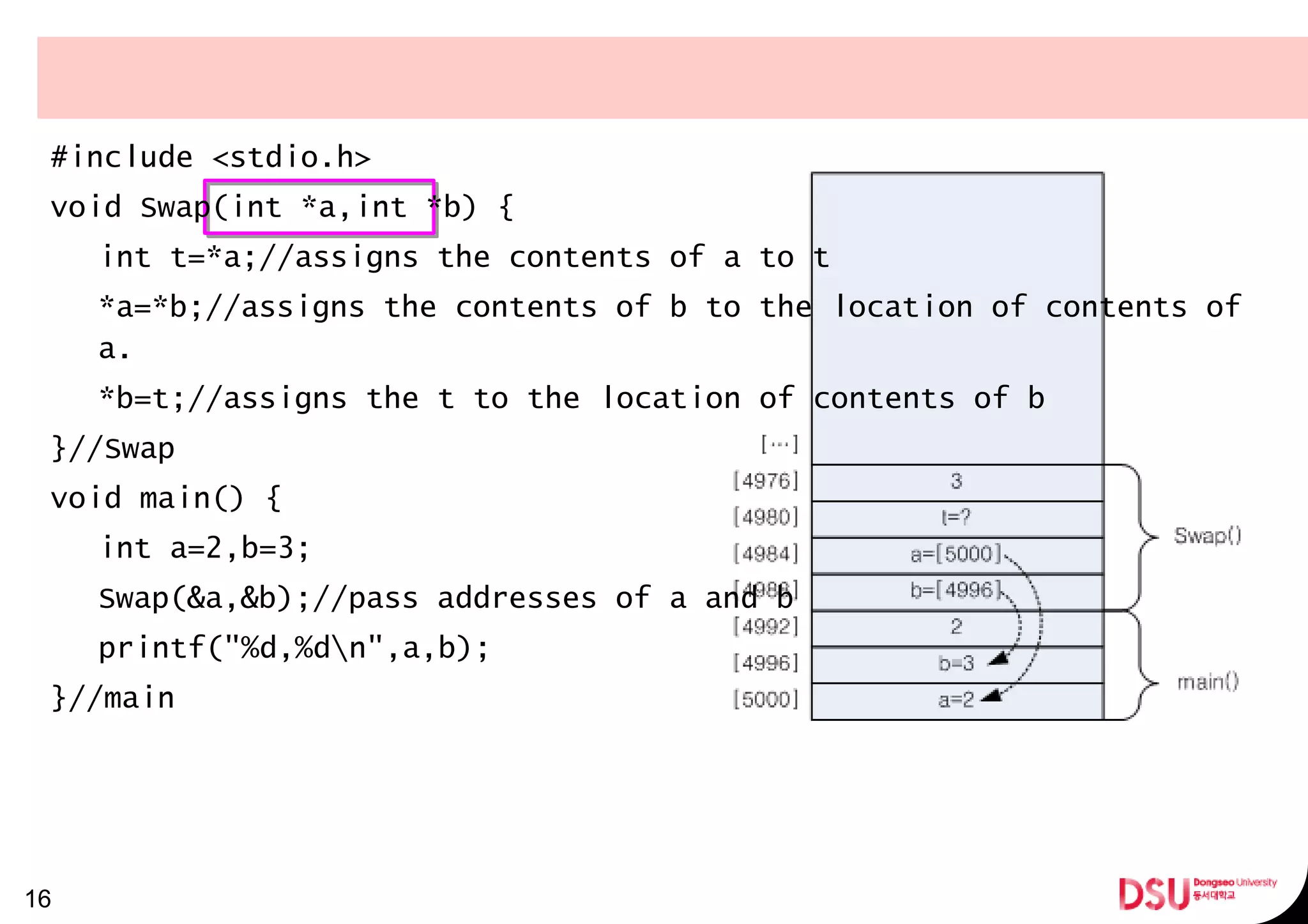
void Swap(int *a,int *b) {
int t=*a;//assigns the contents of a to t
*a=*b;//assigns the contents of b to the location of contents of
a.
*b=t;//assigns the t to the location of contents of b
}//Swap
void main() {
int a=2,b=3;
Swap(&a,&b);//pass addresses of a and b
printf("%d,%dn",a,b);
}//main
17
#include <stdio.h>
void Swap(int *a,int *b) {
int t=*a;//assigns the contents of a to t
*a=*b;//assigns the contents of b to the location of contents of
a.
*b=t;//assigns the t to the location of contents of b
}//Swap
void main() {
int a=2,b=3;
Swap(&a,&b);//pass addresses of a and b
printf("%d,%dn",a,b);
}//main
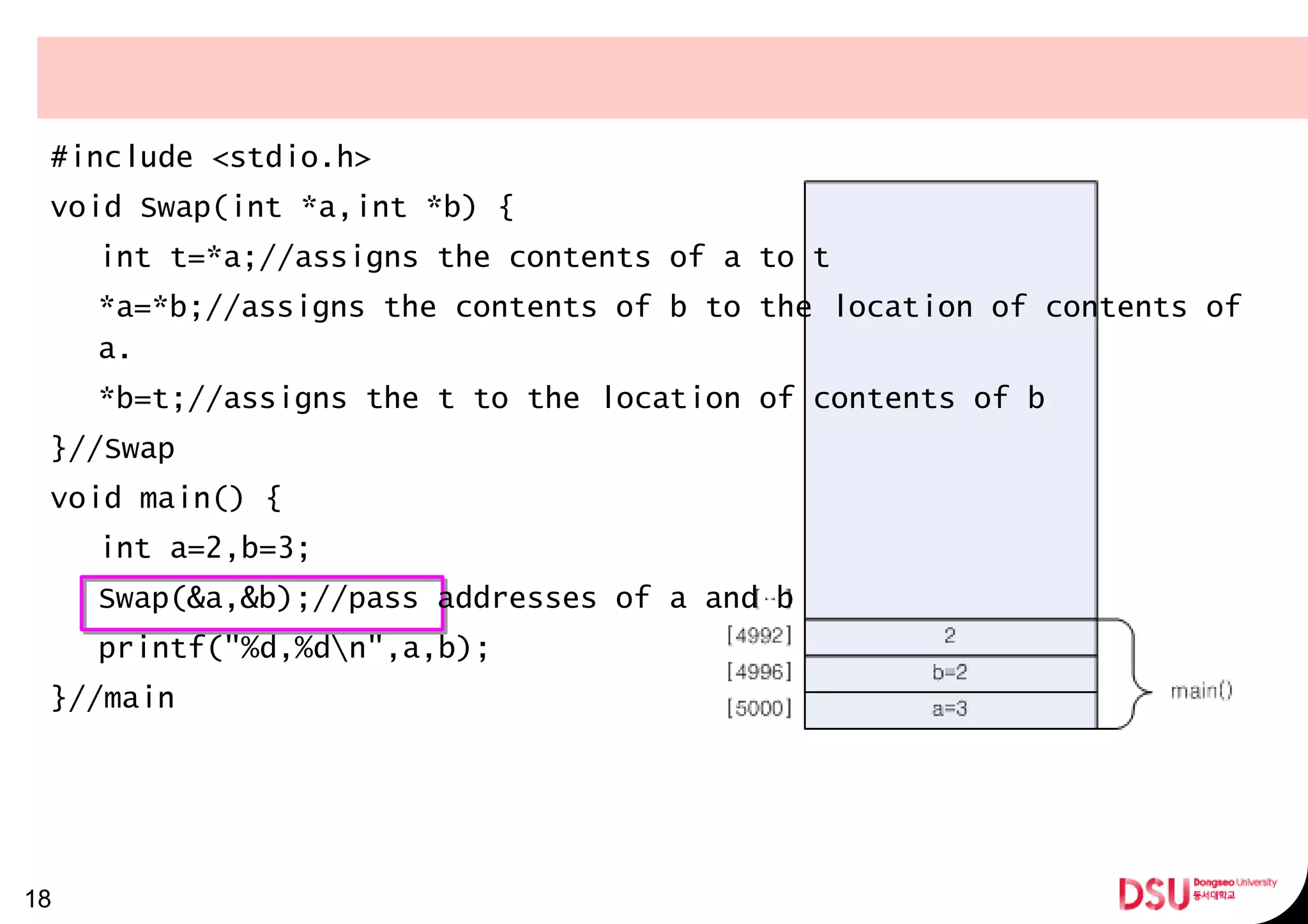
18
#include <stdio.h>
void Swap(int *a,int *b) {
int t=*a;//assigns the contents of a to t
*a=*b;//assigns the contents of b to the location of contents of
a.
*b=t;//assigns the t to the location of contents of b
}//Swap
void main() {
int a=2,b=3;
Swap(&a,&b);//pass addresses of a and b
printf("%d,%dn",a,b);
}//main
C++ implementations of a stack
class KStack
{
public:
KStack() : m_sp( 0 )
{
}
void Push( int data_ );
bool Pop( int& outData_ );
bool IsEmpty() const;
private:
int m_sp;
int m_data[ 100 ];
};//class KStack
19
void KStack::Push( int data_ )
{
m_data[ m_sp ] = data_;
m_sp += 1;
}
bool KStack::Pop( int& outData_ )
{
if( m_sp <= 0 ) return false;
m_sp -= 1;
outData_ = m_data[ m_sp ];
return true;
}
bool KStack::IsEmpty() const
{
return m_sp == 0;
}20
Template KStack
template<typename T, int STACK_SIZE>
class KStack
{
public:
KStack() : m_sp( 0 )
{
}
void Push( T data_ );
bool Pop( T& outData_ );
bool IsEmpty() const;
private:
int m_sp;
T m_data[ STACK_SIZE ];
};//class KStack
21
template<typename T, int STACK_SIZE>
void KStack<T,STACK_SIZE>::Push( T data_ )
{
m_data[ m_sp ] = data_;
m_sp += 1;
}
template<typename T, int STACK_SIZE>
bool KStack<T, STACK_SIZE>::Pop( T& outData_ )
{
if( m_sp <= 0 ) return false;
m_sp -= 1;
outData_ = m_data[ m_sp ];
return true;
}
22
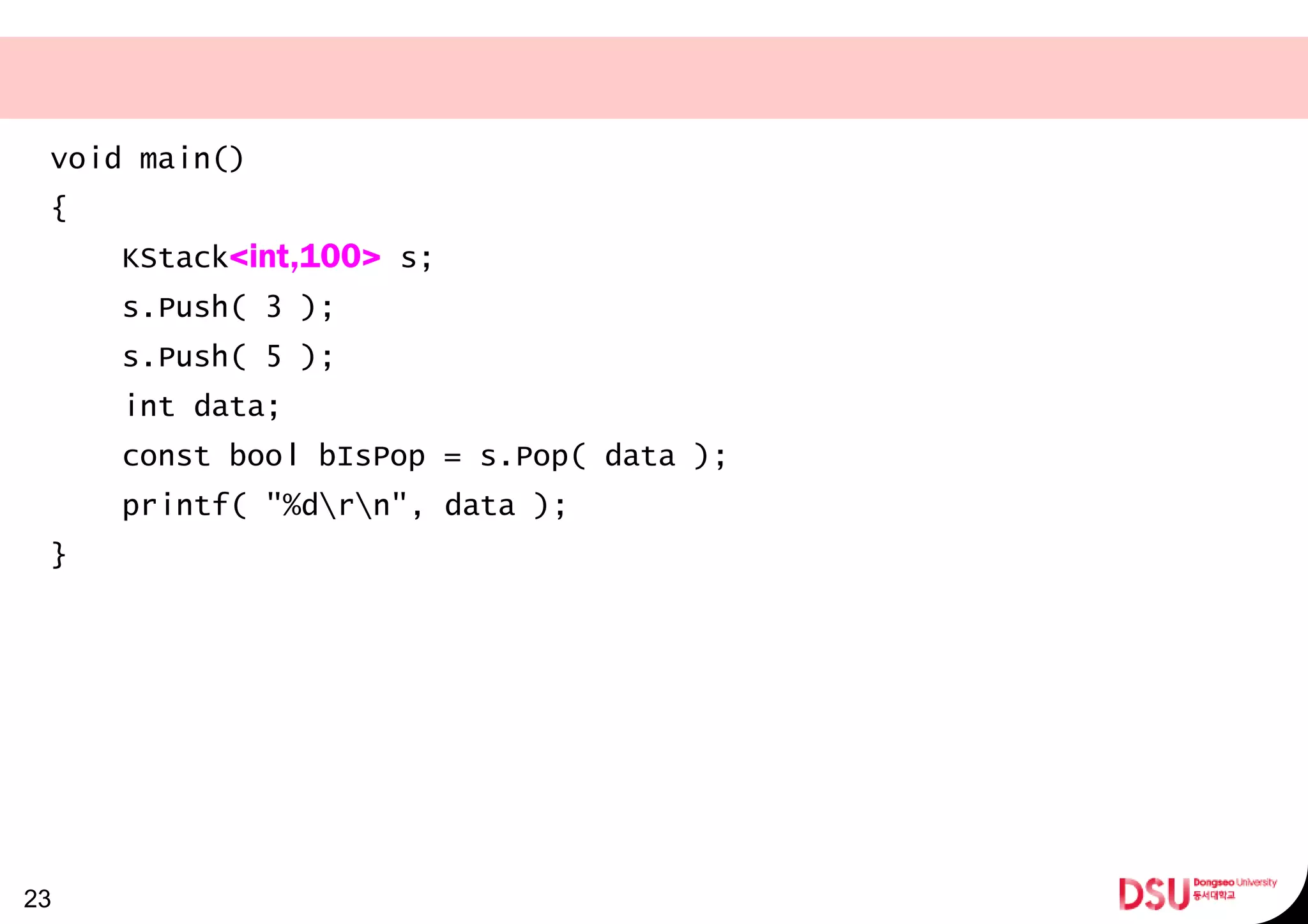
void main()
{
KStack<int,100> s;
s.Push( 3 );
s.Push( 5 );
int data;
const bool bIsPop = s.Pop( data );
printf( "%drn", data );
}
23
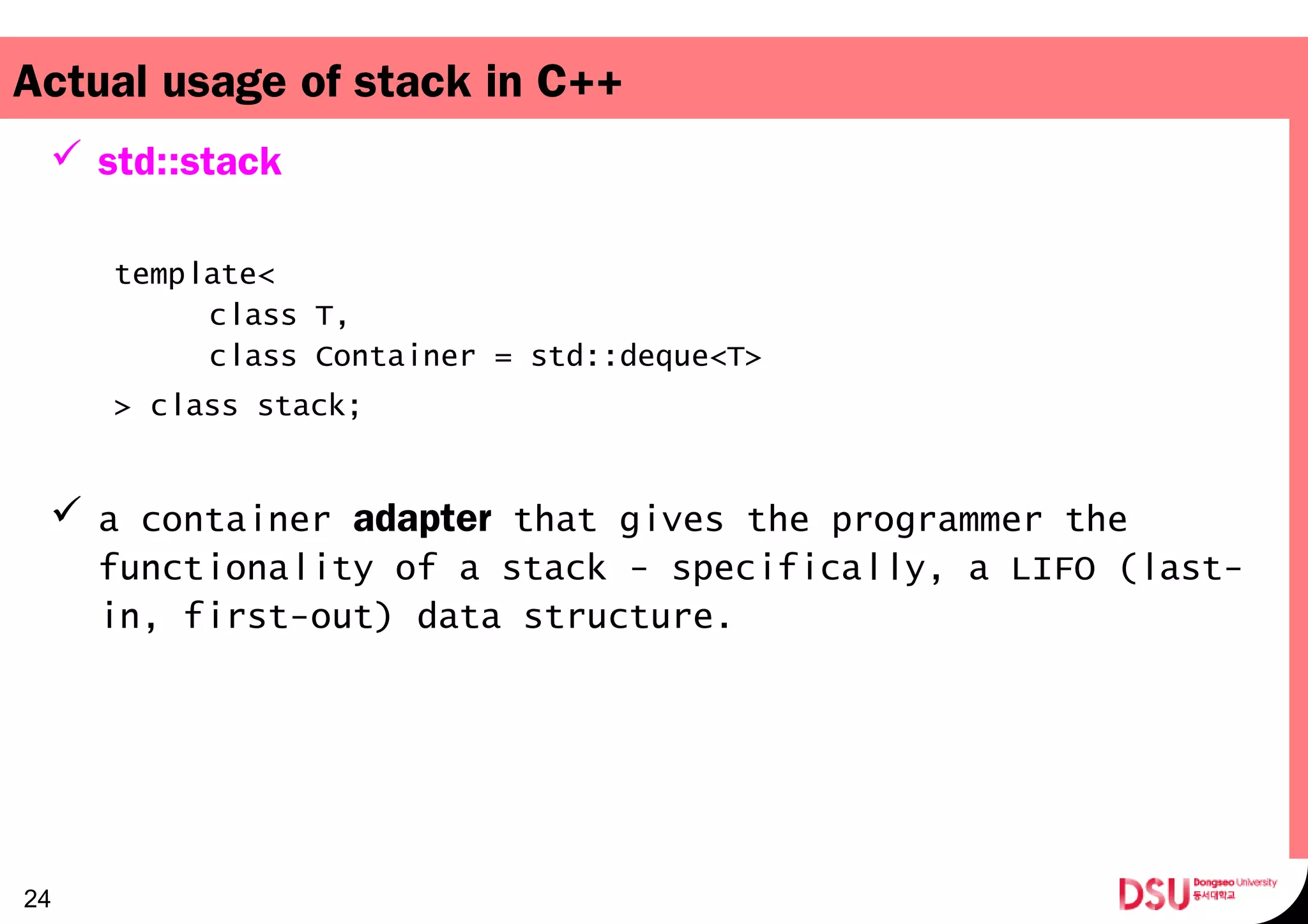
Actual usage of stack in C++
 std::stack
template<
class T,   
class Container = std::deque<T>   
> class stack;
 a container adapter that gives the programmer the
functionality of a stack - specifically, a LIFO (last-
in, first-out) data structure.
24
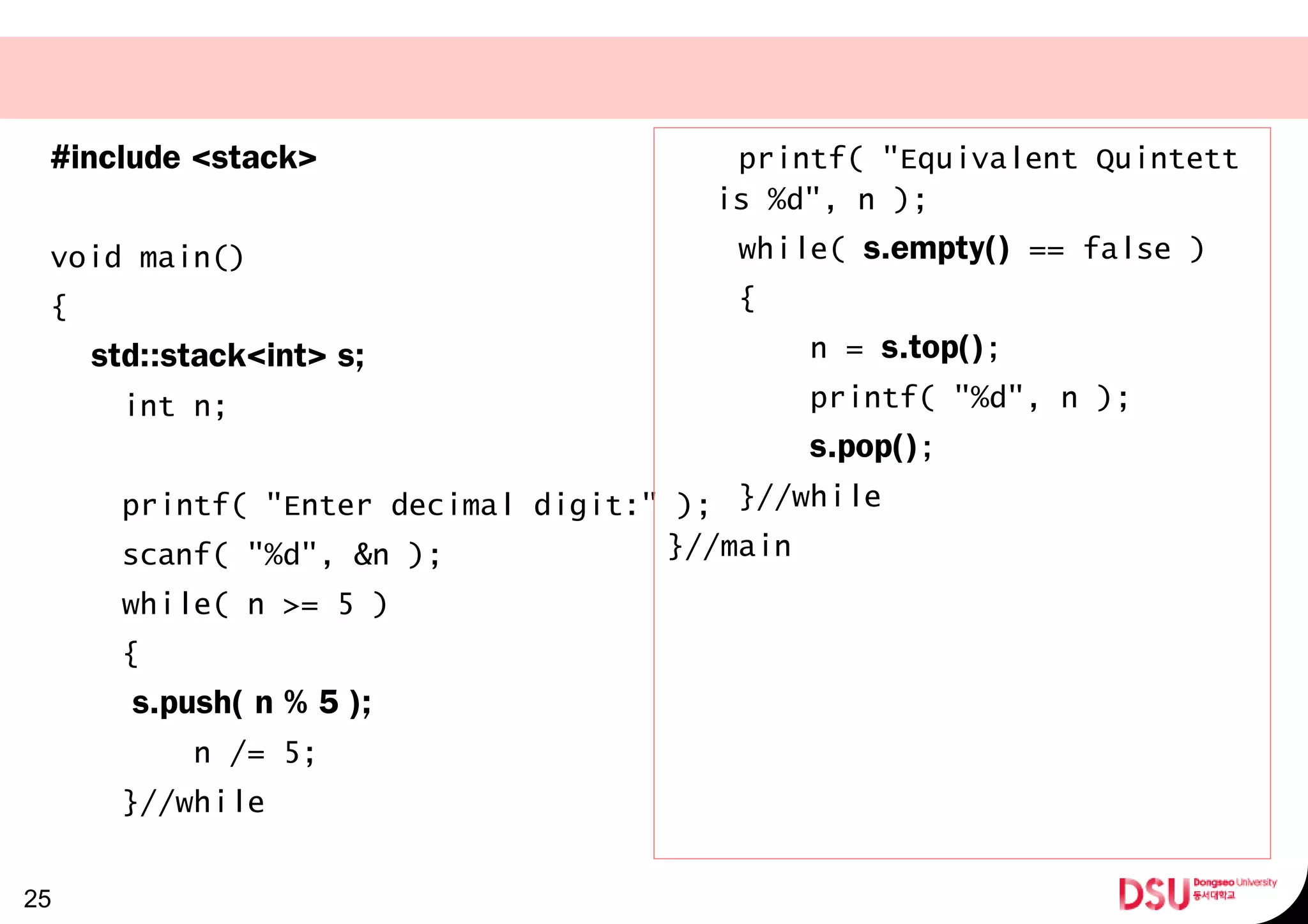
#include <stack>
void main()
{
std::stack<int> s;
int n;
printf( "Enter decimal digit:" );
scanf( "%d", &n );
while( n >= 5 )
{
s.push( n % 5 );
n /= 5;
}//while
25
printf( "Equivalent Quintett
is %d", n );
while( s.empty() == false )
{
n = s.top();
printf( "%d", n );
s.pop();
}//while
}//main
Algorithms with Stack
 Convert Decimal Number to Pentamal Number
 Reverse Polish Notation: Evaluating Postfix Notation
 Conversion from Infix to Postfix Notation
26
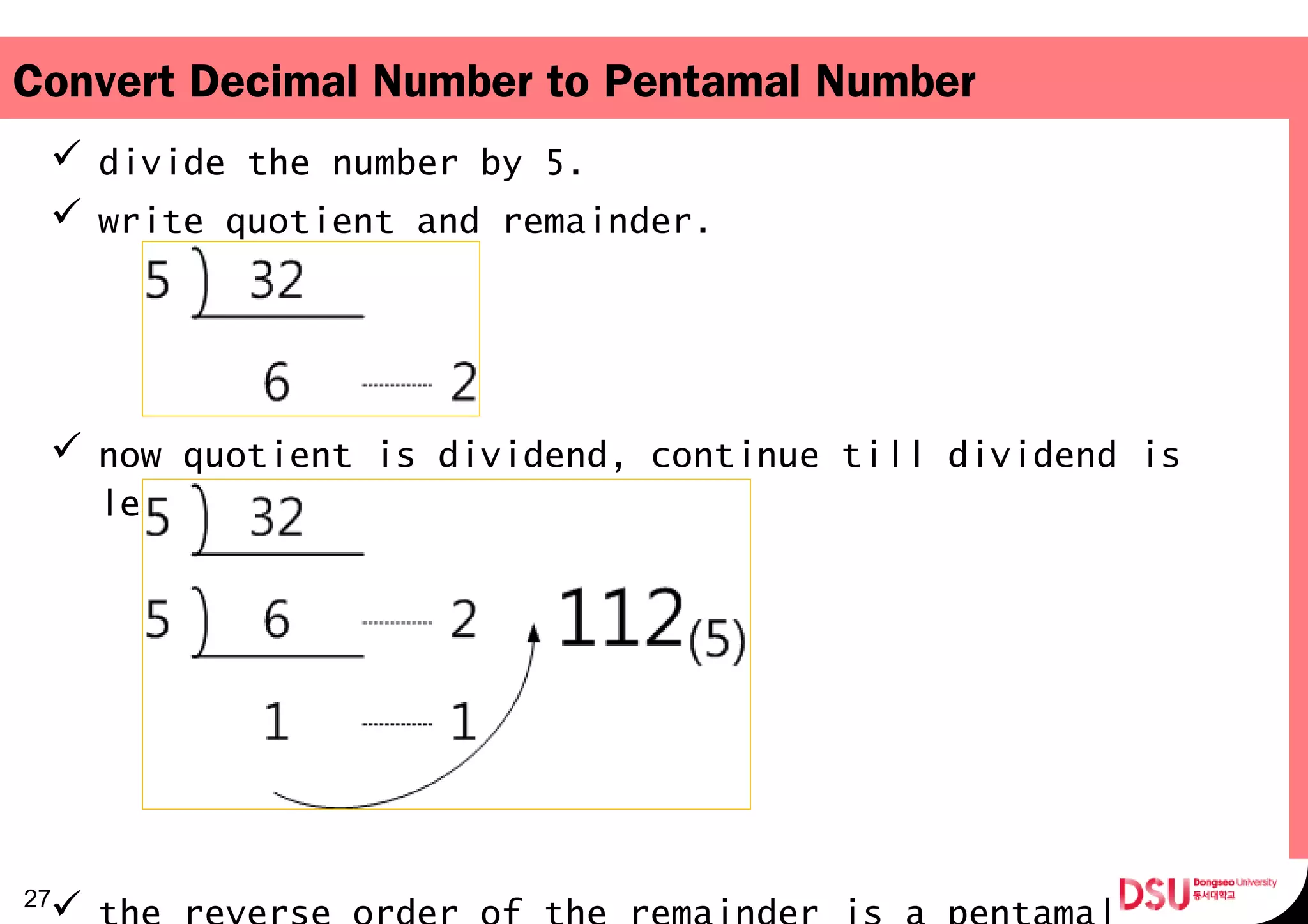
Convert Decimal Number to Pentamal Number
 divide the number by 5.
 write quotient and remainder.
 now quotient is dividend, continue till dividend is
less than 5.
27
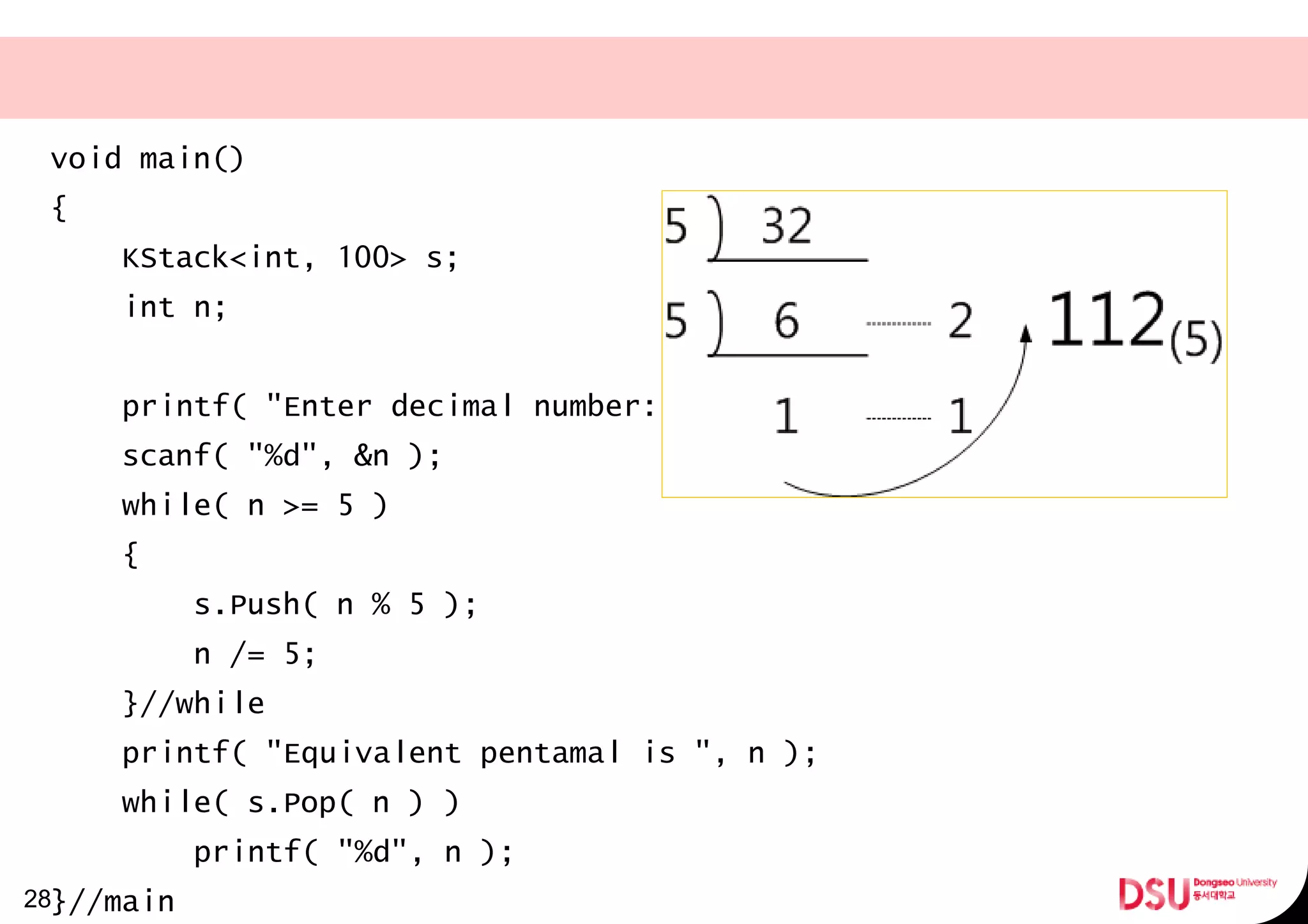
void main()
{
KStack<int, 100> s;
int n;
printf( "Enter decimal number:" );
scanf( "%d", &n );
while( n >= 5 )
{
s.Push( n % 5 );
n /= 5;
}//while
printf( "Equivalent pentamal is ", n );
while( s.Pop( n ) )
printf( "%d", n );
}//main28
Practice
 Write a class that convert decimal number to n-ary
number.
– binary
– trimal
– tetramal
– pentamal
– hexamal
– heptamal
– octal
– nonamal
 there must a getter that gets the converted number in
string.
29
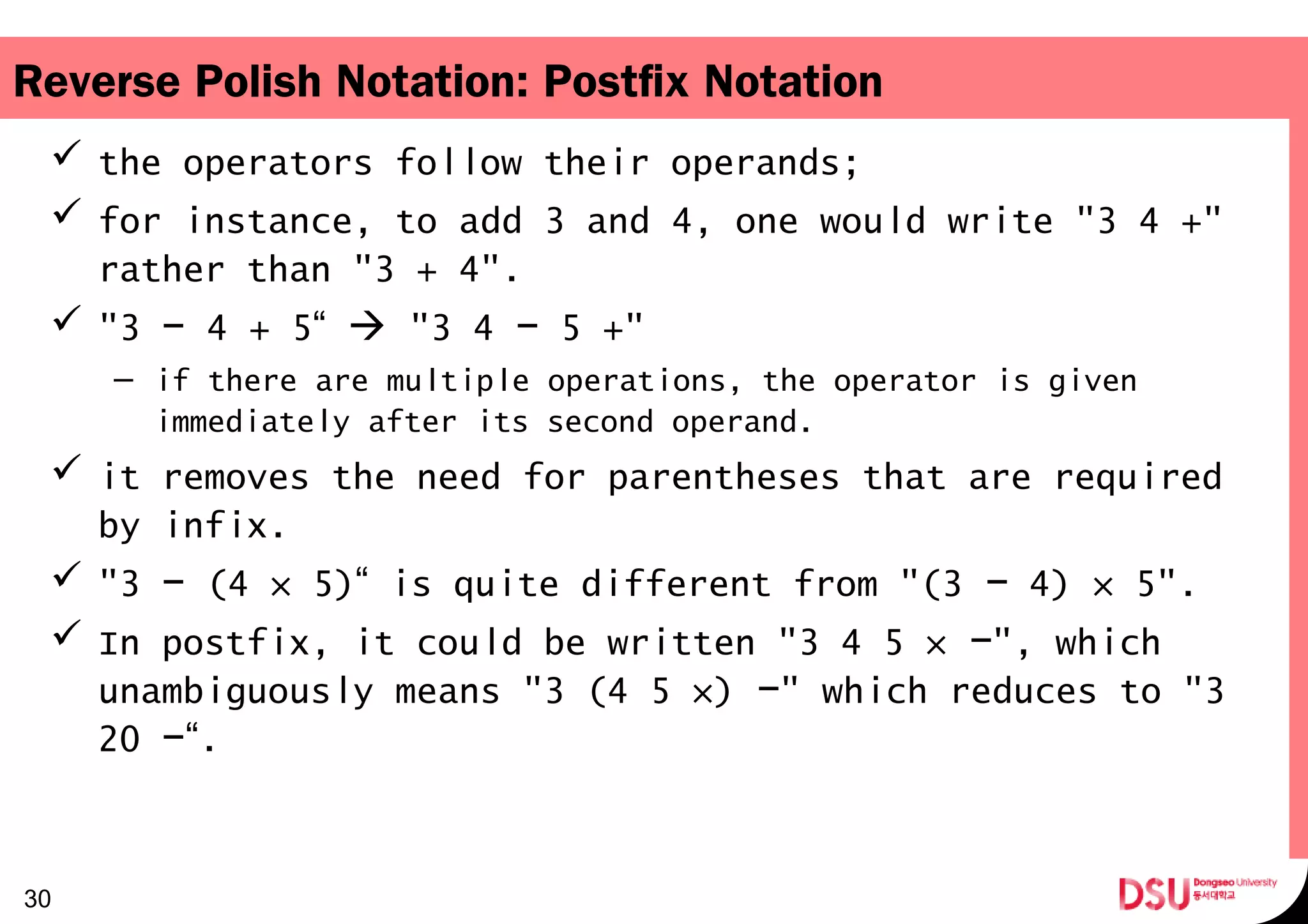
Reverse Polish Notation: Postfix Notation
 the operators follow their operands;
 for instance, to add 3 and 4, one would write "3 4 +"
rather than "3 + 4".
 "3 4 + 5“−  "3 4 5 +"−
– if there are multiple operations, the operator is given
immediately after its second operand.
 it removes the need for parentheses that are required
by infix.
 "3 (4 × 5)“ is quite different from "(3 4) × 5".− −
 In postfix, it could be written "3 4 5 × ", which−
unambiguously means "3 (4 5 ×) " which reduces to "3−
20 “.−
30
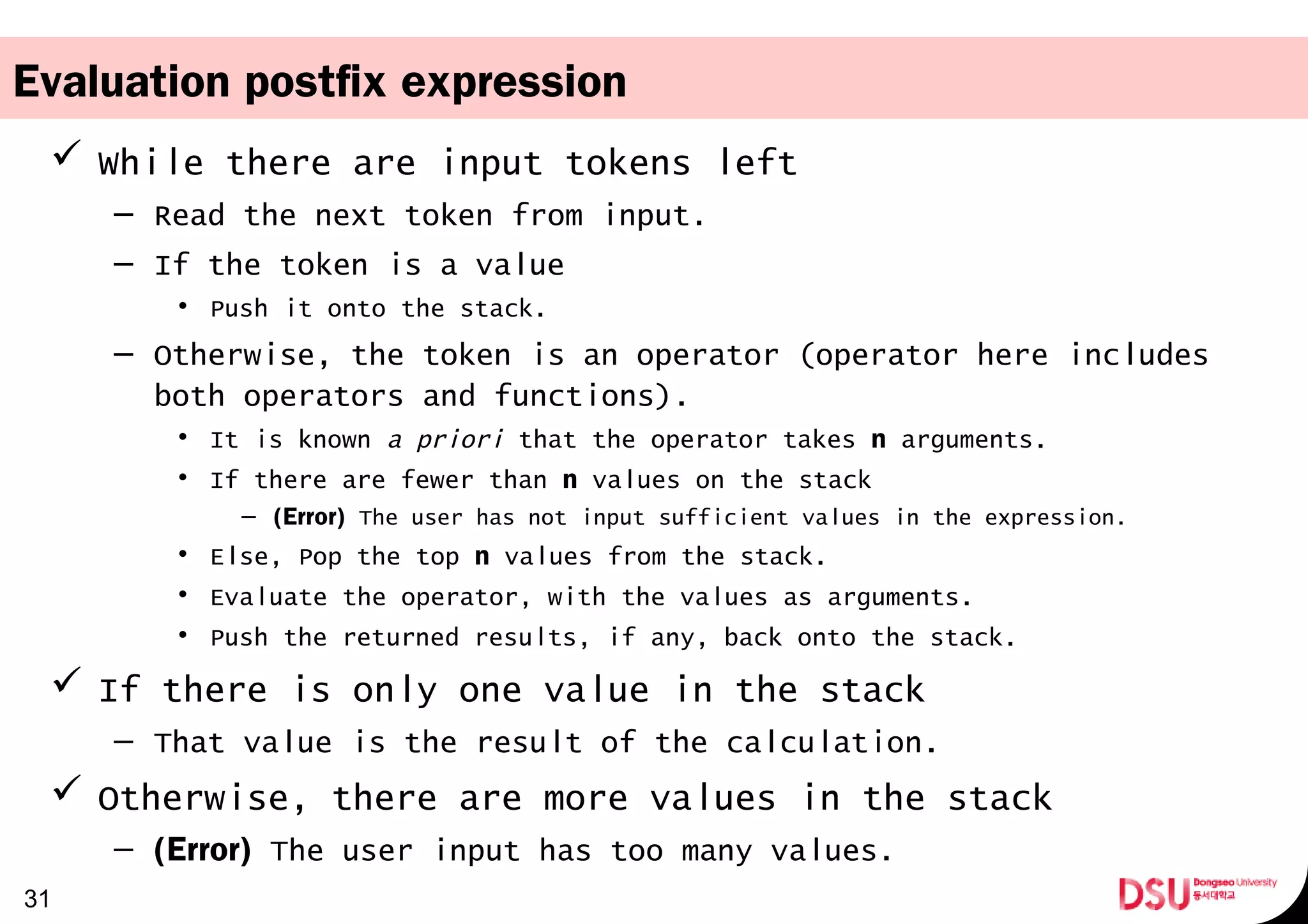
Evaluation postfix expression
 While there are input tokens left
– Read the next token from input.
– If the token is a value
• Push it onto the stack.
– Otherwise, the token is an operator (operator here includes
both operators and functions).
• It is known a priori that the operator takes n arguments.
• If there are fewer than n values on the stack
– (Error) The user has not input sufficient values in the expression.
• Else, Pop the top n values from the stack.
• Evaluate the operator, with the values as arguments.
• Push the returned results, if any, back onto the stack.
 If there is only one value in the stack
– That value is the result of the calculation.
 Otherwise, there are more values in the stack
– (Error) The user input has too many values.
31
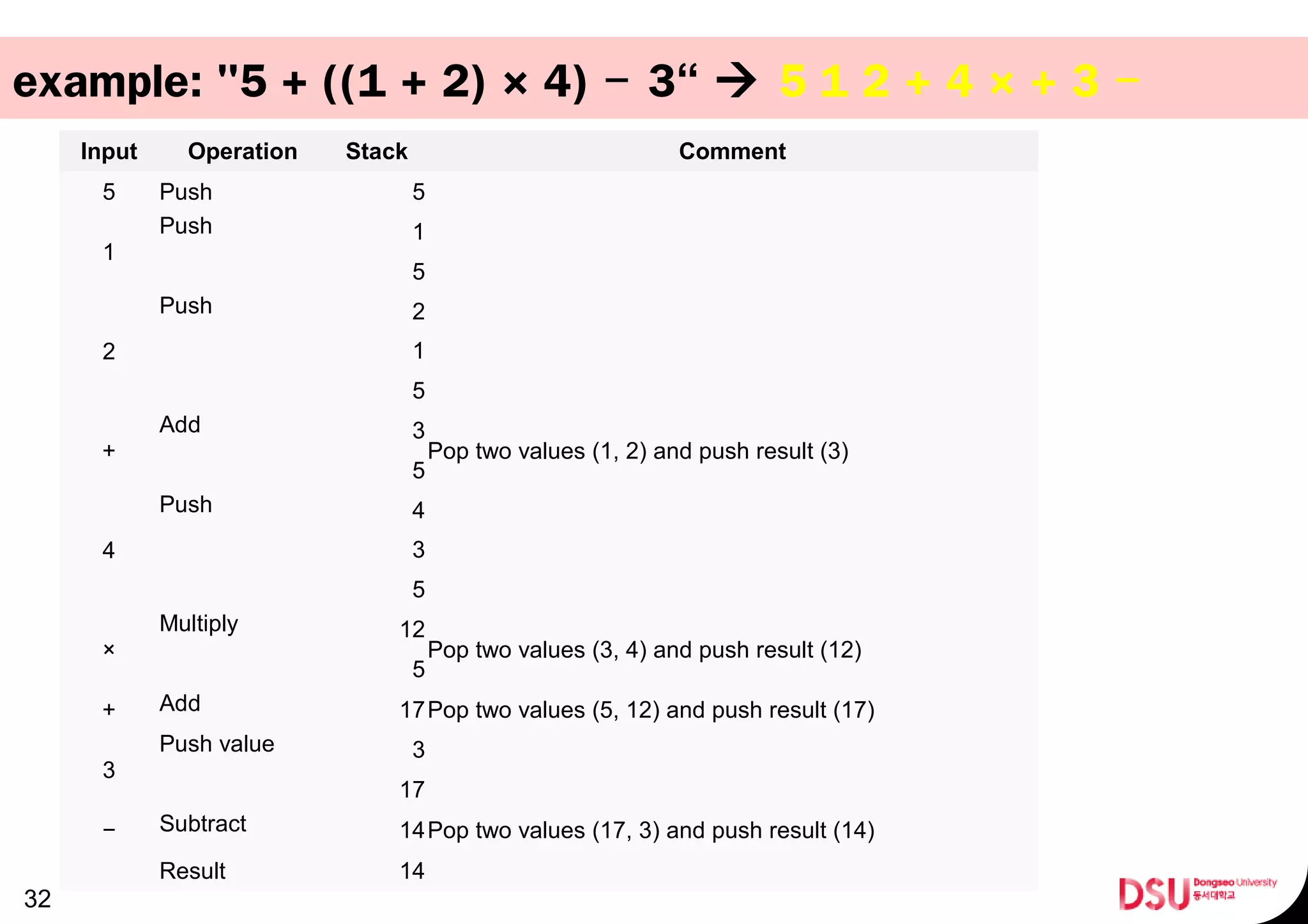
example: "5 + ((1 + 2) × 4) 3“−  5 1 2 + 4 × + 3 −
32
Input Operation Stack Comment
5 Push 5 
1
Push 1
 
5
2
Push 2
 1
5
+
Add 3
Pop two values (1, 2) and push result (3)
5
4
Push 4
 3
5
×
Multiply 12
Pop two values (3, 4) and push result (12)
5
+ Add 17Pop two values (5, 12) and push result (17)
3
Push value 3
 
17
− Subtract 14Pop two values (17, 3) and push result (14)
  Result 14 
Practice
 Write a class that evaluates a postfix notation.
33
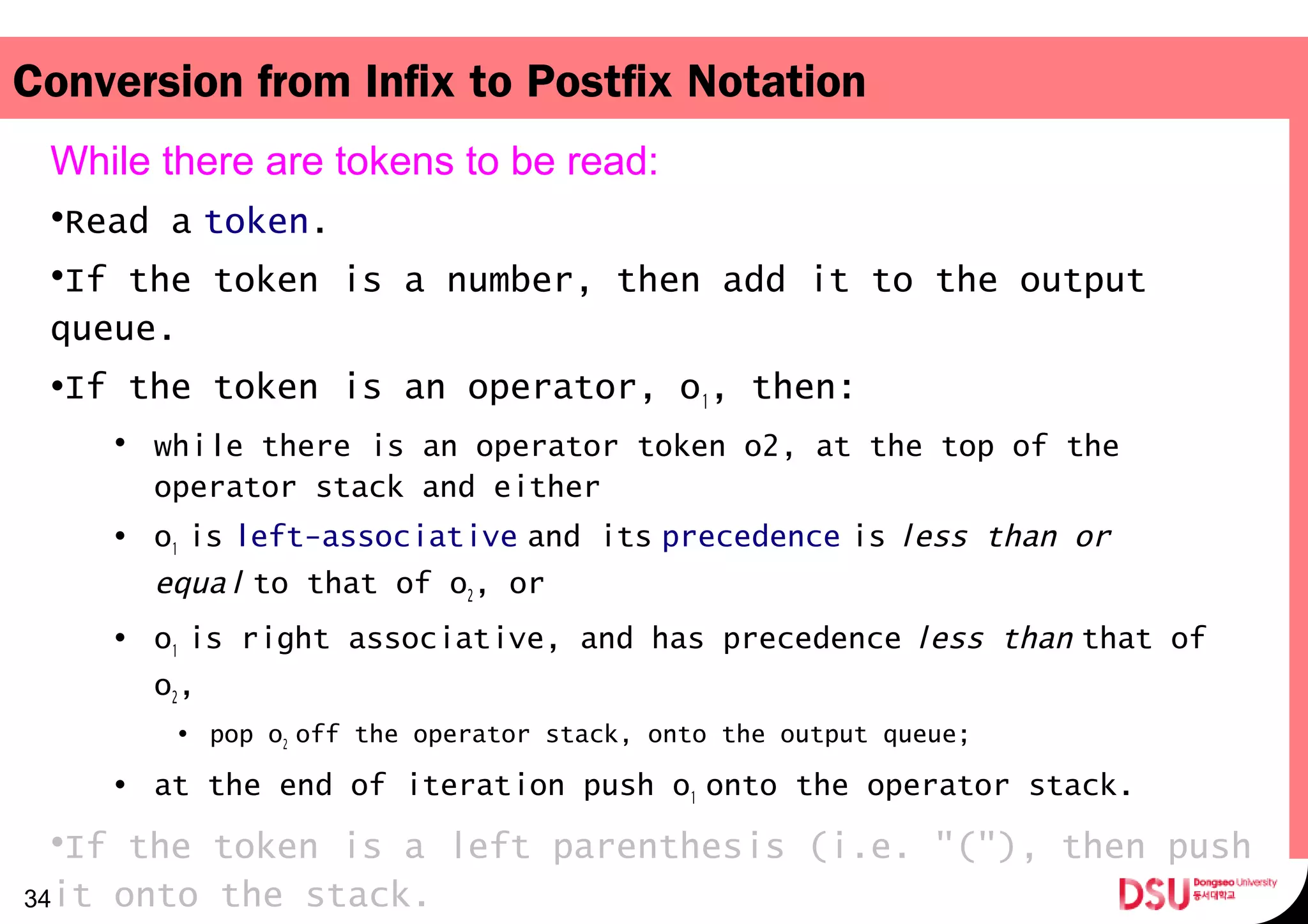
Conversion from Infix to Postfix Notation
While there are tokens to be read:
•Read a token.
•If the token is a number, then add it to the output
queue.
•If the token is an operator, o1, then:
• while there is an operator token o2, at the top of the
operator stack and either
• o1 is   left-associative and its   precedence is   less than or
equal to that of o  2, or
• o1 is right associative, and has precedence   less than that of 
o2,
• pop o2 off the operator stack, onto the output queue; 
• at the end of iteration push o1 onto the operator stack. 
•If the token is a left parenthesis (i.e. "("), then push
it onto the stack.34
• If the token is a left parenthesis (i.e. "("), then
push it onto the stack.
• If the token is a right parenthesis (i.e. ")"):
• Until the token at the top of the stack is a left
parenthesis, pop operators off the stack onto the output
queue.
• Pop the left parenthesis from the stack, but not onto the
output queue.
• If the stack runs out without finding a left parenthesis,
then there are mismatched parentheses.
When there are no more tokens to read:
• While there are still operator tokens in the stack:
• If the operator token on the top of the stack is a
parenthesis, then there are mismatched parentheses.
• Pop the operator onto the output queue.
Exit.35
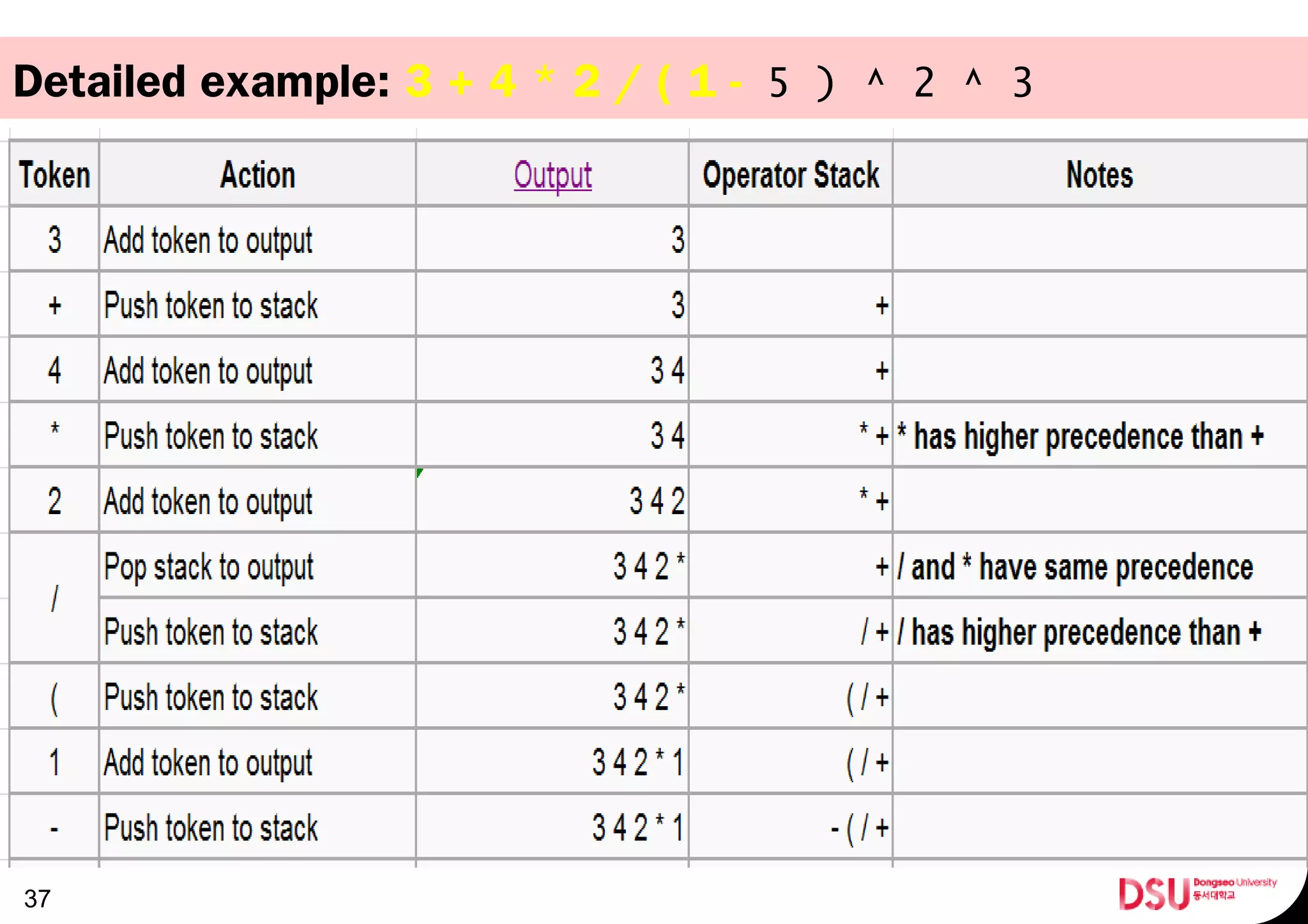
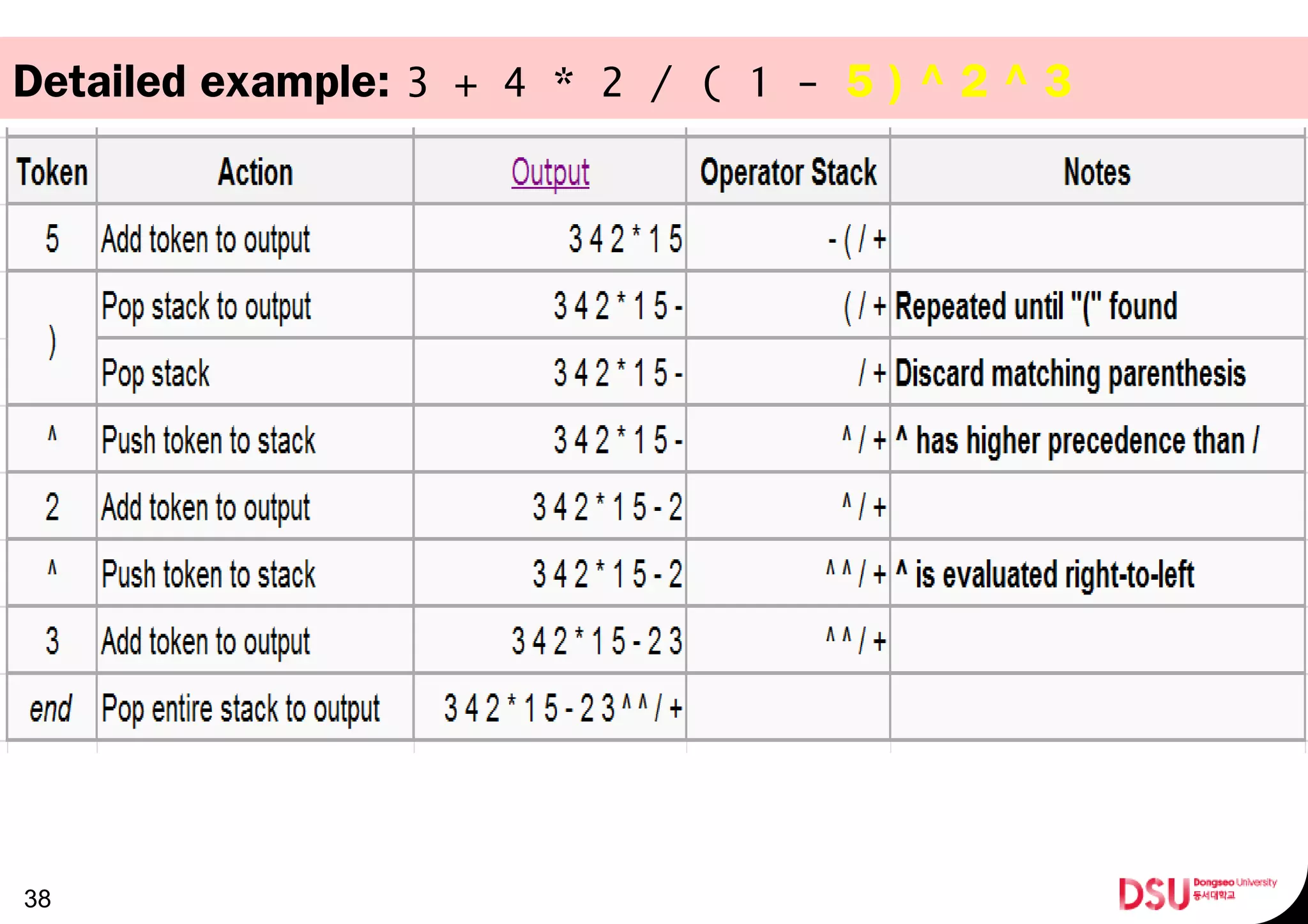
Detailed example: 3 + 4 * 2 / ( 1 - 5 ) ^ 2 ^ 3
 predefined operator properties table.
 How can we implement this properties table?
36
Detailed example: 3 + 4 * 2 / ( 1 - 5 ) ^ 2 ^ 3
37
Detailed example: 3 + 4 * 2 / ( 1 - 5 ) ^ 2 ^ 3
38
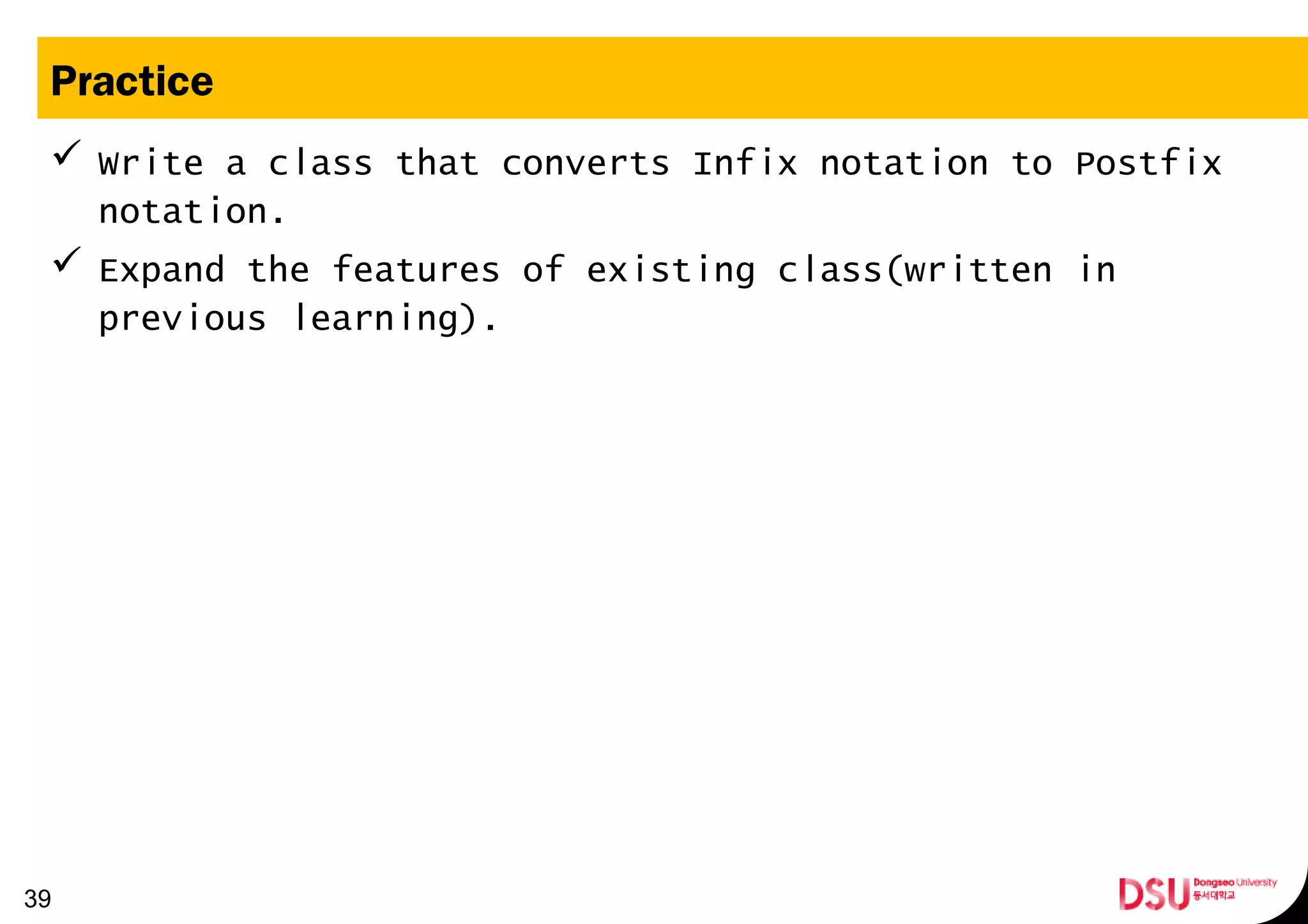
Practice
 Write a class that converts Infix notation to Postfix
notation.
 Expand the features of existing class(written in
previous learning).
39
int priority( char a ) {
int temp = 0;
if( a == '^' )
temp = 4;
else if( a == '*' || a == '/' )
temp = 3;
else if( a == '+' || a == '-' )
temp = 2;
return temp;
}
int main() {
std::string infix;
infix = "3+4*2/(1-5)^2^3";
std::stack<char> operator_stack;
std::string postfix;
40
for( unsigned i = 0; i < infix.length(); i++ ) {
if( infix[ i ] == '+' || infix[ i ] == '-' || infix[ i ] == '*' || infix[
i ] == '/' ) {
//
} else if( infix[ i ] == '^' ) {
//
} else if( infix[ i ] == '(' ) {
operator_stack.push( infix[ i ] );
} else if( infix[ i ] == ')' ) {
while( operator_stack.top() != '(' ) {
postfix += operator_stack.top();
operator_stack.pop();
}
operator_stack.pop();
} else {
postfix += infix[ i ];
}
}
41
if( infix[ i ] == '+' || infix[ i ] == '-' || infix[ i ] == '*' || infix[ i ] == '/'
) {
while( !operator_stack.empty() && priority( infix[ i ] ) <=
priority( operator_stack.top() ) ) {
postfix += operator_stack.top();
operator_stack.pop();
}
operator_stack.push( infix[ i ] );
} else if( infix[ i ] == '^' ) {
while( !operator_stack.empty() && priority( infix[ i ] ) <
priority( operator_stack.top() ) ) {
postfix += operator_stack.top();
operator_stack.pop();
}
operator_stack.push( infix[ i ] );
} else if( infix[ i ] == '(' ) {
42
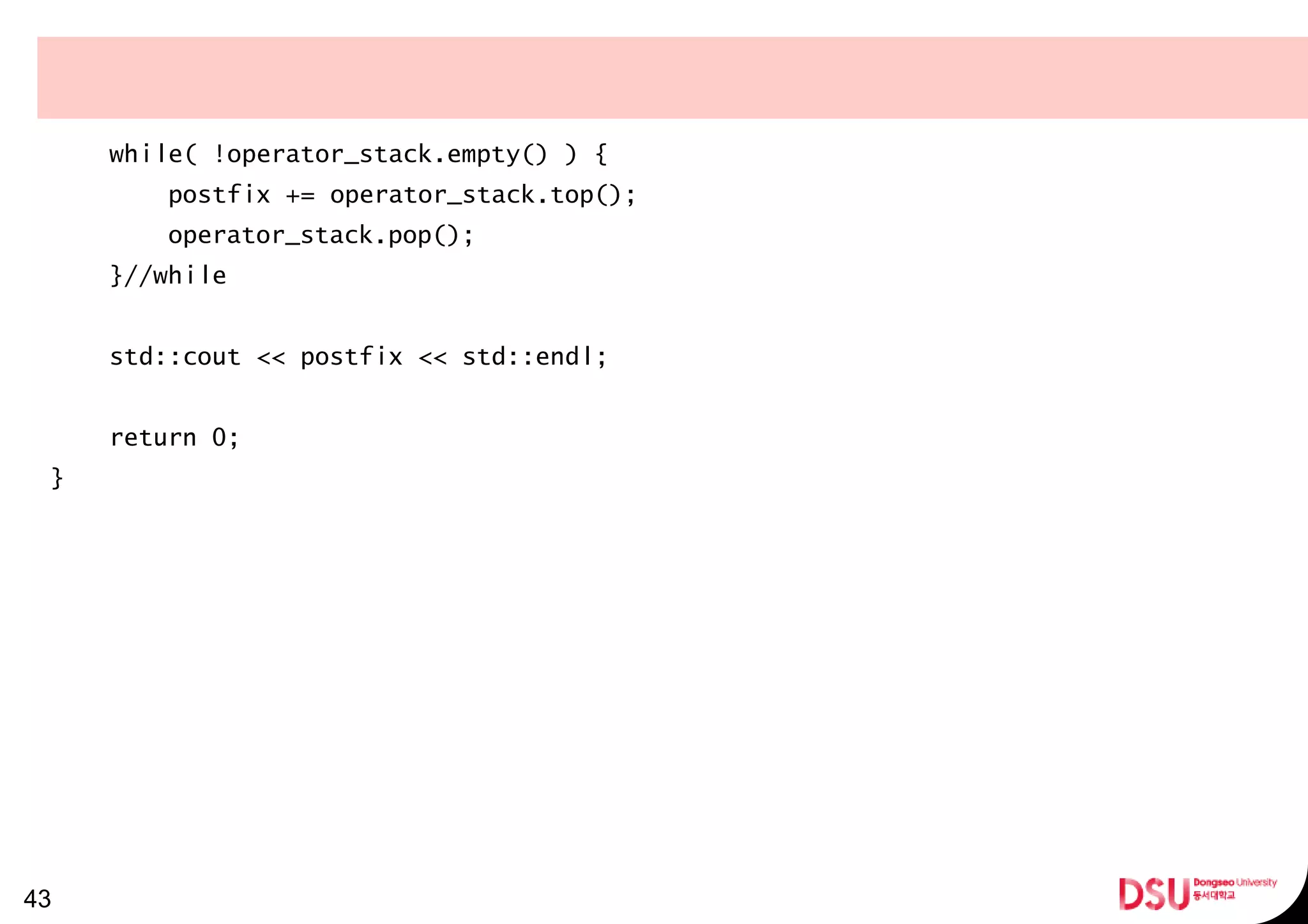
while( !operator_stack.empty() ) {
postfix += operator_stack.top();
operator_stack.pop();
}//while
std::cout << postfix << std::endl;
return 0;
}
43
Actual usage of equation evaluation in C++
 boost::math
 boost::spirit
44
End
 https://en.wikipedia.org/wiki/Abstract_data_type
 https://en.wikipedia.org/wiki/Reverse_Polish_notation
 https://en.wikipedia.org/wiki/Shunting-yard_algorithm
 http://www.cplusplus.com/forum/beginner/16722/
45

01 stack 20160908_jintaek_seo

  • 1.
    StackStack Mobile Game ProgrammingMobileGame Programming jintaeks@gmail.com Division of Digital Contents, Dongseo Univ. September 8, 2016
  • 2.
    Presentation Outline  ADT Data Structure  Stack  Implementation of a stack – KStack – template KStack  Algorithms with stack – Base conversion of numeral system – Evaluation of postfix notation – Conversion from infix to postfix notation 2
  • 3.
    Abstract Data Type(ADT) an abstract data type (  ADT) is a mathematical model for    data types where a data type is defined by its behavior  (semantics) from the point of view of a user of the  data.  possible values, possible operations on data of this type, and the behavior of these operations.  Example: integers – Values …, -2, -1, 0, 1, 2, … – Operations • Addition • Subtraction • Multiplication • Division • Greater than, etc… 3
  • 4.
    ADT examples  Somecommon ADTs, which have proved useful in a great variety of applications, are: – Container, List, Set, Multiset – Map, Multimap, Graph, Stack – Queue, Priority queue – Double-ended queue – Double-ended priority queue 4
  • 5.
    Data Structure(s)  a datastructure is a particular way of organizing     data in  a computer so that it can be used efficiently.  Data Structures implement one or more particular  abstract data types (ADT).   Data Structure is a concrete implementation of the contract provided by an ADT.  Examples: – Array, Stack, List – Associative array, Record(struct) – Union – Set – Graph, Tree – Class – … 5
  • 6.
    Stack  an abstractdata type that serves as a collection of        elements.  two principal operations: – push, which adds an element to the collection. – pop, which removes the most recently added element that was not yet removed.  LIFO (for   last in, first out)  the push and pop operations occur only at one end of the structure, referred to as the top of the stack.   may be implemented to have a bounded capacity.  Overflow – when the stack is full and does not contain enough space to accept an entity to be pushed. 6
  • 7.
    Stack runtime  Simplerepresentation of a stack runtime. 7
  • 8.
    Hardware stacks #include "stdafx.h" voidTest( int i ) { i = 4; } void main() { int i; int j; i = 3; j = i; Test( i ); printf( "%drn", i ); } 8
  • 9.
    Stack Settings inVisual Studio 2013  Property pageLinkerSystemStack Reserve Size 9
  • 10.
    Working Example #include <stdio.h> voidSwap(int a, int b) { int t=a; a=b; b=t; }//Swap void main() { int a=2; int b=3; Swap(a,b); printf("%d,%dn",a,b); }//main 10
  • 11.
    #include <stdio.h> void Swap(inta, int b) { int t=a; a=b; b=t; }//Swap void main() { int a=2; int b=3; Swap(a,b); printf("%d,%dn",a,b); }//main 11
  • 12.
    #include <stdio.h> void Swap(inta, int b) { int t=a; a=b; b=t; }//Swap void main() { int a=2; int b=3; Swap(a,b); printf("%d,%dn",a,b); }//main 12
  • 13.
    #include <stdio.h> void Swap(inta, int b) { int t=a; a=b; b=t; }//Swap void main() { int a=2; int b=3; Swap(a,b); printf("%d,%dn",a,b); }//main 13
  • 14.
    Revised working example #include<stdio.h> void Swap(int *a,int *b) { int t=*a;//assigns the contents of a to t *a=*b;//assigns the contents of b to the location of contents of a. *b=t;//assigns the t to the location of contents of b }//Swap void main() { int a=2,b=3; Swap(&a,&b);//pass addresses of a and b printf("%d,%dn",a,b); }//main 14
  • 15.
    15 #include <stdio.h> void Swap(int*a,int *b) { int t=*a;//assigns the contents of a to t *a=*b;//assigns the contents of b to the location of contents of a. *b=t;//assigns the t to the location of contents of b }//Swap void main() { int a=2,b=3; Swap(&a,&b);//pass addresses of a and b printf("%d,%dn",a,b); }//main
  • 16.
    16 #include <stdio.h> void Swap(int*a,int *b) { int t=*a;//assigns the contents of a to t *a=*b;//assigns the contents of b to the location of contents of a. *b=t;//assigns the t to the location of contents of b }//Swap void main() { int a=2,b=3; Swap(&a,&b);//pass addresses of a and b printf("%d,%dn",a,b); }//main
  • 17.
    17 #include <stdio.h> void Swap(int*a,int *b) { int t=*a;//assigns the contents of a to t *a=*b;//assigns the contents of b to the location of contents of a. *b=t;//assigns the t to the location of contents of b }//Swap void main() { int a=2,b=3; Swap(&a,&b);//pass addresses of a and b printf("%d,%dn",a,b); }//main
  • 18.
    18 #include <stdio.h> void Swap(int*a,int *b) { int t=*a;//assigns the contents of a to t *a=*b;//assigns the contents of b to the location of contents of a. *b=t;//assigns the t to the location of contents of b }//Swap void main() { int a=2,b=3; Swap(&a,&b);//pass addresses of a and b printf("%d,%dn",a,b); }//main
  • 19.
    C++ implementations ofa stack class KStack { public: KStack() : m_sp( 0 ) { } void Push( int data_ ); bool Pop( int& outData_ ); bool IsEmpty() const; private: int m_sp; int m_data[ 100 ]; };//class KStack 19
  • 20.
    void KStack::Push( intdata_ ) { m_data[ m_sp ] = data_; m_sp += 1; } bool KStack::Pop( int& outData_ ) { if( m_sp <= 0 ) return false; m_sp -= 1; outData_ = m_data[ m_sp ]; return true; } bool KStack::IsEmpty() const { return m_sp == 0; }20
  • 21.
    Template KStack template<typename T,int STACK_SIZE> class KStack { public: KStack() : m_sp( 0 ) { } void Push( T data_ ); bool Pop( T& outData_ ); bool IsEmpty() const; private: int m_sp; T m_data[ STACK_SIZE ]; };//class KStack 21
  • 22.
    template<typename T, intSTACK_SIZE> void KStack<T,STACK_SIZE>::Push( T data_ ) { m_data[ m_sp ] = data_; m_sp += 1; } template<typename T, int STACK_SIZE> bool KStack<T, STACK_SIZE>::Pop( T& outData_ ) { if( m_sp <= 0 ) return false; m_sp -= 1; outData_ = m_data[ m_sp ]; return true; } 22
  • 23.
    void main() { KStack<int,100> s; s.Push(3 ); s.Push( 5 ); int data; const bool bIsPop = s.Pop( data ); printf( "%drn", data ); } 23
  • 24.
    Actual usage ofstack in C++  std::stack template< class T,    class Container = std::deque<T>    > class stack;  a container adapter that gives the programmer the functionality of a stack - specifically, a LIFO (last- in, first-out) data structure. 24
  • 25.
    #include <stack> void main() { std::stack<int>s; int n; printf( "Enter decimal digit:" ); scanf( "%d", &n ); while( n >= 5 ) { s.push( n % 5 ); n /= 5; }//while 25 printf( "Equivalent Quintett is %d", n ); while( s.empty() == false ) { n = s.top(); printf( "%d", n ); s.pop(); }//while }//main
  • 26.
    Algorithms with Stack Convert Decimal Number to Pentamal Number  Reverse Polish Notation: Evaluating Postfix Notation  Conversion from Infix to Postfix Notation 26
  • 27.
    Convert Decimal Numberto Pentamal Number  divide the number by 5.  write quotient and remainder.  now quotient is dividend, continue till dividend is less than 5. 27
  • 28.
    void main() { KStack<int, 100>s; int n; printf( "Enter decimal number:" ); scanf( "%d", &n ); while( n >= 5 ) { s.Push( n % 5 ); n /= 5; }//while printf( "Equivalent pentamal is ", n ); while( s.Pop( n ) ) printf( "%d", n ); }//main28
  • 29.
    Practice  Write aclass that convert decimal number to n-ary number. – binary – trimal – tetramal – pentamal – hexamal – heptamal – octal – nonamal  there must a getter that gets the converted number in string. 29
  • 30.
    Reverse Polish Notation:Postfix Notation  the operators follow their operands;  for instance, to add 3 and 4, one would write "3 4 +" rather than "3 + 4".  "3 4 + 5“−  "3 4 5 +"− – if there are multiple operations, the operator is given immediately after its second operand.  it removes the need for parentheses that are required by infix.  "3 (4 × 5)“ is quite different from "(3 4) × 5".− −  In postfix, it could be written "3 4 5 × ", which− unambiguously means "3 (4 5 ×) " which reduces to "3− 20 “.− 30
  • 31.
    Evaluation postfix expression While there are input tokens left – Read the next token from input. – If the token is a value • Push it onto the stack. – Otherwise, the token is an operator (operator here includes both operators and functions). • It is known a priori that the operator takes n arguments. • If there are fewer than n values on the stack – (Error) The user has not input sufficient values in the expression. • Else, Pop the top n values from the stack. • Evaluate the operator, with the values as arguments. • Push the returned results, if any, back onto the stack.  If there is only one value in the stack – That value is the result of the calculation.  Otherwise, there are more values in the stack – (Error) The user input has too many values. 31
  • 32.
    example: "5 +((1 + 2) × 4) 3“−  5 1 2 + 4 × + 3 − 32 Input Operation Stack Comment 5 Push 5  1 Push 1   5 2 Push 2  1 5 + Add 3 Pop two values (1, 2) and push result (3) 5 4 Push 4  3 5 × Multiply 12 Pop two values (3, 4) and push result (12) 5 + Add 17Pop two values (5, 12) and push result (17) 3 Push value 3   17 − Subtract 14Pop two values (17, 3) and push result (14)   Result 14 
  • 33.
    Practice  Write aclass that evaluates a postfix notation. 33
  • 34.
    Conversion from Infixto Postfix Notation While there are tokens to be read: •Read a token. •If the token is a number, then add it to the output queue. •If the token is an operator, o1, then: • while there is an operator token o2, at the top of the operator stack and either • o1 is   left-associative and its   precedence is   less than or equal to that of o  2, or • o1 is right associative, and has precedence   less than that of  o2, • pop o2 off the operator stack, onto the output queue;  • at the end of iteration push o1 onto the operator stack.  •If the token is a left parenthesis (i.e. "("), then push it onto the stack.34
  • 35.
    • If thetoken is a left parenthesis (i.e. "("), then push it onto the stack. • If the token is a right parenthesis (i.e. ")"): • Until the token at the top of the stack is a left parenthesis, pop operators off the stack onto the output queue. • Pop the left parenthesis from the stack, but not onto the output queue. • If the stack runs out without finding a left parenthesis, then there are mismatched parentheses. When there are no more tokens to read: • While there are still operator tokens in the stack: • If the operator token on the top of the stack is a parenthesis, then there are mismatched parentheses. • Pop the operator onto the output queue. Exit.35
  • 36.
    Detailed example: 3+ 4 * 2 / ( 1 - 5 ) ^ 2 ^ 3  predefined operator properties table.  How can we implement this properties table? 36
  • 37.
    Detailed example: 3+ 4 * 2 / ( 1 - 5 ) ^ 2 ^ 3 37
  • 38.
    Detailed example: 3+ 4 * 2 / ( 1 - 5 ) ^ 2 ^ 3 38
  • 39.
    Practice  Write aclass that converts Infix notation to Postfix notation.  Expand the features of existing class(written in previous learning). 39
  • 40.
    int priority( chara ) { int temp = 0; if( a == '^' ) temp = 4; else if( a == '*' || a == '/' ) temp = 3; else if( a == '+' || a == '-' ) temp = 2; return temp; } int main() { std::string infix; infix = "3+4*2/(1-5)^2^3"; std::stack<char> operator_stack; std::string postfix; 40
  • 41.
    for( unsigned i= 0; i < infix.length(); i++ ) { if( infix[ i ] == '+' || infix[ i ] == '-' || infix[ i ] == '*' || infix[ i ] == '/' ) { // } else if( infix[ i ] == '^' ) { // } else if( infix[ i ] == '(' ) { operator_stack.push( infix[ i ] ); } else if( infix[ i ] == ')' ) { while( operator_stack.top() != '(' ) { postfix += operator_stack.top(); operator_stack.pop(); } operator_stack.pop(); } else { postfix += infix[ i ]; } } 41
  • 42.
    if( infix[ i] == '+' || infix[ i ] == '-' || infix[ i ] == '*' || infix[ i ] == '/' ) { while( !operator_stack.empty() && priority( infix[ i ] ) <= priority( operator_stack.top() ) ) { postfix += operator_stack.top(); operator_stack.pop(); } operator_stack.push( infix[ i ] ); } else if( infix[ i ] == '^' ) { while( !operator_stack.empty() && priority( infix[ i ] ) < priority( operator_stack.top() ) ) { postfix += operator_stack.top(); operator_stack.pop(); } operator_stack.push( infix[ i ] ); } else if( infix[ i ] == '(' ) { 42
  • 43.
    while( !operator_stack.empty() ){ postfix += operator_stack.top(); operator_stack.pop(); }//while std::cout << postfix << std::endl; return 0; } 43
  • 44.
    Actual usage ofequation evaluation in C++  boost::math  boost::spirit 44
  • 45.
    End  https://en.wikipedia.org/wiki/Abstract_data_type  https://en.wikipedia.org/wiki/Reverse_Polish_notation https://en.wikipedia.org/wiki/Shunting-yard_algorithm  http://www.cplusplus.com/forum/beginner/16722/ 45

Editor's Notes

  • #9 Use Watcom tablet to explain internal details of this small program. Draw stack memory and it’s operations in progress.